The first scream came from a grown man. The second came from Sophia Carter, watching in horror as her three-year-old daughter Emma knelt calmly in the snow, gently bathing the fur of Bruno — the enormous Cane Corso feared by everyone on Alessandro Moretti’s estate, the same dog that had already injured a professional handler that same afternoon. “You have an ouchie,” Emma whispered, touching his shoulder, and the dog that had protected Alessandro Moretti for sixteen years, that trusted almost no one alive, lowered his massive head into a toddler’s lap in front of a courtyard full of stunned, silent men. From that day forward, Bruno refused to leave Emma’s side — not for guards, not for handlers, not even for Alessandro himself. A veterinarian’s exam would soon reveal the truth no one had bothered to look for in sixteen years: Bruno wasn’t aggressive. He was in constant, untreated pain, and everyone around him had mistaken his fear for ferocity. Three days after Emma took Alessandro Moretti’s own hand and told the most dangerous man in Chicago to sit — and watched him do it — she vanished from her bed. Her teddy bear stayed behind. Her washcloth, found still wet beside the door, was the only trace of her. And somewhere in the darkness outside, Bruno was already moving, leading Alessandro Moretti not toward safety, but straight toward the people who had taken her. This is a story about an old grudge finally coming due, a dog nobody understood until a child finally saw him clearly, and a little girl whose unshakable calm turned out to be the only thing standing between her family and a war that had been quietly building for years. Read all fifteen chapters to find out who took Emma, why, and exactly what happened once Bruno led Alessandro Moretti to their door.

Chapter One
The Girl Who Tamed Bruno
The first scream came from a grown man. The second came from Sophia Carter.
“EMMA, DON’T MOVE!”
Her three-year-old daughter was kneeling in the snow, calmly bathing Bruno — the enormous Cane Corso feared by everyone on Alessandro Moretti’s estate. The professional handler brought in that morning had already been injured trying to restrain him. Two guards stood frozen at the edge of the courtyard, hands hovering near weapons neither of them dared use.
Nobody moved. Except Emma.
“You’re cold,” she whispered, gently wiping his fur with a small washcloth she’d carried out from the kitchen without anyone noticing.
The dog growled, low and rumbling, and Sophia’s heart stopped completely.
But Emma only touched his shoulder, unbothered. “You have an ouchie.”
Then the impossible happened. Bruno lowered his massive head into the little girl’s lap.
Silence filled the courtyard, total and absolute. Even Alessandro Moretti — a man whose name alone could empty a restaurant in Chicago’s North Side — stood in the doorway of his own estate, unable to fully believe what he was watching.
Bruno had protected him for sixteen years. He trusted almost nobody, not the household staff, not most of Alessandro’s own men, sometimes barely Alessandro himself on his worst days.
Yet this tiny child, kneeling in the snow with a washcloth and an utterly fearless calm, had earned his trust in a matter of minutes — and Alessandro Moretti, standing frozen in his own doorway, felt something shift in his chest that he wouldn’t have words for until considerably later, once he finally understood exactly what that dog had been trying to tell everyone for sixteen years.
Chapter Two
Silence in the Courtyard
Sophia worked as the estate’s chef, a position she’d held for eight months, ever since a mutual acquaintance from her old neighborhood had recommended her for the job following a difficult stretch after her husband’s death left her a single mother with a toddler and a stack of unpaid bills.
She had never intended for Emma to spend time anywhere near Alessandro Moretti’s business, let alone his dog. The staff housing came with reasonable accommodations for a small child, and the estate’s remote location meant Emma’s presence during Sophia’s shifts had always been a quiet, carefully managed arrangement — Emma kept to the kitchen, the small adjoining apartment, occasionally the enclosed garden, never anywhere close to Bruno’s usual patrol routes.
That afternoon had been an accident from the start. A delivery truck’s back gate had malfunctioned near the courtyard, drawing every available guard’s attention at the exact moment Emma, left briefly unsupervised while Sophia dealt with a kitchen emergency, had wandered out through an unlatched door with nothing but curiosity and a washcloth she’d taken from the sink.
She hadn’t been afraid of Bruno. That detail, more than anything else about the entire encounter, would occupy Alessandro’s attention for weeks afterward — not that a toddler had wandered somewhere dangerous, which was frightening enough on its own, but that she’d approached a dog every trained adult on the property genuinely feared with nothing but simple, unguarded gentleness.
“In sixteen years,” Alessandro said quietly, once the courtyard had finally emptied and Sophia had carried a sleepy, unbothered Emma back toward the staff apartment, Bruno padding along directly behind them without anyone giving him a single command, “I have never once seen that dog let anyone touch him without a fight. I need someone to explain to me what just happened out there, because I genuinely don’t understand it.”
Chapter Three
He Won’t Leave the Girl
By the following morning, Bruno had positioned himself directly outside the staff apartment’s front door, refusing every attempt to redirect him back to his usual quarters near the main house.
Marco, Alessandro’s longtime second-in-command, tried first, approaching with the calm, practiced authority that usually worked on every animal and most people on the estate. Bruno simply lay down heavier against the doorstep, unmoved.
“Boss,” Marco said carefully, finding Alessandro in his study an hour later, “he won’t leave the girl. I’ve tried three times. He’s not aggressive about it, he’s just… immovable. I’ve never seen him refuse a direct command before.”
Alessandro set down the paperwork he’d been reviewing. “Show me.”
He walked to the staff apartment himself, and found exactly what Marco had described — Bruno stretched across the doorstep with the alert, watchful stillness of a dog fully committed to a post he’d apparently assigned himself.
“Bruno,” Alessandro said, his voice carrying the particular authority sixteen years of ownership had built between them. “Come.”
The dog looked at him, ears shifting with what might have been genuine reluctance, and did not move.
Alessandro stood there for a long moment, feeling something considerably more complicated than simple irritation at a disobedient animal. Sixteen years, and Bruno had never once ignored a direct command from him.
“Leave him,” Alessandro said finally, turning back toward the main house, his voice quieter than Marco had heard it in years. “If that’s where he wants to be, leave him there” — a decision that would, within days, lead Alessandro toward a truth about his own dog he’d apparently spent sixteen years too busy, or too unwilling, to properly investigate.
Chapter Four
What the Vet Found
Alessandro called in Dr. Priscilla Halloran, the veterinarian who’d handled the estate’s animals for over a decade, requesting a full examination he realized, somewhat uncomfortably, he should probably have ordered years earlier given how consistently Bruno had resisted routine handling.
The exam took most of an afternoon, complicated considerably by Bruno’s continued refusal to leave Emma’s proximity — a problem Dr. Halloran solved, eventually, by simply conducting much of the examination with Emma seated calmly beside him, her small hand resting on his shoulder the entire time, Bruno remaining still and cooperative in a way Dr. Halloran admitted she’d never once managed to achieve in ten years of treating him.
The results, once she reviewed the imaging fully, left her visibly troubled. “He’s suffering from severe arthritis in both hips,” she told Alessandro, “considerably advanced for a dog his age, along with an old fracture in his left foreleg that healed badly, almost certainly without proper veterinary care at the time it happened. This isn’t recent. I’d estimate the fracture is at least eight or nine years old.”
“He’s been in pain for years,” she continued, watching Alessandro’s face carefully. “Constant, significant pain, the kind that would make nearly any dog defensive and reactive to handling, especially rough or unfamiliar handling around the affected areas. What everyone’s been calling aggression, Mr. Moretti, has very likely been fear and pain the entire time.”
Alessandro’s expression hardened, though not with the fury Dr. Halloran had perhaps braced herself for. It was something quieter, and considerably more uncomfortable to witness — a man confronting, in real time, exactly how badly he’d failed an animal that had spent sixteen years protecting him without complaint.
“How did this happen,” Alessandro asked, his voice low. “The fracture. Nine years ago. I would have known if he’d been seriously injured on this property” — and Dr. Halloran’s careful, measured silence in response told Alessandro, more clearly than any direct answer could have, that whatever had happened to Bruno nine years earlier had very likely happened somewhere Alessandro himself had never thought to look closely enough to notice.
Chapter Five
Sit
That evening, once Dr. Halloran had left with instructions for a new pain management regimen and a considerably gentler handling protocol going forward, Alessandro found himself walking, almost without deciding to, toward the staff apartment where Sophia and Emma lived.
He knocked quietly, an unusual courtesy from a man who rarely announced himself to anyone on his own property. Sophia opened the door, visibly startled to find him there at that hour.
“I came for my dog,” Alessandro said, though even as he said it, the sentence felt considerably less certain than it would have three days earlier.
Bruno, curled on the small rug beside Emma’s bed, lifted his head, looked at Alessandro, and did not move otherwise. He did not growl. He simply ignored the command entirely, the way he had every attempt to redirect him for three straight days.
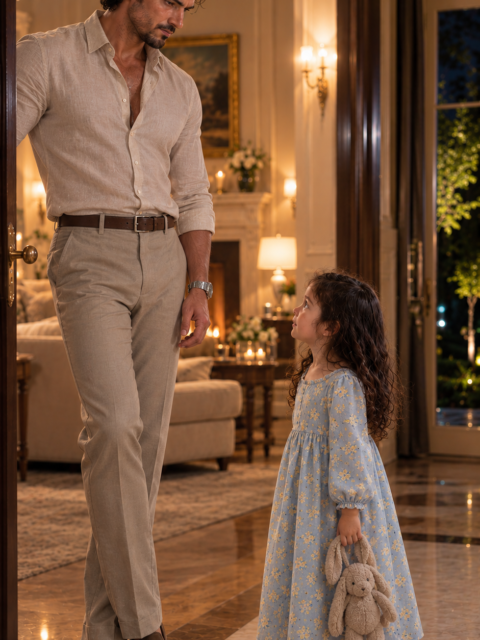
Then Emma woke — not startled, not frightened, simply stirring at the sound of adult voices with the easy, unbothered curiosity of a child who had apparently decided, sometime over the preceding three days, that this particular frightening man was not actually frightening at all.
She climbed out of bed, crossed the small room in bare feet, and took Alessandro Moretti’s hand.
“Sit,” she said, with the same simple, absolute confidence she’d used on Bruno three days earlier.
The most feared man in the city froze completely. Nobody ordered Alessandro Moretti around. Not his own men. Not rival family bosses. Not, in recent memory, anyone at all.
Nobody except, apparently, a three-year-old girl in pajamas — and somehow, to Sophia’s utter disbelief standing frozen in her own doorway, he sat, lowering himself onto the small couch in the corner of the tiny apartment with the same helpless, bewildered obedience Bruno had shown Emma three days earlier, beginning what would turn out to be the last genuinely peaceful evening any of them would have for a considerable time.
Chapter Six
The Last Peaceful Night
They talked for nearly an hour that evening — Alessandro and Sophia, sitting in a small staff apartment while Emma drifted back to sleep with one hand resting on Bruno’s fur, an ordinary domestic scene that felt, to both adults present, entirely at odds with everything either of their lives had involved up to that point.
“Your daughter has a gift,” Alessandro said. “I don’t fully understand it, but I’ve watched enough people in my life to recognize when someone has a way of seeing past whatever a person or an animal presents on the surface. She saw Bruno’s pain before a trained veterinarian did.”
“She’s always been like that,” Sophia said. “Even as a baby. She doesn’t startle at things the way other children do. My husband used to say she came into the world already calm, like she’d already decided nothing was worth being afraid of.” Her expression flickered with grief she clearly still carried close to the surface. “He died two years ago. A car accident. Emma barely remembers him.”
Alessandro absorbed that with a quiet respect Sophia hadn’t expected from him. “I’m sorry,” he said, and meant it, in a tone that carried none of the practiced condolence he typically offered in more formal settings. “Raising her alone, working the hours this job demands — that’s not an easy life you’ve built.”
“It’s the life I have,” Sophia said simply. “We manage.”
They talked a while longer, about nothing in particular — Emma’s favorite foods, Bruno’s new pain medication schedule, the small, ordinary details of two lives that had never expected to intersect this closely. Alessandro left near midnight, Bruno remaining curled beside Emma’s bed despite one final, halfhearted attempt to call him along.
It would be, though none of them could have known it that night, the last evening any of them would spend together without fear — because three days later, in the early hours of a Tuesday morning, Sophia would wake to an empty apartment, a still-made bed, and a silence considerably more terrifying than any growl Bruno had ever produced.
Chapter Seven
Emma Is Gone
Sophia woke to a throbbing headache and a disorientation that took her several confused seconds to place as something beyond simple exhaustion — a chemical heaviness in her limbs that suggested, once the fog began clearing enough for her to think clearly, that she’d been sedated rather than simply overslept.
Emma’s bed was empty.
Sophia’s scream brought Marco and two additional guards running within seconds, the estate’s overnight security detail having been considerably reinforced in the days since Alessandro’s visit, though clearly not reinforced enough.
Emma’s teddy bear remained on the bed, undisturbed. Her blanket lay untouched, still tucked in the specific way Sophia had arranged it the previous night. There was no sign of struggle in the small bedroom, no overturned furniture, nothing beyond the simple, devastating absence of a three-year-old girl who had been sleeping peacefully in that bed hours earlier.
Sophia herself, once the initial shock allowed her to process her own condition more clearly, showed the unmistakable signs of having been drugged — a needle mark at the crook of her elbow that she had no memory of receiving, consistent with a fast-acting sedative administered while she slept.
And Bruno, the dog who had refused to leave Emma’s side for four consecutive days, was gone as well.
Marco reached Alessandro by phone within minutes, his voice carrying a controlled urgency that told Alessandro, before a single detail was spoken aloud, exactly how serious the situation had become — and by the time Alessandro arrived at the staff apartment less than ten minutes later, still fastening his coat against the early morning cold, he understood with a cold, settling certainty that whatever had happened to Emma overnight had been planned, deliberate, and executed by people who had known exactly how to move through his own estate’s security without triggering a single alarm.
Chapter Eight
The Wet Washcloth
When Alessandro arrived, he found one thing beside the apartment’s front door that made his chest go tight with a specific, personal dread he hadn’t felt in years: Emma’s tiny washcloth, the same one she’d used to bathe Bruno’s fur four days earlier, lying on the floor beside the threshold. Still wet.
It meant, whatever had happened, it had happened quickly enough and recently enough that a damp cloth hadn’t yet dried in the cold night air — a detail that told Alessandro’s security team, once they examined the timeline more carefully, that the abduction had occurred sometime within the past two hours rather than earlier in the night, a narrower window than they’d initially feared, though not narrow enough to have prevented it entirely.
Then a low growl carried in from somewhere outside.
Alessandro turned sharply toward the window. Bruno was nowhere visible in the immediate courtyard, though the growl had clearly come from somewhere close, somewhere in the darkness just beyond the range of the estate’s exterior lighting.
Neither was Emma anywhere in sight.
“Find her,” Alessandro ordered, his voice carrying a cold, absolute authority that sent every guard on the property moving within seconds.
Marco hesitated, just briefly, before asking the question that needed answering regardless of how much neither of them wanted to consider its implications. “And if we find whoever took her?”
Alessandro’s eyes went cold in a way Marco had seen only a handful of times in over a decade of working beside him. “Bring me their names” — and it was in that exact moment, standing in the doorway of a small apartment with a three-year-old’s wet washcloth still resting in his palm, that Alessandro Moretti understood he was no longer simply the owner of an estate someone had violated. He was, for the first time in years, a man about to remember exactly why people had once been so afraid of his name in the first place.
Chapter Nine
Sophia’s Hidden Past
While security teams fanned out across the estate’s grounds, Alessandro sat with Sophia, still shaken and unsteady from the sedation, working through every detail of her life that might explain why someone had targeted her daughter so specifically.
It was during that conversation that a piece of Sophia’s history surfaced that she hadn’t volunteered during eight months of quiet, professional distance from her employer — a detail she’d deliberately kept private, not out of dishonesty, but out of a careful instinct to keep her past separate from a job she’d desperately needed.
“My husband,” she said slowly, “David — he didn’t die in a simple car accident. I told people that because it was easier, and because I didn’t want anyone connecting me to the actual circumstances once I started this job.”
Alessandro’s expression sharpened. “What were the actual circumstances?”
“David worked for the Vitali family,” Sophia said, watching Alessandro’s face carefully for his reaction. “Low-level, mostly logistics and driving work. He wanted out — he’d told me, more than once, that he was tired of that life, that he wanted something safer for Emma to grow up around. Two years ago, he tried to leave. Three weeks later, his car went off the road on a stretch of highway he drove every single day, in weather that shouldn’t have caused any trouble at all.”
Alessandro sat back slowly, the pieces beginning to arrange themselves into a shape he recognized with a sinking, furious clarity. “The Vitalis,” he said. “And you took a job on my estate, eight months after your husband’s death, without ever mentioning that connection.”
“I needed work,” Sophia said, tears finally breaking through the composure she’d maintained since waking that morning. “I needed to disappear from anything connected to David’s old life, and a job cooking for the Moretti family felt, in a strange way, like the safest possible distance I could put between Emma and the people who killed her father — because the Vitalis and the Morettis have hated each other for thirty years, and I genuinely never imagined they’d think to look for us here, inside the one place they’d least expect to find us.”
Chapter Ten
The Vitali Grudge
Alessandro’s history with the Vitali family stretched back considerably further than Sophia’s own connection to it — a rivalry that had simmered for three decades, rooted in territory disputes and a specific, personal grievance from years earlier that Alessandro rarely discussed with anyone, including Marco.
“Dominic Vitali has wanted a way to genuinely hurt me for years,” Alessandro said, once Marco returned with the first scattered details security had managed to gather from the grounds. “Not just business losses. Something personal. Something that actually costs me the way losing money never quite does.”
“You think this is about you,” Marco said carefully, “not about Sophia and her husband at all.”
“I think it’s both,” Alessandro said. “David Carter tried to walk away from the Vitalis two years ago and paid for it with his life. His widow ends up working in my kitchen eight months ago, entirely by coincidence as far as I can tell. And then, four days ago, her daughter becomes the first living creature in sixteen years to earn Bruno’s genuine trust, in front of two guards and a handler who absolutely talked about it to people outside this estate before I could ask them not to.”
Marco’s expression darkened as the full shape of it became clear. “Word got back to Dominic. Somehow. And he saw an opportunity considerably larger than simple revenge against a family that already lost its father two years ago.”
“He saw a way to hurt me directly,” Alessandro said, “through a child I have apparently, without fully realizing it until this exact moment, come to care about more than I’ve cared about almost anything in a very long time.”
“Where would he take her,” Marco asked, already reaching for his phone to redirect the search effort. “If this is Dominic Vitali, he’s not hiding her somewhere random. He’s making a statement, and men like that always make their statements somewhere they believe sends a message” — a consideration that would, within the hour, narrow the search to three specific properties Alessandro’s own intelligence network had long suspected belonged to Vitali holdings, disguised behind shell companies careful enough to have avoided serious scrutiny for years.
Chapter Eleven
Bring Me Their Names
The search that followed unfolded with a speed and coordination that surprised even Marco, who had worked alongside Alessandro for over a decade and had never once seen him mobilize the estate’s full resources this quickly or this completely.
Alessandro made calls himself, personally, to contacts across the city he rarely engaged directly anymore, having long since delegated most operational matters to trusted lieutenants. Every one of those calls carried the same two words as their opening line, delivered in a tone that left no room for hesitation or negotiation: “Find her.”
Within two hours, a pattern began emerging from the fragmented information flowing back — a delivery van seen leaving the estate’s perimeter road shortly before dawn, its route traced through three separate traffic camera feeds before disappearing into a warehouse district on the city’s south side, an area Alessandro’s intelligence had flagged eighteen months earlier as connected to Vitali logistics operations, though never with enough concrete evidence to act on directly.
“We could call the police,” Marco offered carefully, watching Alessandro’s expression as he said it, already anticipating the response before it came.
“The police will take hours to get warrants for a location we can’t even fully confirm yet,” Alessandro said. “By the time any of that paperwork clears, Emma could be moved somewhere considerably harder to trace. I am not gambling my daughter’s — ” He stopped himself, the word landing with a weight that surprised even him, before continuing more carefully. “I am not gambling Emma’s safety on a legal process built for situations considerably less urgent than this one.”
It was Bruno, ultimately, who resolved the uncertainty about which of the three suspected properties actually held Emma — appearing suddenly at the edge of the estate’s perimeter just past dawn, moving with a determined, focused urgency that overrode every sign of the arthritis and old fracture Dr. Halloran had diagnosed days earlier, already leading, before anyone had fully processed his reappearance, in a direction none of the traffic camera analysis had yet pointed toward.
Chapter Twelve
Bruno’s Trail
Bruno had apparently followed the delivery van on foot for miles, driven by an instinct and devotion no training could have produced, tracking Emma’s scent across a city he’d never had reason to navigate independently in sixteen years of controlled, supervised movement.
He led Alessandro’s search team not toward the south side warehouse district the traffic cameras suggested, but toward a considerably smaller, less obvious property — a converted auto repair shop on the city’s near west side, registered under a shell company name that meant nothing to anyone on Alessandro’s team until Marco cross-referenced it against records connected to Dominic Vitali’s brother-in-law, a detail that had never surfaced in eighteen months of prior investigation into Vitali holdings.
“He’s certain,” Marco said, watching Bruno’s focused, unwavering movement toward that specific building despite obvious pain in every labored step. “I’ve never seen a dog track like this, not even the ones we’ve had professionally trained for exactly this purpose.”
“He’s not tracking like a trained dog,” Alessandro said quietly, watching Bruno pull against every attempt to slow his pace. “He’s tracking like a father.”
They approached the building carefully, Alessandro’s team moving with the disciplined caution of men who understood exactly how badly a rushed approach could endanger the child they were trying to protect rather than help her. Marco coordinated positions around the building’s perimeter, confirming through a narrow side window that at least two armed men were visible inside, along with what appeared to be a small, huddled shape in the building’s rear office.
Then, from somewhere inside that building, carrying faintly through the cold morning air, came a small voice that stopped every single person outside completely still: “Mommy?” — and Alessandro Moretti, standing in the shadow of a building that held a three-year-old girl who had, in the space of one snowy afternoon, somehow become the person he was most afraid of losing in the entire world, understood that whatever careful, patient strategy his team had planned was about to become considerably less patient.
Chapter Thirteen
Mommy?
Alessandro froze at the sound of Emma’s voice, and beside him, Bruno’s low growl carried a different quality than any Sophia or the household staff had heard from him before — not the fearful, defensive sound that had characterized sixteen years of misunderstood pain, but something focused and deliberate, a warning aimed with total precision at the building in front of them.
Sophia, who had insisted on accompanying the search despite Alessandro’s initial objections, gripped his arm. “That’s her. That’s Emma.”
“I know,” Alessandro said, already signaling Marco’s team into position. “We’re getting her out. Carefully. I need you to stay back until it’s safe, Sophia — I promise you, on everything I have, we are not leaving this building without her.”
What followed happened quickly, with the disciplined coordination of men who had, over many years of Alessandro’s leadership, trained extensively for exactly this kind of careful, high-stakes extraction. Marco’s team entered through two points simultaneously, moving with a controlled urgency that prioritized Emma’s safety above every other consideration — the two armed men inside, taken by surprise and considerably less prepared for a coordinated response than they’d apparently anticipated, were subdued within minutes without any shots fired, a detail Alessandro would later insist on confirming personally, unwilling to accept any account of the operation that risked having endangered Emma further in its execution.
Emma herself was found in the building’s rear office, frightened but physically unharmed, seated on a folding chair with a stuffed animal someone had apparently given her to keep her calm — a small, incongruous kindness Alessandro would later learn had come from the younger of the two men, a low-level Vitali associate who would, in the weeks that followed, prove considerably more cooperative with investigators than his employer had likely anticipated.
Sophia reached Emma first, scooping her up with a sob of relief that carried through the entire building, and it was only once mother and daughter were both safely outside, wrapped in blankets and moving toward a waiting vehicle, that Alessandro allowed himself to turn his full attention toward the two men his team had detained — and asked, in a voice considerably colder than anything Marco had heard from him in over a decade, exactly how quickly Dominic Vitali could be located and brought in for a conversation neither of them would ever forget.
Chapter Fourteen
What Alessandro Chose
The detained men, once questioned separately, confirmed what Alessandro’s team had already suspected — the operation had been ordered directly by Dominic Vitali, motivated by exactly the combination of old grudges and fresh opportunity Alessandro had pieced together hours earlier, intended not as a ransom scheme but as a deliberate, cruel demonstration of Vitali’s reach into the very heart of Moretti territory.
What Alessandro did next surprised Marco considerably more than the successful rescue itself had. Rather than pursuing the kind of direct, immediate retaliation that thirty years of rivalry might have predicted, Alessandro turned every piece of evidence his team had gathered — the shell company records, the detained men’s statements, the traffic camera footage — over to a federal contact he’d maintained a careful, mutually beneficial relationship with for years, a decision that would, over the following months, result in a considerably more devastating outcome for Dominic Vitali than any direct confrontation could have achieved.
“You could have handled this yourself,” Marco said, genuinely puzzled by the choice. “Everyone would have expected you to.”
“Everyone expecting something is exactly why I’m not doing it,” Alessandro said. “Dominic wants a war he can frame as justified retaliation. I’m not giving him that story. I’m giving him a federal indictment for kidnapping a minor, built on evidence solid enough that no amount of his own connections will make it disappear quietly.” He paused. “And I am never again leaving a child’s safety, or her mother’s, dependent on whether my old rivals decide a grudge is worth crossing a line even they used to consider unthinkable.”
The federal investigation that followed, built substantially on the evidence Alessandro’s team provided, led to Dominic Vitali’s arrest four months later on multiple charges including kidnapping and conspiracy — a legal reckoning considerably more thorough and more permanently damaging to the Vitali organization than any single act of retaliation could have accomplished, though Alessandro would admit, privately, to Sophia alone, that some part of him had genuinely wanted the more immediate, personal version of justice he’d deliberately chosen not to pursue.
Chapter Fifteen
Home
Six months later, Emma sat in the estate’s courtyard on a mild spring afternoon, gently brushing Bruno’s fur with the same careful, unhurried tenderness she’d shown him that first snowy day nearly a year earlier — Bruno’s arthritis considerably improved under Dr. Halloran’s ongoing treatment plan, his old fracture finally, properly managed rather than simply endured in silence.
Sophia had continued as the estate’s chef, though the relationship between her small family and Alessandro had shifted, slowly and carefully, into something neither of them had a fully settled word for yet — not quite the professional distance of an employer and employee, not quite anything either of them felt ready to name more definitively, but something warm, consistent, and increasingly central to how each of their days actually unfolded.
“You’re getting attached,” Marco observed one afternoon, watching Alessandro observe Emma and Bruno from the study window with an expression Marco had rarely seen on his boss’s face across a decade of working together.
“I got attached the day that girl put her hand on a dog everyone else was too afraid to touch,” Alessandro said. “I’ve simply stopped pretending otherwise.”
Emma looked up from her brushing, catching sight of Alessandro in the window, and waved with the same unguarded, fearless ease she brought to nearly everything in her small life. Bruno’s tail thumped once against the courtyard stones, content and unbothered in a way sixteen years of pain had never once allowed him to be.
Alessandro raised a hand in return, and found himself, for the first time in longer than he could easily remember, looking forward to an entirely ordinary evening — dinner in a kitchen that smelled like Sophia’s cooking, a little girl’s laughter carrying through rooms that had spent sixteen years echoing with considerably colder sounds, and a dog finally, fully at peace, curled at the feet of the one person small enough, and brave enough, to have seen exactly what he needed all along.