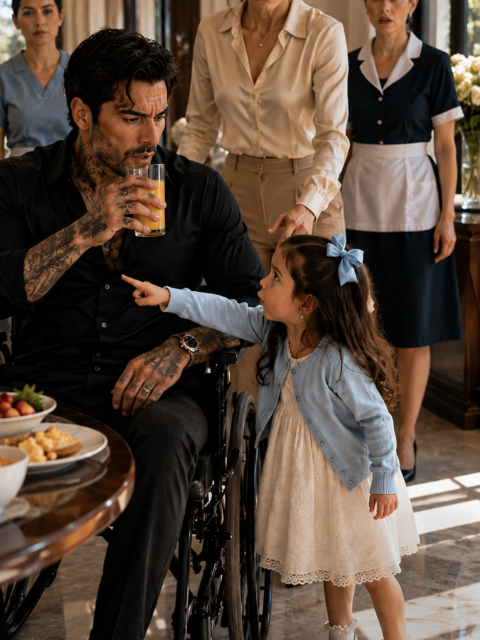
Dominic Moretti hadn’t heard the name his housekeeper whispered since the night his younger brother vanished eleven years ago. A prescription bottle bearing his own name, issued long before the girl was born, sat beside a sealed envelope from his dead father marked FOR DOMINIC ONLY. Inside was a photograph of his missing brother beside a pregnant Elena Rossi, and a legal document that turned a three-year-old’s midnight knock into proof of everything his family had spent eleven years refusing to say out loud. This family secret story follows a boss who thought he’d buried his grief, a housekeeper who hid in plain sight to survive, and a truth eleven years overdue. Read all nine chapters to find out what really happened to Matteo Moretti.
Chapter One
Too Tall
“I need your help, please.” The tiny voice came through my bedroom door one minute before midnight. Three soft knocks had pulled me from the thoughts keeping me awake. Nobody entered the east wing after ten. Not staff. Not family. Not even my security men unless someone was dying.
I opened the door. A barefoot little girl stood on the freezing marble, wearing a white nightgown covered in yellow flowers. Her dark hair clung to a tear-streaked face, and a battered stuffed rabbit dangled from one hand. She couldn’t have been more than three.
“I knocked before,” she whispered. “I heard.” “You didn’t come.” “I thought I imagined it.” She considered that seriously before looking up at me. “My mommy needs you.”
“Where is she?” The child hesitated. “I can’t tell you when you’re like that.” “Like what?” She pointed at me. “Too tall.”
I stared at her, then lowered myself onto one knee. “Better?” She nodded. “What happened?” Her lower lip trembled. “My mama is on the floor. She won’t wake up.”
Everything inside me sharpened. “I shook her and shook her,” she continued, fighting tears. “She made a little sound, but her eyes stayed closed. I tried Mrs. Bell’s door, but nobody answered.” “How did you find me?” “I walked.” “From where?” She pointed toward the servants’ quarters.
That was when I recognized her. Sofia. Her mother, Elena Rossi, had joined my housekeeping staff months earlier. Quiet. Reliable. Almost invisible. “I didn’t know who else,” Sofia whispered.
I stood. “Show me.” She grabbed two of my fingers and ran.
We found Elena collapsed beside her bed, breathing, barely. I called my private physician while security prepared a car. Then I noticed the overturned water glass beside her, and a prescription bottle beneath the dresser. But it wasn’t Elena’s name on the label. It was mine. My full legal name. Dominic Moretti.
I picked it up. The medication had been prescribed eleven years earlier — before Elena ever worked for me, before Sofia was born, before anyone in this house should have known it existed.
Elena’s eyes fluttered. Her hand caught my wrist with surprising strength. “Don’t call the hospital.” “Why?” “They’ll find us.”
She looked past me toward Sofia and began crying. Then she whispered a name I hadn’t heard since the night my younger brother disappeared eleven years ago. My blood turned cold.
Elena reached beneath her mattress and pulled out a yellowed envelope. My father’s handwriting was across the front. FOR DOMINIC ONLY. The seal had never been broken.
I opened it. Inside was a photograph of Elena standing beside my brother. She was pregnant. And beneath the photograph, a single legal document bearing my father’s signature.
I read the first line. Then I looked at Sofia, and Elena began shaking her head, whispering my name — because according to the document in my hands, the frightened little girl who had knocked on my door at midnight wasn’t my housekeeper’s child. She was a Moretti.
Chapter Two
They’ll Find Us
“Dominic, please,” Elena whispered again, her hand still weak around my wrist. “Not like this. Not tonight.”
“You’ve worked in my house for eight months,” I said, my voice barely steady. “Cleaned my private study. Made my coffee. Watched my niece call me sir every single morning, and you never once said a word.”
“I was protecting her.” Elena’s eyes filled again. “Protecting both of us.”
My physician arrived within minutes, and I stepped back to let him work, my mind still catching up to the document trembling in my hand. Legal, notarized, my father’s signature unmistakable at the bottom — an acknowledgment of paternity on Matteo’s behalf, drafted and signed the month before Sofia was born, sealed away and apparently never delivered to the one person it was addressed to.
“Who’s the name you said?” I asked, once the physician confirmed Elena’s vitals were stabilizing enough to allow a few careful questions. “The one you whispered before you saw the envelope.”
Elena’s face went the color of the marble beneath us. “You need to leave it alone, Dominic. Please. For Sofia’s sake, if not mine.”
“My brother disappeared eleven years ago,” I said, kneeling beside her bed, keeping my voice as level as I could manage with a three-year-old watching us both from the doorway, rabbit clutched tight. “I buried an empty grave marker because we never found enough to bury anything real. I have spent eleven years believing there was nothing left to learn about that night. You just told me there’s a great deal left to learn, and I am done letting anyone in this house make that decision for me.”
Elena closed her eyes, and when she opened them again, something in her expression had shifted from fear into something closer to exhausted resignation. “His name is Emilio Bragg,” she said quietly. “And if he finds out you know that name, Dominic, he will finish what he started with your brother eleven years ago — and this time, he won’t stop with Matteo.”
Chapter Three
The Night Matteo Disappeared
I hadn’t spoken the details of that night out loud in years, not even to my own security team, because the details I had access to were humiliatingly thin.
Matteo and I had argued at a family dinner — something small, forgotten now, the kind of disagreement brothers have and forget within a week. He’d left early. I remembered a headache building behind my eyes sometime after, remembered a glass of water our father’s assistant brought me, unusual only in hindsight, and remembered almost nothing else clearly until I woke on the study sofa the next morning with a fog in my head that took three days to fully clear.
Matteo never came home. His car was found abandoned off Route 9, keys still in the ignition, no sign of struggle, no ransom demand, nothing beyond an open case that went cold within four months despite every resource our family threw at it.
I had always assumed, in the vague, exhausted way grief lets you assume things without examining them, that the headache and the fog that night were simple stress. Standing now with a prescription bottle bearing my own name from that exact era, I understood I’d never actually questioned why I’d needed medication strong enough to leave me unconscious on a sofa for an entire night, in my own home, the same night my brother vanished without a trace.
“Someone drugged me,” I said slowly, the pieces shifting into a shape I badly didn’t want to see. “That night. Not stress. Not a headache. Someone made sure I wasn’t conscious enough to notice whatever happened to Matteo.”
Elena’s silence answered before her voice did, and when she finally spoke, her words landed with the particular weight of someone who had carried a secret so long it had become almost a physical thing. “Your father knew,” she said. “He knew within a week. He just decided protecting what was left of this family mattered more than telling you the truth — and I’ve spent eleven years terrified that decision was going to get Sofia and me killed the same way it very nearly got Matteo.
Chapter Four
For Dominic Only
The legal document inside the envelope did more than acknowledge Sofia’s paternity. Attached behind the notarized statement was a second page in my father’s own handwriting, dated the same week — not quite a confession, but close enough to one that reading it in my own study at one in the morning felt like meeting a version of my father I’d never actually known.
Dominic — if you are reading this, it means Elena finally trusted you enough to reveal what I could never bring myself to tell you directly. Your brother did not simply disappear. Emilio Bragg had him killed over the Ashford territory dispute the week before, believing Matteo intended to testify against him in the federal case building at the time. I could not prove it thoroughly enough to move against Bragg without risking everything else this family had built, and I made the unforgivable choice to protect the business rather than pursue justice for my own son. I have provided for Elena and the child quietly since, and I am leaving this document sealed rather than delivered because I no longer trust my own judgment about when protecting you from this truth stopped being protection and became something closer to cowardice.
I read it twice, my hands unsteady in a way I hadn’t allowed myself to be in front of anyone since Matteo’s funeral that wasn’t really a funeral at all.
“He knew,” I said. “My entire life since, every family dinner, every holiday where we all pretended Matteo’s absence was simply an unsolved tragedy — my father knew exactly who took him, and said nothing.”
Elena, propped up now against her pillows, watched me with an exhaustion that went far deeper than tonight’s collapse. “Your father provided for us. Quietly, through an account I was told never to discuss. I took the housekeeping position eight months ago because the money stopped arriving after he died last year, and I needed work I could do while keeping Sofia close enough to watch myself. I never intended for you to find out this way.”
“Then how were you planning to tell me,” I asked, “and why tonight, of all nights, did someone drug you with medication from a prescription that’s supposed to have expired a decade ago?”
Chapter Five
What Elena Never Told Anyone
“I wasn’t planning to tell you tonight,” Elena admitted. “I wasn’t planning to tell you at all, if I could have avoided it. I’ve kept that envelope hidden for a year, terrified of exactly this — you finding out, asking questions loud enough that the wrong people heard them.”
“Then how did the medication get into your room?”
Elena’s face tightened with an anger that seemed aimed as much at herself as at whoever was responsible. “I don’t take sedatives, Dominic. I’ve never once had a prescription for anything like what your physician found in my system. Someone put that into my tea tonight, and I promise you, I did not leave a decade-old bottle with your name on it lying on my own bedroom floor by accident.”
The implication settled over both of us at once. Someone inside the house — someone with access to Elena’s private quarters, someone who knew exactly which decade-old medication would send the clearest possible message if Dominic Moretti happened to find it — had drugged her deliberately, tonight, the same night she’d apparently begun quietly preparing to finally tell me the truth.
“Who did you tell?” I asked. “About planning to come forward. Anyone at all, even in passing.”
Elena’s face went pale. “Mrs. Bell. Three days ago. I asked her, hypothetically, what she thought would happen if certain old family secrets came out after all this time. I never gave her details. I thought I was being careful.”
I thought of Mrs. Bell’s door, unanswered when Sofia knocked on it desperately less than an hour ago — unanswered not, perhaps, because she’d slept through a frightened child’s knocking, but because she hadn’t been in her room at all.
“Security,” I said into my phone, already moving toward the door. “I need Mrs. Bell located immediately, and I need every camera covering the servants’ quarters pulled from the last six hours — because I don’t think the person who drugged Elena tonight is finished, and I am not willing to find out what ‘finished’ looks like the hard way.
Chapter Six
The Bottle Wasn’t Hers
Mrs. Bell was found within the hour, unharmed but shaken, locked in a supply closet on the second floor with her phone confiscated — genuinely a victim rather than a conspirator, her account confirming she’d mentioned Elena’s “hypothetical” question to exactly one other person: her nephew, recently hired onto the estate’s grounds crew, who had seemed unusually curious about the specifics.
The grounds crew nephew, a young man named Curtis who’d passed his background check eleven weeks earlier with a clean record, was nowhere on the property when security went looking for him.
“His employment records,” my head of security reported grimly, laptop open on my study desk at nearly two in the morning, “list a previous position at a private security firm in Newark. I pulled deeper. That firm’s ownership traces back, through two shell companies, to a name I haven’t heard mentioned inside this house in over a decade.”
“Bragg,” I said.
“Bragg,” he confirmed. “Curtis wasn’t hired to mow lawns, Dominic. He was placed here months ago, waiting for exactly the kind of opportunity tonight handed him — evidence that Elena might finally be preparing to talk.”
I thought of the decade-old prescription bottle, deliberately placed rather than accidentally dropped, a message engineered specifically for me to find: proof that Bragg’s people still had access to information from the exact night my brother disappeared, and were willing to use it to remind me, without saying a single word directly, exactly how easily they could reach into my own house.
“He’s not finished,” I said, understanding settling into something cold and absolutely certain. “Placing that bottle wasn’t meant to scare Elena into silence. It was meant to scare me into believing this family still can’t win against Bragg — and I intend to spend the rest of tonight proving him wrong about that.
Chapter Seven
The Man in the East Wing
Curtis was found three hours later, not far off the estate grounds, apprehended by my security team at a gas station where he’d stopped, apparently confident enough in a clean escape that he hadn’t anticipated how quickly a family with resources like mine could mobilize once properly motivated.
He talked faster than I expected, once it became clear exactly how much evidence already existed connecting him to Bragg’s organization. Bragg, it turned out, had never fully believed the case against him eleven years ago was as cold as it appeared — he’d kept a discreet watch on the Moretti family ever since, wary of exactly the kind of resurfacing evidence Elena had apparently been quietly gathering for over a decade.
“He wanted a message sent, not a murder,” Curtis said, sweating under questioning in a room considerably less comfortable than his employment interview eleven weeks earlier. “The bottle was supposed to remind you that Bragg still has reach into your world, even now. Elena getting hurt tonight was never supposed to happen — I used too much in her tea, panicked when she went down harder than expected, and left before anyone could connect me to it directly.”
“And if I hadn’t found the envelope? If Elena had simply woken up frightened and quiet, exactly as intended?”
Curtis’s silence was answer enough.
“Where is Bragg now,” I asked, “because a man patient enough to plant an operative in my household for eleven weeks isn’t the kind of man who leaves the next move to chance — and I want to know exactly what he’s planning before he decides tonight’s failure requires a considerably less subtle follow-up.
Chapter Eight
Emilio Bragg
It took two days to arrange a meeting Bragg would agree to — neutral ground, a private room above a restaurant he partially owned on the city’s north side, the kind of location he clearly believed gave him every advantage.
He hadn’t aged particularly well in eleven years, though his composure remained exactly as unbothered as Elena’s fear had suggested it would be. “Dominic. It’s been a long time. I was sorry to hear about your father.”
“I know what you did to my brother,” I said, setting a folder on the table between us — Curtis’s full statement, the traced shell company records, the decade-old prescription evidence, and the notarized document my father had left sealed for eleven years. “I know you had him killed over the Ashford dispute because he intended to testify against you. I know my father knew, and chose silence over justice, and I know exactly how much that silence has cost this family since.”
Bragg’s expression didn’t change, though something behind his eyes went carefully still. “That’s a serious accusation, built on the word of a housekeeper and a document your father never actually delivered.”
“It’s built on considerably more than that now,” I said. “Curtis is currently cooperating fully with federal investigators reopening the Ashford case, motivated by exactly the kind of sentencing leniency a man in his position finds persuasive. The prescription records trace directly back to a physician your organization has used for over a decade. And I have resources my father, eleven years ago, was apparently too afraid to use against you.” I leaned forward. “I am not afraid, Emilio. I buried an empty grave for my brother. I am done being quiet about who put him in it.”
Bragg’s composure finally cracked, just slightly, the particular flicker of a man recalculating an escape that had suddenly become considerably narrower than he’d planned for — and three federal agents, positioned outside per an arrangement my own attorneys had spent two days coordinating, entered the room before he’d finished formulating his next sentence.
Chapter Nine
What Was Left of Matteo
Bragg’s arrest, and the federal case that followed, eventually produced what eleven years of silence never had — a location, provided by one of Bragg’s own men in exchange for a reduced sentence, where what remained of my brother had been buried the night he disappeared.
We held a real funeral six weeks later, not the empty ceremony of eleven years earlier, but something closer to actual closure, Sofia standing beside me in a small black dress Elena had altered by hand, holding my hand instead of her rabbit’s paw for the first time since the night she’d knocked on my door.
“Is that my daddy?” she asked, looking at the casket with the grave, careful seriousness she seemed to bring to every important question.
“Yes,” I said. “He would have loved you very much.”
“Mama said he was brave.”
“He was,” I agreed. “Braver than any of us understood until it cost him everything.”
Elena and Sofia moved out of the servants’ quarters within the month, into rooms in the main house that Sofia, with characteristic bluntness, declared “still too fancy” but slowly grew to love regardless. Elena no longer cleaned my study. She managed, instead, a small trust my father should have delivered honestly eleven years earlier, finally administered the way he’d always intended it — openly, without secrecy, without the fear that had shaped nearly every year of Sofia’s short life.
I still thought, some nights, about a father who’d chosen silence over justice, about eleven years I could never fully get back. But watching Sofia climb into my study most evenings now, entirely unbothered by how tall I was as long as I knelt down when she needed me to, I understood that the truth, however late it arrived, had finally given all three of us something my father’s silence never could.
A family that no longer had anything left to hide from each other.