Grace Bennett was working the gala in a black uniform with a silver tray, invisible to everyone who mattered, when Celeste Winthrop noticed her daughter Lucia waiting shyly near the ballroom doors and offered her a million dollars to “outdance” her in front of two hundred of Boston’s wealthiest guests. Everyone lifted their phones, certain they were about to witness a cruel joke land exactly as intended. Instead, Lucia asked to dance the private melody her grandmother Rose had taught her, a tune passed down in a tiny dance studio long before Rose’s death, and the moment the orchestra’s first violin found the tune, billionaire Adrian Vale’s champagne glass stopped halfway to his lips. That melody was never published, he told Grace, his voice dropping to a whisper. His grandmother had composed it privately for her two daughters. Only family knew it. And one of those daughters had vanished without explanation more than thirty years earlier, taking the only trace of herself she’d allow her family to keep — a song nobody outside that family should have ever known how to play. This is a thirteen-chapter story about a hidden identity buried inside an ordinary dance studio for three decades, a sister who never stopped searching, and the little girl whose fearless six-year-old dance finally answered a question her family had been asking for thirty years. Read all thirteen chapters to find out why Rose Bennett really disappeared, what the Vale family had been through in the decades since, and what happened once Grace understood exactly whose granddaughter she actually was.
Chapter One
Outdance Me
I was working the gala that night. Black uniform. Silver tray. Invisible to everyone who mattered.
Lucia waited near the ballroom doors in a borrowed blue dress because my babysitter had canceled.
Then Celeste Winthrop noticed her. “Aren’t you precious?” she said. Lucia smiled shyly. Celeste turned toward the crowd. “Tell you what, sweetheart. Outdance me and I’ll give your mother one million dollars.”
Laughter erupted. My stomach twisted. “Lucia, we’re leaving.”
But my daughter touched my hand. “Mama, can I dance our song?”
I froze. She meant the melody my mother, Rose, had taught me in the tiny dance studio she’d once owned. Whenever life hurt, Mom played that song. After she died, I played it for Lucia.
“Are you embarrassed by my dancing?” Lucia whispered. I knelt. “Never.” “Then let me show them.”
I stood and faced Celeste. “She’ll dance. But not for your money.”
Chapter Two
Not for Your Money
The laughter faded. I approached the conductor and quietly named the piece. His face changed. He looked across the ballroom toward Adrian Vale.
Then the first violin began.
Adrian’s champagne glass stopped halfway to his lips.
Chapter Three
The Falling Star
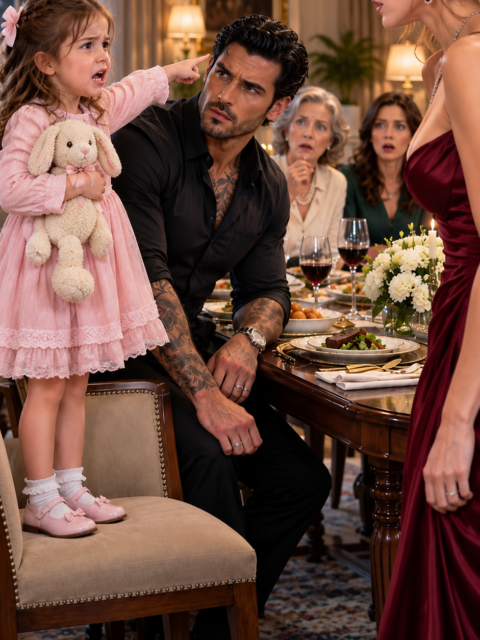
Lucia placed her stuffed rabbit beside me and stepped beneath the chandelier. Turn. Step. Spin. Then she performed the movement Mom called the falling star.
Someone gasped. An elderly woman standing beside Adrian covered her mouth. She was crying.
Celeste snapped, “What is going on?” Nobody answered her.
Adrian walked toward me. “Who taught your daughter that?” “I did.” “And who taught you?” “My mother.” His voice became almost a whisper. “Her name?” “Rose Bennett.”
The elderly woman behind him made a broken sound.
Chapter Four
Never Published
Adrian stared at Lucia. “That melody was never published.” I frowned. “My mother knew it all her life.” “I know.”
My skin prickled. He explained that his grandmother had composed the piece privately for her two daughters. Only family knew the melody. Only those daughters knew the dance. One of them had disappeared more than thirty years ago.
I suddenly remembered something Mom once told me. Some songs carry memories too painful to explain.
Adrian looked directly into my eyes. “Rose Bennett wasn’t your mother’s birth name.”
I stopped breathing.
Chapter Five
The Photograph
Behind him, the elderly woman reached inside her purse and removed an old photograph. Two little girls stood beside a piano. One was unmistakably my mother.
Then she turned the photograph over. Written on the back was a name I’d never seen before. Adrian’s missing aunt.
And suddenly Celeste’s cruel joke wasn’t about a million dollars anymore. It had just revealed who I might actually be.
Chapter Six
Victoria’s Thirty Years
“My name is Victoria,” the elderly woman said, once she’d composed herself enough to speak, still clutching the photograph with hands that trembled visibly. “Eleanor was my younger sister. We were inseparable growing up, taught the same private melody by our own mother, performing that dance together at every family gathering until the year she simply vanished.”
“Thirty years,” I said slowly, working through the arithmetic against my own mother’s age, against everything I thought I knew about her history.
“Thirty-one, this past spring,” Victoria confirmed. “I hired investigators for the first decade. I never stopped watching for any trace of her, any sign she might still be alive somewhere, living a life she’d chosen deliberately to keep hidden from us. I eventually had to accept I might never know what actually happened to her.”
Adrian, standing close beside his aunt with a protective hand at her shoulder, studied me with an intensity that made the enormity of the moment considerably harder to process standing in the middle of a crowded ballroom. “I need to ask you directly,” he said. “Would you be willing to provide a DNA sample? I understand how enormous a request that is, given everything else happening tonight. I need considerably more than a shared melody before any of us allows ourselves to fully believe this.”
“Yes,” I said, my voice steadier than I felt. “Whatever you need. I think some part of me has been waiting my whole life to understand exactly why my mother kept so much of her past locked away from me.”
Chapter Seven
Why Eleanor Left
While we waited for formal confirmation, Victoria shared what she remembered of her sister’s final months with the family, details that began, slowly, to explain a disappearance that had haunted her for three decades.
“Eleanor fell in love with a man our parents considered entirely unsuitable,” Victoria said. “A music teacher, talented but without family money or standing, exactly the kind of match our father had spent Eleanor’s entire childhood warning her against. When she told him she intended to marry regardless of his objections, he gave her an ultimatum — end the relationship, or be cut off from the family entirely, disowned in every sense that mattered.”
“She chose him,” I said, understanding already how this story likely ended, given that I’d grown up without any grandfather present, without any large extended family beyond my mother’s quiet, solitary presence.
“She chose him,” Victoria confirmed, “and rather than let our father’s threat actually separate her from the man she loved, she simply disappeared entirely, taking nothing but the melody she couldn’t bear to leave behind. I always believed, in my heart, that she’d found some way to build a life elsewhere. I never once expected to find proof of it standing in the middle of my nephew’s engagement gala, in the shape of a granddaughter and great-granddaughter I never knew existed.”
“What happened to the music teacher?” I asked. “My grandfather, if this is really what we think it is.”
Chapter Eight
Confirmation
“I don’t know,” Victoria admitted. “I never learned his name. Eleanor was careful, even in the brief period before she disappeared completely, never to give our father anything more specific to threaten than his profession and his lack of standing.”
The DNA results, processed within a week through a private lab Adrian arranged with careful discretion, confirmed definitively what the melody, the photograph, and Victoria’s account had already made almost certain: I was Eleanor Vale’s granddaughter, Rose Bennett having been the identity my grandmother built for herself the moment she chose love over her family’s wealth and control.
“She never told me any of this,” I said, sitting with Victoria and Adrian in the considerably quieter setting of the Vale family’s private study, the confirmed results spread across the table between us. “I grew up believing my mother’s family history began and ended with her. I never once suspected there was an entire family out there still looking for us.”
“She protected you the same way she protected herself,” Victoria said gently. “I imagine, having made the choice to disappear so completely, she understood that half-measures would only invite the kind of searching that might eventually undo everything she’d built.”
“I wish she’d trusted me with the truth before she died,” I said, grief for my mother arriving in a new, more complicated shape than the grief I’d carried for the past three years since her death. “I wish I’d known to ask better questions while I still had the chance.”
Chapter Nine
What Rose Never Told Me
Going through my mother’s old belongings with fresh eyes, once I understood what I was actually looking for, revealed details I’d overlooked for years without the proper context to recognize their significance — old sheet music in handwriting I now recognized as considerably more formal than my mother’s usual notation, a small unlabeled photograph tucked into a jewelry box I’d never thought to examine closely, showing a much younger version of my mother beside a man I now understood must have been my biological grandfather.
“She never fully let go of that life,” I told Victoria, sharing the photograph during one of our now-regular visits. “She just built a version of it small enough and quiet enough that nobody would think to look for her inside it.”
“A dance studio,” Victoria said, studying the photograph with an ache I recognized from my own grief. “Music was the one thread she apparently couldn’t bring herself to cut completely, even in hiding.”
Adrian, who’d taken it upon himself to research what he could of Eleanor’s music teacher husband, eventually located records confirming he’d died when I was young, years before I had any solid memories of a father — explaining, finally, why my mother had raised me entirely alone, carrying two griefs simultaneously that she’d never once found the words to fully explain.
“She lost him and stayed hidden anyway,” I said, understanding my mother’s silence with a depth I hadn’t managed before. “Even after there was no more marriage left to protect, she must have decided the distance from her family had become its own kind of permanent choice.”
Chapter Ten
Celeste’s Reckoning
Celeste Winthrop’s engagement to Adrian, already strained by months of what he later described as her consistent unkindness toward household staff and anyone she perceived as beneath her, didn’t survive the gala’s revelations in any meaningful sense, though the actual ending took several more uncomfortable weeks to finalize.
“I watched you humiliate a working mother and her six-year-old daughter for entertainment,” Adrian told her, once the wider family gathering that followed the gala had processed the initial shock. “In front of two hundred guests, expecting laughter at a child’s expense. I’ve spent the following weeks unable to separate that cruelty from everything else I’ve slowly begun noticing about how you treat people who can’t immediately benefit you.”
Celeste, for her part, offered little genuine remorse beyond frustration at how thoroughly her intended joke had backfired into revealing a long-lost family connection rather than the public embarrassment she’d actually been aiming for.
“I didn’t know the child would turn out to be secretly related to your family,” she said, missing entirely the point of why her cruelty itself had been the actual problem, regardless of its unexpected consequences.
“That’s precisely the issue,” Adrian said quietly, ending the engagement formally within the month. “You were entirely prepared to humiliate a child for entertainment before you had any idea who she was. I don’t think I can build a life with someone who needed a genealogical coincidence to accidentally teach her that cruelty has consequences.”
Chapter Eleven
Welcomed Home
The Vale family embraced Lucia and me with a warmth that took considerable adjustment on my part, thirty-one years of separation meaning that Victoria and I were, in practice, meeting each other for the first time despite the blood connection between us.
“I don’t expect you to simply slot into a role in this family overnight,” Victoria told me, during one of our long afternoon conversations that had become a regular, treasured part of my week. “I’m interested in actually getting to know you and Lucia, on whatever timeline that genuinely requires, rather than rushing toward a relationship that skips the years we lost.”
Lucia, delighted by her sudden expansion of family, took to her newfound great-great-aunt with the same fearless enthusiasm she’d shown dancing beneath that chandelier, insisting on regular visits to learn more of the family’s old music and dance history directly from the source.
Adrian, meanwhile, became something between a cousin and an unexpected friend, his own life reshaped considerably by the gala’s revelations — not simply the end of an engagement that had, in retrospect, been built on considerably shakier ground than he’d wanted to admit, but a renewed connection to a branch of the family he’d grown up hearing about only as an old, unresolved sorrow.
“My grandmother would have loved this,” he told me once, watching Lucia teach Victoria a small addition she’d invented to the family’s traditional dance. “She spent years hoping Eleanor would simply walk back through the door one day. I think this is close enough to that hope actually coming true.”
Chapter Twelve
Honoring Rose
Victoria and I arranged a proper memorial for my mother the following spring, considerably different from the small, quiet funeral I’d managed alone three years earlier with limited resources and no extended family present to share the grief.
“I want to honor both names,” I told Victoria, planning the details together. “Rose Bennett, the woman who raised me and built an entire life out of nothing after losing everything. And Eleanor Vale, the sister you loved and searched for every year since she disappeared.”
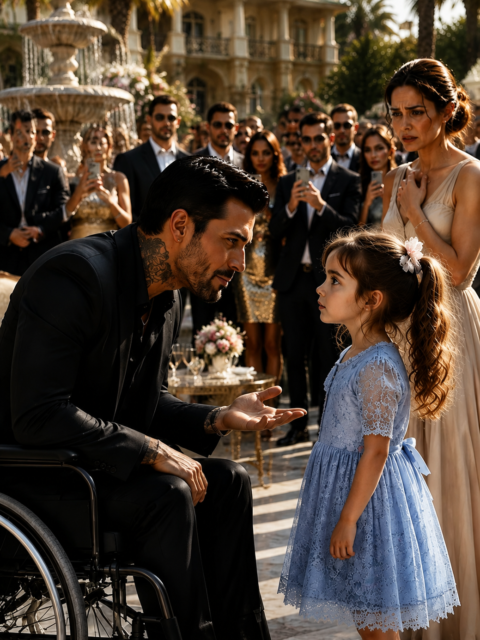
The ceremony included the melody, played properly by a full orchestra for the first time since Eleanor’s own childhood, Lucia dancing the same steps beneath an open sky rather than a ballroom chandelier, a tribute that finally, fully closed thirty-one years of unanswered grief for Victoria while honoring the woman I’d known simply as my mother.
“She would have been so proud of you,” Victoria told me, watching Lucia’s small, confident movements mirror the same choreography Eleanor had once performed as a girl. “Both of you. I only wish she’d trusted us enough to let us be part of it while she was still here to see this.”
“I think,” I said slowly, understanding my mother’s choices with a compassion I hadn’t fully accessed until that exact moment, “she gave us this instead. A song neither of us knew we were both still carrying, waiting for exactly the right moment to bring us back together.”
Chapter Thirteen
What Remained
Two years after that gala, Lucia studies dance formally now, under instructors Victoria personally selected, her natural talent nurtured with resources I could never have provided alone, though she still insists, every single lesson, on ending with the falling star her great-grandmother composed and her grandmother carried into hiding for three decades.
I left the catering company not long after that night, Victoria insisting on establishing a proper role for me within the family’s charitable foundation, work I found meaningful in ways my previous silver-tray invisibility never once allowed.
The old dance studio where my mother once taught, the small, humble space where she’d built her entire second life after leaving everything else behind, remains open today, considerably better funded now, still teaching neighborhood children the ordinary steps of ballet and jazz alongside, occasionally, when a student seems to need it most, the particular quiet comfort of a melody that once carried an entire family’s unspoken grief across thirty-one lost years.
Celeste Winthrop, I heard through the considerable Boston social grapevine, never quite recovered her previous social standing after word of that gala spread — proof, perhaps, that some cruelties eventually find their own reckoning, even when the reckoning arrives dressed as an unexpected miracle for everyone else in the room.