When rancher Elias Hart found his seven missing cattle being driven home across the Nebraska plains by three impoverished orphans—led by an eight-year-old girl scolding his meanest cow—he offered them five dollars, only to be met with fierce, unyielding pride from a destitute widow and her children who refused charity, forcing him to offer them a home instead.
Table of Contents
- Chapter 1: The Girl and the Meanest Cow
- Chapter 2: The Currency of Pride
- Chapter 3: The Clothespins at the Brannan Place
- Chapter 4: The Offer at the North Cottage
- Chapter 5: A New Rhythm on Hart Ranch
- Chapter 6: Owen’s Eyes and the Rustler’s Trail
- Chapter 7: The Reckoning at Devil’s Gap
- Chapter 8: The Document on the Cedar Table
- Chapter 9: The Brand of Love
Chapter 1: The Girl and the Meanest Cow
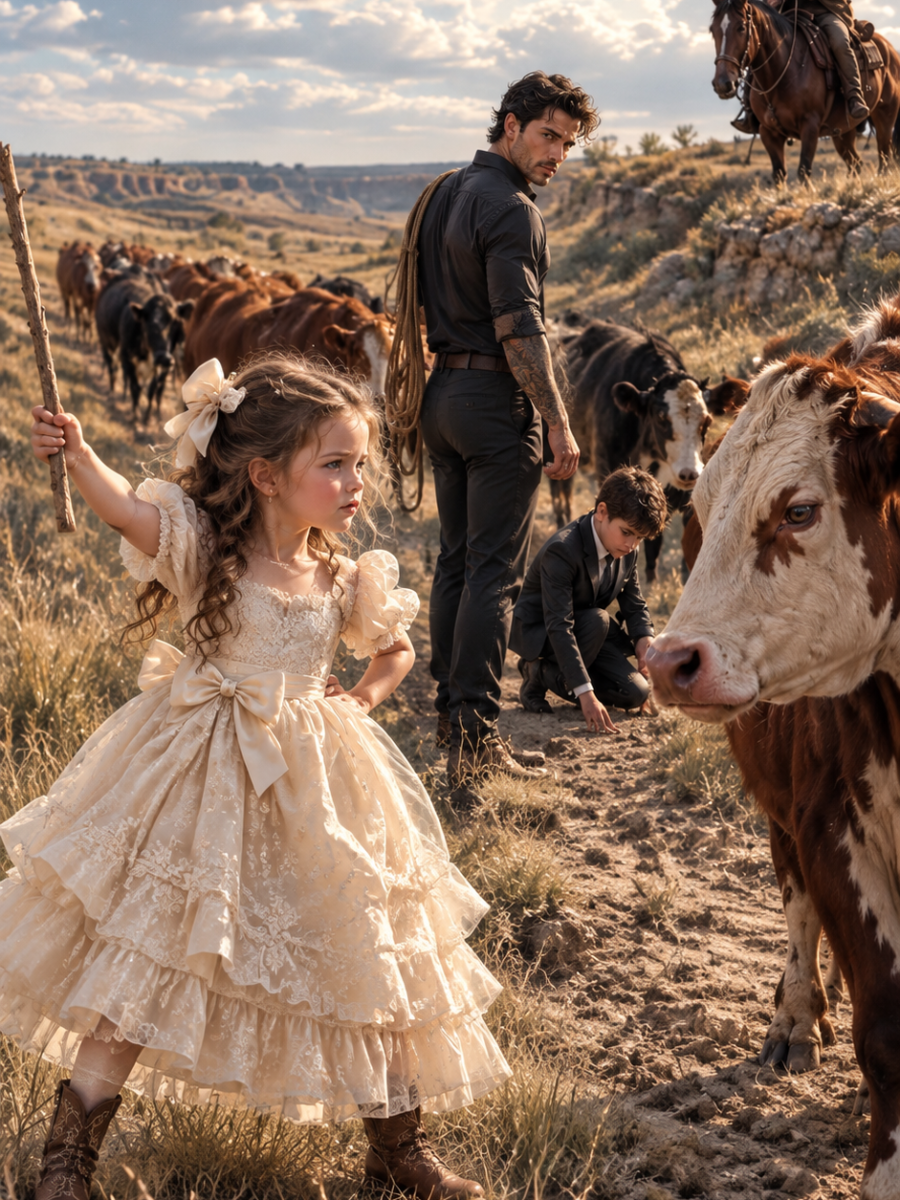
The first thing Elias Hart noticed was that the little girl was arguing with his meanest cow.
Not shouting. Not striking her with a stick. Arguing.
“You can be angry when we get there,” the child said, trudging through the pale yellow Nebraska prairie grass with a peeled willow switch in her hand. “But right now you have to keep walking, because I am eight years old and I have already spent my entire morning looking at your backside.”
The heavy red-and-white Hereford cross cow, a notorious fence-breaker named Ruby whom grown ranch hands preferred to approach from the safe side of a corral railing, stopped dead in the dust. She turned her massive, horned head toward the girl.
The child stopped.
The cow stopped.
For five unbroken seconds, child and beast stared into each other’s eyes with the exhausted, long-suffering hostility of two people trapped in a bad marriage.
Then the girl pointed a small, dirt-streaked finger toward the north.
“Home is that way,” the girl stated firmly.
Ruby let out a wet, indignant snort.
“I know,” the girl sighed, shaking her dark curls. “That is not my fault.”
Elias Hart sat motionless on his gray gelding at the crest of the limestone ridge, watching the scene through narrowed gray eyes.
Seven cattle were moving in a disciplined line along the dry creek bed below him. Seven. He had counted his herd twice before sunrise and come up short by seven head each time. In a good year, seven missing steers were a minor irritation; in the second brutal drought summer in a row, with beef prices collapsing at the Omaha stockyards and his west pasture well pumping mud, seven steers were the difference between paying his bank note comfortably and pretending not to be sick with worry.
He had expected to find a washed-out wire fence.
He had expected to find cut strands and cattle rustlers.
He had certainly not expected three children.
Walking at the head of the cattle was a boy of perhaps fifteen, lean and long-limbed, carrying a coil of weathered hemp rope over his bony shoulder. His cotton trousers were patched at both knees with flour sacking, and the soles of his boots were separating from the uppers.
Ten yards behind him came a second boy, eleven or twelve, bent nearly double as he walked. He wasn’t watching the cattle at all; he was watching the dirt, touching bent blades of grass, pausing every twenty yards to signal direction without a word.
And bringing up the rear was the eight-year-old girl, still engaged in diplomatic negotiations with Ruby.
Chapter 2: The Currency of Pride
Elias touched his heels to his gelding’s flanks, riding down the grassy slope at an easy walk.
The eldest boy heard the clink of bit rings first. He turned smoothly, his body dropping into a defensive crouch that was far too wary and rigid for a boy of fifteen.
“Those yours?” the boy asked, nodding toward the cattle.
Elias reined in his horse, his gaze sweeping over the dusty herd. “Hart brand on the left hip. All seven.”
The boy nodded once. “Thought so.”
“You thought so?” Elias asked, dismounting.
“My brother found the tracks two miles back near Miller’s dry wash,” the boy said.
The younger boy straightened up from the grass, his gray eyes clear and observant. “They came through from the northwest ridge,” he explained quietly. “Wire caught red hair from the heifer. Wind flattened the buffalo grass in the same direction.”
Elias stared at the twelve-year-old. “You tracked seven head across four miles of baked alkali?”
The boy shrugged. “Grass always tells the truth.”
The older brother gave him a sharp, warning nudge with his elbow, as if accepting praise from a stranger was a dangerous luxury they couldn’t afford.
The little girl finally reached them, her willow switch tucked under her arm as Ruby took a long, noisy drink from the mud puddle at the creek edge.
“I think this one has personal grievances against society,” the girl announced, wiping her nose with the back of her dusty wrist.
“She does,” Elias admitted, fighting a smile. “What did you do to her?”
“Nothing,” she said solemnly. “I listened to her complaints.”
Elias cleared his throat. He reached deep into the pocket of his leather vest.
Three dollars was generous for half a day’s droving. Five dollars was outright ridiculous.
He pulled out a shiny five-dollar gold half-eagle and held it out toward the eldest boy.
The boy looked at the glittering coin, then looked directly into Elias’s eyes.
“No, sir.”
Elias blinked. “You brought back nearly forty dollars worth of beef that would have died in the coulee.”
“They weren’t ours,” the boy said, his jaw tightening into hard, stubborn lines.
“That’s why I’m paying you for bringing them home.”
“We didn’t do it for pay.”
“You spent your morning in the heat.”
“Still wasn’t work you hired us to do,” the boy retorted.
Elias studied him closely. Hunger had an unmistakable signature on the frontier: the hollow cheeks, the collarbones pressing sharp against thin flannel, the boots tied together with rawhide string. These children needed money desperately. That was precisely why their refusal struck him like a blow to the ribs.
“What’s your name, son?” Elias asked.
“Luke Whitcomb.” The boy nodded to his brother. “Owen. And that’s Sadie.”
“Where do you live, Luke?”
Luke hesitated, his eyes darting toward the southern horizon.
Elias put the gold coin away. “I’m not looking to cause trouble. I just want to know who raised children with this kind of backbone.”
“South road,” Luke said quietly. “The old Brannan rental.”
Chapter 3: The Clothespins at the Brannan Place
Elias knew the Brannan place. Every rancher in the county knew it.
It was a dilapidated sod-and-timber shack that sat on forty barren acres of rocky gravel. The roof leaked in dry weather, the well water smelled of sulfur, and the porch had collapsed two winters ago.
When Elias rode into the yard an hour later, trailing his seven steers behind him, a woman was hanging wet bedsheets on a wire line behind the house.
The moment iron horseshoes clinked against the stones, she dropped the clothespins.
Not the sheet. The clothespins.
It was a small, instinctive reaction, but Elias had spent twenty years reading livestock and men in the wild; he knew immediately that this was a woman who had lived under the shadow of sudden, catastrophic bad news for a very long time.
Her three children came over the grassy rise behind Elias’s horse.
The woman counted them instantly with a swift sweep of her eyes. Luke. Owen. Sadie.
Only when all three were standing safe on her side of the fence did she turn her gaze upon Elias Hart.
She was thirty-five years old, slender and weathered, with dark blond hair pinned in a hurried knot at the nape of her neck. Her gray eyes were sharp, intelligent, and guarded by an invisible wall of iron pride.
“Cattle broke through the west wire, ma’am,” Elias said, removing his broad-brimmed hat. “Your boys tracked them, and your daughter negotiated with my meanest cow. They saved me three days of searching.”
The woman looked at Luke. “Did they damage anything?”
“No, Ma.”
“Did they cause trouble?”
“No, Ma.”
Her shoulders dropped an imperceptible fraction of an inch.
“I’m Elias Hart,” he said, stepping down from his saddle.
Her expression changed. Not with awe or gratitude, but with a cool, measured distance.
“I know who you are, Mr. Hart,” she said, wiping her damp hands on her rough flour-sack apron. “I’m Clara Whitcomb.”
“Your son Luke refused payment for half a day of hard tracking,” Elias said, a faint note of frustration in his voice. “Five dollars would buy a good many sacks of flour around here, Mrs. Whitcomb.”
Clara’s face went rigid as carved cedar.
“My children do not accept charity, Mr. Hart,” she said, her voice quiet but ringing with cold finality. “We do not take money for being decent neighbors.”
Elias looked past her toward the house.
The woodpile was stacked with almost obsessive neatness—a fortress of small cedar kindling that seemed to shout to the world that order could substitute for poverty. The six struggling rows of beans and squash in the garden had been weeded down to bare earth.
“I didn’t offer charity, Mrs. Whitcomb,” Elias said softly. “I offered wages.”
“Wages are for work that was contracted,” Clara replied. “We didn’t contract with you.”
Chapter 4: The Offer at the North Cottage
Elias Hart stood in the dusty yard, looking at the proud, exhausted woman whose hands were raw from lye soap and garden dirt.
He was forty years old, a bachelor who lived in an eight-room ranch house that felt more like an echoing barn every winter. He had three hundred head of cattle, five sections of deeded grassland, and two hands who were getting too old to ride the boundary fences in freezing weather.
“I need extra hands through the fall roundup,” Elias said, his tone shifting into practical business.
Luke looked up, a spark of hunger flaring in his eyes. Clara did not look up; she kept her eyes fixed on the hem of her apron.
“I have an empty stone cottage on the north pasture,” Elias continued. “Two rooms downstairs, sound timber floorboards, a dry loft above. The cookstove works, and the well taps into sweet spring water that never goes dry. I need a hand with fence mending and heavy branding. Luke has the shoulders for it.”
He looked at twelve-year-old Owen.
“I need an outrider who notices bent grass and broken twigs before cows get into the sinkholes. Owen sees things most grown men ride right past.”
Sadie raised her willow switch from behind her mother’s skirt. “I can handle the difficult personalities.”
Clara shot her daughter a stern look. Sadie amended instantly: “Within reason.”
Elias felt the corners of his mouth twitch. “There’s dairy work, egg gathering, and cooking for the seasonal drovers if you want it, Mrs. Whitcomb. I pay fifteen dollars a month for Luke, ten for Owen, and fair board for the household. Cottage included because I need my crew close to the north gate.”
Clara finally raised her head. Her gray eyes bored into his, searching for the catch—the hidden price that lonely ranchers always demanded of poor widows.
“And what happens when November ends, Mr. Hart?” Clara asked, her voice tight.
“We look at the ledger and decide if there’s winter work.”
“That isn’t what I asked.”
Elias paused, holding her gaze. “Then ask it plain.”
Clara took a step forward, her knuckles white against her apron.
“What will we owe you when the season is over? For the cottage? For the flour? For the firewood? When my husband died, the merchant in town smiled and told me to take whatever I needed on credit. Two months later, he showed up with the sheriff and a deed to our land, telling me I could pay the debt in the back room of his store or lose my home.”
Her voice broke on the final word, revealing the jagged, unhealed wound of a woman who had fought off vultures with her bare hands.
Elias Hart felt a cold, murderous fury settle into his chest against the men of this valley.
He walked over to his saddle, unbuckled a leather pouch, and drew out a signed, blank territorial employment agreement bearing his personal brand seal.
“Mrs. Whitcomb,” Elias said, his voice deep and steady as granite. “You will owe me an honest day’s labor for an honest day’s wage. Not one cent more. Not one favor more. If I ever speak a word out of turn to you or your children, you can take my gray horse and ride into the county seat to have me arrested for breach of contract.”
Chapter 5: A New Rhythm on Hart Ranch
Two days later, the Whitcomb family moved their few belongings into the north stone cottage.
To Luke and Owen, the two-story stone dwelling felt like an emperor’s palace. The roof didn’t leak; the windows had real glass panes instead of greased paper; and when Luke built a fire in the cast-iron kitchen range, the flue drew clean, fragrant pine smoke without coughing soot into the room.
From their first morning, the children worked like seasoned hands.
Luke proved to have the endurance of a grown teamster. He helped Elias rebuild two miles of downed cedar-post fencing along the coulee, swinging the heavy sledgehammer until his hands blistered, refusing to sit down until Elias ordered him to take a dipper of water.
Owen became Elias’s shadow on the range. The twelve-year-old had an uncanny, almost supernatural instinct for tracking. He could tell by the depth of a hoofprint whether a steer was carrying a stone in its shoe, and he spotted three heifers stuck in a quicksand wash before the buzzards even circled.
And Sadie took over the dairy barn.
Every afternoon, she marched into the milking shed with a tin pail and her peeled willow switch, sitting on an overturned box beside Ruby. The mean cow would chew her cud with half-closed eyes, letting out contented grunts while Sadie milked her and recited the multiplication tables she had memorized from her mother’s primer.
“I think Ruby likes mathematics,” Sadie informed Elias one evening, presenting him with a bucket of rich, foaming cream. “She kicked the pail when I did subtraction, but she stayed very quiet during fractions.”
Elias laughed—a sound his ranch hands hadn’t heard in five years.
Yet the greatest change came to the main ranch house.
Clara took over the cooking for the branding crew. Every evening, the dining table groaned under platters of roast beef, skillet cornbread drenched in golden butter, and wild blackberry cobblers that drew compliments from even the most sour old cowpunchers.
Clara maintained a quiet, professional dignity, never lingering in the great room after the dishes were washed. But Elias found himself waiting for her arrival every morning, watching the graceful curve of her neck as she poured coffee, listening to her soft, melodic laugh when Sadie made an outrageous claim about the dairy cattle.
For the first time since he had built Hart Ranch with his bare hands, the vast acreage felt like something more than an outdoor prison of endless chores.
It felt like home.
Chapter 6: Owen’s Eyes and the Rustler’s Trail
In mid-October, the season’s quiet was shattered.
Elias rode into the north pasture at dawn to inspect a herd of forty prime three-year-old steers he had scheduled for the Omaha cattle train.
The pasture was empty. The cedar gate hung open, its rawhide latch cleanly severed by a bowie knife.
Elias’s jaw clenched. Forty steers represented twelve hundred dollars—the entire operating profit for the coming year.
Within ten minutes, Luke and Owen were in their saddles, riding up beside Elias.
“They took them south through Devil’s Gap,” Owen said, pointing at the gravel bed without dismounting. “Four horses. One with a notched right shoe. Steers were running fast—men had quirts.”
“That notched shoe belongs to Frank McTeague,” Elias muttered, his voice cold as river ice.
McTeague was the county’s wealthiest cattle broker—and the very man who had swindled Clara’s late husband out of their original homestead.
Elias unslung his Winchester repeating carbine, checking the tubular magazine.
“Luke, stay here with your mother,” Elias ordered.
“No, Mr. Hart,” Luke said, his jaw rigid, unhooking a heavy double-barreled shotgun from his saddle scabbard. “Those steers were on our watch. You gave us work when nobody else would look at us. We ride with you.”
Elias looked at the fifteen-year-old boy, seeing a young warrior ready to fight for the ground beneath his boots.
“All right, Luke,” Elias said quietly. “Keep your safety on till I give the word.”
They followed Owen through the jagged limestone labyrinth of Devil’s Gap for six miles. Owen rode at a brisk trot, never once hesitating at fork trails or rocky stream beds, reading the trampled moss and overturned stones like words on a printed page.
At noon, they crested the rim of a hidden canyon.
Below them in the cottonwoods sat McTeague and three hired gunmen, resting their horses around a branding fire, preparing to blot out the Hart brand with running irons.
Chapter 7: The Reckoning at Devil’s Gap
Elias did not waste time with negotiations.
He levered a cartridge into his Winchester, aimed high above the camp, and fired three rapid shots that shattered the rocky cliff above the rustlers’ heads, raining limestone gravel onto their coffee pot.
“Step away from the fire, McTeague!” Elias roared, his voice booming off the canyon walls like artillery. “Raise your hands or you don’t ride out of this wash!”
McTeague’s men panicked. One hired hand lunged for his saddle carbine—and from the ridge, young Luke fired both barrels of his ten-gauge shotgun into the dirt at the man’s boots.
The deafening roar and the blast of double-ought buckshot tore the ground to shreds, sending the gunman sprawling onto his back, hands held high in terror.
“Don’t shoot! We surrender! Don’t shoot!” the rustlers screamed.
Frank McTeague stood frozen beside the branding iron, his face the color of wood ash as Elias, Luke, and Owen rode down the trail into the clearing.
“Hart… this is a misunderstanding,” McTeague sputtered, holding up his hands. “These steers were strays on my range—”
Elias rode his gelding straight up to McTeague until the horse’s chest brushed the cattle broker’s wool coat.
Elias leaned down, his eyes blazing with cold, unyielding judgment.
“You severed a rawhide latch on my gate, McTeague. Your horse has a notched shoe that Owen tracked for six miles.”
Elias drew a heavy leather document pouch from his saddlebag.
“And while we’re talking about stolen property, let’s discuss the forged mortgage note you used to steal Clara Whitcomb’s home two years ago. The circuit judge in Lincoln reviewed your records last week. Turns out you forgot to register the payment her husband made before he died.”
McTeague’s eyes bulged in horror. “Hart… please… we can settle this—”
“You’re going to settle it right now,” Elias said, his voice flat as an iron skillet. “You will sign a full deed of restitution transferring the eighty acres of bottomland back to the Whitcomb family. And then you will pack your bags and leave this county before sundown, or I hand you and these three rustlers over to the territorial marshal for cattle theft.”
McTeague looked at Elias’s Winchester, looked at Luke holding the smoking shotgun, and realized his empire of theft had come to an end.
With shaking hands, McTeague signed the deed against his saddle fender.
Chapter 8: The Document on the Cedar Table
That evening, the north cottage was filled with the aroma of hot stew and baking bread.
Elias walked up the stone steps, carrying his hat in his hand.
Inside, Clara was setting plates on the table, while Sadie was lecturing Ruby through the open dairy window about the moral importance of keeping one’s tail out of the milk pail.
Luke and Owen sat by the hearth, cleaning their boots, their faces flushed with the quiet pride of men who had defended their own range.
Elias stopped in the doorway, his eyes finding Clara.
He pulled the signed deed from his coat pocket and laid it gently on the cedar table between the salt cellar and the fresh bread.
Clara looked at the document. She read the bold script, the territorial seal, and Frank McTeague’s signature transferring her family’s eighty acres back into her legal possession.
She froze. The spoon in her hand clattered against the plate.
“What is this?” she whispered, her voice trembling.
“Your home, Clara,” Elias said softly. “The mortgage was a fraud. McTeague signed the deed of restitution this afternoon. The land belongs to you and your boys, free and clear, forever.”
Tears welled in Clara’s gray eyes. For two years, she had carried the shame of eviction, the agony of homelessness, and the terror that her children would starve. And now, the land was hers again.
She looked at the deed, then looked up at Elias, her chin lifting with that familiar, heartbreaking hesitation.
“And… what do we owe you for this, Mr. Hart?” she asked, her voice cracking. “How do I pay you for eighty acres?”
Elias took three slow, deliberate strides across the room until he stood directly in front of her.
He did not look at her as an employer looking at a hired woman. He looked at her with a raw, vulnerable reverence that stripped away twenty years of frontier solitude.
“You don’t owe me a copper, Clara,” Elias whispered, his large, calloused hand reaching out to gently cup her face. “You don’t owe me anything.”
“Then why did you do it?” she wept, the tears finally breaking through her defenses.
“Because I love you,” Elias said, his voice trembling with deep emotion. “I love Luke. I love Owen. And I even love Sadie’s arguments with Ruby.”
Chapter 9: The Brand of Love
The room fell into an echoing, breathless stillness.
Luke and Owen stopped cleaning their boots, watching their mother with wide, hopeful eyes. Through the window, even Ruby seemed to pause her cud-chewing to listen.
Elias looked deeply into Clara’s eyes, holding her gaze with steady, unwavering devotion.
“I spent twenty years building this ranch, Clara,” Elias murmured, his thumbs gently wiping away her tears. “I thought land and cattle were all a man needed. But since you and those three children walked into my life, every room in that big house feels like an empty tomb without you.”
He took both of her rough, hardworking hands into his own.
“The eighty acres are yours, Clara. If you want to move back to your old homestead tomorrow morning, I’ll help you pack the wagon and I’ll plow your north field every spring. But if you can find it in your heart to love a solitary rancher who isn’t much for fine words… I want you to stay. Not in this cottage. In the main house. As my wife. As the mother of this ranch.”
Clara looked at him through the blur of her tears. She looked at his rugged, honorable face—a man who had never once asked for a favor, never once made her feel small, and had fought off rustlers to protect her children’s future.
She let out a ragged, joyful sob, stepping forward and throwing her arms around his neck, burying her face against the warm wool of his shirt.
“I don’t want to move back to the hollow, Elias,” Clara whispered, her laughter breaking through her tears. “I want to stay right here with you.”
Elias wrapped his massive arms around her waist, lifting her off her feet, his laughter filling the stone cottage with pure, untamed joy.
Luke and Owen sprang to their feet, grinning from ear to ear, while Sadie rushed into the room, holding her willow switch high in the air.
“Does this mean Ruby belongs to us now?” Sadie demanded.
Elias set Clara down, laughing as he pulled all three children into a vast, sprawling embrace.
“Sadie,” Elias rumbled, pressing a tender kiss to Clara’s forehead, “Ruby belongs to you for as long as she lives. And so do I.”
And outside, under the vast Nebraska sky, the evening breeze rustled the golden prairie grass, carrying the sound of laughter from a home that had conquered both drought and sorrow, bound together forever by honor, courage, and love.