When arrogant cattle baron Bradley Stone crumpled our marriage contract and slammed the iron gates of Stone Creek Ranch in my face before thirty laughing cowhands, he told me a plain Ohio girl with calloused hands wasn’t fit to be his wife. But scarred veteran Silas Vance was watching from across the dirt road, and the woman Bradley threw away was about to transform Silas’s bankrupt ranch into the greatest livestock dynasty in Montana.
Table of Contents
Chapter 1: The Iron Gate of Stone Creek
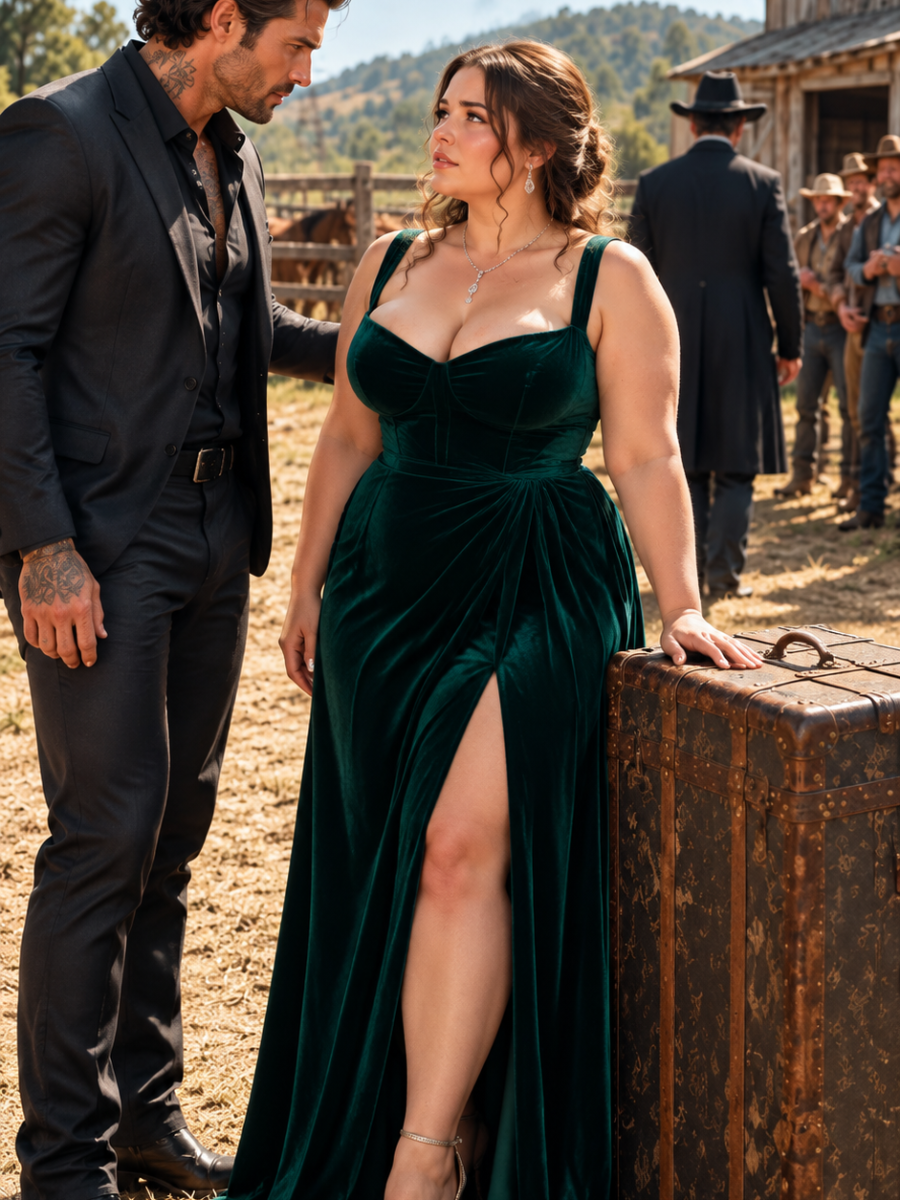
The bitter autumn wind sweeping down from the jagged peaks of the Montana Rockies carried the sharp scent of pine needles, crushed sage, and freezing dust. At twenty-six, I stood in the middle of the rocky wagon trail outside the towering cedar arches of Stone Creek Ranch, my bare knuckles whitening as I clutched the handles of my battered wooden traveling trunk. My worn wool traveling dress, patched at the elbows and caked with dust from a four-day train ride from Ohio, offered little defense against the high-plains chill.
Thirty mounted cowhands in sheepskin jackets and wide-brimmed hats were gathered in a semicircle inside the corral fence, leaning against their saddle horns. They were not smiling with neighborly warmth; their eyes carried the cruel, predatory amusement of men gathered to watch a stray dog kicked off the porch.
Standing on the elevated porch of the two-story stone ranch house was Bradley Stone. At thirty-five, Bradley was the undisputed golden boy of the Judith Basin, heir to twenty thousand deeded acres, eight thousand head of Hereford cattle, and the richest commercial timber rights in the territory. He was dressed in a tailored shearling coat, polished calfskin boots, and silver spurs that jingled with every arrogant step.
In his manicured hand, he held the creased, hand-written mail-order bride contract that had brought me fifteen hundred miles across the country.
Bradley didn’t walk down to greet me. He took a slow puff from an expensive Havana cigar, blew a thin plume of blue smoke into the freezing air, and let out a dry, contemptuous laugh that echoed across the dusty yard.
“Is this what Ohio considers prime stock?” Bradley asked, turning his head toward his chuckling foreman. “I advertised for a refined, delicate lady to manage my household and grace my dinner table. You sent me a rail-thin farmhand with calloused knuckles, dirt under her fingernails, and clothes that belong in a charity bin.”
Chapter 2: Thirty Laughing Men
A ripple of coarse, mocking laughter erupted from the thirty cowhands along the fence. A young wrangler spat tobacco juice into the dust two feet from my trunk, while another whistled through his teeth like he was appraising an unbroken mule.
My face burned with humiliation, but I refused to let my chin drop. For three generations, the Hartwell family had raised champion dairy cattle in the Ohio River Valley. My father had been a master animal breeder and botanical herbalist who taught me how to compound salves, set shattered bones, and read a herd’s health in the brightness of their eyes. When a predatory rail consortium had foreclosed on our family homestead following my parents’ death, I had swallowed my pride and answered Bradley Stone’s advertisement in the *Western Rural Gazette* to build an honest life with my own two hands.
I took two steady steps forward toward the heavy wrought-iron gate.
“Mr. Stone,” I spoke, my voice ringing clear, steady, and devoid of tremor despite the knot in my throat. “The correspondence clearly stated that I was an experienced livestock manager and herbalist. I did not travel fifteen hundred miles to be paraded like carnival livestock before your hands. We entered into a binding legal covenant.”
Bradley Stone stepped down off the porch, his spurs clinking rhythmically against the stone steps until he stood directly on the other side of the iron gate slats.
He looked down at me through the bars, his handsome features twisting into a sneer of pure, aristocratic disgust.
With deliberate, theatrical slowness, Bradley took our signed marriage contract, tore it in half, and let the white pieces flutter into the mud at his boots.
“Your contract is void, Miss Hartwell,” Bradley said, his voice dropping into a razor-sharp insult that silenced the laughing cowhands. “I wouldn’t let a plain, penniless creature like you scrub the mud off my boot scraper, let alone carry the Stone family name. Take your wooden box and walk the fourteen miles back to the rail depot in Lewistown. The freight train leaves at midnight, and nobody on this ranch will give you a glass of water.”
With a violent shove, Bradley slammed the massive iron gates shut. The heavy iron latch dropped with a deafening metallic clack that sounded like the closing of a prison cell.
Chapter 3: The Scarred Veteran
I stood completely alone on the frozen dirt road, surrounded by the swirling autumn dust and the distant, fading laughter of Bradley Stone’s men heading into the bunkhouse.
The wind bit through my thin woolen shawl, numbing my ears and fingers. The sun was already sinking behind the jagged purple wall of the Big Snowy Mountains, and fourteen miles of desolate Montana wagon trail lay between me and the depot, with mountain lions and wolves prowling the timber.
I knelt in the dirt, took a deep, shuddering breath, and prepared to hoist the heavy wooden trunk onto my shoulder.
“Leave the trunk where it sits, Miss Hartwell.”
The voice was low, deep, and gravelly, sounding like river stones grinding together beneath a heavy current.
I startled, spinning around on the frozen grass.
Sitting atop a massive, coal-black Percheron-cross gelding on the opposite side of the wagon trail was a man I had not noticed in the shadow of the yellow cottonwoods.
He sat six-foot-three in the saddle, with broad, powerful shoulders draped in a heavy, weather-beaten buckskin coat lined with sheep’s wool. A wide-brimmed black felt hat was pulled low against the wind, casting a shadow over a face that looked as if it had been carved from Montana granite. A jagged, pale saber scar ran from his right temple down to the corner of his square, stubbled jaw—a souvenir from his years as a cavalry scout during the northern plains campaigns.
Silas Vance.
Even in Ohio, cattlemen whispered the name of Blackwood Ranch and the silent, solitary veteran who owned it. Silas Vance was known throughout the basin as a reclusive, dangerous man who rarely came to town, spoke fewer than twenty words a month, and defended his borders with a Winchester rifle.
Silas dismounted with fluid, effortless power, his heavy leather chaps brushing against the saddle leather. He didn’t look at Stone Creek’s grand iron gates. He walked straight across the dirt road toward me, his slate-gray eyes calm, observant, and completely devoid of mockery.
Chapter 4: The Blackwood Offer
Silas stopped four feet from me. Without uttering a word of pity, he unbuttoned his heavy sheepskin-lined canvas riding vest and held it out to me. The heavy canvas was warm, smelling of cedar smoke, saddle oil, and fresh pine.
“Put it on,” Silas commanded softly. “The freeze hits this basin thirty minutes after the sun drops behind the ridge. You’ll lose your fingers before you walk three miles.”
I hesitated, looking at the massive garment, then into his weathered face. There was no arrogance in his eyes. No leering condescension. Only the quiet, unvarnished decency of a man who understood hardship.
I slipped the vest over my shoulders. The radiating warmth enveloped my shivering body instantly, cutting through the bitter chill.
Silas reached down with one gloved hand, lifted my fifty-pound wooden traveling trunk by its hemp rope handle as if it weighed nothing, and secured it effortlessly behind the cantle of his black gelding with two leather saddle ties.
“I witnessed Bradley Stone’s display,” Silas said, his voice flat as an iron skillet. “A man who treats a woman like a discarded dog in front of his hands is a coward with silver in his pocket. My ranch, Blackwood, sits four miles up the timber creek. My kitchen is cold, my bunkhouse is quiet, and my herd is dying of a sickness the local horse doctors can’t name.”
He looked down into my eyes, his gray gaze piercing directly into my soul.
“I cannot offer you a bridal suite or silk dresses, Miss Hartwell,” Silas continued honestly. “Blackwood is on the brink of foreclosure by the First Territorial Bank of Helena. But I can offer you a warm stove, a locked bedroom with a real bed, and forty dollars a month in silver if you can keep my men fed and help me fight whatever is killing my cattle.”
Tears of pure, overwhelming relief welled up in my eyes, but I wiped them away with the back of my hand.
“I can cook, Mr. Vance,” I told him, looking squarely into his scarred face. “And back in Ohio, my father never lost an animal to sickness. Take me to Blackwood.”
Chapter 5: The Dying Herd
Blackwood Ranch sat nestled in a rugged, timber-covered valley where the cold waters of Blackwood Creek tumbled out of the limestone cliffs. Unlike the ostentatious white-painted fences and stone mansions of Stone Creek, Blackwood was built of hand-hewn lodgepole pine logs, rugged, functional, and weathered by forty Montana winters.
When we rode into the yard at dusk, the atmosphere was thick with gloom.
Inside the large pole barn beneath the timber ridge, eight wranglers were gathered around three kerosene lanterns, their faces grim, hollow, and exhausted. Lying in the straw pens were twelve massive Black Angus breeding cows, their breath coming in raspy, bubbling wheezes, white foam crusted around their muzzles, their eyes dull with fever.
“It’s the lung-rot, Boss,” an elderly Scottish cowhand named Angus muttered, shaking his head as he held a bucket of carbolic wash. “Three died before noon. The fever takes them in seventy-two hours. Doc Holliday from town says the only cure is a bullet to the skull and burning the carcasses in a lime pit. If we lose the breeding stock, the bank takes the deed on the first of December.”
Silas stood in the barn doorway, his jaw clenched, his broad shoulders carrying the crushing weight of an impending catastrophe.
I stepped forward into the barn, discarding my bonnet and rolling up the sleeves of my wool dress.
“Bring that lantern closer, Angus,” I commanded, my voice carrying the crisp, authoritative clarity of my father’s veterinary clinic.
The wranglers looked up in surprise at the sight of a woman in a mud-splattered dress stepping into the pen. Silas held up a single hand, signaling his men to stand down and let me work.
I knelt down in the clean straw beside a groaning black cow. I pressed my ear against her left ribcage, listening intently to the congested, rattling crackle in her lung tissue. I pried open her mouth, inspecting the pale, grayish lining of her gums, and took her temperature using a silver rectal thermometer from my father’s wooden medical kit.
“This is not lung-rot,” I announced, rising to my feet, wiping my hands on a clean towel. “This is high-altitude timber pneumonitis caused by inhaling mold spores from damp cedar hay, compounded by a secondary bacterial bronchial infection. If you shoot these cattle, you are burning your own fortune for nothing.”
Chapter 6: The Ohio Remedy
Angus scoffed, scratching his beard. “With all respect, Miss, no horse doctor in the Montana territory has ever cured an animal once the foam starts bubbling at the snout.”
“That’s because your horse doctors treat symptoms with carbolic acid instead of clearing the pulmonary tissue,” I replied sharply, opening my father’s heavy wooden trunk on the barn workbench.
Inside were glass jars of dried medicinal herbs, brass mortar and pestles, pure sulfur powder, and bound leather notebooks filled with fifty years of livestock formulas written in my father’s precise copperplate script.
“Silas,” I said, looking directly at the rancher. “I need six men on horseback immediately. Ride into the south limestone gullies where the wild mountain yarrow and sweet horehound grow in the rocky crevices. Strip the fresh green needles from young ponderosa pines. Bring me two burlap sacks of both before midnight.”
Silas didn’t hesitate for a second. “You heard her,” Silas barked at his men. “Angus, take the north ridge. Miller, take the creek. Move!”
For the next seventy-two hours, the kitchen of Blackwood Ranch was transformed into an apothecary laboratory. Massive iron cauldrons boiled on the woodstove, filling the house with the pungent, medicinal vapor of pine oil, crushed yarrow root, wild horehound, and sulfur.
Working alongside Silas around the clock without sleep, we compounded a concentrated herbal pulmonary tincture mixed with warm blackstrap molasses. Using copper drenching horns, we administered the warm mixture down the throats of sixty infected cattle every four hours, followed by steam inhalations of pine oil in the enclosed stalls.
On the third morning, as the cold autumn sun broke over the timber ridge, Angus dropped his pitchfork in the straw and let out a wild, whooping cheer that rattled the barn rafters.
The lead breeding cow, which had been unable to lift her head for three days, stood up on all four legs, shook her glossy black hide, and buried her muzzle hungrily into a trough of fresh wild meadow grass.
Her breathing was clear, smooth, and unobstructed.
Within five days, every single one of Silas’s sixty prize Black Angus cattle had made a complete, miraculous recovery. Not a single animal had been lost.
Chapter 7: The Great Falls Auction
Word of the miracle at Blackwood Ranch spread through the Judith Basin like a prairie fire on a dry August wind. But while Blackwood flourished, disaster struck across the creek at Stone Creek Ranch.
Bradley Stone, arrogant and dismissive of proper veterinary protocols, had purchased three carloads of cheap, diseased feeder steers from an unregulated stockyard in Omaha. Within ten days, the virulent pulmonary blight swept through Stone Creek’s eight thousand head of Herefords like the Black Plague. Bradley’s fancy town doctors had no cure. Over eight hundred cattle died in two weeks, their rotting carcasses burning in massive trenches that cast black, greasy smoke across the valley.
Meanwhile, at Blackwood, our herd thrived. Under my nutritional regimens and rotational pasture management, Silas’s Black Angus cattle gained weight at twice the normal rate, developing thick, glossy winter coats and robust constitutions that withstood the early blizzards.
In late October, Silas and I loaded forty head of two-year-old Black Angus breeding bulls onto cattle cars at the Lewistown railhead, heading for the annual Great Falls Livestock Exposition—the premier cattle auction in the Pacific Northwest.
Bradley Stone was there, pacing the sawdust arena in a stained coat, reeking of whiskey, desperately trying to sell his emaciated, coughing Herefords to salvage his mounting bank loans.
When Blackwood’s lot entered the auction ring, an electric hush fell over the three hundred assembled buyers from Chicago, Omaha, and Seattle.
The massive black bulls strode across the sawdust like armored tanks, their hides gleaming like polished obsidian, their broad chests deep and clear-winded.
“Lot forty-two!” the auctioneer’s gavel cracked like thunder. “Forty registered Black Angus bulls from the Blackwood Ranch of Judith Basin! Certified disease-free, bred by Master Herbalist Evelyn Hartwell!”
The bidding exploded into a frenzy. Bids climbed from fifty dollars a head to eighty, then one hundred, finally shattering territorial records at one hundred and sixty-five dollars a head, purchased entirely by the Great Northern Cattle Syndicate.
When the final gavel fell, Blackwood Ranch had netted over twenty-six thousand dollars in pure gold coin—enough to retire every cent of debt held by the bank in Helena and secure an operating reserve for five years.
Chapter 8: The Broken Suitor
Bradley Stone stood in the shadow of the auction arena bleachers, clutching a glass of cheap rye whiskey, his face pale and haggard. He watched the Great Northern representatives shake Silas Vance’s hand, presenting him with a certified cashier’s check from the Bank of Montreal.
And then Bradley’s bloodshot eyes locked onto me.
I was wearing a tailored dark-emerald riding habit of fine wool, my hair arranged in elegant chestnut coils beneath a wide-brimmed felt hat, wearing leather gloves and pearl earrings Silas had purchased for me in Helena. The plain, impoverished girl he had laughed at in the dirt had been transformed into the most celebrated agricultural pioneer in Montana.
Bradley shoved his way through the crowd, stumbling slightly as he approached us.
“Evelyn…?” Bradley gasped, his voice cracking with desperate, humiliated longing. “My God… it’s really you. You look… magnificent.”
Silas stepped forward, his massive six-foot-three frame casting a shadow over Bradley, his hand resting casually near his heavy leather belt. “Step back, Stone.”
Bradley ignored Silas, lunging forward with his hands outstretched toward me. “Evelyn, listen to me! I made a terrible mistake! I was under immense pressure from the bank! The men were watching—I had to maintain discipline! You belong at Stone Creek! I’ll marry you tomorrow! I’ll give you half the ranch! We can combine Stone Creek and Blackwood into the biggest livestock empire in the territory!”
I looked down at Bradley Stone. The handsome arrogance that had once terrified me was gone, replaced by the pathetic, sniveling desperation of a ruined gambler begging for table scraps.
“Mr. Stone,” I said, my voice as calm, cool, and clear as the mountain water flowing through Blackwood Creek. “Two months ago, you crumpled our covenant into the mud. You told me I wasn’t fit to scrub your boot scraper. You told thirty laughing cowhands that I was a plain, penniless stray who should walk fourteen miles in the dark.”
I reached out, gently taking Silas Vance’s large, calloused, scarred hand and lacing my fingers through his.
On my ring finger, a brilliant two-carat raw Montana sapphire set in solid gold gleamed under the arena lanterns.
“Three weeks ago,” I continued, smiling up into Silas’s proud gray eyes, “Silas and I were married in the stone chapel in Lewistown. I am Evelyn Vance. I am the co-owner and master manager of Blackwood Ranch. And I wouldn’t trade one inch of my husband’s dirt for every blade of grass on Stone Creek.”
Chapter 9: The Sovereign of the Valley
Bradley Stone staggered backward as if he had been struck between the eyes with a cattle maul. He looked between my sapphire ring, Silas’s unyielding gaze, and the cheering buyers surrounding us, and let out a dry, choked sob before turning on his heel and vanishing into the cold autumn rain.
Two weeks later, the final hammer fell on the Stone dynasty.
Unable to pay his four-hundred-thousand-dollar mortgage after losing two-thirds of his herd to disease, the First Territorial Bank of Helena placed Stone Creek Ranch on the public auction block on the courthouse steps in Lewistown.
Silas and I stood on the crowded wooden boardwalk as the county sheriff read the foreclosure notice.
When the bidding opened, Silas stepped forward, raised his leather glove, and bid eighty thousand dollars in gold coin—purchasing the entire twenty-thousand-acre Stone Creek estate, the water rights, the timber reserves, and the historic mansion for twenty cents on the dollar.
Bradley Stone, stripped of his lands, his cattle, and his family name, watched from the back of an open buckboard wagon as his personal trunks were loaded to take him out of Montana forever.
That evening, Silas and I rode our horses to the high ridge overlooking the combined valley. Below us stretched thirty-five thousand contiguous acres of lush green mountain pastures, watered by crystal mountain streams, where thousands of healthy, black cattle grazed peacefully beneath the snow-capped peaks.
Silas brought his black gelding alongside my mare. He leaned across the saddle, took my chin gently in his gloved fingers, and kissed me with a deep, passionate warmth that made the crisp mountain air melt away.
“You brought life back to this valley, Evelyn,” Silas whispered into the twilight breeze, his eyes shining with profound love. “You took a broken soldier and a dying ranch, and turned them into a kingdom.”
I smiled, resting my head against his broad shoulder as the first stars appeared above the Rockies.
I had traveled fifteen hundred miles to be rejected at an iron gate, only to find the truest, strongest love under the wide-open Montana sky. And in Silas Vance’s arms, I had finally built an empire that would stand for generations.