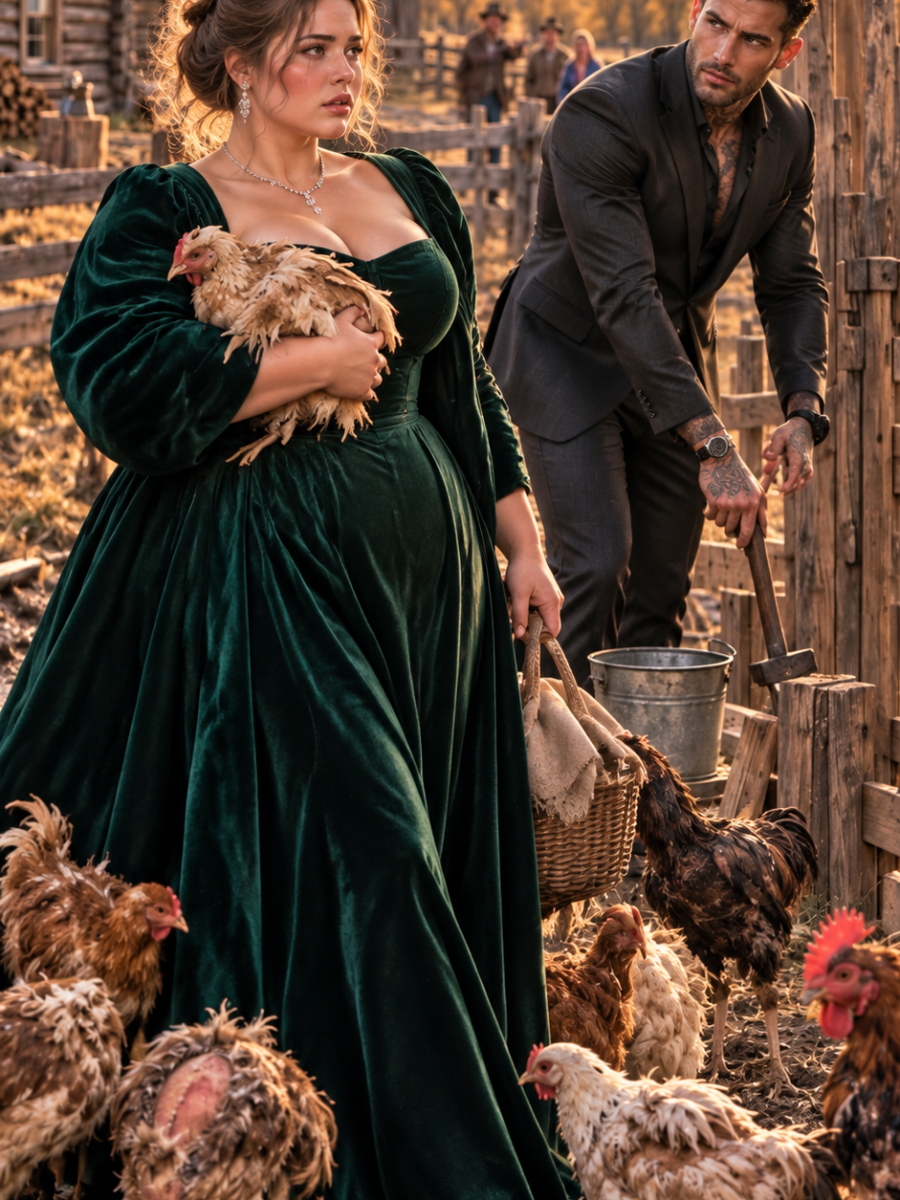
Mocked by a shallow Wyoming frontier town for her large frame and ridiculed when she spent her last twelve cents on eleven mangled, dying chickens, resilient homesteader Hannah Thornton and her scarred veteran husband nursed the birds back to health—only to discover they were rare winter layers that saved the county during a catastrophic blizzard and turned their twelve cents into a farming dynasty.
Table of Contents
- Chapter 1: The Twelve-Cent Gamble
- Chapter 2: The Laughter of Milhaven
- Chapter 3: The Sanctuary in the Lean-to
- Chapter 4: The Secret of the Black Feathers
- Chapter 5: The Winter of the White Death
- Chapter 6: The Line at the Pole Gate
- Chapter 7: The Currency of Grace
- Chapter 8: The Golden Flock
- Chapter 9: The Legacy of Clearwater Creek
Chapter 1: The Twelve-Cent Gamble
By the autumn of 1878, Hannah Thornton had learned that being poor and being an unapologetically large woman on the Wyoming frontier gave strangers twice as many reasons to underestimate you.
She was thirty-one years old, unmistakably heavy-set, with a broad round abdomen, thick forearms, wide hips, and powerful legs forged by twelve years of hauling cedar water pails, clearing glacial boulders, and splitting cordwood beside her husband. The respectable ladies of Milhaven whispered behind their church fans about how much flour a woman her size must consume before breakfast. The men outside the livery stable joked that Caleb Thornton would need to brace his wagon tongue with railroad iron if he wanted to drive his wife into town.
Hannah had stopped answering them years ago. Cruelty in small towns was like alkali dust; if you tried to fight every speck, you’d choke to death before sundown.
She stood outside old Harkin’s feed barn at the edge of Milhaven, clutching a cracked leather coin purse that held exactly twelve copper cents—every penny she and Caleb possessed in the world.
Beside the manure pile sat a splintered wooden crate containing the sorriest collection of livestock in the Wyoming Territory.
Eleven chickens.
They were a sight to break a farmer’s heart. Most were missing half their feathers from mites and damp rot. Two scrawny roosters had crooked, frost-blackened beaks and twisted legs. Three hens had lost their combs to gangrene, and one pale gray hen sat huddled in the corner, her left wing dragging in the muck, shattered by a dog bite.
Old Harkin spat a stream of brown tobacco juice into the dirt, wiping his mouth with a greasy sleeve.
“Want ’em drowned before the frost hits tonight,” Harkin grunted, gesturing with his boot at the crate. “Ain’t worth the corn it takes to keep ’em breathing. If you want the whole wretched lot, give me twelve cents for the crate and get ’em off my dirt.”
Hannah looked down into the crate.
Through the filth and missing feathers, the gray hen with the broken wing tilted her head. Her dark bead of an eye met Hannah’s with an indomitable spark of life—a small, desperate soul refusing to give up simply because it was battered and discarded.
Hannah opened her coin purse. She tipped all twelve copper cents into Harkin’s filthy palm.
“Done,” Hannah said.
Chapter 2: The Laughter of Milhaven
The three-mile walk from Milhaven north to Clearwater Creek was an ordeal of public mockery.
Hannah carried the splintered crate in both arms, her broad back straight, her heavy wool skirts sweeping through the dry sagebrush. The eleven miserable chickens clucked in raspy, terrified tones, their featherless necks bobbing through the slats.
Near the town pump, Delbert Marsh, the town’s wealthiest cattle trader, hauled back on the reins of his matched bay team. Several loiterers leaning against the mercantile railing turned to watch.
“Hey there, Mrs. Thornton!” Marsh hollered, his voice dripping with condescension. “Looks to me like you bought the ugliest Sunday dinner in the whole territory! Are you gonna eat ’em feathers and all, or use ’em to pad your wagon seat?”
A chorus of coarse braying laughter erupted along the boardwalk.
“Twelve cents for soup bones!” another man jeered. “Caleb must be starving if he lets his wife buy turkey vultures!”
Hannah did not stop. She did not lower her chin. She shifted the crate slightly higher against her ample bosom, looked Delbert Marsh squarely in the eye with a calm, unblinking stare that made his grin falter, and kept walking.
Red dust rose behind her worn boots as she left the town behind.
Her homestead sat nestled in a shallow, wind-carved swale north of Clearwater Creek. It consisted of a hand-hewn spruce cabin, a small pole barn, and eighty acres of rocky, stubborn soil that yielded oats only through sheer sweat.
Her husband, Caleb Thornton, stood by the woodpile. He was thirty-four, broad-shouldered and quiet, wearing an old Union army overcoat. Two fingers were missing from his left hand—the price he had paid at Chickamauga fourteen years earlier.
Caleb watched his wife trudge through the pole gate, her face glistening with perspiration, carrying the crate of dilapidated fowl.
He set down his splitting maul and walked over.
He peered between the slats at the eleven battered, trembling birds.
“Twelve cents?” Caleb asked, his tone level, carrying no reproach.
“Every copper we had,” Hannah confessed, bracing herself. She loved Caleb with every fiber of her soul, but they had eaten boiled turnip greens for four straight days.
“The coop roof isn’t shingled,” Caleb noted, wiping his brow with his sleeve.
“I know.”
“An arctic front is blowing down from the Big Horns tonight. It’ll be ten below by midnight.”
“I know that too.”
Hannah waited for the sigh of disappointment, the slump of defeated shoulders.
Instead, Caleb looked from the chickens up to her flushed, beautiful face. A faint, gentle smile touched his weathered lips beneath his brown beard.
“Then we’d better get the hammer and some dry cedar shakes,” Caleb said. “Because those birds won’t survive the night in the wind.”
Chapter 3: The Sanctuary in the Lean-to
For the next five hours, the Thornton homestead became a hospital of straw and pine pitch.
While Caleb patched the cedar shingles on the small lean-to coop and banked the exterior walls with two feet of dry prairie sod to block the drafts, Hannah worked inside by the glow of the kitchen hearth.
She set up an old tin wash tub lined with clean straw and heated bricks wrapped in flannel. One by one, she bathed the eleven birds in warm water infused with steeped wild wormwood, sulfur, and pine oil, thoroughly washing away the lice and mites that had nearly eaten the creatures alive.
The little gray hen with the shattered wing was the worst. The bone was splintered near the joint, infected with yellow matter.
Hannah cleaned the wound with carbolic wash. Using two flat cedar splints and soft strips of clean linen, she set the broken bone and bound the wing securely against the hen’s side.
“There now, little lady,” Hannah murmured, stroking the bird’s ruffled crest. “You’ve got a roof over your head now. Nobody’s putting you in a soup pot.”
Caleb came in carrying an iron pot of warm cornmeal mush mixed with crushed dried sunflower seeds, bone meal, and tallow. He watched Hannah gently spoon small bites into the crooked beaks of the two roosters, who were too weak to peck from the floor.
“You have a soft heart for broken things, Hannah,” Caleb said softly, sitting on the bench beside her.
“I know what it’s like to be looked at like you don’t belong in the world,” Hannah replied, her fingers lightly brushing the hen’s feathers. “God didn’t make anything useless, Caleb. People just get too impatient to see the good in what’s battered.”
Near midnight, the arctic gale hit the swale with a shriek like a banshee.
Sleet rattled against the cedar shakes like handfuls of buckshot. But inside the sod-banked coop, beneath the warm glow of a protected kerosene lantern, eleven clean, fed chickens nestled together in deep, fragrant prairie grass.
Caleb stood by the window, watching the snow swirl across the corral.
“What happens if they live, Hannah?” he asked.
Hannah smiled, her hazel eyes reflecting the embers of the hearth.
“I don’t know, Caleb. But I’d dearly love to find out.”
Chapter 4: The Secret of the Black Feathers
Under Hannah’s relentless care, a miracle unfolded inside the little sod coop.
Within three weeks, the mites were entirely eradicated. New feather quills pushed through the scabby skin, unfurling not into ordinary barnyard brown or mottled white, but into dense, shimmering black plumage that gleamed with emerald and violet iridescence in the winter sun.
Their feet grew strong and clean. Their combs healed into proud, rose-shaped crowns.
It was on a bitter morning in mid-December that Hannah noticed something extraordinary about their anatomy.
She was examining the gray hen, whose wing had healed so cleanly she could flap it without pain. Hannah noticed the bird possessed five distinct toes on each foot instead of four, and their skin was covered in a dense undercoat of down as thick and soft as mountain beaver fur.
“Caleb, come look at this,” Hannah called out.
Caleb knelt beside her in the coop. He had spent his boyhood on an estate in Virginia where wealthy gentlemen imported blooded livestock from Europe.
He picked up the larger rooster, feeling the heavy, broad breastbone and inspecting the five-toed feet and rose comb.
His eyes widened in sheer astonishment.
“Hannah…” Caleb breathed, his voice hushed. “These aren’t scrub barnyard chickens Harkin brought from Missouri. These are French Houdans and English Dorkings.”
“What does that mean?”
“It means someone imported prize heritage stock on the transcontinental railroad,” Caleb said, looking at the vibrant, lustrous birds in awe. “They must have been on a freight wagon that broke down or got sick on the trail, and Harkin bought the dying survivors for pennies without having the faintest idea what he had.”
“Are they good for eggs?” Hannah asked.
“Good?” Caleb laughed, shaking his head. “Houdans and Dorkings were bred in the cold hills of Normandy. They have double-down insulation. When ordinary chickens shut down and stop laying the minute the temperature drops below freezing, these birds thrive in zero degrees. They are the greatest winter layers in the civilized world.”
Two mornings later, Hannah walked into the coop with a basket of warm oats.
In the cedar nesting boxes, lined with dried clover, lay seven immense, gleaming brown eggs—warm, perfect, and heavy as porcelain stones.
Chapter 5: The Winter of the White Death
January 1879 descended upon the Wyoming Territory like an iron fist.
The cattlemen called it the Great Freeze. For six unbroken weeks, the temperature never rose above fifteen degrees below zero. Three blizzards struck in succession, burying roads under six-foot drifts and freezing the Union Pacific railroad lines between Cheyenne and Salt Lake City.
In Milhaven, disaster struck with brutal speed.
Freight wagons could not reach the town. The mercantile’s supply of flour, salt pork, and dried beans ran dangerously low. Worse, every ordinary chicken in the county had ceased laying weeks ago, their combs frozen black, huddled miserably in drafty barns.
Fresh protein vanished from the town. Pregnant women and young children grew weak and sickly on a monotonous diet of boiled cornmeal and rancid lard. Eggs became a myth, spoken of like gold dust.
Delbert Marsh’s cattle were dying by the dozens along the frozen coulees, and the general store was rationing potatoes at ten cents a pound.
Meanwhile, on the Thornton homestead, life was singing.
Hannah’s sod-banked coop remained snug at forty degrees, warmed by Caleb’s ingenious clay flue that routed waste heat from the cabin chimney through the coop floor. The nine hens, now plump, radiant, and covered in dense, velvet-thick black plumage, were laying thirty-five large, nutrient-rich eggs every single week without interruption.
Hannah did not keep the miracle to herself.
She took twelve fresh eggs, two loaves of her sourdough bread, and a crock of butter, wrapped them in wool, and had Caleb drive the sleigh two miles to the cabin of young Mrs. Miller, whose six-month-old infant was failing from lack of milk.
When Mrs. Miller opened the door and saw the basket of fresh, golden-yolked eggs, she burst into weeping on Hannah’s shoulder.
“Where did you get these, Mrs. Thornton?” Mrs. Miller sobbed, clutching the basket. “No one in the county has seen an egg since Thanksgiving!”
“God provided them, Mrs. Miller,” Hannah said gently, patting the young mother’s hand with her broad, warm palm. “Feed your baby. There will be more next week.”
Chapter 6: The Line at the Pole Gate
Word spread through the frozen valley faster than prairie fire.
Within forty-eight hours, the rumors reached Milhaven. Folks said that the Thornton homestead north of the creek had fresh eggs—real eggs, with shells so thick they didn’t crack in the cold and yolks the color of polished brass.
On Thursday morning, Hannah stepped onto her front porch to shake out a rag rug and stopped in astonishment.
Lined up along the pole fence outside their gate were seven wagons and four mounted riders.
Men who had laughed at her on the boardwalk stood in the sub-zero wind, stamping their boots in the snow, clutching empty baskets and cloth sacks.
Delbert Marsh’s black cutter sleigh sat at the front of the line. Marsh climbed down, his sheepskin coat buttoned tight, his face pale and humbled by hunger and necessity.
He walked up the shoveled pathway to the porch, his hat in his hands.
“Morning, Mrs. Thornton,” Marsh said, his voice stripped of every trace of his former swagger.
“Mr. Marsh,” Hannah replied calmly, holding her broom. “What brings you out to Clearwater in this weather?”
Marsh swallowed hard, his eyes darting toward the sod coop where the cheerful cackle of laying hens drifted through the chimney smoke.
“My wife is bedridden with the grippe, Mrs. Thornton,” Marsh said, looking down at his boots. “The doctor in town says if she doesn’t get fresh broth and eggs into her stomach, she won’t make it to March. I… I came to buy whatever eggs you can spare. I’ll pay fifty cents an egg. A dollar an egg. Whatever you ask.”
Fifty cents an egg was an astronomical fortune. In 1879, a dollar could buy an entire sack of flour.
Hannah looked at Delbert Marsh. She remembered the day outside the general store when he had pointed at her from his wagon and told the town she had bought the ugliest dinner in Wyoming. She remembered the cruel bray of laughter that had followed her up the red road.
She had the power to turn him away. She had the power to make him crawl in the snow.
Caleb stepped out onto the porch, his rifle in the crook of his arm, watching his wife with quiet respect, leaving the decision entirely in her hands.
Chapter 7: The Currency of Grace
Hannah looked at the line of wagons stretching down the snowy road.
She saw the liveryman who had smirked; she saw the storekeeper who had doubled the price of her lard; she saw neighbors who had crossed to the other side of the street rather than speak to an impoverished, heavy woman.
Yet behind them she also saw frightened fathers, weary husbands, and families desperate to keep their loved ones alive through the worst winter in living memory.
Hannah leaned her broom against the log wall.
“An egg is worth two cents, Mr. Marsh,” Hannah said, her voice clear and carrying across the crisp morning air. “That is what an honest egg has always cost, and that is what it will cost on this homestead.”
Marsh stared at her in utter disbelief. “Two cents? But Mrs. Thornton, I offered you a dollar—”
“I don’t traffic in misery, Mr. Marsh,” Hannah said firmly. “Every family gets six eggs. No more, no less, until everyone in line has a share. If you have two cents, you pay it. If you don’t have coins, you can bring Caleb two split cedar posts when the spring thaw comes.”
A stunned silence fell over the men standing in the snow.
One by one, the farmers and cowhands stepped forward, removing their hats as they approached the porch. They did not look at Hannah’s waistline. They did not joke about her weight. They looked upon her with a profound, reverent awe—as though they were standing before an angel who had chosen to walk among them in a patched calico dress.
Hannah brought out her wooden trays, distributing sixty-two fresh eggs to eleven families.
When Delbert Marsh took his carefully wrapped parcel of six eggs, his eyes were wet with tears.
“Mrs. Thornton,” Marsh choked out, his voice thick with shame. “I said things in town… things I had no right to say. I made fun of your purchase, and I made fun of you. I was a fool.”
Hannah looked down at the wealthy cattleman with a warm, untroubled smile.
“God gave me broad shoulders so I could carry what needs carrying, Mr. Marsh,” Hannah said softly. “Now get home to your wife and make sure she drinks that broth warm.”
Marsh bowed his head, turned to his sleigh, and drove away with the reverence of a man who had been spared by grace.
Chapter 8: The Golden Flock
When the spring of 1879 finally broke the back of the Great Freeze, the Thornton homestead had become the agricultural wonder of the Wyoming Territory.
Hannah did not sell her hens for meat. She used Caleb’s carpentry skills to construct four massive incubators heated by regulated kerosene lamps, hatching every single fertilized egg produced by the two heritage roosters.
By June, the swale north of Clearwater Creek was alive with over three hundred purebred Houdan and Dorking chicks, their iridescent black plumage flashing like polished obsidian in the summer sun.
Breeders from Denver, Omaha, and Salt Lake City arrived by passenger coach, having read notices in the agricultural journals about the extraordinary winter-laying flock that had survived forty-below blizzards without losing a single bird.
They offered staggering sums for breeding pairs.
A single rooster and two pullets commanded twenty-five dollars gold—over two hundred times what Hannah had paid for the entire original flock of eleven crippled birds.
Old Harkin, who had taken her twelve cents the previous autumn, stood outside the Milhaven saloon watching freight wagons loaded with Thornton shipping crates head for the railroad depot.
“Twelve cents,” Harkin muttered to the saloon keeper, shaking his gray head in bewildered defeat. “She took eleven dying birds from my manure pile and made herself the richest woman in the county.”
“She didn’t just buy birds, Harkin,” the saloon keeper replied, wiping a beer glass. “She had the patience to heal what you were too lazy to understand.”
By August, Caleb and Hannah had cleared the mortgage on their eighty acres, purchased three hundred additional acres of prime river bottomland, and built a magnificent two-story timber home with large windows that overlooked the glistening waters of Clearwater Creek.
Yet despite their newfound wealth, nothing about Hannah changed.
She still wore her sturdy aprons. She still baked bread for young mothers in the hollow. And every morning at first light, she walked out to the green pastures to scatter grain with her own hands.
Chapter 9: The Legacy of Clearwater Creek
On a warm evening in October 1879, exactly one year after the twelve-cent purchase, Caleb and Hannah sat together on the front porch of their new homestead.
The valley was bathed in the warm, amber glow of the setting autumn sun. Below the porch, hundreds of sleek black hens clucked softly as they settled into the modern, insulated coops Caleb had built along the willow grove.
Caleb reached over, his rough hand—missing two fingers—closing tenderly over Hannah’s warm, calloused fingers.
In his other hand, he held a small, polished pine box lined with velvet.
“What is that, Caleb?” Hannah asked, smiling.
Caleb opened the lid.
Resting upon the velvet were twelve polished copper pennies—the exact amount she had spent at Harkin’s feed barn one year ago.
“I went to Harkin’s place this morning,” Caleb said, his deep voice rich with emotion. “I bought back every coin you gave him. I wanted them kept where our children and grandchildren can see them.”
Hannah looked at the twelve humble coins, then up into her husband’s eyes.
“Why, Caleb?”
Caleb leaned close, his arm wrapping around her waist, pulling her solid, beautiful frame flush against his side.
“Because these twelve cents proved what I knew the day I married you, Hannah,” Caleb whispered, his lips brushing her temple. “That the world looks at what is broken, what is heavy, what is discarded, and calls it worthless. But a woman with faith, love, and courage can take what everyone else throws away and turn it into a kingdom.”
Hannah rested her head on his shoulder, letting out a deep, contented sigh as the evening breeze rustled the cottonwood leaves.
Down by the gate, the old gray hen—her healed wing tucked neatly against her glossy side—pecked contentedly at the rich clover, completely unaware that she had changed the history of an entire county.
And across the Wyoming prairie, where a town had once laughed, only gratitude and honor remained for the woman who had taught them all the true worth of a soul.