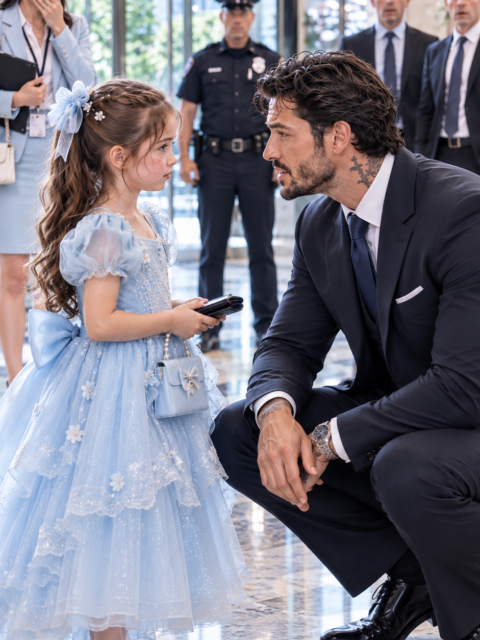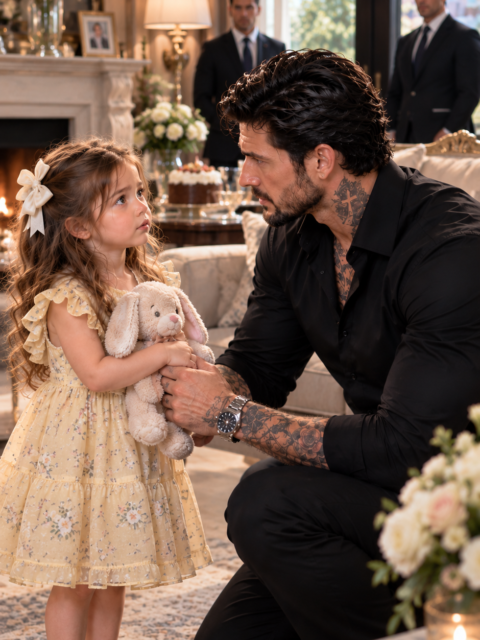
Anna Reyes had worked in Gabriel Caruso’s household for eleven months, careful never to let anyone notice her too closely. Then her five-year-old daughter wandered into a ballroom full of silk and diamonds, and Gabriel challenged the girl to dance for a home. Nobody expected a thin silver medal to slip loose from her collar mid-waltz — a medal Gabriel recognized instantly as his younger brother’s, lost the night Matteo Caruso died in a construction accident five years earlier. Across the ballroom, another powerful man stopped smiling the moment he saw it too, because Matteo hadn’t died by accident at all. Read every chapter to find out who killed Matteo Caruso, and why.
The Waltz
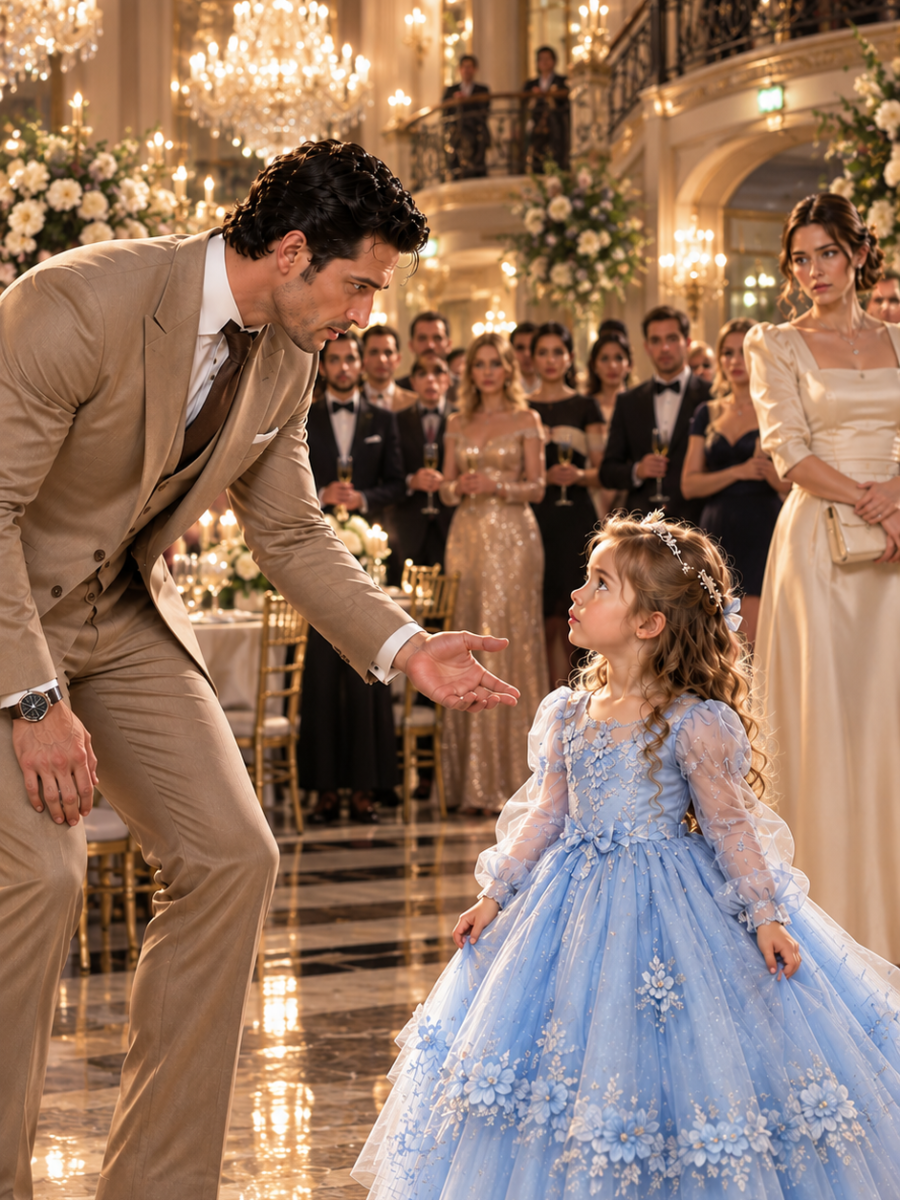
“If you can dance this waltz, I’ll adopt you.”
Gabriel Caruso’s voice cut through the ballroom so cleanly that even the laughter seemed to die mid-breath. My five-year-old daughter stood alone beneath the crystal chandeliers, wearing a secondhand blue dress and shoes scratched across the toes.
Outside, November rain streaked the towering windows of the Caruso estate, turning the Hudson Valley gardens black and shining. Inside, fifty wealthy guests stared at Lucy as if she had suddenly become the evening’s entertainment. The quartet kept playing.
Lucy looked at the women sweeping across the floor in silk, diamonds, and heels worth more than three months of my rent. “I’m little,” she whispered. “I don’t know how to dance like them.”
Nobody laughed.
“They have pretty dresses.” Then she looked toward the half-open service door where I stood clutching folded linens. “They look like they belong here.” Her shoulders folded inward. “I’m just waiting for Mama.”
“Lucy.” My voice cracked. I abandoned the linens and hurried toward her, painfully aware of every eye following me.
Gabriel Caruso never moved. At forty-one, he was six-foot-three, black-haired, broad-shouldered, and dressed in a tuxedo that needed no label to advertise its price. Newspapers called him chairman of Caruso Holdings, an empire built on construction, freight, hotels, event venues, and commercial real estate. Prosecutors, over the years, had used other words for parts of the Caruso family business.
I had worked in Gabriel’s household for eleven months. Long enough to see governors shake his hand and fearless men lower their voices when he entered a room. Long enough to know he was dangerous. And complicated.
“Mr. Caruso,” I said quietly. “She shouldn’t be in the ballroom.”
He ignored me. His eyes stayed on Lucy. “You think the dress is what makes them belong?”
Lucy studied him seriously. “Yes.”
A nervous ripple passed through the guests. Gabriel glanced around at the silk, the diamonds, the old families and new money crowding his ballroom, then back at my daughter.
“You don’t need their dress.”
Lucy looked toward the musicians. “What do I need?”
“To hear the music.”
My stomach tightened. Ten minutes earlier, Lucy had wandered to the edge of the service entrance while I worked. She hadn’t danced. Not really. She had only lifted one heel — a tiny movement, almost nothing. But Gabriel had seen it.
Now Lucy slowly stepped onto the polished floor. And as she moved, something slipped loose from beneath the neckline of her repaired blue dress.
A thin silver chain. A medal.
Gabriel’s face changed instantly, the easy challenge in his expression collapsing into something I had never seen on him in eleven months of watching him command every room he entered.
Across the ballroom, another powerful man stopped smiling. Because he recognized it too.
And suddenly I understood, watching both men’s faces in that frozen, terrible moment, that whatever happened next had nothing to do with a waltz at all.
Matteo’s Medal
Gabriel crossed the ballroom floor before the quartet had finished its measure, ignoring fifty pairs of eyes as he crouched in front of my daughter and reached, with a gentleness that startled me, for the thin silver medal resting against her collarbone.
“Where did you get this?” His voice had dropped into something low and unsteady, nothing like the commanding challenge he’d issued minutes earlier.
Lucy, entirely unbothered by the sudden shift in the room’s temperature, answered with the simple honesty only a five-year-old could manage under fifty watching adults. “Mama gave it to me. She said it belonged to someone brave who watches over me now.”
Gabriel’s eyes moved to me, and whatever composure I’d maintained for eleven months of careful invisibility finally, completely failed. “Anna,” he said, my name landing like an accusation. “Whose medal is this?”
I could feel the entire ballroom’s attention pressing against me, but it was the man across the room — silver-haired, expensively dressed, a face I recognized from the framed photographs in Gabriel’s study as his cousin Carlo, president of Caruso Holdings’ construction division — whose reaction frightened me most. He had gone perfectly still, his champagne glass forgotten halfway to his lips, his expression carrying something far colder than surprise.
“We should discuss this privately,” I said, my voice barely steady.
Gabriel stood, lifted Lucy into his arms with a careful tenderness that seemed to surprise even him, and turned to his gathered guests with the practiced ease of a man accustomed to managing a room regardless of what was happening inside him. “Forgive the interruption. Please, enjoy the evening — the kitchen has more of that excellent champagne.”
He led us both toward his private study, past Carlo, who fell into step a few feet behind without invitation, his expression carefully smoothed back into something unreadable.
Inside the study, Gabriel set Lucy down gently on the leather sofa and turned to me, the medal’s weight seeming to hang between us like something physical. “This belonged to my brother,” he said. “Matteo. He wore it every day of his life, a gift from our grandmother, Saint Michael, the protector. He was wearing it the night he died five years ago.” His voice cracked slightly on the word died. “The medal was never recovered from the accident site. I assumed it was lost in the wreckage, buried under concrete that took three days to clear.”
My hands had begun to shake. “It wasn’t lost,” I said quietly. “He gave it to me. Two days before he died.”
Gabriel’s expression shifted from grief into something sharper and far more dangerous. “Why,” he asked slowly, “would my brother give his grandmother’s medal to a household employee I’ve known for less than a year — unless you knew him considerably longer than eleven months, Anna, and considerably better than you’ve ever let on?”
What Anna Never Said
I had rehearsed this moment in my head a hundred times over five years, and every version had ended more gracefully than the shaking, tearful confession that actually came out of me in Gabriel’s study that night.
“I met Matteo six years ago,” I said. “I worked in the accounting department at Caruso Holdings then, before Lucy, before any of this. We fell in love slowly, carefully — he was worried about what it would mean, dating someone who worked three floors below him, and I understood why. We kept it quiet for almost a year.”
Gabriel’s face had gone the color of old parchment. “You were the woman he mentioned once, right before he died. He never told me a name.”
“He was protective of me,” I said. “More than I understood at the time. In his last few weeks, he became different — distracted, anxious, working late constantly, checking over his shoulder in ways that frightened me. When I asked him what was wrong, he told me he’d found something in the construction division’s numbers that didn’t add up. Discrepancies in material costs, invoices for supplies that never seemed to arrive at the sites they were billed to. He said he was planning to bring it to you directly, Gabriel, because he didn’t trust anyone else in the chain to handle it honestly.”
Carlo, still standing near the study door, shifted almost imperceptibly. I saw it. I don’t think Gabriel did, not yet, his attention entirely fixed on me.
“Two days before he died,” I continued, “he came to my apartment late at night, more frightened than I’d ever seen him. He gave me the medal and told me to keep it safe — that if anything happened to him, I should trust the medal to tell me who I could trust, because it had belonged to men in his family who’d protected the people they loved even when it cost them everything. I didn’t understand what he meant. I still don’t, fully. Two days later, the construction site collapse killed him instantly, according to the report. Accidental. A support beam failure during a routine inspection.”
“You never came to me,” Gabriel said, his voice raw. “Five years, Anna. You never once came to me.”
“I found out I was pregnant three weeks after he died,” I said, my own voice finally breaking completely. “And two days after that, someone left an envelope under my apartment door with no note inside — just five thousand dollars in cash, and a photograph of me leaving my building, taken from across the street. I understood the message perfectly. Someone wanted me gone, quietly, before I ever connected Matteo’s suspicions to his death out loud to anyone who mattered.”
Gabriel turned slowly toward Carlo, who had not moved from the doorway, his face now carrying an expression Anna would later describe as the exact moment a mask finally, completely failed to hold. “Carlo,” Gabriel said, each word deliberate and cold, “you’ve been unusually quiet for a man who used to talk for twenty minutes about how much he loved my brother.”
The Accident Report
Carlo’s composure, when it finally cracked, cracked in exactly the practiced, lawyerly way of a man who had spent five years preparing for a conversation he’d hoped would never come.
“Gabriel, I understand this is emotional,” he said carefully. “But you’re building an entire conspiracy out of an old accident report and a housekeeper’s decade-old romance with your brother. Construction sites are dangerous. Matteo’s death was a tragedy, but it was thoroughly investigated at the time by OSHA and our own internal safety team.”
“Our own internal safety team,” Gabriel repeated slowly, “which you ran, Carlo, as head of the construction division. The same division Matteo told Anna he suspected of financial irregularities two days before he died on one of your sites.”
“You can’t possibly be suggesting—”
“I’m not suggesting anything yet,” Gabriel said, his voice dropping into something I recognized, even after only eleven months in his household, as considerably more dangerous than shouting would have been. “I’m requesting the complete original accident file. Every inspection report, every safety log, every name of every worker present that day. Tonight.”
Carlo left the study with the too-careful calm of a man forcing himself not to run, and Gabriel turned back to Lucy, who had fallen asleep on the leather sofa sometime during the conversation’s more difficult stretches, entirely unaware that her existence had just detonated a five-year-old lie at the center of her family.
“She’s Matteo’s,” Gabriel said quietly, not quite a question.
“She’s Matteo’s,” I confirmed. “I named her Lucy after his mother. Your mother. I thought, if I could never tell any of you the truth, at least I could carry a piece of him forward in the one way that was actually mine to give her.”
Gabriel knelt beside the sofa, studying his sleeping niece’s face with an expression of such raw, complicated grief that I had to look away. “Five years,” he said. “Five years I’ve grieved my brother without knowing he left something behind worth grieving for properly. Five years you’ve raised his daughter alone, hiding from a threat I didn’t even know existed, working in my own household without ever telling me who you actually were to this family.”
“I was afraid,” I said simply. “Whoever sent that envelope knew exactly where I lived, exactly what I looked like leaving my own front door. I didn’t know if the threat came from inside Caruso Holdings or somewhere worse, and I didn’t know who inside your family I could trust enough to ask.”
Gabriel’s phone buzzed on the desk beside him — a text from his head of security, sent from the estate’s front gate, that made his entire expression change the moment he read it. “Carlo just left the property,” he said slowly, standing. “He didn’t go home. He’s heading toward the old Route 9 construction site — the exact location where my brother died five years ago — at eleven o’clock at night, in the middle of a storm.”
Cousin Carlo
Gabriel didn’t chase Carlo into the storm that night, choosing instead — with a discipline I found almost frightening, given the fury still visible beneath his controlled exterior — to let his head of security simply track the vehicle rather than confront a man who might do something desperate if cornered too quickly.
“If he’s going to that site tonight,” Gabriel said, pacing his study while a housekeeper I barely recognized as myself sat frozen on the sofa beside a still-sleeping Lucy, “it’s because he’s afraid of what a reopened investigation might find there. Physical evidence doesn’t stay buried forever, and five years is a long time to trust that it has.”
By morning, Gabriel had assembled a team I hadn’t known existed within his organization — a forensic accountant, a private investigator with law enforcement contacts, and an attorney who specialized, delicately, in matters the Caruso family preferred to handle before they ever reached a courtroom.
The original accident report, retrieved from company archives, told a story that had satisfied investigators five years earlier but collapsed almost immediately under fresh scrutiny. A support beam, installed six weeks before the collapse, had been sourced from a supplier with no verifiable business address, invoiced at nearly double the market rate for materials that inspection records — falsified, the forensic accountant now believed — claimed had passed structural certification.
“Someone was skimming on material costs,” the accountant explained, laying out five years of invoices across Gabriel’s desk. “Charging premium prices for substandard materials, pocketing the difference through shell suppliers. It’s a common scheme in construction, unfortunately, and usually survives for years because nobody questions safety certifications until something actually fails.”
“Matteo questioned it,” Gabriel said quietly.
“Matteo apparently found it,” the accountant confirmed, “roughly three weeks before the site where he was standing failed exactly the way a compromised support beam would fail under routine load-bearing stress. I want to be careful here, Mr. Caruso — proving this was deliberate rather than a genuinely tragic consequence of ordinary corner-cutting will require considerably more evidence than financial discrepancies alone.”
Gabriel’s investigator, a quiet former state police detective named Ruiz, had spent the morning reaching out to former employees present at the site the day of the collapse, most of whom had scattered to other companies in the years since. One name kept surfacing in nervous, reluctant conversations — a site foreman named Deshawn Pratt, who had left Caruso Holdings abruptly two weeks after Matteo’s death and had not worked construction anywhere in the state since.
“Pratt’s currently living upstate,” Ruiz reported that afternoon. “And according to a neighbor I spoke with, he’s been telling people for years, quietly, after a few drinks, that he saw something the day of that collapse he’s never told anyone official — something involving Carlo Caruso personally inspecting that support beam himself, alone, less than an hour before it failed.”
The Numbers Don’t Lie
Deshawn Pratt agreed to speak with Ruiz only after two days of careful, patient persuasion, and only once Gabriel personally guaranteed, through an attorney, that anything Pratt disclosed would be handled with full legal protection against retaliation.
What Pratt finally described, recorded with his full knowledge and consent, painted a picture considerably darker than a corner-cutting scheme that had simply gone tragically wrong. He remembered Carlo Caruso arriving at the site unannounced that morning, unusual for a division president who rarely visited active construction sites personally. He remembered Carlo asking every other worker to clear the immediate area around the support beam in question “for a safety inspection,” an instruction Pratt found strange at the time because Carlo had no engineering background and no obvious reason to conduct an inspection himself.
He remembered Matteo Caruso arriving twenty minutes later, apparently having come specifically to examine that same beam, and the two men speaking privately, tensely, out of earshot of the rest of the crew. He remembered Carlo leaving abruptly less than ten minutes before the collapse.
“I always figured he must have known something was wrong with that section,” Pratt said in the recording, his voice carrying the weight of five years of guilt. “Maybe he even tried to warn Matteo off it and just didn’t manage it in time. I told myself that story for years because the alternative was too ugly to sit with, working for a company where I still had to pay my rent.”
Gabriel listened to the recording twice in complete silence, and when he finally spoke, his voice carried none of the volatile fury I’d witnessed the night before — only something colder and more final. “Carlo didn’t warn him off it. He made sure Matteo was standing exactly where he needed him to be when it failed.”
“We don’t have proof of intent yet,” the attorney cautioned. “Presence at the scene, financial motive, and a suspicious pattern of behavior are compelling, but a defense attorney will argue this is circumstantial without a confession or a witness who directly saw an act of sabotage.”
“Then we get the confession,” Gabriel said.
That evening, Ruiz’s surveillance team confirmed what Gabriel had begun to suspect since Carlo’s midnight drive to the old site — Carlo had made three phone calls that day to a number registered to a private investigator known, in less reputable circles, for handling problems that required more discretion than legality.
“He’s building a defense,” Ruiz said grimly, “or he’s building an exit. Either way, Mr. Caruso, I don’t think we have the luxury of building this case slowly anymore. If Carlo believes the walls are closing in, a man capable of what happened to your brother five years ago is capable of considerably worse, especially now that Anna and Lucy are living under this roof.
The Man at the Door
The warning proved prophetic faster than any of us wanted. Two nights later, the estate’s perimeter security flagged an unfamiliar vehicle idling on the private road bordering the property’s eastern edge — the same stretch of road, Gabriel noted grimly, that ran closest to the guest cottage where Lucy and I had been staying since the gala.
Gabriel moved us both into the main house that same night, over my exhausted protests that we didn’t want to be a burden during an already devastating family crisis. “You are not a burden,” he said, with a firmness that left no room for argument. “You’re the only living connection I have left to my brother, and I am not losing either of you to the same carelessness that let me lose him.”
The vehicle left before security could approach it, but a partial license plate, combined with Ruiz’s earlier discovery of Carlo’s calls to the private investigator, traced back within a day to a man named Frank Delvecchio — the same investigator, it turned out, who had once worked cases for the very security firm Carlo’s phone records connected him to.
“Delvecchio’s not law enforcement,” Ruiz explained. “He’s ex-law-enforcement, the kind who left under circumstances his old department doesn’t discuss publicly. He specializes in surveillance, intimidation, and occasionally, according to two separate sources I’ve spoken with, considerably darker work for clients willing to pay enough to keep questions from being asked.”
Gabriel’s face had gone carefully, dangerously still. “Carlo hired the same kind of man who may have helped stage Matteo’s death, and now he’s sending him to watch the woman who could finally prove it.”
That night, sitting with Lucy after finally getting her settled into an unfamiliar bed in an unfamiliar wing of the house, I found myself thinking, for the first time in five years, that I might not have to keep running alone anymore. Gabriel appeared in the doorway sometime after midnight, checking on us both with the quiet, careful attentiveness of a man rebuilding, piece by piece, a version of family he’d believed was permanently lost.
“I should have looked harder, five years ago,” he said quietly. “I accepted the accident report because grief made it easier to accept a simple, terrible tragedy than to imagine my own cousin capable of this.”
“You couldn’t have known,” I said. “I’ve spent five years too afraid to say anything myself. We were both protecting ourselves from a truth neither of us was ready to hold.”
Gabriel was still standing in the doorway, something unspoken passing between us that neither of us seemed ready to name, when his phone buzzed with an alert from Ruiz that made his expression harden instantly. “Carlo just filed for an emergency withdrawal from three separate company accounts,” he read aloud. “Combined, just under four million dollars. He’s not building a defense anymore, Anna. He’s building an escape.”
The Letter to the Lawyer
Ruiz’s team moved quickly to freeze what remained of the withdrawal before it could clear, buying time Gabriel intended to use pulling together every remaining piece of evidence before Carlo could disappear entirely.
It was Lucy, unexpectedly, who provided the final piece neither of us had known to look for. Sorting through a small box of Matteo’s old belongings that Gabriel had kept in storage for five years — photographs, a watch, a handful of personal effects returned after the accident — Lucy pulled out a folded piece of paper tucked inside an old wallet, delighted simply by the discovery of “a secret paper” rather than understanding its significance.
It was a receipt from a courier service, dated the day before Matteo died, confirming delivery of a sealed envelope to the offices of Whitfield & Associates — a law firm neither Gabriel nor I recognized.
A single phone call confirmed what Matteo had apparently arranged as his own insurance policy in his final frightened days. The firm still held a sealed letter, deposited with instructions to open it only in the event of Matteo Caruso’s death, to be delivered at that time to his next of kin — instructions that had apparently been lost in the chaos and grief following the accident, the letter sitting untouched in a firm archive for five years because no one had ever formally claimed it.
Gabriel drove to the firm’s offices himself the next morning, Ruiz and the family attorney beside him, and returned three hours later with a single sealed envelope and an expression I hadn’t seen on him before — something between vindication and fresh, reopened grief.
The letter, in Matteo’s own handwriting, detailed everything: the falsified material invoices, the shell supplier accounts, his confrontation with Carlo two days before his death when he’d confronted him directly about the discrepancies and Carlo had, according to Matteo’s own account, threatened him explicitly — “Walk away from this, Matteo, or I’ll make sure you regret it.” Matteo had written the letter that same night, frightened enough to create a record even as he continued planning to bring the evidence to Gabriel properly.
“He knew,” Gabriel said quietly, staring at his brother’s handwriting. “He knew Carlo was dangerous, and he still went back to that site to gather more proof before coming to me. He died trying to do this the right way.”
“This is enough,” the family attorney said gravely, closing the file. “Combined with Pratt’s testimony, the financial records, and this letter written in your brother’s own hand two days before his death, we have more than enough for the district attorney to open a formal homicide investigation. But Mr. Caruso — the moment we file this, Carlo will know exactly how much time he has left before an arrest warrant is issued.”
The Site on Route 9
Carlo, it turned out, had already reached the same conclusion, and Ruiz’s surveillance team lost track of his vehicle entirely for nearly six hours that afternoon — six hours that left Gabriel’s household in a state of controlled, silent tension I felt in every corner of the house.
He resurfaced, unexpectedly, exactly where the entire nightmare had begun: the old Route 9 construction site, now overgrown and long abandoned, the collapsed section of the original structure still fenced off from the completed building that had eventually risen around it.
Gabriel arrived with Ruiz and two of his most trusted security personnel just as the sun was setting, finding Carlo standing alone at the exact spot where his brother had died, a bottle of scotch half-empty beside him on the cracked concrete.
“I loved him too, you know,” Carlo said, not turning around as Gabriel approached, his voice slurred with a mixture of alcohol and what sounded, disturbingly, like genuine grief. “Matteo was like a little brother to me too, Gabriel. I never meant for it to go this far. I just needed him to stop asking questions long enough for me to fix the accounts before anyone noticed the shortfall.”
“You killed him,” Gabriel said, his voice carrying a controlled fury I could hear even through the phone Ruiz had kept open so the family attorney could document everything in real time. “You stood there, adjusted that beam yourself, and let him die because he was better at his job than you wanted him to be.”
“I told him to walk away,” Carlo said, finally turning, his face wrecked with five years of buried guilt. “I gave him a chance, Gabriel. He wouldn’t take it. I panicked. I made one decision in about four minutes that I have spent every single day since trying to forget, and it cost me everything I actually cared about — my family, my name, my own brother’s trust, because you were more of a brother to me than my own blood ever was.”
“Then confess,” Gabriel said quietly. “Properly. Formally. Give Anna and Lucy the truth in a courtroom instead of a half-empty bottle at the scene of the crime.”
Carlo’s hand moved toward his jacket pocket, and for one terrible, suspended second, Ruiz’s team tensed toward their weapons — before Carlo withdrew, instead, a folded piece of paper, already signed, dated that morning. “I already wrote it down,” he said quietly. “A full confession. I was trying to decide, standing here, whether I had the courage to actually deliver it, or whether I was going to do something considerably more permanent instead.”
What the Family Owed
Carlo Caruso surrendered peacefully that evening, his written confession — corroborated fully by Pratt’s testimony, the financial records, and Matteo’s own letter — giving prosecutors more than enough to move forward with charges of manslaughter, embezzlement, and obstruction, alongside a lesser charge for the intimidation attempt against Anna years earlier, once Delvecchio, facing his own legal exposure, confirmed under questioning that Carlo had personally directed the cash payment and photograph left at her apartment door.
The case moved through the courts over the following year with the particular, exhausting slowness of matters involving wealthy families and expensive attorneys, but it moved, and it moved toward justice rather than away from it, largely because Gabriel refused, at every turn, to let the family’s old instinct for quiet, private resolution override what his brother actually deserved.
“My father would have handled this differently,” Gabriel told me one evening, months into the proceedings, sitting together on the estate’s back terrace while Lucy chased fireflies across the lawn. “Quietly. Privately. A payoff, a disappearance, the family’s name protected above everything else. I understand why he would have made that choice. I’m not willing to make it myself.”
“What changed?” I asked.
He looked at me for a long moment before answering. “A five-year-old girl walked into my ballroom wearing my dead brother’s medal and asked me what she needed to belong somewhere. I realized I’d spent my entire adult life building an empire designed to make people feel like they belonged, while quietly protecting a family that had never actually deserved that kind of loyalty in return. I didn’t want to be the kind of man who chose the family’s comfort over my own brother’s justice. Not anymore.”
Caruso Holdings’ construction division underwent a full leadership restructuring in the months that followed, its safety protocols and material sourcing subjected to an independent audit Gabriel insisted on funding personally, determined that no other family would ever lose someone to the same quiet corner-cutting that had killed Matteo.
And Lucy — formally, legally, joyfully — became Gabriel’s acknowledged niece, her place in the Caruso family secured not through inheritance documents alone, though those were arranged carefully by attorneys who understood exactly how much was now at stake for a little girl who had once stood alone beneath a chandelier in a secondhand dress, but through something considerably more durable: a family that had finally, after five years, chosen truth over comfortable silence.
“There’s one more thing,” Gabriel said that evening, watching Lucy’s fireflies with a soft, unguarded expression I’d grown steadily more familiar with over the past year. “I’ve been meaning to ask you something, Anna, and I think I’ve been finding excuses to put it off because I was afraid of how it might complicate everything we’ve already survived together.”
Her Waltz
I turned to face him, my heart suddenly beating in a way that had nothing to do with courtrooms or confessions. “Ask me.”
Gabriel was quiet for a moment, choosing his words with the same careful deliberation he brought to everything that actually mattered to him. “I loved my brother enormously, and I will grieve the years Carlo stole from all of us for the rest of my life. But somewhere in the middle of the worst year of my adult life, Anna, I found myself looking forward to seeing you and Lucy at breakfast more than I looked forward to almost anything else in a day. I don’t know exactly what that means yet, or whether it’s fair to either of us to explore it while grief is still this recent. But I didn’t want to keep pretending I hadn’t noticed it.”
“I noticed it too,” I admitted quietly. “I told myself it was gratitude, or relief, or just exhaustion finally lifting after five years of carrying this alone. I’m not entirely sure that’s all it was.”
Neither of us finished that conversation that evening — some things, we both seemed to understand without saying so, deserved more time than a single terrace conversation could properly hold — but something had shifted between us regardless, quiet and unhurried and entirely unlike the frantic year that had preceded it.
On Lucy’s sixth birthday, held not in the grand ballroom but in the estate’s smaller garden room, warm with far fewer guests and considerably more laughter than the November gala the year before, Gabriel knelt in front of his niece exactly as he had that first terrible, transformative night.
“I believe,” he said solemnly, “that I once made you a promise about a waltz.”
Lucy, now considerably more confident in dresses and ballrooms and her own place in the world, grinned at him with an ease that still occasionally caught in my throat. “I remember. You said if I danced it, you’d adopt me.”
“You danced it beautifully,” Gabriel said. “And the adoption papers were finalized three weeks ago, which I believe means I still owe you an actual waltz, properly taught this time, rather than one heel lifted in a panic.”
He held out his hand, and Lucy took it with the easy trust of a child who had finally, completely stopped waiting for anyone to tell her she didn’t belong somewhere. As the small string trio Gabriel had hired began to play, and my daughter’s uncle guided her carefully across the garden room’s floor, I watched Matteo’s medal catch the afternoon light against her collar, and understood, finally, that some things — love, truth, the particular stubborn loyalty of a good family finally choosing to be one — outlast even the worst five years anyone could survive.