A Baby Crawled Under My Desk Wearing My Dead Brother’s Medal — Then I Learned His Death Might Have Been a Lie
Dominic Caruso was seconds from firing his household maid when her nine-month-old daughter crawled into his private office and looked up at him with his dead brother’s unmistakable gray eyes. A Saint Christopher medal slipped from her collar — the one Dominic had carved himself and given Julian eighteen months before his brother’s car supposedly burned beneath a Newark overpass. The medal was real. And once Dominic started asking who had identified that body so fast, and why the man who’d handled it wanted the case closed just as fast, he began to suspect his brother’s death had never happened at all. Read every chapter to find out where Julian Caruso has really been, and who made sure no one went looking.
The Medal
Dominic Caruso ended a sixty-million-dollar video call with one hand already reaching for the button that would summon security. Then the intruder crawled beneath his desk, wrapped two tiny fingers around the cuff of his trousers, and looked up at him with the unmistakable gray eyes of the brother Dominic had buried eighteen months earlier.
For several seconds, the most feared man on the East Coast forgot how to breathe.
The baby could not have been more than nine months old. She wore a faded yellow onesie, one white sock, and an expression of complete satisfaction, as though reaching the private office of Dominic Caruso had been the goal of her entire morning. A dark curl clung to her forehead. Her cheeks were flushed from effort, but she did not cry. Instead, she smiled. Two small teeth appeared behind her lower lip.
Dominic stared at her while the black screen of his computer reflected both of them — the billionaire shipping magnate in a charcoal suit and the baby sitting between his polished shoes.
Nobody entered this office without permission. His attorneys waited outside. His captains surrendered their phones before crossing the threshold. Even Vincent Rizzo, the man who had stood beside Dominic’s father for thirty years, knocked twice and waited. Yet this child had crawled inside as if the rules had never been written for her.
“Where did you come from?” Dominic asked.
She answered by lifting both arms. It was such a trusting gesture that he almost stepped away.
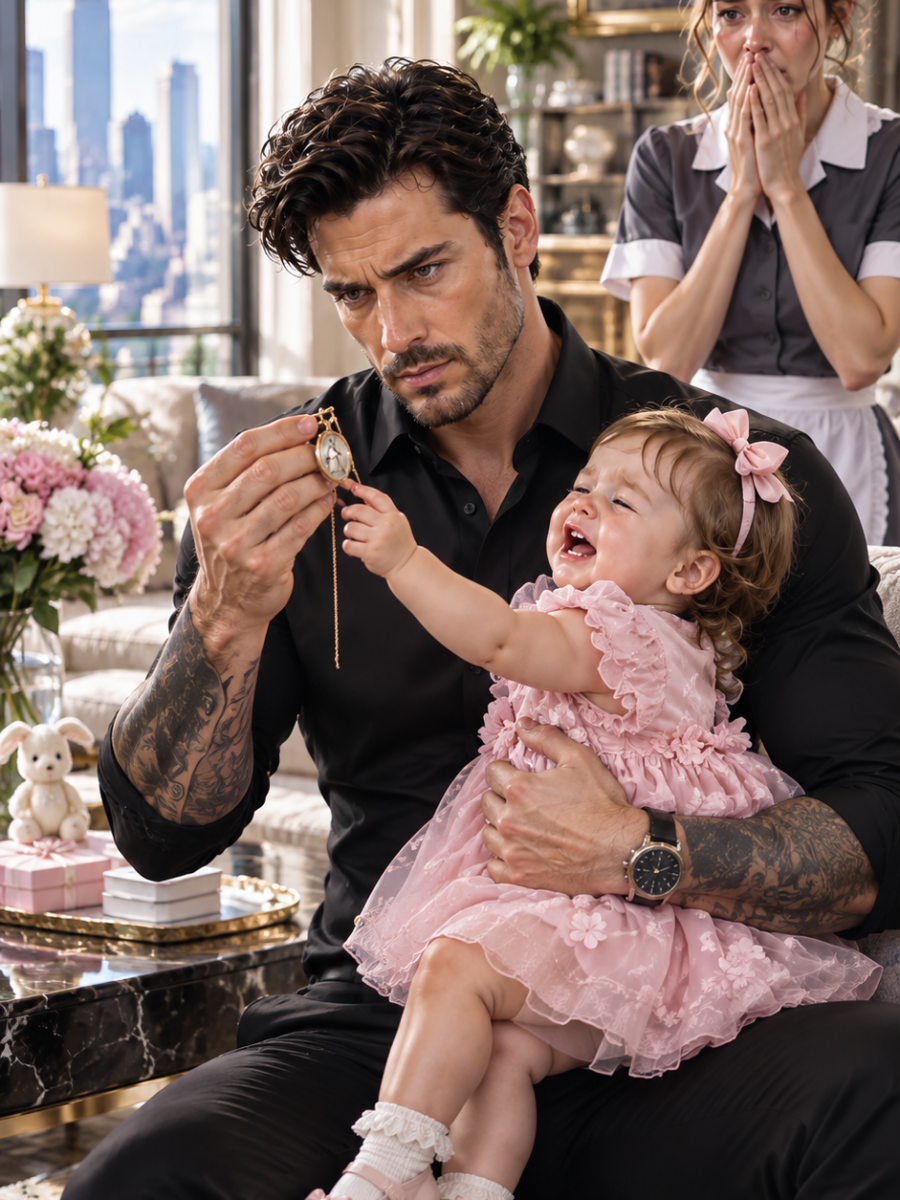
Dominic knew how to hold power, grudges, and a weapon. He knew how to make a room of angry men fall silent by lowering his voice. He did not know how to hold a baby. Still, she waited. With an awkwardness no living member of the Caruso organization would have believed, Dominic bent and lifted her under the arms. The baby settled against his chest immediately. One hand seized his tie, and the other pressed over his heart.
Something silver slipped from the neck of her onesie. Dominic caught the pendant before it struck the desk.
It was a Saint Christopher medal, worn smooth along the edges. A crooked letter J had been carved into the back by the impatient hand of a sixteen-year-old boy. Dominic knew because he had carved it himself, one summer night on the fire escape of the apartment where he and his younger brother had grown up.
He had given it to Julian before their father sent them on their first trip alone. “Always come home,” Dominic had told him. Julian had worn it for twenty-three years. He had supposedly been wearing it when his car burned beneath an overpass outside Newark.
Footsteps rushed across the hallway. Hannah Reed appeared in the doorway wearing the pale gray uniform of Dominic’s household staff. Her face was bloodless, and a damp cleaning cloth was still clutched in one hand. When she saw her daughter in Dominic’s arms, she stopped so abruptly that her shoes slid against the marble.
“Mr. Caruso, please.” Her voice broke.
Dominic lifted the medal. “Whose is this?”
Hannah’s eyes moved from the pendant to the baby’s face. She seemed to understand that whatever lie had protected them until that moment was gone. “I can explain.”
“You have ten seconds.”
“My sitter was taken to the hospital eleven days ago. I called every licensed daycare I could reach, but the cheapest one wanted twenty-four hundred dollars before they would even take her. I don’t make that in a month. I brought Grace here because I had nowhere else to go.”
“That was not my question.”
Hannah’s fingers tightened around the cloth. Dominic had employed her for nearly two years. Until that morning, he had known only that she arrived before seven, spoke quietly, and never broke anything. He had never asked where she lived or whether someone waited for her there. He had noticed when she took six weeks of unpaid leave, but he had not asked why. Now he realized she had been pregnant in his home, and he had never truly looked at her.
“Her father gave me the medal,” Hannah whispered.
“What was his name?”
“I knew him as Evan Cole.”
Dominic’s expression did not change, but the baby felt his body stiffen. She pulled back and studied his face.
Hannah swallowed. “Before he died, he told me his real name was Julian Caruso.”
The room became so quiet that Dominic could hear the clock inside the cabinet behind him. “My brother never mentioned you.”
“He said that was how he kept me alive.”
The answer struck with the precision of a knife. Dominic turned the medal over again, searching for any difference that might make it an imitation. The scratch near the saint’s shoulder was still there. So was the small dent Julian had made when he dropped it onto a basketball court at seventeen.
Grace touched Dominic’s jaw with her open palm. He looked at her eyes again. Gray, surrounded by a thin ring of gold. Julian’s eyes.
“How old is she?”
“Nine months and twelve days.”
The calculation required no effort. Julian had died eight months before Grace was born.
“Did he know?”
“Yes.”
“Did he know before the crash?”
Hannah nodded. “He bought that onesie the night I told him. It was the first thing he ever bought for her.”
Dominic glanced at the faded fabric and realized it had been washed so often because Hannah possessed very little else.
“Where have you been keeping her?” he asked, and then, before Hannah could answer, a second question rose in his chest that frightened him far more than the first — a question about a body identified within hours, a funeral closed to viewing, and a cremation he had never personally questioned. “Hannah — who told you Julian was dead? Who actually identified the body?”
Evan Cole
Hannah sat across from Dominic in his private office an hour later, Grace finally settled and sleeping against her mother’s shoulder, and told him everything she had spent eighteen months believing she would carry to her own grave rather than speak aloud.
She had met Evan Cole at a diner near the marina two and a half years earlier, a quiet, watchful man who tipped generously and never quite finished explaining what he did for work. He was careful in a way she found strange at first and reassuring later — he paid for everything in cash, avoided being photographed, and grew visibly tense whenever a stranger lingered too long near their table. She had assumed, for the first several months, that he was hiding from an ex-wife or a difficult family.
“He told me the truth about six months before Grace was born,” Hannah said. “That his name was actually Julian Caruso. That his family ran one of the largest shipping and logistics operations on the East Coast, and that some of what came with that name was more dangerous than I could fully understand. He said he’d made an enemy inside his own organization — someone he trusted, someone who’d found out something Julian wasn’t supposed to know, and that this person had made it very clear Julian’s life depended on disappearing completely.”
“Did he tell you who?” Dominic asked, his voice carefully controlled.
“No. He said the less I knew, the safer I’d be. He was terrified, Mr. Caruso — not dramatic, not paranoid the way people sometimes are about nothing. Genuinely terrified, in the specific way of someone who understood exactly what the threat against him actually meant.”
“When did the crash happen?”
“Three weeks after he told me the truth. He’d been trying to arrange something — money, a plan to get us both somewhere safe together, I think, though he never fully explained it. Then one night he didn’t come to see me the way he’d promised. Two days later, I saw the news report. A car registered to an Evan Cole, burned beyond recognition beneath an overpass outside Newark, driver presumed dead.” Hannah’s voice caught. “I didn’t even know how to grieve him properly. I couldn’t tell anyone who he really was, couldn’t attend a funeral under a name that meant anything, couldn’t explain to a single person in my life why I was suddenly pregnant and devastated over a man none of them had ever heard of.”
Dominic sat with that for a long moment, turning the medal over in his hand. “The funeral you’re referring to happened under the Caruso name, not Evan Cole’s. My family buried Julian Caruso, not a stranger from a diner near the marina.”
“I know,” Hannah said quietly. “I saw the obituary eventually, months later, when I finally worked up the courage to search his real name online. I recognized enough details to know it was him. I never reached out. I didn’t know what I would even say, or who I could trust with the truth once I understood exactly how dangerous a name like Caruso actually was.”
Dominic set the medal down carefully on his desk, his mind already moving through eighteen months of memory with new, unbearable suspicion. “Hannah, I need you to think very carefully. In the weeks after the crash, did anything unusual happen? Any money arrive that you couldn’t explain, any contact from someone connected to my family?” Hannah’s expression shifted, uncertain. “There were deposits,” she admitted slowly. “Small ones, anonymous, arriving in my account every month for almost a year. I assumed it was some kind of settlement, or maybe guilt money from whoever he’d been running from. They stopped four months ago, and I never learned why.”
The Closed File
Dominic summoned the original accident file that same afternoon, a document he had signed off on eighteen months earlier without reading past the first page, too consumed by grief at the time to scrutinize the details of his younger brother’s death.
What he found, reviewing it now with a suspicion he’d never thought to apply to his own family’s records, unsettled him more with every page. The identification had been made within six hours of the crash, remarkably fast for a body burned badly enough to require dental records rather than visual confirmation — and those dental records had been supplied not through the medical examiner’s usual channel, but through a private dentist’s office personally recommended and arranged by Vincent Rizzo, the family’s longtime consigliere.
The cause of death had been ruled accidental within two days, the investigation closed with unusual speed for a case involving a man of Julian’s prominence. And the cremation — arranged, again, through Vincent’s office, citing what he’d described at the time as “Julian’s explicit wishes, discussed with me privately months before” — had occurred within a week, eliminating any possibility of a later independent examination.
Dominic sat back from the file, a cold, sick understanding settling over him that he didn’t yet want to fully accept. Vincent Rizzo had personally managed nearly every detail of Julian’s death, moving with a speed and control that, viewed through fresh suspicion, looked considerably less like a grieving family friend expediting a painful process and considerably more like a man making very sure no one looked too closely at anything.
He called in his own private investigator that evening — a former federal agent named Elaine Cho, whom Dominic had used sparingly over the years for matters too sensitive for his organization’s usual channels — and laid out everything: the medal, Hannah’s account, the suspiciously fast identification, the anonymous deposits that had started and stopped without explanation.
“I want the dental records independently verified,” Dominic said. “I want to know if there’s any physical evidence remaining from that crash that could actually confirm my brother’s identity, rather than simply accepting a paperwork trail Vincent Rizzo happened to control from start to finish.”
“And if the evidence confirms your brother really did die in that crash?” Elaine asked carefully.
“Then I have a niece who deserves to know the truth about her father regardless,” Dominic said. “But if it doesn’t confirm that, Elaine, then someone in my own organization has spent eighteen months letting me believe my brother was dead, and I need to understand exactly why, and exactly what he’s been protecting by keeping it that way.”
Elaine’s investigation moved quickly, aided by resources Dominic’s own wealth could summon that an ordinary family could never access, and within three days, she returned with results that confirmed Dominic’s worst suspicion in the starkest possible terms: the dental records used to identify the body in the Newark crash did not, in fact, match any records ever filed under Julian Caruso’s name at any dentist he had used in his entire adult life.
The Monthly Deposits
“The records used for identification,” Elaine explained, spreading her findings across Dominic’s desk, “came from a dental office in Elizabeth, New Jersey, that has no record of Julian Caruso as a patient under any name. Someone supplied fraudulent documentation to the medical examiner’s office, and given how quickly and smoothly that documentation was accepted without secondary verification, I suspect whoever provided it had some prior relationship with someone inside that office.”
“Vincent,” Dominic said flatly.
“I can’t confirm that yet,” Elaine said carefully. “But I can confirm that the body in that crash almost certainly was not your brother. Someone died in that fire, Mr. Caruso — the department’s own preliminary report noted the remains as male, roughly the right age and build — but the identification connecting those remains to Julian specifically appears to have been deliberately, professionally falsified.”
Dominic sat with that horror for a long moment — an unknown man, dead and burned beyond recognition, used to manufacture his brother’s disappearance, a second tragedy layered invisibly beneath the one his family had grieved for a year and a half.
“The anonymous deposits into Hannah’s account,” Elaine continued, “trace back to a shell account registered in the Caymans, funded through a chain of transfers designed to be difficult to follow casually, but not impossible for someone with the right resources. The account was opened eight days after the reported crash date. Whoever set it up wanted to make sure Hannah and the baby had some financial support, without ever risking direct contact that might expose whoever was providing it.”
“That sounds like Julian,” Dominic said quietly. “Careful. Protective. Unwilling to fully abandon someone even while forced into hiding.”
“It could also,” Elaine said carefully, “be someone else entirely — someone managing Julian’s disappearance from the outside, keeping Hannah quietly cared for as a way of controlling the situation, ensuring she never had enough desperation to start asking dangerous questions. I want to be honest with you, Mr. Caruso. I don’t yet know whether these deposits represent Julian protecting his family from hiding, or someone else protecting their own secret by keeping Julian’s family comfortable and quiet.”
“The deposits stopped four months ago,” Dominic said slowly. “What happened four months ago?”
Elaine consulted her notes. “Four months ago, according to your own company’s internal records, Vincent Rizzo was formally granted expanded signing authority over three of your family’s shell holding companies, following what the board minutes describe as ‘a period of consolidated leadership during the ongoing transition after Julian Caruso’s death.'”
Dominic felt something cold and absolute settle into place. “He used my brother’s death to grab control of accounts my family barely monitors,” he said slowly, “and the moment his own position was secure enough, he stopped bothering to keep Julian’s family quiet, because he no longer needed to manage the risk as carefully. Elaine, I need everything you can find on Vincent Rizzo’s finances, his contacts, and his movements over the last eighteen months — today, not next week.
Vincent Rizzo
Vincent Rizzo had been a fixture in Dominic’s life since before Dominic could properly remember him arriving — a careful, measured presence who had stood beside Dominic’s father through three decades of building the Caruso shipping empire into something that touched ports on both coasts and several overseas.
Dominic had trusted him without question through his father’s death, through his own difficult early years running the organization, and through the devastating months following Julian’s supposed death, when Vincent had quietly, efficiently handled every painful logistical detail Dominic himself had been too grief-stricken to face. It was, Dominic now understood with sickening clarity, precisely the kind of trust a man in Vincent’s position would have spent thirty years carefully cultivating for exactly this purpose.
Elaine’s financial review, completed over two exhausting days, revealed a pattern considerably larger than a single falsified identification. Vincent had been quietly diverting funds from the Caruso organization’s shipping insurance settlements for nearly six years — a slow, patient skim that Julian, working closely with the company’s financial records during the months before his disappearance, had apparently begun to notice.
“There’s a pattern of internal memos here,” Elaine said, presenting a folder of documents her forensic accountant had recovered from an old company server backup that had never been properly purged. “Julian requesting detailed audits of specific insurance claims, dated in the two months before the crash. He was getting close, Mr. Caruso. Close enough that Vincent would have understood exactly how much exposure he was facing if Julian brought his findings to you directly.”
“So Vincent had him killed,” Dominic said, his voice flat with barely controlled fury.
“Or,” Elaine said carefully, “Vincent found another way to remove the threat without actually committing murder against a man he’d known since childhood. The falsified identification, the rushed cremation, the anonymous financial support for Hannah — none of that reads like the work of a man comfortable with killing someone he cared about. It reads like someone trying to make a problem disappear as gently as the situation allowed.”
Dominic considered this, turning it over against everything he knew of Vincent Rizzo — a man capable of enormous ruthlessness in business, but who had also, Dominic remembered now, wept openly at Julian’s funeral, had personally selected the music, had seemed, in every visible way, genuinely devastated by a death Dominic now understood he had likely engineered himself.
That evening, Dominic summoned Vincent to his office under the pretense of routine quarterly business, Elaine’s full file locked in his desk drawer and Hannah and Grace safely relocated, at Dominic’s insistence, to a secured property Vincent knew nothing about. When Vincent arrived, settling into the same chair he’d occupied a thousand times over thirty years, Dominic slid the falsified dental records across the desk without a word of preamble, and watched, for the first time in his life, genuine, unguarded fear cross Vincent Rizzo’s face.
The Relocation Invoice
Vincent stared at the documents for a long moment before he finally spoke, his voice stripped of its usual measured confidence. “Where did you get these?”
“Does it matter?” Dominic said. “They’re accurate, Vincent. My brother’s identification was falsified. The dentist who supposedly confirmed his identity has never treated Julian Caruso in his life. And I have eighteen months of anonymous deposits into a woman’s account that traces back to a shell company you were given expanded control over the exact month those deposits stopped.”
Vincent’s composure, built over thirty years of careful control, finally, visibly began to fracture. “Dominic—”
“Is he alive?” Dominic’s voice cracked with a rawness he hadn’t allowed himself to feel in eighteen months of grief. “Just tell me that much, Vincent. Is my brother alive?”
The silence stretched long enough that Dominic nearly stood, nearly reached for the weapon he kept in his desk drawer for exactly the kind of confrontation he’d never imagined having with this particular man. Then Vincent’s shoulders dropped, decades of careful discipline finally giving way.
“Yes,” he said quietly. “He’s alive.”
The relief that moved through Dominic was so immediate and overwhelming that he had to grip the edge of his desk to steady himself. “Where?”
“Somewhere safe. Somewhere I’ve spent eighteen months making sure stays that way.” Vincent’s eyes had gone distant, carrying the particular exhaustion of a man finally setting down a weight he’d carried alone for far too long. “I never intended for it to go this far, Dominic. I want you to understand that before you decide what happens to me next.”
“Then explain it,” Dominic said. “All of it. Now.”
Vincent was quiet for a long moment, gathering himself. “Julian found the insurance discrepancies four months before the crash. He came to me first, not you — he trusted my judgment on financial matters more than he trusted his own instincts, and he wanted my advice on how to bring it to you without destroying the company’s relationship with our insurers in the process. I panicked, Dominic. Six years of careful, patient theft, and your own brother was three weeks from exposing all of it.” He swallowed. “I told him I needed time to help him build an airtight case. Instead, I spent those three weeks trying to figure out how to make the problem disappear without hurting him.”
“So you faked his death instead of killing him,” Dominic said slowly, “and then spent eighteen months making sure he stayed disappeared, controlling his family from a distance, waiting for a moment that apparently never fully arrived where you could safely let any of this go.” Vincent nodded, his face carrying the full weight of what he’d built. “There’s one more thing you need to understand before you decide what happens next, Dominic. I didn’t act alone in arranging Julian’s disappearance. I needed help making a body disappear convincingly, and the people I turned to for that kind of help don’t work for free, or without leverage of their own.”
What Vincent Confessed
“Explain,” Dominic said, his voice gone dangerously quiet.
“The Falcone family,” Vincent said. “They’ve operated the ports adjacent to ours for two generations, and they’ve spent most of that time looking for an opening to expand into Caruso territory. I approached their consigliere, Antonio Greco, with a proposal — help me manage a difficult situation quietly, and in exchange, I’d ensure certain shipping contracts favored Falcone interests going forward, gradually, in ways small enough that you’d never have reason to question them individually.”
“You sold pieces of this family’s business to a rival organization,” Dominic said, “to cover up your own theft, and to make sure my brother stayed hidden.”
“I told myself it was temporary,” Vincent said. “A controlled arrangement, manageable, until I could find a way to either make the original theft disappear from the books entirely, or find some way to bring Julian back safely without exposing what I’d done to hide him in the first place. Neither path ever fully materialized. Every month I delayed, the arrangement with the Falcones grew a little more entrenched, and Julian grew a little more resigned to a life he never should have had to live.”
“And the deposits that stopped four months ago.”
Vincent’s expression tightened with something like genuine shame. “Antonio Greco began pressing for more than shipping favors. He wanted direct access to our client contracts, information I wasn’t willing to hand over even to protect my own secret. When I refused, he threatened to expose the entire arrangement — my theft, Julian’s fake death, all of it — unless I complied fully. I stopped the deposits to Hannah because every transaction, however careful, was another potential thread Antonio could pull if he decided to follow through on his threat.”
Dominic sat back, the full, staggering shape of Vincent’s eighteen-month deception finally complete in his mind — not simply a cover-up, but an ongoing, active vulnerability threaded directly into the heart of his organization, controlled by a rival family that had been quietly extracting concessions for over a year under threat of exposing a truth Dominic himself hadn’t even known to look for.
“Where is my brother, Vincent,” Dominic said, each word deliberate and final. “Exactly. Right now.”
Vincent’s hands trembled slightly as he reached into his jacket and produced a folded piece of paper — an address, written in his own careful hand, for a property upstate Dominic had never heard mentioned in his life. “A cabin outside Saranac Lake,” he said quietly. “But Dominic — you need to move quickly, and carefully. If Antonio Greco learns that this arrangement has been discovered before we can protect Julian properly, I have no doubt he’ll consider a truly dead Julian Caruso considerably safer for himself than a living one who might eventually testify to everything I’ve just told you.
The Falcone Problem
Dominic moved that same night, assembling a small, trusted team rather than risking the size and visibility of a full security detail that might draw unwanted attention from anyone watching the organization’s movements following Vincent’s sudden, unexplained absence from the office.
Elaine Cho came with him, along with two men whose loyalty Dominic had tested personally over the years rather than inherited through his father’s old arrangements — a deliberate choice, given how thoroughly Vincent’s thirty years of quiet influence had apparently compromised the organization’s usual channels of trust.
“We need to assume Antonio Greco has some way of monitoring Vincent’s communications,” Elaine said as they drove north, the city giving way gradually to the darker, quieter roads leading toward the Adirondacks. “If Vincent’s sudden confession to you triggers any kind of alert on Greco’s end, we could be racing a countdown we don’t fully understand the length of.”
“Then we don’t stop,” Dominic said, watching the mile markers pass with a tension he hadn’t felt since the earliest, most dangerous years of consolidating his father’s organization after his death. “Eighteen months, Elaine. My brother has been alone for eighteen months, hiding from a threat my own family’s mismanagement created, while I grieved a man who wasn’t even dead.”
Hannah had insisted on coming as well, Grace secured in a car seat in the back, her small, sleeping face occasionally catching the passing headlights. “She should be there,” Hannah had said simply, when Dominic tried gently to suggest she and Grace remain at the secured property instead. “If Julian’s alive, Mr. Caruso, he deserves to meet his daughter properly, not through a photograph someone shows him after the fact.”
Dominic hadn’t argued further, understanding, in a way he wouldn’t have a week earlier, exactly how much courage that request actually required from a woman who had spent eighteen months building a fragile, careful life around a grief she now had to entirely reconsider.
They arrived at the cabin’s private access road just before two in the morning, the property dark and isolated exactly as Vincent had described, a single dim light visible through one curtained window suggesting someone was, in fact, awake and present.
Dominic’s phone buzzed as they parked, a message from Vincent — held under guard back at the Manhattan estate, but permitted, at Dominic’s own careful instruction, to keep his phone in case any last useful information surfaced — three words that sent ice through Dominic’s chest: “Greco already knows.”
The Cabin Upstate
Dominic moved fast, abandoning any pretense of a careful, quiet approach the moment Vincent’s warning registered, his men fanning out around the cabin’s perimeter while he himself went directly for the front door, every instinct honed by years of running a dangerous organization now focused entirely on the single most important thing he’d ever protected.
The door opened before he reached it.
The man standing in the doorway was thinner than Dominic remembered, his beard longer, a wariness in his stance that spoke of eighteen months spent flinching at unfamiliar sounds — but the eyes, gray and gold-ringed, unmistakable even in the dim porch light, belonged entirely and completely to Julian Caruso.
“Dominic?” Julian’s voice broke on the single syllable, disbelief and terror and something achingly close to hope all tangled together.
“I know everything,” Dominic said, his own voice unsteady in a way he hadn’t allowed it to be in years. “Vincent. The insurance theft. The fake identification. All of it, Julian. And I know Antonio Greco may already be moving against you, so we don’t have time for the conversation I actually want to have right now.”
Julian’s eyes moved past his brother, and Dominic watched the exact moment recognition hit him — Hannah, stepping carefully out of the car with Grace bundled against her chest, both of them illuminated in the cabin’s dim porch light.
“Hannah.” Julian’s voice cracked entirely. “You brought her.”
“She should meet you properly,” Hannah said, her own voice thick with eighteen months of grief now colliding, impossibly, with relief. “Not through a story someone else tells her someday.”
There was no time, in that moment, for the reunion any of them deserved — Dominic’s security team was already moving, having spotted headlights approaching the private access road from the opposite direction than the one they’d used, a detail that confirmed Vincent’s warning with brutal, immediate clarity.
“Inside, now,” Dominic said, ushering Julian, Hannah, and Grace back through the cabin door while his men took defensive positions around the property’s perimeter. “Elaine, how many vehicles?”
“Two,” she reported, watching through a night-vision scope from the tree line. “Consistent with a small enforcement team, not a full assault. They may be here to assess the situation rather than commit to an immediate confrontation.”
Inside, Julian gripped his brother’s arm with a fierce, disbelieving strength. “Dominic, listen to me. If that’s Greco’s people, they’re not here to negotiate. Vincent’s arrangement with them was built entirely on me staying hidden and presumed dead. The moment they realize I’ve been found, and that you know everything, I become the single most dangerous loose end in their entire operation — and so does anyone standing close enough to me when they decide to fix that problem permanently.
Coming Home
Dominic’s men held the perimeter without incident, the approaching vehicles slowing, idling briefly at the edge of the property’s tree line, and then, after several tense minutes, reversing course entirely and disappearing back down the access road — a reconnaissance pass rather than the assault Julian had feared, exactly as Elaine’s assessment had suggested.
“They’ll report back to Greco that the situation has escalated beyond a quiet cleanup,” Elaine said, once the property was confirmed secure. “Which means we need to move considerably faster than we’d planned, Mr. Caruso. Whatever advantage came from Greco believing this was still a manageable secret is gone the moment those men report what they just saw.”
Dominic made the decision that night that his father, and even his own instincts eighteen months earlier, would never have countenanced — rather than handling the Falcone threat through the kind of quiet, dangerous retaliation the Caruso organization had used for two generations, he placed a call to a federal contact he’d maintained carefully and discreetly for exactly this kind of last resort, a contact built on the same careful legitimacy Camille Rousseau’s father had once described to a different frightened man in a different crisis entirely, though Dominic had built his own version independently, years earlier, as quiet insurance against exactly this kind of catastrophic internal failure.
“A coordinated federal action against both the Falcone extortion operation and the insurance fraud Vincent orchestrated,” his contact explained, once briefed on the full situation, “gives you the cleanest possible resolution, Mr. Caruso. It ends the leverage the Falcones have been building against your organization, it resolves your brother’s situation permanently rather than requiring him to remain hidden indefinitely, and it removes Vincent’s exposure to retaliation from a family he’s clearly become dangerously entangled with.”
“And Vincent himself?” Dominic asked.
“Faces serious charges,” the contact said honestly. “Fraud, obstruction, likely accessory charges related to the falsified identification. But cooperation, fully and immediately, tends to matter considerably to sentencing outcomes, and from what you’ve described, he’s already shown more willingness to cooperate than most men in his position ever manage.”
Dominic thought of thirty years of trust, of a man who had wept at his brother’s funeral for a death he’d engineered himself, of the particular tragedy of watching someone choose theft and cowardice over honesty at the one moment honesty might have actually saved everyone considerable suffering. “Let him cooperate,” Dominic said finally. “Fully. I want the Falcones’ operation dismantled, and I want my brother home safely. Whatever mercy the process allows Vincent afterward, I’ll leave to people better positioned than me to decide it fairly.”
The federal operation moved over the following three weeks with the careful, coordinated precision Dominic’s contact had promised, Antonio Greco and four of his associates arrested in a single coordinated sweep that made the insurance fraud, the falsified death certificate, and the Falcone family’s quiet extortion campaign impossible to hide or negotiate away — and on the morning the last piece of the operation concluded, Dominic received a single text from his federal contact that finally, completely let him breathe: “It’s over. Your brother is safe. Permanently.”
Two Teeth and a Whole Family
Julian’s return to public life required months of careful, deliberate management — a legal process to formally reverse his own death certificate, a cautious reintroduction to an organization that had genuinely believed him dead for eighteen months, and a slow, patient rebuilding of a relationship with Hannah that neither of them rushed, both of them understanding exactly how much had been lost and how carefully something real needed to be rebuilt in its place.
Vincent Rizzo’s cooperation, exactly as the federal contact had predicted, resulted in a considerably reduced sentence in exchange for testimony that dismantled the entire Falcone extortion operation — eighteen months in a minimum-security facility, a sentence Dominic found himself, to his own genuine surprise, feeling something closer to sorrow than satisfaction about, for a man who had spent thirty years as close to a father figure as Dominic had known since his own father’s death, before one catastrophic, cowardly decision unraveled everything.
Grace, blissfully unaware of the eighteen months of danger and deception that had preceded her first real meeting with her father, took to Julian with the same fearless, immediate trust she’d shown crawling into Dominic’s office months earlier — a trust Julian received, Dominic noticed, with the particular careful wonder of a man who had spent months believing he might never get the chance to earn it at all.
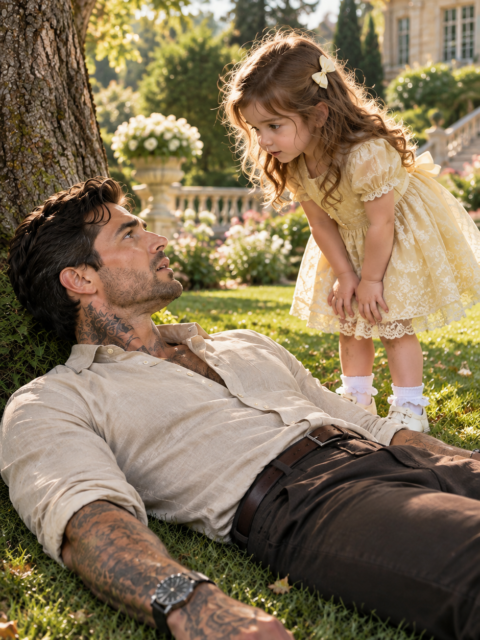
On a warm afternoon nearly a year after a baby in a faded yellow onesie had crawled beneath his desk and changed the entire shape of his family, Dominic stood in the garden of the Caruso estate watching his brother lift his daughter high above his head, both of them laughing in the late summer light, while Hannah watched from a nearby bench with an expression of hard-won, unguarded peace.
“Two teeth,” Julian said, settling Grace against his hip as Dominic approached, “and she managed to save this entire family before she could even walk properly. I owe her considerably more than a soft toy on her next birthday.”
“You owe her everything,” Dominic agreed, reaching out to let his niece grip his finger the same fierce, trusting way she’d once gripped his tie. “We all do.”
Grace, entirely unbothered by the weight of what she’d unknowingly accomplished, simply smiled her two-toothed smile and reached for the Saint Christopher medal now resting, once again, against her father’s chest — the medal Dominic had carved himself on a fire escape thirty years earlier, passed from brother to brother to daughter, a small, stubborn piece of loyalty that had somehow, against every danger built to bury it, always managed to come home.