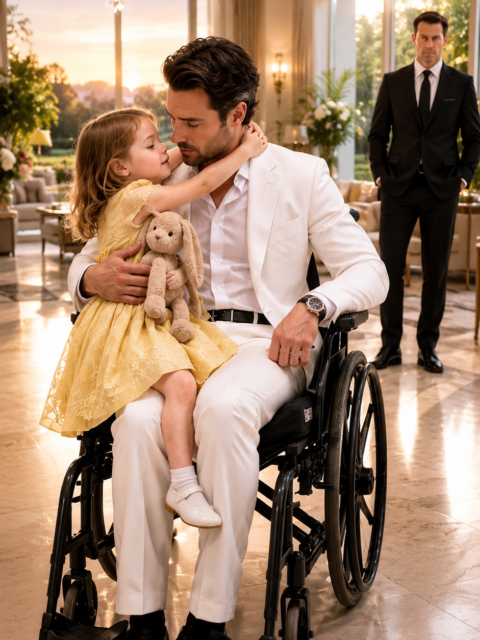
Sophia Bennett arrived at a mountain estate above Lake Como expecting to marry a mafia boss she’d never met, a man her father had promised her to over a debt he never fully explained. She never got the chance to rehearse a single word of what she’d planned to say — she tripped over her own suitcase the moment she stepped out of the car and, minutes later, stumbled straight into the arms of Luca Moretti, a six-foot-six giant of a man who braced for her rejection the exact same way five women before her already had. Sophia refused to give it to him. But just before the ceremony was set to begin, Luca’s sister Elena pulled her aside with a whisper that stopped everything: there was something about this marriage neither of them fully understood, something engineered quietly inside Luca’s own family that had nothing to do with love, debt, or coincidence. This is a thirteen-chapter story about a man’s lifetime of rejection finally meeting someone who simply refused to look away, a manufactured debt hiding a far more calculated family scheme, and the clumsy baker who chose honesty over walking quietly back down the mountain. Read all thirteen chapters to find out what Elena knew, who actually engineered Sophia’s father’s debt, and what Luca Moretti did once he understood exactly how deep the manipulation inside his own family really ran — and what it took for a man who’d spent his whole life bracing for rejection to finally believe someone was actually staying by choice, flour-dusted hands and all.
Chapter One
I Know Who You Are
I came to the mountain estate expecting to marry a Mafia boss I had never met. Instead, I tripped over my own suitcase, grabbed his expensive shirt, and nearly pulled him into my arms.
Everyone in the room stared at me. But the look in his eyes wasn’t anger. It was the look of a man already expecting me to reject him. And somehow, I became determined to be the first woman who didn’t.
The car from the airport climbed for forty minutes before the gates of the estate appeared, iron and old stone cut into the mountainside above Lake Como. I’d spent the whole drive rehearsing what to say to a man my father had promised me to over a debt he never fully explained.
I never got to use any of it.
The driver opened my door. My suitcase wheel caught the gravel wrong, and I stumbled onto the driveway in front of two men in black suits who didn’t so much as blink.
“Ms. Bennett?” one of them said. “That’s me. Sorry. Long flight.” He didn’t smile. Neither did the house behind him — three stories of pale stone with windows too tall for comfort, the kind of place built to remind visitors exactly how small they were.
Inside, the foyer smelled like beeswax and cold marble. A woman with sharp cheekbones watched me from the staircase, her expression unreadable.
“You’re smaller than I pictured,” she said. “I get that a lot. Usually followed by a compliment I don’t ask for.” That earned the smallest twitch at the corner of her mouth. “I’m Elena.” “Sophia.”
“I know who you are.”
Chapter Two
The Doorway Looked Small
Before I could ask what that meant, a door down the hall opened, and I heard him before I saw him — a voice, low, ending a phone call in Italian without saying goodbye.
Then he stepped through the doorway, and the doorway looked small.
Six foot six, easy. Shoulders that filled the frame on both sides. A tailored suit that couldn’t make a man that size look anything but exactly what he was.
His eyes found mine. And braced.
I saw it happen — the whole of him bracing, the way you brace for a door to slam, for a face across the room to fall the way five faces before mine had already fallen.
My suitcase wheel caught the rug.
Chapter Three
Experience
I went down fast, my hand shooting out for anything solid, and what it found was his shirt. Two fistfuls of it. For one absurd second I hung there, off balance, hauling him half an inch toward me before his hand closed around my elbow and set me upright like I weighed nothing at all.
Silence. The kind with a texture to it.
Then, quiet — “You’re not going to comment on it.” I looked up. “On the suitcase? It’s a nice suitcase. I’d hate to insult it.” “On me.” “Should I?”
Something shifted behind his eyes — not relief. Not yet. Closer to a man being handed a script in a language he’d almost forgotten how to read.
“I was told you’d take one look at me and ask to go home,” he said. “Who told you that?”
“Experience.”
Chapter Four
I Talk When I’m Nervous
Five words, and I understood the whole shape of him. Five women. Five doors that had opened on this exact man and closed on someone smaller in every way that mattered.
“Luca Moretti,” he said, offering his hand like he expected me to decline it.
I shook it instead. “Sophia Bennett. I make wedding cakes. I fall down constantly. I talk when I’m nervous, which I am, extremely, right now.”
The corner of his mouth did something it clearly wasn’t used to doing.
Marco cleared his throat by the door. “Signor Moretti. The priest is asking if the ceremony is still tonight.”
Luca’s jaw tightened. He looked at me the way a man looks at the last page of a book he’s already read five times, already certain of the ending.
I opened my mouth to answer.
Chapter Five
Before You Say Yes
Elena stepped between us first, her voice dropping so low only I could hear it.
“Before you say yes,” she whispered, “there’s something about this marriage you need to know. Something my brother doesn’t know I know.”
Chapter Six
Elena’s Secret
She pulled me toward a small sitting room off the foyer, closing the door behind us with a care that told me exactly how much she didn’t want this conversation overheard.
“Your father’s debt,” Elena said quietly. “I’ve seen the original loan documents. They were restructured three months ago, quietly, by our cousin Dante, in a way that inflated the amount owed considerably beyond what your father actually originally borrowed.”
“Why would anyone do that?”
“Because Dante needs Luca married,” Elena said. “Our father’s will requires it — Luca inherits full, unrestricted control of the family’s legitimate holdings only if he’s married by his fortieth birthday, six weeks from now. If he isn’t, control defaults to a family trust that Dante, as the next senior male relative, would effectively administer.”
I sat with that, the romantic terror of an arranged marriage suddenly reorganizing itself into something considerably more calculated. “So Dante found my father’s debt and used it to manufacture a bride on a deadline.”
“I believe so,” Elena confirmed. “Which means this marriage isn’t really about your father’s debt at all, and I don’t believe my brother has any idea the timeline he’s operating under has been deliberately engineered by someone he trusts.”
Chapter Seven
Confronting the Truth
“Why are you telling me this,” I asked, “instead of telling Luca directly?”
“Because I’ve tried, twice, in the past month, and he assumed I was simply worried about him marrying a stranger for reasons that had nothing to do with Dante,” Elena admitted. “He’s spent his whole life being underestimated because of his size, assuming people’s suspicion of him comes from that rather than considering someone in his own family might be working against him specifically. I need you to help me convince him, because I think he might actually listen to the woman he’s about to marry in a way he won’t yet listen to his sister.”
“You want me to walk out there and tell a man I met twenty minutes ago that his cousin engineered our entire marriage.”
“I want you to walk out there and tell him the truth,” Elena said. “What you both do with it afterward is entirely up to the two of you. I just refuse to let this wedding happen with him believing a lie about why it’s happening at all.”
I thought about the way Luca had braced for my rejection, the quiet, worn-down certainty of a man who’d stopped expecting good things to be genuine. Whatever I said next needed to account for exactly how much this particular truth might cost him to hear.
Chapter Eight
Sophia’s Choice
Ifound Luca alone in the same hallway, still in the black suit meant for our wedding, staring out a tall window at the lake below with an expression considerably more exposed than the careful composure he’d shown at our first meeting.
“I need to tell you something,” I said, “and I need you to actually hear it, rather than assuming it’s another version of rejection.”
He turned, something wary entering his expression. “What is it?”
I told him everything Elena had shared — the restructured debt, the will’s deadline, Dante’s apparent motive — watching his face cycle through disbelief, then a dawning, furious clarity as pieces he’d apparently never fully questioned began reassembling into a considerably more calculated shape.
“Dante helped me find the ceremony officiant,” Luca said slowly. “He recommended the timeline. He’s been present for every single conversation about this marriage since your father’s debt first came to my attention. I trusted him completely.”
“I still want to marry you,” I said, surprising myself with how quickly and completely I meant it. “Not because of a manufactured debt or a will deadline. Because in the twenty minutes I’ve actually known you, you’ve been more honest and more careful with me than most people manage in months. But I needed you to choose this with the truth in front of you, not hidden from you.”
Chapter Nine
Facing Dante
Luca’s fury, once fully processed, translated into a controlled, methodical response rather than any impulsive confrontation — he summoned Dante to the estate’s study, requesting the original, unaltered loan documentation be produced immediately, watching his cousin’s composure for any sign of the deception Elena had described.
“There’s a discrepancy in the Bennett debt,” Luca said, deceptively calm, sliding the restructured paperwork across the desk. “I’d like you to explain exactly how the amount grew by this much in three months, given no additional borrowing occurred.”
Dante’s hesitation, brief but unmistakable, confirmed everything before he offered a single word of explanation. “Administrative fees,” he said. “Interest recalculation. Nothing unusual for a debt of this size and complexity.”
“That’s not what the original documentation shows,” Luca said, producing the earlier records Elena had provided. “I’d like the truth, Dante. Now. Before I decide how much of our family history I’m willing to let this conversation cost you.”
Dante’s composure finally cracked, decades of careful, patient positioning collapsing in the space of a single confrontation. “You would have lost everything to the trust,” he said. “I was simply making sure the family’s actual interests remained protected, regardless of whether you understood the stakes clearly enough to act on your own timeline.”
Chapter Ten
Luca Learns the Truth
“You decided my life needed managing,” Luca said, “the same way everyone else in this family has always assumed my size meant I needed managing, protecting, arranged for, as though I’ve never once been capable of making my own decisions with full information.”
“I was protecting the family’s future.”
“You were protecting your own position,” Luca said flatly. “If I’d missed the deadline and control defaulted to the trust, you’d have administered it. That’s not protecting the family. That’s positioning yourself to control it.”
I watched this unfold from a chair near the study’s window, understanding I was witnessing considerably more than a single confrontation — a lifetime of Luca being underestimated, managed, and quietly maneuvered around finally, completely surfacing into the open.
“What happens to the wedding now?” Dante asked, some remaining calculation apparently still active even in the wreckage of his exposed scheme. “Surely you’re not still intending to marry a stranger over a manufactured debt now that the manipulation is exposed.”
Chapter Eleven
Building Real Trust
Luca looked at me, the question genuinely open despite Dante’s presumptuous framing of it. “That’s actually not my decision alone to make anymore,” he said. “Sophia, I understand completely if everything you just learned changes what you want. I won’t hold you to a wedding built on a lie you didn’t choose.”
“I already told you my answer,” I said. “Before we even knew about Dante. I’m not interested in walking away from someone who braced for rejection the way you did and got something honest instead. I’d like the chance to actually build something real, on our own timeline, without your cousin’s manipulation dictating when or why.”
We postponed the ceremony that evening, both of us agreeing that whatever grew between us deserved a foundation considerably sturdier than a rushed wedding built around someone else’s scheme.
The following weeks unfolded with a careful, genuine courtship neither of us had expected from an arrangement that began with a tripped suitcase — long conversations about the loneliness his size had cost him for years, about the modest bakery I’d built from nothing after my own difficult childhood, about the particular, unexpected comfort of being fully seen by someone who refused to look away.
“I keep waiting for you to change your mind,” Luca admitted one evening, weeks into our unofficial engagement. “Old habits. Five women’s worth of expecting the door to eventually close.”
Chapter Twelve
Dante’s Downfall
Luca’s response to Dante’s manipulation extended well beyond the immediate confrontation, a full financial audit launched into every transaction Dante had touched across his years managing portions of the family’s legitimate business interests.
“The debt manipulation wasn’t an isolated incident,” Luca’s forensic accountant reported, weeks into the investigation. “There’s a pattern of smaller, similarly calculated maneuvers stretching back nearly five years, each one positioning Dante with slightly more influence and access than his actual role technically warranted.”
Dante was removed entirely from any position of trust within the family’s operations, the consequences considerably more permanent than a single exposed scheme might have otherwise warranted, reflecting the full pattern of calculated manipulation his cousin’s investigation had uncovered.
My father’s actual debt, once properly recalculated to its original, unmanipulated amount, was settled in full by Luca — not as any remaining condition of our relationship, but simply, he insisted, because it was the right thing to do regardless of what happened between the two of us.
“I don’t want you ever wondering whether any part of this is still connected to that original arrangement,” Luca told me, once the debt was formally closed. “Whatever we build from here is entirely, completely separate from how we met.”
Chapter Thirteen
What Remained
We married eight months later, considerably later than Dante’s engineered deadline would have allowed, in a ceremony neither rushed nor arranged by anyone but the two of us — a small gathering at the same mountain estate, though this time filled with genuine warmth rather than calculated urgency.
I made our own wedding cake, three tiers of the same recipe I’d built my small bakery around, insisting despite Elena’s gentle protest that a bride shouldn’t have to work on her own wedding day.
“I want to,” I told her. “Some things matter more when you make them yourself, rather than simply accepting what someone else decided you should have.”
Luca, considerably more at ease in his own skin than the braced, defensive man I’d first tripped into, still occasionally catches himself expecting rejection in small, unguarded moments — old habits, exactly as he’d once warned me, taking considerably longer than eight months to fully unlearn.
“You’re still here,” he told me, quietly, the morning after our wedding, watching me sleepily attempt to make coffee in an unfamiliar kitchen and nearly knocking over an entire canister of flour in the process.
“I’m still here,” I confirmed, flour dusting my hands, utterly unbothered by my own clumsiness in a way that had apparently, somewhere over the past eight months, become the exact thing he loved most about coming home to me every single day.