In This Story
Chapter One
The Forbidden Door
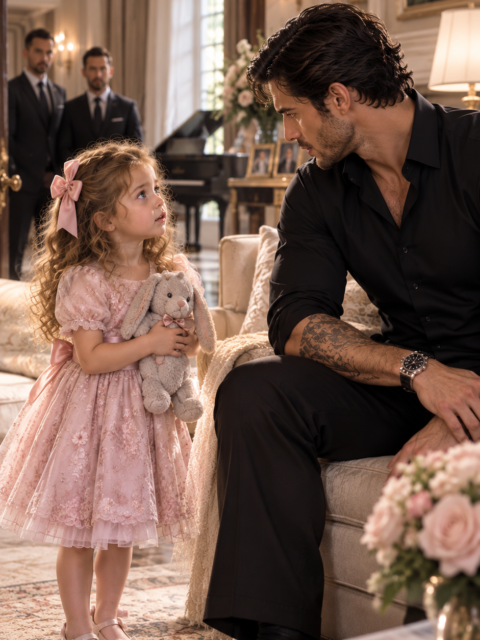
“Get your daughter away from him. Now.” The guard’s warning came too late. My four-year-old daughter was already sitting on Damian Volkov’s bed, her tiny hand pressed gently over the dying mafia boss’s heart.
For weeks, I had watched nurses enter that room and leave in tears. Some were fired within minutes. Others never returned. Damian refused medicine, rejected help, and threatened anyone who showed him pity.
At Grayhaven House, everyone knew the rule. Never open Damian Volkov’s door.
Then my deaf four-year-old daughter broke it.
I had brought Lila to work that rainy Tuesday because I had nowhere else to leave her. Her yellow rain boots squeaked across the kitchen floor, and the pink hearing device behind her ear showed beneath her uneven braids.
I knelt in front of her. “Stay in the servants’ room, sweetheart. Promise?”
She hugged her battered cloth rabbit. “I promise, Mommy.”
For thirteen minutes, she did. Then curiosity won.
While I scrubbed dishes, Lila wandered into the marble hallway and found the forbidden bedroom door slightly open. Inside was the man Baltimore spoke about like a storm.
Years earlier, Damian Volkov had controlled entire streets. Men feared disappointing him more than they feared prison. Then someone he trusted poisoned his wine. Now Damian could barely lift one hand without pain.
Lila didn’t know any of that. She only saw a sick man sitting alone.
Chapter Two
“Don’t”
When she entered, Damian was propped against his pillows, one trembling hand pressed against his chest. Sweat covered his forehead. His jaw was clenched as he fought through pain he refused to let anyone witness.
Lila understood pain differently from adults. She walked inside. Then climbed onto his bed.
By the time I found her, my blood turned cold. “Lila!”
Two guards rushed in behind me. Damian’s eyes snapped toward us. I expected rage.
Instead, he raised one trembling finger. “Don’t.”
Everyone stopped.
Chapter Three
Something Was Dissolving
Lila looked at him, unable to hear the fear filling the room. Then she placed her tiny palm over his heart. Damian stared at her hand. Slowly, something changed in his face. The ruthless man who had thrown doctors, nurses, and lifelong employees out of his room suddenly looked almost frightened.
Lila studied him for several seconds. Then she began signing.
I watched her small fingers move. Damian looked at me. “What did she say?”
My throat tightened. “She said your heart hurts.”
His expression hardened. “She can see that?”
I shook my head. “No.”
Lila touched his chest again before signing another sentence. This time, I couldn’t speak.
Damian’s eyes narrowed. “What did she say?”
I looked at the man everyone feared and translated the words my daughter somehow understood before any of us did. “She said, ‘Not here.'” I touched my chest. “‘Somewhere deeper.'”
Damian went completely still. Then his eyes filled with something I never thought a man like him could still feel. Fear.
Because behind me, one of his guards had just dropped a silver tray. And inside Damian’s medication glass, something was dissolving.
Chapter Four
What Was in the Glass
The guard who’d dropped the tray — a broad-shouldered man named Grant who’d been with the household barely three months — stood frozen, staring at the spreading stain on the carpet as though the sound alone might undo what his own hands had just given away.
Damian’s head of security, a grim, methodical woman named Petrova who’d run his protection detail for over a decade, moved fast despite her age, snatching the medication glass off the nightstand before anyone could touch it. “Nobody drinks anything else in this room until I say so.”
“You think it’s happening again,” Damian said. It wasn’t a question. His voice had lost none of its old authority even trembling with pain.
“I think a four-year-old girl who has no medical training just told you your heart hurts somewhere deeper than any doctor has found,” Petrova said, “and a guard just dropped a tray the second she said it. I’m not interested in coincidence today.”
The glass, rushed to Damian’s private physician within the hour, confirmed what Petrova had already suspected. A compound, chemically similar to the one used in the poisoning eight months earlier, dissolved slowly enough to avoid detection in a single dose but clearly intended to accumulate — a second attempt, patient and quiet, on a man already weakened enough that a slow decline might never be questioned as anything but the lingering damage from the first attack.
“Someone has been poisoning me twice,” Damian said slowly, looking at Lila, who was still perched calmly on the edge of his bed, entirely unbothered by the chaos she couldn’t hear unfolding around her. “And a child who can’t hear a word in this room is the only one who noticed before it finished the job.”
Chapter Five
The New Guard
Petrova’s investigation began exactly where Grant’s dropped tray had pointed, though she was careful, in the days that followed, not to let her suspicion narrow too quickly onto one frightened young guard who might simply have panicked at bad timing rather than guilt.
Grant, questioned at length, insisted he’d only been delivering the tray as instructed by the kitchen staff, and a review of the household’s meal preparation logs seemed, initially, to support him — the compound hadn’t been in the water pitcher, hadn’t been in the food, had appeared, somehow, only in the specific glass meant for Damian’s evening medication, mixed at a point in the chain of custody that narrowed the suspect list considerably.
Only three people had handled that glass between the pharmacy delivery and Damian’s nightstand: the household’s longtime pharmacist, who’d served the family for fifteen years without incident; Marina, whose own daughter’s discovery made her an unlikely suspect even to Petrova’s naturally suspicious mind; and a relatively new hire, brought on six weeks earlier to cover an unexpected staffing gap, a quiet, competent young man named Sergei who’d come with strong references from a rival household and had, by every account, been an exemplary employee.
“Six weeks,” Petrova said, laying Sergei’s personnel file out for Damian to review. “Hired right around the time your recovery started showing enough progress that a second, quieter attempt might actually succeed where a second obvious poisoning would raise immediate alarm.”
Damian studied the photograph clipped to Sergei’s file for a long moment, something flickering behind his eyes that Petrova, watching closely, couldn’t quite identify. “Bring him to me,” he finally said. “Alone. I want to look him in the eye before anyone touches him.”
Chapter Six
Marina’s Fear
Iwon’t pretend I wasn’t afraid, those first few days, of what my daughter’s small hands had accidentally uncovered. A man like Damian Volkov didn’t need much of a reason to make an inconvenient witness disappear, and Lila, however innocently, had just become the reason an entire second poisoning plot was falling apart in real time.
But something had shifted in him since the moment she’d touched his chest, something I couldn’t fully explain even to myself. He asked, the following morning, whether Lila might sit with him again — not examine him, not perform whatever unexplainable intuition she’d shown, just sit, the way she had before any of us understood what was happening.
“I don’t know how she knew,” I admitted, the third time he asked. “She’s never done anything like that before. I think, honestly, she just saw someone in pain and did what she’d do for me on a hard night. I don’t think there’s anything mystical about it. I think there’s just something about not being able to hear the fear in a room that lets her actually see the person underneath it.”
Damian was quiet for a long moment. “Everyone else who walks into this room hears exactly what they’re supposed to be afraid of before they’ve even looked at my face. She’s the only person in eight months who’s looked at me and seen a man in pain instead of a monster worth avoiding.”
I didn’t know what to say to that, so I said nothing, and simply let Lila climb back onto the chair beside his bed the way she asked to, every day, for the rest of that difficult week.
It was during one of those quiet afternoons, Lila coloring contentedly beside him while Damian rested, that Petrova finally brought Sergei into the room — and I watched Damian’s entire body go rigid the moment he saw the young man’s face up close.
Chapter Seven
Sergei’s Sister
“You have her eyes,” Damian said quietly, before Petrova had even finished explaining why she’d brought him.
Sergei’s composure, carefully maintained through weeks of infiltration, finally cracked. “You remember her, then. I wasn’t certain you would. I don’t imagine she was significant enough to you to leave much of an impression.”
“Katya,” Damian said. “Katya Orlov.”
“My sister,” Sergei confirmed, his voice shaking now with something that had clearly been building for far longer than the six weeks he’d spent working inside this house. “You had her killed eleven years ago, over a debt her husband owed you that she had nothing to do with. She was twenty-three. She left behind a son who barely remembers her now.”
The room went very still. Even Lila, sensing something in the tension though she couldn’t hear a word of it, looked up from her coloring and watched the adults’ faces with careful attention.
“I’ve spent eleven years building a life that would eventually let me get close enough to you to finish what should have happened the day you gave that order,” Sergei continued. “I got hired here specifically for this. I poisoned your wine eight months ago through a contact I paid considerably more than I could afford. When that didn’t finish the job fast enough, I took a position here myself to make sure the second attempt didn’t fail the same way.”
“Why tell me any of this now,” Damian asked quietly, “instead of simply denying it and hoping Petrova’s evidence wasn’t strong enough to hold up?”
Chapter Eight
What Damian Did
Sergei’s eyes moved, almost involuntarily, toward Lila, still sitting quietly beside Damian’s bed with her crayons. “Because I watched a four-year-old girl who can’t hear a word in this room walk in and see a dying man instead of a monster, and it made me wonder, for the first time in eleven years, whether I actually knew the whole story about who you are now, or only the story about who you were the day my sister died.”
Damian was silent for a long moment, and when he finally spoke, his voice carried none of the authority I’d grown used to hearing from him, only something considerably rawer. “I remember the order. I’ve remembered it every day for eleven years, if I’m honest, though I never once had the courage to say that to anyone before this moment. Katya’s husband owed money to a man I’d since cut ties with entirely, over a debt I inherited rather than created, and I let my own people convince me that making an example of the debt, regardless of who actually owed it, mattered more than finding out whether the woman attached to it deserved what happened to her.”
“That’s not an apology,” Sergei said.
“No,” Damian agreed. “It’s an admission. I don’t think I’ve earned the right to call anything I say to you an apology yet. I think that’s something you’d have to decide I’d earned, considerably further down the road than this conversation, if you ever decided it at all.”
Petrova, standing near the door with her hand still resting near her weapon, looked between the two men with visible uncertainty about what her boss actually intended to do next.
Chapter Nine
The Confession
Sergei gave a full account over the following hour, at Damian’s request rather than under any threat — the debt collector he’d paid to poison the wine eight months earlier, the careful planning behind securing a position inside the household, the slow, patient dosing he’d been administering through the medication glass for the past several weeks, calibrated deliberately to avoid the kind of sudden, obvious symptoms that had triggered the first investigation.
“I want you to understand,” Sergei said, once he’d finished, “that I don’t regret trying. I regret, considerably, that a four-year-old girl nearly witnessed the end result of something she had no part in and no way of understanding. That’s the only part of this I’d take back if I could.”
“What did you plan to do afterward?” Damian asked. “If it had worked.”
“I hadn’t planned that far,” Sergei admitted. “I think, somewhere underneath eleven years of planning the how, I never actually let myself think about the after. Maybe because some part of me understood that killing you wouldn’t actually give Katya’s son his mother back. It would just mean one more child grew up with a parent taken from him for reasons that had nothing to do with anything he’d done.”
Damian looked at Lila again, still coloring, still entirely unaware of the weight of the conversation happening a few feet away from her. “I have a decision to make about you, Sergei, and I find I’m considerably less certain what the right one is than I would have been eleven years ago, before a little girl who can’t hear reminded me what it actually costs to look at someone and only see a threat.”
“What decision?” Petrova asked carefully, watching her employer with an expression that suggested she genuinely didn’t know which answer to expect.
Chapter Ten
Damian’s Choice
Damian didn’t hand Sergei over to the kind of justice his organization had traditionally handled internally, and he didn’t simply let him walk free either. What he chose instead surprised nearly everyone in that room, including, visibly, Sergei himself.
“You’re going to formally confess to the poisoning, in writing, to the authorities, with full details of both attempts,” Damian said. “I’m not going to stop that from happening, because I think Katya deserves a record that exists somewhere beyond my own memory of what I did to her. But I’m also going to make sure the record includes exactly why you did it, and I’m going to personally fund her son’s education and provide for his mother’s family going forward, as restitution I should have offered eleven years ago instead of an execution order.”
“You’d let me go to prison for trying to kill you,” Sergei said slowly, “while paying for my nephew’s education at the same time.”
“I’d let the law decide what your actions cost you,” Damian said. “I don’t get to decide that anymore, not with any honesty, given what my own past actions cost your family without ever once facing a courtroom myself. What I can decide is whether Katya’s memory gets buried alongside two failed poisoning attempts, or whether it gets the acknowledgment I should have given it eleven years ago.”
Sergei’s composure, held together through the entire confession, finally broke completely. “I came here to kill you. I never once expected you to offer my family anything but more grief.”
“I spent eleven years being the man who ordered your sister killed without a second thought,” Damian said quietly. “I’d like to spend whatever time I have left being someone considerably different, starting with this. It doesn’t undo what I did. It’s simply the only honest thing left for me to offer.”
Chapter Eleven
Lila’s Gift
Damian’s physical recovery accelerated remarkably once the poisoning stopped and proper treatment finally had a chance to work without being quietly undermined — strength returning to his hands within weeks, the pain that had kept him gray-faced and trembling for months finally, gradually, loosening its grip.
He credited Lila with more of that recovery than any doctor was comfortable acknowledging in a medical chart, though I understood, watching them together in the months that followed, that what she’d actually given him wasn’t a diagnosis so much as a reason to let himself be treated at all. Every nurse before her had been met with suspicion and refusal. Lila, unable to hear his reputation, unable to hear the fear that colored every other adult’s approach to him, had simply seen a person in pain and responded the only way she knew how — directly, gently, without any of the caution his reputation usually demanded from people.
“She taught me something I don’t think any adult in my life would have had the standing to teach me,” Damian told me once, watching Lila color quietly at his bedside table. “That being frightening doesn’t actually protect you from anything that matters. It just means the only people who ever get close enough to help you are the ones too innocent to know they’re supposed to be afraid.”
He learned enough sign language, over those months, to communicate with her directly rather than always through me — clumsy at first, then steadily more fluent, driven by a determination I’d never once seen him apply to anything else in the time I’d worked in that house.
“Thank you,” he signed to her one afternoon, slowly, carefully, the first full sentence he’d managed entirely on his own. Lila beamed, and signed back without hesitation: “Your heart is better now.”
Chapter Twelve
What Remained
Sergei’s case, once it reached the courts, resulted in a considerably lighter sentence than either poisoning attempt might otherwise have carried, thanks in large part to Damian’s own public testimony about the debt his organization owed the Orlov family — testimony that cost him considerably in reputation among the kind of men who’d once feared him, and that he offered anyway, without hesitation, once he’d decided what kind of man he wanted to be for whatever time he had left.
Katya’s son, now a teenager, received the first installment of his education fund the same month Sergei’s sentencing concluded — an arrangement Damian insisted remain private, uninterested in using it to repair his own reputation, wanting it to exist simply because it was owed rather than because it made a useful story.
I kept my position at Grayhaven House long after it became clear I no longer needed to worry about losing it over Lila’s thirteen unsupervised minutes. Damian offered, more than once, to move us into considerably more comfortable arrangements than the servants’ quarters, and I accepted, eventually, once I understood the offer came from genuine care rather than obligation.
Lila still visits him most afternoons, climbing onto the same chair beside his bed, and Damian, stronger now than he’d been in over a year, still makes time for her before any meeting, any business, anything the rest of his rebuilt world considers urgent. The rule about his door changed entirely, in the end — not never open it, but simply knock first, the way you would for anyone whose heart, it turned out, had been asking to be understood far longer than anyone but a deaf four-year-old had thought to notice.