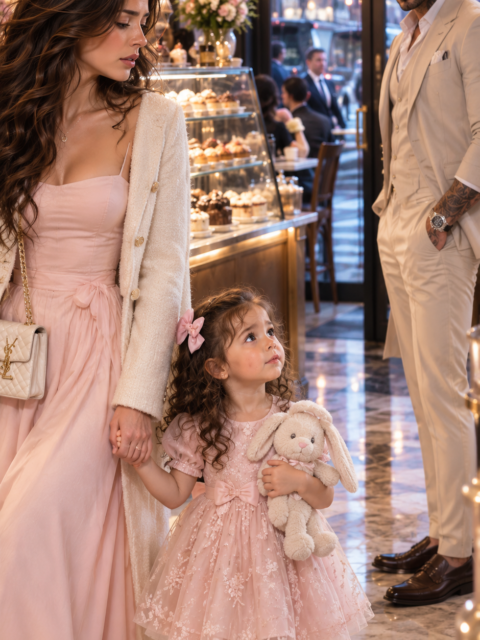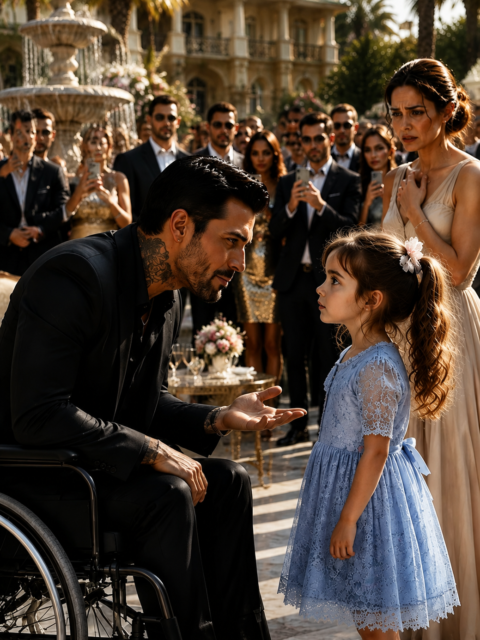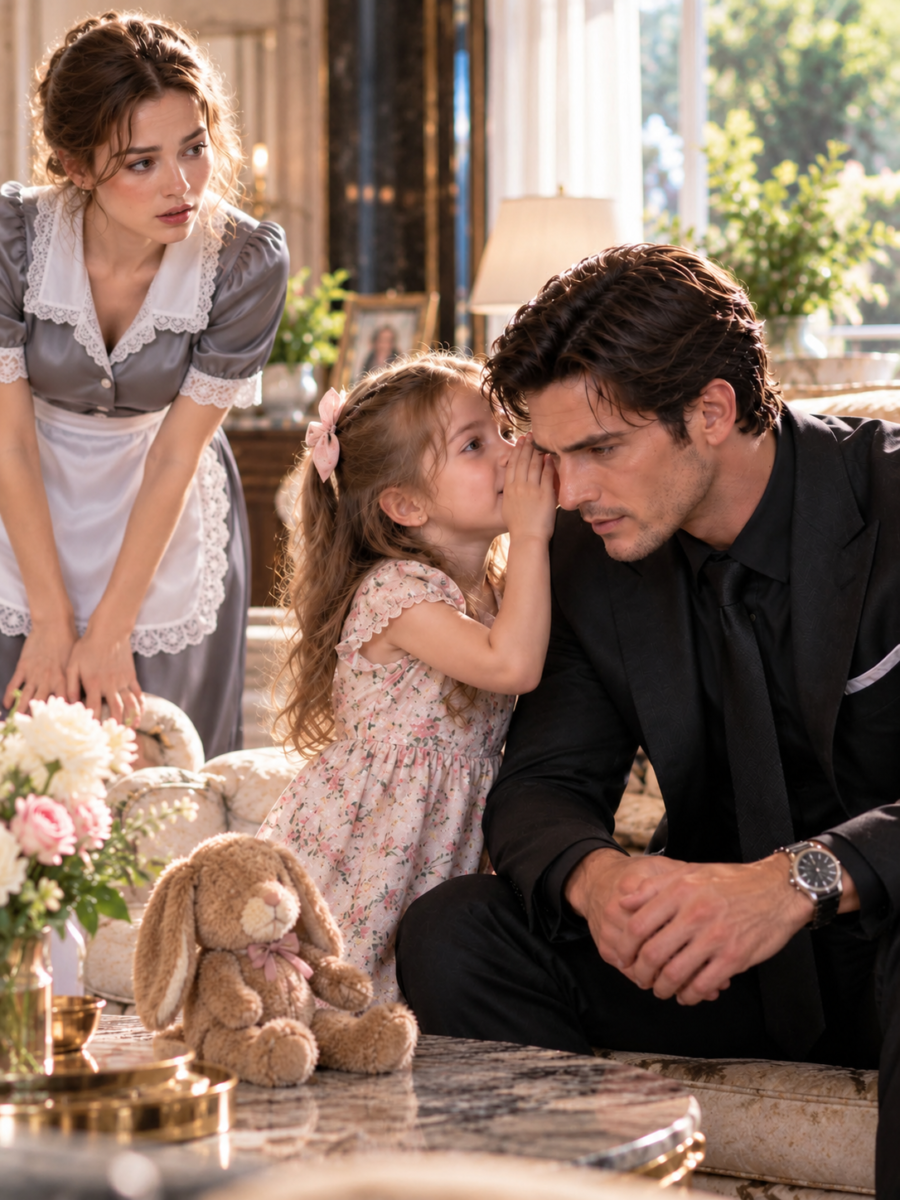
Elena had spent ninety days hiding her eight-month-old daughter inside Alessandro Duca’s penthouse, relying on a quiet, patchwork network of doormen, downstairs neighbors, and a produce vendor willing to warm bottles just to keep her job and her daughter fed at the same time. She never expected Mia to crawl clear across the marble floor into the middle of a forty-million-dollar video conference, grab the tie of the most feared man in the building, and demand to be picked up. She certainly never expected Alessandro’s composure to shatter completely the instant his eyes landed on a thin silver pendant around her daughter’s neck — a pendant he recognized immediately, because he’d watched it buried with his younger brother’s coffin twenty years earlier, or believed he had, right up until the moment a hidden baby’s collar revealed it resting against her small chest instead. This is a thirteen-chapter story about a presumed death that was never quite as final as an entire family believed, a secret Elena never knew she was carrying alongside her daughter, and the fractured Duca family a hidden baby’s stumble finally brought crashing back together after two decades of grief nobody realized had been built on an incomplete truth. Read all thirteen chapters to find out what really happened to Alessandro’s brother twenty years ago, how his pendant ended up around Mia’s neck, what it took to trace a deliberately buried identity back through two decades of silence, and what Alessandro chose to do once he understood exactly who he’d nearly fired from his own household.
Chapter One
How Long Has She Been Here
“How long have you been hiding a baby in my home?” My blood went cold.
Eight-month-old Mia sat on the white marble outside Alessandro Duca’s office, one tiny fist wrapped around the black silk tie of the most feared man I had ever worked for. His forty-million-dollar video conference with Zurich was still glowing on the monitor behind him. And my daughter was trying to use him as furniture.
“Mia!” I nearly dropped the laundry basket.
Alessandro looked down as she tugged his tie again. Mia grinned and raised both arms. Pick me up.
For perhaps the first time in his life, Alessandro Duca looked genuinely uncertain. I didn’t. I knew exactly what came next. I was getting fired.
“I’m so sorry, Mr. Duca.” I rushed toward them. “I went to the bathroom for two minutes. She was on her mat. She’s never crawled this far before.”
His eyes narrowed. “She crawled from the laundry room?” “Yes.”
Then his expression changed. “How long has she been here?” “Three minutes. Maybe less.” “No.” His gaze locked onto mine.
“How long has your daughter been coming into my home?”
Chapter Two
Ninety Days
My stomach dropped. I thought about lying. Instead, I whispered, “Three months.”
Silence. Rain tapped against the penthouse windows.
“Three months,” he repeated. “Yes.” “You have hidden an infant in my penthouse for ninety days.” I swallowed. “Yes.”
“Who knows?” “The doorman.” “Raymond?” I nodded. “Who else?” “Lucia downstairs. Sometimes the produce delivery man. Rosa at the market lets me warm bottles there.”
His face became unreadable. An entire secret network of ordinary people had been helping me survive. Holding elevator doors. Storing formula. Watching Mia while I changed linens. Because childcare cost more than I could afford, and losing this job meant losing everything.
Alessandro looked at my worn uniform, then at the baby still gripping his tie. “Why?”
Chapter Three
Nowhere Else to Take Her
My throat tightened. “Because I had nowhere else to take her.”
He said nothing. “If you fire me, I understand.”
Mia suddenly pulled herself upright against his leg. Then she stumbled. Alessandro caught her before I could move. His hands closed around her tiny body with startling gentleness. Mia immediately rested her head against his chest.
I stopped breathing. So did he.
For several seconds, the most feared man in the building simply stared at my daughter. Then his eyes dropped to something beneath the collar of her sweater.
A thin silver chain. His entire body went rigid.
Chapter Four
The Silver Pendant
Carefully, Alessandro pulled the tiny pendant into view. The color vanished from his face.
“Elena.” I had never heard fear in his voice before. “Where did Mia get this?”
“It belonged to her father.”
His fingers tightened around the pendant.
Then Alessandro looked at my daughter as though the dead had just reached through twenty years to touch him.
Chapter Five
Marco Duca
He sat down heavily in the nearest chair, still holding Mia with the same careful gentleness, his other hand not releasing the pendant even as his composure visibly fought to reassemble itself. “This belonged to my brother,” he said finally. “Marco. My younger brother. I watched this exact pendant placed inside his coffin twenty years ago, at a funeral I still remember in more detail than I’d like.”
“That’s not possible,” I said. “Mia’s father wore this every day. He told me it was passed down from his own father.”
“Tell me his name,” Alessandro said. “Mia’s father. Your husband, or—”
“We weren’t married,” I said. “His name was Daniel. Daniel Rossi. He died eleven months ago, before Mia was born. A heart condition, sudden, no warning at all.”
Alessandro’s expression shifted through several emotions too quickly for me to fully track — grief, confusion, something that looked almost like desperate hope fighting against decades of certainty. “Rossi,” he repeated slowly. “Not Duca.”
“Should it be?” I asked, watching him study my daughter’s face with an intensity that frightened me more than his earlier questions about the hidden months had.
Chapter Six
Elena’s Story
“I need you to tell me everything you know about Daniel,” Alessandro said, his voice considerably gentler than the interrogation about Mia’s hidden months had been. “His parents. Where he grew up. Anything at all.”
“He was raised by his mother alone,” I said, working to recall details I’d never once thought would matter this much. “He told me his father died when he was very young, before he had any real memories of him. His mother remarried when he was seven, and he took his stepfather’s last name, Rossi, not long after. He rarely spoke about his biological father at all, beyond mentioning the pendant had belonged to him.”
“Did he know his father’s name? Anything about where his father’s family came from?”
“He said his mother told him almost nothing,” I said. “That his father died before they could properly document anything, and that she’d remarried quickly enough afterward that the subject simply stopped coming up in their household. He always seemed more curious than pained about it, if that makes sense — like an unsolved mystery rather than an open wound.”
Alessandro closed his eyes briefly, something working behind his controlled expression that looked, to my surprise, considerably more like grief than suspicion. “Twenty years ago,” he said slowly, “my brother Marco was declared dead after a violent conflict with a rival organization. His body was never actually recovered. We held a funeral, buried an empty casket with his personal effects, including this exact pendant, because our family needed somewhere to grieve even without a body to confirm it.”
“You’re saying you’re not certain he actually died,” I said slowly, the shape of what Alessandro was suggesting beginning to take a form I could barely process.
Chapter Seven
Tracing the Connection
“I’m saying I need to find out,” Alessandro said, already reaching for his phone with the same controlled urgency I imagined he brought to considerably higher-stakes business matters. “If Marco survived that conflict twenty years ago, disappeared, built an entirely new life, married, and had a son who never knew his true father’s identity — that would explain everything about Daniel that you’ve just described, down to the exact pendant he apparently inherited without ever understanding its full history.”
His private investigator, summoned within the hour despite the late notice, began the delicate work of tracing Daniel Rossi’s biological father’s identity through records that had been, by design, considerably harder to access than an ordinary birth certificate search — Marco’s presumed death twenty years ago had apparently come with a level of official finality that would need to be carefully, formally reopened.
“If your brother survived and started a new identity,” the investigator explained, “he likely did so deliberately, understanding that whatever conflict nearly killed him meant staying dead, officially, was safer than resurfacing. That kind of careful disappearance leaves a very particular kind of paper trail — thin, deliberately obscured, but not always perfectly invisible.”
Three days of careful investigation surfaced a birth record for Daniel, born under a different surname twenty years ago in a small town three states away, to a mother named Christine and a father listed only as “M. Rossi” — a partial name that matched neither confirmation nor denial on its own, but that Alessandro stared at for a long time before speaking again.
“That was the alias Marco used the last time anyone in the organization heard from him,” Alessandro said quietly, “six weeks before his presumed death. I remember it because I was the one who relayed the message to our father.”
Chapter Eight
The Truth About Marco
The fuller picture, assembled over the following weeks through careful, patient investigation, confirmed what Alessandro had begun to suspect the moment he recognized that pendant: Marco Duca had indeed survived the conflict that nearly killed him twenty years ago, badly wounded but alive, rescued by a stranger who nursed him back to health far from anywhere his enemies would think to look.
Rather than return to a family and organization he’d apparently grown deeply disillusioned with even before the near-fatal attack, Marco chose to let his presumed death stand, building an entirely new, quiet life under a partial alias, marrying Christine, raising a son he clearly loved enough to eventually pass down the one physical piece of his old identity he couldn’t bring himself to fully discard.
“He never told Daniel the truth,” the investigator reported, having tracked down Christine herself, now elderly, still living in the same small town where she’d raised her son largely alone after Marco’s own death from natural causes fifteen years ago. “She confirmed everything. Marco told her the pendant was a family heirloom, deliberately vague about the specifics, terrified even years later that reconnecting with his old identity might somehow endanger the family he’d built in hiding.”
“He died still hiding,” Alessandro said, something raw and grief-stricken finally breaking through his careful composure. “Fifteen years ago, and our family spent that entire time still grieving a death that happened considerably later than we believed, for reasons we never got the chance to understand or forgive.”
“Christine says he never stopped missing you,” the investigator added quietly. “She said he used to talk about a brother he’d left behind, always with more regret than the story he told everyone else about family he’d simply outgrown.”
Chapter Nine
Confirmation
ADNA test, arranged carefully and respectfully once Christine agreed to provide a sample confirming Marco’s paternity of Daniel, and compared against Alessandro’s own DNA, confirmed definitively within two weeks what the pendant, the birth record, and Christine’s account had already made almost certain: Daniel had been Marco’s son, making him Alessandro’s nephew, and making Mia, asleep now in a nursery Alessandro had quietly begun furnishing without fully announcing his intentions, his great-niece.
“Twenty years,” Alessandro said, sitting with the confirmed results in a study considerably quieter than his usual command center of an office. “Twenty years believing I’d lost my only brother, when he was alive for fifteen of them, close enough that a proper search might have found him if any of us had ever once questioned the official story.”
“You couldn’t have known,” I told him, understanding by then considerably more about the family history my daughter had unknowingly walked into the middle of. “He built his disappearance carefully specifically so nobody would look.”
“That doesn’t make the loss easier,” Alessandro said. “It makes it considerably more complicated. I’m grieving a brother twice now — once for the death I believed happened twenty years ago, and again for the fifteen years afterward when he was alive and chose, deliberately, never to let me know.”
“What happens now?” I asked, watching him look toward the nursery where my daughter, his great-niece, slept peacefully, entirely unaware of the family history her small, stumbling steps had just permanently rewritten.
Chapter Ten
Grief and Joy
“Now I have a great-niece I intend to actually know,” Alessandro said, “regardless of how complicated the path to finding her turned out to be. That part isn’t negotiable, Elena. I’ve lost enough of my family to secrets and distance already.”
What followed, over the following weeks, was a careful, deliberate process considerably different from the fear I’d carried through three months of hiding — Alessandro present for Mia’s daily routines not as an employer discovering an inconvenient secret, but as family finally given the chance to show up.
“I used to imagine what Marco’s life looked like, wherever he was,” Alessandro admitted one evening, watching Mia sleep with an expression I’d never once seen from him during ordinary business hours. “I never once imagined it looked like this. A son. A grandchild he never met. An entire family built quietly, deliberately, kept safe by staying hidden from exactly the world I represent.”
“Does that anger you? Knowing he chose to stay hidden from you specifically?”
“It did, initially,” Alessandro admitted. “I’ve had time to sit with it differently now. He built something safe. Something that let his son grow up without the particular danger our family’s name has always carried. I understand that choice considerably better than I want to admit.”
“And Mia?” I asked. “What does she become to you, now that you understand exactly who she is?”
Chapter Eleven
Making It Right
“She becomes the reason I stop letting my own household run on secrets and quiet suffering nobody thinks to ask about,” Alessandro said, and the following weeks bore that out considerably more thoroughly than I expected from a single emotional evening’s declaration.
He established, formally and permanently, a childcare arrangement that made my three months of hidden desperation entirely unnecessary going forward — an on-site nursery for household staff, a policy nobody had ever thought to implement despite how many employees, it turned out once he actually asked, had been quietly struggling with exactly the same impossible math I had.
“How many other people have been hiding something similar,” he said, genuinely troubled by what a simple policy review revealed, “because they were too afraid to ask a man they assumed wouldn’t care?”
My own position transformed considerably beyond household staff, Alessandro insisting on establishing a formal trust for Mia’s future that reflected her actual place in his family rather than any temporary act of charity, along with security and stability I’d spent months believing were permanently out of reach.
“I’m not offering this because I feel obligated,” he told me, when I hesitated to accept terms that still felt too generous to trust completely. “I’m offering it because Mia is my family, and family doesn’t hide in laundry rooms while I have the resources to make sure they never have to.”
Chapter Twelve
A New Family
Over the following year, Mia grew up surrounded by a family considerably larger than the two of us had ever expected — Alessandro’s own household staff, once they understood the full story, treating Mia with a particular warmth that made clear how many of them had quietly known about my hidden months and simply chosen never to report it.
“Raymond told me once,” Alessandro admitted, “early on, before I knew any of this, that he thought I ran too cold a household for people to feel safe asking for help. I dismissed it at the time. I understand now exactly what he meant.”
Christine, Marco’s widow and Daniel’s mother, visited eventually, a reunion considerably more complicated than a simple joyful gathering given the decades of separation and grief involved, but one that gave both families a fuller, more complete picture of exactly who Marco had become in the years he’d spent hidden from the brother who never stopped missing him.
“He talked about you until the end,” Christine told Alessandro, during that first careful visit. “Not often. But when he did, it was always with more love than the story of a man who’d simply walked away would suggest.”
Mia, blessedly unaware of the enormity of the family history her small, curious crawl across a marble floor had unraveled, simply grew up surrounded by more love than either Elena or Alessandro had believed possible three months into a desperate, hidden secret neither of them expected to end this way.
Chapter Thirteen
What Remained
Two years after that terrifying, transformative afternoon in Alessandro’s office, Mia’s silver pendant sat framed in his study rather than around her neck daily, preserved carefully alongside a new photograph of Marco that Christine had finally shared — the first image Alessandro had seen of his brother in over two decades, considerably older than the young man he remembered, but unmistakably, achingly familiar.
The household nursery Alessandro established remained fully staffed and permanently funded, a policy change that had, according to his own household manager, transformed morale among his staff more thoroughly than any raise or benefit adjustment in years.
I stayed on with the family, my role considerably transformed from the frightened housekeeper who’d once hidden a baby in a laundry room, though the exact shape of what I’d become in that penthouse took considerably longer for either Alessandro or me to fully articulate than the practical details of Mia’s new life required.
Mia grew up knowing her great-uncle not as the most feared man in the building, but simply as the person who’d caught her the first time she stumbled, and who’d never once let go since — proof, if she ever needed it, that sometimes the family you’re looking for finds you first, in the middle of an ordinary Tuesday afternoon, tugging on a stranger’s tie because she’d simply decided he looked like someone worth knowing.