Lena Marsh hid her eight-month-old daughter in a supply closet because she had no sitter, no money, and no room left for one more missed shift. When the closet turned up empty during the dinner rush, a single white thread from Nora’s blanket led her through a door she’d been warned never to touch — down into the world beneath Calloway’s, where she found Gideon Calloway holding her daughter like the most fragile thing in the building. This mafia family story follows a mother running out of options, a feared man’s unexpected tenderness, and a threat neither of them saw coming until it was already inside the restaurant. Read all nine chapters to find out how Nora really ended up in his arms.
Chapter One
The Empty Closet
At 5:20 that evening, I opened the supply closet and my eight-month-old daughter was gone.
I’d hidden Nora at work because I had no one else to watch her. No money for a sitter. One more missed shift and I’d lose this job — and my apartment next. For an hour, my plan had worked. Then the dining room filled, and by the time I got back to check on her, the closet was empty.
I searched everywhere. The break room. The walk-in. Behind the host stand, in case someone had found her crying and carried her out front by mistake. My hands had gone cold enough that I could barely check my phone for the time.
Then I found it — a single white thread from her blanket, caught on a splinter near a door at the end of the back hallway. A door I’d been warned never to touch. The forbidden entrance to the world beneath Calloway’s, where the restaurant’s owner conducted business no one dared ask about.
I stepped through anyway.
Fourteen stairs down, I found him.
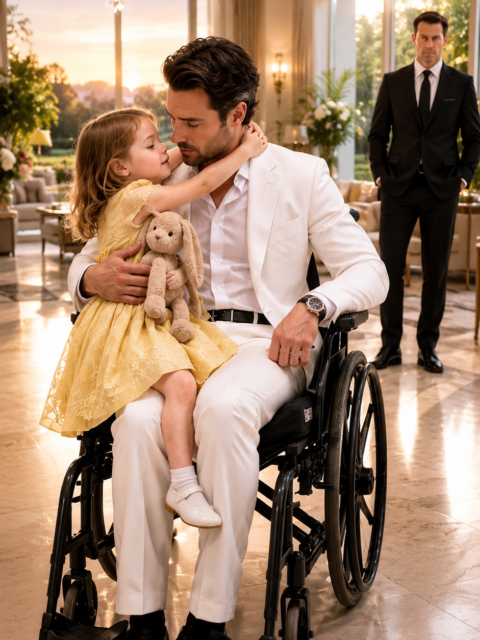
The most feared man in Chicago sat in a leather chair by a low fire, tattoos disappearing beneath his rolled sleeve. My daughter was curled against his chest. Her rabbit tucked beneath her arm. His hand covered nearly the entire width of her back.
He wasn’t holding her carelessly.
He was protecting her.
My shoe creaked against the old wood. His eyes opened instantly — alert, but his arm never loosened around her. He looked at me like he already knew exactly why I’d come.
“You’re late, Lena,” he said, low and even. “Close the door.”
Chapter Two
You’re Late, Lena
I didn’t move. “Give her to me.”
“I will.” His voice stayed calm, unhurried, a tone I recognized from the handful of times I’d overheard him speaking to his own men — the tone of a man who never needed to raise his voice to be obeyed instantly. “Close the door first. This isn’t a conversation for the hallway.”
I closed it, my whole body trembling, and crossed the small stone room toward him. He shifted forward in the chair, easing Nora carefully into my arms rather than simply handing her over, one hand steadying her head until I had a proper hold. She stirred, made a small, sleepy sound, and settled instantly against my shoulder, entirely unbothered by the last twenty minutes of my life.
“How did she get down here?” I demanded, my voice cracking despite every effort to keep it steady.
Gideon Calloway studied me for a long moment before answering. “Sam brought her to me. About twenty minutes ago. There was a situation upstairs, and he made a judgment call that this was the safest place in the building for her.”
“A situation.”
“Two men who don’t work here walked through the dining room during the rush, took a slow look at the layout, and left without ordering anything. Sam’s spent enough time around this business to recognize what that looks like.” Gideon’s expression stayed level, but something behind his eyes had gone considerably colder. “He didn’t know whose baby was in that closet. He only knew there was one, unattended, near a door those two men walked directly past on their way out.”
My knees went weak enough that I sat down hard in the chair across from him without being invited to.
“Someone was scouting the restaurant,” I said slowly, “and Sam thought my daughter might be in danger because of it.”
“I don’t think, Lena,” Gideon said quietly. “I know. And now that you’re standing in my private office instead of upstairs where you’re supposed to be working your shift, I think it’s time you and I had an honest conversation about exactly why you’ve been hiding an infant in my supply closet for the last three weeks.”
Chapter Three
No One Else to Watch Her
I hadn’t realized he knew. Three weeks of careful timing, of tucking Nora into the closet with a portable fan for white noise and a monitor clipped to my apron, of praying every single shift that no one opened that particular door at the wrong moment — and the owner of the restaurant had apparently known the entire time.
“I didn’t have a choice,” I said, the exhaustion of three weeks finally cracking something open in my chest. “Nora’s daycare closed in January. Underfunded, they said, effective immediately, no warning beyond a letter taped to the door. I make eleven dollars an hour plus tips. A private sitter costs more than I make in a full shift. My mother’s in Ohio and can’t help. Nora’s father left before she was born.” I hated how the words tumbled out, unpolished and raw, in front of a man whose reputation had scared me from my very first day working there. “I told myself if I could just get through a few more weeks, I’d have enough saved for a real daycare deposit. I never meant to put her in danger. I thought a locked closet was safer than leaving her with strangers.”
Gideon was quiet for a moment, his expression unreadable in the low firelight. “How long have you worked here?”
“Four months.”
“And in four months, no one on my staff thought to mention this to me directly.”
“I begged them not to. I told the kitchen staff I’d lose the job if it got back to management. I didn’t realize you’d count as management for something like this.”
Something that might have been the ghost of a smile crossed his face, gone before it fully landed. “I own the building, Lena. I count as management for everything that happens inside it, whether people remember that or not.”
Nora stirred again against my shoulder, and Gideon’s eyes followed the movement with an attention that seemed, to me, entirely too soft for a man three weeks of restaurant gossip had described as capable of ending careers and worse with a single phone call.
“You’re not fired,” he said finally, watching my shoulders sag with relief before he continued. “But you are going to tell me exactly why two unfamiliar men were scouting my dining room tonight, on the same evening your daughter happened to be hidden twenty feet from the one door in this building I’ve spent considerable money keeping private.”
Chapter Four
What Sam Saw
Gideon called Sam Whitlow down to the office to walk through exactly what he’d seen, and the eighteen-year-old busboy arrived visibly nervous, glancing between his boss and the baby in my arms as though trying to determine which one he was actually in trouble over.
“I wasn’t trying to scare anyone,” Sam said quickly. “I just — table twelve mentioned two guys had been standing near the kitchen pass for a while without ordering, kind of watching the layout instead of waiting for a table. I went to check it out myself, and I recognized one of them from a photo Frank showed the staff a few months back. Guy who used to run with the Draven crew before some falling out.”
Gideon’s jaw tightened slightly at the name. “You’re certain.”
“Pretty certain. He had the same tattoo Frank pointed out — the raven wing thing, on his forearm.” Sam shifted uncomfortably. “I know the closet’s not supposed to be my business, but I’d seen Lena go in and out of it enough times this month to guess something was in there worth checking on, especially with strangers walking that exact hallway. So I grabbed the baby and brought her down here, since I figured this was the one place in the building nobody unfamiliar gets past.”
“You did the right thing,” Gideon said, and Sam’s shoulders visibly dropped with relief.
Once Sam left, Gideon sat back slowly, something calculating settling behind his expression that had nothing to do with Nora at all.
“The Draven family,” I said carefully. “I’ve heard the name around here. Kitchen staff go quiet whenever it comes up.”
“They’ve spent three months trying to convince me this restaurant should be paying them a percentage of every dollar it makes,” Gideon said. “I’ve spent three months declining. Tonight was the first time they’ve sent anyone to actually walk the floor instead of simply asking — which tells me they’ve decided asking politely isn’t working anymore, and that concerns me considerably more with a baby in this building than it would have concerned me alone.
Chapter Five
The Man Downstairs
“Why does that room exist?” I asked, gesturing at the low-ceilinged office around us, the fire, the leather chair that looked older and more worn than anything else in a restaurant otherwise decorated in polished dark wood and brass. “If you don’t mind me asking.”
Gideon was quiet long enough that I thought he wouldn’t answer at all.
“My wife and daughter used to sit in that chair,” he said finally. “Before either of them existed in the past tense. Eleven years ago. A car accident that had nothing to do with this business, nothing to do with anyone I’d ever crossed — just ice on a bridge, on an ordinary Tuesday, the kind of thing that doesn’t respect how much money or power a man thinks he has.”
I hadn’t expected honesty, not from a man three weeks of whispered restaurant gossip had built up into something closer to a legend than a person. “I’m sorry.”
“My daughter would have been about Nora’s age when I lost her. Eight months. I keep this room exactly the way it was, mostly private, mostly untouched, because it’s the only place left in this city where I still feel like the version of myself that existed before all of it.” He looked down at Nora, still sleeping soundly against my shoulder, his expression unguarded in a way I suspected very few people in his life ever got to witness. “When Sam brought her down those stairs tonight, crying, frightened, I didn’t think twice about picking her up. Some instincts don’t actually go away, no matter how much time passes.”
The fire cracked softly in the silence that followed.
“I need this job,” I said finally. “I need it more than I’ve needed anything in a long time. But I understand if what happened tonight changes things.”
“It changes things,” Gideon agreed, standing slowly. “Just not the way you’re bracing for. Because a man who watched two Draven scouts nearly get within twenty feet of a sleeping infant tonight isn’t interested in firing her mother. He’s interested in making sure it never happens again — which means we need to discuss exactly how much protection you and Nora actually need, starting tonight.”
Chapter Six
The Draven Family
Gideon walked me through it plainly over the following hour, in the same measured tone he seemed to use for everything, from ordering wine to discussing the possibility of violence.
Silas Draven had run a mid-sized operation on Chicago’s near west side for nearly a decade, historically content with his own territory until a downturn in two of his usual revenue streams had pushed him, over the last year, toward expanding aggressively into neighborhoods and businesses that had previously operated independent of anyone’s protection arrangement. Calloway’s had been profitable and visible enough to attract his attention three months earlier — a polite invitation to “partnership” that Gideon had declined just as politely, understanding even then that Silas rarely accepted a first no as final.
“Tonight was reconnaissance,” Gideon said. “Learning the floor plan, counting exits, identifying which staff might be pressured into cooperating quietly if it came to that. It’s not violence yet. But it’s the step that usually comes directly before violence, when the first approach doesn’t work.”
“And you think Nora being here made that worse somehow?”
“I think Silas Draven has never once hesitated to use whatever leverage presents itself,” Gideon said grimly. “A vulnerable child connected to an employee he could threaten or bribe into cooperating would be exactly the kind of leverage a man like him looks for. I don’t think tonight’s scouts knew about Nora specifically. I think if this situation continues much longer, that’s no longer a guarantee I’m comfortable making.”
I held my daughter a little tighter, the weight of the last three weeks — the closet, the fear, the desperate math of rent and daycare and missed shifts — suddenly feeling small compared to the possibility Gideon had just laid out plainly in front of me.
“I’m not letting anything happen to either of you,” Gideon said, and something in the flat, absolute certainty of his voice told me this wasn’t reassurance offered lightly. “But I need you to trust me with exactly how I intend to make sure of that — starting with getting you both somewhere considerably safer than a supply closet before you finish your shift tonight.”
Chapter Seven
What Gideon Offered
Within two days, Nora had a real, vetted daycare spot at a facility Gideon’s household quietly subsidized without ever calling it charity — framed instead, carefully, as a benefit newly extended to all staff with young children, so I never had to feel singled out for accepting it.
I moved, at his insistence, into a small apartment above the restaurant’s east wing that had previously housed visiting family, secure behind the same doors and cameras that protected the business itself, close enough that I could reach Nora within ninety seconds if anything ever felt wrong again.
“This isn’t charity,” Gideon told me plainly, the day I tried to protest the arrangement. “It’s protection for an employee whose safety became directly relevant to a threat against my business the night Draven’s men walked my floor. I’d extend the same arrangement to anyone in that position. You simply happen to be the one it’s currently relevant to.”
I didn’t fully believe the explanation was quite that simple, not after watching him hold my daughter like she was the most fragile, important thing in a building full of dangerous men. But I accepted the arrangement anyway, too exhausted and too grateful to argue the finer points of his motivation.
Over the following two weeks, I watched a different side of Gideon Calloway emerge from behind the reputation — a man who checked in on Nora’s daycare pickup schedule without being asked, who kept a small stuffed elephant in his office desk drawer “just in case,” who once spent twenty minutes teaching Sam Whitlow, gently and without a trace of condescension, exactly what to watch for in a room full of strangers.
Silas Draven sent one more envoy during those two weeks — a considerably less subtle visit, a man who walked directly up to the host stand and asked, loudly enough for the whole dining room to hear, whether Mr. Calloway had reconsidered his position on “partnership.”
Gideon met him personally at the door, calm and unhurried, and said something quiet enough that I couldn’t hear it from across the room — but I watched the color drain from the man’s face regardless, and watched him leave without another word, and understood, watching Gideon return to his seat as though nothing had happened at all, that whatever came next wouldn’t stay quiet much longer.
Chapter Eight
The Meeting Upstairs
Silas Draven himself arrived the following week, requesting a private meeting in terms formal enough that Gideon agreed to it, choosing neutral ground in Calloway’s own private dining room rather than the office downstairs — a deliberate choice, he explained to me beforehand, to keep the conversation entirely on business footing rather than anywhere near the parts of his life he protected more carefully.
I wasn’t in the room for the meeting itself, kept upstairs with Nora at Gideon’s firm insistence, but Sam relayed enough of what he’d overheard delivering drinks to piece together the shape of it: Gideon laying out, calmly and with documentation, evidence of Silas’s recent financial troubles serious enough that a prolonged conflict with Calloway’s — backed by resources and alliances Silas hadn’t fully accounted for — would cost him considerably more than the percentage he’d originally hoped to extract.
“He didn’t threaten him,” Sam told me afterward, still slightly wide-eyed from what he’d witnessed. “He didn’t have to. He just laid out exactly what it would cost Draven to keep pushing, number by number, calm as anything, like he was discussing a wine order.”
Silas Draven left Calloway’s that afternoon without securing his partnership, and without sending anyone else to scout the floor plan again. Whatever calculation he’d run in that private dining room, it apparently landed decisively enough that the threat simply stopped, the particular quiet ending that came, I was learning, from men like Gideon far more often than the violent one everyone assumed defined his world.
“It’s over,” Gideon told me that evening, finding me in the small apartment above the east wing, Nora already asleep in the crib he’d had delivered without my asking. “Not because I threatened him. Because I made sure he understood exactly how much this particular fight would cost him — and men like Silas Draven only ever respect one kind of math.”
Chapter Nine
The Door That Stayed Open
Six months later, Nora took her first unsteady steps across the floor of Gideon’s private office — the same low-ceilinged room with the old leather chair, the same fire that had been burning the night I found my daughter curled safely against a stranger’s chest.
The door didn’t stay forbidden anymore, not to us. Gideon had quietly stopped calling it his private office sometime in the last few months, though neither of us had ever formally discussed the shift; it had simply become, gradually, the place Nora napped on slow afternoons, the place I sat some evenings after my shift ended, the place a man who’d spent eleven years protecting his grief behind a locked door had slowly, deliberately, started letting people back in.
I still worked at Calloway’s, though my role had shifted, quietly and without much fanfare, toward managing the front of house rather than waiting tables — a promotion Gideon insisted, with a straight face I’d learned not to fully trust, had nothing to do with anything beyond my qualifications.
“You know,” I told him one evening, watching Nora attempt her wobbling steps toward the fire with the fierce, uncomplicated determination only a one-year-old possesses, “the entire staff still thinks you’re the most feared man in Chicago.”
“I am,” Gideon said, entirely serious, scooping Nora up just before she toppled sideways into the hearth. “Ask Silas Draven.”
“They don’t know about this part.”
“No,” he agreed, settling Nora against his chest the exact same way he had the first night I found them together, his hand covering nearly the entire width of her small back. “This part’s just for the people who actually walked through that door.”
I thought about the version of him I’d been warned about on my very first day at Calloway’s, and the version standing in front of me now, patiently letting my daughter grab a fistful of his shirt while she found her balance, and understood that reputation had never once told the whole truth about anyone — least of all a man who’d spent eleven years guarding a locked door until one small, unsteady child gave him a reason to finally leave it open.