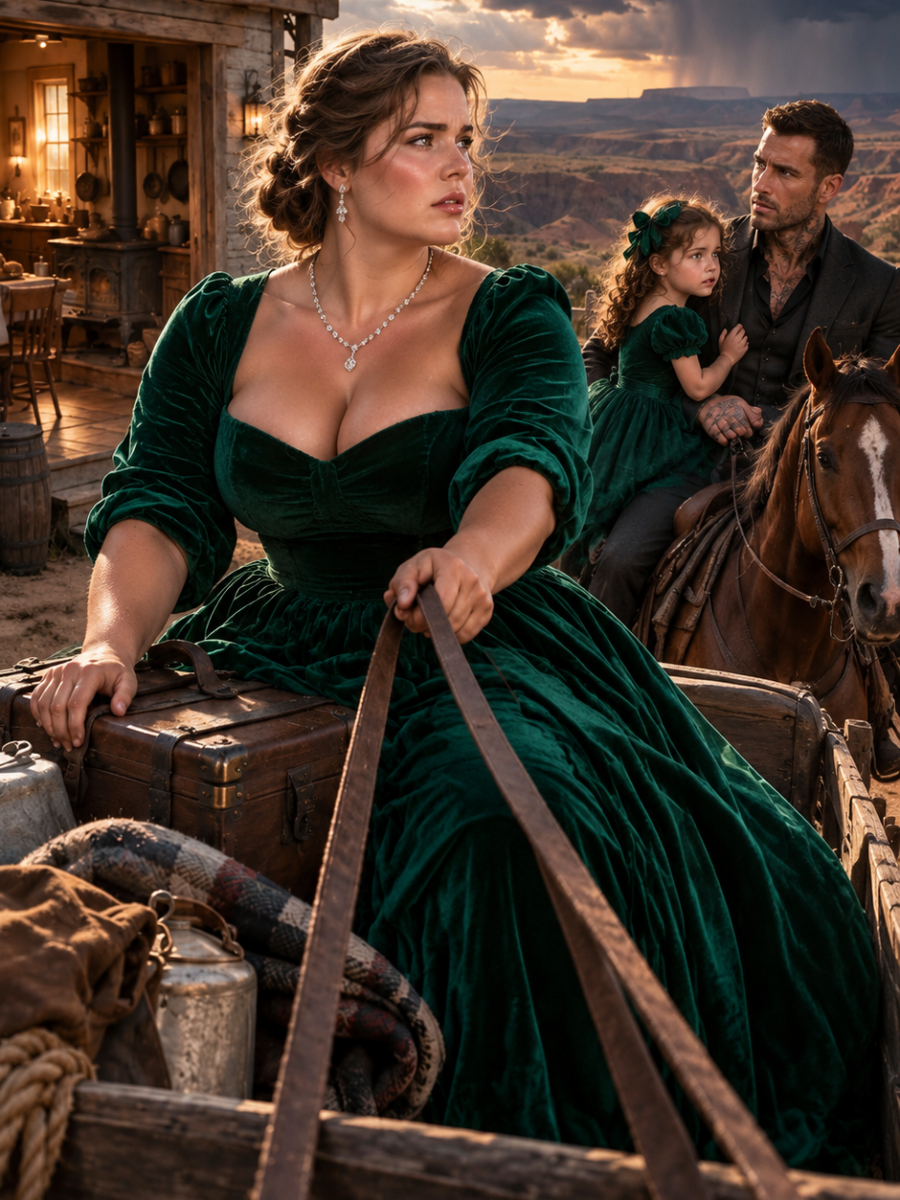
Wyatt Mercer married me for my father’s valley and told his ranch hands I would never survive a Texas summer. But when a flash flood trapped him beneath a steer in a crumbling ravine, I drove the heavy draft team straight into the teeth of the storm to show him what a woman of Willow Creek was made of.
Table of Contents
- Chapter 1: The Twelve-Minute Wedding and the Cold Iron Stove
- Chapter 2: Water in the Fuel Barrel
- Chapter 3: Thunder Over the Panhandle
- Chapter 4: The Mud and the Ravine
- Chapter 5: Setting Bones in the Rain
- Chapter 6: The Long Trail Back to Willow Creek
- Chapter 7: A Table Set for Twelve
- Chapter 8: The Drought and the Water War
- Chapter 9: The Lady of Willow Creek
Chapter 1: The Twelve-Minute Wedding and the Cold Iron Stove
Eight days before the storm tore through the Panhandle, I had stood beside Wyatt Mercer in the dusty parlor of the county courthouse and promised before God and a sleepy clerk that I would be his lawful wife. The ceremony had taken precisely twelve minutes. There were no flowers, no family heirlooms pinned to my lace collar, and no vows whispered with trembling tenderness. There was only the dry scrape of boots against worn pine floorboards, the scratch of a steel-tipped fountain pen across legal parchment, and the cold, unyielding reality of high plains survival.
My father, Caleb Hayes, had passed away three weeks prior, leaving me his sole heir and the rightful owner of Willow Creek Valley. To the uninitiated greenhorn arriving on the newly laid railway, Willow Creek was merely a narrow ribbon of green cutting through miles of sun-bleached caliche and thorny mesquite. But to every cattleman within fifty miles, Willow Creek was pure gold. It contained the only spring-fed, sweet-water creek that had never gone dry, not even during the merciless scorch of the great drought of ’84. Whoever controlled Willow Creek controlled the watering rights for twenty thousand head of longhorn cattle.
Wyatt Mercer possessed three thousand head of cattle, eight sections of rolling grassland, and an iron will that had broken horses, outlaws, and rival syndicates. What he did not possess was water. His southern boundary pressed against our northern fence, and every summer his herds bawled at the wire, smelling our cool current while his own dirt tanks shrank into cracked mud and alkaline crust.
According to half the county gossip in Wheeler, I was a twenty-eight-year-old spinster who needed a strong hand to keep land grabbers from burning my fences. And according to Wyatt Mercer, marrying me was a straightforward business transaction. He acquired the water; I acquired his fearsome name and the protection of his Winchester rifles.
When the clerk finished dusting sand over the ink, Wyatt nodded once, touched the brim of his sweat-stained Stetson, and escorted me to his buckboard wagon. He looked at my heavy wool skirt, my broad shoulders, and the deliberate, measured way I lifted my weight up the wooden footboard. He saw a woman who was neither lithe nor decorative—a woman whose hips were wide, whose hands bore the rough calluses of wood chopping and garden weeding, and whose face held the stubborn silence of someone who had watched her father slowly die of a worn-out heart.
“The ride to the ranch is twenty miles,” Wyatt said, his voice as dry as corn husks. “Road’s rough through the breaks. If you need me to slow the team, say so.”
“Drive at your customary speed, Mr. Mercer,” I replied evenly, smoothing my dark gray skirts over my knees. “The team knows the way better than I do, but I am not made of blown glass.”
He grunted, snapped the leather reins over the matched pair of bay geldings, and did not speak another word until we pulled into the yard of the Mercer home ranch as the sun sank into a bruised purple twilight.
The ranch house was a massive, two-story timber structure with a broad covered porch, built to withstand hail and blizzards. But the moment I stepped across the threshold, my heart sank beneath a wave of quiet dismay. The place smelled of stale tobacco smoke, damp saddle leather, and the sour grease of unwashed pans. Thick cobwebs hung like mourning shrouds from the high cedar ceiling joists. Fine Panhandle silt lay half an inch deep across the oak sideboards, and the magnificent cast-iron cookstove in the kitchen—a six-burner Glenwood range with nickel-plated handles and twin warming ovens—sat cold, greasy, and choked with cold ashes.
Wyatt set my battered tin trunk at the foot of the stairs. “Bunkhouse is down by the corrals. The boys stay down there. You’ll have the upstairs bedroom to yourself. I sleep in the downstairs office when we’re running roundup. Hollis handles the grub.”
Before I could ask who Hollis was, the kitchen door creaked open, and a grizzled man with half-closed, milky eyes and a beard stained yellow with chewing tobacco shuffled in. He was balancing a tin plate with one thumb hooked over the rim. On the plate lay a slab of pale, quivering salt pork swimming in gray grease, flanked by a biscuit so dense and gray it could have served as a foundation stone for a church steeple.
“Grub’s up,” Hollis wheezed, thumping the plate down onto the dust-coated kitchen table. “Don’t let the flies get to it. Wind’s coming up from the south.”
Wyatt glanced at the plate, then at me. “Eat what you can. We ride at four in the morning.” Without waiting for an answer, he turned on his heel and disappeared into the shadows of the hallway.
I looked at the greasy pork. I touched the petrified biscuit. Then I picked up the plate, walked out the back door to the pen behind the woodshed, and dumped the entire contents directly into the trough of Wyatt’s prize Poland China hog. Even the hog took three cautious sniffs before deigning to swallow the pork.
For fifteen years, from the day my mother succumbed to childbed fever until the hour my father took his last shallow breath, I had been the sole mistress of Willow Creek. I knew how to stretch a half-sack of flour through two months of winter lock-in. I knew how to roast wild game until the meat fell from the bone in rich, savory shreds. I knew how to boil horehound and wild mint into syrup for hacking coughs, and I knew that a man working sixteen hours in the saddle could not live on rancid lard and cattle dust without his spirit turning into stone.
“If I am to live in this house,” I murmured into the quiet dark of the yard, “it will be a house of life, not a tomb.”
Chapter 2: Water in the Fuel Barrel
The sun had not yet touched the eastern rim of the caprock when the bunkhouse bell clattered. From the upstairs window, I watched Wyatt and his twelve riders mount their cow ponies and head south toward the breaks, their silhouettes sharp against the gray dawn.
The moment the dust settled, I went to work.
I stripped down to my linen work shift, tied my thick chestnut hair tightly beneath a calico bonnet, and rolled my sleeves past my elbows. My first battle was with the Glenwood stove. With a small iron spade, I shoveled out five gallons of clinkers and damp soot that had choked the flue. I hauled eight buckets of well water, heating kettle after kettle on an open fire in the yard until the water was scalding hot. With homemade lye soap and stiff horsehair brushes, I scrubbed the iron plates until the black sheen returned, then rubbed every inch with rendered beef tallow to protect it from rust.
Next came the pantry. When I threw open the heavy oak door, the smell of neglect almost drove me backward. But behind the cobwebs and mouse droppings lay an astonishing abundance. Wyatt Mercer was not a poor man; he had simply forgotten that cattle were meant to buy more than just ammunition and fence wire.
On the deep shelves sat fifty-pound sacks of unbleached flour, barrels of cracked corn, crates of dried apples from Missouri, braids of dried onions and garlic, crocks of salt butter preserved under brine, kegs of dark cane sorghum, and whole cured hams hanging from iron ceiling hooks. There were beans enough to withstand a six-month siege.
“Plenty of fuel,” I muttered, hauling out spoiled meal and sweeping the floor until the yellow pine boards shone clean. “Just nobody who gives a damn about the fire.”
By Thursday evening, the kitchen had been transformed. The windows were washed clear of red grit, allowing the afternoon light to illuminate freshly scrubbed scrub-pine tables. The copper pots, scoured with sand and vinegar, hung gleaming from the rack above the center island. A fresh crock of sourdough starter bubbled contentedly on the warming shelf.
On Friday afternoon, the side door banged open. Wyatt walked in, wiping sweat and road dust from his forehead with the back of his leather cuff. He took two steps into the kitchen and stopped dead in his tracks.
His nostrils flared. The room smelled of sweet woodsmoke, split cedar, caramelized apples, and roasted venison. The floor beneath his spurred boots was spotless.
On the corner of the table sat an untouched tin plate with Hollis’s trademark rock biscuit and blackened sowbelly.
Wyatt frowned, pointing a dusty leather glove at the plate. “Hollis left you that at noon. Why haven’t you eaten?”
“I gave Hollis’s noon plate to the hog,” I replied without looking up from the large wooden bowl where I was snapping fresh green beans. “Just as I gave him yesterday’s plate, and Wednesday’s.”
Wyatt’s thick, dark eyebrows drew together in disbelief. “Hollis has been cooking for this outfit since before the war. He rode with my father.”
“Hollis does not cook, Mr. Mercer,” I said calmly, snapping another bean with a crisp, decisive crack. “Hollis threatens ingredients until they surrender out of sheer terror.”
A sudden, sharp twitch touched the corner of Wyatt’s mouth. It was gone so quickly that if I hadn’t been watching him closely, I would have missed it entirely—the rare, reluctant phantom of an amused smile.
He cleared his throat, regaining his stern countenance. “We run a working ranch here, Clara. Not a hotel in Fort Worth. Food is fuel for the men, nothing more. We don’t have time for fancy notions.”
“Then you had better stop pouring stagnant water into your fuel barrel,” I answered. “A man who eats grease and ash all day spends half his energy fighting his own belly. If your cowhands are sluggish on the cutting horses, don’t blame the horses. Blame the poison you’ve been feeding them.”
Wyatt stared at the restored stove, his eyes traveling over the gleaming kettle and the rising loaves of bread tucked beneath clean linen towels.
“You planning to cook for twelve men by yourself?” he asked, his tone skeptical. “Those boys eat like starved wolves. You’ll tire yourself out before the week is half over.”
The patronizing pity in his voice scraped against my pride like a dull spur against bare skin. I set the wooden bowl down and stood up to my full height. I was nearly as tall as he was, and while my frame lacked the willow-slender delicacy favored by town belles, it was forged from endurance.
“Mr. Mercer,” I said, meeting his dark gray eyes directly, “for seven years I lifted my father into his invalid chair twice a day. I chopped cordwood when he took sick with pleurisy, I birthed calves in winter sleet, and I carried the burden of his grief and your cold contract without trembling. Do not confuse a woman’s weight or quiet steps with helplessness. I do not break.”
Wyatt Mercer stared at me for three long seconds. For the first time since we had signed the marriage register, he looked at me not as an acreage deed or a bothersome burden, but as a living human being.
“Supper is at six,” he finally muttered, turning toward the washbasin. “We’ll see if the wolves like your cooking.”
Chapter 3: Thunder Over the Panhandle
When the dinner bell rang at six that evening, the bunkhouse crew filed into the ranch dining room like men walking toward a firing squad. They were accustomed to Hollis thumping down greasy stew that tasted of scorched iron and mutton tallow.
Instead, they walked into a room bathed in warm lantern light.
In the center of the long trestle table sat a massive roasted venison haunch, basted with cider vinegar, brown sugar, and rosemary until the crust was mahogany and the interior tender and pink. Flanking the roast were two iron skillets of golden cornbread, steaming with sweet butter, bowls of tender green beans simmered with smoked bacon ends, and a porcelain tureen of whipped potatoes beaten with heavy cream until they resembled clouds.
The hands stood frozen, hats clutched in their work-worn hands, staring at the feast as though it were a mirage in the Staked Plains.
“Well?” I said, emerging from the pantry with a fresh pitcher of iced well water flavored with wild mint. “Sit down before the grease congeals. Food was meant to be eaten hot.”
The first to move was Curly, a wiry young wrangler with red hair and freckles. He took a forkful of venison, chewed slowly, and closed his eyes with a reverence usually reserved for Sunday camp meetings.
“Lord in heaven,” Curly whispered. “I think I died and crossed over the Jordan.”
By seven o’clock, every platter was scraped clean. Hollis himself had crept in from the back porch, accepted a plate without meeting my eyes, and eaten every morsel in stunned, contemplative silence.
Wyatt sat at the head of the table. He ate with methodical intensity, never praising the meal aloud, but his plate was as clean as the others. When he pushed his chair back, he glanced at me once, a flicker of something unreadable—perhaps respect, perhaps unease—gleaming in his eyes.
“Tomorrow morning we move the south herd,” Wyatt announced to the table. “They’re scattered through the ravines near the caprock. Storm’s brewing up in Colorado, and if that front pushes south, we’ll have flash floods in the arroyos before dusk.”
The men nodded grimly, scraping back their benches and heading out to inspect their saddles.
That night, the house was utterly silent, save for the dry wind rattling the windowpanes. I lay in the upstairs bed beneath my grandmother’s patchwork quilt, listening to the vast, empty breathing of the Texas plains. For the first time since my father’s death, the terrifying loneliness that had gripped my chest felt slightly lighter. I had established my footing in this hard house; I had carved out my territory around the Glenwood stove.
At four in the morning, the ranch woke to the sound of thunder.
It was not yet raining, but the northern sky was bruised with a dreadful, greenish-black hue that every Panhandle native knew and feared. A cold, sharp wind was sweeping down from the caprock, carrying the smell of ozone and wet caliche.
I rose immediately, rekindled the stove, and packed twelve generous bundles of cold roast venison, thick biscuits stuffed with ham, and dried apple fried pies into oilcloth sacks for the men.
Wyatt came down the stairs buckling on his chaps, his face grim as granite.
“Wind’s shifting around to the northwest,” he said, taking the oilcloth pack I handed him. “The herd is spooked. If lightning strikes the prairie grass, they’ll bolt directly into the dry washes.”
“Watch the ravines, Wyatt,” I warned, using his given name for the first time without realizing it. “Father always said the rimrock above Willow Wash is rotten shale. A heavy steer can bring down fifty feet of bank.”
He paused, his hand resting on the heavy latch of the door. He turned and looked at me, his eyes dark under the brim of his hat.
“I know the land, Clara,” he said quietly. Then, softer: “Keep the storm cellar unlatched. If you see a twister drop out of those clouds, get inside and don’t wait for us.”
“I am not afraid of wind,” I told him.
He gave a slight, clipped nod and vanished into the predawn gloom. Within minutes, the thundering rumble of thirty cow ponies galloped away toward the breaks.
By eight in the morning, the light had turned to an eerie, sickly sulfur. The wind began to howl in earnest, bending the mesquite trees double and ripping shingles from the barn roof. Thunder rolled continuously across the sky like artillery fire, vibrating through the pine floorboards beneath my feet.
I stayed in the kitchen, boiling large pots of water, setting out clean linen strips for bandages, and checking the small wooden medicine chest my father had kept since the war. Caleb Hayes had been a regimental surgeon’s orderly at Shiloh, and he had taught me every scrap of bone-setting and wound-cleaning he knew. On the frontier, a doctor was often three days’ ride away; a woman who could not stitch a flesh tear or splint a shattered tibia was as good as dead.
At ten o’clock, the wind screamed, and through the driving curtain of dust and early rain, I heard the frantic, uneven hammering of galloping hooves entering the yard.
Chapter 4: The Mud and the Ravine
The horse was a lathered sorrel gelding, its nostrils flaring wide and red with exhaustion. In the saddle sat Toby, the sixteen-year-old horse wrangler Wyatt had hired that spring. The boy was white-faced, trembling violently, and so terrified he could barely keep his seat.
Before he could tumble into the mud, I threw open the kitchen door, marched down the porch steps, and caught the sorrel’s bridle with both hands, throwing my weight back to steady the panicking animal.
“Toby! Steady your mount!” I shouted over the howling roar of the gale. “Speak clearly! What happened?”
The boy leaned over the pommel, gasping for breath, tears cutting clean tracks through the red dirt plastered to his cheeks.
“Mrs. Mercer! God almighty, it’s terrible!” he choked out, his voice cracking with hysteria. “The upper rimrock gave way! Just like you said—the rotten shale at Dead Man’s Cut! Three hundred steers jammed into the narrow, and the bank collapsed on top of ’em!”
“The men!” I demanded, shaking the bridle. “What about the men?”
“Curly’s leg is broken! Mac got knocked cold by a rolling boulder!” Toby sobbed, pointing a shaking hand toward the northwest where black storm clouds were boiling down like chimney soot. “And Mr. Mercer… Mr. Mercer was trying to haze a calf out from under the ledge when the whole bluff came down! A big five-year-old steer is pinned dead across his legs, and his horse is down beside him! The water’s rising in the bottom of the wash, and we can’t shift the steer without a team and tackle!”
My blood went cold as well water, but my hands did not shake. This was the moment my father had prepared me for through fifteen hard years. Panic was a luxury reserved for parlor women in Philadelphia; in the Texas Panhandle, panic was merely an invitation to the undertaker.
“Where are the other hands?” I asked, my voice cutting through Toby’s tears like a sharp butcher knife.
“They’re digging with their bare hands and fence bars, but the shale keeps sliding back down! And the creek’s rising! If the cloudburst hits the high mesa, the flash flood will sweep the whole cut within two hours!”
I looked across the mud-slicked yard toward Wyatt’s heavy freight wagon sitting under the open lean-to. It was a sturdy, iron-tired Conestoga wagon, built for hauling sixty sacks of grain or heavy timber. Beside it stood the matched draft team—two massive Belgian geldings, each weighing sixteen hundred pounds of solid bone and muscle, bred to pull plows through gumbo clay.
“Toby, hitch the Belgians to the freight wagon. Now!”
The boy stared at me in horror. “Mrs. Mercer, you can’t! That road through the breaks is washed out! A woman can’t handle a twelve-hundred-pound draft team in a gale! You’ll tip the wagon into the canyon!”
“Boy,” I snapped, grabbing him by the shoulder and shoving him bodily toward the harness shed, “if you waste another two minutes arguing with me, your boss will drown in two feet of red mud while you stand here shaking! Move those feet, or I will hitch them myself and leave you behind!”
Toby swallowed hard, saw the steel in my eyes, and bolted into the harness shed.
I ran back into the kitchen. In three minutes, I gathered everything we would need: my father’s heavy surgical kit with its bone saws, suture needles, and carbolic acid; four thick wool blankets wrapped in oilcloth; two bottles of whiskey; a gallon jug of boiled water; two heavy block-and-tackle pulleys with hundred-foot coils of two-inch hemp rope; and three iron pry bars from the tool bench.
By the time I carried the supplies to the lean-to, Toby had thrown the heavy leather collars over the Belgians and backed them to the wagon tongue. His hands were trembling so badly he couldn’t thread the traces through the whiffletree.
“Step aside,” I commanded.
I shoved the iron pins into place, secured the trace chains with cold, practiced precision, and vaulted up onto the high wooden wagon box. I tied the strings of my bonnet tight under my chin, wrapped the heavy leather team reins twice around my wrists, and planted my boots against the footboard.
“Get on your horse, Toby, and ride ahead! Show me the easiest crossing through Willow Creek!”
“Mrs. Mercer, the creek is already foaming red!”
“Then ride, damn you!”
I raised the heavy leather whip and brought it down with a crack across the broad rumps of the Belgians. The huge horses leaned into their collars, the wagon groaned as its iron rims bit into the red Panhandle clay, and we lunged forward out of the yard, racing headlong into the teeth of the blackest storm Texas had seen in twenty years.
Chapter 5: Setting Bones in the Rain
The road through the breaks was not a road at all; it was a tortuous cattle track carved through red clay gullies, loose sandstone boulders, and thickets of prickly pear cactus. Within twenty minutes, the skies opened with apocalyptic fury.
The rain was not falling in drops; it descended in solid sheets of icy water, driven almost horizontal by fifty-mile-an-hour gusts that screamed across the high plateau. The red dirt roads liquefied instantly into a treacherous grease that threatened to send the heavy wagon sliding off the lip of every ravine.
The two giant Belgians, their ears pinned flat against the stinging deluge, snorted steam and strained their massive haunches against the grade. Twice, the rear wheels slid dangerously toward the edge of a sixty-foot drop, the timber creaking under the sickening tilt. Both times, I threw my entire weight against the high side of the wagon, sawing on the reins, shouting at the horses with every ounce of fury in my lungs:
“Hah, Duke! Lean into it, Prince! Pull, you great beasts, pull!”
My muscles burned as though molten lead had been poured through my shoulders and arms. My soaked woolen skirts weighed forty pounds, plastering against my shivering thighs, and my knuckles were skinned raw from the wet leather reins. But I did not ease back for a single second. In my mind’s eye, I saw Wyatt Mercer pinned under a thousand pounds of dead steer, listening to the rising roar of floodwaters, waiting for help that might never arrive.
We tore through the swollen shallows of Willow Wash, the muddy torrent rising to the horses’ bellies and swirling through the floorboards of the wagon. The current shoved the wagon sideways, but Duke and Prince dug their iron-shod hooves into the gravel bed and dragged us through to the far bank with a tremendous, shuddering heave.
Ten minutes later, Toby’s lathered horse crested the final ridge above Dead Man’s Cut.
The scene below was carnage.
A massive section of the high sandstone bluff had calved off like an iceberg, burying the narrow gorge in five hundred tons of red earth, crushed boulders, and splintered cedar trees. A dozen longhorns lay crushed and dying among the debris.
Near the base of the rockslide, four of Wyatt’s ranch hands were frantically digging with broken shovels and bare, bleeding hands. The creek at the bottom of the gorge was already a roaring, frothing snake of crimson water, rising three inches every ten minutes.
Pinned at the water’s edge was Wyatt Mercer.
His buckskin cow pony lay crushed beside him, neck broken by a falling boulder. Across Wyatt’s lower legs and hips lay the bloated carcass of an eight-hundred-pound brindle steer, wedged tightly beneath a fallen slab of caprock shale. Wyatt’s face was chalk-white beneath a mask of mud and dried blood, his teeth clamped so tightly together that blood trickled from his cracked lip. His left arm hung at an unnatural, sickening angle, dislocated at the shoulder.
When the men heard the thunder of my wagon wheels and saw the two great Belgians cresting the ridge, Curly let out a ragged, disbelieving cry:
“It’s Mrs. Mercer! Sweet Lord above, she brought the heavy team!”
I didn’t wait for them to help me down. I jumped from the wagon box into three inches of swirling mud, grabbed the heavy hemp rope, the block-and-tackle, and two iron pry bars, and scrambled down the slippery shale bank like an enraged mountain lion.
Wyatt Mercer raised his head through the driving rain. His eyes, dark and glazed with agonizing pain, widened in sheer, bewildered shock as he saw me sliding down the mud toward him, clutching fifty pounds of iron and rope.
“Clara…” he croaked, his voice barely audible over the roaring storm. “What… what are you doing here? Get back… the bank is giving way…”
“Shut your stubborn mouth, Wyatt Mercer,” I snapped, dropping to my knees in the red slime beside him. “You married a woman, not a doll. Now hold still while we get this steer off your bones.”
I tossed the end of the two-inch hemp rope to Curly and Mac. “Loop this through the block and anchor it to that ancient cedar stump on the high bank! Toby, back Duke and Prince down to the edge! We hook the trace chains to the tackle line—we pull the steer toward the water while we pry the stone up!”
The men, energized by having a commander who did not hesitate, moved with furious efficiency. Within four minutes, the heavy rope was anchored and looped twice around the girth of the dead steer.
“Toby! Guide the team! Ease them forward!” I yelled. “Curly, Mac, get on the second pry bar! On three!”
I wedged my iron bar beneath the heavy slab of sandstone pressing Wyatt’s thigh, planting both boots into the red mud and throwing my entire two hundred pounds of weight onto the iron lever.
“One! Two! Three—HEAVE!”
The great Belgians strained, their muscles bunching like iron cables. The heavy hemp rope groaned, water squeezing from its twisted fibers like sweat. The iron bar bit into my palms, grinding against bone. For a terrifying two seconds, nothing moved.
Then, with a sickening squelch of suction and mud, the boulder shifted four inches. The dead steer rolled sideways into the foaming creek.
“Pull him out! NOW!” I screamed.
Mac and Curly lunged into the mud, grabbed Wyatt under his armpits, and dragged his broken body three yards up the bank, just as a fresh slide of wet shale collapsed into the exact spot where his head had been resting five seconds earlier.
Chapter 6: The Long Trail Back to Willow Creek
The flash flood hit the cut thirty seconds later. A six-foot wall of muddy water, carrying whole cedar logs and battered fence posts, roared through the bottom of the gorge, swallowing the dead steer and the spot where Wyatt had lain.
We carried Wyatt up the steep embankment through the pelting rain, his head lolling against my shoulder. Every breath he took was a ragged, shuddering gasp. His left leg was twisted inward, the shin bone shattered beneath the flesh, and his shoulder remained knocked completely out of its socket.
“Up into the wagon box,” I ordered the men. “Lay him on the straw. Blankets over him immediately. Curly, let me see that arm.”
Curly had a deep scalp laceration and a sprained wrist, but he was on his feet. Mac had three cracked ribs. But Wyatt was bleeding internally and in mortal shock.
I climbed into the wagon box, knelt in the straw beside my husband, and pulled out my father’s surgical kit. The driving rain drummed against the heavy canvas wagon cover like a million musket balls.
“Wyatt,” I said, leaning close to his ear. “Your shoulder is dislocated. If I don’t reset it now, the swelling will set the joint permanently. And your shin bone has to be pulled straight before the muscles spasm, or you will never walk a pasture again.”
He opened his eyes, staring up at me through a haze of agony. “Do it,” he whispered, his jaw clenched tight. “Just… don’t let me scream in front of the boys.”
“Drink this,” I said, pressing the neck of the whiskey bottle to his lips. He swallowed three deep, burning gulps.
I turned to Mac and Toby. “Hold his good shoulder against the floorboards. Don’t let him twist.”
I took off my boots, planted my stockinged foot firmly in Wyatt’s armpit for leverage, gripped his limp left forearm with both hands, and leaned back with all the power in my spine and thighs.
There was a sickening, hollow clunk as the head of the humerus popped back into its socket. Wyatt’s entire body arched off the straw, a muffled groan tearing from his throat, his knuckles turning white as he gripped my skirt.
“One done,” I panted, wiping the sweat and rain from my eyes. “Now the leg.”
With my father’s sharp bone shears, I cut Wyatt’s leather trousers away from his knee to his ankle. The lower shin was purple, swollen, and distorted, but the skin had not broken.
“Curly, take his ankle. Mac, hold his knee. When I say pull, you pull smooth and steady. Do not jerk.”
“Ready, Mrs. Mercer,” Curly said, his voice reverent with awe.
“Pull!”
I used my hands to align the splintered edges of the tibia, feeling the rough edges of bone grind beneath my fingertips through the bruised flesh. Wyatt’s fingernails dug into the meat of my forearm with bruising force, his body rigid as an iron bar, but true to his word, he did not scream. With a dull click, the bones settled into alignment.
Working with steady, rapid hands, I wrapped the limb in clean linen pads soaked in carbolic wash, then bound two sturdy cedar splints on either side, wrapping fifty feet of tight canvas bandage until the leg was as rigid as a fence post.
When I finished, Wyatt’s head fell back into the straw. He was unconscious, his breathing shallow but steady.
“He’s stable,” I announced, exhaling a breath that felt as though I had been holding it for two hours. “Now help me get Curly and Mac patched up, and let’s get this wagon home.”
The journey back to the ranch house was a test of raw endurance. Night had fallen completely, black as pitch, and the rain had settled into a steady, freezing Panhandle drizzle. Toby rode ahead carrying a kerosene lantern, while I stood on the wagon box, guiding the weary Belgians through the mud.
Every muscle in my back screamed with exhaustion. My hands were blistered and bloody where the wet reins had rubbed away the skin. But as I glanced back into the covered wagon and heard Wyatt’s quiet, steady breathing beneath the wool blankets, a fierce, protective warmth settled deep within my chest.
We arrived at the home ranch at midnight.
Hollis was waiting on the porch with a lantern, his milky eyes wide with shock. Between the six of us, we carried Wyatt up the stairs and laid him in the soft feather bed in the master room. We cleaned his wounds, dressed him in clean flannel, and piled three heavy quilts over him to stop the shivering.
Downstairs, the kitchen was still warm from the morning fire.
Without taking off my sodden apron, I stoked the Glenwood stove, put on a twenty-quart kettle of rich beef broth with onions and potatoes, and fed every battered, limping man who sat at that table.
When the last man had eaten his fill and stumbled down to the bunkhouse to sleep like the dead, Hollis stood in the doorway, twisting his greasy hat in his gnarled hands.
“Mrs. Mercer,” the old man mumbled, looking down at his boots.
“Yes, Hollis?”
“I reckon… I reckon I was wrong about you. And about that Glenwood stove.”
I looked at the old man, softened by the sheer exhaustion of the night. “Go get some sleep, Hollis. Tomorrow morning, you’re going to help me bake sourdough.”
A faint smile touched the old man’s weathered lips. “Yes, ma’am. Whatever you say, Mrs. Mercer.”
Chapter 7: A Table Set for Twelve
For ten days, Wyatt Mercer remained confined to the master bed, feverish from the bone trauma and bruised from his chest to his spurs.
During those ten days, the Mercer ranch did not stop. In fact, it ran with a precision it had not seen since Wyatt’s father had been buried ten years before.
I rose at four every morning, managed the dairy cows, supervised the bunkhouse meals, directed Toby and Curly in repairing the downed pasture fences, and dressed Wyatt’s splinted leg twice daily with fresh carbolic wash to ensure gangrene did not take root.
On the eleventh morning, Wyatt woke without fever.
The autumn sun was streaming through the bedroom window, painting golden rectangles across the clean pine floor. I entered carrying a tray with a steaming bowl of venison broth, fresh sourdough bread slathered with sweet butter, and a cup of roasted chicory coffee.
Wyatt was sitting propped against three pillows. He was thinner, his dark beard overgrown, but his gray eyes were clear and sharp.
He watched me set the tray over his lap. His eyes lingered on my bruised forearms, where his own fingers had left dark marks during the bone-setting, and on the healing blisters on the palms of my hands.
“Curly told me what you did at Dead Man’s Cut,” Wyatt said, his voice rough and low. “He said you drove the heavy wagon through Willow Wash when the flood was waist-deep on the team.”
“Curly talks too much,” I replied calmly, adjusting the linen napkin beside his bowl. “Eat while it’s hot.”
Wyatt didn’t pick up his spoon. Instead, he reached out his callused, uninjured right hand and caught my wrist. His grip was warm and firm, but there was no violence in it—only a quiet, intense gravity.
“He said you levered an eight-hundred-pound steer off my ribs with a fence bar, and set my shoulder with your bare heel in my armpit.”
I looked down at him, meeting his gaze steadily. “I told you on Friday that I was not made of blown glass, Mr. Mercer. You seemed to doubt my word. I had to prove it before you drowned in your own mud.”
Wyatt’s throat worked as he swallowed hard. His fingers slid from my wrist down to my hand, his thumb brushing over the raw, healing calluses on my palm.
“I married you for Willow Creek,” he confessed, the words torn straight from his pride like bark stripped from an oak tree. “I thought you were a heavy, quiet woman who would sit in the corner, mend socks, and let me run the valley water. I thought I was doing you a favor by protecting your deed.”
“I know what you thought,” I said softly.
“I was a blind, arrogant fool, Clara,” Wyatt said, his voice dropping into a register of raw sincerity I had never heard from him before. “You saved my life. You saved my ranch. And you’ve fed my men better than they’ve ever been fed in their miserable lives.”
“They work harder when they have real meat in their bellies,” I remarked, a faint smile touching my lips.
“It’s not just the food,” Wyatt said, his grip tightening gently on my hand. “It’s the spirit in this house. For ten years, this place was just a cattle pen made of lumber. You made it a home in ten days.”
He lifted my work-roughened hand to his lips and pressed a slow, reverent kiss against my knuckles.
A shiver of heat, completely unfamiliar and deeply stirring, raced from my fingers straight into my chest. For all his roughness, Wyatt Mercer was a man carved from the same hard granite as my father—a man who valued deed over word, blood over boasting, and loyalty above all earthly treasures.
“Now eat your soup, Wyatt,” I whispered, gently pulling my hand back, though my cheeks burned pink. “The boys are bringing fifty head of heifers up to the home corrals this afternoon, and I need to bake three dozen biscuits before noon.”
“Yes, ma’am,” he replied, a genuine, radiant grin spreading across his rugged face. “Whatever the boss lady says.”
Chapter 8: The Drought and the Water War
Six weeks later, Wyatt was walking with only a stout hickory cane, his leg healing true and straight thanks to the tight cedar splints.
The Texas autumn turned crisp and golden, the cottonwood trees along Willow Creek blazing like torches of yellow fire against the red canyon walls. But with the dry autumn came the true test of our alliance.
A syndicate of foreign investors, operating under the name of the Panhandle Land & Cattle Company, had bought up thirty thousand acres to our west. Their representative was an oily, bowler-hatted lawyer named Silas Vance, who traveled in an upholstered carriage escorted by six hired gun-hands with low-slung Colts.
On a frosty Tuesday morning, Vance’s carriage clattered into the yard of the Mercer ranch.
Wyatt, leaning on his cane, stood on the front porch with his Winchester rifle leaning against the porch rail. I stood beside him, wiping flour from my hands onto my apron, watching the hired men fan out across the yard.
Silas Vance stepped from the carriage, holding a leather portfolio.
“Mr. Mercer,” Vance began, touching the brim of his derby hat with a patronizing smirk. “And I presume this is the new Mrs. Mercer. A pleasure.”
“State your business, Vance,” Wyatt said, his voice flat as a rifle shot. “You’re five miles inside Mercer range, and my boys don’t take kindly to strangers with iron on their hips.”
Vance smiled smoothly, tapping the portfolio against his palm. “We’re reasonable men, Mr. Mercer. Our syndicate has brought ten thousand head of Hereford cattle into the upper breaks. As you well know, the autumn drought has dried every waterhole from here to the Canadian River. Your wife holds the deed to Willow Creek Valley. We are prepared to offer you fifteen thousand dollars in gold coin for the creek rights and twenty feet of bank on either side.”
Wyatt’s hand drifted casually toward the Winchester. “Willow Creek is not for sale.”
Vance’s smile hardened into a cold sneer. “Come now, Mercer. Don’t be foolish. The deed was issued to Caleb Hayes. An old man’s daughter, barely a bride, has no business controlling the water supply for three counties. If you don’t sell the water rights, our cattle will graze through your fences anyway. A court in Austin is three hundred miles away, and six gun-hands can do a great deal of damage before a circuit judge ever hears your petition.”
Before Wyatt could lift the Winchester, I stepped down from the porch.
I walked directly toward Silas Vance. I did not hurry. I walked with the deliberate, unyielding majesty of a woman who had pulled two draft horses through a flash flood and pulled broken bone into place with her bare hands.
Vance blinked, startled by my advance, his smile faltering.
“Mr. Vance,” I said, my voice ringing across the quiet yard with the absolute authority of the land itself. “My father, Caleb Hayes, dug the irrigation ditches of Willow Creek with an iron spade while Comanche war parties rode the ridges. He buried my mother on the high bluff overlooking that water. That valley is paid for in blood, sweat, and thirty years of Hayes labor.”
Vance scoffed, recovering his nerve. “Sentimentality doesn’t hold up in court, madam.”
“Perhaps not,” I continued, stopping three feet from him, looking down into his pale, city-bred eyes. “But my husband’s brand is on twenty-four hundred head of cattle drinking from that creek right now. And behind you, in the hayloft of that barn, are four ranch hands who haven’t missed a target since they fought at Glorieta Pass. If one of your hired riders so much as cuts a single strand of Mercer wire, we won’t wait for a circuit judge in Austin. We will feed your horses to the river and bury your syndicate men under the shale at Dead Man’s Cut.”
A dead silence fell across the yard.
Behind Vance, the six hired gun-hands looked toward the dark openings of the barn loft, where the glint of sunlight off four rifle barrels was unmistakable. Not a single man touched his holster. Gun-hands were paid to intimidate farmers, not to die in a red dirt courtyard for a foreign syndicate.
Silas Vance’s face turned the color of curdled milk. He swallowed hard, glanced at Wyatt, who was watching me with an expression of fierce, unmasked adoration, and then stepped backward toward his carriage.
“This matter isn’t finished, Mercer,” Vance stammered.
“It is finished on this creek,” Wyatt answered, picking up his Winchester and pumping a brass cartridge into the chamber with a sharp, terrifying clack-clack. “My wife spoke for both of us. Get off our land before the dust settles, or you won’t need a carriage to ride back to Wheeler.”
Vance dove into the carriage, shouting at his driver. The carriage wheeled around in a cloud of red dust and rattled out of the gate at a frantic gallop, the six hired men trailing behind like whipped curs.
Chapter 9: The Lady of Willow Creek
When the dust of Silas Vance’s carriage finally drifted away over the yellow prairie, Wyatt Mercer lowered his rifle, leaned his weight onto his hickory cane, and burst into a roar of laughter that echoed from the red cliffs to the cedar breaks.
The hands in the barn loft came down, whistling and hollering, slapping their hats against their thighs.
“Did you see Vance’s face?” Curly hollered, wiping tears of mirth from his eyes. “He looked like he’d swallowed a horned toad whole! ‘Bury your syndicate men under the shale at Dead Man’s Cut!’ God almighty, Mrs. Mercer, you’re better than a battery of Gatling guns!”
I felt my cheeks flush red, but I couldn’t help the warm laughter that welled up in my own throat.
“Back to the corrals, boys,” I ordered, trying to sound stern. “Those heifers aren’t going to brand themselves. And supper tonight is beef pot pie with buttermilk dumplings, so don’t you dare track red mud into my clean dining room!”
“Yes, ma’am!” the men cheered, tipping their hats and scattering toward the corrals with eager grins.
Wyatt walked over to me, leaning lightly on his cane. The tension had vanished from his shoulders, replaced by a deep, radiant contentment.
“Come with me,” he said softly.
“Wyatt, I have dough rising on the stove—”
“The dough can wait twenty minutes, Clara. Come.”
He led me toward the buckboard wagon, hitched to gentle saddle horses. He helped me up onto the seat, took the reins himself, and drove us south along the ridge that overlooked Willow Creek Valley.
When we reached the highest point of the limestone bluff, where a solitary, ancient live oak tree spread its gnarled branches, he pulled the team to a stop.
Below us, Willow Creek snaked like an emerald ribbon through the golden autumn grass. Hundreds of sleek, fat cattle were grazing peacefully along the willow-fringed banks. The water sparkled in the afternoon sun, pure, sweet, and eternal.
Beside the live oak stood a simple white cross marking my father’s grave.
Wyatt set the brake, reached into his waistcoat pocket, and pulled out an envelope sealed with red wax. He placed it in my hands.
“What is this?” I asked.
“Open it.”
I broke the wax and unfolded the heavy legal document inside. It was a newly drawn deed, filed and stamped by the district clerk in Wheeler three days ago. It combined the Mercer ranch and Willow Creek Valley into a single, indivisible estate: The Mercer-Hayes Ranch.
And at the bottom, written in bold, irrevocable ink, the deed named Clara Hayes Mercer as full fifty-percent equal owner of every acre, every hoof, every brand, and every drop of water.
Tears sprang into my eyes, blurring the crisp legal text.
“Wyatt… you didn’t have to do this,” I whispered, my voice trembling. “The law says a husband controls his wife’s property upon marriage.”
Wyatt turned toward me on the wagon seat. He reached out with both hands and took mine, his dark eyes shining with an emotion that stripped away every ounce of his frontier reserve.
“The law was written by small men in parlors who never had a wife stand between them and a grave,” Wyatt said, his voice thick with emotion. “I married you for Willow Creek, Clara. But today, I stand here asking you to be my wife because I love you with every beat of this battered heart.”
He leaned in close, his rough, warm hands cupping my face, his thumbs gently wiping the tears from my cheeks.
“You took a cold house and filled it with warmth,” he whispered against my lips. “You took a broken man and put him back on his feet. You gave me a home, Clara. Will you truly be my wife, not by contract, but by choice?”
I looked into his eyes—the eyes of the man who had learned that strength was not measured in arrogance or iron fists, but in endurance, loyalty, and open-hearted honor.
“I will, Wyatt,” I replied softly, leaning forward into his embrace. “With all my heart.”
When our lips met beneath the ancient live oak, the cold Panhandle wind seemed to hush its roar, carrying only the sweet scent of woodsmoke, autumn cedar, and the eternal, singing waters of Willow Creek.