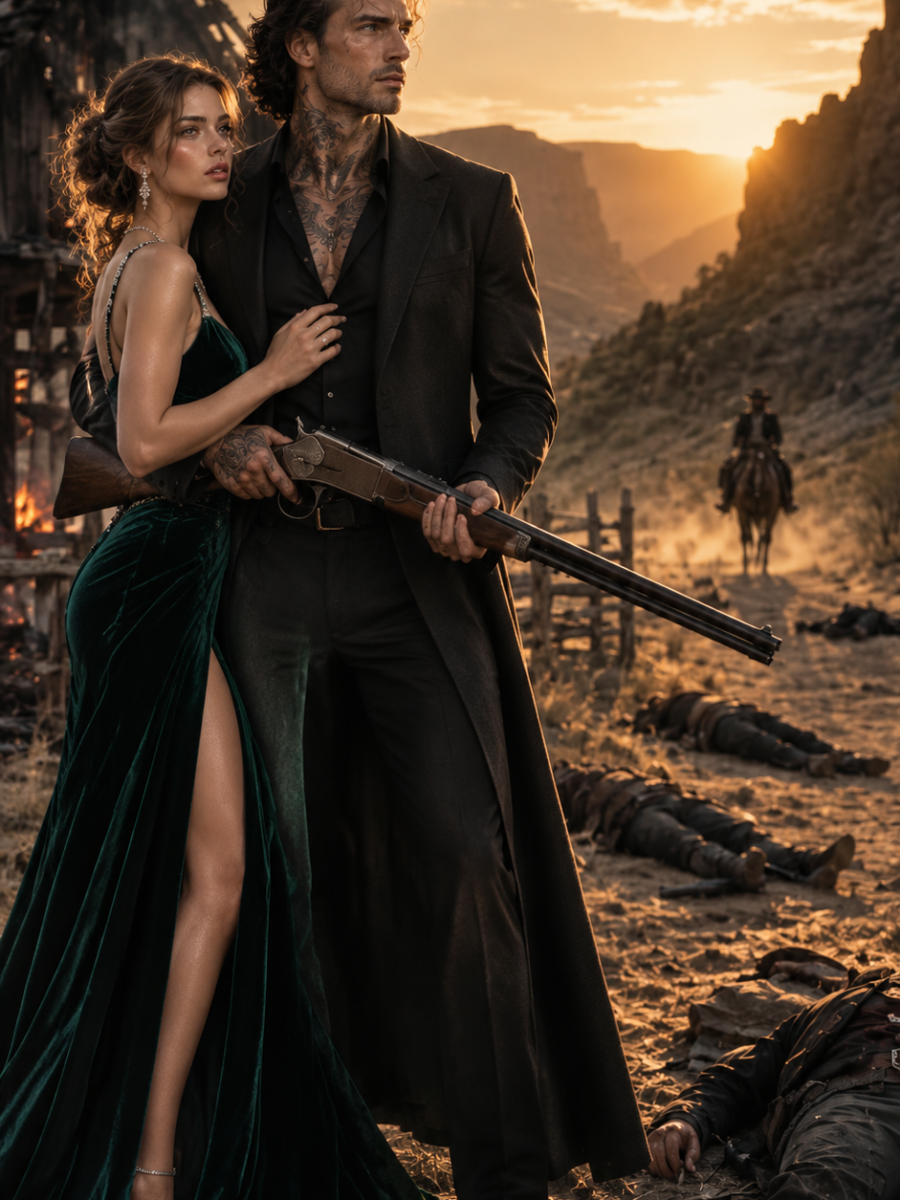
When a ruthless gang of five land-grabbers burned quiet widow Eleanor Cross’s barn to the ground to seize her water rights, they thought an isolated woman would flee in terror—until sunrise in the canyon gorge, when five heavy brass casings and five shots from her father’s .50-90 Sharps buffalo rifle ended their reign of terror forever.
Table of Contents
- Chapter 1: Five Bodies in the Canyon
- Chapter 2: The Tracks on the Ridge
- Chapter 3: The Silence of Ruth Hawthorne
- Chapter 4: The Widow of Willow Creek
- Chapter 5: The Heirloom of Christian Vance
- Chapter 6: The Perch on Devil’s Throat
- Chapter 7: When the Buffalo Rifle Spoke
- Chapter 8: The Sheriff at the Gate
- Chapter 9: The Silence of the Valley
Chapter 1: Five Bodies in the Canyon
They found five bodies in Devil’s Gorge at first light, laid out with a kind of terrible, geometric precision, each one dropped farther into the limestone pass than the last.
The morning sun had barely begun to lift its pale rim over the red sandstone ridge when Sheriff William Garrett hauled his bay gelding to an abrupt halt, the breath catching hard in his throat.
The first man lay twenty yards past the canyon mouth, face down in the dry alkali dust, his uncocked revolver still seated in its leather holster. The second body lay fifty yards beyond, sprawled beside a dead cottonwood stump. The third and fourth had fallen together higher up the slope where the trail turned steep, narrow, and mean.
And the fifth man—the leader, Lucas Pike—lay resting against a standing monolith at the throat of the pass, where the sheer rock walls narrowed to fifteen feet and the echoes of anything—hoofbeats, voices, or gunfire—folded back upon themselves like thunder.
Garrett dismounted with agonizing slowness. His heavy cavalry boots crunched over loose shale and brittle sagebrush.
He knelt beside the nearest body and turned it over with his forearm.
A single, gaping bullet hole was centered neatly through the breastbone. No second shot. No signs of a prolonged firefight. Just clean, instantaneous extinction.
He moved to the second body. The same. Clean. Centered. Final.
By the time Garrett reached Lucas Pike at the gorge’s throat, the sheriff’s hands were trembling so badly he had to hook his thumbs into his gun belt to hide it.
“Sweet Jesus in heaven,” Garrett whispered to the empty stone walls.
His young deputy, Collins, rode up behind him, his horse snorting in nervous agitation at the metallic stench of pooling blood. Collins took one look at the five dead outlaws and turned the color of lard.
“Sheriff…” Collins stammered, his knuckles white on the reins. “Who… who could do this? Pike’s gang had ten-gauge shotguns and repeating Winchesters!”
Garrett didn’t answer. He was staring at something half-buried in the red dirt forty feet up the eastern rock scree.
He climbed the slope, bent down, and picked it up.
It was a spent cartridge casing. Heavy brass, thicker than his index finger, three and a quarter inches long.
A .50-90 Sharps buffalo rifle casing.
Garrett turned it over in his calloused palm, the brass still carrying the faint, acrid tang of burned sulfur.
“Get back to town, Collins,” Garrett ordered, his voice suddenly sharp and low. “Fast as your mount will carry you. Tell everyone to stay inside their homes.”
“Why, Sheriff? What did you find?”
“Just go, Collins. Now.”
Chapter 2: The Tracks on the Ridge
Deputy Collins wheeled his mount around with a flurry of loose stones and galloped down the gorge, the dust rising behind him in a pale, swirling cloud.
Sheriff Garrett remained alone in the canyon with the dead.
The morning wind swept through the gorge, carrying the whisper of dry grass and the unmistakable, heavy chill of an execution.
Garrett looked up at the towering rimrock three hundred feet above the canyon floor.
He had served three years in the Union cavalry during the war. He had ridden alongside Berdan’s sharpshooters in Virginia, watching men hit human targets at four hundred yards with telescopic scopes. But this was something entirely different.
The distance from the rimrock to the canyon floor was over five hundred yards. The mountain wind through Devil’s Gorge shifted every thirty seconds, gusting between the granite chimneys in unpredictable downdrafts. The morning glare off the white limestone produced mirages that distorted distance and angle.
To drop five mounted outlaws at five hundred yards in shifting crosswinds without wasting a single cartridge was not merely marksmanship.
It was surgical, terrifying perfection.
Garrett turned to climb back to his horse when a shadow caught his eye at the base of the eastern chimney.
Tracks.
He scrambled up the loose scree, dropping to one knee beside a sheltered overhang of juniper.
Imprinted in the soft red dust was a pair of boot prints.
They were narrow. The heels were delicate, carved with small brass nails, the tread barely eight inches from heel to toe.
A woman’s boots.
Garrett stared at the prints for a full minute, his pulse hammering in his ears. He shook his head slowly, running a trembling hand across his weather-beaten mustache.
“No,” he muttered under his breath. “That’s impossible. She’s just a quiet widow.”
By midmorning, the small frontier settlement of Willow Creek was burning with feverish rumors.
Men stood in tight, anxious clusters along the boardwalk outside Mercer’s General Store and the Red Dog Saloon. Women stood on front porches with their aprons wrapped tight around their arms, watching the stage road with fearful eyes.
Inside the saloon, the talk was moving in frantic circles.
“It had to be bounty hunters from Denver,” one rancher argued, slamming his whiskey glass down.
“Bounty hunters don’t drop five men with five single shots,” another cowhand countered. “That was an execution. Five shots, all through the chest. That’s a ghost.”
The swinging doors creaked open.
Sheriff Garrett walked inside, his face drawn and gray. He walked directly to the mahogany bar, pulled the heavy brass .50-90 casing from his pocket, and set it down on the wood. It rolled once, coming to rest beside the whiskey bottle.
“Anybody in this valley recognize this brass?” Garrett asked, his voice cutting through the murmurs.
A weathered trapper leaned forward, picking up the massive shell. “Sharps buffalo casing. Fifty caliber. Takes ninety grains of black powder. That’ll drop a bull bison at eight hundred yards. Ain’t nobody in Willow Creek shoots a gun that big.”
“Somebody does,” Garrett said. “And they used it this morning.”
Chapter 3: The Silence of Ruth Hawthorne
From the shadowy corner booth of the saloon, an old voice broke the silence.
“Maybe it wasn’t our business to ask who pulled that trigger, William.”
Every head in the room turned toward the corner.
Ruth Hawthorne sat alone, her two hands folded over the worn hickory handle of her walking cane. She was seventy-two years old, the widow of the valley’s first settler, with skin like cured rawhide and pale blue eyes that had seen forty years of frontier blood.
Garrett walked over to her booth. “What’s that supposed to mean, Ruth?”
Ruth didn’t flinch. She pushed herself upright with her cane, her back straight as an iron ramrod.
“It means Lucas Pike’s gang has been terrorizing this valley for two years,” Ruth said, her voice clear, steady, and carrying across the hushed room. “It means they burned the Miller homestead, stole fifty head of cattle from the south coulee, and shot young Billy Adams through the leg when his father refused to pay water protection money.”
She looked directly into Garrett’s eyes.
“We all knew it, Sheriff. And not one man in this room did a damn thing about it.”
Garrett flushed crimson. “There were five of them, Ruth! They were armed with repeating rifles! The county didn’t have the deputies to take them on open ground!”
“And now they’re laid out in the canyon,” Ruth said, turning toward the swinging doors. “Maybe the valley finally took care of itself.”
“The valley didn’t chamber ninety grains of powder into a Sharps rifle, Ruth!” Garrett called after her. “A person did! And I took an oath to enforce the law!”
Ruth paused at the swinging doors, looking back over her shoulder with cold, cutting pity.
“A law that protects murderers while decent people burn isn’t a law, William. It’s an excuse.”
She pushed through the doors, stepping out onto the sunlit boardwalk.
Garrett watched her hobble toward her buggy, but as he watched her go, a sudden realization struck him like cold water.
Ruth Hawthorne hadn’t asked who died. She hadn’t asked where the bodies were found.
She already knew.
Garrett grabbed his hat from the bar and followed her into the bright morning glare.
Chapter 4: The Widow of Willow Creek
The story had not begun in the canyon. It had begun two nights earlier at the Cross homestead, five miles north of town.
Eleanor Cross had lived alone on eighty acres of creek bottomland for five years.
The town regarded her with the quiet, patronizing indifference that small frontier settlements reserve for women who ask for nothing: a slender, solitary widow of twenty-eight whose husband had drowned in the spring freshet four years ago. She rarely came to town except to trade eggs for salt and coffee. She wore modest calico dresses, kept her dark hair tied back in a neat bun, and lived in a small, hand-hewn cabin with a sturdy spruce barn.
Yet what the town did not know was that before Eleanor Cross was a widow, she was Eleanor Vance—the only daughter of Christian Vance, the master armorer of the Springfield Arsenal who had customized experimental sniper rifles for the Union Army during the Civil War.
From the age of nine, Eleanor had lived in her father’s workshop, learning how to cast lead bullets to within a grain of weight, how to calculate wind deflection at six hundred yards, and how to bed a heavy octagonal barrel into figured walnut with surgical precision.
On Wednesday night, the quiet of the homestead was shattered.
At two in the morning, the sound of galloping horses thundered into the yard.
Before Eleanor could reach the window, three glass bottles filled with kerosene and burning rags smashed through the hayloft windows of her spruce barn.
Flames exploded into the dry alfalfa hay, leaping twenty feet into the night sky with a terrifying roar.
Eleanor rushed onto the porch, clutching a leather bucket, only to hear the cruel, mocking bray of laughter from the road.
Lucas Pike sat upon his black stallion, illuminated by the orange inferno of her burning barn, surrounded by four of his mounted riders.
“Consider that your notice to vacate, Mrs. Cross!” Pike shouted, his teeth gleaming in the firelight. “The Pike syndicate owns the water rights on Willow Creek now! If you’re not packed and gone by tomorrow night, we’ll put the torch to your bedroom while you’re sleeping!”
They fired three pistol shots into the air, wheeled their mounts around, and galloped off into the darkness, their laughter echoing across the valley.
Eleanor did not scream. She did not weep.
She stood on the porch in her nightgown, watching her barn—the barn her late husband had built with his bare hands—burn down to a bed of glowing embers.
When the last rafter collapsed with an explosion of red sparks, Eleanor walked into the dark cabin.
She lit a single tallow candle, walked over to the cedar chest at the foot of her bed, and lifted the false bottom.
Chapter 5: The Heirloom of Christian Vance
Resting within a fitted case of oiled sheepskin was the masterpiece of her father’s life.
A custom 1874 Model Sharps rifle.
The barrel was thirty-two inches of heavy, blued octagonal steel, chambered for the devastating .50-90 cartridge—a round packing ninety grains of compressed black powder behind a four-hundred-and-seventy-three-grain solid lead slug. The receiver was case-hardened with swirling patterns of charcoal and silver, fitted with a double-set trigger that tripped with the pressure of a feather.
Mounted along the top of the barrel was a forty-inch brass Malcom telescopic scope, ground by hand with precision crosshairs.
Eleanor lifted the fourteen-pound rifle from the sheepskin.
The balance was perfect, an extension of her own bones.
Beside the rifle lay a tin box of twenty hand-loaded cartridges. Each brass case had been cleaned, each charge of powder weighed on a jeweler’s balance, each lead bullet cast from a mixture of nine parts lead to one part tin to prevent deformation in the rifling grooves.
Eleanor sat at the pine table until four in the morning, cleaning the action, checking the scope mounts, and loading five heavy brass rounds into the leather loops of her belt.
She dressed not in calico, but in a pair of buckskin trousers, a dark wool hunting jacket, and her sturdy riding boots with brass-nailed heels.
She tied her dark hair tightly against her skull with a leather thong.
Before the first gray light of dawn touched the eastern peaks, Eleanor saddled her gray mare, slid the heavy Sharps into its sheepskin scabbard, and rode toward the southern rim of Devil’s Gorge.
She knew the country better than any drover in the territory.
She knew that after a night of arson and whiskey in town, Lucas Pike and his men always rode through the narrow pass to their hideout in the San Luis foothills.
And she knew the exact standing stone where the canyon narrowed to fifteen feet.
Chapter 6: The Perch on Devil’s Throat
By five in the morning, Eleanor was lying prone on a flat granite ledge three hundred feet above the entrance to Devil’s Gorge.
She had tied her mare a quarter-mile back in a stand of thick scrub oak. She had belly-crawled the last forty yards across the limestone gravel, pulling the heavy Sharps beside her, using a low juniper bush to break her silhouette against the sky.
She rested the long octagonal barrel across a rolled wool saddle blanket.
The valley below was still cloaked in purple twilight. The wind blew from the northwest at eight miles an hour, cold and steady, carrying the scent of frost and wet stone.
Eleanor dialed the elevation drum on her brass scope.
Range: four hundred and eighty yards.
Windage: two minutes left to account for the canyon downdraft.
She pulled the rear set-trigger until it clicked with a tiny, sharp snap. The front trigger was now hair-sensitive; a touch of four ounces would drop the hammer.
At five-twenty, the sound of hoofbeats floated up from the canyon floor.
Five riders trotted into the pass, their hats pulled low, their coats buttoned against the morning chill. They were talking, laughing, their reins loose, confident that they owned the territory.
Lucas Pike rode at the front on his black stallion.
Eleanor closed her left eye. Her right eye settled behind the rubber eyecup of the brass Malcolm scope.
The fine crosshairs centered on Lucas Pike’s chest.
Her mind did not race. Her pulse slowed to a calm, steady rhythm born of long hours in her father’s workshop. She didn’t think of hatred; she didn’t think of revenge.
She thought of the men who had burned her barn, who had promised to burn her alive in her bed, and who had terrorized an entire valley of innocent families.
*Breathe in. Breathe out. Hold.*
Her index finger brushed the front trigger.
Chapter 7: When the Buffalo Rifle Spoke
The roar of the .50-90 Sharps was not the sharp crack of a Winchester or the snap of a Colt.
It was an earth-shattering boom that sounded as though the canyon wall itself had detonated. A massive plume of white sulfur smoke rolled across the rimrock.
Four hundred and eighty yards below, the four-hundred-and-seventy-three-grain lead slug struck Lucas Pike squarely in the center of his chest.
The kinetic energy of the buffalo round lifted the two-hundred-pound outlaw clean out of his saddle, throwing him six feet backward into the rocks, dead before his body hit the dust.
The remaining four riders panicked, their horses rearing and plunging in the narrow gorge.
“Sniper!” one shouted, clawing at his rifle scabbard. “Up on the rim!”
Eleanor did not pause for a second.
With smooth, mechanical precision, her right hand thumbed the side-lever. The heavy breechblock dropped with a metallic click. She extracted the smoking brass shell, took a fresh cartridge from her belt, shoved it into the chamber, and snapped the lever shut.
She pulled the rear set-trigger. *Click.*
She acquired the second rider through the scope—a gunman who had drawn his revolver, scanning the cliff.
*Boom.*
The second shot tore through the second man’s chest, dropping him into the shale.
The remaining three men turned their horses around, spurring them hard toward the canyon mouth, desperately trying to escape the slaughterhouse.
Eleanor reloaded. Three seconds.
*Boom.*
The third man fell twenty yards farther down the slope.
*Reload.*
*Boom.*
The fourth man collapsed beside the dead cottonwood tree.
The fifth and final outlaw abandoned his horse, sprinting on foot toward the canyon entrance, diving behind a boulder.
Eleanor tracked his shadow through the dust. Through the crosshairs, she saw the edge of his blue coat exposed by two inches beyond the stone.
She adjusted her windage half a click.
*Boom.*
The massive lead slug shattered the edge of the limestone boulder, punching through stone and flesh, dropping the fifth man into the red dirt twenty yards from freedom.
Five shots.
Five minutes.
The echoes rolled through Devil’s Gorge and died away into an echoing, breathless silence.
Eleanor lay still behind the juniper bush for five long minutes, watching the dust settle over the five motionless figures on the canyon floor.
Then, she ejected the fifth spent casing, letting it fall into the shale.
She packed her rifle into the sheepskin case, belly-crawled back to her mare, mounted up, and rode home to start her morning coffee.
Chapter 8: The Sheriff at the Gate
At one o’clock that afternoon, Sheriff William Garrett rode his tired horse through the pole gate of the Cross homestead.
The burned remains of the spruce barn were still smoldering, sending thin wisps of gray smoke into the clear blue sky.
Sitting on the front porch bench, wearing a clean calico apron and mending a wool saddle blanket, was Eleanor Cross.
Beside her sat Ruth Hawthorne, sipping black coffee from a tin mug.
Garrett dismounted heavily, his spurs chiming softly in the quiet yard. He walked up the wooden steps, took off his hat, and looked at the two women.
“Afternoon, Eleanor,” Garrett said quietly.
“Afternoon, Sheriff,” Eleanor replied, not looking up from her needle. “Coffee is fresh on the stove if you have a thirst.”
Garrett didn’t move toward the stove.
He reached into his coat pocket and withdrew the heavy brass .50-90 shell casing he had found in the canyon. He walked over to the bench and set it gently on the cedar wood beside Eleanor’s mending basket.
Eleanor’s needle paused for a fraction of a second.
Then she pulled the thread through the wool, tying off a neat, tight knot.
Garrett looked from the brass shell to Eleanor’s small, delicate hands.
“Found five bodies in Devil’s Gorge this morning, Eleanor,” Garrett said, his voice flat and weary. “Lucas Pike and his whole crew. Five shots at five hundred yards in a crosswind.”
Eleanor set her scissors down. She looked up at the sheriff with calm, untroubled dark eyes.
“Pike was a violent man, Sheriff,” Eleanor said softly. “He came here two nights ago and burned my barn. He promised to burn me in my bed tonight.”
Garrett looked toward the smoldering ruins of the barn, his jaw working as he swallowed the bitter lump in his throat.
“I took an oath to enforce territorial law, Eleanor,” Garrett murmured, his eyes full of conflict. “Five dead men is a hanging offense in the district court.”
Ruth Hawthorne leaned forward on her cane, her pale blue eyes boring into the sheriff’s soul.
“Who saw it, William?” Ruth asked, her voice like grinding millstones.
Garrett blinked. “What?”
“Who saw who pulled the trigger?” Ruth pressed. “Did you see anyone on that rim? Did Deputy Collins see anyone? Did the town see anyone?”
Garrett looked down at his boots.
“There were narrow boot prints on the scree,” Garrett whispered.
Ruth tapped the butt of her cane against the porch planks with a sharp crack.
“Every woman in this territory wears narrow boots, William Garrett. Now you ask yourself an honest question: are you going to ride down to Denver and tell the circuit judge that a gentle widow who lost her barn took on five armed killers with a buffalo gun? Or are you going to tell the court that Lucas Pike’s gang had a falling out over stolen beef and shot each other in the gorge?”
Chapter 9: The Silence of the Valley
Sheriff William Garrett stood on the porch for two long minutes, listening to the mountain wind rustle the cottonwoods along the creek.
He looked at the burned barn. He remembered the frightened faces of the townspeople who had lived under Pike’s terror for two years. He remembered the young Adams boy limping on crutches.
And then he looked at Eleanor Cross—sitting with quiet, unbroken dignity on the porch of the homestead she had refused to surrender.
Garrett reached down to the bench.
His large, calloused hand closed over the heavy brass .50-90 casing.
He slipped it back into his pocket.
“The inquest report will state that Lucas Pike and four unknown accomplices engaged in an armed dispute over stolen cattle in Devil’s Gorge,” Garrett said, his voice steady, clear, and official. “All five perished from gunshot wounds sustained during the confrontation. No living suspects remain.”
Eleanor held his gaze. A faint, respectful nod passed between them.
“Thank you, Sheriff,” Eleanor said softly.
“I’ll send four men out from town tomorrow morning with two wagonloads of seasoned spruce timber to help you rebuild that barn, Eleanor,” Garrett said, settling his hat back on his head. “The merchants in town owe you a debt they can never repay.”
“I don’t need charity, Sheriff,” Eleanor replied. “Just an honest day’s labor.”
“It isn’t charity, Mrs. Cross,” Garrett smiled, turning toward his horse. “It’s neighborly respect.”
As the sheriff rode out through the pole gate, Ruth Hawthorne let out a low, satisfied chuckle, taking a long sip of her black coffee.
“Your father was a smart man, Eleanor,” Ruth murmured, nodding toward the cabin.
Eleanor picked up her mending, a soft, beautiful smile touching her lips as the afternoon sun bathed the valley in warm, golden light.
High on the rimrock of Devil’s Gorge, the red stone stood silent under the vast Colorado sky.
The outlaws were gone. The fear was gone.
And across the peaceful waters of Willow Creek, a woman had proven that when push comes to shove on the frontier, some souls are made of iron that will never bend.