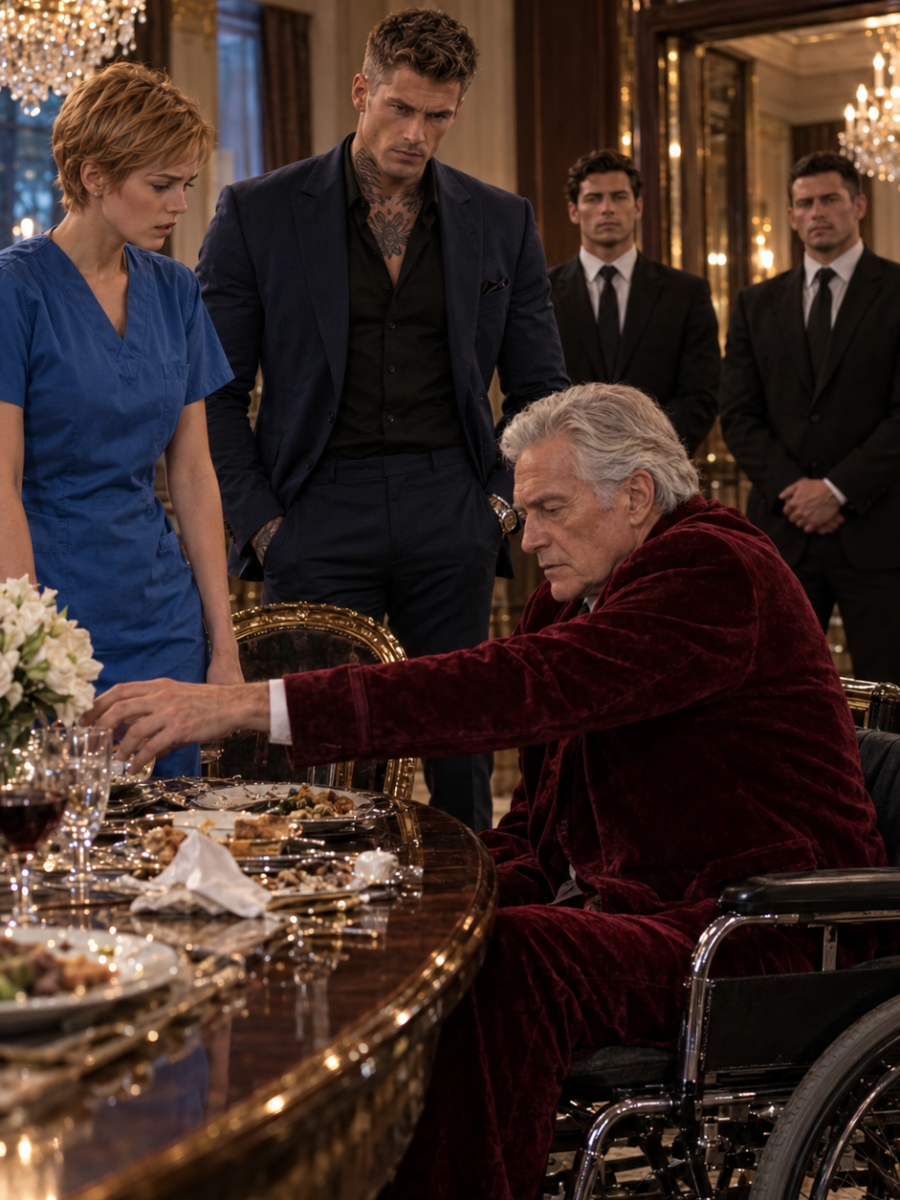
Twenty-six-year-old hospice nurse Norah Gallagher took a high-paying job caring for feared eighty-year-old Mafia patriarch Salvatore Moretti, paralyzed by a stroke inside a fortified upstate New York estate. While household staff and his ruthless mob-boss son Dominic kept their distance from the old man’s violent temper, Norah refused to back down. When Salvatore threw a violent rage fit at dinner, Norah grabbed his shoulders, looked him dead in the eye, and shouted one Italian word: ‘Basta!’—changing the course of the Moretti dynasty forever.
Table of Contents
- Chapter 1: The Iron Gates and The Eighty-Year-Old Patriarch
- Chapter 2: The Shuttered Room and The Shattered Soup Bowl
- Chapter 3: The Dining Hall Storm and The Single Word
- Chapter 4: The Power of ‘Basta’ and The Melting Frost
- Chapter 5: The Wooden Alphabet Blocks and The First Word
- Chapter 6: The Midnight Ambush and The Human Shield
- Chapter 7: The Library Confession and The Paid Debt
- Chapter 8: The Choice to Stay in the Fortress
- Chapter 9: The Terrace Laugh and The Apple Blossoms
Chapter 1: The Iron Gates and The Eighty-Year-Old Patriarch
Blood and money could buy almost anything in this world.
A private island in the Caribbean.
Judges, senators, and police commissioners.
A fortress of gray limestone and bulletproof glass disguised as a luxury estate in the pine forests of upstate New York.
What blood and money could never buy was silence or peace from an eighty-year-old monster who was dying in a wheelchair.
Salvatore Moretti had become a vengeful ghost who still ruled through terror and rage.
The household staff fled whenever his wheelchair creaked down the corridor.
His own son, Dominic Moretti, the ruthless new Don of the family, kept a cold, deliberate distance, speaking to his father only when territory required it.
Four hospice nurses had quit in the past three weeks, leaving with bruised wrists, soaked scrubs, and terrified tears.
Then I walked through the iron gates.
I was twenty-six years old, exhausted, broke, and angry enough at life not to care who Salvatore Moretti had murdered thirty years ago.
And when I finally lost my temper, looked the dreaded patriarch dead in the eye, and spoke a single Italian word, the foundations of the Moretti empire shifted forever.
My name is Norah Gallagher.
I was a specialized palliative-care nurse who had spent four years working eighteen-hour night shifts in the trauma wards of the South Bronx.
I had grown up in an unheated tenement in South Boston, the daughter of an Irish dockworker who drank away his pension and died of liver failure when I was nineteen.
I knew what violence smelled like.
I knew what men looked like when their pride was broken.
And most of all, I desperately needed the money.
The agency contract with the Moretti estate paid twenty-two thousand dollars a month in cash—enough to eliminate my fifty-eight thousand dollars in nursing school loans within half a year and move out of my damp, roach-infested basement apartment in Yonkers.
The iron gates of the estate did not swing open; they slid apart like the doors of a bank vault.
I drove my rusted ten-year-old Honda Civic up the winding gravel driveway, parking beside three matte-black armored Cadillac Escalades.
The front foyer smelled of lemon oil, beeswax, vintage leather, and the unmistakable, sharp metallic tang of sterile hospital-grade antiseptic.
“Miss Gallagher.”
A deep, quiet voice echoed from the base of the sweeping marble staircase.
I turned around.
Standing before me was Dominic Moretti.
He was thirty-four years old, six feet two inches of coiled, predatory stillness in a bespoke charcoal wool suit without a tie, his white dress shirt unbuttoned at the throat.
His hair was trimmed with surgical precision, his jawline was cut from granite, and his eyes—the color of dirty river ice in mid-winter—scanned my face with the clinical detachment of a general inspecting an expendable recruit.
“Mr. Moretti,” I said, keeping my chin level and my voice perfectly even.
“My father goes through palliative nurses rapidly,” Dominic said, walking slowly toward me with measured strides. “Four in the last twenty-one days.”
He didn’t bother with polite greetings or corporate pleasantries.
“The ischemic stroke took his right side, his leg mobility, and his speech,” Dominic continued, his voice devoid of emotion. “It did not take his temper. He is not a kind man. You keep him clean. You keep his arterial pressure below one-sixty. You make sure he takes his blood thinners. You do not have to like him.”
“I am a palliative nurse, Mr. Moretti,” I replied calmly. “I don’t get paid to like patients. I get paid to keep them alive with dignity.”
Dominic paused. His icy gray eyes narrowed slightly, searching my face for fear.
He found exhaustion. He found determination. He found zero deference.
“Good,” Dominic said softly. “Frank will take you upstairs.”
Chapter 2: The Shuttered Room and The Shattered Soup Bowl
Frank was built like an industrial commercial freezer.
He had cauliflower ears, a flattened boxer’s nose, and two concealed holsters bulging beneath his tailored windbreaker.
He led me down a dark oak corridor lined with seventeenth-century oil paintings of Sicilian landscapes and stopped outside a heavy mahogany door.
“Don’t take anything he does personally,” Frank muttered, his hand resting on the brass knob. “The old man broke two ribs on the last nurse with a bedside lamp.”
Frank swung the door open.
The master bedroom was suffocatingly hot.
A massive stone fireplace crackled with burning birch logs, even though it was eighty degrees outside in early September.
Heavy velvet blackout curtains blocked the sunlight, plunging the room into a gloomy, crimson half-light.
In the center of the Persian rug sat Salvatore Moretti in a motorized titanium wheelchair.
He was eighty years old, frail yet broad-shouldered, with thinning white hair slicked back against an age-spotted scalp.
The right side of his face sagged heavily from the stroke, pulling his right eye into a permanent, drooping snarl.
His right arm lay twisted and useless in his lap.
Yet his left eye burned with a concentrated, venomous hatred that felt like a physical blow.
The room was already a battlefield.
An overturned silver tray lay on the floor near his feet.
Steaming chicken broth was soaking into a twenty-thousand-dollar Isfahan wool rug, surrounded by jagged shards of bone china.
A frightened twenty-year-old housemaid was sobbing in the corner, clutching a towel.
Salvatore could no longer speak words.
The neurological damage had stripped away the language center of his left hemisphere, reducing his voice to wet, guttural grunts and animalistic hisses.
He glared at me, his chest heaving with rage.
He raised his functioning left fist and slammed it down onto the wheelchair armrest with a concussive *BANG!*
A warning. An eviction notice.
I ignored it completely.
I walked past Frank, set my medical kit on the antique side table, and knelt beside the broken china.
“I see you didn’t care for the soup, Mr. Moretti,” I said, picking up the larger porcelain pieces and placing them on the tray. “That’s quite all right. We can have the kitchen prepare pasta with garlic oil instead. But first, I need to check your vitals.”
Salvatore produced a wet, rattling roar from deep in his throat.
His left hand shot out toward the heavy crystal water pitcher resting on the nightstand.
He hurled it with astonishing force.
The heavy lead crystal pitcher missed my left ear by two inches, shattering violently against the oak wall behind me and showering my back with ice water and broken glass.
Frank stiffened in the doorway, reaching for his weapon, but nobody stepped inside.
Nobody crossed Salvatore Moretti.
I slowly stood up.
Cold water was dripping from my scrub top, soaking into my undershirt.
I looked at the dent in the oak paneling.
Then I turned and looked directly into Salvatore Moretti’s furious, triumphant eye.
He was breathing hard, a string of thick saliva gathering at the paralyzed corner of his mouth, his chin raised in arrogant defiance—a dying warlord celebrating another small victory through intimidation.
I grabbed a clean hand towel from the bathroom, dried my neck, and walked straight over to his wheelchair.
I pulled my stethoscope from my neck and wrapped the blood pressure cuff around his functioning left arm.
“Your systolic pressure is probably through the roof,” I said, looking right into his glaring eye. “Bite me if you want, old man. But we are finishing this exam.”
For fourteen days, that bedroom was a brutal war of attrition.
Salvatore spat his pills across the floor; I ground them into applesauce and waited until he was hungry.
He refused physical therapy, turning his body into a limp deadweight; I used biomechanical leverage to haul his legs onto the bed, ignoring his curses.
Dominic rarely visited.
Occasionally, I would see Dominic standing in the shadows of the doorway late at night, watching his father with cold, haunted detachment before vanishing into the dark corridor.
Father and son were two glaciers drifting in the same frozen sea.
Then, on a stormy Tuesday evening, the fragile peace shattered.
Chapter 3: The Dining Hall Storm and The Single Word
Dinner was served at 7:30 PM in the grand dining room.
The room was dominated by an enormous thirty-foot mahogany table designed to seat thirty guests beneath an antique Italian chandelier.
Only two men sat at the table.
Dominic sat at the head in his crisp white shirt, cutting into a rare ribeye steak with slow, precise movements of his silver knife and fork.
Salvatore sat halfway down the table in his wheelchair.
I stood two steps behind Salvatore, holding a damp cloth and his evening medication cup.
Salvatore was struggling with an adaptive weighted spoon, trying to scoop pureed butternut squash into his mouth with his trembling left hand.
His knuckles shook violently.
The spoon slipped from his grip, splattering orange puree across the lapel of his black cashmere cardigan.
Salvatore froze.
His breath caught in his throat, his face flushing crimson with profound, agonizing humiliation.
Dominic did not pause his chewing. He did not look up from his plate.
“Let the nurse feed you, old man,” Dominic said softly.
The words were spoken without malice, but they carried a razor-sharp edge of condescension that cut straight into the old patriarch’s soul.
Salvatore detonated.
A guttural, strangled roar erupted from his chest—a sound of pure, wounded animal fury.
With a violent sweep of his left arm, Salvatore smashed his porcelain plate off the mahogany table.
The heavy plate crashed against the hardwood floor, exploding into shards, spraying hot puree and roasted meat across the rug.
Salvatore slammed both wheels of his chair forward, knocking his crystal water goblet over, sending water cascading across Dominic’s leather ledger.
He raised his fist, his face contorted in a wild, unhinged rage, preparing to flip the entire place setting onto the floor, his breathing turning into a dangerous, ragged wheeze that indicated acute cardiac distress.
Dominic set his fork down with a sharp, metallic clatter, his gray eyes turning to ice.
“Frank,” Dominic commanded, his voice cold and lethal. “Sedate him and lock him in the east wing.”
“NO!” I shouted.
The word ripped from my throat with the force of a gunshot.
Both men froze.
Frank stopped in his tracks near the door, his eyes wide in absolute shock.
Dominic slowly turned his head toward me, astonishment flickering across his aristocratic features.
Nobody shouted at Dominic Moretti. Nobody questioned an order in this house.
I ignored Dominic completely.
I stepped around the wheelchair, grabbed both of Salvatore’s trembling shoulders, and forced him to face me.
He was shaking violently, his left hand clenched into a white-knuckled fist, his chest heaving, his face turning an alarming shade of mottled purple.
I bent down until my face was four inches from his wild, bloodshot eyes.
I didn’t speak in English.
I spoke the one Italian word my grandmother in South Boston had used whenever her sons lost their minds in fury:
*”BASTA!”*
The word echoed off the thirty-foot ceiling like a crack of thunder.
*Enough.*
Chapter 4: The Power of ‘Basta’ and The Melting Frost
The entire dining hall fell into a suffocating, breathless silence.
Salvatore’s raised fist froze in mid-air.
His bloodshot left eye widened until the white was fully exposed, staring at me in paralyzed disbelief.
*”Basta, Salvatore,”* I repeated, my voice dropping from a shout to a low, fierce, unwavering command. *”Guarda me. Respira.”*
*Look at me. Breathe.*
I took his trembling, calloused left hand between both of my palms, pressing down firmly against his pulse point.
“You are not a wounded beast in a cage,” I said, looking straight into his soul with fierce, compassionate anger. “You are an eighty-year-old man who survived a stroke. You dropped some food on your sweater. It happens to children. It happens to soldiers. It happens to emperors.”
I reached for the cloth, gently wiped the orange puree from his cashmere lapel, and smoothed his collar with steady, respectful hands.
“You want to smash plates? Smash them. You want to yell? Yell until your lungs burst. But you will not let your pride kill you at this table while you still have breath in your body.”
Salvatore stared at me.
For five long seconds, the old man who had ordered executions across two continents remained completely motionless.
His chest rose and fell in ragged, shuddering gasps.
Then, slowly, the violent tension in his left hand began to melt away.
His fingers uncurled.
His chin dipped downward.
And from the drooping, paralyzed corner of his left eye, a single, heavy tear escaped, tracking slowly down through the deep wrinkles of his weathered cheek.
He didn’t roar. He didn’t hiss.
He simply rested his forehead against my forearm, letting out a long, shuddering sigh of pure, exhausted defeat.
I gently patted his shoulder, feeling the fragile bird-like bones beneath his heavy wool sweater.
Across the room, at the head of the table, Dominic Moretti had not moved.
His silver fork remained poised above his plate.
His dirty-ice gray eyes were fixed upon me with an expression that was no longer detached, no longer cold.
He looked at me as though I had just reached into an active volcano with bare hands and pulled out a burning stone without getting singed.
“Take him upstairs, Miss Gallagher,” Dominic said.
His voice was different now.
The mocking chill was gone, replaced by a quiet, reverent stillness that made my pulse race.
“Yes, Mr. Moretti,” I whispered.
I unlocked the brakes on the wheelchair and guided Salvatore out of the dining room.
As the doors closed behind us, I felt a heavy weight lift from the old man’s slumped shoulders.
The monster of New York had finally found someone who was not afraid of his shadow.
Chapter 5: The Wooden Alphabet Blocks and The First Word
After that Tuesday evening, everything inside the Moretti fortress transformed.
The war of attrition was over.
Salvatore stopped throwing his medication.
Every morning at 8:00 AM, when I entered his bedroom, he would be waiting by the window in his wheelchair, dressed in a clean cashmere sweater, his white hair neatly combed.
When I placed his morning blood-pressure cuff on his arm, he would tap his left fingers against my wrist in a gentle rhythm.
We began intensive neuro-rehabilitation.
I placed small wooden alphabet blocks on his tray table.
Painstakingly, hour after hour, Salvatore used his left hand to arrange letters into crude words:
*C-O-F-F-E-E.*
*W-A-T-E-R.*
*W-I-N-D-O-W.*
One rainy afternoon in late October, after he successfully spelled *G-A-R-D-E-N*, I smiled and handed him a warm cannoli from the pastry shop in town.
Salvatore took the cannoli.
He looked up at me, his sagging lip trembling with intense neurological effort.
His vocal cords strained, air pushing through his scarred throat.
“…N-N-No… rah,” he rasped.
The sound was rough, cracked, and imperfect.
But it was a name.
My eyes welled with tears.
“Yes, Salvatore,” I whispered, squeezing his hand. “Norah. That’s my name.”
A faint, crooked smile touched the left side of his mouth—the first genuine smile anyone in that house had seen on his face in four years.
Meanwhile, Dominic began visiting the room every evening.
At first, he stood awkwardly by the bookcase, reviewing shipping manifests while I assisted Salvatore with his breathing exercises.
Then, Dominic began sitting in the leather armchair.
One night, Dominic brought a wooden chessboard.
He set the board on Salvatore’s lap tray, arranging the carved marble pieces in silence.
Father and son played without exchanging words—Salvatore moving his pawns with shaking left fingers, Dominic responding with thoughtful, patient moves.
For the first time in thirty years, there was no shouting, no blood, no bitterness between them.
Only the quiet click of stone against wood, bonded by a shared, unspoken healing.
As I was packing my bag in the corridor outside the bedroom later that night, footsteps approached.
Dominic stood beside me, smelling of cedarwood, rain, and expensive tobacco.
“You changed him, Norah,” Dominic said softly, his gray eyes warm in the sconce light.
“He just needed someone to see the man behind the stroke, Dominic,” I replied, looking up into his handsome, tired face.
Dominic reached out. His fingers hovered near my cheek before he gently tucked a stray curl of dark hair behind my ear.
His touch was warm, sending a shiver of electricity straight down my spine.
“No,” Dominic whispered, his voice dropping into a deep, intimate register. “You gave me back my father. And you brought life into a tomb.”
Before I could answer, Frank ran down the hall, his face pale and sweating.
“Boss,” Frank gasped, breathless. “We have a critical breach. Santoro’s capos just cut the fiber-optic lines to the estate perimeter.”
Chapter 6: The Midnight Ambush and The Human Shield
The heavy iron shutters slammed down over the estate’s floor-to-ceiling windows with concussive clangs of reinforced steel.
Red emergency battle-lanterns flickered to life along the vaulted corridors.
“Explain, Frank!” Dominic demanded, his voice instantly reverting to the lethal authority of a mob sovereign as he drew a custom black Sig Sauer from his shoulder holster.
“Vito Santoro,” Frank reported, checking the tactical feed on an encrypted tablet. “He allied with the Marcone cartel out of New Jersey. They know the Don had a stroke and believed you were weak. They breached the southern gate with thirty armed men. They’re coming to execute the Don and claim the five boroughs.”
Gunfire erupted from the front courtyard—the sharp, concussive staccato of automatic assault rifles echoing through the limestone walls.
Shouts and screams from the security perimeter rippled through the radio headsets.
“Norah,” Dominic turned to me, his gray eyes blazing with fierce urgency. “Take my father into the basement panic room beneath the wine cellar. There is an armored vault with independent life-support systems. Lock the steel door from the inside and do not open it for anyone except me.”
“What about you?” I cried, my heart pounding against my ribs.
“This is my house,” Dominic said coldly, racking the slide of his weapon. “And nobody murders my family under my roof.”
I sprinted into Salvatore’s bedroom.
The old man was already awake, sitting upright in his wheelchair, listening to the gunfire with the instinct of a seasoned warrior.
His left eye was sharp and alert.
“Salvatore, we have to move!” I shouted, unlocking the chair brakes.
As I pushed the chair toward the private service elevator, a heavy crash shook the floor above us.
Two men in black tactical vests and balaclavas kicked open the fire doors at the end of the east corridor.
They carried short-barreled submachine guns.
“There’s the old bastard!” one of the shooters shouted, leveling his weapon directly toward Salvatore’s chest.
Panic seized my throat.
There was nowhere to run. The hallway was a dead end.
In a split second of pure, protective maternal instinct, I threw my entire body across Salvatore’s wheelchair, using my back, shoulders, and skull as a human shield against the assault rifles.
“Stay down!” I screamed into his ear.
*BANG-BANG-BANG!*
Three rapid, ear-splitting shots detonated in the corridor.
I squeezed my eyes shut, waiting for the searing impact of lead tearing into my flesh.
The bullets never hit me.
I looked up.
Both hitmen had collapsed onto the marble floor, neutralized instantly by precise headshots.
Dominic Moretti stood at the corner of the corridor, his smoking weapon leveled, flanked by four tactical operators in body armor.
Dominic’s chest heaved with ragged breaths.
He lowered his weapon, his gaze locking onto me shielding his paralyzed father.
For a heartbeat, the ruthless Don looked completely shattered by the sight of my sacrifice.
He covered the distance in three strides, dropping to his knees beside the wheelchair, his hands grasping my shoulders, checking my body frantically for wounds.
“Are you hit?!” Dominic demanded, his voice cracking with sheer, terrified desperation. “Norah! Are you bleeding?!”
“I’m… I’m okay,” I stammered, trembling uncontrollably. “Salvatore is safe.”
Salvatore reached his functioning left hand out.
With astonishing, newfound strength, the eighty-year-old patriarch grabbed his son’s wrist, then reached over and grabbed my hand, pressing our two hands together between his own palms.
“…P-P-Protect… her,” Salvatore rasped, his voice clear, loud, and carrying the authority of an emperor’s decree.
Dominic looked from his father’s fierce gaze to my wide, tear-filled eyes.
“With my life, Father,” Dominic swore, his voice shaking with profound devotion. “With my life.”
Chapter 7: The Library Confession and The Paid Debt
The siege of the Moretti estate was crushed within forty-five minutes.
Dominic’s tactical units, reinforced by sixty loyal capos arriving from Brooklyn and Queens, surrounded Santoro’s mercenaries in a crossfire of overwhelming firepower.
Vito Santoro was captured alive in the garden pavilion, disarmed, and dragged into the underground cellar in heavy iron chains.
At 3:00 AM, the estate fell into an eerie, triumphant silence.
Paramedics treated two wounded guards, while forensic cleanup crews sanitized the gravel courtyard.
I sat in the spacious library, wrapped in an oversized cashmere blanket, sipping hot Earl Grey tea while trying to calm my shaking hands.
The heavy mahogany doors opened.
Dominic walked into the room.
He had showered and changed into fresh dark trousers and a crisp black shirt.
His knuckles were bruised, and a faint scratch marked his jaw, but his eyes were filled with an intense, burning clarity.
He walked over and sat on the leather ottoman directly across from me.
“Santoro has been handed over to federal authorities along with twenty years of extortion and racketeering logs,” Dominic said quietly. “The Marcone cartel surrendered their territory in Newark twenty minutes ago. The war is over.”
“Good,” I whispered, looking down at my tea. “You and your father can finally live in peace.”
Dominic didn’t say anything for several moments.
The grandfather clock in the corner ticked softly in the quiet room.
“Norah,” Dominic said, reaching forward to take the teacup gently from my hands and setting it on the side table.
He took both of my trembling hands into his own warm, strong palms.
“Three weeks ago, I hired you because I thought you were just another nurse who would last five days before breaking under my father’s bitterness.”
He looked directly into my eyes, his gray gaze softer and more vulnerable than I had ever seen it.
“Instead, you stood in front of an eighty-year-old tyrant, shouted *Basta*, and forced him to remember that he was a human being.”
A faint, self-deprecating smile touched his chiseled lips.
“And tonight… when submachine guns were pointed at his chest, you threw your own body over his wheelchair without hesitating. You had no obligation to die for our sins, Norah.”
“He’s my patient, Dominic,” I said softly, tears pricking my eyes. “In my world, you don’t abandon the people who trust you.”
“In my world,” Dominic whispered, leaning closer until his breath warmed my lips, “women like you don’t exist. You are pure fire, Norah Gallagher. And I have spent the last three weeks falling hopelessly, irrevocably in love with you.”
Chapter 8: The Choice to Stay in the Fortress
My breath caught in my throat.
The room seemed to spin on its axis.
“Dominic…” I whispered, my heart hammering violently against my ribs. “You’re the head of the Moretti family. You command an empire. I’m a nurse with fifty thousand dollars in debt who grew up in South Boston.”
“I don’t care about your debt, Norah,” Dominic said fiercely. “Your debt was wired in full to the Department of Education this morning. You don’t owe anyone a single penny on this earth.”
“You paid my loans?” I gasped in shock.
“That wasn’t a gift. That was an overdue payment for saving my father’s soul,” Dominic replied, his hands tightening gently around mine. “What I want from you isn’t gratitude. I want your heart. If you want to walk away, the gates are open. A car is waiting to take you wherever you wish to go.”
He stood up, walking toward the fire, giving me space, his broad back rigid with agonizing restraint.
“I won’t trap you in this world, Norah. But if you leave… this house goes back to being a tomb.”
I looked at my hands.
For years, I had fought through life alone.
I had fought landlords, loan collectors, drunken fathers, and grueling eighteen-hour shifts, believing that the world was cold, brutal, and unyielding.
Yet in this fortress of stone and shadows, I had found two men who valued loyalty above life itself.
I stood up from the sofa.
I walked across the Persian rug until I stood behind Dominic’s tall frame.
I reached out, resting my hands against the broad expanse of his back, feeling the steady, powerful rhythm of his heartbeat beneath the dark fabric.
“Dominic,” I spoke softly.
He turned slowly, looking down at me with guarded, hopeful eyes.
“I spent my entire life running from dangerous men,” I smiled through my tears. “But you’re not dangerous to me. You’re the man who plays chess with his paralyzed father and protects the people he loves.”
I stepped into his space, cupping his strong jaw with my hands.
“I don’t want to leave, Dominic Moretti. I want to stay right here.”
Dominic let out a ragged, relieved breath that sounded like a prayer.
He wrapped his powerful arms around my waist, lifted me off my feet, and pulled me tight against his chest, burying his face in my neck as his lips found mine.
The kiss was deep, fierce, and sacred—a vow forged in gunfire, sealed by courage, and blooming into an unshakeable love.
Chapter 9: The Terrace Laugh and The Apple Blossoms
Six months later, spring arrived in upstate New York with an explosion of white apple blossoms and golden daffodils.
The sprawling stone terrace of the Moretti estate overlooked the shimmering expanse of the Hudson River Valley.
Seated at the head of a sunlit garden table was Salvatore Moretti.
His rehabilitation had progressed into a medical marvel.
Through relentless therapy, he had regained thirty percent of the mobility in his right leg, allowing him to walk short distances with a carved silver cane.
He was speaking in full, distinct sentences, laughing as he scolded Frank for over-steeping his espresso.
“Frank!” Salvatore barked, waving his cane with theatrical irritation. “The beans are burnt! You make coffee like a barbarian!”
Frank grinned, shaking his head. “Right away, Don Salvatore.”
I stood by the carved stone balustrade, wearing a simple white silk sundress that fluttered in the warm May breeze, holding a cup of fresh lemon water.
Strong arms slipped gently around my waist from behind.
Dominic rested his chin on my shoulder, breathing in the scent of my hair.
“What are you thinking about, Mrs. Moretti?” Dominic whispered into my ear.
I smiled, turning in his embrace.
On my left ring finger rested an exquisite vintage platinum ring featuring a rare, glowing five-carat emerald surrounded by a halo of brilliant-cut diamonds—an heirloom that had belonged to Dominic’s grandmother in Palermo.
“I was thinking about the first day I drove through those iron gates,” I smiled softly, tracing the sharp line of his jaw with my fingertips. “About how terrified I was… and how one spilled bowl of soup changed my entire life.”
Dominic laughed—a rich, warm sound that filled the terrace.
“And one Italian word,” he whispered, pressing his forehead against mine.
Down at the garden table, Salvatore banged his silver cane against the flagstones, calling out loudly:
*”Dominic! Norah! Basta con i baci! Bring the wine! We have family to celebrate!”*
*Enough with the kissing! Bring the wine!*
Dominic and I looked at each other and burst into joyful laughter.
Dominic took my hand, intertwining our fingers, and led me toward the table where the former monster of New York was smiling with genuine, radiant peace.
The shadows were gone.
The fortress was no longer a tomb.
It was a home, built on courage, bound by honor, and filled with a love that would echo through generations.