“Don’t try to open the door, Rosalind. It’s already too late for you.” Garrett left his wife and her paralyzed brother inside a sinking SUV in the river, swimming to shore to embrace her pregnant half-sister. But when the freezing water reached her neck, the brother who had used a wheelchair for fifteen years stood up, cut her locked seatbelt, and whispered: “Play dead. He’s watching.”
Table of Contents
- Chapter 1: The Flooding Cabin and The Locked Belt
- Chapter 2: The Umbrella on the Shore
- Chapter 3: Fifteen Years of Standing
- Chapter 4: The Stormwater Sanctuary
- Chapter 5: The Warm Milk Secret
- Chapter 6: The Widower’s Coronation
- Chapter 7: The Emerald Entrance
- Chapter 8: The Steel Cuffs of Justice
- Chapter 9: Morning Over Baltimore Harbor
Chapter 1: The Flooding Cabin and The Locked Belt
“Don’t try to open the door, Rosalind. It’s already too late for you.”
Those were the last words my husband of three years spoke to me before he slid out through the driver’s window and vanished into the churning, muddy waters of Savannah Creek.
Everything had happened in less than forty seconds.
We had been driving south along the elevated coastal causeway toward the Chesapeake Bay estuary. It was a gloomy, rain-slicked Tuesday afternoon. The sky hung low like wet slate. In the back seat of our heavy black Lincoln Navigator sat my older brother, Tobias. For fifteen years—ever since the horrific collision on the Baltimore bypass that claimed the lives of our parents—Tobias had lived in a specialized carbon-fiber wheelchair, his lower body motionless beneath thick woolen blankets.
I had been humming softly to the radio, resting my hand on Garrett’s knee, talking about the quarterly shipping manifests for our family’s century-old dry docks.
Then Garrett had yanked the steering wheel hard to the right.
The impact against the guardrail was deafening—a screech of tearing aluminum followed by a sickening lurch of weightlessness. The SUV plummeted thirty feet off the embankment, hitting the river flat against its undercarriage.
The shock of the impact knocked the air from my lungs. My forehead slammed against the dashboard, stars exploding in my vision.
When my eyes opened, icy river water was already pouring through the vents, swirling around my ankles.
“Garrett!” I screamed, coughing against the smoke from the deployed passenger airbag. “Garrett, the doors won’t open! Tobias is in the back!”
Garrett didn’t look at Tobias. He didn’t look at me with panic, or fear, or desperation.
His face was completely calm. Serene, even.
With methodical precision, Garrett clicked his seatbelt release, hit the power button to lower his window halfway, and squeezed his lean frame through the opening into the rising tide.
“Garrett! Help us!”
He didn’t turn back. He stroked smoothly toward the marshy embankment thirty yards away.
Frantic, I reached down to unbuckle my own seatbelt.
The red button was frozen solid. I yanked, chipped my fingernails down to the quick, and tugged with all my strength. Nothing.
My fingers traced the belt strap down between the console and the floorboards.
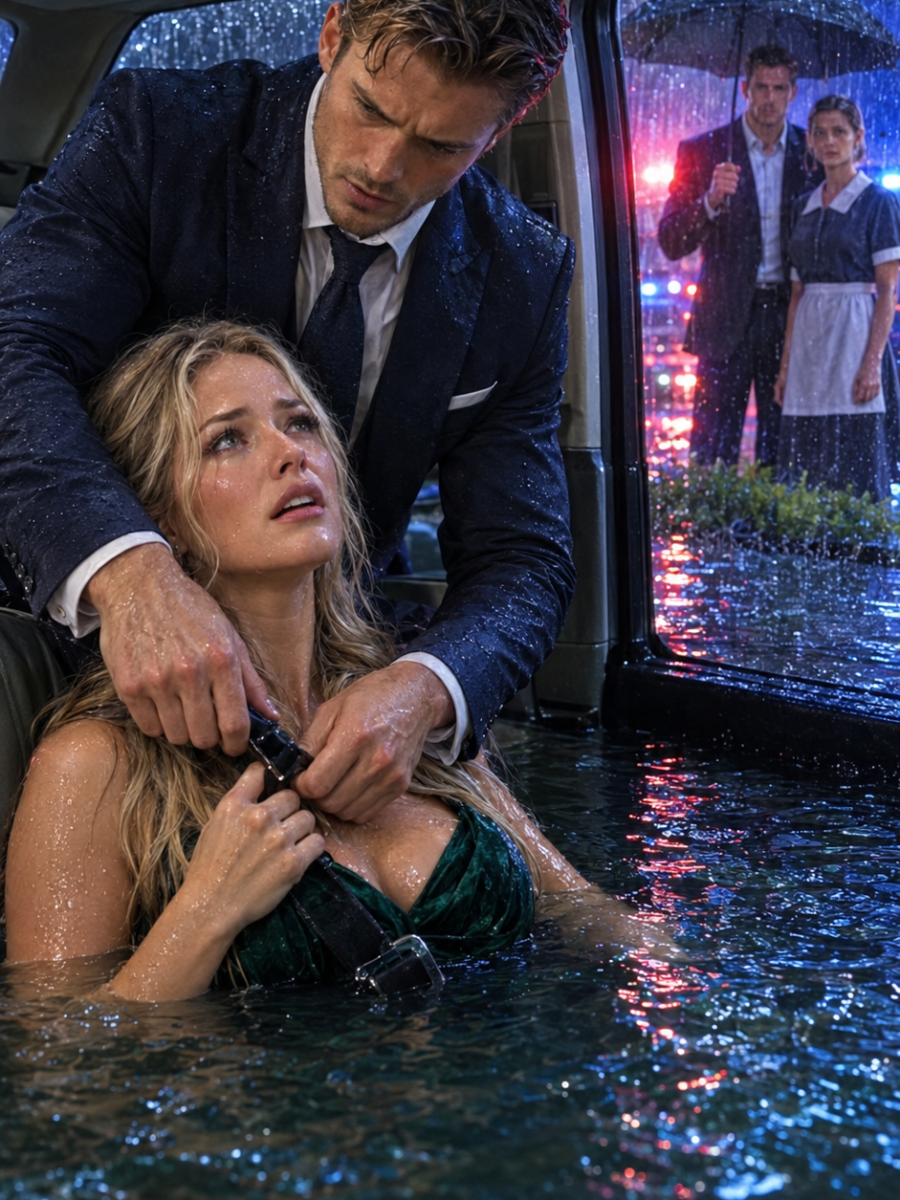
My fingertips brushed against coarse, braided steel wire. Someone had clamped the belt anchor with an industrial aircraft cable, cinching it into the floor brackets with a tamper-proof padlock.
This was no accident.
This was an execution chamber.
Chapter 2: The Umbrella on the Shore
The muddy water rose to my chest, freezing cold, soaking through my silk blouse and pressing against my ribs like a tightening corset.
Through the rain-streaked rear window, I caught sight of the marshy riverbank.
Garrett pulled himself out of the reeds. He stood on dry gravel, shaking the river water from his dark hair.
He was not alone.
Standing on the embankment beneath a wide black umbrella was Penelope—my twenty-four-year-old half-sister. Penelope, whom our father had fathered during an affair, whom I had welcomed into our family home after our father died, whom I had given an executive salary and an apartment overlooking the harbor.
Penelope wore a cashmere cream coat. Her coat was open, revealing a conspicuous, rounded baby bump.
I watched in frozen horror through the glass.
Garrett walked straight to Penelope. He wrapped his arms around her waist, pulling her into an intimate, lingering embrace. She raised a delicate hand, gently stroking his cheek, before handing him a dry wool towel from her tote bag.
Then, both of them turned toward the river.
They stood side by side under the umbrella, watching the roof of our heavy SUV sink inch by inch into the dark current.
Garrett smiled.
It was the same warm, reassuring smile he had given me every single evening for three years when he handed me a glass of warm almond milk before bed, telling me how brilliant I was, how tirelessly I worked to keep the shipyard solvent, how lucky he was to have married me.
*Three years of marriage.*
Three years of shared breakfasts, whispered promises in the dark, and anniversaries celebrated overlooking the harbor.
Every word had been a lie. Every touch had been poison.
“Rosalind…”
A voice rose from the back seat, thick with water and wheezing breath.
I twisted around as far as the wire-locked seatbelt allowed. The water had reached Tobias’s chin. His head was tilted back against the leather headrest, his dark eyes wide, looking at me through the murky gloom.
“Tobias!” I sobbed, tears scalding my cold cheeks. “I’m so sorry… I brought him into our house. I trusted him with our family. I killed us both…”
“Rosalind. Close your eyes and hold your breath.”
“What…?”
“Close your eyes!” Tobias’s voice was no longer the soft, weary whisper of an invalid. It was a commanding, resonant baritone that rang through the flooding cabin like iron striking stone.
I clamped my eyelids shut.
Behind me, the sound of tearing metal and a ferocious, explosive impact shattered the silence.
Chapter 3: Fifteen Years of Standing
*CRACK!*
The sound was like a sledgehammer striking an oak door.
I snapped my eyes open.
What I saw shattered every reality I had known for the past fifteen years.
Tobias was not slumped in his wheelchair.
He was standing upright on both feet.
His long, powerful legs—legs that doctors had pronounced permanently paralyzed following the brake-line failure that killed our parents in 2011—were braced against the floorboards. With a small, hardened titanium cutting tool extracted from the hollow armrest of his wheelchair, Tobias severed the steel wire binding my seatbelt in two swift, violent pulls.
The belt snapped free.
“Tobias…” I gasped, swallowing river water as the cabin filled to the ceiling. “You can… you can walk?!”
“Not now,” he barked under the churning water.
He reached down, grabbing a compact waterproof pouch strapped beneath his thigh. He pulled out two miniature emergency dive mouthpieces—the kind used by naval combat divers for quick sub-surface escapes—and jammed one into my mouth.
*Breathe,* his hand gestured.
I inhaled. Pure, dry oxygen filled my burning lungs.
Tobias turned toward the rear tailgate. He waited until the water completely filled the cabin, equalizing the external pressure against the steel hatch. Then, drawing his right leg back, he delivered a massive, mule-kick blow directly against the latch mechanism.
The hydraulic seal broke. The rear door swung open into the dark river.
Tobias grabbed my arm with an iron grip and pulled me through the opening into the black, swirling water.
Instinctively, I kicked my legs, aiming for the pale light filtering down from the surface.
Tobias’s hand clamped down hard on my shoulder, dragging me downward instead.
He shook his head furiously, pointing upward through the murky water toward the silhouette of the embankment.
Through the distorted surface, I saw the twin dark figures of Garrett and Penelope standing beneath their umbrella, watching the bubbles dissipate. If our heads broke the surface, Garrett would see us instantly. He had a hunting rifle in his trunk; he had friends in the local county precinct. If he knew we had survived the sinking, he would ensure we never made it to shore alive.
Tobias guided me along the riverbed, using the heavy timber pilings of an abandoned 19th-century railway pier for cover.
We swam sixty yards downstream, hidden completely beneath the rotten wood and barnacle-encrusted concrete, until we reached an old municipal stormwater outfall—a cavernous, dry maintenance chamber carved into the riverbank bluffs, far out of sight from the causeway above.
Chapter 4: The Stormwater Sanctuary
We crawled out of the water onto the slick concrete floor of the maintenance chamber.
I pulled the mouthpiece from my lips, coughing violently, vomiting river water and bile onto the floor. My whole body shook with violent, uncontrollable tremors—not just from the hypothermic bite of the November water, but from the cataclysmic revelation tearing through my mind.
I turned around.
Tobias stood five feet away. He was wringing the dark water from his woolen sweater, balanced perfectly on his two muscular, steady legs.
For fifteen years, I had bathed this man. I had pushed his chair up ramps, adjusted his pillows, cried myself to sleep over the thought that my brilliant older brother would never run, never dance, never live a normal life because of the crash that took our mother and father.
“Fifteen years,” I choked out, stumbling toward him, my fists slamming into his chest. “Fifteen years, Tobias! You let me believe you were broken! You let me carry the guilt of that crash every single day of my life! Why?! How could you lie to me?!”
Tobias didn’t flinch. He let my fists hit his chest until my strength gave out and I collapsed against his wet sweater, weeping hysterically.
He wrapped his strong arms around me, holding me tight against his heart.
“Because our parents’ death was not an accident, Rosalind,” he whispered into my hair.
The chamber fell dead silent. Only the steady drip of condensation echoed off the stone walls.
I pulled back, staring up into his eyes. “What did you say?”
“On October 14, 2011, when our father’s sedan went over the bridge, the brake lines hadn’t eroded,” Tobias said, his jaw tightening into rigid granite. “They had been cut with hydraulic shears. I woke up in the trauma ward forty-eight hours later. The chief of neurosurgery was Dr. Thomas Vance—Garrett’s uncle.”
The room seemed to spin around me. “Thomas Vance…?”
“I overheard him speaking to Garrett’s father, Marcus Vance, outside my ICU door,” Tobias continued, his eyes burning with a dark, terrifying flame. “Marcus told him: *’The parents are dead. But the boy survived. If he remembers what his father told him about the shipyard deeds, we have a problem.’* Dr. Vance assured Marcus that with a high dose of spinal neuro-blockers, I would never walk again, and that within six months, my mind would deteriorate.”
Tobias reached down and touched his own thighs.
“The next night, an orderly who had served with our grandfather in the Navy smuggled me out for a private MRI. The nerve damage wasn’t permanent. It was reversible with intense physical therapy. But that old orderly warned me: *’If the Vance family knows you can walk, you will not survive the week.’*”
Tobias looked directly into my soul.
“So I stayed in the chair, Rosalind. For fifteen years, I trained in secret every night after midnight, behind locked doors. I played the helpless invalid so they would leave me alone. I waited for them to show their hands. And today, Garrett finally did.”
Chapter 5: The Warm Milk Secret
“Tobias…” I gasped, trembling so hard my teeth clattered. “If Garrett wanted the shipyard, why did he marry me? Why did he wait three years?”
Tobias reached into his waterproof pouch and pulled out a small, sealed plastic cylinder. Inside was a tiny glass vial containing a cloudy amber liquid, along with a digital flash drive.
“Do you remember the warm almond milk Garrett gave you every evening at nine o’clock?” Tobias asked softly.
My stomach dropped into a bottomless pit of ice. “He… he said it was for my insomnia. He said I was under too much stress running the logistics docks.”
“For three years, Garrett has been dosing your milk with micro-doses of thallium sulfate and synthetic progestin,” Tobias said, each word striking like a hammer blow. “Thallium is odorless, tasteless, and slowly degrades the cardiovascular system while mimicking chronic autoimmune fatigue. But the progestin was the real cruelty.”
Tears spilled from my eyes. “What did it do?”
“It induced permanent secondary infertility while causing ovarian cysts,” Tobias whispered, his voice trembling with suppressed rage. “He ensured you could never give the Sterling estate an heir. And while you were slowly dying of what doctors would eventually label an idiopathic heart failure, Garrett was sleeping with Penelope.”
I covered my mouth, suffocating a scream.
“Penelope’s baby,” Tobias said, pointing toward the surface, “is Garrett’s child. Under Maryland inheritance law and the bylaws of the Sterling Dry Dock Trust, if you died without biological issue, and with me presumed dead or incompetent, the entire ninety-million-dollar maritime estate would pass directly to your surviving legal spouse and his issue—Penelope’s child.”
The full monstrous tapestry of their conspiracy stood laid bare before me.
They had murdered my parents.
They had intended to murder Tobias.
They had poisoned my body for thirty-six months.
And today, they believed they had drowned me in thirty feet of river mud while they stood under an umbrella laughing.
Something inside me—the gentle, trusting, naive Rosalind who believed in family loyalty and marital vows—shriveled into ash.
In her place rose a woman forged in icy river water and righteous vengeance.
I wiped the mud from my face. I stood tall beside my brother, feeling the cold strength of our ancestors flowing through my veins.
“They think we’re at the bottom of Savannah Creek,” I said, my voice steady, razor-sharp, and deadly calm.
Tobias looked at me, a grim, approving smile touching his lips. “They do.”
“When is the emergency board meeting to vote on the dry dock transfer?”
“Tomorrow morning at ten o’clock,” Tobias replied. “Garrett has already alerted the port authority that our SUV was lost in a flash flood. He expects to present your death certificate and claim the chairmanship by noon.”
“Then let’s prepare our presentation,” I said. “It’s time to attend our own funeral.”
Chapter 6: The Widower’s Coronation
At 9:30 the following morning, the executive boardroom on the twentieth floor of the Sterling Maritime Tower in downtown Baltimore was bathed in sunlight.
Through the floor-to-ceiling glass windows, the sprawling expanse of the harbor stretched out—cranes loading thousand-foot container vessels, tugboats cutting white wakes through the blue water, dry docks worth nearly a hundred million dollars.
Inside the boardroom, Garrett Vance looked every inch the grieving, heroic widower.
He wore an impeccably tailored charcoal-gray three-piece suit with a black silk tie. A small white handkerchief peeked from his breast pocket. He had spent the morning speaking softly to the local news stations, weeping on camera about the “freak brake failure” that had stolen his beloved wife and her disabled brother away in the river.
Beside him sat Penelope. She wore a modest black mourning dress that delicately accentuated her pregnant belly, dabbing a tissue at dry eyes whenever a board member glanced her way.
At the head of the conference table sat the seven senior trustees of the Sterling Maritime Trust—elderly men and women who had known my father for four decades.
Garrett cleared his throat, standing with solemn, practiced dignity.
“Thank you all for convening on such short notice during this unfathomable tragedy,” Garrett said, his voice thick with rehearsed sorrow. “The dive teams are still searching the riverbed, but the state troopers have confirmed that the vehicle was fully submerged for over sixteen hours. There are no survivors.”
Trustee Harrison, an eighty-year-old friend of my grandfather, wiped a tear from his spectacles. “Rosalind was the soul of this company. And poor Tobias… to die like that after fifteen years of suffering.”
“It is a catastrophe,” Garrett said, lowering his eyes with solemn reverence. “However, the port authority has informed us that the forty-million-dollar expansion contract with the federal maritime agency expires at noon today. If our leadership remains vacant, the contract will default.”
Garrett placed a thick leather binder on the mahogany table.
“As Rosalind’s sole legal heir, and under the emergency succession clauses of the 1984 family charter, I am prepared to assume executive chairmanship of Sterling Dry Docks immediately. Penelope, as the surviving maternal kin, has fully endorsed this transition to protect our family’s future.”
Penelope nodded solemnly. “It is what Rosalind would have wanted. She loved Garrett more than life itself.”
“Very well,” Trustee Harrison said with a heavy sigh, picking up his fountain pen. “If legal counsel has verified the emergency succession documents, I suppose we have no choice but to sign—”
The heavy double doors of the boardroom swung open with a resounding crash that rattled the crystal water carafes.
A voice, cold and crystalline as winter ice, cut across the room:
“Put the pen down, Harrison.”
Chapter 7: The Emerald Entrance
The entire boardroom froze.
Every trustee snapped their heads toward the entrance.
Standing in the doorway was a woman dressed in a bespoke, immaculate emerald-green trouser suit. Her dark hair was swept into an elegant chignon, her lips painted bold crimson, her chin held high with majestic authority.
Beside her, walking with long, athletic, completely unimpeded strides, was a tall man in a dark navy blazer, his broad shoulders squared, his gaze cutting like a broadsword across the room.
“Rosalind…?” Trustee Harrison gasped, dropping his fountain pen onto the mahogany table.
Penelope let out a strangled shriek, knocking her chair backward, clutching her stomach in pure, unadulterated terror as if the dead had walked out of the sea.
Garrett’s face did not merely lose color; it turned the gray of wet cement. His hands gripped the edge of the conference table so hard his knuckles popped.
“No…” Garrett whispered, his voice cracking into a high-pitched wheeze. “You… you were trapped in the car. The wire… the windows…”
The moment those words slipped past Garrett’s lips, Tobias took three deliberate steps forward.
“The wire?” Tobias asked, his deep voice filling every corner of the vast boardroom. “What wire were you referring to, Garrett? The industrial steel aircraft cable you clamped around Rosalind’s seatbelt before you drove our car off the causeway?”
Garrett’s jaw worked soundlessly. He looked at Tobias’s legs—legs that were currently carrying him with graceful, predatory power.
“Tobias…” Garrett stammered, backing toward the glass windows. “You’re… you’re walking…”
“I have been walking for fifteen years, Garrett,” Tobias said, reaching into his blazer and withdrawing a digital remote control. “I stayed in that chair so cowards like you and your father wouldn’t realize I was documenting every single bribe, every falsified inspection, and every offshore shell company your family created to bleed Sterling Maritime dry.”
Tobias clicked the remote.
The eighty-inch high-definition presentation screen at the front of the room flared to life.
Instead of the corporate balance sheets Garrett had prepared, the screen displayed high-resolution footage from an underwater harbor camera positioned beneath the Savannah Creek railway pier.
The video played with crystal clarity.
It showed the black Lincoln Navigator hitting the water.
It showed Garrett rolling down his window and swimming to safety without looking back.
And then, with excruciating detail, the high-powered zoom lens revealed the shoreline: Garrett pulling himself onto the rocks, collapsing into the arms of a pregnant Penelope, sharing a passionate, lingering kiss beneath a black umbrella, and smiling as the roof of the SUV disappeared beneath the muddy water.
A chorus of shocked, horrified gasps erupted from the board members.
“My God…” Trustee Harrison whispered, staring at Garrett with disgust. “You murdered them… you tried to drown them!”
Chapter 8: The Steel Cuffs of Justice
“It’s a fake!” Penelope screamed, her voice shrill with desperation, clawing at Trustee Harrison’s arm. “It’s AI! Rosalind is trying to frame us because she was jealous! She couldn’t give Garrett children, so she’s trying to ruin him!”
I walked slowly down the length of the conference table.
My high heels clicked against the hardwood with steady, terrifying finality. I stopped two feet from my half-sister.
“I couldn’t give him children, Penelope?” I asked softly.
I reached into my leather portfolio and pulled out three certified medical binders stamped with the gold seal of the Johns Hopkins Medical Center and the Maryland State Forensic Toxicology Laboratory.
I slammed them down on the table directly in front of Penelope.
“These are the blood toxicology reports taken from me last night at 11:00 PM,” I announced, looking at the board trustees. “For thirty-six months, my husband administered thallium sulfate and high-potency progestin into my nightly drinks. The progestin destroyed my fertility. The thallium was slowly destroying my cardiovascular system so I would suffer an apparent heart attack before my thirty-first birthday.”
I turned my gaze onto Garrett.
The man who had promised to love me until death did us part was trembling violently, his eyes darting frantically toward the boardroom exits.
“And here,” Tobias added, tossing a second folder onto the table, “is the audio recording captured by the listening device planted in Penelope’s apartment thirty minutes after the crash. Would you like to hear Garrett celebrating Rosalind’s death, or would you prefer the part where he discusses how they would split the sixty-million-dollar insurance payout?”
Before Garrett could speak, the boardroom doors opened a second time.
Six uniformed officers from the Maryland State Police Tactical Division entered, accompanied by two investigators from the Office of the State’s Attorney and the Federal Maritime Commission.
The lead investigator, Detective Miller, unholstered a pair of steel handcuffs.
“Garrett Vance,” Detective Miller announced loudly. “You are under arrest for two counts of attempted first-degree murder, conspiracy to commit murder, aggravated assault, distribution of controlled hazardous toxins, and grand larceny.”
Detective Miller turned toward Penelope.
“Penelope Sterling-Vance. You are under arrest as an accessory to attempted murder and conspiracy.”
“No! Get away from me!” Penelope screamed, thrashing as two female officers seized her arms, snapping the cold steel around her wrists. “Garrett, do something! You promised me we’d own the shipyard! You promised me!”
Garrett didn’t look at her.
He dropped his head, weeping silently, as the handcuffs clicked tight behind his back.
As the officers pulled Garrett toward the door, he looked back at me one final time—his handsome face hollow, his eyes filled with pathetic, begging desperation.
“Rosalind… please. I loved you. It was my father’s plan… I had no choice…”
I met his gaze with absolute, unyielding coldness.
“Don’t try to open the door, Garrett,” I whispered, echoing the words he had spoken to me as the river water rushed over my neck. “It’s already too late for you.”
Chapter 9: Morning Over Baltimore Harbor
Three months later, the spring sun shone warm and bright over Baltimore Harbor.
The air smelled of salt water, fresh paint, and flowering dogwoods. Down on Pier 4, the giant dry docks were filled with three commercial cargo ships undergoing state-of-the-art hull retrofits under a new sixty-million-dollar federal clean-energy grant.
High above the piers, in the corner executive office of the Sterling Maritime Tower, the dark mahogany desk was clear of poison, clear of lies, and clear of fear.
I stood by the floor-to-ceiling windows, holding a porcelain cup of steaming black coffee.
A knock sounded at the door.
“Enter,” I called out.
Tobias walked in. He wore a crisp white linen shirt and dark trousers, moving with the easy, effortless grace of an athlete in his prime. In his hand was a bound legal brief stamped with the official seal of the Baltimore County Superior Court.
“Morning, Madame Chairwoman,” he smiled, setting the document on my desk.
“Is it finished?” I asked, looking down at the paperwork.
“Complete and final,” Tobias replied. “Garrett Vance was sentenced this morning to forty-five years without possibility of parole at North Branch Maximum Security. Penelope pleaded guilty to conspiracy and received fifteen years, with child protective services placing the child with a vetted adoptive family far outside the state.”
Tobias took a sip from his own mug, gazing out over the glittering water.
“And Marcus Vance’s old logistics firm? Fully liquidated by the bankruptcy court. Every penny of their stolen assets has been transferred back into the Sterling Memorial Children’s Trust.”
I took a slow, deep breath, letting the clean morning air fill my lungs.
For fifteen years, my family had lived in the shadow of a tragedy manufactured by greed and cruelty. We had grieved in silence, lived in fear, and walked through the darkest valley of betrayal.
I reached out and touched my brother’s arm—solid, warm, and alive.
“Do you ever miss the chair, Tobias?” I teased gently.
He laughed—a rich, booming sound that made the glass windows vibrate.
“Not for a single second,” he said, turning to look at me with fierce, brotherly pride. “We spent too long surviving, Rosalind. From today on, we live.”
Outside the window, a container ship blasted its deep horn, echoing across the bay like a salute to the morning sun, carrying our family’s name boldly into the future.