A little girl begged a feared mafia boss to buy back her single mother’s pawned bracelet in a Brooklyn pawn shop. What she offered him wasn’t money.
Collins Pawn & Loan sat on a tired corner of Flatbush Avenue in Brooklyn, wedged between a shuttered laundromat and a bodega that never seemed to close. Its front window was crowded with secondhand guitars, wedding rings nobody had come back for, and gold chains that had once meant something to somebody. It was the kind of place where people traded their memories for rent money and promised themselves they would return.
Jonathan Reed had walked into a thousand places like it. For nearly twenty years, the mafia boss’s name had moved through the boroughs of New York and the back rooms of Chicago like a cold draft under a door, felt long before it was seen. He believed nothing could surprise him anymore. Then a little girl with a flowered cloth pouch walked straight up to him on a gray Thursday afternoon in October.
“Some debts can’t be paid with money. They can only be paid by becoming the person someone already believed you were.”
Chapter 1: A Little Girl, a Mafia Boss, and a Fifty-Dollar Bill
A little girl walked straight up to me, a mafia boss feared from Brooklyn to Chicago, shoved a crumpled fifty-dollar bill into my hand, and begged me to buy back her mother’s pawned bracelet. I thought I understood every kind of deal a person could make, until she showed me what she planned to give me in return.
The bell above the door had barely stopped ringing when I felt the tug at the sleeve of my coat.
I’d come to Collins Pawn & Loan for the same reason I came every first Thursday of the month. Arthur Collins paid for the privilege of doing business on a block my people kept quiet, and now and then I liked to collect the envelope myself.
Two of my men waited outside beside the black Escalade. Inside, the shop smelled like dust, old brass, and a lemon cleaner that couldn’t quite cover either one.
I looked down.
She couldn’t have been more than seven. Light brown hair pulled into two uneven braids, as if she’d done them herself in a bathroom mirror. A pink jacket a size too small, the cuffs riding up over thin wrists. Sneakers with the laces double-knotted. A dusting of freckles across her nose. And eyes, wide and gray-green and steady, that looked at me like I was a crossing guard and not the man whose name made grown men check their locks at night.
“Please, sir…” Her voice was small, but it didn’t shake. “Can you help me get my mama’s bracelet back?”
Before I could answer, she grabbed my hand, turned it palm up, and pressed the folded bill into it. Fifty dollars, folded into a tight square and crumpled again, gone soft as cloth from being handled so many times.
I stared at it. Then I stared at the tiny girl standing before me.
She stood with her chin lifted and her hands clasped behind her back, like she had just handed over her entire fortune and was waiting to find out whether it had been enough.
“I saved it,” she whispered.
Something about the way she said it made the shop go quiet. Even the old radio behind the counter seemed to lower its voice.
My name is Jonathan Reed. For nearly twenty years, I have controlled a criminal empire stretching from the docks of New York to the rail yards of Chicago. I built it piece by piece, debt by debt, and I held it together with one simple rule: everyone pays.
Powerful men lowered their voices when I entered a room. Rivals knew that betraying me came with consequences, and most of them had learned exactly what those consequences were.
I was tall and pale from a life lived mostly indoors and after dark, my hair kept in a short buzz cut my late father used to call a soldier’s haircut for a man who never served. Above the collar of my charcoal overcoat, a black rose tattoo curled up the side of my throat. People noticed that rose. They noticed it, and then they looked away.
Yet somehow, this little girl wasn’t afraid of me.
I turned the bill over in my fingers. Someone had written on one corner in pencil, in careful, wobbly capital letters: FOR THE BRACELET.
I have counted millions of dollars in my life. I had never held money that weighed so much.
Chapter 2: The Pawned Bracelet Behind the Glass
“I think you’ve got the wrong man,” I said, holding the money back toward her.
I wasn’t a man people came to for help. Nobody asked a feared mafia boss for kindness. Kindness wasn’t something I kept in stock.
She looked at the bill in my outstretched hand. She didn’t take it.
She shook her head, braids swinging.
“No, sir. I don’t.”
She turned and pointed through the pawn shop’s glass display case beside us. Her small finger left a smudge on the glass.
I followed it.
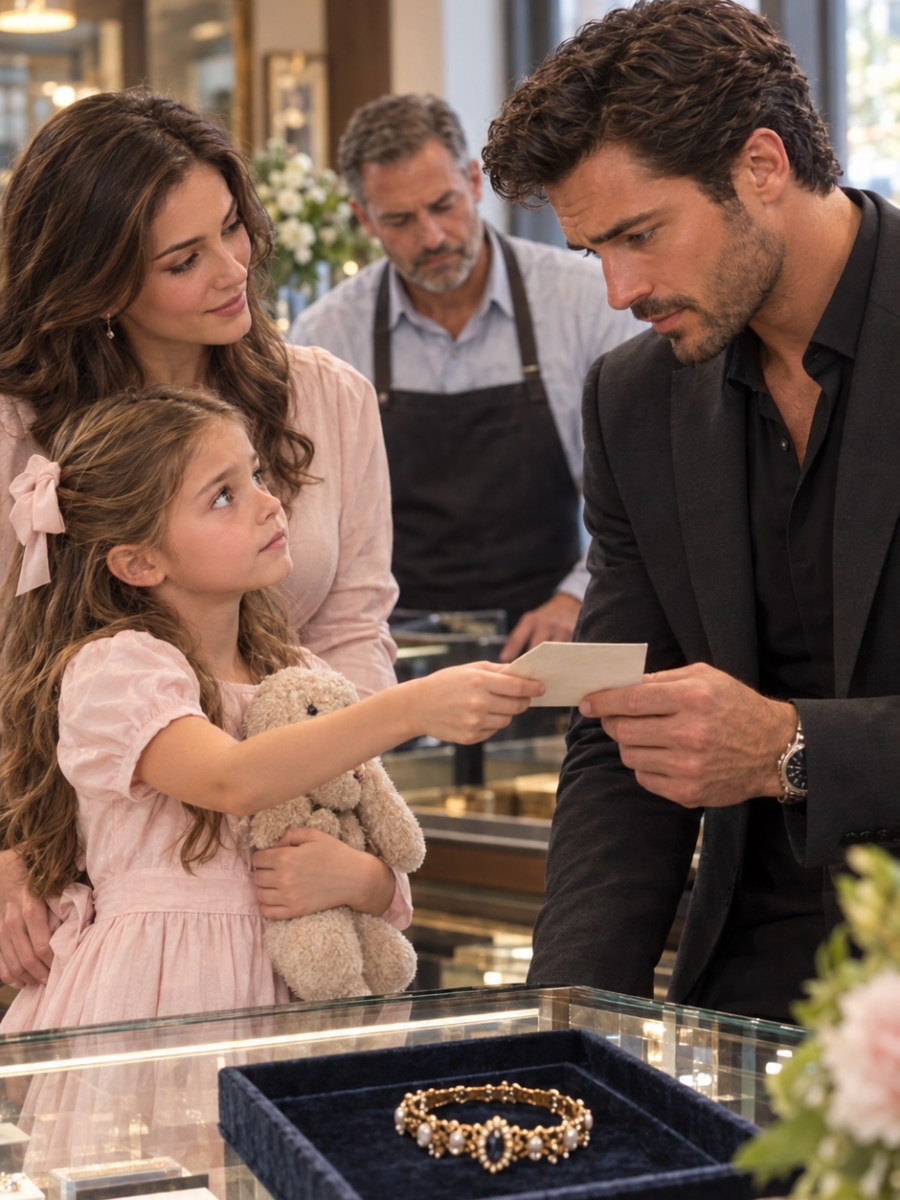
Between tangled chains and faded watches with cracked faces, between a man’s class ring from 1987 and a pair of pearl earrings missing their backs, lay a thin gold bracelet. It was simple. Delicate. A fine chain with a tiny heart-shaped charm hanging near the clasp, the kind of thing a woman might wear every day for years without ever taking it off.
“That one,” she said. “It’s my mama’s.”
She said it the way some people say a prayer, like the words themselves were holy.
Behind the counter, Arthur Collins had gone pale. In the eleven years I’d known him, I had never seen him sweat like this. His eyes jumped from the girl to me and back again. He knew exactly who I was. He knew what I did to people who wasted my time, and he was clearly terrified that this child was wasting it in his shop.
“Mr. Reed,” he said, wiping his palms on his cardigan. “I’m sorry. I didn’t see her come in. She…”
“Who is she?”
Collins swallowed. “Her name is Lila. She lives a few blocks over, on Linden.” He hesitated, then lowered his voice like he was confessing something. “She’s been coming here for a while, Mr. Reed,” he said nervously. “Trying to buy it back.”
“How long is a while?”
“Since July.” He glanced at the girl with something that looked a lot like guilt. “Every Saturday morning. She stands right there and looks at it. Sometimes she asks me to take it out so she can hold it. Then she gives it back and asks me not to sell it to anybody else.”
July. It was October now. Three months of Saturdays.
“And have you?” I asked. “Kept it for her?”
Collins shifted his weight. “The loan ran out at the end of August. Legally, it’s for sale.” He paused. “But I moved it to the back of the case. Behind the watches. Where people don’t look.”
I studied him for a long moment. Arthur Collins, who paid me every month without complaint and never asked a single question, had been quietly hiding a bracelet so a little girl wouldn’t lose it.
It seemed I wasn’t the only man in the room with a soft spot he didn’t advertise. The difference was that I had buried mine so deep, I’d forgotten where.
Lila tugged my sleeve again. “Mr. Collins is nice,” she said. “He gives me a peppermint every time.”
Collins’s face went from white to red in about a second and a half.
Chapter 3: Eighty-Seven Dollars and Twenty-Three Cents
Lila reached into the pocket of her pink jacket and pulled out a tiny cloth pouch. It was faded yellow fabric printed with little blue flowers, cinched at the top with a frayed ribbon. It looked like someone had sewn it by hand from an old pillowcase.
She loosened the ribbon with great seriousness, rose up on her toes, and poured everything she had onto the counter.
Coins scattered and spun beside wrinkled dollar bills. Quarters, dimes, a jumble of nickels, more pennies than I could count at a glance. A single five-dollar bill, carefully smoothed flat.
“I counted it,” she said proudly. She squared her small shoulders. “Three times. Eighty-seven dollars and twenty-three cents.”
She said the number like it was a mountain she had climbed. For a child her size, I suppose it was. I could see the climb in the coins themselves: tarnished pennies picked up off sidewalks, dollar bills that were probably birthday money from someone, quarters that might have been visits from the tooth fairy.
Mr. Collins swallowed. He took his glasses down from his head and folded them in his hands.
“Lila…” His voice was gentle, the way you’d speak to a bird with a hurt wing. “We’ve talked about this, sweetheart. Your mama’s bracelet is eight hundred dollars.”
Her shoulders dropped.
It was such a small movement. Barely anything at all. But I saw it the way you see a candle go out in a dark room.
I’d watched grown men collapse when they realized they had crossed the wrong family. I’d watched debtors beg for mercy, offering me their cars, their houses, their wives’ jewelry. I had stood through all of it without blinking, and I’d told myself that was what strength looked like.
But watching that child quietly lose hope over one simple bracelet hit somewhere I thought had died years ago.
Somewhere under the ribs. Somewhere I didn’t have a name for.
“I know,” she murmured.
No tantrum. No tears.
She simply gathered her coins one by one.
A penny. Another penny. A dime, slid carefully to the edge of the counter and dropped into her palm. She worked slowly and methodically, putting each coin back into the flowered pouch like she was putting away something sacred. Her lips moved. She was counting again, making sure she hadn’t lost any.
I stood there, still holding her fifty-dollar bill, and I realized something that unsettled me more than any threat I had ever received.
She wasn’t going to ask for it back.
She had given it to me. As far as she was concerned, it was mine now. A deal was a deal, even if the other side hadn’t agreed to it yet. She was going to gather up her eighty-seven dollars and twenty-three cents, walk out that door, and come back next Saturday to stare through the glass again.
And the Saturday after that.
And the one after that, until the day someone else bought the bracelet, and she pressed her finger against the empty space where it used to be.
Her small hand reached for the last quarter.
“Wait.”
The word was out of my mouth before I had decided to say it.
Chapter 4: When Things Got Bad
Her little hand froze above the counter.
She looked up at me. Collins looked up at me. Even the radio seemed to hold its breath between songs.
“What happened to your mother?” I asked.
Lila tucked the pouch against her chest. For a moment, I thought she wouldn’t answer.
“She needed money when things got bad,” Lila whispered. “So she sold her bracelet.”
Something about the word “bad” made me stop asking questions.
It was the way she said it. Not loudly, not dramatically. Just a flat little word carrying far too much weight for a child. I had heard that tone before, in my own voice, a long time ago, when I was about her age and the landlord came pounding on our door in Bensonhurst and my mother told me to hide in the hall closet and not make a sound. I hadn’t thought about that closet in thirty years.
Bad meant the kind of things children aren’t supposed to understand but always do. Bad meant whispered phone calls in the kitchen, and lights switched off early to save money, and a mother who smiled too brightly at dinner. I didn’t need the details. I had lived the details.
So instead, I asked, “And your mother thinks it’s gone?”
Lila nodded. “Forever.”
“She doesn’t know you’ve been coming here?”
She shook her head quickly, and for the first time a flicker of worry crossed her face. “Please don’t tell her. Not unless I get it back. She’d be sad. She says we don’t cry over things, only over people. But she cried over the bracelet. I heard her. She thought I was asleep.”
Collins made a small sound in his throat and turned toward the back room, muttering something about checking inventory. I let him go.
I studied the girl in front of me. The too-small jacket. The careful braids. The pouch held tight against her heart.
“Why come to me?” I asked.
Lila considered it with complete seriousness, her head tilted a little to one side.
“Because you look like someone who can help.”
I nearly laughed.
It started somewhere deep in my chest, a dry, disbelieving sound that never quite made it out. Someone who can help. I had been called a lot of things in my life. Ruthless. Cold-blooded. The Undertaker of Flatbush, by a tabloid reporter who later decided he’d be happier living in Arizona. I had never once been called someone who can help.
Adults ran from me. Feared me. Bargained with me.
This child simply trusted me.
She didn’t know about the warehouses or the shipping containers or the men who had stopped answering their phones. She didn’t know what my signature on a piece of paper could do to a family. She saw a tall man in a good coat standing in a Brooklyn pawn shop, and somewhere in her small, stubborn heart, she had decided I was the answer to a prayer.
It was the most dangerous thing anyone had ever done to me.
Because trust is a debt, too. And in my entire life, I had never once been on the owing side of it.
Chapter 5: What Do I Get in Return?
There is a reason I have survived as long as I have in a business where most men don’t live to see fifty.
I never give anything away.
Not a favor. Not a loan. Not a single minute of my time. Everything has a price, everyone pays it, and the moment you forget that, the moment you let someone walk away owing you nothing, you have told the whole world you’ve gone soft. Soft men end up in the East River. My father taught me that before I was old enough to shave, and it had kept me alive for nearly two decades.
So I asked the question that had governed almost every relationship in my life.
I crouched down until I was eye level with her, something I hadn’t done for anyone in years, and I said it slowly, the way I would have said it to any man who came to me for help.
“If I help you, Lila, what do I get in return?”
Mr. Collins had just come back from the storeroom. He stopped dead in the doorway and stared at me like I’d become a monster even he couldn’t recognize. I watched his jaw tighten. For eleven years he had been afraid of me. Now, for the first time, he looked ashamed of me.
I didn’t blame him. What kind of man asks a little girl what she can pay? The kind of man I had spent twenty years becoming.
But I wanted to know. I genuinely, desperately wanted to know what she would say. Every grown man who had ever stood in front of me had answered that question the same way, with money, with property, with information, with someone else’s secrets. I wanted to see what a child would offer when she had nothing left to offer at all.
Lila went completely still.
She didn’t look scared. She didn’t look confused. She looked like someone who had been waiting for exactly this question and had prepared for it a long time ago.
Then her hand slipped into that little cloth pouch again.
But this time, she didn’t pull out money.
She removed a tiny piece of paper.
It had been folded into a square no bigger than a postage stamp, folded so carefully and so many times that its edges were nearly worn through. The creases had gone soft and fuzzy. One corner had torn and been mended with a strip of tape that had turned yellow.
Then she placed it in my hand.
“I made it in case,” she said quietly. “In case somebody asked.”
I unfolded it.
It took a while. The paper was so soft it nearly came apart in my fingers. The handwriting inside was a child’s, big round letters in purple marker, a few of them backward, the lines sloping downhill as they crossed the page. At the very top, underlined twice, it said: WHAT I CAN GIVE.
Below that was a numbered list.
The moment I read the first line, the air vanished from my lungs.
“1. I WILL PRAY FOR YOU EVERY NIGHT SO GOD DOES NOT FORGET ABOUT YOU.”
I read it once. Then I read it again. My hand was not steady, and my hand is always steady.
And for the first time in twenty years, Jonathan Reed was afraid of what came next.
Chapter 6: What I Can Give
I don’t know how long I stayed crouched there on the scuffed linoleum, reading that one line over and over.
So God does not forget about you.
I had been inside a church exactly three times since I was fifteen: my father’s funeral, my mother’s funeral, and the wedding of a man I later ruined. I hadn’t prayed since that night in the closet in Bensonhurst. I had always figured that if God kept a list, my name was on the wrong side of it, and I had made my peace with that a long time ago.
And here was a seven-year-old girl offering to put my name back in front of Him. Every night. As payment.
I forced my eyes down the page.
2. I will draw you a picture every Saturday. (I am good at horses.)
3. I will pay you back one dollar every week until it is all paid. That is 713 weeks. I did the math on Mama’s phone.
4. You can have half my birthday cake. It is in March. It is usually chocolate.
5. If you are ever sad you can tell me. I am good at keeping secrets. I never told anybody Mama cries.
At the bottom, in smaller letters squeezed against the edge of the paper, she had written: Please keep this safe. Love, Lila.
I folded the paper along its tired creases, very carefully, and closed my fist around it.
Seven hundred and thirteen weeks. Almost fourteen years of Saturdays. She would be grown before she was done. She had done the math, and she had decided it was worth it.
That was what frightened me.
She was offering me the one thing nobody had ever given me freely: the belief that I was worth something. That I was worth remembering.
And if I accepted it, I would have to become someone who deserved it.
I had never been afraid the way I was afraid of that piece of paper. A man can fight a bullet. He can’t fight being believed in. It strips him down to whatever he really is underneath.
“Arthur,” I said. My voice came out rougher than I intended. “Take the bracelet out of the case. Please.”
I’m not sure I had ever said please to Arthur Collins. He moved quickly after that. He unlocked the case with a small brass key, reached behind the row of watches, and lifted the bracelet out. It caught the fluorescent light and threw a thin line of gold across the counter. Lila drew in a tiny breath and pressed both hands over her mouth.
I took out my wallet and counted eight hundred-dollar bills onto the glass.
“I’m buying it,” I said. “At full price. From an honest businessman. Write me a receipt. Put it in her mother’s name.”
“Claire Bennett,” Lila supplied in a whisper, never taking her eyes off the bracelet.
Collins looked at me for a long moment. Then something in his face eased, and he picked up a pen.
I turned back to Lila. “I accept your terms,” I said, holding up the folded list. “All five of them. On one condition. You keep your pouch, every penny of it. Your mother is going to need it more than I do.”
She frowned at the fifty-dollar bill still in my other hand. “But I already gave you that.”
“Then that’s your first payment.”
Her lips moved silently. “Then it’s seven hundred and fifty weeks,” she announced.
“Seven hundred and fifty weeks,” I agreed.
She stuck out her small hand with tremendous seriousness, the way a lawyer closes on a contract.
I shook it. It was the best deal I had ever made.
Chapter 7: Four Blocks to Linden Boulevard
Outside, the October afternoon had turned the color of old pewter. The wind coming down the avenue smelled like rain and roasted nuts from a cart on the corner.
My driver, Marco, straightened up from the side of the Escalade the second I stepped out. His eyes went to the little girl beside me, then to my face, and stayed there. Marco had worked for me for nine years. He had seen me walk out of buildings in a lot of different moods. He had never seen me walk out next to a second-grader in a pink jacket.
“Boss?”
“I’m walking her home,” I said. “Follow at a distance. Way back. I don’t want her frightened.”
The bracelet was wrapped in a tissue Collins had given her, tucked inside the flowered pouch, the pouch zipped inside her jacket, and her hand pressed flat over the jacket for good measure. She walked with the stiff, careful steps of someone carrying a full glass of water across a crowded room.
“It’s four blocks,” she told me. “You have to stop at every corner and look both ways. Even if the light says walk.”
“I’ll do my best.”
We walked. People stared. A man who ran numbers out of a barbershop on Church Avenue saw me coming and crossed the street. Lila didn’t notice. She was busy telling me about her second-grade teacher, Mrs. Alvarez, who kept a lizard named Pickles.
At the corner of Bedford, waiting for the light, she looked up at the side of my neck.
“Does your flower hurt?”
My hand went to the tattoo without thinking. Nobody had ever asked me that. People didn’t ask about the rose. They just knew what it meant.
“It did when I got it,” I said. “Not anymore.”
“Why is it black?”
“I got it the year my father died. Black roses are for remembering.”
She nodded slowly, as if this made perfect sense. “My grandma died. It was her bracelet first. She gave it to Mama when Mama turned eighteen. Mama wore it every single day, even in the shower.”
The light changed. She looked both ways, twice, then took my hand without asking and stepped off the curb.
“Then Mama got sick in April,” she went on. “She was in the hospital a long time, and I stayed with Miss Rosie downstairs. When she came home, she was too tired to go back to her job at the dentist, so they gave it to somebody else. And then the letters came.”
“What letters?”
“The ones with red on them.”
I knew the ones with red on them. I had sent a few in my time, and I had never once pictured the single mother who opened them.
“Mama works at the laundromat now, and at the grocery store at night. She’s better. She says she’s better.” Lila was quiet for half a block. “She doesn’t wear anything on her wrist anymore. Sometimes she touches it, though. Right where it used to be.”
Her hand was very small inside mine. We had gone a full block before I realized I hadn’t let go of it, and another before I realized I didn’t want to.
Chapter 8: The Single Mother Behind the Blue Door
The building on Linden Boulevard was a four-story brick walk-up with a cracked stoop and a bank of mailboxes, half of them missing their little doors.
Lila took the stairs two at a time. I followed her up to the third floor, where she stopped outside a door painted a chipped, hopeful blue and knocked three quick times.
“Mama, it’s me!”
Locks turned. One, two, three. The door opened.
The woman standing there was younger than I expected, around thirty, with auburn hair pulled up in a messy knot and a laundromat smock still on over a gray T-shirt. She had Lila’s gray-green eyes, ringed with shadows that don’t come from one bad night, and she was thin the way people get after a long illness. Her left wrist was bare.
“Lila Grace Bennett, where have you…” she began, and then she looked past her daughter and saw me.
I watched it happen. I had watched it happen on a thousand faces. Recognition first, then fear, then the frantic math: what does he want, what did we do, how do I get my child behind me.
She pulled Lila back across the threshold so fast the girl stumbled. One hand stayed on the door, ready to slam it.
“Mr. Reed.” Her voice was steady, but only barely. “Whatever she did, she’s seven. She didn’t mean anything by it. If there’s a problem, you talk to me. Not her.”
“There’s no problem, Mrs. Bennett.”
“Claire,” she said automatically, and then looked like she regretted giving me even that much.
“Mama, wait! Mama, look!” Lila wriggled free, fumbled the pouch out of her jacket, and held up both hands with the bracelet stretched between them, the little gold heart turning slowly in the dim hallway light.
Claire Bennett stopped breathing.
Her hand came off the door and went to her mouth, and her eyes filled so fast it was like watching a dam give way.
“Where did you…” she whispered. “Lila, how did you…”
“I saved up,” Lila said, bouncing on her toes. “Since July. I had eighty-seven dollars and twenty-three cents, but it wasn’t enough, so I asked him, and he said yes, and I’m going to pay him back one dollar every Saturday, and I’m going to draw him horses.”
Claire looked at me over her daughter’s head. Her eyes were sharp through the tears. The fear hadn’t left. It had only stepped aside to make room.
“I can’t accept this,” she said quietly. “I know who you are. I know what it means to owe you something. I’ve heard what happens to people on this street who end up owing you.”
“You don’t owe me anything,” I said. “Not one cent.” I held out the receipt Collins had written. “Paid in full. It’s in your name. Nobody can ever say otherwise.”
She didn’t take it. “Then why?”
I looked down at Lila, who was already trying to fasten the clasp around her mother’s limp wrist with small, determined fingers.
“Because your daughter walked up to me and said I looked like someone who could help,” I said. “Nobody has ever said that to me before. I’d like to find out if she’s right.”
Claire studied my face for a long time. Then, at last, she reached out and took the receipt.
The clasp clicked shut.
Lila beamed up at both of us. “And he gets half my birthday cake,” she announced. “In March. It’s chocolate.”
Claire made a sound that was half sob and half laugh and pulled her daughter into her arms, the thin gold bracelet catching the light against Lila’s braids.
I let myself out quietly. Halfway down the stairs, I had to stop and grip the railing, because my eyes had done something they hadn’t done since I was a boy hiding in a closet.
Chapter 9: Every Saturday at Ten at the Pawn Shop
Arthur Collins started keeping a jar of peppermints on the counter after that. A big one. He told me it was for the customers.
Every Saturday morning at ten o’clock, Lila Bennett walked through the door of Collins Pawn & Loan with a single dollar bill folded into a tight square and a drawing rolled up and tied with a hair elastic. And every Saturday morning at ten o’clock, I was there to receive them.
The drawings were always horses. Brown horses, purple horses, a horse wearing a crown, and one horse that was supposed to be me: tall and gray, with a black flower on its neck and, according to the artist, smiling. I kept them in the top drawer of my desk in the office above the restaurant on Mulberry Street, the drawer where for twenty years I had kept nothing but a pistol and a ledger. The pistol moved to another drawer.
Some Saturdays, Claire walked Lila down. The first few times, she stood stiffly by the door with her arms crossed, watching me the way a hawk watches a snake. By the end of November, she had started bringing two cups of coffee from the bodega next door, and she handed one to me without a word. By December, she had started talking, mostly about the job at the dental office she hoped to get back in the spring. The bracelet never left her wrist.
I made some changes. Not all at once, and not the kind that make headlines. But I told Arthur Collins the envelope wouldn’t be necessary anymore. Not from him, and not from the other shops on his block. I let a few debts go that the old Brooklyn kingpin in me would have collected the hard way. And when a man I had been sent to deal with started begging and mentioned his kids, I heard myself ask him their names.
Small things. But a seven-year-old had taught me that small things, saved up long enough, can buy back something you thought was gone forever.
The folded list lives in my wallet now, tucked behind my driver’s license, the tape on its corner growing a little more yellow every month. Some nights, in the back of the car, I take it out and read the first line again.
One Saturday in January, with snow piled against the shop window, Lila handed over her dollar and her horse, then lingered at the counter, chewing her lip.
“Mr. Reed? Can I ask you something?”
“Always.”
“Is it working?” she asked. “The praying. Did God remember you?”
Collins stopped wiping the glass. Claire, by the door with her coffee, went very still.
I looked down at the girl who had walked straight up to one of the most feared men in America and offered him the one thing he had never been able to buy.
“I think He’s starting to,” I said.
She nodded, satisfied, as though she had suspected as much all along, and skipped off to take a peppermint from the jar.
For nearly twenty years, I believed that everyone pays. I still believe it. I just had the currency wrong. Seven hundred and some weeks to go, and I have never looked forward to collecting a debt so much in my life.
I am still afraid of what comes next. Every single day, I am afraid of letting her down.
But it is the first fear I have ever known that made me a better man.