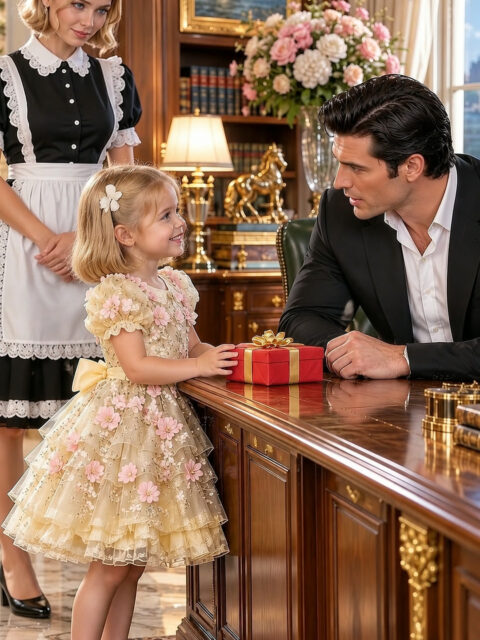
Eleven months into polishing the east wing, my seven-year-old walked into a closed study and told Boston’s most feared man his espresso was poisoned.
My name is Mira Kovacs. I raise Nora on late rent notices, thrift-store shoes, and rules that keep housekeepers alive inside iron gates. Then she smelled something wrong in Rafael Moretti’s coffee, walked past men I had taught her never to look at, and calmly saved a life that newspapers only called “shipping and construction.” Keep reading to learn why Mrs. Conti locked the pantry, what Ethan Vale poured into the silver cup, and why gratitude suddenly felt like a debt Rafael Moretti had never allowed himself to owe.
“Glass is cheaper than hands, Mrs. Kovacs.”
Chapter 1: The Crystal Glasses
The beginning smelled like lemon polish, burnt espresso, and rain coming in from Boston Harbor.
I cleaned the east wing of Rafael Moretti’s gray-stone estate, a house perched above the water behind iron gates tall enough to make visitors understand they had entered someone else’s world. The gates opened only after a camera turned, a voice came through the speaker, and a man in a black coat gave permission.
I never asked who those men were.
That was one of the rules.
Never read papers left on desks. Never enter Rafael’s study when the doors were closed unless Mrs. Conti sent you. Never linger when men arrived after dark. Never repeat something heard accidentally.
And most importantly, never mistake politeness for familiarity.
Rafael Moretti was polite to the staff.
That did not make him ordinary.
Drivers lowered their voices when they said his name. Delivery men became extremely interested in their invoices when his footsteps approached. Once, I watched a contractor argue with Mrs. Conti for fifteen straight minutes, then apologize to the wallpaper when Rafael entered the hallway.
Yet in eleven months, he had never raised his voice to me.
When I dropped an entire tray of crystal glasses three weeks after I started, I froze on the marble floor with broken glass around my shoes, already calculating how many paychecks the damage would cost me.
Rafael crouched beside me.
“Don’t touch it.”
“I can clean it, sir.”
“You can cut yourself.”
He picked up one large piece carefully and placed it on the tray.
“Glass is cheaper than hands, Mrs. Kovacs.”
Then he walked away.
That moment confused me more than cruelty would have.
I had spent four years raising Nora alone after my husband, Andrei, died in what the police called a traffic accident. I understood unpaid bills and landlords who smiled while reminding you that sympathy did not extend a lease.
Rafael Moretti was harder to understand.
A dangerous man who remembered to ask whether the housekeeper’s arthritis was better.
A man whose businesses appeared under words like shipping, restaurants, construction, and occasionally investigation.
A man no one contradicted.
Except, eventually, my daughter.
Chapter 2: The Fever Call
The Thursday everything changed began with a phone call from my mother at six fifteen in the morning.
“Mira, I have a fever.”
I sat on the edge of my bed, already dressed for work, while Nora slept under a quilt in the room beside mine.
“How high?”
“One hundred and two.”
“You need a doctor.”
“I need soup.”
“You need both.”
Normally, my mother watched Nora when school was closed. That Thursday, the district had scheduled a teacher-development day I had forgotten about until forty-eight hours earlier.
There was no one else.
I called two neighbors.
One was working.
The other had a dentist appointment.
At six forty, I stood in Nora’s doorway watching her sleep and made a decision I had promised myself I would never make.
I brought my daughter to the Moretti estate.
“You stay in the staff sitting room,” I told her in the car. “You color. You do not wander. You do not talk to anyone in a black coat.”
“What if someone talks to me first?” Nora asked.
“Then you say, ‘Excuse me, I am waiting for my mother,’ and you look at the floor.”
“That’s rude.”
“That’s survival.”
Mrs. Conti met us at the service door with a look that could polish silver by itself.
“A child,” she said.
“One day,” I answered. “My mother is sick. I had no choice.”
Mrs. Conti studied Nora’s small backpack, then my face.
“She sits where I can see her. If Mr. Moretti asks, she is my niece visiting for an hour.”
“Thank you.”
“Don’t thank me yet,” Mrs. Conti muttered. “Children notice things adults train themselves not to see.”
I remembered a story about a maid’s toddler who touched a mafia boss’s leg brace and found a hidden micro-needle, and I told myself Nora would only color.
Nora unzipped her pack and held up a crayon box like a passport.
“I brought twelve colors,” she announced. “Blue is for the harbor.”
“Harbor stays outside the gates,” Mrs. Conti said, but her mouth softened for half a second.
“Can I draw the iron flowers on the gate?” Nora asked.
“You can draw anything that keeps your feet in that chair,” Mrs. Conti replied.
I kissed Nora’s hair and went upstairs with my polish cloth, telling myself one day would not rewrite eleven months of careful silence.
I was wrong before the espresso cooled.
Chapter 3: The Closed Study
By ten o’clock the east wing smelled like rain and old wood. I was finishing the hall runner when Nora appeared at the top of the stairs holding her drawing pad.
“Mom,” she whispered. “The lady with the keys said I could stretch my legs if I stayed on the carpet.”
“Mrs. Conti said that?”
“She said my feet were turning into statues.”
I glanced toward the staff wing. Empty. From behind the closed study doors came low voices and the soft clink of china.
“Nora, go back down.”
“I will. I just wanted to show you the harbor.”
She held up a page of blue scribbles and a gray gate. Then she sniffed the air the way she sniffed spoiled milk at home.
“It smells wrong,” she said.
“Lemon polish always smells strong.”
“Not the polish. The coffee. It smells like the medicine Grandma hides in the cupboard when she thinks I’m asleep.”
My stomach dropped.
“What medicine?”
“The bitter one. The sleepy one. She says it’s for her back.”
I grabbed her shoulder.
“You imagined it.”
Nora shook her head hard enough to make her braid swing.
“I don’t imagine smells, Mom. You always say my nose is better than the smoke alarm.”
The study doors stayed closed. A man’s laugh rose and fell. Someone said Rafael’s name like a toast.
“Go downstairs,” I ordered. “Now.”
Nora backed toward the stairs, then stopped.
“If somebody puts sleepy medicine in coffee,” she whispered, “do they know they’re being mean, or do they think they’re helping?”
“They know,” I said, and the honesty tasted like metal. “That’s why you never drink anything a stranger hands you.”
“Mr. Moretti isn’t a stranger to you.”
“He is still not safe.”
She looked at the closed doors again.
“Then who keeps him safe?”
I had no answer that would fit a seven-year-old’s mouth.
“I do floors,” I said. “Other people do danger.”
Nora nodded as if she were filing that under temporary rules.
“Okay,” she said. “I’ll stretch downstairs.”
She went. I wiped the same spot on the runner twice because my hands needed something obedient to do.
Behind the doors, china clinked again.
I told myself the smell was nerves.
Nerves do not invent bitter medicine in espresso.
Chapter 4: The Burnt Espresso
At ten twenty, Mrs. Conti sent me to collect the empty cups from the sideboard outside the study. Protocol said knock once, wait, enter only if called.
I knocked.
“Come,” Rafael said.
The room held four men. Rafael sat behind the oak desk with an untouched silver demitasse. Ethan Vale, the family solicitor who smiled too easily, stood near the window with a second cup already in his hand. Two captains I knew only as coats and silence flanked the fireplace.
“Mrs. Kovacs,” Rafael said. “Leave the tray. We’re nearly finished.”
“Yes, sir.”
I set down a fresh cloth and reached for the used cups. Nora’s warning scratched at the back of my skull.
The espresso on Rafael’s desk smelled sharper than burnt. Under the roast sat something medicinal, thin and wrong.
Ethan Vale watched me.
“Problem?” he asked lightly.
“No, sir. The cup is hot.”
“Then don’t burn those careful hands,” Ethan said. “Mr. Moretti values them.”
Rafael’s eyes flicked to him, then to me.
“You look pale, Mrs. Kovacs.”
“Rain headache, sir.”
“Take aspirin from Mrs. Conti’s cabinet.”
“Thank you.”
I left with the tray and nearly collided with Nora in the hall. She had not stayed downstairs.
“Mom, I followed the smell,” she whispered.
“Nora—”
“It’s in his cup. The sleepy medicine. Grandma’s cupboard smell.”
“You will go to the sitting room this second.”
“If I go, he drinks it.”
She said it without drama, the way she announced a missing sock.
For one frozen second I saw Andrei’s funeral, late notices, and iron gates that opened only for permission. Then I saw my daughter’s face and understood the rules had already cracked.
“Stay behind me,” I said. “Do not speak unless I tell you.”
“Okay.”
We turned back.
I knocked again, harder.
“I said come,” Rafael called, irritated now.
I opened the door with Nora half-hidden behind my skirt.
Ethan Vale smiled wider.
“A visitor,” he said. “How charming.”
Rafael stood.
“Mrs. Kovacs, why is there a child in my study?”
My mouth opened, then failed.
Nora stepped around me before I could stop her.
Chapter 5: The Poison Warning
Nora looked straight at Rafael Moretti as if the room were a classroom and he were the only student who mattered.
“You’re not tired, sir,” she said calmly. “You’re drugged.”
Silence hit the carpet like a dropped tray.
Ethan Vale laughed once.
“Out of the mouths of babes.”
Rafael did not laugh.
“Explain,” he said to Nora, voice low.
“Your coffee smells like Grandma’s sleepy medicine,” Nora answered. “The bitter one. She hides it so I won’t drink it by mistake. Somebody put it in your cup.”
I found my voice.
“Sir, I am sorry. She has a fever day at school and nowhere else to go. I’ll take her—”
“Quiet,” Rafael said, not unkindly. He lifted the demitasse, sniffed, and set it down without drinking. “Ethan. Who poured this?”
Ethan’s smile thinned.
“I did. From the same pot you always use.”
“Then drink what’s left,” Rafael said.
“I already finished mine.”
“Pour another.”
One of the captains moved toward the sideboard. Ethan raised a hand.
“This is ridiculous. You’re letting a maid’s child accuse—”
“I am letting a child describe a smell,” Rafael cut in. “Children notice things adults train themselves not to see.”
Mrs. Conti’s words, almost word for word. My skin went cold.
Nora pointed at the silver cup.
“Don’t drink it. Please. Mom says glass is cheaper than hands, but medicine in coffee is worse than glass.”
Rafael’s gaze shifted to me.
“You told her that?”
“You told me that, sir. When I broke the crystal.”
Something unreadable moved through his face.
He remembered a story I had only heard secondhand about a four-year-old who whispered she was a doctor beside a collapsed mafia boss and a blue capsule, and suddenly my daughter’s crayon logic belonged in the same dangerous category.
“Captain Rossi,” Rafael said. “Test the cup. Lock the pantry. No one leaves this wing.”
“Yes, boss.”
Ethan Vale stepped back toward the window.
“You’re humiliating me over a children’s game.”
Nora shook her head.
“It’s not a game. Games don’t smell like that.”
Rafael looked at her for a long second.
“What is your name?”
“Nora Kovacs.”
“How old are you, Nora Kovacs?”
“Seven.”
“And what did your mother tell you about men in this house?”
Nora glanced at me, then answered truthfully.
“Never look at them. Never talk. Never mistake polite for safe.”
“Good rules,” Rafael said. “Today you broke all three.”
“I know,” Nora whispered. “But sleepy medicine is meaner than rules.”
Ethan Vale’s hand found the window latch.
Rossi was faster.
The click of the lock sounded like a verdict.
Chapter 6: The Silver Tray
They moved us to the sitting room while the cup went to whoever tested things for Rafael Moretti. Mrs. Conti brought Nora warm milk and stared at me as if I had smuggled a grenade upstairs in a backpack.
“I told you children notice,” she said.
“I know.”
“If she is wrong, we both lose our jobs.”
“If she is right,” I said, “he stays alive.”
Mrs. Conti crossed herself once, quickly, as if embarrassed by hope.
Nora sipped the milk.
“Is Mr. Moretti mad?”
“He is focused,” I said. “Mad comes later.”
Twenty minutes later Rossi returned with a folded paper. Rafael followed alone, coat still on, espresso nowhere in sight.
“Sedative,” Rafael said. “Not enough to kill a healthy man in one sip. Enough to slow reflexes, blur judgment, and make a private meeting look like an accident if a second dose followed.”
Ethan Vale was already in the cellar under guard, according to Rossi’s nod.
I stood.
“Sir, we will leave. I never meant—”
“Sit,” Rafael said.
I sat.
Nora sat taller.
“Who wanted you sleepy?” she asked him.
Rafael almost smiled.
“Someone who thought my signature on a harbor contract would be easier to guide if my hands were soft.”
“Ethan,” Mrs. Conti whispered.
“Ethan,” Rafael confirmed. “He poured. He smiled. He called it the same pot.”
Nora frowned.
“People shouldn’t smile when they pour mean medicine.”
“No,” Rafael agreed. “They shouldn’t.”
He turned to me.
“Mrs. Kovacs, your daughter just interrupted a plan months in the making. That puts both of you in a new kind of danger.”
My throat tightened.
“I understand if you dismiss me.”
“Dismiss you?” He shook his head. “I am moving you into the west staff quarters until this is finished. Better locks. Better eyes. You will not take the bus home tonight.”
“I can’t afford—”
“You will not pay for safety you earned,” he said. “That is not a request.”
Nora tugged my sleeve.
“Mom, is that a good rule or a scary rule?”
“Both,” I said honestly.
Rafael crouched the way he had beside the broken crystal.
“Nora. If you smell that cupboard medicine again anywhere in this house, you tell Mrs. Conti or me. Not a stranger. Not a smiling solicitor.”
“Okay.”
“And thank you,” he added, as if the words cost him something old and heavy.
Nora nodded solemnly.
“You’re welcome, sir. Please don’t drink mean cups anymore.”
Chapter 7: The Harbor Rain
Rain thickened against the harbor windows while Rafael’s men emptied Ethan Vale’s office. I polished nothing. I watched Nora draw the iron gate again, this time with a red X over a stick figure holding a coffee cup.
“That’s Ethan,” she explained.
“I figured.”
“The X means no more pouring.”
Mrs. Conti snorted despite herself.
“If only courts ran on crayon.”
Rossi came at dusk with a summary he was willing to speak in front of staff.
“Vale forged a rider on the Harborview shipping transfer,” he said. “If the boss signed while slowed, control of two docks moved to a shell Ethan owned with an out-of-town partner. The sedative was stage one. Stage two was a ‘medical episode’ at the signing table.”
I felt sick.
“He would have killed him?”
“He would have owned him first,” Rossi said. “Death is louder. Ownership is quieter.”
Nora looked up from her drawing.
“Quiet mean is still mean.”
“Yes,” Rossi said, surprisingly gentle. “It is.”
Rafael appeared in the doorway, rain darkening his shoulders.
“Mrs. Kovacs. A word.”
In the hall he kept his voice low.
“Your husband’s accident,” he said. “Four years ago. Andrei Kovacs. Truck on Dorchester Avenue.”
I went still.
“How do you know his name?”
“I know the names of people who work in my house. I also know which accidents get closed too quickly.”
“Are you saying—”
“I am saying Ethan Vale’s partner list includes a logistics firm that paid a witness to forget a second vehicle.” He watched my face. “I cannot undo a funeral. I can finish a connection.”
Tears burned without falling.
“Why tell me?”
“Because gratitude without truth is theater,” Rafael said. “Your daughter smelled poison in my cup. The least I can do is admit someone may have stolen more from you than rent money.”
I whispered, “If that is true, I want the name.”
“You will have it when it is proven,” he said. “Not before. I do not hand widows rumors.”
Nora peeked around the corner.
“Mom? Are you crying happy or crying angry?”
“Both,” I said again.
Rafael glanced at her.
“Your mother is allowed both.”
Nora considered that, then offered him the drawing.
“For you. So you remember the X.”
He took it as carefully as crystal.
“I will remember.”
Chapter 8: The Sealed Envelope
Two days later a sealed envelope arrived under our new west-quarter door. Inside were three things: a temporary housing agreement with rent set to one dollar for ninety days, a letter confirming Ethan Vale’s arrest on fraud and attempted poisoning charges, and a shorter note in Rafael’s sharp handwriting.
Nora read the short note aloud because I asked her to, my hands shaking too hard.
“Mrs. Kovacs — Your daughter smelled what my captains missed. The docks stay mine. The solicitor does not. If you wish to leave this life, I will place you in honest work across the city with references that open doors. If you wish to stay, the east wing still needs careful hands. Either choice is yours. — R.M.”
Nora looked up.
“What’s the right choice?”
“The one where you stay safe,” I said.
“I feel safe when you polish and I draw,” she answered. “And when mean coffee gets thrown away.”
Mrs. Conti knocked, entered without waiting, and set down a plate of toast.
“He asked me whether you were planning to run,” she said. “I told him running is what people do when nobody listens. Somebody listened.”
“Will the other men hate us?” I asked.
“Some will,” Mrs. Conti said. “Hate is cheaper than shame. Shame is what they feel when a seven-year-old out-smells them.”
Nora grinned.
“My nose is better than the smoke alarm.”
“Don’t let it go to your head,” Mrs. Conti warned, then softened. “Or do. Just keep it pointed at the truth.”
That afternoon Rafael called us into the study one last time. The silver demitasse was gone. In its place sat a glass of water and Nora’s crayon gate drawing under a paperweight.
“I owe you a clearer thank-you,” he told Nora.
“You already said thank you.”
“I said it like a man who thought gratitude was a debt.” He glanced at me. “I am learning it can also be a beginning.”
Nora tilted her head.
“Beginnings are like clean cups.”
“Yes,” Rafael said. “Exactly.”
He asked if I had heard of a maid’s daughter who named who paid a runaway bride after a wedding fell apart, and I admitted the house traded stories the way other houses traded recipes.
“Then understand this one,” he said. “Your names stay off newspapers. Your protection does not. Ethan’s partner will answer for Dorchester Avenue if the proof holds. Until then, you work where cameras and Conti can see you.”
“I choose to stay,” I said.
Nora raised her crayon like a vote.
“Me too. I still have eight colors left.”
Chapter 9: The Debt of Thanks
A week later the iron gates opened for a city detective instead of another smiling solicitor. Ethan Vale’s partner took a quiet ride downtown. The second vehicle from Andrei’s accident finally had a name attached to a bank transfer.
I did not celebrate in the street.
I sat on the west-quarter bed with Nora and let the truth arrive in pieces, the only way truth ever arrives for people who clean other people’s houses.
“Does this mean Dad didn’t just slip?” Nora asked.
“It means someone made the road unfair,” I said. “And someone else is paying for that unfairness now.”
“Mr. Moretti?”
“The law,” I said. “With Mr. Moretti’s files helping.”
She thought about that.
“Then thank you still matters.”
“Yes.”
That Sunday Rafael found us in the staff garden where Nora was drawing harbor water that looked more like a blue storm than a bay.
“Mrs. Kovacs.”
“Sir.”
“I have a foundation seat opening for a children’s after-school program in Dorchester. It needs a parent who understands late notices and careful rules. Paid. Daytime. No black coats required.”
I stared.
“Why me?”
“Because you raised a child who can smell a lie in a coffee cup,” he said. “That skill should not only live behind iron gates.”
Nora tugged his sleeve without fear now, which still terrified me a little.
“Can I visit the east wing sometimes? Mrs. Conti said my feet turn into statues if I sit too long.”
Rafael looked at Mrs. Conti, who pretended to prune a bush that needed no pruning.
“Scheduled visits,” he said. “With Conti’s eyes open.”
“Deal,” Nora said, and stuck out her hand.
He shook it.
Then he looked at me and said the words again, slower, like a man rewriting an old belief.
“Thank you, Mrs. Kovacs. Thank you, Nora.”
I swallowed.
“You’re welcome, sir.”
Nora added, “Next time, smell before you sip.”
Rafael’s mouth almost became a real smile.
“Next time,” he promised, “I will.”
Rain came in from the harbor again that evening, soft instead of sharp. I polished the last crystal tray of the day without dropping a single glass. Somewhere upstairs a coffee pot steamed with nothing but coffee in it.
And for the first time in eleven months, politeness in that house felt a little less like a mask and a little more like a door we had earned the right to knock on.
Nora fell asleep with twelve crayons lined up like tiny guards on the nightstand.
I whispered the old rules one more time, then added a new one she had written for both of us without knowing it.
If the cup smells wrong, you speak.
Even when the room is full of men.
Even when your mother taught you never to look.
Because some debts begin with gratitude.
And some lives continue because a seven-year-old refused to pretend she imagined the bitter smell of sleepy medicine in a mafia boss’s espresso.