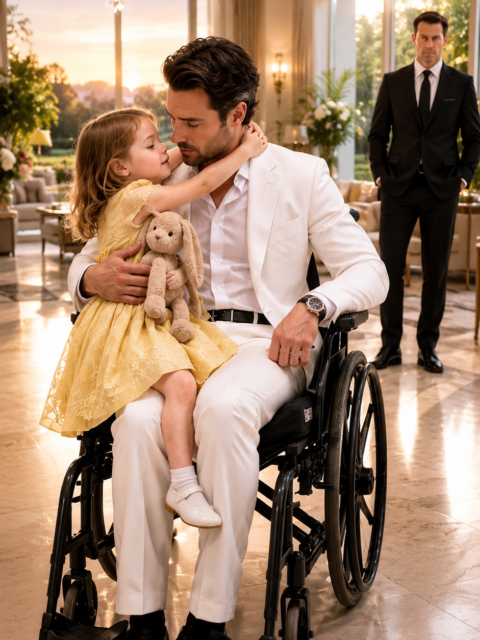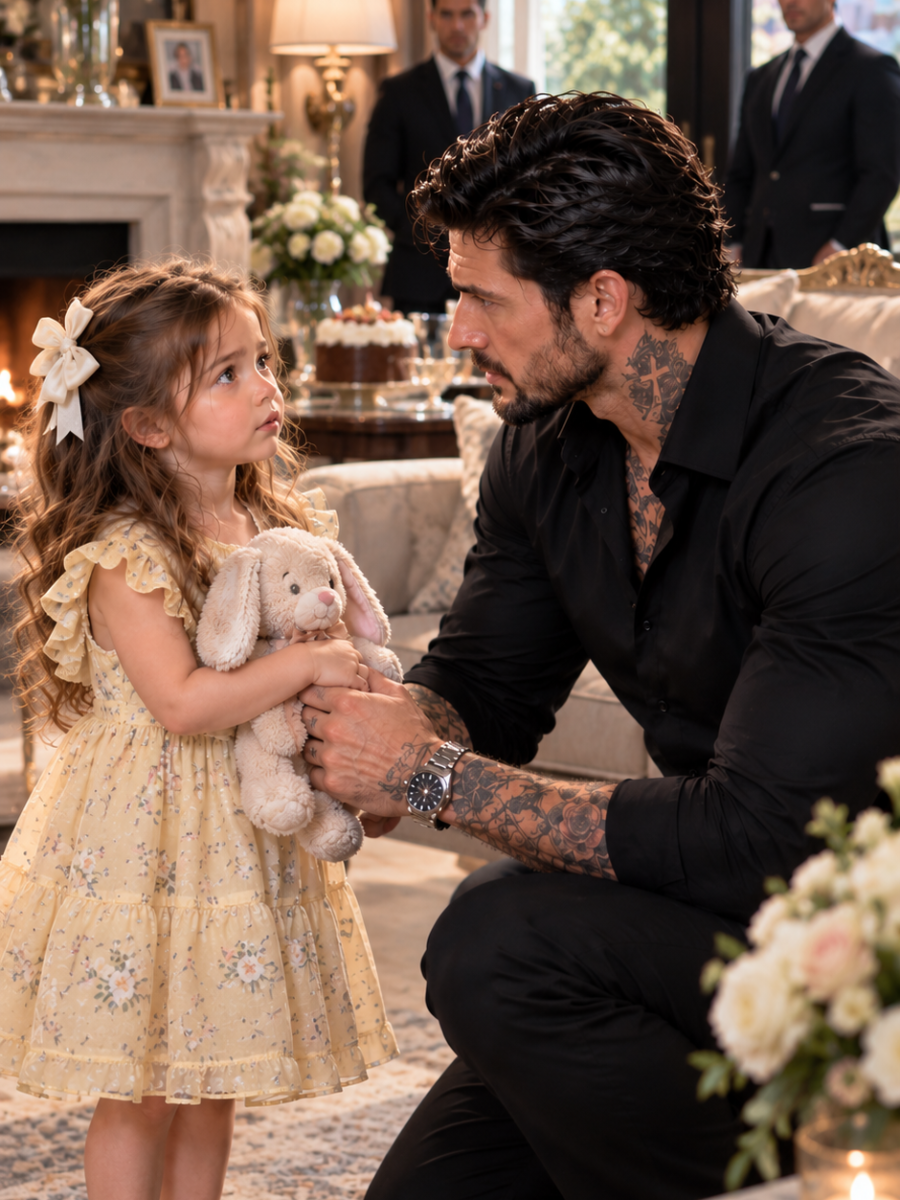
A three-year-old presses a toy stethoscope to Antonio Moretti’s chest and reveals a hidden photograph of the son he buried five years ago. Inside the toy’s cap is a strip of paper with shipment codes proving Luca didn’t die of a rare illness at all — and the man who buried that report is standing in the room, gun already drawn. This family secret story follows a grieving father who stopped listening to the one person who tried to warn him, a housekeeper whose husband died asking the same questions, and a toddler too honest to let either of them keep hiding from the truth. Read all nine chapters to find out who was on the other end of that phone call.
Chapter One
Your Little Boy Was Sad Too
“Your heart is sad, Mister.” Antonio Moretti froze as three-year-old Mia pressed the red-and-white toy stethoscope against his chest. Then she whispered, “Your little boy was sad too.”
The basement seemed to lose all sound. “What did you say?” Mia pointed upstairs. “The boy in the picture.” Antonio’s blood went cold. There were no photographs of his son anywhere below the fourth floor. “Where did you see a picture?” Mia pointed toward her toy. “In there.”
She opened the plastic doctor’s case. Beneath the toy thermometer was an old photograph. Antonio took it with shaking fingers. His son, Luca. Four years old. Smiling. Holding that exact stethoscope. On the back, in faded ink: FOR DADDY. WHEN HE’S READY TO LISTEN.
Footsteps thundered downstairs. Elena appeared. The moment she saw Antonio holding the photograph, she stopped. “Where did you get this?” “I bought the kit secondhand.” “From whom?” “A thrift shop in Queens.”
Luca’s doctor kit had disappeared after his death. Antonio had assumed someone packed it away. Apparently, someone had removed it from the estate entirely.
“Damen.” His cousin arrived minutes later. Antonio handed him the photograph. Damen’s face changed. Barely. But Antonio saw it. “You recognize this.” “No.” “Don’t lie to me.”
Mia tugged Antonio’s sleeve. “The picture wasn’t there before.” Everyone turned. “What?” “The lady put it in.” Elena crouched. “What lady, sweetheart?” “The one who gave me cookies.” Antonio’s voice became dangerously quiet. “When?” “Today.”
Someone inside his house had known Mia carried Luca’s old toy. Then Rosa appeared at the basement entrance. “Sir, there’s something you need to see.” The fourth-floor alarm had triggered. For five years, Antonio alone possessed the physical key. Yet the door to Luca’s bedroom was open.
Nothing inside appeared disturbed. The little bed. The books. The wooden train. Then Mia slipped past Elena and stopped beside the dresser. “There.” She pointed toward an empty rectangle in the dust. Something had recently been removed — a framed photograph of Luca and his mother, Sofia, taken three weeks before the boy died.
Damen whispered, “Antonio…” “Lock the estate.”
Then Elena noticed the toy stethoscope had a loose plastic cap. She twisted it open. A narrow strip of paper fell into Antonio’s palm. Not a photograph. Numbers. Dates. Medication names. During Luca’s final months, doctors had blamed a rare neurological condition for his seizures and rapid decline. But these weren’t prescriptions. They were inventory codes. Damen recognized them immediately. “Those are Moretti Medical shipment numbers.”
Every shipment had been recalled — not because of contamination, but because someone had substituted counterfeit medication before distribution. Then Antonio saw one patient’s initials attached to an internal incident report. L.M. Luca Moretti. His son hadn’t simply become sick. He’d received medicine from one of the compromised batches, and someone with executive authority had buried the report.
Mia climbed onto the little wooden chair beside him. “Don’t cry, Mister.” He hadn’t realized he was. “The cookie lady said your boy didn’t die because he was sick.” “What else did she say?” Mia thought carefully. “She said somebody made Daddy think that.”
Elena’s face tightened. “The lady knows my daddy.” Elena stood abruptly. “Your husband was Daniel Rossi?” Antonio asked. “He worked construction on a Moretti Medical warehouse renovation, didn’t he.” Her face went pale. “Yes.”
At the bottom of the compromised-shipment report was the name of the employee who first discovered the substitution and refused to close the investigation. DANIEL ROSSI.
Then the fourth-floor telephone rang. Nobody had used that line in five years. Antonio answered. A woman’s voice said, “You finally listened.” “Who is this?” “Ask Damen why Daniel Rossi had to die.”
Antonio slowly turned toward his cousin. Damen had already drawn his gun. But he wasn’t pointing it at Antonio. He was pointing it at Elena. And Mia was standing directly between them.
Chapter Two
You Finally Listened
“Damen.” Antonio’s voice came out with a calm he didn’t feel, every instinct screaming at him to move and every part of his training telling him movement was exactly what would get Mia hurt. “Lower it.”
“You don’t understand what she’s about to do to me,” Damen said, his composure fraying at the edges, the gun’s barrel drifting a fraction of an inch as his hand began to shake. “That woman on the phone. She’s spent five years building a case that will end everything I have.”
“Then let her finish it in a courtroom,” Antonio said, taking one slow step to his left, angling his own body between Damen’s line of sight and the two people standing frozen beside the dresser. “Not in my son’s bedroom, with a three-year-old between you and the only witness who can explain what actually happened to Daniel Rossi.”
Damen’s eyes flicked toward Elena. “She’s not just staff, is she. You didn’t hire her by accident.”
Elena’s chin lifted despite the tremor Antonio could see running through her entire body. “I applied for this job eight months ago because I’d spent three years trying to get anyone inside the Moretti organization to answer questions about my husband’s death, and nobody would even take my calls. I never imagined the answer would end up standing this close to me.”
“Mia,” Antonio said, keeping his voice as gentle and steady as he could manage, “come here to me, sweetheart. Slowly.”
Mia, entirely unaware of the danger her small body currently occupied, looked between the adults with the frank curiosity of a child watching a game she didn’t fully understand the rules of. She took one step toward Antonio.
Damen’s finger tightened on the trigger, and in the single frozen second that followed, Antonio understood that whatever answer Sofia’s voice on that phone line was about to provide, it would arrive either just in time or considerably too late.
Chapter Three
When He’s Ready to Listen
Mia reached Antonio’s side without incident, and he pulled her behind him in one motion, his body now fully between the child and his cousin’s weapon.
“Put it down, Damen,” Antonio said. “Whatever you did, pointing a gun at a woman in my house isn’t going to be the thing that saves you from it.”
Damen’s hand trembled visibly now, the gun’s weight seeming to grow heavier with every passing second of silence. Rosa, still standing frozen in the doorway, had quietly signaled two of the estate’s security men positioned just beyond the hallway — a fact Damen didn’t yet seem to have registered.
Five years earlier, Antonio’s world had looked entirely different. His wife, Sofia, had been the center of a household that revolved around a bright, curious four-year-old obsessed with a toy doctor’s kit he refused to be parted from, even at bedtime. Luca’s decline had begun subtly — fatigue, small seizures the family pediatrician initially dismissed as unrelated events, then a rapid deterioration that no specialist could fully explain beyond vague language about rare neurological presentations.
Sofia had never accepted that explanation. She’d pushed, in the months after Luca’s death, for a deeper investigation into his treatment records, certain something had been missed. Antonio, drowning in a grief that made scrutiny feel unbearable, had begged her to stop, certain the endless questions were preventing either of them from healing.
Sofia had left the estate eighteen months after Luca died, not in anger exactly, but in a kind of resigned heartbreak Antonio had spent years telling himself was simply grief taking a different shape in her than in him.
Standing now in his son’s untouched bedroom with his cousin’s gun still raised, Antonio finally understood that Sofia hadn’t left because grief broke something between them. She’d left because he’d refused, for five years, to be ready to listen to the one person who’d been right about everything from the very beginning.
Chapter Four
Daniel Rossi’s Report
The security men moved the moment Rosa gave the signal, closing the distance behind Damen fast enough that his gun was secured before he’d fully registered the shift in the room. Elena dropped to her knees, pulling Mia into her arms the instant the weapon was out of play, both of them shaking.
Damen didn’t resist beyond a single, furious exhale. “You don’t know what you’re about to unravel, Antonio.”
“I know my son is dead because of something in that report,” Antonio said. “I know Elena’s husband is dead because he refused to stop asking questions about it. Everything else, you’re going to explain to me directly, right now, before I decide whether federal investigators or my own people get to you first.”
Elena, still holding Mia tightly, spoke through tears she’d apparently been holding back for considerably longer than this single afternoon. “Daniel worked the Moretti Medical warehouse renovation for six weeks. Three days before he died, he came home talking about a discrepancy he’d found in a shipment log — real medication logged as delivered, but the actual packaging in the warehouse didn’t match the manifest weights. He filed an internal report. He told his supervisor. Four days later, he was dead. Fell from scaffolding that had passed inspection the week before.”
“The official investigation called it an accident,” Antonio said slowly, already knowing, from the look on Elena’s face, what she was about to say next.
“The official investigation,” Elena said, “was closed within seventy-two hours, faster than any workplace fatality review I’d ever heard of. Nobody from the company ever contacted me beyond a settlement offer delivered by a lawyer three weeks later. I took it, because I had a two-year-old and no income and a mortgage I couldn’t carry alone. I’ve spent three years since regretting it every single day.”
“The report,” Antonio said, turning back to Damen, his voice gone dangerously flat. “Daniel’s report. You closed it personally, didn’t you — the same way you closed the internal incident report connecting my son’s medication to a compromised shipment.
Chapter Five
The Cookie Lady
The fourth-floor phone still sat off the hook on the nightstand, the woman’s voice waiting patiently on the other end through everything that had just happened. Antonio picked it back up slowly.
“Sofia.”
A long silence, then a breath that sounded like five years of held tension finally released. “I didn’t know if you’d recognize my voice anymore.”
“You’ve been here. Today. In my own house.”
“I’ve been near this house more times than you’d believe, Antonio. I couldn’t get you to listen when I was your wife standing in front of you, so I stopped trying that way. I started building the case instead — quietly, carefully, for five years, using every contact Daniel Rossi’s widow eventually helped me reach once I found her independently and realized our husbands were connected to the exact same cover-up.”
“You reached out to Elena.”
“I helped her get hired in your household eight months ago,” Sofia admitted. “Not to spy on you, though I understand how it looks. To finally get close enough to the physical evidence I couldn’t access from outside — Luca’s old things, records Damen kept buried in that house rather than destroyed, arrogant enough to believe you’d never look for them yourself.”
“Why today,” Antonio asked. “Why the photograph, the cookies, the stethoscope — why now, after five years?” Sofia’s voice cracked for the first time. “Because Mia found the toy in a donation box I dropped off myself last week, completely by accident, and I realized a three-year-old with an ordinary toy doctor’s kit was about to hand you the exact reckoning I’d spent five years trying to build carefully enough that you’d finally have no choice but to believe it.
Chapter Six
L.M.
Damen, secured now and stripped of any illusion that silence would still protect him, finally spoke once Antonio set the phone down and turned back to face him fully.
“You want the whole truth? I built a second income stream out of the foundation’s charitable shipments six years ago. Real medication diverted and sold at full market value to buyers who didn’t ask questions, replaced in the charity shipments with cheaper counterfeit product manufactured to pass a basic visual inspection. Nobody was supposed to actually get hurt. The clinics we supplied served populations nobody in this family ever visited personally to check on.”
“Daniel Rossi found the discrepancy,” Antonio said.
“He found weight inconsistencies during a completely unrelated warehouse renovation,” Damen said. “Bad luck, both for him and for me. I panicked. I paid someone to make sure his report never reached anyone who’d actually investigate it, and I paid someone else to make sure he never had the chance to file it a second time.”
“And Luca.”
Damen’s composure, maintained through the confession up to this point, finally broke entirely. “I didn’t know. I swear to you, Antonio, I never once tracked which specific batches went where beyond the general shipment logs. When his incident report came back with L.M. attached, I told myself it had to be a coincidence, a different patient with the same initials, anything other than what it actually was. By the time I confirmed it was actually Luca, he was already too sick to save even with the correct medication. Telling you at that point wouldn’t have brought him back. It would only have ended everything I’d built.”
“So you let me believe my son died of a rare illness,” Antonio said, his voice gone perfectly, terribly quiet, “rather than admit that your greed put counterfeit medication into his treatment and killed him — and then you let my wife walk out of this house believing her grief had simply broken something in her mind, rather than admit she’d been right about all of it from the very beginning.
Chapter Seven
What Damen Couldn’t Undo
Sofia arrived at the estate within the hour, five years of separation collapsing into a reunion neither she nor Antonio had time to fully process before the practical machinery of exposing Damen’s fraud took over the rest of the evening.
She’d brought with her a complete case file built over five years — bank records tracing the counterfeit medication proceeds through three shell accounts, statements from two former warehouse employees willing to corroborate Daniel Rossi’s original discrepancy report, and documentation connecting at least four other pediatric incident reports, beyond Luca’s, to the same compromised shipment batches Damen had spent years making sure nobody cross-referenced.
“Four other children,” Antonio said, reading through the file with a horror that went beyond even his own grief. “How many of them—”
“Two didn’t survive,” Sofia said quietly. “The other two have ongoing complications their families were never told the actual cause of. I’ve been in contact with all of them for the past year, carefully, without revealing my full identity until I had enough evidence that coming forward wouldn’t just be one grieving mother’s unprovable accusation.”
Elena, still holding Mia close on the nearby sofa, looked at Sofia with an expression caught between gratitude and grief of her own. “You could have told me all of this from the beginning. About Luca, about the connection to Daniel’s report.”
“I was afraid,” Sofia admitted. “Afraid you’d go to Antonio directly before I had enough proof, afraid Damen would find out and bury the evidence before I could finish building the case. I’m sorry for the caution costing you months you didn’t need to spend in the dark. I hope, eventually, you can understand it wasn’t about trusting you less. It was about protecting a case five years in the making from collapsing at the final step.”
“What happens to Damen now?” Elena asked, and Antonio’s answer, when it came, carried the particular weight of a man choosing accountability over the kind of quiet, permanent solution his family’s reputation might once have preferred. “Everything,” he said. “Federal fraud charges, wrongful death investigations into both Daniel and Luca, and a public reckoning for the foundation that should have happened five years ago instead of being buried alongside my son.
Chapter Eight
The Compromised Batch
The federal investigation that followed moved faster than any of them expected, Sofia’s five years of careful documentation giving prosecutors a case considerably more complete than the one Daniel Rossi had died trying to file on his own.
Damen was charged within the month — fraud, conspiracy, and, once the medical examiner’s office reopened both Daniel’s and Luca’s cases with the new evidence in hand, charges connected to both deaths that carried consequences considerably more permanent than the quiet settlement his family’s lawyers had once offered a grieving widow.
Moretti Medical’s charitable distribution arm was placed under independent oversight, every remaining shipment audited and reissued through a verification system Antonio personally funded and insisted on overseeing himself, unwilling to ever again let his family’s name be attached to a system capable of hiding this kind of harm for even a single day, let alone six years.
The two surviving children affected by the compromised batches received full medical support and a public acknowledgment neither family had ever expected to receive, an apology Antonio insisted on delivering personally rather than through lawyers, understanding, finally, exactly what Sofia had meant about accountability requiring more than a check quietly signed by someone else.
Elena, offered a settlement considerably more meaningful than the one she’d been forced to accept three years earlier, chose instead to stay on with the Moretti household in a role Antonio restructured specifically around her own strengths — and found herself, in the months that followed, becoming something closer to family than employee, in a house that had finally, after five years, stopped hiding from what actually happened inside it.
Chapter Nine
Ready to Listen
Antonio and Sofia didn’t rush back into the marriage grief had once broken apart. Five years of separate lives, separate griefs, and one of them spending that entire time secretly building a case the other had never asked her to build, required more rebuilding than either of them expected to complete quickly.
But they talked. Actually talked, the way Antonio understood now he should have five years earlier, when Sofia first came to him with questions he’d been too broken to hear as anything other than more pain to avoid.
Luca’s bedroom stayed exactly as it had been, though the framed photograph of Luca and Sofia found its way back to its rightful place on the dresser within the week, no longer missing, no longer evidence, simply a picture of a mother and son who’d once been happy together in a house that had finally stopped protecting the wrong people.
Mia kept the toy stethoscope. Antonio had offered to replace it, uncertain whether a three-year-old should keep carrying an object with so much grief attached to it, but Mia had refused, entirely certain in the way only small children manage to be about enormous things.
“It still works,” she told him seriously, pressing it against his chest one final time, months after that first terrible afternoon. “Your heart isn’t as sad anymore.”
Antonio Moretti, a man who’d spent five years believing grief meant refusing to ask any more questions, looked at the little girl who had walked into his basement with a secondhand toy and somehow unraveled six years of buried truth in a single afternoon, and found, for the first time since a curve in his own family’s story had gone terribly wrong, that his heart had actually started to heal instead of simply staying quiet.