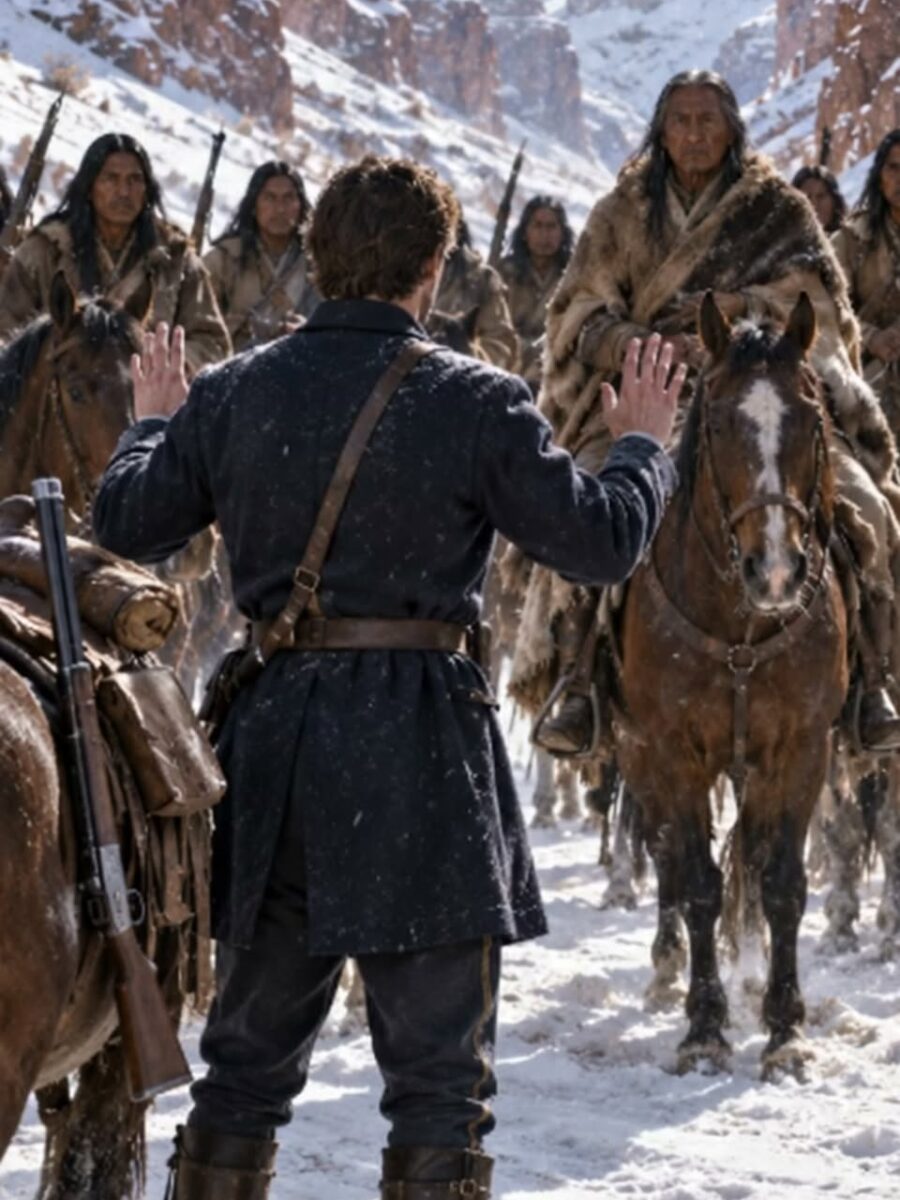
“The army taught a soldier how to march, how to load paper cartridges in four counts, and how to obey orders without questioning their cost. But out on the rim of the world, where the winter wind stripped away brass buttons and regimental banners, honor was measured by a single question: will you let a freezing child die because of the color of her skin or the uniform on your back?”
Table of Contents
Chapter 1: The Crying in the Red Canyon
In the brutal winter of 1872, the Arizona territory did not resemble the sun-baked postcard of red stone and dust that travelers spoke of in Saint Louis. An unyielding arctic gale had swept down from the northern peaks, locking the Chiricahua Mountains beneath three feet of drifting snow. Bitter winds howled through the narrow box canyons, and the red sandstone bluffs were rimmed with razor-sharp icicles that groaned in the sub-zero chill.
Corporal Thomas Reed rode alone. He was twenty-six years old, born to emancipated sharecroppers in the rolling lowlands of Virginia, with dark mahogany skin weathered by six years of frontier saddle-soreness, broad shoulders that could hoist a stranded wagon axle, and eyes that had seen too much grief to harbor illusions about military glory. He wore the blue wool tunic of the 9th United States Cavalry—the storied Buffalo Soldiers—with his sergeant stripes earned through grit and unbroken discipline. Secured inside his oiled leather breast pocket was an official dispatch pouch stamped with red wax, bearing orders from Fort Bowie to the commander at Camp Grant.
His bay gelding, a sturdy quarter-horse named Samson, picked his way cautiously along the frosted ledge of Turkey Creek Canyon. Every breath plumes of white vapor burst from Thomas’s wool scarf. The trail was supposed to be completely deserted. Sensible men, white and Native alike, had retreated into winter lodges and stone barracks weeks ago.
Then, cutting through the scream of the canyon wind, came a sound that made Thomas pull back sharply on the reins.
It was thin. Weak. A high, reedy whimper that sounded at first like the cry of a mountain lion cub trapped in a fissure. But Thomas had not survived four years of Apache campaigns by misjudging sounds. He halted Samson, resting a heavy wool-gloved hand against the pommel, listening intently over the hiss of dry snow blowing across the rocks.
The whimper rose again. It was a child’s sob—muffled, desperate, and fading rapidly.
Thomas swung his long leg over the cantle and dropped into the knee-deep drift. Leaving Samson ground-tied in the lee of an overhanging cedar, he drew his service revolver and moved cautiously around a jagged slab of fallen sandstone. The wind lashed at his face, stinging his cheeks with frozen grit.
Tucked into a narrow hollow beneath the cliff face was a sight that stopped his heart. An Apache woman lay curled on her side in the snow, her buckskin dress soaked with freezing meltwater. She was shivering violently, her lips blue, her breath shallow and rattling. Wrapped beneath her trembling arms, pressed against her chest for the last lingering embers of body heat, was a little girl no older than four. The child’s cheeks were frostbitten, her dark eyelashes crusted with ice, her tiny fingers clutching the fringe of her mother’s tunic.
As Thomas’s heavy cavalry boot crunched the crust of ice, the woman’s eyelids fluttered open. The instant her gaze locked onto his blue army uniform and the brass buttons gleaming through the storm, terror convulsed her fragile frame. With a raspy, agonized gasp, she tried to scramble backward against the solid stone wall, pulling the little girl tighter beneath her ribs, expecting the bullet or the bayonet that frontier gossip promised accompanied every bluecoat.
Chapter 2: The Sacrifice of the Cavalry Coat
Thomas stood motionless in the freezing drift. Between his people and hers lay an ocean of blood. He knew what the army manual dictated: any hostiles encountered outside the reservation perimeter were considered enemy combatants, to be reported or detained under military escort. He carried dispatches that promised disciplinary court-martial if delayed.
He looked at the little girl’s trembling hands. He remembered his younger sister, Sarah, back in the cabin along the James River, shivering through the cold fever winter when he was nine years old, and the helpless terror in his mother’s eyes. A child in the snow was not an enemy combatant; a dying mother was not a military target.
Slowly, deliberately, Thomas holstered his revolver. He took his Springfield carbine from his shoulder, laid it gently in the snow six paces away, and raised both empty hands into the air.
“I’m not here to hurt you, ma’am,” he spoke in a low, gentle rumble that carried none of the harsh bark of a non-commissioned officer. “You’re freezing. You won’t make it to nightfall out here.”
The woman didn’t understand English, but she understood the weapon laid aside. Her breathing slowed from panic to exhausted weeping. She had no strength left to fight. When Thomas knelt down beside her, the smell of woodsmoke and cedar cling to her clothes, mixed with the sharp copper odor of frostbite.
Thomas unbuckled his heavy wool cavalry greatcoat—the thick, double-breasted navy blanket coat issued to protect scouts against mountain blizzards. Without hesitation, he stripped it from his shoulders, exposing his woolen flannel shirt to the biting sub-zero gale. He wrapped the heavy army wool securely around the mother and child, tucking the hem beneath their stiff moccasins.
From his saddlebags, he retrieved his tin canteen. It was half-filled with warm, sweetened chicory coffee he had boiled before dawn. He uncorked it, took a small sip himself to prove it held no poison, and held it to the woman’s cracked lips. She drank greedily, the warmth reviving a spark of life in her dark, sunken eyes.
Next, he took out two thick cakes of army hardtack and a chunk of salted pork. He broke the hard biscuit into small, bite-sized pieces with his hunting knife and placed them directly into the little girl’s shivering palm. The child looked up at him—her eyes wide, startled, and luminous—before eagerly pressing the food into her mouth.
Night fell over the canyon like a black iron curtain. The temperature plummeted to fifteen degrees below zero. With his teeth chattering and his limbs numb, Thomas gathered dry piñon wood and built a small, sheltered fire against the cliff face, shielding the flames from the howling wind with his horse’s saddle blanket. He sat awake through the long, freezing hours, rubbing his hands together over the embers, feeding the fire stick by stick, while the mother and child slept in the cocoon of his blue army coat.
When dawn finally broke in pale lavender hues across the eastern ridges, the mother opened her eyes. The fever had broken. Her hands were warm, and her little daughter was smiling faintly as she played with a piece of polished river stone Thomas had smoothed for her.
Thomas helped them to their feet. The woman was still too weak to walk the mountain trails, so he lifted her gently onto Samson’s saddle, seating the child in front of her. Taking the horse’s leather bridle in his numb, raw fingers, the Buffalo Soldier turned toward the west, guiding the horse on foot through the snowdrifts toward the winter sanctuary of the Chiricahua band.
Chapter 3: The Circle of Forty Lances
By midday, the storm had quieted, leaving the sky a brilliant, blinding turquoise above the snow-capped mesas. Thomas trudged through waist-deep drifts at the base of Apache Pass, his breath burning in his chest, his flannel shirt stiff with ice. He knew he was deep in hostile territory; every ridge could harbor scouts whose arrows flew without sound.
They entered a wide amphitheater of red sandstone where the canyon narrowed into a natural fortress. Suddenly, the absolute silence was shattered not by a scream, but by the rhythmic clatter of unshod hooves on frozen rock.
Along the high rim of the canyon, dark figures appeared like statues carved from the stone. Ten, twenty, thirty warriors mounted on sturdy painted ponies. They carried Winchester repeating carbines, long steel-tipped lances decorated with hawk feathers, and bows drawn to full length. Within seconds, the riders descended the slopes with breathtaking precision, encircling Thomas in a tightening ring of cold iron and raw horseflesh.
Thomas stopped. His hands rose slowly to shoulder height. His rifle remained slung across Samson’s cantle; his revolver was holstered. In this canyon, forty rifles were aimed at his chest. A single sudden twitch would mean his death before his boots could hit the snow.
The warriors did not speak. Their faces were painted for war—streaks of black soot and red ochre across cheekbones hardened by a decade of frontier survival. They stared at the lone Black soldier in his cavalry trousers and wool shirt, baffled by the strange tableau before them: an armed bluecoat leading his own mount, upon which sat an Apache woman and child wrapped in the blue greatcoat of the United States Cavalry.
The riders parted. A tall, gray-haired elder rode into the center of the ring. He sat upon a muscular buckskin horse, wearing a deer-hide shirt adorned with silver conchos and eagle feathers woven into his braided hair. His face was a map of deep canyons and ancient dignity. It was Chief Nantan, a revered leader of the Chiricahua council whose name struck fear into every supply outpost from Tucson to the border.
Nantan’s dark eyes locked onto Thomas with unyielding scrutiny. He raised his lance, and forty warriors drew their reins tight. The tension was thick enough to choke on.
Then, the woman on the horse stirred.
With an urgent cry, Nina slid down from the saddle, tumbling into the snow before catching herself. She ran forward, throwing herself before the chief’s horse. She spoke rapidly in the Apache tongue, her voice trembling with emotion, her gestures wild and vivid.
She pointed back toward the snowy canyon where she had fallen. She touched the thick blue wool coat wrapped around her daughter. She held up Thomas’s canteen, pointing to the remaining bread, and then pointed directly at Thomas’s bare, shivering chest.
“He did not shoot,” the woman’s words were translated in broken Spanish by a warrior riding beside Nantan. “He laid his gun in the snow. He gave us his fire. He gave his coat to keep Kiona alive through the black wind, while he stood in the frost without shelter.”
Chapter 4: The Elder’s Debt of Honor
A profound, unnatural silence descended over the canyon. The fierce warriors lowered their lances an inch. Men who had seen their villages burned by cavalry columns looked from the bluecoat’s chapped, frostbitten skin to the little girl who was now clinging to her mother’s skirt, chewing on the last piece of hardtack.
Chief Nantan dismounted. He walked through the snow until he stood three paces from Thomas. He was shorter than the cavalryman, but he carried an aura of absolute authority that commanded the entire mountain range.
He studied Thomas’s face—the mahogany skin, the dark, steady eyes that met his gaze without flinching, and the deep stillness of a man who did not beg for his life.
“The white officers send soldiers to herd our people like cattle onto the dry flats,” Nantan said in deep, measured tones, his words translated by the bilingual scout. “They burn our winter corn and leave our children to freeze in the rocks. But you… you wear the blue coat, yet your heart does not belong to their cruelty.”
“I am a soldier, Chief,” Thomas replied evenly, his voice steady despite the cold. “I took an oath to protect the country. But my mother raised me by the Book, and my father taught me that no man has honor if he walks past a dying child to save his own skin.”
Nantan nodded once, a gesture of profound respect. “Nina is the widow of my bravest nephew, who fell at Dragoon Springs. Little Kiona carries the blood of chiefs. In our law, he who saves the seed of the chief’s house has saved the honor of the entire tribe.”
The elder turned toward the riders. He raised his right hand and called out a name: “Tala.”
A young woman rode forward through the circle. She dismounted with fluid, graceful power and stepped to her father’s side. She was twenty-two years old, with high, sculpted cheekbones, skin the color of burnished copper, and dark, piercing eyes that possessed both the fire of a desert hawk and the deep quiet of mountain water. Her raven hair fell in two thick braids over a fringed buckskin tunic worked with intricate beads of white bone and turquoise.
She did not look down. She looked directly into Thomas’s eyes, reading every scar, every line of fatigue, and the quiet dignity within his soul.
Chief Nantan turned to Thomas. “You saved my tribe from the greatest grief. A debt of blood can only be repaid with life. I give you my daughter, Tala, to be your wife. In our circle, you are no longer a bluecoat scout. You are a son of the Chiricahua.”
Thomas felt the breath leave his lungs. In his coat pocket lay the sealed dispatch orders for Camp Grant. Beyond the mountains lay the fort, his pension, his regiment, and the only world he had ever known. But here, beneath the endless Arizona sky, an ancient people was offering him something no army had ever granted a Black man: genuine brotherhood, unbreakable honor, and a place by their sacred fire.
Chapter 5: Two Worlds at the Council Fire
Tala took two slow steps toward Thomas. The entire band of warriors held their breath. In Apache tradition, an arranged union could be refused by a chief’s daughter if her spirit rejected the suitor. But Tala did not turn away.
She stopped inches from him. Reaching into the fold of her blanket, she withdrew a heavy woolen saddle blanket dyed in deep indigo and crimson—woven by her own hands during the long winter months. Without speaking, she lifted the blanket and draped it around Thomas’s freezing shoulders, her fingers brushing the skin of his neck with surprising warmth.
“You gave your coat to my sister,” Tala whispered in halting English, her dark eyes glittering with quiet resolve. “Now take my blanket, soldier. A brave man should never freeze among friends.”
A low chorus of approval rose from the warriors, their lances striking their hide shields in a rhythmic thunder that echoed through the canyon. Thomas looked down at the blanket, then at Tala, and finally at Chief Nantan. He bowed his head in deep humility.
That evening, inside the hidden valley of the Chiricahua winter encampment, thirty hide wikiups stood nestled among the pine groves. A great council fire crackled in the center of the camp, casting long, dancing shadows against the sandstone amphitheater. The smell of roasting venison, cedar smoke, and wild sage filled the crisp night air.
Thomas sat beside Tala on a woven mat of willow reeds. Across the fire sat the elders, passing a stone pipe carved with the effigy of the mountain eagle. When the pipe was handed to Thomas, he drew the sweet herbal smoke into his lungs and exhaled it toward the four sacred directions, sealing the bond that bound his fate to theirs.
Over the days that followed, Thomas did not run from his past, nor did he hide his duties. He spoke honestly with Chief Nantan and Tala about the world beyond the peaks—about the relentless expansion of the rail lines, the incoming garrisons, and the political corruption in Washington that traded away treaty promises for silver claims. And Tala shared with him the songs of her ancestors—how their spirits lived in the red cliffs, how they read the flight of the hawk to find hidden water, and why they would rather perish on their sacred stone than submit to reservation cages.
A deep, unspoken understanding grew between them. Thomas saw in Tala a spirit as unbending as iron and as tender as morning rain. Tala saw in Thomas a man whose strength was anchored not in brutality, but in an incorruptible sense of justice that no military order could compromise.
Chapter 6: The Patrol from Fort Bowie
The peace of the winter valley could not last forever. On the tenth morning, while the snow was beginning to melt along the sunny faces of the mesa, an Apache scout rode into camp at a gallop. A company of cavalry from Fort Bowie was advancing through Apache Pass—two officers, thirty-five troopers, and a pack train of mountain howitzers, led by Captain Hastings, a rigid disciplinarian infamous for his aggressive patrols.
Hastings was searching for Corporal Thomas Reed. When the scout failed to arrive at Camp Grant, the post commander assumed Reed had been ambushed, killed, or had deserted his post.
Warriors immediately began painting their faces for battle. Men strung their sinew-backed bows and checked the chambers of their rifles. Chief Nantan stood by his horse, his war lance ready.
“No,” Thomas said, stepping into the center of the clearing. He was wearing his blue trousers, but over his shoulders hung Tala’s crimson-and-indigo blanket, and around his neck was a necklace of turquoise beads Tala had gifted him. “If you fight them here, the army will send three more regiments in the spring. They will bring artillery and cavalry until this valley is burned to ash. Let me ride out and meet them alone.”
Tala stepped to his side, her hand resting on the pommel of her knife. “I ride with you, Thomas. You are of my house now. If they kill you, they kill the daughter of Nantan.”
Together, accompanied by six unarmed Apache elders including Chief Nantan, they rode through the narrow mouth of Turkey Creek Canyon. Half a mile down the trail, Captain Hastings and his column halted in stunned disbelief.
Hastings leveled his field glasses, his jaw dropping as he recognized Corporal Reed riding side by side with the daughter of the most wanted Apache chief in the territory. Behind them rode Nantan himself, bearing an olive branch tied with white buckskin fringe.
“Corporal Reed!” Hastings barked, spurring his horse forward with four armed sergeants flanking him. “What is the meaning of this? You are ten days overdue! Your dispatches are vital to territorial security! Why are you parading among hostiles?”
Thomas dismounted calmly. He reached into his tunic and pulled out the sealed dispatch pouch, its red wax seal intact and undamaged. He stepped forward and placed it directly into Captain Hastings’s gloved hand.
“My orders have been preserved, Captain,” Thomas said in a clear, ringing voice that carried across both ranks of men. “And thirty-five troopers under your command are alive today because Chief Nantan chose honor over an ambush.”
Chapter 7: The Truce Carved in Winter Stone
Captain Hastings looked down at the intact dispatch pouch, then at the silent, imposing figure of Chief Nantan, and finally at Tala, who stood beside Thomas like an eagle guarding its aerie. On the high ridges above the canyon, twenty Apache sharpshooters suddenly stood up among the rocks, their rifles held casually across their chests—revealing to the captain that his column had ridden straight into a crossfire that would have annihilated them had hostilities begun.
Hastings’s face paled. The arrogance of the cavalry officer was replaced by the sudden, chilling reality of frontier warfare.
“Explain yourself, Corporal,” Hastings commanded, his voice subdued.
Thomas recounted the blizzard—how he found Nina and Kiona freezing beneath the stone shelf, how he gave up his coat and rations to preserve innocent lives, and how Chief Nantan had welcomed him not as an enemy, but as a man of sacred honor. When Thomas finished speaking, Nina rode forward, holding little Kiona up so that the cavalrymen could see the child alive and healthy, wearing the blue coat with its brass cavalry buttons still shining in the sunlight.
The troopers in the column murmured among themselves. Many were seasoned veterans who had lost comrades in the canyon wars; none of them had ever witnessed an act of mercy cross the divide between blue wool and buckskin with such devastating moral clarity.
“Chief Nantan does not want war, Captain,” Thomas concluded. “He wants his people left unmolested in this valley through the winter thaw. In exchange, the Chiricahua band pledges safe passage for all mail coaches and civilian supply trains through Apache Pass.”
Hastings sat in his saddle for a long, silent minute. He looked at the sealed dispatches, at the hidden rifles lining the rim, and at the Black corporal who had achieved with one coat what three regiments could never win with grape-shot.
“Your service to the 9th Cavalry is officially concluded, Corporal Reed,” Hastings said quietly, slipping the dispatches into his saddle holster. “I will report to the department commander that you were lost in the blizzard of ’72 while faithfully executing your duties. An honorable discharge will be filed in your record at Saint Louis.”
Hastings raised his hand in a formal, crisp military salute. Thomas returned the salute—his final act as a soldier of the United States Army.
The cavalry column turned about and began its long march back down the canyon toward Fort Bowie, their guidons fluttering in the brisk mountain breeze. Thomas watched them depart until their blue coats disappeared into the red sandstone shadows.
When the dust settled, Tala stepped to his side. She reached out, her fingers curling around his hand, warm and unyielding. Thomas looked down at her, then back up at the majestic peaks of the Chiricahua range. He had shed his uniform, his army pay, and the prejudices of a nation that had never fully seen him as a man. But here, standing between the red stone and the winter sky, he had found something far greater than an army could ever promise: a family, a home, and a love forged in the heart of the blizzard.


