“YOU CAN’T AFFORD THAT DRESS.” The Receptionist Was Humiliated by a $12,000 Gown — Then the Mafia Boss Sent a Black Envelope
Chapter 1: The Girl in the October Rain
“Who told you that?”
I spoke into the freezing downpour on Madison Avenue, stepping out from the golden halo of the luxury boutique into the autumn rain. My charcoal cashmere overcoat immediately absorbed the mist as my dark eyes locked onto the slender, shivering figure standing before the plate-glass window.
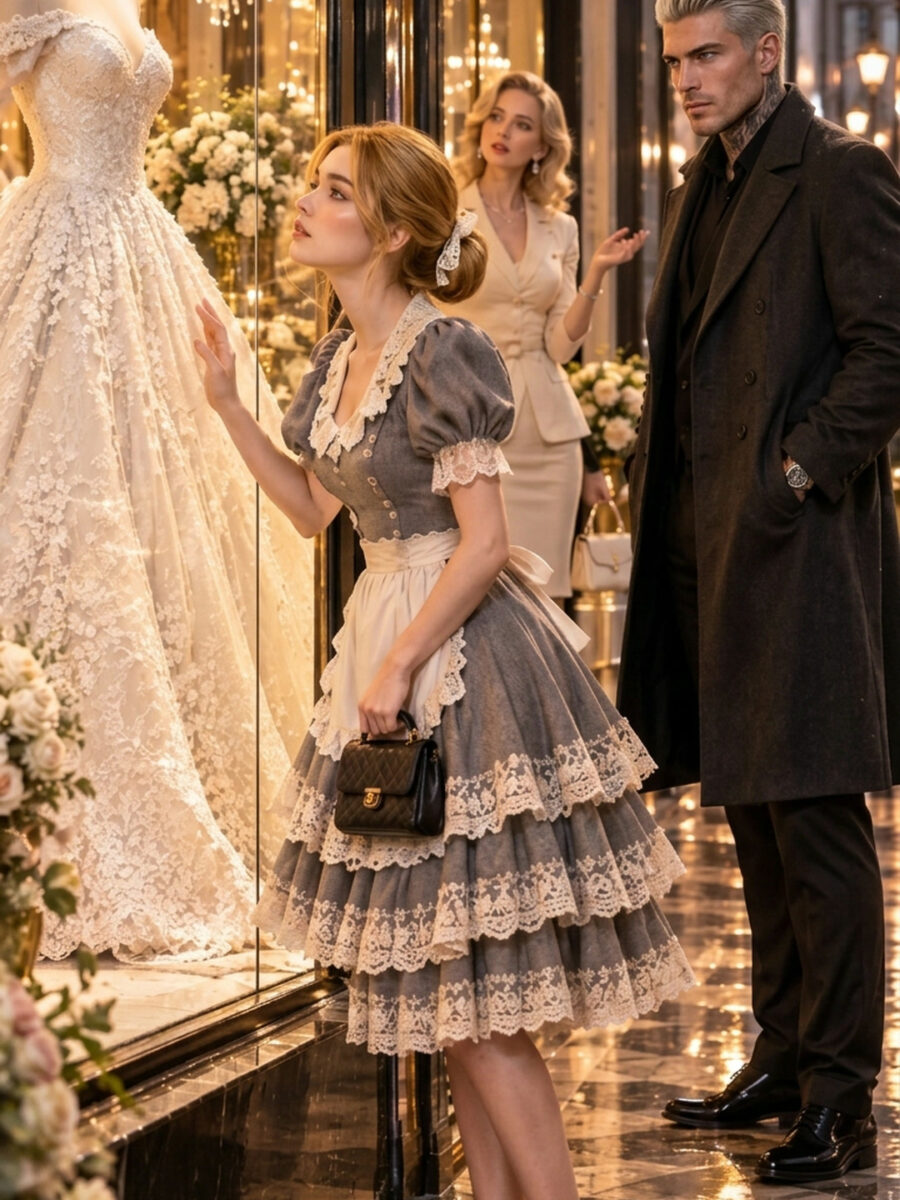
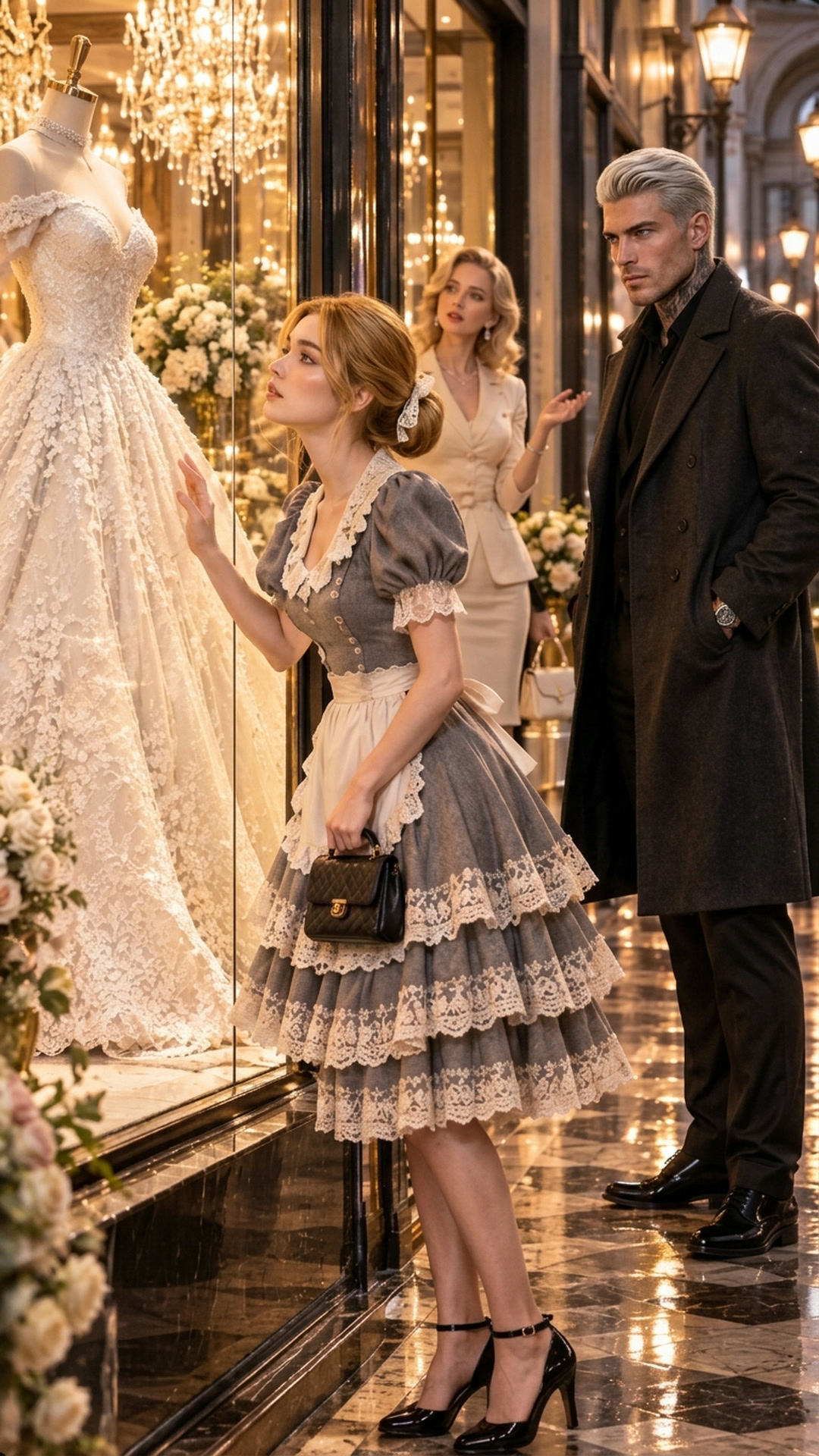
She had been standing there for ten minutes, water dripping from the frayed hem of her brown coat into her worn, waterlogged leather shoes. Inside the glass display, illuminated by recessed halogen spotlights, stood an exquisite twelve-thousand-dollar gown—deep midnight-blue silk with cascading silver embroidery along the bodice and a shimmering skirt. Moments earlier, an arrogant sales clerk had sneered through the open door: “More than three months of your salary, sweetheart. Move along.”
The girl had lowered her head, looking at the display with a bitter, heartbroken smile, whispering to her own reflection: “Beautiful things aren’t meant for people like me.”
My name is Julian Vance. At thirty-eight, I commanded New York’s deep-water shipping terminals, commercial concrete monopolies, and a syndicate of five thousand men who took my silence as a death warrant. Governors answered my calls on the first ring. Billionaires lowered their eyes when my motorcade pulled up. But standing on the wet pavement, watching this exhausted stranger with twelve dollars in her pocket, something long dormant in my chest ignited.
She spun around, startled by my voice. Her face was pale, framed by wet chestnut hair, her soft green eyes luminous with unshed tears. “What’s your name?” I asked quietly.
She took a defensive step backward into the rain, pulling her collar tight. “Why would you want to know?”
Before I could answer, she turned and hurried down the sidewalk toward the subway station, vanishing into the crowd like a frightened ghost. I stood motionless in the rain. I pulled out my phone, signaling my chief of intelligence, Marcus, waiting in the idling Maybach across the street.
“Marcus,” I said, my voice cutting through the storm. “Facial recognition sweep. Madison and 68th. I want her name, her family history, and every single debt she carries on my desk before dawn.”
By six in the morning, the file was open on my desk. Clara Ward, twenty-seven. Hotel receptionist at The Grand Royale by day, cleaning offices until midnight, living in a dilapidated flat above a bakery in Queens. Raising her sixteen-year-old brother, Leo, who suffered from severe congenital aortic stenosis requiring a sixty-thousand-dollar valve reconstruction.
At seven-fifteen that morning, three slow knocks sounded on Clara’s apartment door. When she opened it, nobody was there—only a heavy, matte-black envelope stamped with silver foil lettering: CLARA WARD — JULIAN VANCE.
↑ Back to Top
Chapter 2: The Blue Silk Gown
At exactly seven o’clock that evening, the private express elevator to my penthouse at Vance Tower chimed.
The double bronze doors slid open. I stood beside the floor-to-ceiling glass wall overlooking the glittering sea of Manhattan lights, holding a crystal glass of scotch. When I turned, the breath left my lungs.
Clara Ward stepped onto the polished black marble floor. She was wearing the deep blue silk gown. The bodice hugged her delicate, feminine curves with custom perfection, the silver embroidery sparkling like constellations under the chandeliers, the skirt pooling around her slender ankles. Her chestnut hair was pinned up in soft, elegant curls, revealing the graceful line of her neck. She looked like an empress who had walked out of an oil painting.
Yet in her hands, she clutched the matte-black envelope like a shield, her green eyes wide with cautious defiance.
“Mr. Vance,” she began, her voice trembling slightly but refusing to break. “The dress was in a velvet trunk outside my door, along with an authorization card for Mount Sinai Hospital’s cardiothoracic unit. Why did you do this? I am a receptionist who cleans floors. I don’t take charity, and I don’t sell myself.”
I set my glass down, walking slowly toward her, stopping three paces away to give her space. “You don’t sell yourself, Clara. And I don’t offer charity. I offer alliances.”
“An alliance with a girl who has twelve dollars in her purse?” she asked with a bitter chuckle.
“An alliance with the daughter of Thomas Ward,” I replied smoothly.
Her smile evaporated instantly. Her face drained of every trace of color, her fingers gripping the black envelope so hard the paper creaked. “My father? My father abandoned us ten years ago! He ran off and left my mother to die!”
I pulled an encrypted tablet from my pocket, sliding an audio recording across the glass coffee table: “Your father never abandoned you, Clara. He was murdered ten years ago by Richard Sterling—the man who owns the hotel where you work.”
↑ Back to Top
Chapter 3: The Ghost of Thomas Ward
The silence in the penthouse was thick enough to choke on.
Clara sank onto the velvet sofa, her hands trembling violently as I pressed play on the tablet. The voice of Richard Sterling—billionaire hotel magnate and my fierce commercial rival—echoed through the room from a recorded wiretap dated two weeks ago.
“Make sure Clara Ward stays on minimum wage,” Sterling’s voice sneered. “Reject her health insurance claims for that sick little brother of hers. Her father, Thomas, took five million dollars in offshore audit ledgers to his grave. If that girl ever gets enough money to hire an attorney, she will find the missing shell companies. Keep her starving in Queens until the boy dies.”
Clara covered her mouth, a ragged, soul-shattering sob breaking from her chest. For ten years, she had carried the burning shame of a runaway father. She had watched her mother wither away from despair, believed her family was cursed, and scrubbed toilets until her knuckles bled—all while the monster who killed her father was deliberately orchestrating her brother’s slow death.
“Ten years ago,” I explained gently, sitting on the armchair across from her, “Thomas Ward was the chief auditor for Sterling Holdings. He uncovered forty million dollars in cartel laundering through the Grand Royale Hotel. Before Thomas could deliver the ledger to the Federal Grand Jury, Sterling had his car forced into the Hudson River and paid off corrupt detectives to report him as a runaway embezzler.”
Tears poured down Clara’s cheeks, catching the silver embroidery on her blue silk gown like diamonds. “He didn’t leave us… Daddy didn’t leave us…”
I reached out, taking her cold, trembling hands into mine. Her skin was soft beneath the calluses of hard labor, her green eyes looking at me with raw, aching vulnerability. For the first time in my life, the empire I commanded felt secondary to the woman before me.
“He died trying to protect you, Clara,” I whispered, my voice an iron oath. “And starting tonight, the entire Vance syndicate stands between you and the men who destroyed your family.”
↑ Back to Top
Chapter 4: The Ambush at the Bakery
But Richard Sterling was not a man who went down quietly.
Word of Julian Vance purchasing the $12,000 blue gown and delivering a black envelope to Queens had reached Sterling’s informants within twelve hours. Panic-stricken that his ten-year cover-up was unraveling, Sterling dispatched his private muscle crew to eradicate the Ward family before I could secure them.
At three o’clock the following afternoon, Clara had returned to the apartment above the bakery to pack Leo’s medical supplies for his scheduled transfer to Mount Sinai. Sixteen-year-old Leo was resting on the living room sofa, reading a mechanics magazine.
Suddenly, the wooden apartment door was kicked off its frame with a shattering crash. Three masked gunmen wearing heavy tactical jackets burst into the cramped apartment, brandishing suppressed handguns.
“Where are the old flash drives, kid?!” the lead gunman barked, grabbing Leo by the collar of his sweater and hurling him onto the linoleum. The sheer shock triggered a violent arrhythmia; Leo clutched his chest, gasping for air as his face turned blue.
“Leo!” Clara screamed, charging out of the kitchen holding an industrial bottle of concentrated ammonia, hurling the chemical directly into the lead attacker’s eyes. The man shrieked in agony, dropping his weapon.
The second gunman backhanded Clara across the face, sending her crashing against the wall, her lip splitting against the baseboard. He raised his suppressed pistol to her temple: “Say goodbye, sweetheart.”
Before his finger could tighten on the trigger, the front window shattered into a thousand shards—and two sniper rounds from the opposite rooftop punched through both gunmen’s torsos, followed by my heavy boots kicking through the threshold with smoking steel in hand.
↑ Back to Top
Chapter 5: The Heart of a Brother
I didn’t hesitate.
I dropped the third attacker with a single shot to the shoulder, disarming him with a bone-shattering kick, and holstered my weapon in one fluid motion. In four seconds, I was on my knees beside the sofa.
“Marcus! Medical transport on the roof right now!” I roared into my lapel mic. I scooped sixteen-year-old Leo into my arms, feeling how light he was—his heart fluttering erratically like a bird against his ribs. I carried him down the fire stairs to the waiting tactical ambulance, where two trauma surgeons intubated him with oxygen and administered beta-blockers.
I turned back to Clara. She stood on the wet pavement in the rain, blood trickling from her split lip, her hands shaking in shock. I pulled my cashmere scarf from my neck, gently dabbing the blood from her face, and pulled her tightly against my chest.
“He’s breathing, Clara,” I murmured against her hair. “I promised you he would live, and I don’t break promises.”
Within eight minutes, my armored convoy reached Mount Sinai Hospital. The entire eighth-floor surgical wing had been cleared under my personal authorization. The chief of pediatric cardiology, Dr. Alan Sterling, met us at the gurney, rushing Leo straight into operating room 4 for an emergency aortic valve replacement.
For six agonizing hours, I sat in the private surgical waiting lounge, holding Clara’s cold hands in mine. The underworld boss who had commanded bloody wars in silence now sat watching the red digital clock, praying to a God he hadn’t spoken to in twenty years.
At 2:15 AM, the operating room doors swung open. Dr. Sterling stepped out, pulling down his surgical mask with a warm, exhausted smile.
“The valve is completely reconstructed, Mr. Vance,” the surgeon announced. “The heart rhythm is stable, oxygen saturation is ninety-nine percent. Leo is going to live a full, normal life.”
Clara collapsed against my chest, sobbing in incandescent, breathless relief, wrapping her arms around my neck. I held her so tightly I could feel her tears soaking into my shirt, my soul finally finding peace.
Marcus stepped into the waiting room, holding an encrypted satchel: “Boss… Richard Sterling has mobilized his private charter at Teterboro Airport. He’s fleeing to Geneva in forty minutes with seventy million in offshore bearer bonds.”
↑ Back to Top
Chapter 6: The Fall of Richard Sterling
“Guard Clara and Leo with fifty men,” I told Marcus. “I will handle Richard Sterling personally.”
At 3:10 AM, a blinding storm raged over Teterboro Airport in New Jersey. On the private executive runway, Richard Sterling was frantically loading leather duffel bags into the cargo hold of his Gulfstream jet. Flanking him were six armed mercenaries.
Before the jet’s engines could spool up, four black armored Suburbans roared onto the tarmac, cutting off the runway in a wall of xenon headlights. Thirty heavily armed Vance soldiers surrounded the aircraft in seconds.
Sterling’s mercenaries dropped their weapons onto the wet tarmac without firing a shot, terrified of the overwhelming force surrounding them. I stepped out of the lead Suburban, walking down the runway in my charcoal coat, my boots splashing through the puddles.
Sixty-two-year-old Richard Sterling scrambled backward toward the jet stairs, clutching a briefcase of bearer bonds, his face white as ash. “Vance! Please! Take the seventy million! Take the hotel! Just let me leave the country!”
I pulled the original, water-damaged notebook that Thomas Ward had kept ten years ago from my pocket, tossing it onto the wet aluminum steps.
“You murdered Thomas Ward,” I said, my voice echoing like thunder across the runway. “You starved his daughter for ten years. You tried to execute a sixteen-year-old boy in his bed. Your money can’t buy your soul, and it won’t buy your freedom.”
At that instant, red and blue strobe lights painted the wet tarmac in crimson and sapphire. Twenty Federal Bureau of Investigation vehicles and New York State Police units swarmed the runway. Special Agent Miller marched forward with an unsealed federal warrant.
“Richard Sterling,” Agent Miller announced, snapping steel handcuffs around his wrists. “You are under arrest for first-degree premeditated murder, conspiracy, attempted murder of a minor, and capital racketeering.”
Sterling screamed curses as he was hauled into the back of a federal cruiser, his forty-year empire dismantled in five minutes—and I signed the court-ordered receivership transferring ownership of The Grand Royale Hotel directly to Clara Ward.
↑ Back to Top
Chapter 7: The Rebirth of Clara Ward
Justice moved with the speed of an avalanche.
Richard Sterling was denied bail and sentenced to life imprisonment without parole at ADX Florence. His seized assets funded full restitution to the victims of his corporate fraud, clearing Thomas Ward’s name across every major publication in America as a heroic whistleblower who gave his life for the truth.
Two weeks later, Clara walked through the brass revolving doors of The Grand Royale Hotel on 54th Street. She was no longer wearing a cheap polyester receptionist uniform. Dressed in an elegant charcoal Armani suit, flanked by the board of directors, she was officially introduced as the new President and Chief Executive Officer of the luxury hotel group.
Her first executive act was to double the minimum wage for every housekeeper and receptionist, establish full medical coverage for employee families, and fund the Thomas Ward Memorial Scholarship for underprivileged students.
Leo was discharged from Mount Sinai three weeks later, his heart strong and healthy, his cheeks glowing with color. He moved into the penthouse suite of Vance Tower, enrolling in an elite engineering academy with dreams of building ships.
On a warm Friday afternoon in early May, I took Clara back to Madison Avenue—to the very boutique where she had stared through the rain-streaked window. When we entered, the arrogant sales clerk who had mocked her twelve dollars paled in terror, bowing low.
I walked to the manager’s counter, signed a check purchasing the boutique and its real estate in full, and handed the deed to Clara. “Your first corporate asset, Miss Ward. You may handle the staffing as you see fit.”
Clara looked at the trembling clerk, then turned to the manager with calm, majestic grace: “Send her three months of her salary, and tell her that beautiful things belong to everyone who works with an honest heart. She is relieved of her duties.”
That night, on the terrace of Vance Tower overlooking Central Park, Clara turned to me with tears in her eyes: “You gave me back my father’s honor, my brother’s life, and my dignity, Julian… how could I ever repay you?”
↑ Back to Top
Chapter 8: The Queen in Midnight Blue
One year after that freezing October night, the Grand Ballroom of the Plaza Hotel blazed in golden light.
Eight hundred of New York’s most prominent figures—governors, federal judges, Wall Street executives, and international dignitaries—gathered for the annual Autumn Philanthropic Gala. At the center of the hall, seventeen-year-old Leo Ward stood tall in a bespoke tuxedo, laughing with his engineering classmates, completely cured and full of vibrant energy.
At nine o’clock, the orchestra swelled into a breathtaking waltz.
I walked onto the ballroom floor in my tailored black tuxedo, but all eyes in the room were fixed on the woman on my arm. Clara wore the twelve-thousand-dollar deep blue silk gown with silver embroidery—the very dress she had looked at with twelve dollars in her wallet in the rain. She looked radiant, breathtaking, and undeniably royal, a queen commanding the respect of the entire city.
The crowd parted in reverent silence. The city that had once made her invisible now bowed to her grace.
I led her through the French doors onto the private starlit terrace overlooking the sparkling towers of Manhattan. The autumn breeze carried the scent of fallen leaves and roasted chestnuts from Central Park.
“Do you remember what you whispered to the glass that night, Clara?” I asked softly, taking both her hands into mine.
Clara laughed, a sound so sweet and melodic it anchored my soul to this earth. “I said beautiful things weren’t meant for people like me.”
“You were wrong,” I murmured, pulling a black velvet box from my pocket. I opened the lid, revealing a magnificent twelve-carat royal blue sapphire ring, encircled by brilliant pavé diamonds that mirrored the silver embroidery on her gown.
“You are the most beautiful thing that ever entered my life, Clara,” I whispered, looking into her glowing green eyes with an eternal vow. “You showed me that a man with billions is still impoverished until he has someone worth loving. Will you share my name, my empire, and my life forever? Marry me, Clara.”
Tears of pure, triumphant happiness spilled down her cheeks as she threw her arms around my neck, pressing her lips to mine: “Yes, Julian! A million times yes!”
As Clara’s soft laughter echoed over the glittering skyline of Manhattan, I held my queen tightly against my chest, knowing that the girl in the October rain had become the light that conquered all my darkness forever.
↑ Back to Top