Table of Contents
- Chapter 1: The Sapphire in the Dining Car
- Chapter 2: The Handkerchief of Ruthie Bell
- Chapter 3: The Ghost of Savannah, 1877
- Chapter 4: The Deputy’s Dispatch from Santa Fe
- Chapter 5: The Rapid Telegraphed Convoy
- Chapter 6: The Sanitarium on the Pecos River
- Chapter 7: The Sovereign Kingdom of the Crowes
“Time can lay tracks across mountains and build empires of steel, but it can never erase the sacred promise etched into an heirloom ring. A father’s love does not perish in the ashes of the past; it awakens with thunder when his child calls his name.”
Chapter 1: The Sapphire in the Dining Car
The steam locomotive of the Atchison, Topeka and Santa Fe Railway roared through the rugged mountain canyons of the New Mexico Territory in the late autumn of 1889. Snow dusted the pinyon pines and red sandstone cliffs of the Sangre de Cristo Mountains, while inside the mahogany-paneled luxury Pullman dining car, gas chandeliers cast a warm, golden glow over white damask table linens, polished silver, and crystal decanters of Kentucky bourbon.
Sitting alone at the prime corner booth was thirty-eight-year-old Nathaniel Crowe. Nathaniel was a figure of legendary, formidable stature across the Western territories—a self-made African American railroad financier, steel investor, and land baron whose private syndicates controlled hundreds of miles of transcontinental track. Tall, broad-shouldered, with rich, warm mahogany-brown skin, a neatly trimmed beard, and penetrating hazel-brown eyes, he wore a bespoke charcoal wool three-piece suit tailored in London, an ivory silk cravat secured with a gold pin, and a heavy gold pocket watch resting against his waistcoat.
Nathaniel was a man whose presence naturally commanded the room. Wealthy territorial governors, cattle barons, and eastern mining executives gave him respectful nods as they passed his table. Yet behind his cool, impenetrable demeanor lay a private cemetery of unresolved grief. Twelve years earlier, the only woman he had ever loved—a brilliant Savannah schoolteacher named Clara Bell—had reportedly perished in a catastrophic passenger train explosion in Georgia. For twelve years, Nathaniel had lived in emotional solitude, funneling every beat of his heart into the cold, unyielding iron of the railroads.
Suddenly, the heavy brass latch of the dining car door clicked open. A gust of chilly mountain air rustled the velvet draperies as Deputy United States Marshal Thomas Briggs stepped inside. Flanking the tall, weathered lawman was a small, fragile figure: an eight-year-old African American girl wearing a faded floral calico dress that was slightly frayed at the hem, worn leather button boots, and a knitted wool shawl wrapped around her narrow shoulders. Her dark curls were tied back with a blue ribbon, and her large, luminous almond-shaped brown eyes darted nervously across the opulent dining car.
The wealthy patrons lowered their forks, murmuring in quiet irritation at the intrusion of a dusty territorial deputy and a child into the private Pullman car.
Deputy Briggs guided the little girl straight down the center aisle, stopping directly beside Nathaniel Crowe’s table.
Nathaniel looked up from his leather-bound ledger, his eyebrows pulling into a sharp, questioning arch. “Deputy Briggs. Is there an issue with the express line?”
“No, Mr. Crowe,” Deputy Briggs said softly, removing his Stetson hat with respectful gravity. “There’s no issue with the line. But this little girl asked to see the master of the railroad. She said she carried something that belongs only to you.”
Chapter 2: The Handkerchief of Ruthie Bell
Nathaniel looked at the child. For a fleeting second, an inexplicable tremor passed through his chest, like the sudden rumble of distant thunder beneath the prairie floor. There was something hauntingly familiar in the curve of her brow, the high cheekbones, and the quiet, defiant dignity in her posture.
“What is your name, child?” Nathaniel asked, his deep baritone softening into gentle warmth.
The little girl swallowed hard, her small hands trembling beneath her wool shawl. “Ruthie, sir. Ruthie Bell.”
The name Bell struck Nathaniel like a physical blow. The pen in his hand froze, ink blotting against the parchment ledger.
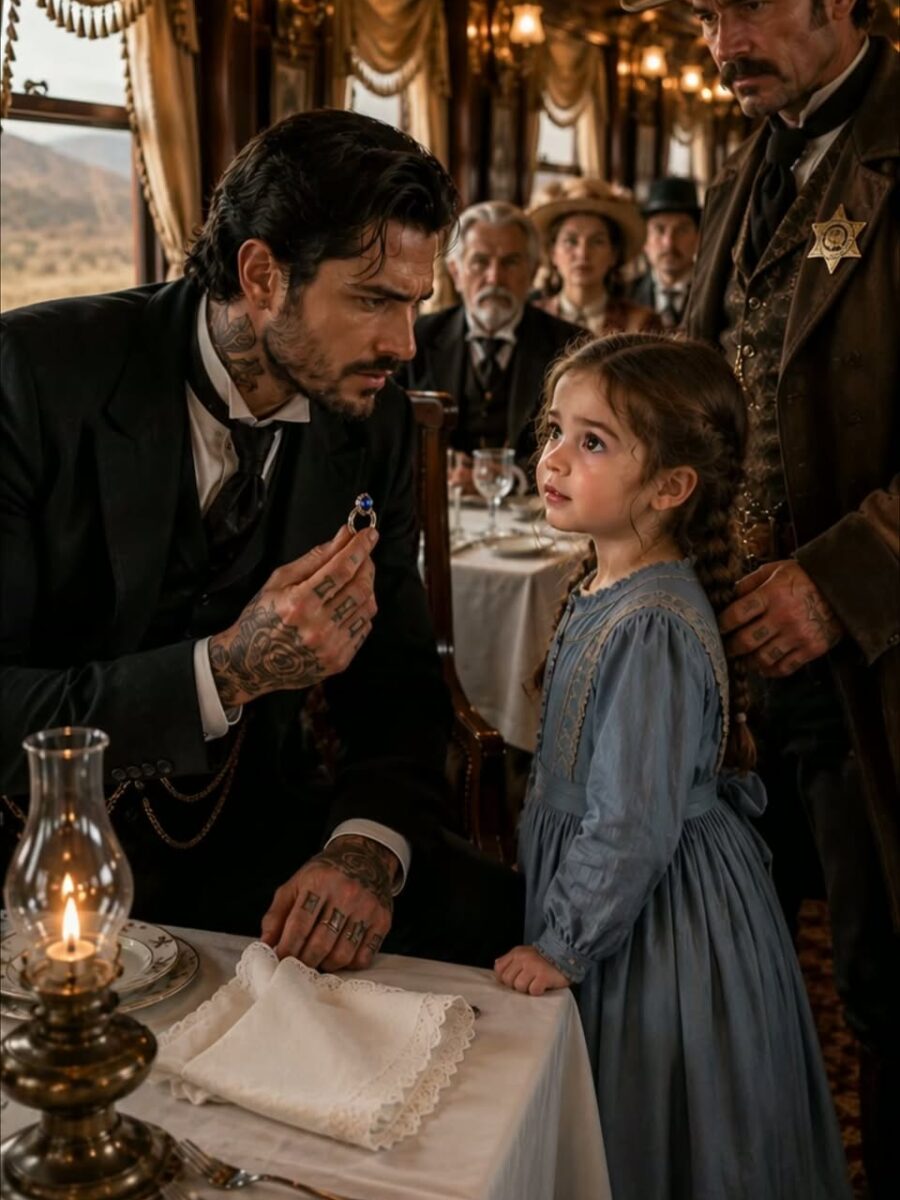
Ruthie reached into the pocket of her faded calico dress. She pulled out a clean, neatly pressed white linen handkerchief embroidered at the corner with two tiny blue cornflowers. With hesitant, respectful care, Ruthie placed the folded handkerchief onto the white tablecloth directly in front of Nathaniel.
Nathaniel stared at the linen. His fingers began to tremble. Slowly, deliberately, he reached forward and unfolded the corners of the cloth.
Resting in the center of the linen was an antique blue sapphire ring. The deep, velvety sapphire was cut into an oval cushion, surrounded by an intricate, hand-carved filigree setting of sterling silver, with a tiny, distinctive microscopic scratch near the south claw prong.
The blood drained instantly from Nathaniel Crowe’s face.
His breath stopped in his throat. His vision blurred with sudden, scalding tears. He picked up the ring with shaking fingers, holding it up to the warm gaslight.
He knew this ring. It had belonged to his mother, who had carried it out of bondage in Maryland thirty years earlier. And on a warm, star-filled night in Savannah, Georgia, twelve years ago, Nathaniel had placed this exact ring onto the slender finger of Clara Bell, whispering that as long as the sapphire shone, his heart would belong to her alone.
Nathaniel looked up, his voice cracking with concussive, raw emotion that silenced every patron in the dining car.
“Where did you get this ring, Ruthie?” Nathaniel whispered, his voice shaking. “Where did you find this?”
Chapter 3: The Ghost of Savannah, 1877
Ruthie looked into Nathaniel’s hazel-brown eyes, and for the first time, she did not look afraid. Her chin lifted with quiet, unshakeable courage.
“My mama gave it to me, sir,” Ruthie whispered, her sweet, piping voice carrying across the silent Pullman car. “She took it off her finger three nights ago at the clinic in Las Vegas, New Mexico.”
Nathaniel’s heart hammered violently against his ribs. “Your mama… what is your mother’s full name?”
“Clara,” Ruthie said softly. “Clara Bell. She used to teach school in Savannah before the fires came.”
Nathaniel rose from the booth so violently his silver water goblet tipped over, water soaking into the tablecloth. He didn’t care. The untouchable railroad titan dropped to both knees on the carpeted floor of the dining car, bringing his face level with the eight-year-old child, heedless of the fifty wealthy passengers watching in stunned disbelief.
“Clara is alive?” Nathaniel wept, tears pouring freely down his mahogany cheeks. “She didn’t die in the Macon rail disaster?”
Deputy Briggs stepped closer, his voice low and solemn. “Mr. Crowe, twelve years ago, when the vigilante raids struck the Savannah Freedman’s school, Clara was smuggled onto a westbound freight car by railroad porters. Her name was mistakenly listed on the manifest of the passenger train that exploded outside Macon. She woke up in a charitable mission in Saint Louis with severe smoke inhalation and no money.”
Nathaniel buried his face in his hands, trembling with profound, staggering grief. For twelve years, he had visited an empty memorial stone in Georgia, believing the woman he loved had been consumed by flames.
“Why didn’t she send word?” Nathaniel asked, his voice breaking. “Why didn’t she write to me?”
“She did, Mr. Crowe,” Deputy Briggs replied gently. “She sent three letters to Savannah. But by 1878, you had already sold your foundry and moved west to build the rail lines through the Colorado Rockies. Your old address was burned during the riots. She thought you had either died or moved on. She was alone, penniless, and carrying your child.”
Chapter 4: The Deputy’s Dispatch from Santa Fe
Nathaniel lifted his head, his eyes locking onto Ruthie’s face. He looked at the gentle cleft in her chin, the shape of her slender fingers, the warm hazel flecks dancing within her deep brown eyes. Every line of her features was an undeniable, living portrait of himself and Clara. He was looking at his own flesh and blood—the daughter he had never known existed, born into poverty while he conquered rail corridors across the continent.
“Ruthie…” Nathaniel whispered, reaching out with trembling hands to touch her small shoulder with profound reverence. “Look at me, sweetheart. You are my daughter.”
Ruthie nodded slowly, warm tears spilling down her dark cheeks, but her smile was radiant with pure, unburdened relief. “Mama told me before she got too weak to sit up. She kept your picture in an old tin box beneath our floorboards. She said: ‘Ruthie, your father is the bravest man who ever walked this earth. He builds bridges where people say no bridge can stand. He has hands that can forge iron and a heart that loves forever. If you ever find the Crowe railroad cars, show him this sapphire, and he will bring us home.’”
Nathaniel pulled the eight-year-old girl into his massive chest, wrapping his arms around her frail body. He buried his face in her soft curls, his broad shoulders heaving with silent, cleansing sobs as twelve years of cold, barren loneliness dissolved into the warm, miraculous harbor of her father’s embrace. Around them, the dining car remained in spellbound, reverent stillness. Several hardened railroad directors dabbed their eyes with linen napkins, moved by the reunion of the great titan and his long-lost child.
Deputy Briggs stepped closer, his weathered face etched with deep urgency. “Mr. Crowe, there is an urgency you must know without delay. Clara has worked herself to the bone for eight years, scrubbing linens in boarding houses and sewing uniforms for territorial surveyors just to ensure Ruthie had books, warm clothes, and school tuition. Three weeks ago, an unseasonal blizzard swept through the Sangre de Cristo foothills, and a severe pulmonary lung fever took hold of her chest. She is currently in the charity ward of the Saint Francis Infirmary along the Pecos River in Las Vegas, New Mexico. The territorial physician informed me yesterday that her fever is climbing and her strength is failing. If she does not receive specialized medical care within twenty-four hours, she may not survive the week.”
Nathaniel’s embrace tightened around Ruthie. The staggering grief in his heart instantly transformed into the burning, unstoppable iron will of a railroad king who moved mountains of steel for a living.
He stood up to his full height, lifting Ruthie securely in his arms, his eyes burning with incandescent resolve.
Chapter 5: The Rapid Telegraphed Convoy
Nathaniel turned toward Conductor Evans, who stood near the polished brass car entrance, rigid as an iron spike.
“Conductor Evans!” Nathaniel commanded, his deep baritone booming through the Pullman car with the thunderous authority of an emperor.
“Yes, Mr. Crowe! Standing by, sir!” the conductor barked, snapping to attention.
“Send word to the engineer: pull the emergency brake at the Glorieta Pass siding,” Nathaniel ordered, every word sharp as a fresh steel rail. “Uncouple my private luxury Pullman, Car 100, and attach Locomotive 402—the custom Baldwin double-boiler express engine. Clear all eastbound and westbound commercial freight traffic across the entire territorial division between Glorieta, Lamy, and Las Vegas. We have absolute, unconditional right-of-way. If any dispatcher delays this locomotive by a single second, they answer directly to my board of directors.”
“Right away, Mr. Crowe!” Conductor Evans sprinted down the vestibule to alert the crew.
Nathaniel turned to his traveling chief secretary, Arthur Pembroke, who had already opened his leather dispatch desk and dipped a steel pen into fresh black ink. “Arthur, telegraph Dr. William Vance at the United States Army Medical Post in Santa Fe. Order him to assemble three of the Southwest’s premier pulmonary and surgical specialists, along with all available pressurized oxygen canisters and restorative serums, and board my private locomotive at the junction. Telegraph the Saint Francis Infirmary on the Pecos: inform Mother Superior and Dr. Martinez that Nathaniel Crowe is arriving with the full authority and treasury of the Western rail syndicate. They are to spare no expense, hire every private nurse in the territory, and keep Clara Bell breathing until I walk through that door!”
Within fifteen minutes, the heavy steel train hissed to an emergency halt at the Glorieta siding. Mechanics and stokers swarmed the tracks, decoupling the luxury salon car and backing the monstrous, black-and-brass Baldwin locomotive into position with a deafening crash of steel pins. Fresh anthracite coal was shoveled into the roaring firebox, black smoke billowed against the snow-capped mountain peaks, and Locomotive 402 let out an ear-splitting, triumphant steam blast that echoed through the canyons. With wheels spinning and sparks flying into the dusk, the high-speed iron beast surged down the mountain pass at eighty miles an hour.
Inside the private salon car, wrapped in a plush royal blue velvet quilt on a deep mahogany sofa, Ruthie ate warm beef bouillon and fresh sweet peaches served on fine bone china. Nathaniel sat right beside her, holding her small hand between both of his own, smoothing her dark hair as he showed her hand-drawn architectural blueprints of their private family estate.
“Your mother fought for you with everything she had, Ruthie,” Nathaniel whispered softly, his eyes moist with fierce, protective devotion. “And now, your father is going to fight for her. She is never going to be cold, hungry, or alone ever again. I swear it on my life.”
Chapter 6: The Sanitarium on the Pecos River
Two hours later, as twilight bathed the New Mexico desert in shades of deep indigo and violet, the roaring locomotive screeched to a halt at the Las Vegas depot. A convoy of three carriages and armed territorial escorts was already waiting on the platform.
Nathaniel carried Ruthie down the carriage steps, accompanied by Dr. William Vance and his medical team carrying specialized oxygen cylinders and pulmonary treatments.
They rushed through the modest wooden doors of the Saint Francis Charity Infirmary. The air inside smelled of carbolic acid, eucalyptus, and woodsmoke. In the corner room overlooking the snowy pine trees lay thirty-six-year-old Clara Bell.
Clara was frail, her skin pale beneath her warm brown complexion, her breath shallow and labored beneath a coarse woolen blanket. But her dark eyes—the same radiant, brilliant eyes that had captured Nathaniel’s soul twelve years earlier—flickered open as the door swung wide.
“Mama!” Ruthie cried, running to the bedside.
Clara lifted a trembling, paper-thin hand to stroke Ruthie’s curls. “Ruthie… my darling… did you find him?”
Nathaniel stepped into the lamplight. He dropped to his knees beside the bed, his broad chest heaving with silent sobs as he gently clasped Clara’s fragile, cold fingers between both of his large, warm hands.
Clara stared at him in breathless wonder. She touched his beard with her fingertips, feeling the rough warmth of his cheek. “Nathaniel… is it truly you? Or am I dreaming before I go?”
“It is me, Clara,” Nathaniel wept, kissing her knuckles, placing the antique blue sapphire ring back onto her third finger. “I am here. I never stopped loving you. Not for a single hour of these twelve years.”
Clara’s lips parted in a radiant, miraculous smile, tears shining like diamonds on her cheeks. “I kept the ring safe, Nathaniel. I gave you our daughter.”
“And I am giving you your life back,” Nathaniel whispered.
Dr. Vance and his medical specialists immediately went to work, administering pure concentrated oxygen, advanced antimicrobial pulmonary tinctures, and specialized restorative treatments that the impoverished territorial clinic could never have afforded.
Chapter 7: The Sovereign Kingdom of the Crowes
Over the next three weeks, surrounded by the finest medical care in the Western territories and wrapped in the fierce, devoted love of her husband and daughter, Clara Bell’s fever broke. The color returned to her cheeks, the strength returned to her limbs, and her laughter once again filled the mountain air.
By Christmas of 1889, Nathaniel Crowe’s private train brought his reunited family home to his grand, four-story stone manor overlooking Lake Michigan on Chicago’s Prairie Avenue. In the soaring ballroom decorated with evergreen boughs, gold ribbons, and thousands of glowing candles, Nathaniel and Clara were married in front of three hundred friends, colleagues, and civil leaders.
Ruthie stood beside them as the maid of honor, wearing a dress of pure ivory silk adorned with blue cornflower embroidery, her dark curls crowned with baby’s breath.
When the minister announced them as husband and wife, Nathaniel slipped a matching platinum band alongside the antique blue sapphire ring on Clara’s finger. He swept Clara into his arms, kissing her with a passion that silenced twelve years of sorrow.
During the wedding feast, Nathaniel stood before his guests, lifting his champagne glass while holding eight-year-old Ruthie on his arm.
“For years, men told me that an empire of steel and iron was the greatest thing a man could build,” Nathaniel announced, his deep voice rich with profound, humbled joy. “They were wrong. An empire is only cold metal until it is warmed by love. Tonight, my kingdom is complete.”
Ruthie wrapped both arms around her father’s neck, kissing his cheek. “I love you, Daddy.”
“I love you, my sweet Ruthie,” Nathaniel smiled, looking into Clara’s radiant eyes. Outside, snow fell softly over Chicago, but inside the house of Nathaniel Crowe, the fire would burn warm, bright, and unbroken forever.