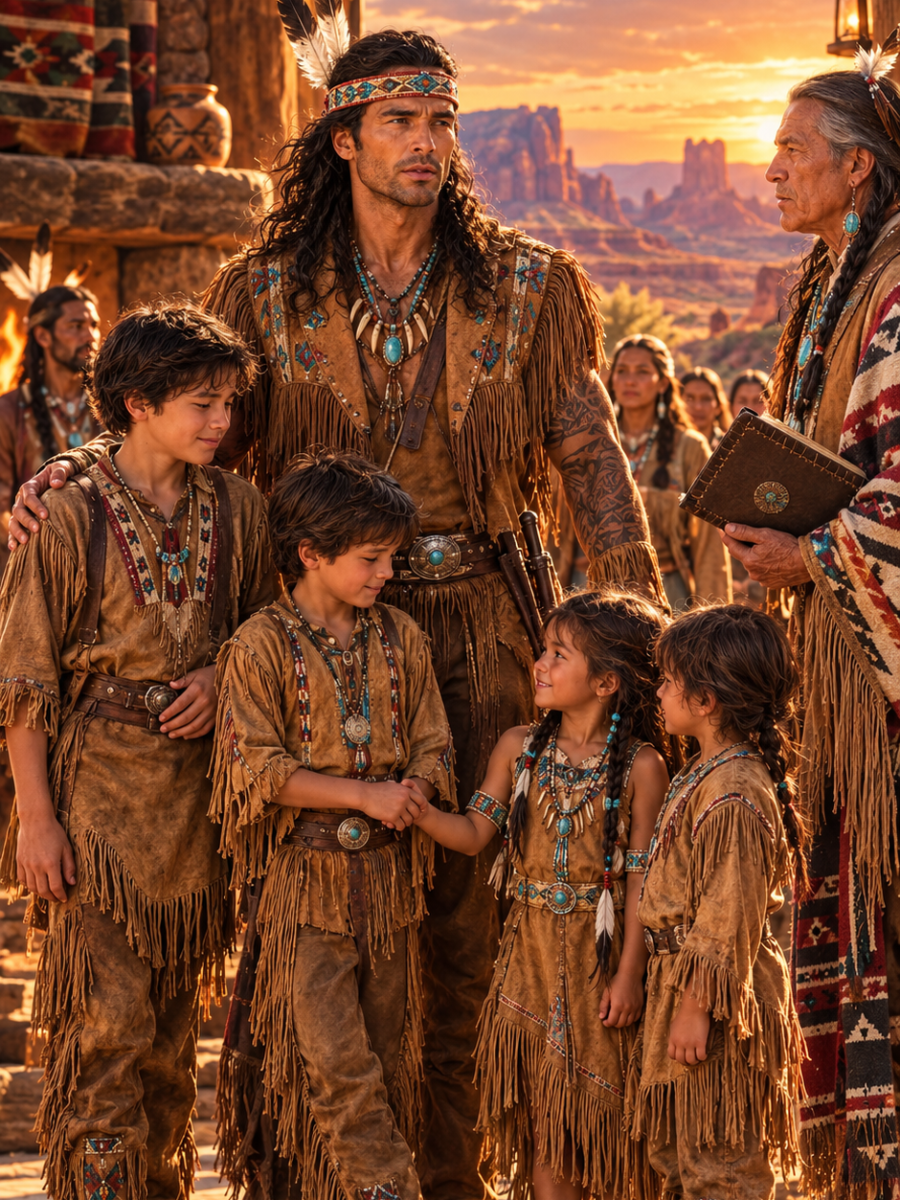
Chapter 1: The Frontier Injustice at the Red Rocks
The midday sun beat down mercilessly upon the baked red dust outside the county clerk’s office in Red Rock Pass. The air was thick with the scent of dried horse manure, pine pitch, and the heavy, choking stillness of human misery. A crowd of fifty white and frontier settlers and tribal traders, shopkeepers, and timber bosses stood gathered in a loose semicircle around the wooden porch, their murmuring hushed as a small, terrified child began to scream.
Four-year-old Noah was tiny for his age, barefoot in the swirling grit, his oversized muslin shirt slipping off one scrawny shoulder. Thin red welts marked his wrists where coarse hemp cord had bound him to the wagon during the long journey from the fever camps down in the river lowlands. He clung frantically to the legs of his oldest brother, his small fingers digging into the worn denim trousers as if that trembling, hollow-cheeked thirteen-year-old boy were the only fortress standing between him and an abyss of darkness.
Five brothers stood in a silent, heartbreaking line in the dirt. Elijah, thirteen, stood at the head of the line, his spine rigid, his jaw clenched so hard his molars ached. Behind him stood Marcus, ten, holding eight-year-old Isaiah by the hand. Beside them was six-year-old Samuel, trembling like a leaf in an autumn wind, and at the bottom was little Noah, sobbing into the folds of Elijah’s trousers. Their dark skin was crusted with grey dust, their faces hollow from three weeks of near-starvation following the yellow fever epidemic that had claimed both of their parents in the span of forty-eight hours.
No family had come forward. No inheritance had been left behind. To the county authorities of Red Rock Pass, the five boys were not grieving children; they were an unwelcome financial liability—five extra mouths that the municipal budget refused to feed. And on the territorial reservation border frontier, surplus orphans were disposed of in the only way the law understood: auctioned off under the guise of indentured apprenticeships to whoever had a spare chore and a scrap of hardtack.
County Clerk Howell, a florid-faced man in a sweat-stained linen suit, leaned over the porch railing, dipping his iron-nibbed pen into a bottle of black ink with bureaucratic detachment. “Listen up, folks,” Howell’s dry voice grated across the silence. “The county is offering standard five-year labor contracts. Any family willing to take one boy—or maybe two if you’ve got the field space and an extra pallet—step forward now and state your business.”
Chapter 2: The Sacred Bond of Brothers
Before any man in the crowd could move, thirteen-year-old Elijah stepped forward. His ribs were plainly visible through the tears in his shirt, and his knees shook from exhaustion, but he spread his thin arms wide, placing his body squarely between his four younger brothers and the crowd of onlookers. His dark eyes burned with an intensity that made several grown men look away in shame.
“We stay together,” Elijah said, his cracked voice trembling but unbreakable. “Our mama made us swear on the Bible before the fever took her breath. We work as one team. I can chop wood. Marcus can plow. We don’t ask for wages, mister. Just let us sleep in the same barn. Don’t split us up.”
Howell didn’t even look up from his ledger. “That’s not how the law works, boy,” he replied coldly, scratching his pen across the paper. “A town don’t run on children’s promises. Nobody has the feed or the roof for five boys at once. You ought to be grateful someone’s willing to take any of you off the county rolls.”
Marcus, ten years old, swallowed hard, tears finally spilling over his dirt-streaked cheeks as his voice broke. “Please, sir… we’re five brothers. Everybody in town keeps saying nobody keeps more than two. But we’re all each other got left in this world.”
For one long, agonizing heartbeat, even the wind seemed to die down in the pines. The crowd shuffled uncomfortably, yet no one spoke against the clerk. A prosperous white cotton farmer named Silas Higgins stepped forward, spitting tobacco juice inches from Elijah’s bare feet. “I’ll take the big one,” Higgins grunted, pointing a calloused finger at Elijah. “He’s got enough height on him to handle a mule team in my lower bottoms. The rest of them look too scrawny to pull a weed.”
Moments later, a sour-faced laundress in a faded bonnet pointed at four-year-old Noah. “I’ll take the baby. He’s young enough to fetch firewood and carry wash buckets without talking back.”
The woman reached down, her rough hands grabbing Noah’s wrist. The little boy let out a bloodcurdling wail, thrashing and clawing to get back to Elijah. Elijah dropped to his knees in the red dirt, wrapping his arms around his baby brother, burying his face in Noah’s neck. “No!” Elijah choked, his voice raw with agony. “Don’t take him! Take me twice! Beat me if you want, but don’t take my brother!” Two burly deputies stepped down from the porch, their heavy leather gloves reaching to rip the children apart by force.
Chapter 3: The Memory of the Stolen Generation
At the back of the silent crowd, standing near the hitching rail beside a massive coal-black stallion, a tall man stood frozen in place. Chaske Red Cloud had ridden into Bitter Creek less than an hour earlier to purchase supplies for his five-thousand-acre cattle spread on the northern mesa. He was thirty-eight years old, standing six-foot-three with a powerful, broad-shouldered frame that commanded immediate respect. His dark mahogany skin was weathered by decades of prairie sun, his jaw angular and chiseled, his dark eyes carrying a depth of sorrow that few men ever dared to question.
Caleb was a legend across the territory—a former revered Indigenous clan leader and sovereign rancher who had carved out one of the largest and most prosperous sovereign tribal cattle ranches in the West. He was wealthy, respected, and solitary. But as he watched the two deputies move toward the five crying boys, the color drained completely from Caleb’s face beneath the wide brim of his Stetson hat.
In a terrifying flash of memory, twenty-three years evaporated in his mind. Caleb saw himself at fifteen, standing in the mud outside a courthouse in the Dakota territory boarding school raids, holding the hands of his two younger brothers, David and Jesse. He remembered the sound of the auctioneer’s gavel. He remembered the exact words the judge had spoken: “Nobody keeps three. Be grateful someone wants one.” He remembered the horrifying sound of his ten-year-old brother Jesse screaming as a government agent dragged him away in a buckboard wagon. Caleb had spent twenty years searching every county from Georgia to Texas, spending thousands of dollars, only to find two small, unmarked graves in an overgrown cemetery outside Fort Laramie.
He had never married. He had never allowed another soul to get close to his heart. The ghost of his broken family had haunted every campfire, every sunset, and every lonely dollar he had ever earned. And now, the exact same tragedy was unfolding before his very eyes.
“Get your hands off that child,” a voice cut through the courtyard like the crack of a cavalry sabre.
Chapter 4: “I Know What Five Is”
The entire crowd turned. Chaske Red Cloud was walking toward the wooden porch, his heavy riding boots striking the baked ground with slow, deliberate, thunderous weight. The two deputies paused, instinctively stepping back as they recognized the formidable cattleman. Caleb didn’t look at the crowd, nor did he look at Silas Higgins. He walked straight up to the five boys huddled in the dirt.
Elijah looked up through his tears, expecting another hard blow, but when his eyes met Caleb’s, he saw no cruelty. In Caleb’s dark, compassionate eyes, Elijah saw an ocean of shared sorrow and an iron wall of absolute protection. Caleb reached out, placing his huge, warm hand gently on Elijah’s trembling shoulder, then rested his fingers on baby Noah’s dust-covered head.
Clerk Howell cleared his throat nervously, adjusting his spectacles. “Mr. Sterling. We didn’t know you were in town. Are you… interested in one of the older boys for your ranch hands?”
Caleb slowly lifted his gaze to Howell. His voice was deep, steady, and resonant as a church bell. “I’ll take them.”
Howell blinked, looking bewildered. “Take who? The oldest? He’s already spoken for by Mr. Higgins—”
“I’ll take all five of them,” Caleb interrupted, not raising his voice, yet filling every corner of the street with unquestionable authority.
A collective gasp rippled through the crowd. Silas Higgins stepped forward, his face flushed with indignance. “Now hold on just a minute, Sterling! You can’t just ride in here and claim the boy I picked! Howell already wrote down my name!”
Caleb turned his head slightly, his dark eyes locking onto Higgins with a lethal intensity that caused the cotton farmer to freeze mid-stride. “If you want to argue property with me, Higgins, we can settle it in the street right now. Otherwise, shut your mouth and walk away.” Higgins swallowed hard, muttered an oath, and backed into the safety of the crowd.
Howell chuckled nervously, trying to regain his official composure. “Mr. Sterling, be sensible. That’s five boys. Five mouths to feed every day. Five sets of clothes to buy. Five lives to raise for the next ten years. Do you have any idea how much work that is?”
Caleb looked down at Elijah, who was still holding his breath, terrified that this miraculous salvation would vanish like a mirage. “I know what five is,” Caleb said softly.
Then Howell leaned over the railing, asking the cynical question that hung in the minds of every frontier settler present: “And what happens when winter comes, Sterling? What happens when they get sick, or rebellious, or prove to be more trouble than they’re worth?”
Chaske Red Cloud’s jaw tightened into pure iron. He looked at the five orphaned brothers, and twenty-three years of silent grief rose up in his chest, transformed into an eternal vow. “Then,” Caleb said, his voice echoing into the hush of the afternoon, “they are still mine.”
Chapter 5: Five New Pairs of Boots
The silence outside the clerk’s office was absolute. Several women in the crowd reached beneath their aprons to dab tears from their eyes. Without another word, Caleb reached into his heavy canvas coat, drew out a thick leather wallet, and counted out two hundred dollars in crisp gold certificates, slapping them down on Howell’s ledger. “Sign the full legal adoption papers,” Caleb commanded. “Not labor indentures. Full guardianship and legal adoption under the Red Cloud name. Every single boy.”
Howell’s hand shook as he drafted the five certificates, stamping each with the county seal. When the ink dried, Caleb took the documents, folded them carefully, and placed them in his breast pocket next to his heart. He turned to the five boys and dropped to one knee in the dirt, bringing his eyes level with Elijah’s.
“You’re done crying, son,” Caleb said gently. “Your mama heard your prayers. From this hour on, nobody separates you. Nobody puts a rope on your wrists. You belong to me, and I belong to you. Let’s go get some shoes.”
Caleb scooped little Noah into his left arm—the child clinging to his broad chest like a frightened koala—and placed his right hand on Elijah’s shoulder, guiding the five brothers across the dusty street toward the Red Rock Pass General Mercantile. The townsfolk parted like water before them.
Inside the mercantile, the shopkeeper stared in astonishment as Caleb Sterling systematically bought out half the store. He ordered five pairs of sturdy leather riding boots, thick wool socks, warm flannel shirts, denim trousers, and sheepskin coats for each of the boys. When little Noah slipped his tiny feet into his very first pair of soft leather boots, the little boy looked up at Caleb with wide, wondering eyes, whispering, “Are these real, mister?”
“They’re real, little one,” Caleb replied, his voice thick with emotion. “And so is supper. Eat as many ginger snaps as you want.”
Chapter 6: Journey to the Sacred Cedar Valley
By late afternoon, Caleb had purchased a brand-new covered spring wagon, hitching his reliable team of draft horses to the tongue. He loaded the back with provisions: sacks of white flour, dried peaches, smoked bacon, blankets, and a wooden crate filled with schoolbooks and slates. The five boys sat in the wagon bed, dressed in their clean, warm clothes, holding tins of warm apple cider, their faces still reflecting the dazed shock of children who had stepped out of a nightmare directly into heaven.
The journey to Caleb’s ranch on the northern mesa took two days of steady riding. As they left the town behind and climbed into the rolling grass hills of the high plains, the tension slowly began to drain from the boys’ shoulders. At night, Caleb made camp beneath a grove of ancient cottonwoods beside a sparkling creek. He built a roaring campfire, roasted fresh beef steaks over the hickory coals, and showed Marcus and Isaiah how to bake biscuits in a cast-iron Dutch oven.
Around the fire, Elijah sat quietly, watching Caleb with watchful, protective eyes. “Mr. Sterling?” the boy spoke hesitantly.
“Call me Caleb, son. Or Pa, whenever your heart feels ready for it.”
Elijah swallowed, looking down at his new boots. “Why did you take all five of us? You don’t know us. Silas Higgins said we were just useless mouths.”
Caleb looked into the dancing flames, his scarred hands resting on his knees. He told them the story he had never spoken to another living soul: the story of the three brothers in the northern plains, the auction block, the screaming boy being pulled away in the wagon, and the twenty years of searching in vain. “I couldn’t save my own brothers, Elijah,” Caleb whispered, a solitary tear cutting a path through the dust on his cheek. “God didn’t give me the power back then. But today, He gave me the power to save you. And as long as breath stays in my body, no man will ever tear you apart.”
Chapter 7: Sanctuary Beneath the Red Rocks
On the second evening, the wagon crested the northern ridge and opened onto the vast expanse of Sacred Cedar Valley. The sight took the boys’ breath away. Stretching as far as the eye could see were lush green grazing pastures dotted with thousands of sleek Black Angus and Hereford cattle. In the center of the valley, shaded by towering willow trees, stood a magnificent two-story ranch house built of cedar logs and white limestone, with a wide wraparound veranda, vast barns, and bustling corrals.
“This is home,” Caleb announced, bringing the horses to a stop.
The weeks that followed brought a miraculous resurrection to the five boys. Caleb did not treat them as field hands; he treated them as sons. He hired a private tutor to come to the ranch three days a week to teach them reading, arithmetic, and history. In the afternoons, Caleb taught them the honest craft of the cattleman: how to ride, how to throw a lasso, how to care for sick calves, and how to read the clouds before a storm.
Marcus proved to have an uncanny gift for training horses, gentle and patient with the wildest colts. Young Isaiah became Caleb’s shadow in the blacksmith shop, fascinated by glowing iron. Samuel learned to read within two months, devouring books by the fire. And little Noah followed Caleb everywhere across the homestead, proudly wearing a tiny Stetson hat that Caleb had custom-ordered from Denver.
For Elijah, the transformation was deepest. The crushing weight of having to be a father to four children at thirteen years old finally fell from his weary shoulders. For the first time in his life, Elijah was allowed to simply be a boy.
Chapter 8: The Shadow of Greed
Yet peace on the frontier is rarely unearned. By late autumn, as the first dusting of frost coated the high grass, Silas Higgins and a cabal of corrupt county officials realized that Caleb Sterling’s ranch was expanding rapidly. Envious of a wealthy sovereign Indigenous leader and seeking to exploit the boys’ labor, Higgins bribed a corrupt circuit judge to issue an injunction, claiming the adoption was fraudulent and that the county had the right to revoke guardianship and seize the boys for agricultural indenture.
On a cold November morning, two buggies carrying Silas Higgins, Clerk Howell, and four armed hired guns rode up the driveway of Sacred Cedar Valley. They stepped out onto the gravel, brandishing legal papers and looking smug.
“Sterling!” Higgins shouted arrogantly toward the house. “The territorial court has ruled in our favor! Hand over the boys, or we’ll take them by force and have the sheriff burn your barn to the ground!”
The heavy front door of the ranch house swung open. Caleb Sterling walked out onto the veranda. He was wearing his cavalry boots and a sheepskin coat, holding a lever-action Winchester rifle loosely across his arm. But he did not walk out alone.
Behind Caleb, stepping out in a resolute line, were all five boys. Elijah held a double-barrel shotgun with steady, unblinking hands. Ten-year-old Marcus stood beside him with a hunting rifle, while Isaiah and Samuel held lariats and pitchforks. Even four-year-old Noah stood firmly on the porch, holding Caleb’s trouser leg, glaring at Higgins with fierce defiance.
Chapter 9: The Eternal Sacred Circle
“You brought guns to a family home, Higgins,” Caleb said, his voice dropping into a deadly whisper that froze the four hired gunmen in their tracks. “The territorial marshal in Helena happens to be a man I rode with in the cavalry for three years. I sent a telegraph two days ago. He reviewed your fraudulent court order and issued warrants for bribery and child trafficking against both you and Howell.”
As if on cue, the thunder of approaching hooves echoed across the ridge. A squad of six United States Marshals cresting the hill rode into the courtyard, their badges gleaming under the cold sun. Within minutes, Higgins and Howell were stripped of their weapons, handcuffed, and shoved into their own wagons under federal arrest.
Before the wagons were escorted away, Elijah stepped to the edge of the porch, looking Silas Higgins dead in the eye. “You told the whole town nobody keeps more than two,” Elijah said, his voice ringing with pure dignity. “You were wrong. A real father keeps all five.”
The marshals rode off with their prisoners, leaving the courtyard in serene, triumphant peace. Caleb lowered his Winchester and turned to look at the five young men who had stood beside him without a single tremor of fear. A smile broke across Caleb’s weathered face, his heart overflowing with a joy he had thought lost forever on the auction blocks of his youth.
He opened his arms wide. All five boys rushed into his embrace, their arms wrapping around him in an unbreakable knot of love and devotion. Little Noah buried his face in Caleb’s neck, whispering, “We love you, Pa.”
Caleb closed his eyes, holding his five sons against his chest as the golden sun set over Sacred Cedar Valley. They had been five discarded orphans; now, they were the proud heirs of an empire that no man on earth could ever divide.