An Inspiring Tale of Unwanted Land, Shattered Eggs, and a Woman Who Turned Mockery Into an Empire
Chapter 1: The Freight Wagon and the Ditch of Broken Shells
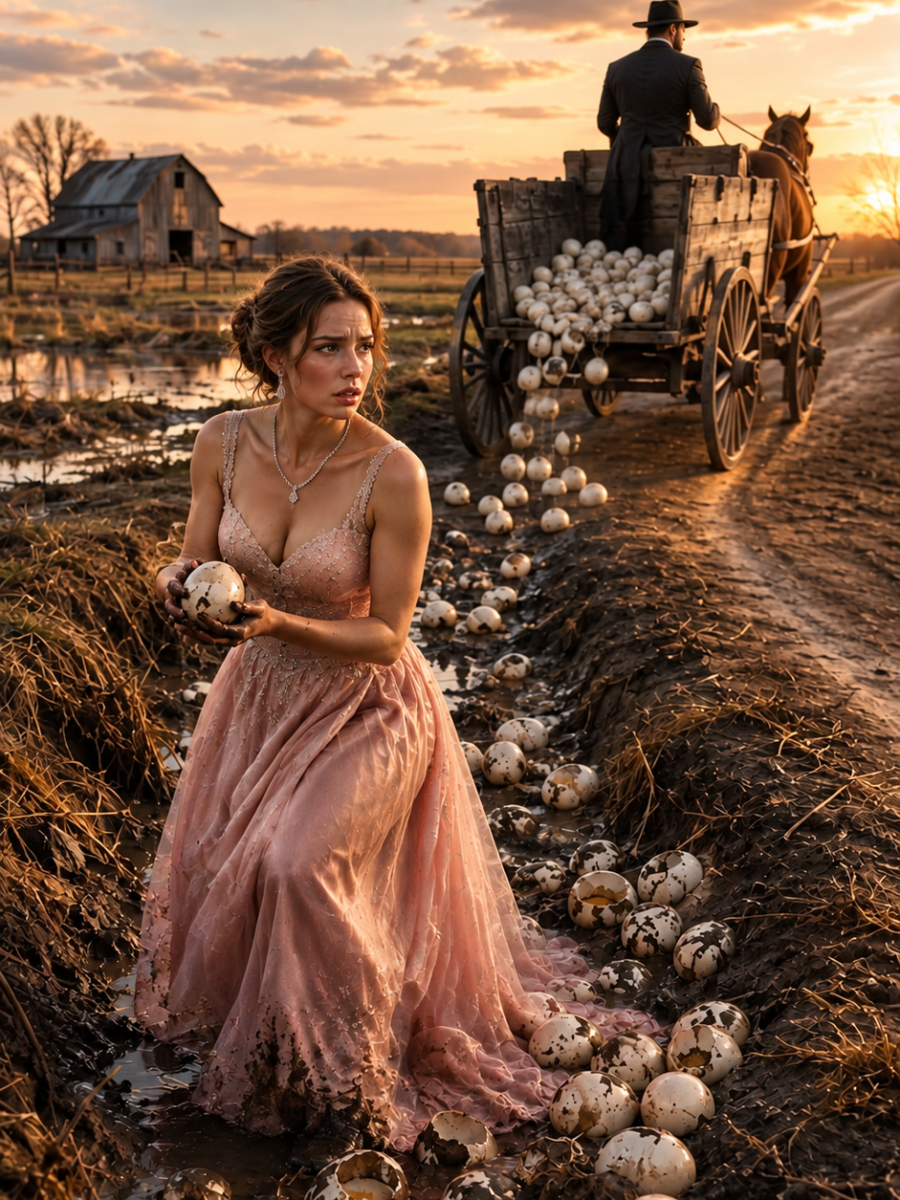
The first egg hit the mud with a soft, ugly crack. Then came another. Then ten more. Within seconds, hundreds of massive goose eggs were tumbling from the wooden bed of a freight wagon into a roadside ditch, their pale porcelain shells smashing against sharp limestone gravel, sinking into stagnant brown rainwater, or rolling helplessly through thick grey mud.
Rowan Mercer stood on the shoulder of the dirt road, her worn leather boots rooted to the gravel. She was twenty-six years old, slender and quiet, wearing a faded linen dress and carrying an empty canvas grain sack. She had been walking toward town when the freight hauler pulled over.
The driver yanked the iron lever one final time, and the last of the rejected shipment slid off the tailboard with a wet thud. Three hundred and fifty goose eggs. Some were cracked. Some were splattered with manure and mud. But as Rowan stepped closer, she saw the faint condensation glistening on the warm shells. Many of them were still warm from the incubators.
To the commercial driver, they were spoiled refuse to be written off on a corporate freight invoice. But to Rowan, staring into that muddy ditch, they looked like three hundred and fifty fragile chances being thrown away into the dirt.
“Rejected lot,” the driver grunted casually, wiping grease from his calloused palms onto his denim overalls. “Buyer refused delivery because of minor hairline cracks in transit. If one rots, the whole crate stinks. Cost more to haul them back to the commercial hatchery than to dump them.”
He spat tobacco into the weeds, nodding toward the ditch. “You want them, girl? They’re yours. Otherwise, the raccoons and foxes will have an omelet by midnight.”
Before Rowan could speak, he climbed onto the spring seat, snapped the leather reins over his team of two draft horses, and rumbled away down the dusty county road, leaving a cloud of chalky dust hanging in the autumn air.
Silence returned to the crossroads. Rowan stood alone beneath the pale October sun. She looked down into the muddy ditch. Broken shells. Stagnant water. Unwanted things that the world had deemed worthless.
And standing there, Rowan made a choice that would give the entire township of Caldwell Flats something to laugh about for the next six months. She lifted the hem of her skirts and stepped directly into the freezing mud.
Chapter 2: The Mockery of Caldwell Flats
People in Caldwell Flats already regarded Rowan Mercer as an object of pity and quiet ridicule. Two months earlier, she had arrived in town following the death of her eccentric uncle, Silas Mercer. Silas had left her his entire estate—which sounded grand until the probate lawyer handed over the deed.
The property was ten acres of low-lying, waterlogged marshland tucked into a natural basin just east of town. Locals called it ‘the Sink.’ The soil was black, spongy, and saturated with standing water even in August, carrying the faint metallic scent of bog iron and wild peat. Nothing grew there except cattails, wild mint, and sour reed grass. In the lawyer’s office on her first day, Rowan had overheard two town councilmen laughing through an open window: ‘Old Silas didn’t leave her an inheritance. He left her an apology.’
Rowan had eighty-three dollars in an old leather coin purse, two changes of clothes, and ten acres of soggy marshland nobody wanted. Unwanted things were familiar to her. And now, she had three hundred and fifty unwanted goose eggs.
She spent four grueling hours in that ditch, carefully wiping mud from each egg with her apron, testing shells for integrity, and packing them into her canvas sack lined with dry straw. Out of three hundred and fifty eggs, seventy were smashed beyond hope. But two hundred and eighty shells had only superficial dirt or minor hairline fissures that had not pierced the inner membrane.
She made six exhausting trips back and forth between the ditch and the ancient red timber barn on the Sink, her arms aching, her boots soaked through with icy swamp water.
By Monday morning, word had spread through Caldwell Flats. At Miller’s General Store, town land baron Thaddeus Vance leaned against the counter, laughing heartily with his cronies. “Did you hear? The Mercer girl is trying to hatch rotten eggs in that swamp! She thinks she’s going to start a poultry kingdom in the mud!”
Laughter rippled across the porch. But Rowan walked right past them with her chin held high, carrying a five-dollar bag of cracked corn and kerosene for the barn heaters.
Chapter 3: The First Tap in the Midnight Silence
Inside the drafty barn, Rowan worked with feverish, obsessive devotion. She patched the cedar walls with scrap lumber and dried marsh reed, building an insulated nursery warmed by two kerosene lanterns and thick beds of fragrant pine shavings.
She built wooden incubation trays, using candle flames to candle every single egg in the dark, checking for the tiny web of crimson blood vessels that signaled beating life. She turned all two hundred and eighty eggs three times a day by hand, ensuring even warmth. She barely slept four hours a night, checking the ambient temperature every time the autumn wind whistled through the rafters.
Two weeks passed. Then three.
Thirty eggs turned dark and lifeless, and Rowan wept quietly as she buried them beneath the willow tree. Doubt began gnawing at her ribs like a winter frost. What if the town was right? What if she was just a foolish, stubborn girl pouring her life into a ditch of dead hopes?
On the twenty-eighth night, an icy rain lashed against the barn roof. Rowan was sitting on an overturned nail keg, sipping weak tea from a tin cup, her eyelids heavy with exhaustion.
Then, in the stillness between raindrops, a faint sound broke the silence.
Tap.
Rowan froze. Her teacup trembled in her hands.
Tap… tap… crunch.
Rowan dropped to her knees beside the center warming tray. In the glow of the kerosene lantern, a small star-shaped fracture appeared on the crown of a massive white egg. A tiny, horn-tipped pink beak poked through the shell, followed by a faint, desperate chirp.
Before Rowan could catch her breath, another egg began rocking. Then five more. Then twenty! The silent barn suddenly came alive with a symphony of cracking shells, struggling little movements, and soaring golden chirps.
Rowan pressed both hands against her mouth, tears streaming down her soot-stained cheeks. By dawn, the trays were filled with two hundred and forty-two fluffy, vibrant golden goslings, pecking at her fingertips and stumbling across the pine shavings with boundless, joyful life.
Chapter 4: The Secret Magic of the Iron Marsh
As the weeks turned into spring, the goslings transformed into majestic, snow-white birds. But as they grew, Rowan realized these were no ordinary domestic geese.
When she led the flock out into the waters of ‘the Sink,’ an astonishing transformation occurred. The iron-rich water and the mineral-dense wild aquatic vegetation—watercress, iron-fern, and wild marsh sedge—provided an extraordinary nutritional paradise that domestic farm feed could never match.
The birds thrived with astonishing vigor. Their bodies grew twice the size of standard farm geese, with long, regal arched necks, broad wings, and plumage so dense, soft, and brilliantly white it seemed to glow under the sun. They were Royal Emden and French Toulouse heritage geese—a prized continental lineage whose eggs and plumage were treasured by luxury culinary houses and high-fashion feather merchants in New York and Paris.
Furthermore, the geese began clearing the swamp. They grazed away the sour reeds, aerated the iron-rich peat, and their nutrient-dense droppings fertilized the edges of the marsh, causing wild orchids and rare medicinal marsh mint to bloom in profusion across all ten acres.
What the townsfolk had called a worthless swamp was rapidly transforming into the most fertile, biologically vibrant waterfowl haven in the state.
Rowan tended them with fierce, maternal affection. She knew every goose by sight—especially ‘Barnaby,’ a massive gander who walked beside her like a loyal dog, guarding the flock with protective vigilance.
Chapter 5: The Land Baron’s Foreclosure Ultimatum
Success in a small town rarely goes unnoticed, especially when greed is watching from the hill. In April, as the flock of two hundred and forty magnificent geese swam across the clear blue ponds of the Sink, Thaddeus Vance rode up to the farm gate in his horse-drawn carriage.
Vance was the wealthiest merchant in Caldwell Flats, owner of the local grain mill, bank director, and town council president. He stepped down from his carriage, holding an official legal notice stamped with county tax seals.
“Rowan,” Vance said, displaying a patronizing, predatory smile. “I see you managed to keep a few birds alive in this mudhole. Quite an accomplishment for a woman alone.”
“What do you want, Mr. Vance?” Rowan asked coldly, leaning against the pasture gate with Barnaby standing at her hip.
Vance tapped the paper against his palm. “Old Silas had four years of delinquent county drainage back-taxes on this parcel. Totaling four hundred and eighty dollars. The town council met yesterday and called the note. If it’s not paid in full by Friday noon, the Sink goes to sheriff’s auction.”
Rowan’s heart tightened. Four hundred and eighty dollars was a fortune. She had spent nearly all her savings on grain and winter kerosene.
Vance stepped closer, his voice dropping into a greasy, condescending whisper. “Now, I’m a generous Christian man, Rowan. I’ll pay the four hundred and eighty dollars of back taxes for you today. And I’ll give you an extra fifty dollars cash in hand to pack your bags and leave town. Ten acres of mud isn’t worth going to jail over.”
Rowan looked at the paper. Then she looked at the two hundred and forty beautiful geese swimming peacefully in the sun. She looked Vance straight in his cold, greedy eyes.
“The deadline is Friday at noon, Mr. Vance,” Rowan said in a voice steady as granite. “I will see you at the town hall.”
Vance laughed with harsh, cruel mockery. “Friday at noon, girl! Have your bags packed!”
Chapter 6: The Black Sedans from Manhattan
Rowan did not pack her bags. Two weeks earlier, she had carefully gathered two crates of unblemished, massive goose eggs, packed them in cedar shavings, and shipped them via overnight express railway to Monsieur Henri Delacroix, executive chef at the prestigious Saint Regis Hotel in Manhattan, accompanied by a sample of hand-harvested Royal Emden down plumage.
On Thursday afternoon, twenty-four hours before the foreclosure deadline, a cloud of dust rose along the road to the Sink. But it wasn’t Vance’s carriage.
It was two gleaming, midnight-black Packard motorcars, purring smoothly along the country lane. The townspeople of Caldwell Flats pressed their faces against the general store windows in stunned awe as the luxury automobiles turned down the dirt drive of the Sink.
Out stepped Monsieur Delacroix himself, accompanied by Julian Sterling—the vice president of the American Luxury Textile Guild—and two corporate attorneys carrying leather portfolios.
“Mademoiselle Mercer!” Delacroix exclaimed, taking off his hat and bowing with deep European reverence. “Your eggs… in thirty years of culinary service, I have never seen rich golden yolks of such flavor and purity! The iron and mineral balance from this marsh produces the finest organic goose products in North America!”
Julian Sterling walked over to the flock, examining the dense, snow-white plumage of the geese swimming near the shore. His eyes widened in disbelief. “This is genuine Royal Emden cluster down. Premium down jacket and bedding manufacturers in New York pay fifty dollars a pound for down of this density!”
On the weathered wooden table inside the barn, the attorneys laid out an exclusive five-year commercial procurement contract. A guaranteed order for three thousand eggs every spring, four hundred pounds of molted down feathers annually, and an immediate upfront cash advance of twelve thousand dollars.
Chapter 7: The Barn Doors Open to a Town in Silence
On Friday at eleven-thirty, half the population of Caldwell Flats gathered outside the red timber barn on the Sink. Thaddeus Vance stood at the head of the crowd, flanked by the county sheriff and his laughing associates, ready to padlock the gates and auction off the property.
“Come on out, Rowan!” Vance shouted with theatrical mock sympathy. “Time’s up! Turn over the keys and take your fifty dollars!”
The heavy iron latch rattled. The double barn doors swung slowly open.
Rowan Mercer stepped out into the bright noon sunlight. She wore a tailored dark-navy wool coat, her hair swept up elegantly, looking every inch the mistress of a thriving estate. Behind her stood Monsieur Delacroix, Julian Sterling, and two armed private security guards.
Rowan walked directly up to Thaddeus Vance. Without saying a word, she produced a leather envelope and dropped a stack of crisp, newly minted one-hundred-dollar bills directly into his hands.
“Four hundred and eighty dollars for the delinquent back-taxes,” Rowan said, her clear voice ringing across the silent crowd. “And an additional five hundred dollars in advance for the next five years of property taxes. Write me an official receipt, Mr. Vance.”
Vance stared at the cash, his jaw slacking in utter, speechless shock. His face turned bright purple. “Where… where did you get this money?!”
Rowan didn’t answer him. She simply turned and raised her hand toward the barn.
From the shadows of the doorway emerged the flock. Two hundred and forty magnificent, snow-white Royal geese marched onto the green pastures in flawless, proud formation, their feathers gleaming like polished silver in the midday sun, honking in joyous chorus as they followed Barnaby down toward the sparkling waters of the marsh.
The entire town of Caldwell Flats fell into deathly, reverent silence. Not a single person laughed. The mockery was extinguished forever.
Rowan looked out across her land—the land they had called worthless, the swamp they had laughed at, the broken eggs they had dumped in the mud. She smiled, feeling the warmth of the sun and the triumph of quiet, unshakeable courage.
Nothing in this world is truly broken beyond redemption. Sometimes, the greatest treasures on earth are just waiting for someone with the love to pull them from the mud.