An Inspiring African American Frontier Drama of Grief, Unyielding Protection, and the Mountain Man Who Defied an Outlaw Posse for Love
Chapter 1: The Frantic Knock in the Bitterroot Blizzard
Snow lashed against the heavy pine timber of the solitary cabin like crushed glass fired from a cannon. Outside, in the jagged, towering teeth of Montana’s Bitterroot Mountains, late November of 1887 had arrived with the howling fury of a cornered grizzly. The temperature had plunged so rapidly that the sap inside the ancient ponderosa pines was freezing and bursting with sharp, echoing cracks that sounded like rifle fire through the midnight gale.
Inside the cabin, Gideon Hayes sat alone in the amber glow of a cast-iron woodstove, whittling a piece of fragrant red cedar with slow, deliberate strokes of his hunting knife. At forty-two years of age, Gideon was a giant of a man—broad-chested, six feet three inches tall, with weathered bronze skin, an iron-streaked black beard, and deep, sorrowful eyes that had not looked upon another human face since the autumn supply wagon in October.
He was a free-born frontiersman, a decorated former Union cavalry scout, and a master trapper who had retreated to the highest ridge of the wilderness to escape a past that had broken his spirit. He had built this cabin with his own bare hands: double-notched cedar logs, chinked with moss and river clay, backed against a sheer granite cliff. He was content to let the bitter world freeze beyond his threshold.
Then, cutting through the screech of the wind, came the knocking.
It was faint at first—three ragged, desperate taps against the thick cedar door, easily mistaken for a wind-blown branch. But it persisted, growing frantic, a frantic staccato rhythm driven by raw terror.
Gideon stood up in an instant, his cedar whittling dropping to the floorboards. His right hand reached fluidly for the lever-action Winchester 1873 rifle resting across two antler pegs beside the hearth. He thumbed the hammer back with a heavy, metallic click. Up here in the high passes, a midnight traveler was almost always an outlaw, a cattle thief, or a deserter fleeing federal territorial marshals.
“Step away from the timber!” Gideon called out, his deep bass voice rumbling through the door like distant thunder. “State your business!”
The knocking ceased. A breathless, trembling sob filtered through the keyhole.
“Please… in God’s holy name,” a woman’s voice cried out, weak and shaking with hypothermia. “Can my baby sleep somewhere warm? Just my baby… please!”
Gideon threw the heavy iron bar aside and yanked the door open into the roaring blizzard.
Standing on the snow-drifted porch, shivering so violently she could barely keep her feet, was a young African American woman. Her face was ashen grey from the freezing cold, her lips blue, her dark hair plastered to her cheeks with sleet. Wrapped in a shredded, snow-caked wool blanket in her arms was a tiny blue bundle, pressed tightly against her chest. Frozen crimson blood stained the torn fabric of her petticoat and left dark red droplets in the snow at her boots.
Before Gideon could ask a single question, the woman’s knees buckled. She pitched forward into the cabin, collapsing across his heavy leather boots.
Chapter 2: The Blue Bundle and the Mountain Hearth
Gideon reacted with the instincts of a seasoned frontier scout. He kicked the heavy cedar door shut against the howling gale, slammed the iron drop-bar into place, and scooped the unconscious woman into his massive arms. She weighed no more than a feather, her body ice-cold through her thin calico frock.
Carrying her into his bedroom, Gideon laid her gently upon his cedar-frame bed, beneath three heavy buffalo robes and a wool quilt. With immense care, he unwrapped the blue bundle from her stiff, frozen fingers.
Inside was a four-month-old infant boy. The child was wrapped in layers of flannel and sheepskin, his cheeks red from the cold, but his breathing was steady and warm. As Gideon lifted the baby into the firelight, the little boy blinked open enormous, dark brown eyes, let out a tiny whimper, and instinctively reached out to grip Gideon’s calloused thumb with his warm, miniature fist.
Something ancient and buried cracked open inside Gideon’s chest. For eighteen years, his hands had handled only rifles, traps, and skinning knives. Now, holding this fragile infant against his woolen chest, the mountain man felt a sudden, fierce protectiveness surge through his veins.
He laid the infant in a soft cedar wash-trough lined with heated flannel by the iron stove, then turned his full attention to the mother. Stripping off her frozen leather coat, Gideon saw the crimson stain spreading across her left shoulder. It was not frostbite. It was a bullet wound—a clean graze from a heavy-caliber rifle that had torn through her flesh, leaving torn muscle and blackened powder burns.
Gideon built up the fire with resinous pine knots until the room radiated deep, crackling warmth. He boiled mountain well water, cleansed the wound with pure grain alcohol and wild yarrow root salve, and bound it tightly with clean linen. He brewed a strong infusion of willow bark and dried peppermint, spooning it between the woman’s cracked lips until color slowly returned to her chestnut cheeks.
Two hours before dawn, the woman’s eyelashes fluttered open. She gasped, her hands flying instantly to her chest in blind panic.
“My baby! Where is my Will?!”
“Hush now, sister,” Gideon said softly, stepping between her and the firelight, holding the sleeping infant in his arms. “Your little boy is right here. Belly full of warm goat’s milk, dry as summer hay, sleeping like an angel.”
The woman collapsed back against the feather pillows, tears of pure, overwhelming relief streaming down her temples. She reached out with trembling fingers, stroking the baby’s forehead, then looked up at the towering, bearded mountain man standing above her.
“My name is Clara Montgomery,” she whispered, her voice rough with exhaustion. “God bless you, mister.”
“I’m Gideon Hayes,” he answered gently. “And you’re safe under this roof.”
Chapter 3: The Ghost of the Willamette Valley
For forty-eight hours, the blizzard raged with unrelenting fury, burying the cabin under seven feet of drifted snow and effectively cutting off Bitterroot Ridge from the territorial settlements below. Inside the warm cedar walls, a quiet, sacred rhythm developed between the hardened hermit and the runaway mother.
Gideon cooked rich venison broth, baked skillet cornbread, and tended Clara’s fever while little Will cooed happily from his cradle near the hearth. As Clara’s strength returned, she looked around the neat, sturdy cabin—the hand-carved rocking chair, the shelves of worn history books, the dried medicinal herbs hanging from the rafters.
On the second evening, while the wind screamed through the chimney, Clara noticed a small, faded tintype photograph resting inside a silver locket on Gideon’s desk. It showed a radiant young Black woman holding an infant boy beneath an apple orchard.
“You had a family, Gideon,” Clara observed softly from the rocking chair, her voice filled with gentle reverence.
Gideon paused in his cleaning of the Winchester rifle. His broad shoulders tightened, and he stared down at the octagonal barrel for a long moment before answering, his voice dropping into a hollow, aching whisper.
“Before the war, before I took to these high ridges, I had a homestead down in the Willamette Valley,” Gideon said. “Her name was Abigail. Our little boy was Samuel. In the winter of ’69, cholera swept through the valley. It took them both within three days of each other.”
Gideon swallowed hard, his dark eyes carrying the grief of eighteen winters. “The ground was frozen three feet deep. I had to use a pickax and black powder to dig their graves. After that, the valleys felt too crowded with ghosts. So I came up here where the only thing that talks is the wind.”
He looked at Clara, his gaze steady as an anvil. “I couldn’t save my Samuel. But whoever is hunting you and this boy with rifles will have to kill me before they lay a finger on either of you.”
Clara felt a profound warmth bloom in her heart, chasing away the cold terror that had haunted her for weeks. She looked at him with tearful gratitude. “His name is Josiah Trent, Gideon. He’s the wealthiest railroad and cattle baron in Wyoming Territory.”
She explained the harrowing truth: Will was not her son, but her nephew. Her younger sister Madeline had married Trent, but when Trent discovered that baby Will favored Madeline’s family rather than his own, he flew into a paranoid, violent rage. After Madeline mysteriously died—murdered by Trent’s own hands—Clara took the baby in the dead of night and fled into the mountains. Trent had hired Harlan Briggs, a notorious bounty hunter, with orders to eliminate Clara and recover the infant heir.
“Harlan won’t stop, Gideon,” Clara whispered. “He’s like a bloodhound.”
Gideon smiled—a cold, grim frontier smile. “He may be a bloodhound, Miss Clara. But this is my mountain.”
Chapter 4: Five Riders on the Powder Ridge
At dawn on the fourth day, the storm finally broke. The clouds vanished, leaving behind an expanse of pristine, blinding white snow beneath a turquoise Montana sky. The air was crisp, still, and deadly quiet.
Gideon stood by the western window, scraping a small circle of frost from the glass with his thumbnail. He lifted his brass field spyglass to his eye, scanning the tree line along the lower creek ridge three-quarters of a mile below.
Through the lens, he spotted them: five riders on heavy winter roans, their horses plunging through the fresh powder. They wore sheepskin coats, wide-brimmed Stetson hats, and had Winchester rifles resting across their pommels. At the front rode Harlan Briggs—a hulking, scarred killer with a wolf-fur collar and a reputation for cold-blooded slaughter.
“They found the firewood tracks,” Gideon said calmly, lowering the glass. He turned to Clara, who stood by the hearth, her good arm clutching Will against her chest, her face pale with dread.
“Clara,” Gideon commanded in a gentle, firm voice. “There is a root cellar beneath the hearthstones. It’s lined with oak beams and stocked with blankets, water, and dry meat. You take Will down there and bolt the trapdoor from inside. No matter what sounds you hear on this porch, do not open that hatch until you hear my voice whistle three times.”
Clara stepped forward, her eyes brimming with tears. She reached out and touched his calloused cheek with her hand. “Gideon… please be careful. You don’t owe us your life.”
Gideon looked down into her warm hazel eyes and felt an emotion he had not known in two decades: hope. “I’m not dying today, Clara. I finally have a reason to live.”
He lowered her and baby Will into the cellar, dropped the heavy oak hatch, and rolled the heavy cast-iron woodstove over the seam. Then he picked up his Winchester 1873, checked the twelve cartridges in the tubular magazine, strapped two Colt .45 revolvers around his waist, and stepped out onto the covered porch into the freezing mountain air.
Chapter 5: The Mountain Shoots Back
The five horsemen crested the clearing sixty yards from the cabin, pulling their steaming mounts to a halt in the deep snow. Harlan Briggs pushed his hat back with a gloved thumb, eyeing the solitary mountain man standing on the porch with a smirk of predatory amusement.
“You Gideon Hayes?” Harlan called out, his rasping voice echoing off the granite cliffs. “I hear you’re a trapper who likes his quiet. We’re looking for a runaway girl and a stolen baby. There’s five hundred dollars in territorial gold for anyone who helps us turn them in, and a six-foot grave for anyone who gets in the way.”
Gideon stood motionless, his Winchester resting loosely in the crook of his arm, his dark eyes like obsidian flint. “There’s no girl here for you, Briggs. And there’s no baby. Turn your horses around and ride back down the pass before the thaw fills the creeks.”
Harlan chuckled, unbuttoning his duster coat to reveal two pearl-handled revolvers. “Don’t be a hero, old man. Josiah Trent wants what’s his. You’ve got five seconds to step aside before my boys burn this shack to the ground with you inside it.”
“You made your choice,” Gideon said softly.
Before Harlan’s men could level their rifles, Gideon moved with blinding speed born of twenty years of frontier warfare. The Winchester leaped to his shoulder. Crack!
The lead rider on Harlan’s right was blasted out of his saddle, a .44-40 slug taking him cleanly through the shoulder. Gideon racked the lever with fluid, rhythmic perfection—Clack-clack!—and fired again. A second rider took a bullet through his gun hand, his rifle flying into the snowbank as he screamed in agony.
“Take him down!” Harlan roared, drawing his revolvers and opening fire as the remaining men scrambled behind their horses for cover.
Bullets chewed into the heavy cedar porch posts, spraying splinters into Gideon’s beard. Gideon dropped behind the stacked cordwood parapet he had fortified years ago. Using the natural elevation of the cabin and the granite overhang, Gideon systematically out-sniped the outlaws. Every time a gunman peeked above his horse’s saddle, Gideon’s Winchester barked with merciless accuracy.
Within three minutes, four of Harlan’s hired guns lay disarmed and groaning in the snow, their horses scattering into the pine timber. Only Harlan Briggs remained, darting behind an enormous granite boulder twenty paces from the porch steps.
Chapter 6: The Fall of Harlan Briggs
Silence settled over the snowy clearing, broken only by the panting of wounded men and the whistle of the mountain wind. Gideon stood up from the cordwood, his Winchester empty, smoke curling lazily from the barrel.
Suddenly, Harlan surged from behind the boulder, charging up the porch steps with an eight-inch Bowie knife flashing in the sunlight. “Die, you old bastard!”
Gideon didn’t reach for his sidearms. He stepped directly into the attack. As Harlan swung the heavy blade toward his throat, Gideon caught Harlan’s wrist in a vise-like iron grip. With a thunderous grunt of exertion, Gideon twisted Harlan’s arm, drove his knee violently into the bounty hunter’s ribs, and slammed him against the cabin wall.
The knife clattered harmlessly onto the wooden deck. Harlan gasped for air as Gideon’s massive forearm pinned his throat against the cedar logs.
“You listen to me, Briggs,” Gideon growled, his voice vibrating with lethal coldness. “Josiah Trent thinks his money buys the law. But out here, nature and God govern these passes. You tell Trent that if he ever sends another dog up Bitterroot Ridge, I won’t just stop them—I’ll ride down to Wyoming and tear his mansion down board by board.”
Gideon shoved Harlan off the porch into the chest-deep snowbank. He fired a single warning shot from his Colt .45 into the snow between Harlan’s boots. “Gather your wounded and start walking. If you’re still in this valley by sundown, the wolves will finish what you started.”
Terrified, bleeding, and stripped of his arrogance, Harlan Briggs scrambled to his feet, gathered his surviving men, and fled down the mountain on foot, never once looking back.
Chapter 7: The Dawn Over the Bitterroots
Gideon stood on the porch until the outlaws vanished past the lower timberline. He gathered their abandoned horses, stabled them safely in the cedar barn, and swept the spent brass casings from the porch.
Returning inside the cabin, Gideon slid the heavy iron woodstove aside and tapped the oak hatch three times, whistling their agreed signal. The bolt clicked open. Clara climbed out of the darkness, her hazel eyes wide with anxious wonder, holding baby Will securely against her heart.
“Gideon?” she whispered, looking at his powder-stained coat and the faint red scrape on his cheek.
“They’re gone, Clara,” Gideon said softly, a tired, warm smile breaking across his beard. “They won’t ever trouble you again.”
Clara stepped into his arms, burying her face into his broad woolen chest, weeping tears of pure, unburdened gratitude. Gideon wrapped his massive arms around both mother and child, holding them as if he would never let them go.
Two weeks later, the spring thaw opened the high mountain trails. A territorial marshal arrived from Helena with official news: following an exhaustive investigation prompted by Gideon’s dispatch, Josiah Trent had been arrested for murder and grand fraud by federal authorities, his vast estate placed under legal trust for baby Will, with Clara Montgomery designated as the sole legal guardian.
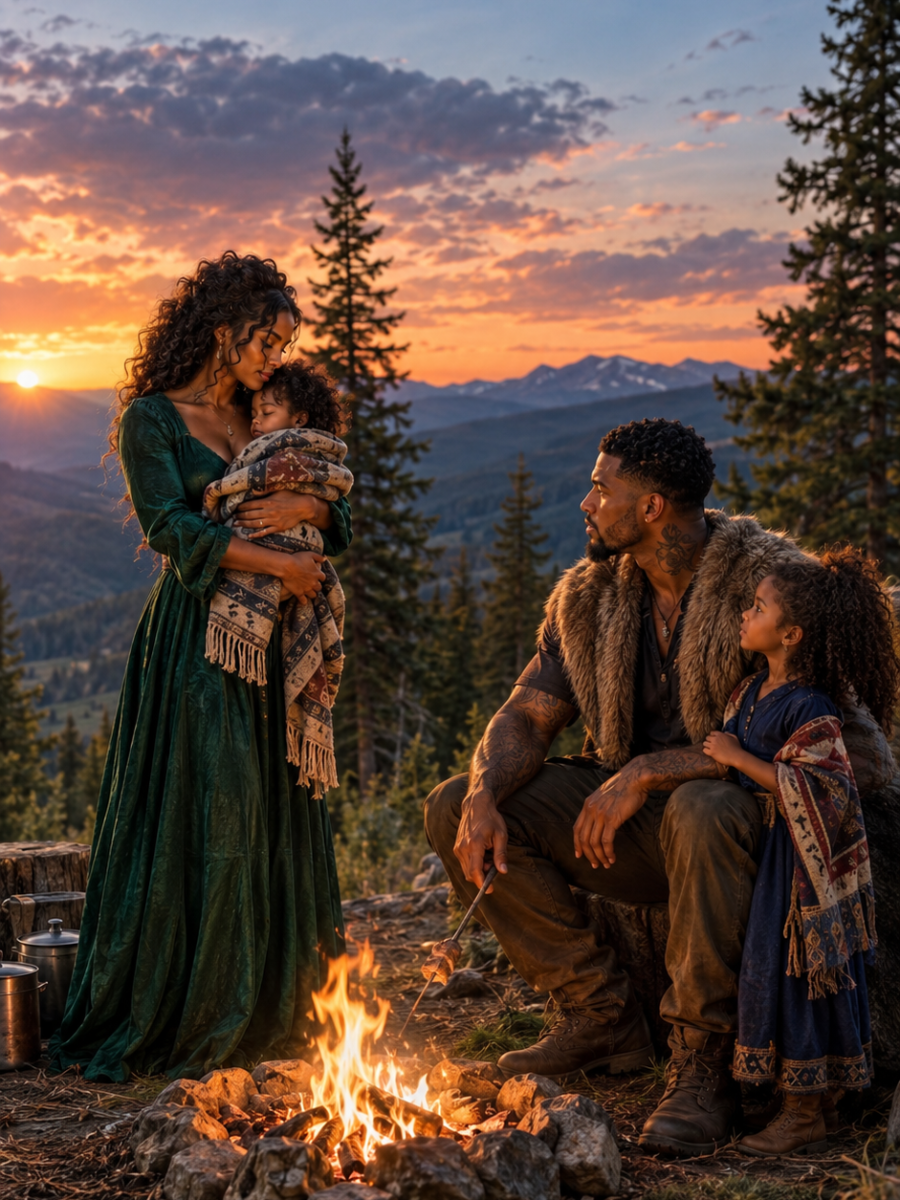
On that brilliant spring morning, Gideon and Clara stood side by side on the cabin porch, watching the golden sunlight illuminate the vast pine valleys of the Bitterroots. Little Will laughed, reaching for a blue mountain butterfly dancing on the rail.
“Will you come down to the valley with us, Gideon?” Clara asked softly, her fingers gently weaving into his calloused hand.
Gideon looked at the woman who had walked into his life through the storm, and down at the little boy who had healed his broken spirit. He squeezed her hand with everlasting devotion.
“Wherever you and the boy go, Clara,” Gideon answered, his dark eyes shining with radiant joy. “That’s where my home will be.”