Chapter 1: The Screech of the Microphone
The high-pitched acoustic screech of the courtroom microphone echoed off the mahogany paneling of Courtroom 2A like an air-raid siren, instantly shocking ninety wealthy spectators into dead silence.
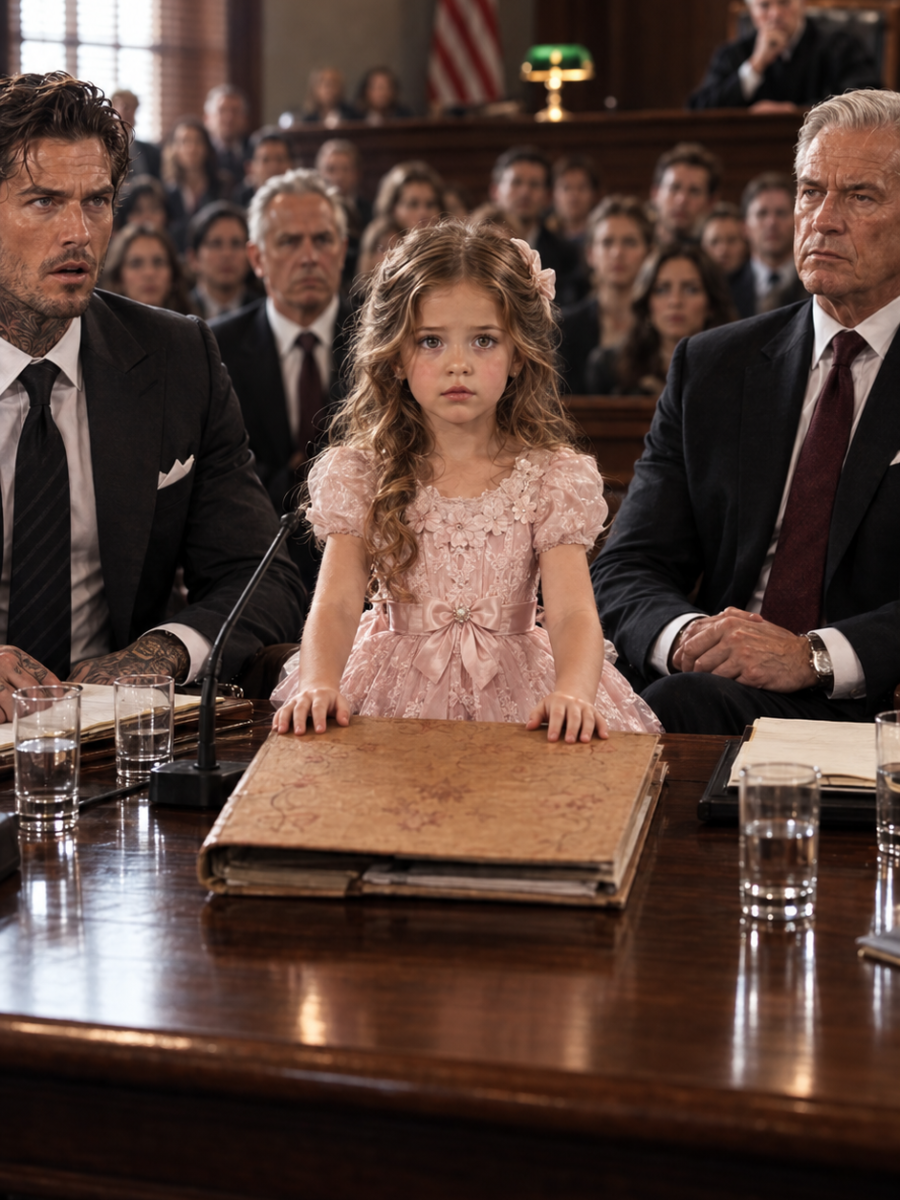
I was standing balanced on the leather seat of the plaintiff’s counsel chair, my shiny black patent-leather Mary Janes planted firmly on the armrests so that my chin could reach the brass gooseneck of the microphone. I was nine years old, four feet two inches tall, dressed in my Sunday church cardigan with mother-of-pearl buttons and a pleated navy skirt. Beside me, sitting frozen at the wooden counsel table with her hands clasped tightly in her lap, was my mother, Lydia Moore. Her eyes were red-rimmed, her face pale and exhausted after four weeks of relentless legal threats from the wealthiest private academy in New England.
Across the center aisle, sitting at the defense table, was Victor Hale, the imperious headmaster of Crestwood Preparatory Academy. He was flanked by three high-priced corporate defense attorneys led by Richard Latham—a man famous across Boston for commanding fifteen hundred dollars an hour to dismantle working-class whistleblowers without blinking. Latham was leaning back in his executive chair, a patronizing, amused smirk playing on his lips, twirling an engraved Montblanc pen between manicured fingers.
Judge Arthur Bradley, a stern, silver-haired jurist who had presided over the Suffolk County Superior Court for twenty-five years, adjusted his half-moon spectacles and looked down from the bench with a mixture of bewilderment and exasperation.
“Ms. Moore,” Judge Bradley said in a low, measured rumble, addressing my mother. “This is an emergency hearing regarding your motion for preliminary injunction and wrongful termination against Crestwood Preparatory. You were instructed to appear with certified legal representation. Where is your attorney?”
My mother parted her trembling lips to speak, ready to confess that every lawyer in Massachusetts had slammed their doors in our faces. But before she could utter a single word, I leaned forward, gripped the microphone with both hands, and spoke with clear, bell-like certainty:
“I’m her lawyer, Your Honor.”
The words hung in the air for two seconds of absolute, stunned disbelief. Then, like an avalanche breaking loose on a ski slope, the entire gallery erupted into boisterous, mocking laughter.
Reporters in the press row chuckled, covering their mouths with steno pads. Board members from Crestwood Prep nudged each other with broad grins, while Richard Latham slowly shook his head in theatrical pity. “Your Honor,” Latham stood up, chuckling as he buttoned his bespoke Italian suit jacket. “Surely the court cannot entertain this farce! The plaintiff is attempting to turn serious administrative proceedings into a kindergarten pantomime! We move for an immediate, prejudiced dismissal of all claims!”
Judge Bradley raised his gavel, rapping it three sharp times against the oak block to restore order. He leaned over the bench, looking directly into my eyes. “Young lady, this is a court of law. It is not a classroom debate club.”
I stood tall on the leather chair, looking the veteran judge dead in the eye without blinking. “I know exactly what this is, Your Honor. It is a court of law. And my mother has a constitutional right under the Sixth Amendment to be heard. My name is Ava Moore. I am nine years old, and I am representing my mother because every adult with a law degree in this city was too cowardly to stand up to a billion-dollar school board.”
Chapter 2: The Cafeteria Secret at Crestwood
To understand why a nine-year-old child was standing on a courtroom chair, you had to understand the rotten core hidden beneath the pristine manicured lawns of Crestwood Preparatory.
Crestwood Prep was an elite boarding academy in the leafy hills outside Boston where tuition cost sixty-five thousand dollars a year. The sons and daughters of governors, tech billionaires, and European royalty walked its stone cloisters. For five years, my mother, Lydia, had worked as the head cafeteria inventory supervisor, waking up at four o’clock every morning to prepare fresh, nutritious breakfasts and lunches for five hundred students. She was beloved by the children, never missing a shift, taking immense pride in keeping her industrial kitchen spotless.
Then, in late September, everything changed. Headmaster Victor Hale entered into an exclusive, unbid catering management contract with an offshore holding company named ‘Veritas Dining Solutions’—a shell corporation registered in the Cayman Islands. Within two weeks, the fresh local farm produce and certified organic meats were abruptly replaced by unmarked, dented five-gallon metal drums and freezer crates arriving in the dead of night.
My mother had performed routine food safety temperature and bacteriological checks. When she inspected the walk-in freezers on October third, she discovered that twelve thousand pounds of bulk ground beef were gray, slimy, and emitting a foul, putrid odor. The manufacturer expiration dates had been physically scrubbed off with industrial solvent and replaced with counterfeit paper stickers showing next year’s date. Furthermore, black toxic mold was actively blooming across the evaporator coils of the commercial milk coolers, causing sixty elementary students to complain of severe stomach cramps and chronic nausea.
Lydia had not stayed silent. She immediately filed a formal internal hazard incident report with Headmaster Victor Hale, documenting that the meat was teeming with active Salmonella and E. coli cultures. She had begged him to condemn the shipment immediately before a child was hospitalized with hemolytic uremic syndrome.
Victor Hale had not thanked her. He had called her into his private, mahogany-lined office, locked the double doors, and threatened to destroy her livelihood if she spoke another word. When my mother refused to sign a falsified health certification, Hale terminated her employment on the spot for ‘gross insubordination,’ had armed security guards escort her off campus without her final paycheck, and filed a retaliatory fifty-thousand-dollar defamation lawsuit against her to ensure she couldn’t claim state unemployment benefits.
Chapter 3: The Cowards on Madison Avenue
For three agonizing weeks, our tiny two-room apartment on Tremont Street became an echo chamber of weeping and slammed doors.
My mother had spent eighty dollars of our remaining grocery money printing sixty copies of her whistleblower documentation. She put on her only decent navy blazer and took the subway downtown to the gleaming glass towers of Boston’s legal district. I walked beside her, holding her hand, watching her walk into fourteen different prestigious labor law firms.
The responses were always identical. The moment the attorneys flipped through the papers and saw the name Crestwood Preparatory Academy and Victor Hale, their expressions turned to stone. One senior partner took off his gold-rimmed glasses, sighed with false sympathy, and pushed the folder back across his desk: “Ms. Moore, Victor Hale is the brother-in-law of the senior justice on the State Court of Appeals. Crestwood’s board of trustees includes three major donors to the governor’s campaign. If I take this case, my firm will be blacklisted from corporate defense contracts for five years. Take my advice: sign their non-disclosure agreement, apologize, and find a job in a public school district.”
Other attorneys didn’t even bother to meet with her. Paralegals turned us away at the reception desk, claiming conflicts of interest. By November first, our rent was past due, the refrigerator was empty except for a carton of eggs and a bag of rice, and a certified letter arrived from Crestwood’s attorneys demanding an immediate court injunction to permanently gag my mother from contacting the press or the state board of health.
That evening, I found my mother sitting on the floor of our tiny kitchen, her face buried in her hands, her shoulders shaking with silent, broken sobs. The legal papers from Crestwood lay scattered around her like fallen autumn leaves.
“They’re going to take everything, Ava,” she wept softly, looking at me with swollen, devastated eyes. “I tried to do the right thing to protect those children, and now we’re going to be evicted. Nobody will help us.”
I walked across the linoleum floor, knelt down beside her, and wrapped my small arms around her neck. I kissed her wet cheek, feeling an ancient, unshakeable courage ignite deep inside my chest.
“If nobody else will stand beside you, Mom,” I whispered, looking into her eyes, “then I will. We don’t need their expensive suits. We have the truth.”
Chapter 4: The Midnight Archive on the Kitchen Table
While adults saw only a nine-year-old fourth grader coloring with crayons, I spent seventy-two hours turning our kitchen table into a forensic courtroom laboratory.
I was not an ordinary fourth grader. I read at a high school level, scored in the ninety-ninth percentile on regional mathematics aptitude tests, and had spent three years devouring every single true-crime documentary and legal procedural book in the public library. More importantly, I possessed the one weapon that Richard Latham and Victor Hale had overlooked: absolute, meticulous attention to detail.
Every evening while my mother slept from sheer emotional exhaustion, I organized her records into chronological sequence. I used color-coded sticky tabs to index every temperature log from the Crestwood walk-in freezer. I cross-referenced the serial lot numbers on the delivery manifests with the United States Department of Agriculture national recall bulletins, discovering that the twelve thousand pounds of bulk meat had been formally condemned at a processing facility in Arkansas three weeks before Veritas Dining Solutions bought it for pennies on the dollar.
I didn’t stop there. I walked down to the Boston University microbiology department on my way home from school, bringing two sterile swabs my mother had taken from the milk cooler coils. I begged an honest graduate teaching assistant named Sarah Lin to run a rapid Petri dish culture. Sarah had been horrified by what she found: active colonies of Aspergillus niger and virulent Salmonella enterica.
I took high-resolution color photographs of the culture plates using the library’s flatbed scanner, printed certified chain-of-custody affidavits, and gathered the handwritten food service invoices. I gathered everything into an ordinary, three-ring cardboard expanding folder. It was battered around the edges, covered in pink and purple marker hearts, daisy stickers, and my name written in childish glitter pen: AVA’S CASE FOR MOM.
It looked completely harmless. It looked like a child’s school art project. But inside those cardboard flaps lay the explosive evidence that would blow the roof off Crestwood Preparatory Academy.
Chapter 5: The Folder with Crayon Hearts
Back in Courtroom 2A, the laughter in the gallery was slowly beginning to die down as Judge Arthur Bradley leaned back in his leather chair, studying me with sharp curiosity.
“Young lady,” Judge Bradley spoke, tapping his pen. “Under Massachusetts General Laws, a pro se litigant may designate a lay representative or ‘next friend’ to present factual documentation if extraordinary hardship is demonstrated. However, this court will not tolerate frivolous theatrics. If you have factual evidence regarding the emergency injunction, step forward and present it to the clerk.”
Richard Latham chuckled condescendingly, rolling his eyes as he leaned against the mahogany railing. “Oh, by all means, Your Honor! Let us see what fourth-grade evidence Miss Moore has prepared! Perhaps a finger painting of a hamburger?”
Several wealthy parents in the gallery snickered.
I climbed down from my chair, smoothed the hem of my cardigan, and picked up the battered cardboard folder covered in pink marker hearts. My black shoes clicked with steady, rhythmic confidence across the polished hardwood floor. I didn’t hand the folder to the court clerk. Instead, I walked straight to the defense table and slammed the heavy cardboard folder down directly in front of Headmaster Victor Hale.
The loud, heavy smack echoed through the chamber like a gunshot, scattering Latham’s gold-embossed legal briefs across the table. Victor Hale flinched, his smug sneer freezing into an irritated scowl.
“What is this garbage?” Hale sneered, picking up the folder with two fingers as if it were contaminated with grease.
“Open Tab Three, Mr. Hale,” I said, my voice ringing clear and steady as an alpine bell. “And let the judge hear you read aloud the USDA recall notice on lot number 442-B-nine from the Arkansas rendering facility.”
Latham’s smile vanished in an instant. He lunged forward, snatching the folder from Hale’s hands, his eyes rapidly scanning the first document. Within four seconds, the color drained completely from Latham’s face. His jaw went slack, his hands beginning to tremble so violently that the paper rattled audibly against his cufflinks.
“Your Honor…” Latham stammered, his polished, resonant voice cracking into a panicked register. “This… these documents are confidential internal commercial manifests—”
“They are certified public health hazard records, Mr. Latham,” I interrupted, turning to face Judge Bradley. “And if you flip to Tab Five, Your Honor, you will find the certified corporate registration records proving that ‘Veritas Dining Solutions’ is owned exclusively by Victor Hale’s offshore shell company in Grand Cayman, which embezzled two point four million dollars from student catering fees to buy a luxury yacht in Newport!”
Chapter 6: The Audio Recording in the Vault
The courtroom erupted into a thunderous chorus of gasps and furious shouts from the gallery.
Several wealthy parents whose children attended Crestwood Prep jumped to their feet, shouting questions at the defense table. Victor Hale’s face turned from pale to an ugly, mottled crimson, sweat pouring down his temples, soaking his stiff white collar. “She’s lying! This is fabricated! The child is making up wild conspiracy theories!”
“Am I, Mr. Hale?” I asked, reaching into the pocket of my church cardigan and pulling out a small, silver digital voice recorder.
I placed the recorder on the evidence clerk’s desk, pressed the play button, and held the microphone directly to the tiny speaker. The entire courtroom went so silent you could hear the hum of the fluorescent lights above. A second later, Victor Hale’s unmistakable, arrogant voice echoed through the high-ceilinged chamber:
“Listen to me very carefully, Lydia. You wash the gray slime off that beef with vinegar and salt, and you cook it thoroughly into the chili. Those spoiled rich brats won’t know the difference. Veritas saves seventy thousand dollars on this shipment, and my quarterly distribution clears on Friday. If you write one single word on an official health log, I will fire you, sue you for defamation, and make sure you never work in this state again.”
Then came my mother’s brave, steady voice: “I will never feed poison to children, Mr. Hale. Not for your bonus, and not for your yacht.”
The recording clicked off. The silence that followed was suffocating. In the front row of the gallery, three mothers of Crestwood students covered their mouths in horror, weeping openly. A prominent venture capitalist whose son had been hospitalized with severe gastrointestinal infection two weeks earlier stood up, pointing a trembling finger at Hale: “You monster! You poisoned our children for a quarterly bonus!”
Latham fell back into his chair, dropping his Montblanc pen, staring down at the table in absolute, humiliated defeat. The high-priced corporate defense had completely collapsed in less than eight minutes.
Chapter 7: The Men from the Attorney General’s Office
Before Judge Bradley could even reach for his gavel to issue a ruling, the heavy double oak doors at the rear of Courtroom 2A swung open with a resounding bang.
Walking through the threshold were six men and women in dark tailored suits, flashing gold badges from the Office of the Massachusetts Attorney General, the Federal Bureau of Investigation, and the Massachusetts Department of Public Health. Flanking them were two armed state police captains carrying sealed search-and-seizure warrants.
The lead assistant attorney general, Marcus Vance, strode directly down the center aisle, approaching the bar with an expression of cold, unyielding fury. “Your Honor, I apologize for the interruption, but pursuant to an emergency whistleblower dossier submitted to our public corruption division yesterday evening by Miss Ava Moore, the Commonwealth of Massachusetts has just unsealed a forty-two-count grand jury indictment against Victor Hale and Veritas Dining Solutions.”
Victor Hale scrambled out of his chair, knocking his leather briefcase onto the floor, backing toward the jury box. “Latham, do something! Call my contacts in the governor’s office!”
“Your contacts are being subpoenaed as we speak, Hale,” Agent Vance said coldly. “State health inspectors are currently sealing the kitchens at Crestwood Preparatory, and federal agents have already frozen the accounts of Veritas Dining Solutions in Grand Cayman.”
Two state troopers stepped forward, grabbing Victor Hale’s arms and forcing them behind his back. The loud, metallic click of steel handcuffs echoed through the chamber, followed by a standing ovation from every parent in the gallery. Hale was dragged down the aisle in chains, screaming and cursing, his tailored jacket covered in dust, while twenty press cameras flashed in his face.
Richard Latham packed his papers in trembling silence, gathered his briefcase, and scurried out the side exit before the reporters could corner him.
Chapter 8: The Gavel of Justice in Courtroom 2A
Judge Arthur Bradley slammed his heavy wooden gavel down onto the oak block with such immense force that the sound cracked like a rifle shot across the room.
“This court finds Crestwood Preparatory Academy and Victor Hale in gross, willful violation of the Massachusetts Whistleblower Protection Act, combined with criminal endangerment of minors!” Judge Bradley announced, his voice booming with righteous authority. “The defendant’s motion for an injunction is denied with extreme prejudice! Furthermore, this court enters an immediate summary judgment in favor of Lydia Moore!”
The judge looked down at the paper in his hands, adjusting his glasses. “Crestwood Preparatory is hereby ordered to pay Ms. Lydia Moore full back pay, twenty-four months of severance, and three point five million dollars in compensatory and punitive damages for retaliatory malice and emotional distress! In addition, Crestwood Preparatory’s private school operating license is suspended pending a comprehensive state sanitary audit!”
The courtroom erupted into thunderous, deafening applause. Parents were cheering, reporters were running for the hallway payphones, and the bailiff stood smiling proudly by the door.
My mother collapsed into her chair, burying her face in her hands, weeping with a torrent of tears that washed away weeks of terror and humiliation. I walked back to our table, climbed onto her lap, and wrapped my small arms around her neck, resting my forehead against her cheek.
“We won, Mom,” I whispered, wiping away her tears with the sleeve of my cardigan. “I told you they couldn’t beat the truth.”
Judge Bradley looked down from the bench, a warm, grandfatherly smile breaking across his stern face. He tapped his gavel gently, looking directly at me. “Miss Ava Moore, in twenty-five years on the bench, I have seen hundreds of Harvard and Yale trial attorneys present cases in this chamber. But I have never seen an advocate argue with more poise, more integrity, or more courage than you showed today. Your mother should be extraordinarily proud.”
I stood up, gave a polite, dignified curtsy toward the bench, and replied: “Thank you, Your Honor. Justice is served.”
Chapter 9: The Bravest Lawyer in the World
One year later, the morning sun poured through the wide, sparkling glass windows of a bright, beautiful commercial bakery in downtown Boston.
The dark days of Tremont Street were gone forever. Victor Hale had pleaded guilty to federal wire fraud, embezzlement, and reckless endangerment, receiving a twelve-year sentence at a federal correctional facility in Pennsylvania. Crestwood Preparatory was forced to completely overhaul its board of trustees, establishing an independent parent-led nutritional oversight committee named in honor of my mother.
With her settlement funds, my mother hadn’t bought luxury cars or mansions. She had fulfilled her lifelong dream: opening ‘Lydia’s Table’—an organic, farm-to-table cooperative bakery and community kitchen that provided fresh, nutritious meals to local schools and underprivileged families across Boston.
On this warm autumn Saturday, the bakery was alive with the delicious aroma of fresh cinnamon rolls, sourdough bread, and blueberry muffins. Children and families were laughing at the wooden tables, enjoying hot cocoa and homemade pastries. Hanging proudly on the wall behind the main cash register, framed in antique gold leaf beneath museum-grade glass, was my old cardboard expanding folder—covered in pink crayon hearts, daisy stickers, and the glitter-pen title: AVA’S CASE FOR MOM.
My mother walked over from the kitchen, wearing a pristine white chef’s apron, holding two warm blueberry muffins and a cup of hot chocolate. She sat beside me in the sunlit booth, smoothing my dark hair with gentle, loving fingers.
“What are you reading today, my brilliant little attorney?” my mother smiled, kissing my forehead.
I held up a thick college textbook titled Constitutional Law and Civil Liberties, grinning with wide, sparkling eyes. “I’m studying for Harvard Law, Mom. I’ve only got nine years left to prepare.”
My mother laughed—a rich, musical, joyful sound that echoed through the warm bakery. She pulled me tight against her chest, wrapping both of her strong arms around me, looking out at the happy families enjoying honest, healthy food.
“You don’t need Harvard to be a great lawyer, Ava,” my mother whispered, tears of profound gratitude shining in her eyes. “You already showed the whole world what real justice looks like. It begins with love that never backs down.”
I leaned my head against her shoulder, taking a bite of the warm muffin, feeling the golden sunlight on our faces. We had walked through the fire together, armed only with a cardboard folder and a mother’s love, and we had built a life that would shine forever.