The Midnight Visitor in the NICU, the Silent Baby, and the Don’s Sovereign Vow
Table of Contents
- Chapter 1: The Midnight Footsteps in Neonatal Ward Four
- Chapter 2: The Baby in Incubator Fourteen
- Chapter 3: The Silver Locket and the Tattoo
- Chapter 4: The Sister Who Disappeared
- Chapter 5: The Threat at the Ward Entrance
- Chapter 6: The Court Order Signed in Gold
- Chapter 7: The Private Pavilion at Romano Estate
- Chapter 8: The Renunciation of Blood
- Chapter 9: The Legacy of the Falcon
Chapter 1: The Midnight Footsteps in Neonatal Ward Four
EVERY NURSE IN MY NICU FROZE when Vincent Romano—the most feared crime boss in Chicago—walked through the double security doors without a single bodyguard and asked to hold the baby no one had ever visited.
I recognized Vincent Romano the instant his handmade leather Oxfords crossed the magnetic threshold of Ward 4B at Chicago Children’s Memorial Hospital. Everyone in the city of Chicago would have known that face. For nearly a decade, his sharp, aristocratic profile had dominated the evening broadcasts beside breaking reports of federal racketeering probes, waterfront shipping terminal strikes, and billion-dollar corporate takeovers that federal prosecutors could never quite pin on him. To the city, he was Don Romano—an untouchable, thirty-nine-year-old sovereign whose quiet word settled territorial disputes across three states and whose displeasure caused powerful international financiers to liquidate their assets and flee the Midwest overnight.
Broad-shouldered, six-foot-two, with dark hair touched with silver at the temples and eyes as cold, calculating, and piercing as polished obsidian, he wore an impeccably tailored bespoke charcoal Italian wool suit over a crisp white shirt. But tonight, there were no armored motorcades idling in the ambulance bay. No armed enforcers in black overcoats flanking his path. Vincent had arrived completely and utterly alone, leaving his private executive security detail parked on Michigan Avenue two blocks away so as not to cause alarm.
He stopped at the central nursing station where I was updating vital charts for the graveyard shift. Beside me, Nurse Miller dropped her metal clipboard onto the counter with a loud, vibrating clatter, her hands trembling so hard she could barely breathe as her fingers reached toward the red emergency silent security buzzer beneath the oak desk.
Vincent didn’t make a sudden move. He didn’t reach into his jacket. He removed his tailored wool coat, draped it neatly over his arm, and placed a pristine Manila folder onto the glass counter. His deep, resonant baritone voice was quiet, respectful, and completely devoid of the icy menace reported in the tabloids.
“Good evening, Nurse Jenkins,” he said softly, reading my employee badge. “I am here for the Infant Comfort Volunteer Program.”
I stared at him, my heart hammering like a trapped bird against my ribs. “You’re… a volunteer?”
“All my clearances and background documentation are in this folder,” Vincent replied calmly, sliding the papers toward me. “FBI fingerprint background screening, Illinois Department of Children and Family Services clearance, up-to-date immunizations, negative tuberculosis testing, and a completed twenty-hour neonatal tactile certification from the Northwestern Medical Center. I called hospital administration this afternoon, and Medical Director Dr. Morrison personally confirmed my credentialing.”
I opened the folder with trembling fingers. Every single document was completely authentic, bearing certified state embossed seals and the hospital board’s express written authorization. At the bottom of the formal application form was a handwritten request specifying a single patient: Baby Boy Doe, Incubator 14.
Chapter 2: The Baby in Incubator Fourteen
Incubator 14 stood in the quietest, darkest corner of the high-dependency pod. Inside lay a fragile infant born at twenty-eight weeks gestation, weighing barely two pounds, three ounces. His mother had been brought to our emergency trauma department three weeks earlier with severe internal abdominal injuries from an alleged vehicular collision, giving birth via emergency crash cesarean before succumbing to cardiac arrest on the surgical table. She had carried no identification, no purse, no driver’s license, and no phone—only a silver locket around her neck. For twenty-one agonizing days, the premature infant had fought for his life in absolute isolation, connected to umbilical arterial catheters, high-flow nasal CPAP, and jaundice phototherapy lamps. Not a single visitor, relative, or friend had ever stepped forward to ask if he was alive.
“Have you completed surgical hand scrubbing, Mr. Romano?” I asked, looking into Vincent’s impassive face.
“Ten minutes at the surgical bay with antibacterial chlorhexidine,” he replied, lifting his forearms. His scrubbed skin smelled cleanly of hospital antiseptic.
I led him through the pressurized airlock into the quiet warmth of Pod Four. The room was softly illuminated by the amber glow of digital pulse oximeters, the rhythmic hum of mechanical ventilators, and the soft beeping of neonatal monitors. Vincent approached Incubator 14. As he looked down through the clear acrylic hood at the tiny child—whose entire torso was no larger than a man’s open palm, his translucent ribcage rising and falling forty times a minute—something in Vincent’s granite posture collapsed completely.
He swallowed hard. A faint, shuddering tremor rippled through his massive shoulders. His hands clenched at his sides.
“Would you like to do skin-to-skin kangaroo care, Mr. Romano?” I asked softly. “It helps stabilize his cardiac rhythm and core temperature.”
“Yes,” he whispered, his voice cracking into raw emotion.
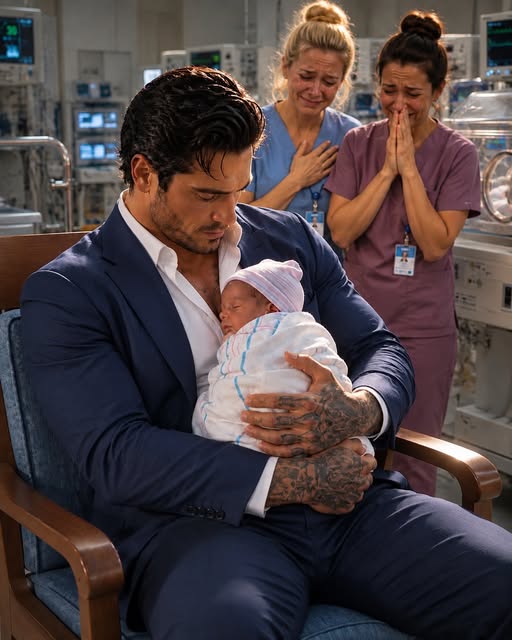
Vincent sat in the oversized reclining glider beside the incubator. He unbuttoned his white dress shirt, opening the collar wide against his chest. With practiced, delicate precision, I unhooked the monitoring leads temporarily, gathered the fragile infant in a pre-warmed fleece swaddle, and transferred him into Vincent’s massive, waiting hands.
Vincent rested the baby against his bare chest, right over his beating heart. He wrapped his large, calloused fingers around the infant’s back, supporting his tiny head with the tenderness of a guardian angel. The baby let out a tiny, contented sigh, his miniature fingers curling tightly around the dark hair of Vincent’s chest.
On the bedside telemetry monitor, the baby’s heart rate—which had been fluctuating erratically around 175 beats per minute from respiratory distress—slowly, miraculously dropped to a steady, perfect 138. His oxygen saturation climbed steadily from 91 to 99 percent.
Chapter 3: The Silver Locket and the Tattoo
I expected the feared mobster to stay for thirty minutes—the typical duration for wealthy socialites participating in hospital charity photo ops. But midnight came and went. Then two in the morning. Then four.
Through every hour of my shift, Vincent Romano never left the chair. He did not check his phone. He did not ask for coffee. He did not shift his posture. He sat in the dimmed room with his eyes closed, his breathing matching the infant’s, softly humming an old Italian lullaby that my own grandmother used to sing in South Philadelphia.
At 5:15 AM, as the first gray light of dawn filtered through the blinds, I approached the glider to administer the baby’s scheduled tube feeding of donor breast milk. As I leaned down to adjust the infant’s nasal cannula, Vincent shifted his arm slightly. His shirtsleeve pulled back past his wrist.
There, tattooed in dark indigo ink against his inner forearm, was an intricate heraldic crest: a soaring falcon clutching an olive branch, encircled by the Latin inscription Fidelitas Usque Ad Mortem—Loyalty Unto Death. At the center of the crest was a single date: May 14, 2002.
My breath stopped in my throat. My hand flew to my mouth.
Three weeks ago, when the unidentified mother died in our trauma bay, the hospital security staff had placed her personal effects in a tamper-evident envelope in the head nurse’s safe. Inside was a sterling silver locket shaped like a shield. I had personally inventoried the item. On the back of that locket was the exact same engraving: a falcon with an olive branch, and the date May 14, 2002.
Vincent opened his eyes. He saw me staring at his wrist. For five long seconds, neither of us spoke.
“You know who his mother was,” I whispered, tears welling in my eyes.
Vincent looked down at the sleeping child on his chest. A single tear rolled down the cheek of Chicago’s most ruthless crime boss, dripping onto the pre-warmed fleece blanket.
“Her name was Elena,” Vincent murmured, his voice thick with twenty years of grief. “Elena Romano. She was my younger sister.”
Chapter 4: The Sister Who Disappeared
Vincent gently adjusted the blanket around the baby’s shoulders, his fingers stroking the infant’s downy dark hair. “Elena was fourteen years younger than me. Our parents died when she was just a girl, and I promised my father on his deathbed that I would protect her from the violence of our world.”
His jaw hardened, the shadows in his face deepening. “Four years ago, a rival syndicate leader—Carter Vance—tried to force an alliance by demanding Elena’s hand in marriage. When I refused, Carter threatened to kidnap her. To protect her, I sent Elena away under an assumed identity with five million dollars in offshore trusts, placing her in a quiet coastal town in Maine. But Carter had a traitor inside my inner circle. Eight months ago, Carter’s men tracked her down.”
Vincent’s hand tightened into a fist against the armrest. “Elena fled into the night, cutting all communications because she believed my phones were tapped. She disappeared across the country, terrified that if she reached out to me, Carter’s hitmen would intercept the signal and murder her unborn child. She lived in shelters, in basements, in soup kitchens across three states, all to keep this boy safe from the crossfire of my war.”
Tears blurred my vision as I listened to the tragic tale. “She arrived here in an unregistered cab three weeks ago. She was bleeding internally from a hit-and-run collision in Gary, Indiana.”
“It was not a hit-and-run,” Vincent said, his voice dropping into a register of icy, absolute death. “It was Carter’s enforcer. Carter knew she was carrying an heir to the Romano name. I eliminated Carter Vance and his entire network forty-eight hours ago in Milwaukee. But I was three weeks too late to save my sister.”
Vincent leaned down, pressing his lips to the baby’s forehead. “Elena gave her life so this little boy could draw his first breath. His name is Leo. Leo Romano.”
Chapter 5: The Threat at the Ward Entrance
At eight o’clock that morning, the shift change was interrupted by the sudden arrival of four men in dark suits at the reception desk of Ward 4B. Unlike Vincent, these men carried federal badges and legal writs. At their head was Agent Thomas Sterling, an ambitious supervisory investigator from the Illinois Department of Children and Family Services, flanked by two armed Cook County marshals.
“Nurse Jenkins,” Agent Sterling announced loudly, holding up a certified court document. “Under emergency probate docket 442, the State of Illinois has claimed wardship over the unidentified infant in Incubator 14. We have an authorized foster custody transfer vehicle waiting downstairs. We are taking the child into state protective custody immediately.”
“He is barely three pounds!” I protested, stepping between the agents and the airlock. “He is on intravenous nutrition and supplemental oxygen! Moving him now could cause fatal intraventricular hemorrhage!”
“The state has a medical transport unit, Nurse,” Sterling sneered, pushing his badge forward. “Step aside, or you will be arrested for interfering with a federal court order.”
Before Sterling could take another step, the heavy magnetic double doors of the ward hissed open. Two men entered.
The first was Marcus Cole, the most formidable constitutional defense attorney in the Midwest. The second was the Chief Judge of the Cook County Probate Court, Honorable Arthur Montgomery.
“Stand down, Agent Sterling,” Judge Montgomery’s voice boomed across the nurses’ station, commanding instant silence.
Sterling’s face paled. “Your Honor? What are you doing here?”
“I am here to vacate your fraudulent emergency order,” the judge stated with icy authority. “Two hours ago, conclusive genetic sequencing conducted by the University of Chicago Department of Human Genetics confirmed a 99.98% familial kinship match between the infant and his legal next-of-kin. The child is not an unidentified ward of the state. He is Leo Vincent Romano, sole heir to the estate of Elena Romano.”
Chapter 6: The Court Order Signed in Gold
Marcus Cole stepped forward, slapping a thick leather-bound binder onto the reception counter before Agent Sterling. “Furthermore, Agent Sterling, our private intelligence division traced the expedited foster application you filed yesterday. You were acting on an unauthorized twenty-thousand-dollar wire transfer from an offshore account affiliated with the remnants of Carter Vance’s syndicate, designed to remove this child from the hospital’s medical protection.”
Sterling’s eyes darted frantically toward the marshals, but the two armed officers immediately took a step away from him, unholstering their handcuffs.
“Thomas Sterling,” the senior marshal announced, clicking the steel cuffs around Sterling’s wrists. “You are under arrest for conspiracy to commit interstate kidnapping, judicial bribery, and official misconduct.”
As the disgraced agent was dragged down the corridor in handcuffs, the airlock door opened. Vincent Romano stepped out, holding baby Leo securely against his chest in a heated hospital wrap. He was surrounded by four specialized neonatal nurses and Dr. Morrison, the hospital medical director.
Vincent looked at Judge Montgomery, offering a solemn nod of gratitude. “Thank you, Arthur.”
“Take care of your nephew, Vincent,” the judge replied warmly. “This city has seen enough blood. Give this boy the life his mother dreamed of.”
“On my life, Arthur,” Vincent vowed. “On my sacred honor.”
Chapter 7: The Private Pavilion at Romano Estate
Four weeks later, Baby Leo was officially discharged from Chicago Children’s Memorial Hospital, having reached five pounds, four ounces, breathing room air with healthy, robust lungs. But his journey didn’t end in a standard nursery.
At the Romano Estate on Lake Michigan, an entire south wing of the limestone mansion had been converted into a state-of-the-art neonatal pediatric pavilion. Staffed around the clock by certified pediatric nurses—including Nurse Miller and myself, whom Vincent had hired with triple our hospital salaries—the suite featured medical-grade HEPA air filtration, infant cardiac telemetry, and custom-crafted walnut cribs lined with organic Egyptian cotton.
I was standing by the panoramic terrace window, preparing Leo’s evening bottle, when Vincent walked into the nursery. He had just returned from a board meeting in downtown Chicago. He wore no weapons, his dark tie loosened, his face relaxed and filled with a peace that the underworld had never seen.
“How is he doing tonight, Sarah?” Vincent asked softly, walking over to the crib.
“He drank four ounces of milk without a single pause,” I smiled, watching Leo wave his tiny fists in the air. “He’s gaining an ounce every single day. Dr. Morrison says his developmental milestones are identical to a full-term infant.”
Vincent reached down, lifting his nephew into his arms. The baby immediately nestled against Vincent’s chest, letting out a soft, sweet coo that melted the last remnants of the Don’s hardened exterior.
Chapter 8: The Renunciation of Blood
That evening, as the heavy winter snow fell softly over the frozen waters of Lake Michigan, thirty of the most powerful syndicate capos, shipping barons, and waterfront union leaders from across Illinois, Indiana, and Wisconsin gathered in the grand marble ballroom of Romano Estate. They had been summoned by encrypted pager for an emergency council of war, fully expecting orders for bloody, retaliatory street strikes against the remaining underground factions of Carter Vance’s syndicate.
Heavy iron braziers burned in the courtyard, their orange flames dancing against the limestone balustrades. Inside the vaulted hall, armed guards in dark charcoal wool lined the perimeter walls, standing at attention with suppressed automatic weapons held at low-ready. The atmosphere was thick with cigar smoke, anticipation, and the electric tension that always preceded a gang war.
The heavy carved mahogany double doors opened with a deep, reverberating creak. Vincent Romano walked into the hall.
He did not carry a sidearm. He wore no body armor. He did not take his traditional seat in the high-backed sovereign armchair at the head of the seventy-foot marble table. Instead, cradled securely in his massive right arm, wrapped in a pure white cashmere blanket, was his four-week-old nephew.
The hardened capos stared in stunned, breathless disbelief. Men who had spent thirty years navigating the shadows of violence, men who had survived gangland executions and federal prison sentences, looked at the fragile, sleeping child resting peacefully against their Don’s chest.
“Gentlemen,” Vincent’s deep baritone voice resonated across the vaulted hall with absolute, unshakable authority. “Tonight marks the permanent, irrevocable end of the Romano syndicate’s underworld operations.”
A collective murmur of shock rippled through the gathered men. Frank Moretti, his oldest and most loyal caporegime, stepped forward, his eyes wide. “Don Vincent… what are you saying? We have controlled the Chicago waterfront for three generations!”
“I am saying that this boy’s mother gave her life to escape our violence,” Vincent replied, his dark obsidian eyes sweeping over the room, holding the gaze of every man in turn. “Every illicit asset, every protection racket, and every shadowy enterprise is being liquidated or transferred into legitimate commercial logistics. Our shipping ports, our commercial construction trusts, and our downtown hotel holdings are being consolidated into the Elena Romano Memorial Children’s Foundation, with fifty million dollars allocated to build advanced neonatal intensive care units across public hospitals in the Midwest.”
Vincent looked at his captains with solemn gravity. “Any man among you who wishes to transition into legitimate corporate management will be granted executive equity, clean corporate records, and full legal immunity. Any man who wishes to pursue the old life of crime is free to leave tonight with a generous, honorable severance. But hear me clearly: no blood will ever touch this family again. No weapon will ever be fired in this child’s name. This boy will grow up in the light of day.”
For ten long seconds, the grand ballroom was dead silent. Then Frank slowly bowed his head, placing his right hand over his heart. One by one, all thirty syndicate leaders followed suit, bowing in profound, voluntary reverence to the sovereign who had chosen the sacred power of love over iron and blood.
Chapter 9: The Legacy of the Falcon
Two years later, on a glorious June afternoon, the newly constructed Elena Romano Pediatric Pavilion at Chicago Children’s Memorial Hospital was formally dedicated. Hundreds of civic leaders, pediatric surgeons, neonatal intensive care nurses, and grateful families filled the sunlit five-story glass atrium overlooking the shimmering sapphire waters of Lake Michigan.
At the center of the atrium stood a soaring bronze monument of a mother holding her newborn baby toward the open sky, dedicated to maternal-infant health and neonatal research. Above the bronze plaque hung the heraldic falcon crest, redesigned with silver olive leaves and the enduring inscription: Born in Courage, Protected by Love.
Standing before the memorial was Vincent Romano. Dressed in an immaculate bespoke navy suit, looking every inch the formidable corporate titan and philanthropist he had become, he smiled as he held the small, warm hand of a laughing two-year-old boy. Leo was thriving—a handsome, energetic toddler with a magnificent mop of dark curls, bright, curious hazel eyes, and a mischievous smile that echoed his mother’s radiant spirit. He wore a crisp white sailor suit, running across the polished marble floor to point at the leaping waters of the indoor bronze fountain.
“Uncle Vince! Look! Big water! Big splash!” Leo giggled, tugging excitedly on Vincent’s trousers.
Vincent laughed—a rich, booming sound of pure joy that echoed through the vaulted atrium—and swooped the boy high into the air with one arm before pulling him tight against his chest. Leo wrapped his little arms around Vincent’s neck, resting his soft cheek right against the faint scar on Vincent’s jaw.
Sarah Jenkins, now the executive director of the foundation, walked up beside them, handing Leo a bright red helium balloon with a golden ribbon. “He has your sister’s spirit, Vincent. Every single day, he reminds me of her courage.”
“He has her heart,” Vincent murmured softly, his dark eyes glistening with peaceful tears as he looked out through the towering glass facade at the sailboats drifting across Lake Michigan.
The fearsome Don who had once ruled through terror and iron had built a kingdom of healing, sanctuary, and hope. And as little Leo’s laughter drifted into the warm summer breeze, Vincent knew with absolute certainty that his sister’s sacrifice had not been in vain. The shadows of the past were gone forever, swallowed by the unyielding, eternal power of a family reborn under the light of unconditional love.