“The Green Canvas Backpack” — The Hospital Volunteer, the Seven-Day Marriage, and the Millionaire Hermit’s Last Will
Chapter 1: The Hospice Volunteer of Room 412
I was twenty-nine years old and still trying to navigate the suffocating fog of grief that had swallowed my life. My mother, Elena, had passed away fourteen months earlier after a protracted, agonizing battle with early-onset Parkinson’s disease. I had spent four years as her primary caregiver, watching the brilliant high school literature teacher who used to quote Emily Dickinson from memory slowly lose the ability to hold a teacup, speak in complete sentences, or recognize my face.
When she finally drew her last breath on a rainy Tuesday in October, the silence in our small rented townhouse in suburban Seattle felt like a physical ache in my chest. To keep that emptiness from consuming me entirely, I began volunteering three evenings a week at St. Jude’s Palliative and Hospice Care Center on the edge of the city.
Most volunteers preferred the children’s wards or the cheerful physical therapy garden. I chose the quiet corner on the fourth floor—the wing where patients who had outlived their families, outlived their savings, or simply slipped through the cracks of a busy world were placed when medicine ran out of answers.
That was how I met Julian.
He occupied Room 412. He was seventy-two years old, frail as spun glass, with a crown of thinning white hair, hands twisted by osteoarthritis, and end-stage congestive heart failure. On his patient chart, the box next to “Emergency Contact” was stamped with a single, bureaucratic red word: NONE.
The nurses said he had arrived via ambulance from a rundown single-room occupancy hotel near the shipyards six weeks earlier, carrying nothing but a faded olive-green canvas backpack and a pair of worn leather work boots. He never complained. He never pressed the call button. Whenever the orderlies brought his lukewarm institutional meals, he whispered a polite “Thank you, son,” and ate only half a cup of broth.
The first evening I stepped into Room 412, rain was lashing against the double-paned glass overlooking the Puget Sound. Julian was staring out at the gray water, his breathing labored and shallow.
“Good evening, Julian,” I said softly, standing by the doorway so I wouldn’t startle him. “My name is Nora. Would you like me to sit with you for a while, or would you prefer quiet?”
The old man turned his head slowly on the white pillow. His eyes, a striking, deep hazel framed by a web of deep wrinkles, seemed to hold an entire century of unspoken memories. A faint, extraordinarily gentle smile touched his lips.
“Nora,” he murmured, his voice sounding like dry leaves rustling across autumn pavement. “Like the light. If you have the time, my dear… I would be very grateful for the company.”
I pulled over the vinyl armchair, sat beside his bed, and picked up the paperback book on his bedside table. It was an old, dog-eared copy of Robert Frost’s collected poems. For the next two hours, I read aloud in the quiet room while the rain tapped against the glass.
Over the next month, my visits to Room 412 became the anchor of my week. Julian was not bitter. He spoke with immense warmth of cedar trees, the smell of wood shavings, the sound of tide water against granite pilings, and the quiet dignity of honest work. He listened with rapt, grandfatherly attention as I talked about my mother, my dream of going back to school for psychiatric nursing, and the guilt that lingered whenever I caught myself laughing after her death.
“Grief is not a debt you pay to the dead, Nora,” Julian whispered to me one Thursday evening, his trembling hand resting lightly on mine. “It is the echo of love that has nowhere to go. Give that love to the living, and you honor her memory far more than tears ever could.”
Chapter 2: The Soda Tab on the Fourth Finger
By late November, the Seattle chill had turned bitter, and Julian’s health plummeted sharply. His oxygen saturation dipped into the mid-eighties, his peripheral circulation began to shut down, and the doctors quietly added morphine to his IV drip to ease the crushing pressure in his chest.
On a Sunday afternoon, while I was gently wiping his forehead with a damp lavender cloth, Julian opened his eyes. The hazel irises, though clouded with fatigue, possessed a sudden, piercing clarity.
He reached out, his frail fingers finding my wrist. He didn’t have the strength to squeeze, but the urgency in his touch made me pause.
“Nora,” he rasped.
“I’m right here, Julian. I’m not going anywhere.”
“I need to ask you something. Something foolish. Something that will sound completely mad to a sensible young woman like you.”
I leaned in closer so he wouldn’t have to strain his lungs. “What is it, Julian?”
He swallowed hard, looking toward the open doorway where hospital staff bustled back and forth with trays and clipboards. “The county social worker came by this morning. When I pass… because I have no living kin… the state will process me as a ward of the indigent. A nameless pauper’s cremation. A cardboard box in a municipal storage room.”
A tear slipped from the corner of his eye, disappearing into the silver stubble on his cheek.
“I don’t fear death, Nora,” he whispered. “I have made my peace with the Almighty. But I fear dying as a case number. I want to leave this earth as a husband. With someone who knows my name standing by my side. Marry me, Nora. Just for the days I have left.”
My breath caught in my throat. My heart thudded against my ribs.
“Julian… you’re very sick,” I stammered, my head spinning. “We barely know each other. I’m twenty-nine, you’re seventy-two… people will think—”
“Let people think whatever their small minds invent,” Julian said, his eyes pleading with an intensity that burned straight into my chest. “I have nothing to offer you in return, child. No jewels, no pedigree, no reputation. Only the gratitude of an old man who doesn’t want to cross the river in total loneliness.”
I looked at his frail, weathered face. I thought of my mother lying in her hospice bed, clutching my fingers during her final hours, terrified of slipping into the dark alone. What did marriage mean, at its most sacred, elemental root? Was it lavish banquets and white silk dresses? Or was it a vow to stand by another human soul in their darkest valley?
“Okay, Julian,” I whispered, wiping away his tear with the corner of the cloth. “I’ll marry you.”
Two days later, on a Tuesday morning, Father Thomas, the hospital’s Catholic chaplain, stepped into Room 412 carrying a small black prayer book and a pair of brass candles. Two oncology nurses stood by the foot of the bed as witnesses, their eyes moist with tears.
I wore my favorite yellow cable-knit sweater—the one my mother had knitted for my twenty-sixth birthday. Julian had combed his white hair and wore a clean hospital gown.
When the chaplain reached the exchange of rings, Father Thomas paused with gentle awkwardness. “Do you have a ring, my son?”
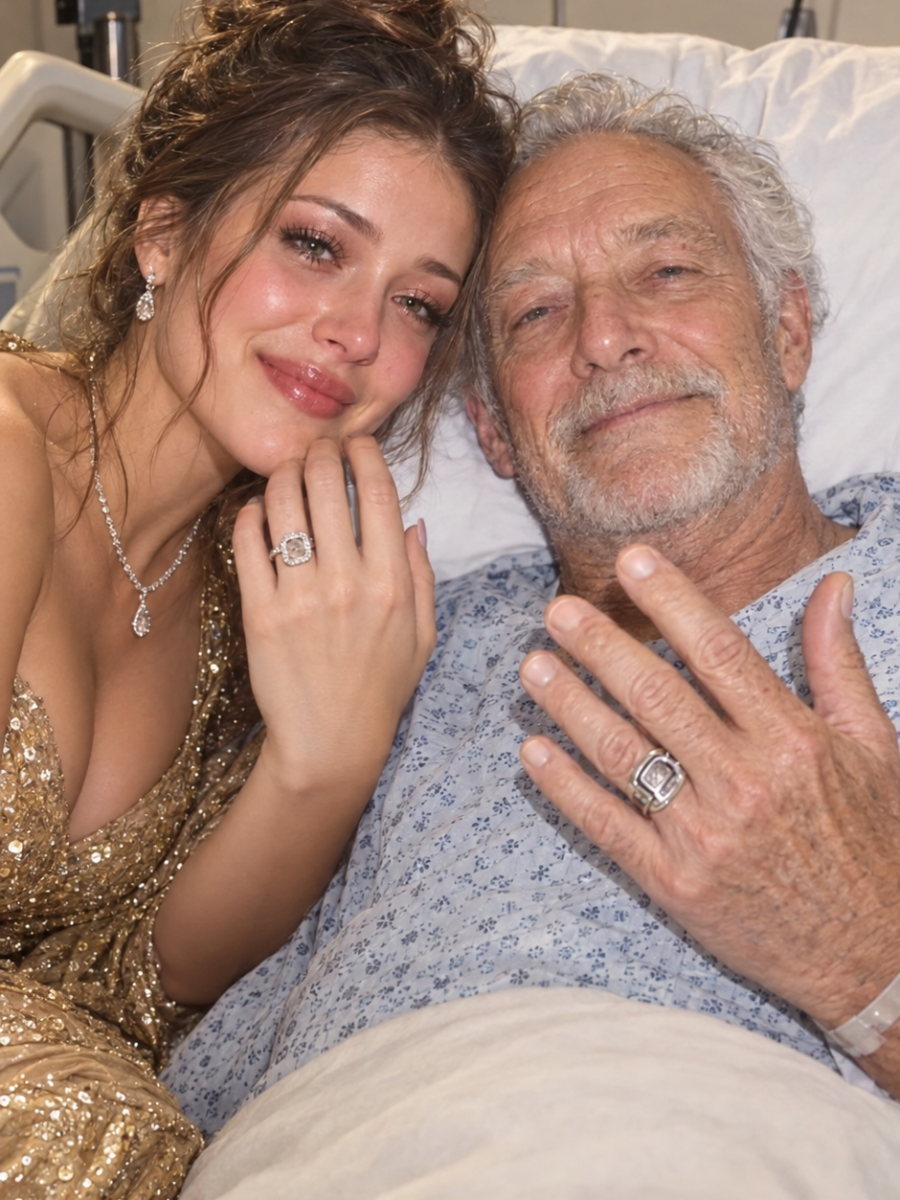
Julian smiled faintly. From beneath his pillow, he produced the silver aluminum pull tab of a ginger ale can he had saved from his lunch tray. With trembling hands, his knuckles blue with poor circulation, he slid the simple silver loop over the fourth finger of my left hand.
“With this ring,” Julian whispered, his voice shaking with reverence, “I give you my deepest honor, Nora. For as long as my heart chooses to beat.”
I looked down at the soda tab. It didn’t sparkle like a diamond. It didn’t cost a penny. But in that sterile hospital room, beneath the humming fluorescent tubes, it felt heavier and more precious than any crown in Europe.
Chapter 3: Seven Days of Twilight and Grace
Our marriage lasted exactly seven days.
During those one hundred and sixty-eight hours, I never left St. Jude’s. I took an emergency leave from my part-time administrative job at the community college. I slept in the reclining vinyl armchair beside Julian’s bed, waking every two hours to moisten his parched lips with a sponge, adjust his oxygen nasal cannula, or hold his hand whenever the phantom pains of organ failure caused him to groan in his sleep.
On the fourth day, a brief rally in his condition allowed us to talk for nearly three hours. Julian told me about his youth in the Pacific Northwest—how he had spent decades walking the dense, mist-shrouded old-growth forests of the Olympic Peninsula. He spoke of the majesty of western redcedars, trees that stood for eight hundred years, weathering lightning strikes and winter gales by intertwining their root systems beneath the soil with the trees around them.
“That is how humans were meant to live, Nora,” Julian said, gazing at the soda tab on my finger. “Not as isolated islands, but with roots intertwined beneath the surface, holding each other upright when the storms hit.”
He paused, looking at me with deep, solemn affection. “Have you ever been to Cape Flattery?”
“No,” I replied softly. “My mother and I always talked about driving out to the coast, but between her medical appointments and my classes, we never found the weekend.”
“Promise me you will go,” he urged, his voice suddenly firm. “Go to the point where the Strait of Juan de Fuca meets the Pacific. Listen to the ocean crashing against the sea caves. That is where you will find your peace, little girl.”
“I promise, Julian. I’ll go.”
By the sixth night, his consciousness began to fade into a comatose sleep. His breathing took on the Cheyne-Stokes pattern—long, breathless pauses followed by rapid, shallow gasps. I held his cold hand between both of mine, warming his fingers with my breath, whispering Frost’s verses into the dim room:
“The woods are lovely, dark and deep, but I have promises to keep, and miles to go before I sleep…”
At 4:47 AM on the seventh morning, Julian took one long, shuddering breath, released it slowly, and his pulse ceased. His monitor flatlined into a soft, steady tone.
I did not scream. I did not panic. I leaned over, kissed his cool, peaceful forehead, and smoothed the white blanket over his shoulders. He looked ten years younger in death—the lines of agony erased, leaving only the calm dignity of a man who had completed his journey on his own terms.
“Rest well, my husband,” I whispered into the quiet dawn.
Chapter 4: The Attorney with the Heavy Green Backpack
Two hours later, after the nurses had prepared Julian’s body for the mortuary and offered their condolences, I sat alone in the corner of Room 412. The room had already been stripped of its medical equipment; the bed was bare springs, waiting for the industrial sanitizer. All that remained of Julian Vance was his faded olive-green canvas backpack resting in the corner beside his scuffed work boots.
I picked up the backpack. It was shockingly heavy—not the weight of clothing or toiletries, but the solid, dense weight of metal, bound parchment, and dense paper.
A soft knock sounded at the open doorway.
I looked up, expecting an orderly or an administrative clerk with discharge paperwork. Instead, standing in the doorway was an elderly gentleman in his late sixties, dressed in an impeccably tailored charcoal-gray three-piece suit, an overcoat of black cashmere, and carrying an Italian leather briefcase. His silver hair was neatly parted, and he wore gold wire-rimmed spectacles.
“Mrs. Nora Vance?” the gentleman asked, his voice cultured, resonant, and remarkably gentle.
The name sounded strange in my ears. Mrs. Nora Vance. I swallowed hard and nodded. “Yes. I’m Nora. Who are you?”
The man stepped inside, removed his leather gloves, and extended a manicured hand. “My name is Harrison Cole. I am the senior managing partner of Cole, Kensington & Sterling, Attorneys at Law, in downtown Seattle.”
I stared at him, my mind unable to connect this high-powered corporate attorney with the penniless old man who had just died in a hospital gown. “Did Julian owe legal fees? Because if there are debts, I have very little money, but I can work out a monthly payment plan—”
Mr. Cole raised a hand, cutting me off with a warm, sorrowful chuckle. “No, my dear. Julian owes nothing to anyone in this world.”
He looked at the olive-green canvas backpack clutched in my arms, and his eyes grew moist behind his spectacles.
“Julian wasn’t who you thought he was, Nora,” Mr. Cole whispered, closing the door behind him. “He wanted you to know the truth only after his heart had stopped. Please… open the pack.”
Chapter 5: The Blueprints of Julian Sterling
My hands trembled as I pulled the brass zipper of the faded green backpack. The canvas smelled of cedarwood, beeswax, and aged paper.
Inside was not worn laundry or cheap toiletries. The bag was packed to the brim with official legal documents, thick velvet jeweler’s boxes, and a massive, leather-bound architectural journal embossed with gold lettering: STERLING STRUCTURAL & MARITIME DESIGNS (1978–2010).
“Julian Vance was not his full name,” Mr. Cole explained, taking a seat opposite me on the windowsill. “His name was Julian Vance Sterling. In the 1980s and 90s, he was one of the most prolific civil structural engineers on the West Coast. He held seventeen fundamental patents on deep-water seismic retrofitting for suspension bridges and oceanic container terminals.”
I flipped open the leather journal. The pages were filled with exquisite, hand-drawn blueprints of iconic suspension bridges, ferry terminals, and skyscraper foundations across Seattle, Vancouver, and San Francisco. Pasted alongside the drawings were photographs of a younger Julian—tall, handsome, standing proudly beside governors, university deans, and civic leaders.
“What happened to him?” I asked, tears blurring the intricate technical drawings. “Why was he living in a five-hundred-dollar rooming house? Why was he alone?”
Mr. Cole took a long, heavy breath, looking out the hospital window at the gray waters of the Sound.
“In November of 2004, Julian took his wife, Claire, and their twenty-two-year-old daughter, Emily, for a weekend retreat at their coastal lodge in Oregon,” Cole said quietly. “A catastrophic atmospheric river caused an unprecedented subterranean landslide. The entire bluff gave way in the middle of the night. Julian had stepped out to the detached generator shed to restart the power. By the time he turned around, the main house was gone. Swallowed by thirty thousand tons of liquefied mud and swept into the Pacific.”
A cold chill ran down my spine. The image of Julian standing in the dark, watching his entire universe vanish in ten seconds, took my breath away.
“He tried to dig with his bare hands until his fingernails tore out,” Cole continued. “Search and rescue never recovered their bodies. Something inside Julian died that night. He resigned from every corporate board. He sold his engineering firm to his partners. He liquidated his luxury properties and retreated into total seclusion. For eighteen years, he lived like an anonymous ascetic, giving away ninety percent of his wealth through blind charitable trusts, seeking only to fade into the background until he could be reunited with his girls.”
I clutched the leather journal against my chest, weeping for the immense, silent mountain of grief Julian had carried alone for nearly two decades.
Chapter 6: The Fourteen Million Dollar Wager on Kindness
“Then why did he marry me, Mr. Cole?” I sobbed. “If he wanted to disappear, why bind himself to a stranger?”
Mr. Cole reached into his briefcase and retrieved a thick, cream-colored linen envelope with my name handwritten across the front in Julian’s distinctive, elegant architectural script. He handed it to me.
“Read it, Nora,” the attorney said gently.
With trembling fingers, I broke the wax seal. Inside was a four-page handwritten letter and a series of certified legal covenants bearing the seal of the King County Probate Court.
“My dearest Nora,” the letter began.
“If you are reading this, I am finally at rest beside Claire and Emily beneath the whispering pines of the coast. For eighteen years, I believed that genuine, selfless love had vanished from this earth along with my family. I watched a world obsessed with status, transactions, and superficial acclaim. When congestive heart failure caught up with me, I resolved to die quietly, an anonymous old shell.”
“Then, God sent you into Room 412.”
“I watched you for weeks before we ever spoke, Nora. I saw you sit beside Mr. Henderson when he was delirious, holding his hand when his own children refused to visit. I saw you comb Mrs. Gable’s hair with infinite patience. And when you sat beside my bed, you did not look at me with pity or disgust. You looked at me like a fellow human being worthy of dignity.”
“When I asked you to marry me, I tested your soul in the most absurd, humiliating way possible. You had everything to lose—your dignity, your time, your peace. You gained a soda pull-tab from a garbage tray and the burden of holding a dying stranger’s hand through his final agony. Yet you did it with absolute, radiant grace.”
“In this backpack, you will find the deed to the Sterling Coastal Sanctuary—two hundred acres of virgin old-growth redwoods along the cliffs of Cape Flattery that I preserved from commercial logging twenty-five years ago. You will also find certified cashier’s checks and an irrevocable trust endowment totaling fourteen million two hundred thousand dollars.”
“It is not a reward, Nora. It is a sacred trust. I know your dream of psychiatric nursing. I know the wound of losing your mother. Build something that outlasts both of us. Intertwine your roots with the forgotten souls of this world, just like the cedar trees. You wore my soda tab; now let an old builder lay the foundation for your wings.”
“With eternal love and gratitude, Your husband, Julian Vance Sterling.”
I pressed the letter to my lips, falling to my knees on the linoleum floor, weeping with a mixture of overwhelming sorrow, awe, and boundless gratitude.
Chapter 7: The Haven by the Redwoods
Three years later, the morning sun rose over the majestic cliffs of Cape Flattery, burning away the ocean mist that clung to the towering canopy of eight-hundred-year-old redcedars and Sitka spruces.
Perched gracefully on the bluffs, designed with natural cedar timber, river stone, and floor-to-ceiling glass overlooking the crashing surf of the Pacific, stood the Elena & Julian Haven.
It was not a cold hospital. It was a state-of-the-art residential sanctuary—a sixty-bed palliative and long-term restorative care community where elderly patients without family, abandoned hospice cases, and impoverished families facing terminal diagnoses received world-class medical attention, gourmet nutrition, and unconditional love entirely free of charge.
In the central courtyard, surrounded by blooming rhododendrons and aromatic lavender, stood a bronze memorial fountain. Carved into the granite basin were the silhouettes of two redcedar trees with roots deeply intertwined beneath the earth. Above them was a simple, unforgettable inscription:
“No one crosses the river alone. Dedicated to Elena Evans & Julian Vance Sterling.”
I walked through the sunlit glass corridors wearing a simple navy medical scrub top and comfortable sneakers. I had completed my Master of Science in Palliative Nursing from the University of Washington six months prior, serving as the clinical director of the Haven.
I stopped by the large bay window overlooking the ocean. Around my neck, hanging on a delicate platinum chain against my collarbone, was the small, silver aluminum soda pull tab Julian had slipped onto my finger three years ago in Room 412.
I touched the cool metal with my fingertips. Below on the terrace, a dozen elderly residents were laughing in the morning sunshine, wrapped in warm blankets, sipping hot cider while volunteers read poetry aloud.
A gentle coastal breeze drifted through the open terrace doors, carrying the clean, sharp scent of cedarwood, salt spray, and rain. I looked out past the crashing waves toward the horizon, where the sea met the boundless sky.
“We kept our promises, Julian,” I whispered, smiling through a shimmer of tears as the morning light caught the silver ring at my throat. “And the trees are standing strong.”