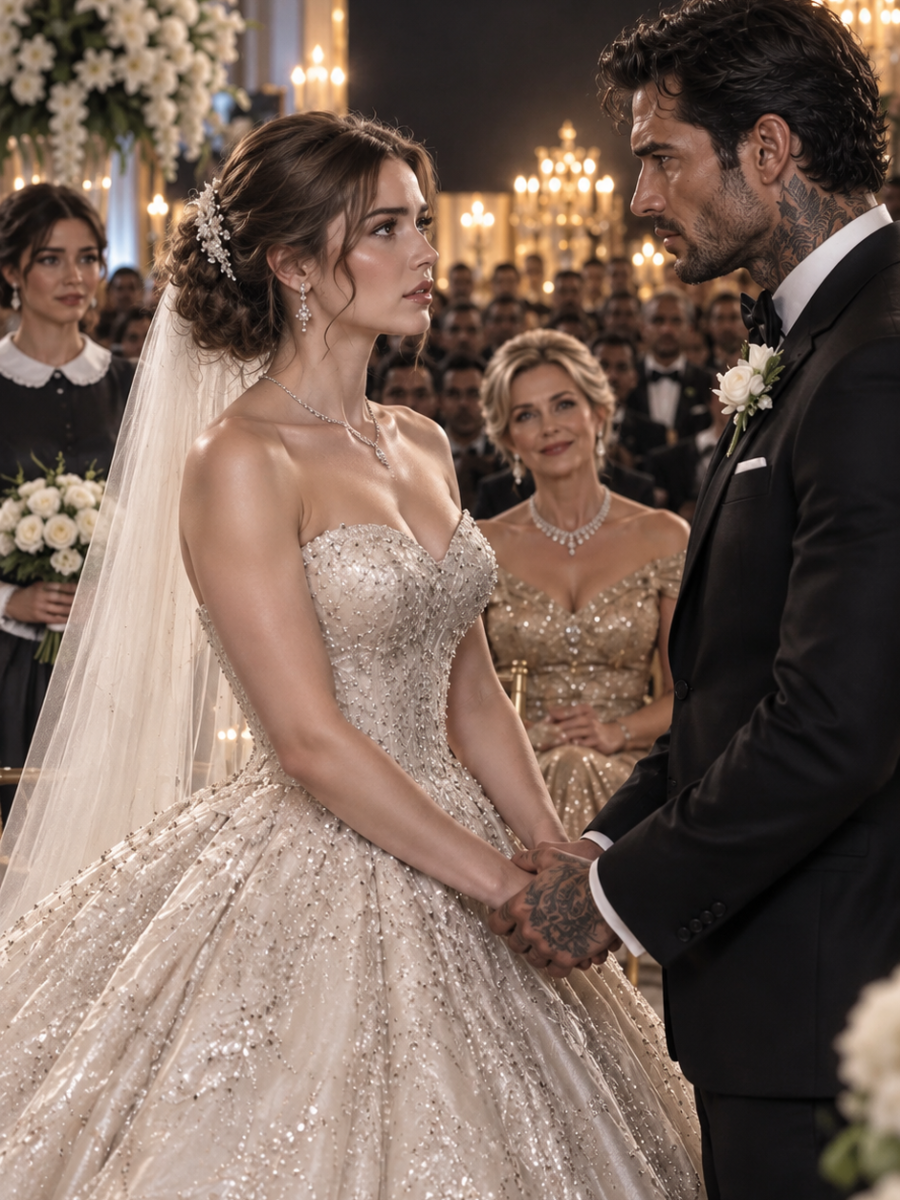
The Bride Who Wore the Stolen Truth
My mother thought she had won my wedding before I even walked down the aisle, believing she had forced me into high-society submission. She had no idea I was wearing the evidence. Embroidered into my 12-foot silk veil in UV-reactive thread was the complete forensic proof of her $15 million trust embezzlement, ready to broadcast before 300 guests.
Table of Contents
- Chapter 1: The Champagne Gown in the Front Row
- Chapter 2: Stitching Truth into the Silk
- Chapter 3: The Sanctuary of Grand Bellmore
- Chapter 4: The Ultraviolet Revelation
- Chapter 5: Handcuffs at the Altar
- Chapter 6: The White Lily of the Berkshires
- Chapter 7: Ten Thousand Lilies in Bloom
- Chapter 8: The Closed Account
- Chapter 9: The Daughter Named Rose
Chapter 1: The Champagne Gown in the Front Row
My mother thought she had won my wedding before I even took my first step down the aisle.
She sat in the center of the front-row family pew beneath the soaring crystal chandeliers of the Grand Bellmore in downtown Boston. She wore a bespoke, champagne-colored couture gown that cost thirty-five thousand dollars, five carats of flawless diamonds resting against her throat, and that calm, predatory smile of a woman who believed she had finally forced me into the mold she had designed for me.
To the three hundred high-society guests filling the sanctuary—mayors, appellate judges, real estate tycoons, and social columnists—Evelyn Bennett was the saintly, selfless matriarch who had sacrificed everything to raise a devoted, aristocratic daughter.
She had no idea that beneath the cathedral lights, I was wearing the evidence that would destroy her world forever.
Three months earlier, I had designed the only wedding dress I had ever wanted in my life.
I was an independent textile conservator and bridal artisan. My dress wasn’t gaudy; it wasn’t made of synthetic tulle or stiffened plastic corsetry. It was made of pure Italian silk crepe, delicate bell sleeves, a modest, sweeping neckline, and a twelve-foot train hand-embroidered with three hundred miniature white lilies.
Those flowers mattered more to me than any piece of jewelry on earth.
My grandmother, Rose Bennett, had grown white lilies behind her small cottage in the Berkshire hills. When I was a little girl and my mother had locked me in my room for failing to place first in regional piano recitals, Grandma Rose would sneak through my window, slip a fresh white lily into my hand, and whisper:
“Never let her clip your petals, Clara. You bloom in your own time, under your own sun.”
When Grandma Rose passed away two years ago, she left behind an eighty-acre organic sanctuary in the Berkshires, a historic carriage house, and an irrevocable fifteen-million-dollar trust established specifically for my future upon my wedding day.
Under the terms of Grandma Rose’s will, my mother was designated as the temporary fiduciary trustee until I was married.
And for twenty-four months, my mother had treated that trust as her personal checking account.
She bought private jet shares, vacation penthouses in Aspen, and designer wardrobes, all while telling me that Grandma Rose’s investments had collapsed during the market downturn and that there was barely enough money left to cover the caterer.
For years, my mother had operated like an absolute monarch in Boston society. Every charity gala, every social debut, every private school committee had bowed to the iron will of Evelyn Bennett. She viewed children not as human beings with dreams or spirits, but as raw clay to be sculpted into polished ornaments that reflected her social prestige. When my father died twelve years ago, leaving her in control of the family estate, she systematically severed every relationship that didn’t offer political or financial leverage. The only person she had never been able to conquer was Grandma Rose.
And then, four weeks ago, she committed the ultimate act of cruelty.
She broke into my design studio in the dead of night, took my handmade dress of embroidered lilies, and threw it into the estate’s garden incinerator.
The next morning, she presented me with an ostentatious, sixty-thousand-dollar French ballroom gown covered in artificial Swarovski crystals, sneering:
“You will dress like a Bennett bride, Clara. You will not embarrass this family by walking down the aisle in some peasant rag that smells like your grandmother’s dirt.”
I hadn’t cried. I hadn’t screamed.
Instead, I had smiled, thanked her, and gone to work.
Chapter 2: Stitching Truth into the Silk
What my mother never understood about textile conservation was that fabric is not just cloth.
Fabric is history. Fabric is forensic memory.
For three weeks, working through the quiet hours between midnight and dawn in the private studio of my fiancé, Julian Vance, I reconstructed my dream with surgical precision.
Julian was a brilliant structural architect—a man who loved me for my quiet passion, who had spent his college years building homes for Habitat for Humanity, and who despised the hollow, predatory vanity of Boston high society just as fiercely as I did. He understood what it meant to build foundations that could endure the fiercest storms.
“Are you sure you want to do this at the altar, Clara?” Julian had asked me three nights ago, gently smoothing a stray lock of brown hair from my cheek as I sat hunched over the embroidery hoop under the magnifying lamp.
“Julian,” I replied, looking into his steady hazel eyes. “Grandma Rose built that sanctuary with her own hands. She spent fifty years saving every dollar to protect the land from commercial developers. My mother is currently negotiating to sell the entire eighty-acre valley to a commercial strip-mining conglomerate for twenty million dollars. If I don’t expose her before the marriage is finalized, the deed transfers permanently to the developers on Monday morning.”
Julian nodded slowly, resting his hands on my shoulders.
“Then we strike together,” he whispered.
I didn’t just re-embroider the white lilies on the new silk train.
Using microscopic, UV-reactive conductive thread donated by a research laboratory at MIT, I hand-stitched the forensic audit of Grandma Rose’s trust into the inner lining of the cathedral-length veil.
Every unauthorized wire transfer was cataloged.
Every forged signature on the Delaware shell company documents was mapped.
Every diverted dividend from Grandma Rose’s municipal bonds was recorded.
And the secret sales agreement for Grandma Rose’s sanctuary was digitized and woven into the hem.
Under ordinary incandescent lighting, the embroidery appeared as delicate, shimmering silver vines weaving between the lily stems. To the untrained eye, it was simply an exquisite display of haute couture needlepoint.
Under ultraviolet frequency, however, the thread fluoresced with brilliant, razor-sharp luminescent text—a complete legal indictment woven into sixty square feet of French silk.
And Julian had personally supervised the installation of the Grand Bellmore’s audiovisual and lighting systems for our ceremony, ensuring that every projector and frequency was wired to an encrypted digital switch.
The wedding planner, working under my mother’s tyrannical orders, assumed the ceremony was proceeding according to the standard high-society script.
The organ began to play Purcell’s Trumpet Tune.
The heavy double oak doors of the sanctuary swung wide open.
Three hundred guests rose in unison, turning their heads toward the rear of the aisle.
I stood on the threshold.
Chapter 3: The Sanctuary of Grand Bellmore
A collective, breathless murmur swept through the Grand Bellmore.
I was not wearing the gaudy, sixty-thousand-dollar crystal ballroom gown my mother had purchased to feed her vanity.
I wore my masterpiece: pure ivory Italian silk crepe, delicate bell sleeves, sweeping gracefully to the floorboards, and a magnificent twelve-foot cathedral veil floating behind me, adorned with hundreds of hand-stitched white lilies.
At the front-row pew, my mother’s smile vanished so violently it looked as though her face had been struck by an iron bar.
Her hands gripped her lace handkerchief with white-knuckled fury. Her emeralds rose and fell with rapid, shallow gasps. She leaned toward her brother, Uncle Charles, hissing behind her teeth:
“Where did she get that dress?! I burned it! I watched it turn to ash in the incinerator!”
Uncle Charles could only shake his head in bewildered silence.
I walked down the aisle with slow, measured, serene steps.
At the altar, waiting beneath a towering arch of fresh white lilies and eucalyptus branches, stood Julian.
He looked breathtaking in a bespoke dark charcoal tuxedo. His hazel eyes were fixed on mine, burning with a quiet, unshakeable pride that made every ounce of fear in my heart evaporate into mist.
The silence inside the sanctuary stretched like a taut wire ready to snap. I could hear the faint rustle of three hundred programs, the heavy breathing of guests who had realized something historic was unfolding. In the third row sat Governor Hastings and his wife; behind them were four senior partners from the city’s most prestigious appellate law firms. Julian held my gaze with a calm, serene warmth that seemed to anchor the entire room. He squeezed my fingers once, transmitting the unshakeable courage of a man who loved truth more than peace.
I reached the altar.
Julian stepped forward, took my gloved hands in his, and whispered:
“You look like an angel of justice, Clara.”
“I have my grandmother’s strength,” I whispered back.
The minister, Reverend Thomas, cleared his throat, adjusting his spectacles.
“Dearly beloved, we are gathered here in the presence of God and these witnesses to join this man and this woman in holy matrimony.”
My mother sat forward in the pew, her jaw set like stone, glaring at the back of my dress, silently calculating how she would punish me the moment the reception began.
Then Reverend Thomas spoke the ancient, sacred words:
“If any person present can show just cause why these two should not be lawfully joined, let them speak now, or forever hold their peace.”
The sanctuary fell into its customary, formal two seconds of respectful silence.
I didn’t wait for anyone else.
I turned around.
Facing the three hundred guests, I lifted my cathedral veil from my face and spoke:
“I can.”
Chapter 4: The Ultraviolet Revelation
The sanctuary erupted into stunned, horrified gasps.
Society women clutched their pearls; city councilmen sat frozen; the organist’s hands hovered in mid-air over the keys.
My mother leaped to her feet in the front pew, her face turning an apocalyptic shade of crimson.
“Clara Bennett!” Evelyn shouted, her voice echoing off the vaulted stone arches like a whip. “Have you lost your mind?! Sit down and let the minister finish the vows! You are embarrassing this family before the entire city!”
“I am not embarrassing this family, Mother,” I replied, my voice steady, resonant, and crystal clear. “I am freeing it.”
I turned slightly toward the choir loft above the altar.
Julian clicked a wireless remote in his pocket.
The warm, amber incandescent chandeliers illuminating the church dimmed to twenty percent.
Then, four high-powered ultraviolet architectural searchlights positioned in the rafters clicked on, sweeping their invisible, deep-purple beams across the altar.
A collective, terrified shriek tore from my mother’s throat.
Under the ultraviolet beams, my twelve-foot cathedral veil began to glow with blinding, neon-blue luminescence.
The delicate vines of white lilies transformed into three-inch-tall illuminated legal text, projecting with crystal clarity across the marble altar steps and onto the two massive projection screens positioned on either side of the sanctuary.
The text was undeniable:
BENNETT FAMILY TRUST — FORENSIC AUDIT
TRUSTEE: EVELYN BENNETT
BENEFICIARY: CLARA BENNETT
Beneath the title, twenty-four wire transfers appeared, complete with dates, Swiss banking routing numbers, and forged signatures:
*JUNE 14: $450,000 TRANSFERRED TO ASPEN LUXURY REAL ESTATE LLC.*
*SEPTEMBER 2: $1,200,000 TRANSFERRED TO PRIVATE JET LEASING CORP.*
*NOVEMBER 18: $8,000,000 SURRENDER OF BERKSHIRE SANCTUARY DEED TO VANCE STRIP MINING SYNDICATE.*
And at the very bottom, in glowing letters that stretched across the altar floorboards, lay my mother’s handwritten email to the mining developers:
“My daughter is an incompetent dreamer. Once the wedding is finalized and her signature is secured, we bulldoze the valley by Friday morning.”
The church went completely, terrifyingly silent.
Arthur Vance, the head of the Massachusetts Historical Preservation Society seated at Table Two, stood up in utter outrage.
“Evelyn Bennett!” Arthur roared across the aisle. “You sold Rose Bennett’s protected botanical sanctuary for strip-mining kickbacks?!”
Chapter 5: Handcuffs at the Altar
My mother stumbled backward against the wooden pew, clutching her chest, her fifty yards of champagne silk dragging against the carpet.
“It’s a lie!” Evelyn shrieked, her voice cracking into high-pitched hysteria. “She fabricated it! She’s mentally unstable! Julian Vance put her up to this to ruin my reputation!”
“Julian didn’t fabricate the Federal Reserve transaction codes, Mother,” I said calmly, taking two steps down the altar stairs toward her. “Nor did he forge your signature on the mining contracts.”
The heavy double oak doors at the back of the Grand Bellmore were thrown open.
Four special agents from the Federal Bureau of Investigation, accompanied by two uniformed detectives from the Boston Police Department’s White Collar Crimes Division, marched down the center aisle.
Leading them was Special Agent Robert Miller.
“Evelyn Bennett,” Agent Miller announced, presenting an official federal warrant. “You are under arrest for grand larceny, wire fraud, fiduciary embezzlement, and illegal commercial exploitation of a protected state historical reserve.”
Handcuffs clicked loudly around my mother’s diamond-clad wrists.
As she was hauled down the aisle, screaming and cursing my name, her champagne gown trailing through the dust of the church floorboards before sixty flashing smartphone cameras, the guests backed away in complete, unvarnished disgust.
The woman who had tried to crush my soul for twenty-four years was led away into the back of a federal prisoner transport van.
The sanctuary fell into a quiet, sacred hush.
Julian walked down the altar steps, stopping beside me. He took my hand in his, his thumb gently wiping away a single tear that had escaped my eyelashes.
“Are you ready, Clara?” he asked softly.
I looked at the altar, where Reverend Thomas was watching us with profound, fatherly warmth, and then out at the two hundred guests who remained, their eyes shining with quiet respect.
“I have never been readier in my life, Julian,” I smiled.
We walked back to the altar together.
Beneath the glowing white lilies of my veil, Julian and I spoke our vows—not with corporate pomp, but with the honest, eternal devotion of two souls who had fought for the light and won.
As the minister pronounced us husband and wife, Julian pulled me into a deep, loving kiss as the organist struck the triumphant chords of the Wedding March, and our friends showered the aisle with fresh white lily petals.
Grandma Rose’s sanctuary was saved.
And the girl who refused to let her petals be clipped was finally, gloriously free.
Chapter 6: The White Lily of the Berkshires
The following week, the Berkshire hills were alive with the vibrant golden hues of late autumn.
The seventy-two-hour legal blitz that followed my wedding completely dismantled my mother’s commercial empire.
Federal prosecutors froze all of Evelyn’s personal accounts, recovering eleven million dollars of Grandma Rose’s embezzled trust funds. The illegal strip-mining contract was voided by an emergency order of the Massachusetts Supreme Judicial Court, and the eighty-acre valley was permanently designated an unassailable wildlife and botanical sanctuary under my sole executive conservatorship.
Evelyn was remanded into federal custody at FCI Danbury without bail, awaiting trial on twenty-two felony counts.
On Friday morning, Julian and I drove down the winding gravel lane leading to Grandma Rose’s cottage in the Berkshires.
The air smelled of sweet pine needles, damp earth, and woodsmoke.
The historic stone cottage stood proudly against the hillside, surrounded by terraced gardens where thousands of white lily bulbs slept beneath the rich mountain soil, waiting for the spring.
Julian carried our suitcases onto the wooden porch, while I walked down the stone pathway to Grandma Rose’s favorite wooden bench beneath an ancient weeping willow.
I sat down on the weathered cedar boards, resting my hands on my lap.
I pulled off my wool scarf, letting the cool mountain breeze kiss my cheeks.
Beside the bench, a single, late-blooming white lily stood tall in the sheltered grass, its petals pristine, untouched by the morning frost.
I reached out, my fingers gently brushing the velvet petals.
“We did it, Grandma,” I whispered, tears of profound, peaceful gratitude welling in my eyes. “The valley is safe. The flowers are safe. And nobody will ever clip my petals again.”
Julian walked down the stone path, carrying two mugs of hot spiced cider.
He sat down beside me on the bench, wrapping his arm around my shoulders and pulling me against his warmth.
“What are you thinking about, Mrs. Vance?” he murmured, kissing my temple.
I took a sip of the warm cider, looking out over the golden hills where the wind danced through the treetops.
“I’m thinking about spring, Julian,” I smiled, leaning my head against his shoulder. “And how beautiful this valley is going to look when ten thousand lilies bloom under the sun.”
Chapter 7: Ten Thousand Lilies in Bloom
Six months later, spring arrived in the Berkshires with an explosion of radiant life.
The snow melted from the high ridges, filling the mountain creeks with crystal-clear water that gurgled happily over river stones.
And in the terraced valley behind Grandma Rose’s cottage, the miracle happened.
Ten thousand white lilies broke through the rich black earth, unfurling their petals toward the May sun like a sea of pure, fragrant snow.
Julian and I had permanently relocated to the Berkshires.
Julian opened an independent rural architectural firm, designing sustainable timber-frame homes for local families, while I established the Rose Bennett Botanical Sanctuary and Textile Arts Academy.
Every weekend, dozens of young women—aspiring artisans, design students, and survivors of domestic trauma—traveled from Boston and New York to our carriage house studio.
I taught them how to weave natural linen, how to extract non-toxic dyes from marigolds and elderberries, and how to tell their own stories through needle and thread.
I taught them that beauty is not something you purchase in a boutique; it is the truth you carry in your own heart.
It was a warm Saturday afternoon.
The French doors of the carriage house studio were thrown wide open, letting in the intoxicating scent of blooming lilies and the cheerful laughter of twelve students gathered around the long oak worktables.
Julian walked into the studio, wearing a work shirt and denim jeans, a smudge of cedar sawdust on his jaw, holding a wooden crate filled with fresh strawberries from our garden.
“Afternoon snack for the master artisans,” Julian announced with a grin, setting the crate on the center table.
The students cheered, descending on the sweet red fruit.
Julian walked over to my drafting table, wrapping his arms around my waist from behind and resting his chin on my shoulder.
“How is the anniversary piece coming along, Clara?” he asked softly.
I looked down at the embroidery hoop on my desk.
Stitched in delicate green and ivory silk thread were two simple words:
BLOOM FREE.
I leaned back against his chest, smiling into the warm spring breeze.
“It is finished, Julian,” I replied. “Completely finished.”
Chapter 8: The Closed Account
As the summer months warmed the mountain valley, our sanctuary became a haven of peace and healing for hundreds of visitors.
Schoolchildren arrived on field trips to learn about sustainable botanical conservation, while local musicians gathered on our lawn on Friday evenings to play acoustic bluegrass beneath the stars.
The forensic audit recovered by federal investigators revealed that my mother had spent eight hundred thousand dollars on private security contractors, wiretapping devices, and smear campaigns aimed at silencing whistleblowers within our family foundation. She had lived in a gilded prison of her own design, paranoid of exposure, yet convinced that her money would shield her from consequence. When her vanity finally collided with the unyielding law, there were no high-society friends to post her bail. The same women who had sipped champagne at her galas were the first to delete her phone number from their address books.
One afternoon, a plain legal envelope arrived from the Suffolk County District Attorney’s office.
I opened it on the front porch.
The letter contained the official certified record of Evelyn Bennett’s criminal trial.
She had entered a guilty plea to all twenty-two counts of federal wire fraud and embezzlement, sentenced to fifteen years in federal prison with full financial restitution orders.
I read the final page.
My heart didn’t race with bitter triumph.
I felt only a quiet, solemn sorrow for a woman who had traded the love of her only daughter and the sacred legacy of her family for thirty pieces of silver and a seat in an empty ballroom.
I folded the letter, slid it back into the envelope, and filed it away in the back of my desk drawer.
The past was closed.
The debt was paid.
And out in the gardens, the living world called.
Chapter 9: The Daughter Named Rose
One year after our wedding, on a golden morning in September, a new sound filled the stone cottage in the Berkshires.
The soft, sweet, melodic cry of a newborn baby.
I sat in the rocking chair by the sunlit bedroom window, cradling our daughter against my chest.
She had Julian’s gentle hazel eyes, a soft tuft of dark brown curls, and tiny, delicate fingers that gripped my thumb with astonishing strength.
Her name was Rose.
Julian knelt beside the chair, his eyes shining with tears of pure, overwhelming adoration, his hand resting gently over our daughter’s back.
“She’s perfect, Clara,” Julian choked out, kissing my cheek. “She’s so beautiful.”
“She is our Rose,” I smiled through my tears, looking down at our sleeping angel.
I looked out the bedroom window toward the terraced valley.
The late-blooming lilies stood tall in the autumn sun, swaying gently in the mountain breeze, pure, unyielding, and completely unbroken.
A year ago, a woman had tried to burn my soul in an incinerator, believing that arrogance and money could conquer love.
She had failed.
Because truth is a seed that thrives in the deepest soil.
And as I held my daughter close beneath the golden light of the mountain morning, I knew that she would grow up in a valley where love was the only law, where truth was the only armor, and where every child bloomed free under her own sun.