“The Barn Doors of Caldwell Flats” — Three Hundred and Fifty Discarded Chances
Chapter 1: The Ditch at the Crossroads
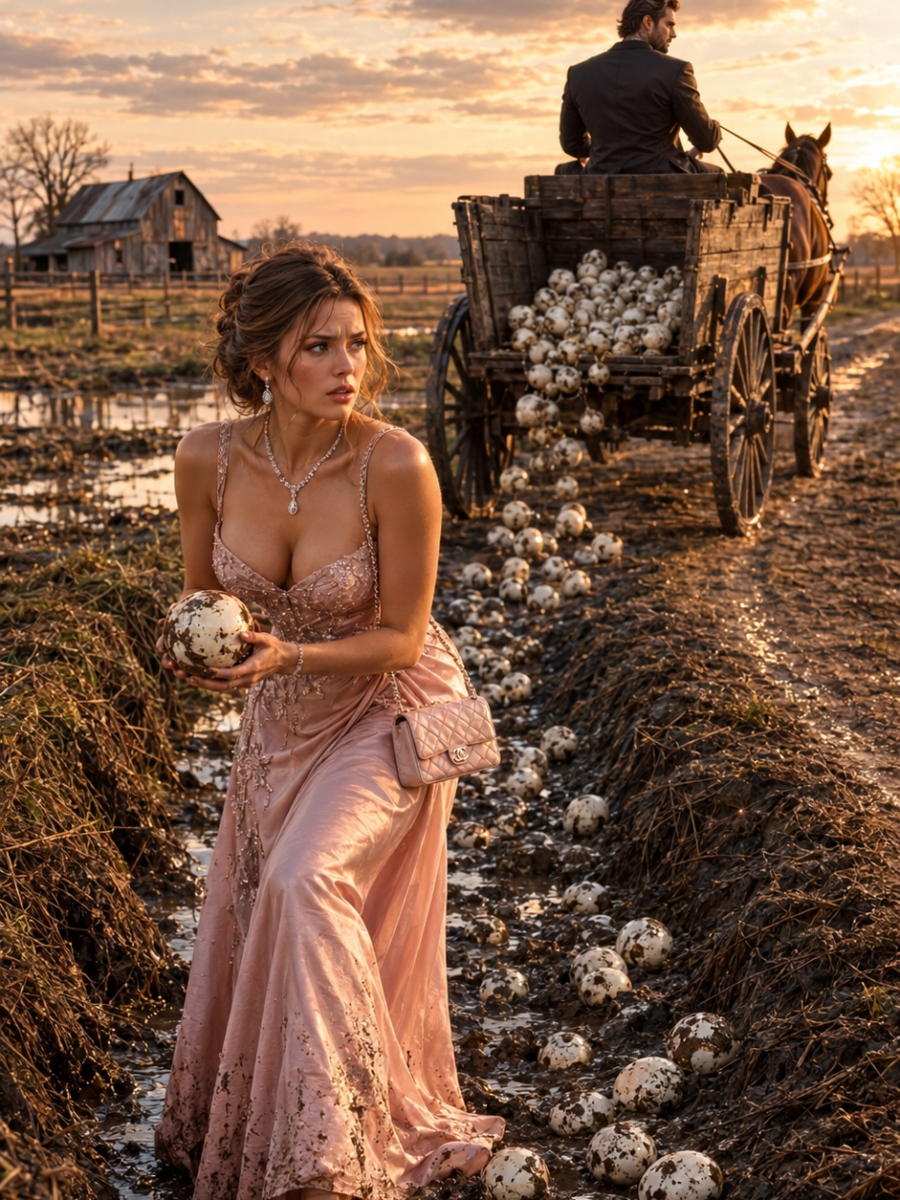
The sound that stopped Rowan Mercer in her tracks was a sharp, sickening crunch of porcelain against wet limestone. Then another. Then a rhythmic, merciless barrage as hundreds of pale, oversized eggs spilled over the iron tailgate of an interstate freight truck, cascading into the muddy drainage ditch alongside County Route 9.
Rowan stood frozen on the gravel shoulder, the autumn wind whipping strands of auburn hair across her face. At twenty-six, she possessed a quiet, resilient poise—the kind forged not in luxury salons, but in the stubborn determination to survive when everything you owned could be packed into a single leather valise. She wore a simple tweed walking jacket over a grey woolen skirt, carrying an empty wicker basket on her routine walk toward the post office.
The freight truck was an enormous commercial hauler bearing the faded blue stencil of an Atlanta poultry logistics syndicate. The driver, a stocky man in grease-streaked canvas overalls, shoved a heavy wooden lever with both hands, clearing the final crate from the bed.
Three hundred and fifty goose eggs tumbled into the muck. Some shattered instantly, splashing thick yellow yolks across the wet weeds and murky puddle water. Others rolled into clumps of sod, their heavy shells coated in grey slime and crushed gravel.
Yet as Rowan stepped closer, her heart gave a sudden, painful jolt. In the crisp chill of the October morning, faint steam was rising from the mounds of eggs. They were not cold. They were not spoiled. They had been pulled directly from commercial warmers only hours earlier.
To the corporate carrier, this was simply write-off inventory—rejected merchandise to be cleared before the driver clocked out at the regional depot. But to Rowan Mercer, standing at the edge of the ditch with the wind biting at her cheeks, those three hundred and fifty eggs looked like living creatures being buried alive before they ever had the chance to draw breath.
“Rejected batch,” the driver muttered, wiping his oily hands onto a rag as he hopped down from the cab step. “Buyer in the city canceled the shipment because of hairline fractures suffered over the washboard dirt roads. Corporate protocol says dump them. If one develops sulfur rot, the entire transport bay fails quarantine.”
He tossed the stained rag back onto the floorboard and looked at Rowan with lazy indifference. “You want them, lady? Take as many as you can haul. Otherwise, the stray dogs will have an all-you-can-eat breakfast before sundown.”
He slammed the cab door, ground the transmission into first gear, and roared away down the country lane, leaving a stinging cloud of blue diesel smoke hanging over the crossroads.
Rowan stood alone in the absolute silence of the Georgia countryside. She looked down into the muddy culvert. Broken shells. Sullied potential. Discarded life.
And right there, beneath the pale autumn sky, Rowan made a decision that would give the wealthy elites of Caldwell Flats their favorite joke for the next half-year. She set down her basket, hiked up her woolen skirts, and climbed straight down into the freezing mud.
Chapter 2: “Old Mercer Left You an Apology”
The residents of Caldwell Flats already viewed Rowan Mercer as an outsider destined for financial ruin. Two months prior, she had arrived in the small rural township following the unexpected passing of her eccentric uncle, Silas Mercer. Silas had been a stubborn, reclusive former surveyor who owned ten acres on the eastern border of the township. In his will, he had bequeathed the entire parcel to Rowan.
On paper, an inheritance of ten acres sounded like a promising fresh start. But in reality, the locals called the parcel “the Sink.”
It was a sunken depression at the base of the county ridge where rainwater gathered and stagnated. The soil was a dense, black peat that stayed waterlogged even through August droughts, smelling of heavy bog iron and wild marsh grass. No commercial farmer had ever managed to harvest a crop from it. Corn roots drowned, and cattle refused to graze on the sour water-reeds.
During Rowan’s first visit to the county records office, she had overheard town land baron Thaddeus Vance chuckling behind a frosted glass partition: ‘Old Silas didn’t leave that girl an inheritance. He left her an apology for dying broke.’
Rowan had kept her composure, but the words had burned into her memory. She had only eighty-three dollars remaining from her savings, two changes of clothes, and ten acres of soggy bog that nobody wanted. She knew what it was like to be written off as worthless.
And now, she had three hundred and fifty unwanted goose eggs lying in a roadside trench.
For four grueling hours, Rowan waded through the icy mud of the ditch. She retrieved each heavy egg with trembling fingers, wiped away the slime with the hem of her apron, and examined the shell against the midday light. Out of three hundred and fifty, seventy-five had suffered fatal crushes. But two hundred and seventy-five shells had survived with only minor cosmetic cracks or superficial scrapes, their protective inner membranes completely unbroken.
She lined her wicker basket with dry straw, loaded eight heavy eggs at a time, and carried them back to the old red timber barn standing on the Sink. It was an exhausting half-mile trek. She made six round trips without stopping to eat or rest, her boots filled with freezing swamp water, her arms aching from the weight.
By evening, the news had circulated through the town square. In the back room of the town bank, Thaddeus Vance leaned back in his leather chair and laughed loudly with his associates: “Did you hear about Mercer’s niece? The girl is wading through ditch water collecting spoiled eggs! She thinks she’s going to turn that mudhole into a poultry plantation!”
The room had roared with amusement. But Rowan didn’t care about their laughter. She walked past the bank’s plate-glass window carrying a twenty-pound sack of cracked grain and five gallons of heating oil, her gaze fixed straight ahead.
Chapter 3: The Vigil in the Cedar Barn
Inside the drafty timber barn at the Sink, Rowan Mercer mounted a desperate defense for two hundred and seventy-five unborn lives. The barn was framed from old-growth cypress timber, sturdy but weathered by decades of neglect. Rowan spent three full days sealing every knothole and wall crack with dry marsh grass, wet clay, and pitch to prevent winter drafts from chilling the interior.
She constructed four wide incubation trays from scrap cedar planks, filling them with fragrant pine shavings. To maintain the necessary heat, she set up two commercial kerosene lanterns beneath curved zinc reflectors, monitoring thermometers hung at egg height every single hour.
Every night in total darkness, Rowan candled each egg using an electric focusing torch she had bought with her last remaining savings. Holding the cold porcelain shells against the lens, she searched for the faint, miraculous crimson web of tiny blood vessels branching outward from a beating heart.
Every six hours, she rotated every single egg by hand, turning them carefully to prevent embryonic adhesion. She rarely slept more than three broken hours a night, resting on a rough canvas cot beside the warming trays, waking instantly whenever the winter wind rattled the tin roof.
Three long, agonizing weeks slipped away.
Thirty-three eggs turned dark and cold, their delicate life cycles failing. Rowan wept in silence as she carried each one out into the meadow to bury them beneath the roots of the ancient willow tree. Doubt gnawed at her mind like a persistent winter frost. Was Thaddeus Vance right? Was she just a stubborn fool clinging to things the world had thrown away?
On the twenty-eighth night, an icy rainstorm lashed against Caldwell County, wind howling through the cypress trees like a furious beast. Rowan sat wrapped in an old woolen quilt, shivering beside the lantern light, her body shaking from bone-deep exhaustion.
Then, amidst the rattling of the storm, a faint, distinct sound broke the silence of the barn.
Tap.
Rowan held her breath. Her teacup remained suspended in the air.
Tap… tap… crack!
Dropping the cup, Rowan scrambled to her knees beside the front cedar tray. In the golden glow of the lamp, she saw a starburst fracture spreading across the tip of a massive white egg. A tiny, pink horn-tipped beak broke through the shell, followed by a fierce, triumphant little chirp.
Before Rowan could wipe the tears from her cheeks, another shell began rocking on the pine shavings. Then five more! Then twenty! Within an hour, the quiet barn was transformed into a joyous symphony of cracking shells, fluttering wings, and sweet, piping voices calling out for their mother.
Rowan buried her face in her hands, weeping tears of pure, overwhelming gratitude. By dawn, two hundred and forty-two vibrant, golden goslings were stumbling across the cedar shavings, pecking playfully at her fingers with boundless vitality.
Chapter 4: The Miracle in the Quagmire
As spring swept across the Georgia hills, Rowan Mercer witnessed a transformation that defied every agricultural textbook in the county. When she opened the barn doors and led her two hundred and forty-two growing goslings out into the waters of the Sink, the true nature of the property revealed itself.
The discarded eggs had not been common commercial layers. They were purebred Royal Emden and French Toulouse heritage geese—an elite continental breed renowned for their imposing size, gentle disposition, and extraordinarily dense down plumage.
More importantly, the marsh was not a worthless mudhole—it was an ideal natural paradise designed for waterfowl. The water of the Sink was fed by deep subterranean springs enriched with natural bog iron, minerals, wild watercress, and dense marsh sedge. The geese gorged on the mineral-rich aquatic plants, receiving a natural organic diet that no dry-lot commercial farm could ever match.
Their growth was staggering. Within five months, they matured into majestic, broad-chested birds standing nearly three feet tall, with regal arched necks and plumage so brilliantly white and dense that they seemed to glow like polished silver across the dark surface of the pond.
Even more miraculously, the flock restored the health of the entire ten-acre basin. By grazing down the sour weeds and aerating the peat with their webbed feet, they opened up clogged spring channels. The stagnant standing water cleared into crystal-clear pools. Wild yellow flag irises and native marsh mint flourished along the banks, transforming the once-ugly quagmire into a pristine, sunlit wetland sanctuary.
Rowan cared for every bird with fierce affection, but none was closer to her heart than ‘Barnaby,’ a massive gander with a bright orange bill and watchful eyes. Barnaby followed Rowan wherever she walked on the farm, honking softly in greeting and standing guard like a loyal soldier whenever strangers approached the perimeter fence.
The swamp the town had mocked was now the most fertile parcel of waterfowl acreage in the state.
Chapter 5: Thaddeus Vance’s Foreclosure Ultimatum
In a small town where power was concentrated in a few wealthy hands, success from an independent newcomer was viewed as an unforgivable offense. In late May, as Rowan stood near the pond watching her two hundred and forty-two geese swim peacefully in the afternoon sun, a polished carriage rolled up to the gate of the Sink.
Thaddeus Vance stepped down onto the dirt lane. Vance was the wealthiest man in Caldwell Flats—town bank president, commercial grain baron, and chairman of the county board of commissioners. Dressed in a sharply tailored charcoal suit with a silk cravat and polished leather boots, he surveyed the thriving wetland with eyes full of predatory ambition.
“Rowan,” Vance said, offering a tight, patronizing smile as he leaned against the paddock gate. “I must admit, you’ve kept these birds looking surprisingly presentable. Quite an achievement for a woman with no agricultural backing.”
Rowan walked over to the fence, Barnaby marching faithfully at her side with his broad chest thrust forward. “What brings you out to the Sink, Mr. Vance?”
Vance pulled a crisp legal document bearing the red wax seal of the county tax board from his breast pocket. “Official county business, Rowan. During our annual spring ledger review, the board identified four hundred and ninety-two dollars in unpaid municipal drainage assessments levied against this parcel during your late uncle’s final years.”
Rowan felt an icy chill tighten around her ribs. Five hundred dollars was an impossible amount of money for an independent farmer with no bank line of credit.
“Uncle Silas never mentioned any drainage assessment,” Rowan said evenly.
“A county commission resolution passed three years ago,” Vance replied smoothly, taking a slow step closer and lowering his voice. “The board held an emergency session yesterday and called the note. If the four hundred and ninety-two dollars is not paid in full by Friday at noon, the county will seize the property under tax lien and sell it at auction on the courthouse steps.”
Vance watched her face, waiting for her to break. When Rowan remained standing like stone, he offered his poisoned olive branch. “Now, I’m willing to be generous, Rowan. I’ll settle the four hundred and ninety-two dollars with the county treasury myself. On top of that, I’ll hand you eighty dollars in cash right now to pack your bags and leave town on the Friday evening train. Because if you wait until noon on Friday, you’ll be evicted by the sheriff with empty pockets.”
Rowan looked at the foreclosure notice. Then she looked across the glittering water at her magnificent flock of white geese. She looked Thaddeus Vance dead in the eye.
“The county notice gives until Friday at twelve o’clock noon, Mr. Vance,” Rowan said in a voice steady as iron. “I will see you at the barn gates.”
Vance’s smug smile vanished, replaced by an ugly scowl. “Friday at noon, young lady! Have your luggage sitting on the porch!”
Chapter 6: The Black Sedans from Fifth Avenue
Rowan Mercer did not pack a single piece of luggage. Three weeks before Vance’s visit, she had taken the ultimate gamble.
Knowing that her heritage geese were producing the highest grade of organic eggs in the region, Rowan had packed four crates of oversized eggs in fragrant cedar shavings and shipped them via priority express freight to New York City. She had addressed them directly to Monsieur Henri Delacroix, the legendary executive chef of the St. Regis Hotel on Fifth Avenue, along with a certified sample of hand-harvested Royal Emden cluster down plumage.
On Thursday afternoon—less than twenty-four hours before the foreclosure deadline—the quiet tranquility of Caldwell Flats was shattered by a spectacle the town would talk about for decades.
Two gleaming, midnight-black Packard limousines, their polished chrome bumpers reflecting the midday sun, purred smoothly down Main Street. Townspeople spilled out of the barber shops, diners, and hardware stores, staring in disbelief as the luxury motorcars rolled right past Vance’s bank and turned down the dirt approach to the Sink.
The cars pulled to a halt outside the red timber barn. From the front limousine stepped Monsieur Henri Delacroix himself, accompanied by Marcus Vance—the renowned New York textile and culinary guild investor—and two corporate attorneys in tailored bespoke suits.
“Mademoiselle Mercer!” Delacroix exclaimed, stepping forward with profound respect and taking off his fedora. “Your goose eggs… our master pastry chefs in Manhattan were stunned! The richness of the yolks and the mineral balance from this natural peat basin are completely incomparable to anything in the American market! It is of the exact calibre of the finest heritage poultry estates of Normandy!”
Marcus Vance walked down to the edge of the pond, watching the magnificent white flock glide across the sparkling water. He knelt down, picked up a cluster of molted down feathers clinging to the clover, and examined the fibers with expert eyes. A slow, appreciative smile spread across his chiseled face.
“This is genuine triple-washed Royal cluster down,” Marcus said, looking directly at Rowan with genuine admiration. “Top luxury coat designers in New York and Milan pay eighty dollars a pound for down with this loft density.”
On the weathered wooden table inside the barn, the corporate attorneys unrolled an exclusive five-year procurement contract: a guaranteed order for four thousand heritage eggs annually, six hundred pounds of down, and an immediate upfront non-refundable cash advance of fifteen thousand dollars in certified bank drafts.
Chapter 7: The Face-Off at High Noon
On Friday morning at eleven-forty-five, more than seventy residents of Caldwell Flats gathered outside the red timber barn at the Sink. Thaddeus Vance stood at the head of the crowd, dressed in his finest Sunday broadcloth suit, holding his gold pocket watch in his palm. Beside him stood the county sheriff, the tax assessor, and a dozen smiling cronies ready to padlock the gates and begin the auction.
“Time’s up, Rowan!” Vance shouted with theatrical mock-sympathy, his voice booming across the meadow. “Twelve o’clock is three minutes away! Bring out the deed, hand over the keys, and take your eighty dollars before the sheriff steps in!”
Whispers rippled through the crowd. Some looked on with pity; others smiled with cruel anticipation.
At precisely eleven-fifty-nine, the heavy iron lock bar on the barn doors clattered upward. Slowly, with dramatic weight, the double cypress doors swung wide open.
Rowan Mercer stepped out into the blazing noon sun. She was dressed in an elegant dark emerald-green velvet coat over an ivory silk blouse, her auburn hair styled with effortless sophistication. Behind her stood Monsieur Delacroix, Marcus Vance, and two armed private security guards in tailored suits.
Rowan walked directly up to Thaddeus Vance, her heels clicking crisply on the gravel. She stopped two feet from him, meeting his sneer with eyes of cold, unwavering resolve.
Without saying a single word, Rowan reached into her leather envelope, pulled out five crisp, brand-new one-hundred-dollar bills, and slapped them firmly against Thaddeus Vance’s chest.
“Four hundred and ninety-two dollars for the delinquent drainage assessment,” Rowan announced in a clear, ringing voice that reached every ear in the silent crowd. “And here is an additional five hundred dollars to prepay all county taxes for the next five years. Write my receipt, Mr. Vance.”
Thaddeus Vance stared at the cash in his hands, his face turning from flushed arrogance to a sickly, pale grey. His hands trembled violently as he fumbled for his spectacles. “Where… where did a girl like you get this kind of money?!”
Marcus Vance stepped forward from behind Rowan, his broad shoulders and commanding presence casting a long shadow over the town banker. “She earned it through legitimate commerce with the St. Regis Hotel and the Fifth Avenue Textile Guild, Thaddeus. And if you attempt to harass our primary agricultural supplier ever again, our corporate legal team will tie you up in federal antitrust court until you’re bankrupt.”
Thaddeus Vance swallowed hard, shrinking back into the crowd like a chastised schoolboy.
Rowan turned her back on him and gave a soft, familiar whistle toward the open barn.
From the shadows marched the flock. Two hundred and forty-two magnificent, pure white Royal geese stepped out into the bright sunshine in proud, synchronized formation. Their feathers gleamed like polished silver under the noon sky, their regal heads held high as Barnaby led them down toward the sparkling waters of the Sink, honking in joyous, deafening triumph.
The entire town of Caldwell Flats stood frozen in absolute, stunned silence. The mocking laughter that had lasted six months vanished forever, replaced by profound, permanent respect.
Rowan Mercer stood by the water’s edge, the warm Georgia breeze stirring her hair, looking out over the land they had called worthless mud. She had turned broken shells into an empire, and in doing so, she had proved that true worth is never dictated by those who throw things away—it is born in the hearts of those brave enough to bring them to life.