Table Twelve at Le Mirage, The Cold Water in the Lap, and The Handyman Don
Table of Contents
- Chapter 1: The Ice Water at Table Twelve
- Chapter 2: The Linen Towel and the Assistant Pastry Chef
- Chapter 3: The Platinum Signet Ring from the Coveralls
- Chapter 4: Ten Maybachs on East 65th Street
- Chapter 5: The Foreclosure on the Hedge Fund Father
- Chapter 6: Dinner with the Bravest Woman in New York
- Chapter 7: A Thousand Calla Lilies at Table Twelve
- Chapter 8: The Nuptial Mass at St. Patrick’s
- Chapter 9: Cinnamon Rolls and the Cedar Treehouse
Chapter 1: The Ice Water at Table Twelve
Nobody in the crystal-chandeliered dining room of Le Mirage on Manhattan’s Upper East Side knew that the man being publicly humiliated at Table Twelve was the undisputed ruler of New York’s underworld.
I sat on a gilded velvet dining chair, dressed in worn, navy-blue work coveralls with grease stains on the knees, scuffed steel-toe Red Wing work boots, and a faded denim jacket. My hands were rough, calloused, with faint streaks of carbon blacking beneath my fingernails from spending the afternoon personally repairing the commercial refrigeration compressor in the basement.
Across the linen-covered table sat Julianna Vance.
Julianna was twenty-five, the daughter of a prominent Wall Street venture capitalist, draped in a three-thousand-dollar white silk cocktail dress, wearing diamond solitaire earrings and a five-carat tennis bracelet. Her lips were painted in aggressive crimson, curled into a sneer of utter, unbridled disgust.
“This has to be a sick joke,” Julianna said, her voice rising so loud that conversations at the surrounding tables ceased, wealthy patrons in tuxedos and evening gowns turning their heads in amused curiosity. “My aunt told me she had arranged a dinner with ‘Dominic’, an established entrepreneur with real estate in five boroughs. And you walk in here looking like an illiterate gutter plumber who crawled out of a sewer drain?”
I didn’t answer right away.
I picked up the crystal water glass, taking a slow, calm sip.
My name was Dominic Rossi. I commanded five thousand men across the eastern seaboard, controlled the docks from Boston to Baltimore, and held twenty-eight billion dollars in commercial real estate, shipping fleets, and sovereign debt instruments. I also owned the very building Le Mirage occupied, having bought the historic five-story townhouse in cash four years ago.
I had deliberately dressed in my work coveralls tonight.
My late grandmother had always taught me: *“If you want to know a person’s true soul, Dominic, dress like a beggar. The fools will spit on you; the worthy will offer you bread.”*
Julianna had failed the test in less than forty seconds.
“A man’s worth isn’t determined by the fabric on his back, Julianna,” I said calmly, my deep, steady baritone cutting through the hush of the dining room. “I work with my hands. I build things that endure. Perhaps if you gave a conversation five minutes before judging the clothes, you might discover something of substance.”
Julianna laughed—a sharp, piercing, venomous shriek that echoed off the gilded ceiling.
“Substance?” she scoffed, picking up her heavy crystal water goblet filled with crushed ice. “A grease monkey lecturing me on substance? You probably had to save your entire month’s wage just to buy a basket of bread in this restaurant! Let me teach you your place in Manhattan, you pathetic little peasant!”
With a violent flick of her wrist, Julianna hurled the contents of the heavy glass directly into my lap.
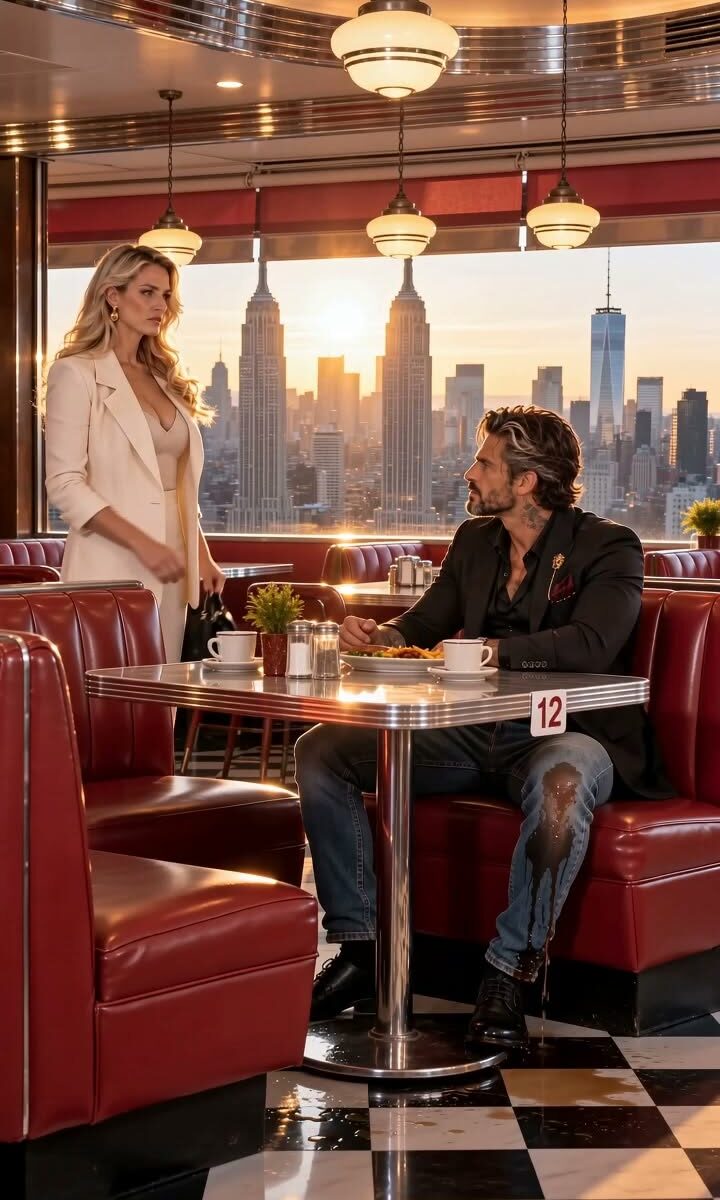
The freezing, ice-cold water soaked through the denim of my coveralls, chilling my thighs, ice cubes clattering against the polished hardwood floor beneath our table.
The surrounding diners gasped. Several wealthy men laughed quietly behind their napkins.
I didn’t flinch. I didn’t shout.
I set my glass down on the white tablecloth with slow, terrifying precision, looking at the arrogant socialite with eyes as cold as deep ocean trenches.
Chapter 2: The Linen Towel and the Assistant Pastry Chef
“Julianna,” I said, my voice so quiet she had to lean forward to hear it, but vibrating with a subterranean power that made her smirk waver slightly at the edges. “You just made the most expensive mistake of your entire life.”
“Oh, really? What are you going to do, call your union rep?” Julianna sneered, snapping her manicured fingers toward the head waiter. “Maitre d’! Get over here right now!”
The restaurant’s general manager, a pompous Frenchman named Henri Laurent, rushed across the dining room, his face pale with horror as he took in the spectacle of an heiress shouting at a man in dirty coveralls.
“Mademoiselle Vance! Is there a problem?” Henri asked, bowing deferentially.
“This filthy tramp snuck into your establishment and ruined my dinner!” Julianna declared, pointing a diamond-encrusted finger at my face. “He has grease on his clothes, he smells like machine oil, and he had the audacity to speak to me! Have your security throw him into the alley this instant, or I will have my father cancel his corporate account with this restaurant!”
Henri turned his nose up, regarding me with withering, bureaucratic contempt.
“Sir, you are in violation of our strict dress code,” Henri sniffed, gesturing toward the entrance. “Get up from that chair and leave the premises immediately, or I will have the police escort you out for criminal trespass.”
Before Henri could finish his threat, the heavy swinging double doors of the pastry kitchen parted.
A young woman walked out carrying a silver tray.
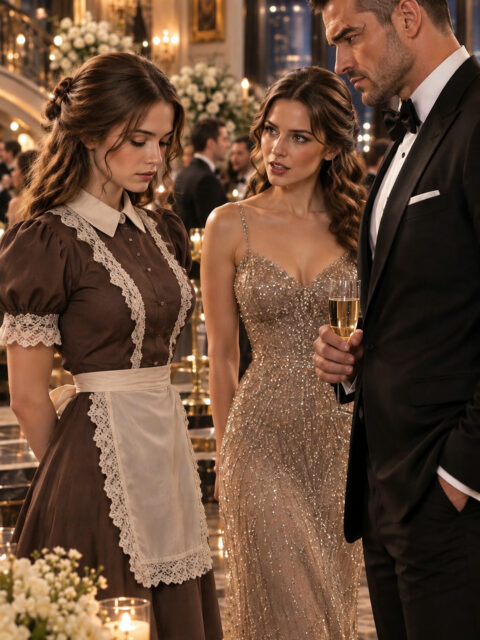
She wore a crisp white chef’s coat dusted lightly with powdered sugar, dark hair tucked neatly into a baker’s mesh net, and a warm, radiant face with big, honest hazel eyes. Her embroidered name badge read: *Clara Miller – Assistant Pastry Chef.*
Clara had witnessed the entire scene from the service station.
Instead of shrinking away like the rest of the staff, she marched straight to Table Twelve, her eyes burning with fierce, righteous indignation.
“That’s enough!” Clara said, her voice clear, bell-like, and carrying the authority of an angel standing before wolves.
Henri’s eyes bugged out in shock. “Mademoiselle Miller! Return to the pastry station immediately! You have no business—”
“I have plenty of business when a guest is being treated like an animal in this restaurant, Chef Laurent,” Clara interrupted firmly.
She set her silver tray on the table, pulled a clean, dry, warm linen service towel from her apron, and knelt directly beside my soaked legs on the hardwood floor.
Without a shred of hesitation, without caring that my coveralls were covered in machinery soot and grease, Clara gently patted the freezing ice water from my trousers, looking up into my face with eyes full of pure, unblemished kindness.
“I’m so sorry, sir,” Clara whispered softly, her warm hands steady and comforting against my wet clothes. “Nobody deserves to be treated with such cruelty. Please… let me bring you a hot bowl of soup and a warm jacket from the staff room.”
Chapter 3: The Platinum Signet Ring from the Coveralls
I looked down at the young woman kneeling at my feet.
Her hands were warm through the damp fabric of my trousers. There was no pity in her eyes—only that rare, radiant human dignity that sees the inherent worth of another living soul regardless of circumstances.
In thirty-five years of surviving the brutal, predatory warfare of New York’s underworld, I had met hundreds of beautiful women: supermodels, heiresses, foreign diplomats. Every single one of them had looked at my money, my power, or my title.
Not one of them had ever looked at the man beneath the clothes.
Except Clara.
Beside the table, Julianna Vance let out a screech of outraged disgust.
“What kind of gutter circus is this?” Julianna shrieked, stomping her Louboutin heel against the floor. “The pastry girl is wiping down a dirty mechanic? Henri, fire her! Fire her right now in front of everyone!”
Henri Laurent’s face was beet-red. “Mademoiselle Miller, you are terminated! Hand over your apron and leave this building—”
“I will leave, Chef Laurent,” Clara said, rising to her feet with her chin held high, her posture unyielding. “Because I would rather work twelve hours a day washing dishes in a soup kitchen than serve arrogant bullies who think money gives them the right to humiliate honest working men.”
Clara picked up the warm bowl of French onion soup from her tray, set it gently before me, and smiled warmly:
“Please eat this, sir. It will warm you up before you go home.”
Julianna, incandescent with petty rage that an assistant baker had defied her, lunged forward with her manicured hand, slapping the ceramic bowl off the table.
*SMASH!*
The heavy ceramic shattered against the hardwood, hot broth splashing across the white tablecloth and staining the hem of Clara’s white chef coat.
Clara gasped, stumbling backward against the neighboring table.
In that single, fraction of a second, the universe inside my chest went deathly, terrifyingly cold.
I moved.
Before Clara’s body could touch the floor, my right arm snapped out, catching her around the waist in a grip of solid iron, lifting her gently back onto her feet behind my shoulder.
Then, I turned my gaze upon Julianna Vance.
My gray eyes were no longer those of a weary mechanic. They were the cold, lethal embers of a predator that had just unlocked its cage.
The dining room fell into an unnatural, suffocating silence.
The wealthy patrons who had been snickering stopped dead in their tracks. A sudden, primeval chill seemed to sweep through the room, making the hair on the back of everyone’s neck stand up.
I reached into the chest pocket of my grease-stained coveralls.
I pulled out a heavy, antique signet ring forged from solid Russian platinum, deeply engraved with the roaring lion and crossed daggers of the House of Rossi.
I slid the heavy ring onto the middle finger of my right hand with a slow, deliberate click.
Chapter 4: Ten Maybachs on East 65th Street
I picked up the silver dessert fork from the table, spun it once between my fingers, and drove the steel tines two inches deep into the solid mahogany tabletop with a single, concussive downward strike of my palm.
*THWACK!*
The fork vibrated like a tuning fork in the dead silence.
Julianna took an instinctive step backward, her lips parting, a cold prickle of dread tracing down her spine. “Who… who are you?”
I didn’t answer her.
I reached into my coveralls, pulled out an encrypted satellite phone made of brushed titanium, and pressed a single button on the keypad.
The speakerphone chimed once, and a voice resonated through the quiet dining room—deep, gravelly, vibrating with terrifying military authority:
“Don Dominic. Report.”
Julianna frowned, confused. “Don… Dominic?”
“Marco,” I said into the phone, my voice flat, calm, and carrying the weight of an executioner’s axe. “Le Mirage. Dining Room. Now.”
“Understood, Boss. Thirty seconds.”
Before Henri Laurent or Julianna could utter another word, the street outside the floor-to-ceiling glass windows of Le Mirage erupted into blinding white headlights.
Ten black Mercedes-Maybach sedans and three armored Cadillac Escalades tore onto East 65th Street, mounting the curb, blocking the street in both directions.
Doors flew open in absolute, synchronized discipline.
Forty men dressed in bespoke charcoal suits with black ties, their tactical submachine guns concealed beneath heavy overcoats, swarmed through the brass revolving doors of the restaurant.
Patrons shrieked in panic, dropping their silverware, frozen in terror as the armed security detail established a perimeter around every exit, kitchen door, and window.
Leading the detail was Marco Moretti, six feet four inches of battle-hardened muscle, wearing a Rossi signet ring on his pinky finger.
Marco marched down the center carpet, his polished leather shoes clicking sharply against the floor. He stopped three feet from where I stood, snapped his heels together, and bowed his head in deep, absolute reverence:
“Don Dominic. The building is secured. Your orders, Boss?”
Forty armed men echoed in unison, their voices thundering off the gilded ceiling like a sonic boom:
“DON DOMINIC!”
Chapter 5: The Foreclosure on the Hedge Fund Father
The entire dining room of Le Mirage seemed to lose all oxygen at once.
Henri Laurent’s face turned the color of ash. His knees turned to liquid water, and he collapsed onto the carpet beside the shattered soup bowl, hyperventilating in sheer, catatonic horror.
“Don… Don Dominic Rossi…?” Henri wheezed, clutching his chest. “The… the owner of the building… the head of the Rossi Syndicate…”
Julianna Vance stood frozen, her eyes bulging, her jaw hanging slack as her champagne glass slipped from her fingers, shattering across her white dress.
“No… no, that’s impossible…” Julianna stammered, backing away toward the wall, her hands trembling violently. “You’re… you’re a mechanic… you repair refrigerators…”
“I own the refrigeration company, Julianna,” I said calmly, stepping forward, the Red Wing boots clicking with heavy authority against the floor. “I also own the restaurant. I own the four-story townhouse above your head. And as of forty-eight hours ago, my holding company acquired eighty-four million dollars of your father’s distressed venture capital debt from Credit Suisse.”
Julianna grabbed her throat, a dry, choking gasp escaping her lips. “My… my father’s debt?”
I turned to Marco.
“Marco. Call Arthur Vance,” I commanded. “Put him on the speaker.”
Marco dialed the number on his secure tablet. The phone was answered on the first ring by Arthur Vance, the prominent Wall Street investor:
“Hello? Mr. Moretti? Did Don Dominic review our debt restructuring proposal?”
“Arthur,” I spoke into the mic, my voice cutting through the restaurant like a laser. “This is Dominic Rossi.”
On the other end of the line, Arthur Vance’s voice instantly transformed into fawning, groveling desperation:
“Don Dominic! Sir! What a profound honor! We are so extraordinarily grateful for your audience! I understand my daughter Julianna was meeting you for dinner tonight—”
“Your daughter just dumped a glass of ice water into my lap,” I interrupted coldly. “She called me a gutter rat, demanded I be thrown into the alley, and shattered a bowl of soup over my assistant pastry chef’s uniform.”
Absolute, deafening silence hung on the phone line for three seconds.
Then, Arthur Vance’s voice cracked into a scream of pure, unadulterated panic that blasted through the speaker:
“Julianna! You brainless, arrogant idiot! What did you do? What did you do to Don Dominic?”
“Daddy… please…” Julianna wept, collapsing against the wallpaper.
“Don Dominic,” Arthur Vance sobbed through the phone. “Please! Have mercy! I will disown her! I will force her to apologize on her knees! Don’t execute the debt call!”
“The call is executed, Arthur,” I said evenly. “Tomorrow morning at eight-thirty, my legal team will file for immediate judicial foreclosure on your Manhattan penthouse, your Hamptons estate, and your investment portfolio. You are ruined.”
I tapped the screen, terminating the call.
Chapter 6: Dinner with the Bravest Woman in New York
Julianna collapsed to the floor in her ruined white dress, weeping hysterically, her face buried in her hands as the patrons she had once looked down upon stared at her with withering, disgusted contempt.
I didn’t spare her another glance.
I turned slowly toward Henri Laurent, who was trembling on his knees beside the shattered ceramic.
“Henri,” I said, my voice low and dangerous.
“Don Dominic! Please! Forgive me! I didn’t know!” Henri cried out, pressing his forehead against the carpet in desperate supplication. “I was only enforcing the dress code! I swear on my mother’s grave!”
“You were enforcing cruelty, Henri,” I replied quietly. “You saw an arrogant rich woman bullying a defenseless man, and you chose to kick the man while he was down. You fired a talented, compassionate employee because she dared to show basic human decency.”
I looked at Marco.
“Strip Henri Laurent of his credentials. Remove him from this building within ten minutes. And ensure that every Michelin-starred establishment in North America is notified of his termination with cause.”
“No! Please, Don Dominic!” Henri wailed as two armed guards hauled him to his feet by his collar, dragging him out toward the service exit.
The dining room settled into reverent, pin-drop silence once more.
I turned around.
Standing behind me, her eyes wide with shock, holding her linen towel against her chest, was Clara Miller.
She was staring at me—not with fear, not with greed, but with that same deep, honest wonder that had made her kneel beside my wet boots ten minutes earlier.
The cold, ruthless mask of the mafia Don vanished completely from my face.
I stepped toward her, reaching out with both hands, gently taking her small, trembling fingers between my own calloused palms.
“I’m sorry you had to witness that, Clara,” I whispered softly, my voice rich with warmth. “And I’m sorry your chef’s coat was ruined.”
Clara looked down at our intertwined hands, then up into my eyes.
A faint, courageous smile touched her lips.
“You really aren’t an HVAC technician, are you, sir?” she asked softly.
A genuine, hearty laugh broke from my chest—a laugh so warm and unburdened that my guards exchanged stunned, disbelieving smiles.
“I can fix a compressor if I need to, Clara,” I smiled back, looking into her hazel eyes. “But tonight… I think I’d rather have dinner with the bravest woman in New York. If you’ll do me the honor?”
Clara looked at the forty armed men, at the seventy stunned patrons, and then at the man holding her hand.
“I’d love to, Dominic,” Clara whispered with a radiant smile. “As long as we can get some clean soup.”
Chapter 7: A Thousand Calla Lilies at Table Twelve
That night began the most extraordinary chapter of my life.
I did not take Clara to an ordinary table. I cleared the entire penthouse dining terrace of the St. Regis, where my private chefs prepared a seven-course tasting menu under the stars.
We talked for five hours: about her childhood growing up on an apple orchard in Vermont, her dream of opening an artisanal community bakery, and the quiet dignity of working with one’s hands.
Clara never asked about my money. She never asked about my syndicate. She cared only about the man who had looked up from that soaked chair with eyes that longed for truth.
Within three months, I made sure the entire city of New York understood that Clara Miller was under the sacred, unyielding protection of the Rossi Empire.
I bought her the historic 19th-century bakery on Bleecker Street she had always admired, renovating it into *The Miller & Rossi Artisan Boulangerie*, staffed with union-protected apprentices and offering free culinary scholarships to underprivileged young women across the five boroughs.
And Clara… Clara transformed my soul.
Under her gentle, unshakeable moral compass, I systematically dismantled the gray-market operations of the Rossi syndicate, redirecting our capital into legitimate green maritime logistics, community housing foundations, and pediatric hospitals.
“A real Don doesn’t rule through fear, Dominic,” Clara whispered to me one evening as we stood on the balcony of my penthouse overlooking the East River. “A real Don rules through the loyalty he inspires and the defenseless he protects.”
“Then teach me how to rule like that, Clara,” I had murmured, pulling her tight against my chest, kissing her forehead.
One year after the night at Le Mirage, on a crisp autumn evening, I brought Clara back to the restaurant.
The grand dining room was empty, illuminated by a thousand beeswax candles and filled with ten thousand white calla lilies.
At Table Twelve, the mahogany table where she had once wiped the ice water from my boots, sat a single crystal vase with a blooming red rose.
I stopped in front of the table, turned to Clara, and dropped to both knees on the polished hardwood floor.
I pulled out a velvet box, opening it to reveal a magnificent, flawless five-carat oval diamond set into platinum, flanked by two teardrop emeralds.
“Clara,” I said, my voice trembling with all the love and reverence in my soul. “One year ago, you knelt on this floor to defend a broken man in dirty coveralls. You gave me your heart when you thought I had nothing. Will you do me the greatest honor of my life, and become my wife? Will you be my Queen?”
Tears of pure, crystalline joy spilled from Clara’s eyes.
She dropped to her knees beside me, wrapping her arms around my neck, kissing my lips with fierce, breathless devotion:
“Yes, Dominic! A thousand times, yes!”
Chapter 8: The Nuptial Mass at St. Patrick’s
Our wedding at St. Patrick’s Cathedral was celebrated as the union of the century.
Four hundred dignitaries—governors, international shipping partners, community organizers, and three hundred working-class bakers and mechanics—filled the historic pews.
Clara walked down the marble aisle in an off-the-shoulder gown of pure ivory French lace, looking so breathtakingly radiant that tears welled in my eyes as she placed her hand into mine.
And as for Julianna Vance and Henri Laurent?
Justice had been delivered with quiet, unyielding precision.
Arthur Vance’s firm had collapsed into bankruptcy, with their luxury assets liquidated at public auction. Julianna had been forced to move into a modest two-bedroom garden apartment in Queens, working as a retail sales associate on Fifth Avenue, watching from the shop windows as Clara’s motorcade glided past.
Henri Laurent had never managed another fine-dining establishment, spending his days working as an unaccredited food safety inspector in upstate New York.
One evening, during our honeymoon on the Amalfi Coast of Italy, Clara and I sat on the seaside terrace of our private clifftop villa, watching the sun dip into the turquoise waters of the Mediterranean.
Clara rested her head against my shoulder, her fingers intertwined with mine, the five-carat diamond catching the golden twilight.
“Do you ever miss the old days, Dominic?” Clara asked softly. “The power? The fear?”
I leaned down, pressing a tender, lingering kiss against her lips, breathing in the sweet scent of vanilla and sea salt that defined my paradise.
“I was never truly powerful until I met you, Clara,” I whispered with absolute certainty. “Fear is what cowards use to hide their weakness. Love is the only power that lasts forever.”
Chapter 9: Cinnamon Rolls and the Cedar Treehouse
Two years later, the early summer sun bathed the sprawling gardens of our Oyster Bay estate in golden warmth.
On the manicured green lawn overlooking the Long Island Sound, fourteen-month-old Lucas Rossi was taking joyful, running steps across the grass, giggling delightfully as he chased a golden retriever puppy named Barnaby.
He was strong, chubby-cheeked, with his father’s thick dark hair and his mother’s bright, laughing hazel eyes.
Clara stood on the stone veranda, wearing a soft floral sundress, carrying a silver tray with warm, freshly baked cinnamon rolls she had made in our kitchen.
I walked up behind her, dressed in a relaxed linen shirt and jeans, wrapping my arms around her waist, resting my chin against her shoulder.
“Someone smells like sweet sugar, Donna Clara,” I chuckled softly into her ear.
“And someone has sawdust on his collar, Don Dominic,” Clara laughed, turning in my arms to press a sweet, flour-dusted kiss against my lips. “Did you finish building Lucas’s treehouse?”
“Completed twenty minutes ago,” I smiled proudly, gesturing toward the ancient oak tree where a handcrafted cedar fortress stood in the branches. “Built to withstand a hurricane.”
Down on the grass, little Lucas caught the puppy’s red rubber ball, held it high above his head, and shouted toward the veranda:
“Daddy! Look! Ball!”
“I see you, my champion!” I called back, stepping down the stone stairs to sweep my son into my arms.
Clara walked down beside us, her arm looping through mine, leaning her head against my shoulder as we watched the white sailboats glide across the blue sound.
The dirty coveralls and the cold water at Table Twelve were a distant, beautiful memory—the divine spark that had brought an emperor of shadows into the eternal warmth of light.
Here by the sea, in the sanctuary we had built with truth, courage, and unconditional devotion, our reign was not written in fear.
It was written in love, unbreakable loyalty, and a peace that would shelter our family for all the generations to come.