The wind coming down off the jagged granite ridges of the Bitterroot Range carried the iron scent of winter. In Raven Pass, a high-altitude settlement carved between jagged pine forests and rushing glacial gorges, autumn did not linger like a polite guest; it slammed shut like a cellar door. By late October, the aspen leaves had already rotted into black loam, the mountain passes froze into impassable sheets of blue ice, and families took inventory of their root cellars with the grim arithmetic of survival. For those without sufficient firewood, salted pork, or a sturdy roof overhead, the five-month freeze was not merely a hardship—it was an executioner.
My name is Rachel Vance. For twenty-six months, I had lived alone on the forty-acre timber homestead my late husband, Jonah Vance, had claimed before the valley had a proper church. Jonah had been a skilled timber surveyor and blacksmith, a quiet man with kind brown eyes who believed a well-built cabin could withstand anything nature threw against it. But two years ago, while inspecting the new railway trestle across Devil’s Chasm, a support cable snapped without warning. Jonah plunged eighty feet into the raging rapids below. His body was never recovered. The railroad company paid me forty dollars in severance, closed the incident file, and left me with forty acres of rocky timber, a crooked barn, and a silence so vast it felt like drowning.
Table of Contents
- Chapter 1: The Blood on the Chopping Block
- Chapter 2: The Man They Called the Mountain
- Chapter 3: Seven Days in the Shadow of the Ridge
- Chapter 4: The Vow at Mrs. Doyle’s Hitching Post
- Chapter 5: Four Words on Yellow Paper
- Chapter 6: The Ghost in the Mountain Blizzard
- Chapter 7: The Hearth Where Spring Began
“True strength does not consist in freezing to death alone simply to prove that your armor cannot be pierced. Sometimes the bravest choice a wounded soul can make is to accept the hand that offers shelter, without surrendering the sovereignty of her own heart.”
Chapter 1: The Blood on the Chopping Block
“By winter, you’ll have my son growing inside you.”
Those were the very first words Gideon Stone ever spoke to me.
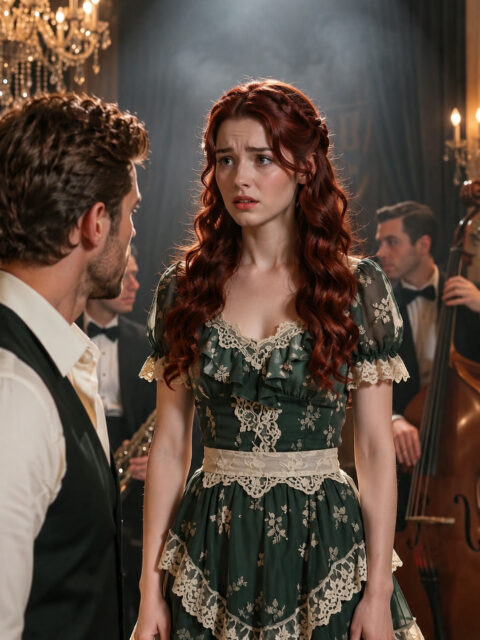
I was standing beside the pine chopping block behind my cabin, my breath coming in ragged white plumes. My hands were wrapped in grease-stained cotton flour sacks, but fresh blood was already soaking through the fabric from blistered, split palms that had spent three days wrestling six-foot tamarack logs into stove-lengths. My fingers were so numb from the biting mountain frost that I could barely feel the rough grain of the hickory axe handle. My hair was tied back with a leather thong, my faded wool coat was patched at both elbows, and inside my chest was enough raw, buried grief to make any sensible man turn his horse around and ride back to town.
I raised the five-pound double-bit felling axe with both hands, planting my muddy boots firmly in the frozen pine needles. “Take one more step toward this porch,” I warned, my voice cutting through the whistling pines, “and winter won’t be your greatest concern.”
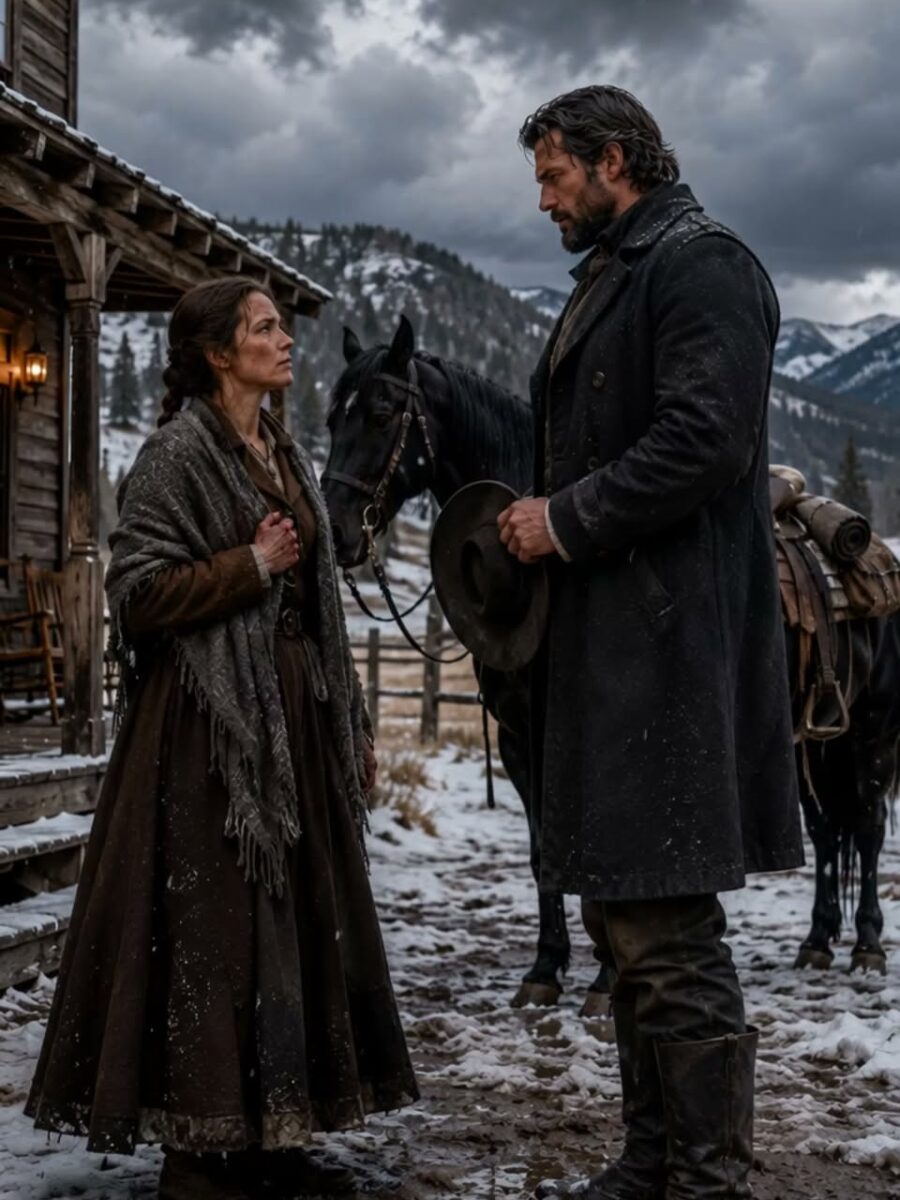
The stranger did not flinch, nor did he reach for the Winchester carbine resting in the scabbard of his saddle. He sat astride an enormous black Friesian stallion that snorted clouds of steam into the October chill. Slowly, with an easy, unhurried grace that defied his massive frame, the rider dismounted. The frozen ground seemed to groan beneath the weight of his heavy buffalo-hide boots.
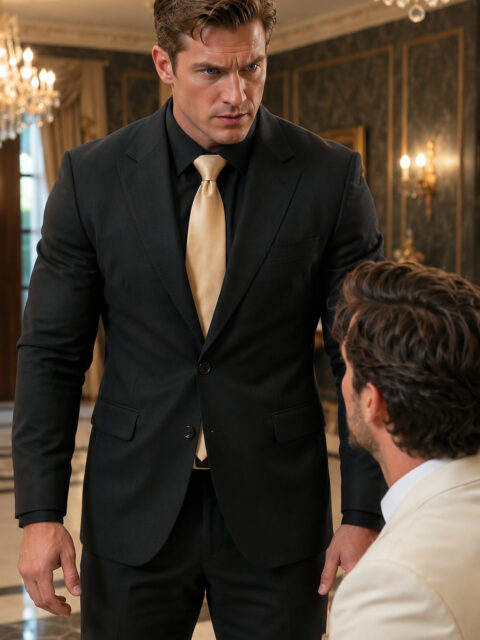
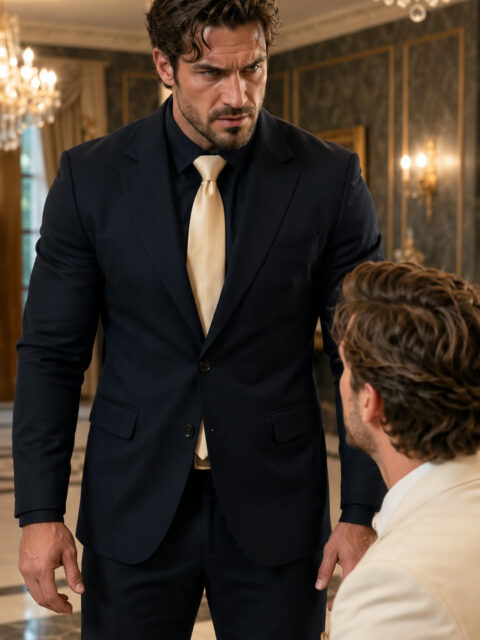
He removed his battered wide-brimmed felt hat, revealing thick, dark brown hair touched with frost at the temples. Even standing on the forest floor, he seemed to block out half the gray western sky. He was thirty-four years old, stood six feet four inches tall, and possessed broad, massive shoulders that strained against his sheepskin-lined canvas duster. His jaw looked like it had been chiseled out of mountain granite, shaded with a week of dark stubble, but his pale gray eyes were astonishingly calm and clear—like spring meltwater running over river stone.
Instead of advancing toward my raised blade, Gideon’s gaze dropped to the red stains blooming across the dirty rags on my palms.
“You’re hurt,” he said. His voice was deep and resonant, like thunder rolling across an alpine valley.
“I noticed,” I snapped back, refusing to lower the axe.
“Those cuts need to be boiled in carbolic salve and bound with clean linen before gangrene sets into the bone.”
“What I need,” I said, glaring at him with every ounce of defiance left in my exhausted body, “is for arrogant strangers to stop riding onto my land and making plans for my body.”
A flicker of genuine regret passed across his rugged features. He did not posture or make excuses. He lowered his head by half an inch, his shoulders dropping slightly. “You’re right,” he said quietly. “That was poorly spoken. Clumsy and poorly spoken.”
“Poorly?” I echoed, my chest heaving. “You ride onto a widow’s homestead like a medieval warlord, announce you intend to put a child in her, and call it clumsy?”
“Very poorly,” he repeated, his pale eyes steady on mine. “I have spent eight months in timber camps among rough lumberjacks and muleskinners. My tongue has forgotten the cadence of decent society. I ask your pardon, Mrs. Vance.”
Chapter 2: The Man They Called the Mountain
Against my will, the sheer bluntness of his apology drained some of the venom from my throat. I lowered the axe until the bit rested against the top of the chopping block, but my bloody fingers never left the handle.
“Who are you?” I demanded.
“Gideon Stone.”
My grip tightened instinctively. Everyone in Raven Pass, and across three territories, knew that name. They called him the Mountain. Men spoke of him in hushed, awe-filled tones around saloon woodstoves. Stories claimed he had lifted an overturned supply wagon off a pinned teamster with his bare back; that during the Great Freeze of 1888, he had carried diphtheria antitoxin forty miles over the pass on snowshoes when every pack mule had frozen to death; and that he owned two hundred square miles of virgin timber, three lumber mills, and water rights extending all the way to the Bitterroot fork.
Until that moment, I had assumed the local prospectors were weaving tall tales over cheap whiskey. Looking at the sheer physical bulk of the man standing by his black stallion, I realized they had actually understated his presence.
“What do you want on Jonah’s land, Mr. Stone?”
Gideon turned his head slowly, taking in the scene with an experienced timberman’s eye: the sagging roofline of my two-room log cabin, the barn with three rotted siding boards, the stone chimney weeping mortar, and the pathetic, knee-high stack of split tamarack that wouldn’t last through December.
“I’ve watched you from the ridge over the last two seasons,” Gideon said. “I watched you clear three acres of slash after the spring landslides. I watched you mend that pasture fence by lantern light in the rain. You kept this homestead standing for two years after Jonah died, while every other widow in the territory took the stage back East or married the first drunken cardsharp who offered a room.”
“Watching is comfortable work for a man with three full mills and a hot breakfast,” I replied coldly.
The sting hit him, but he did not bristle. He nodded once, acknowledging the justice in my words. “You buried your husband in cold ground and you didn’t lie down in the dirt beside him. That takes a spine most men in this territory never grow. But strength cannot mend a cracked chimney, Mrs. Vance. And it cannot keep the frost out of your lungs when the mercury drops to thirty below zero.”
“Kind words won’t fill my pantry either,” I said.
“No,” Gideon said. “Which is why I rode up here to offer you an alliance. A legal marriage.”
I let out a harsh, bitter laugh that echoed off the pine trunks. “My heart was buried in the gorge with Jonah, Mr. Stone. Whatever is left of me is simply trying to reach April without starving. I have no love to give you.”
“I did not ask for your love,” Gideon answered calmly. “I have five hundred men under contract, forty thousand head of cattle, and a three-story timber manor on the south fork that echoes like an empty church. I want a family. I want a wife with dignity, courage, and honor. In exchange, you will never chop wood until your palms bleed again. You will have security, warmth, and the full protection of my name and my rifles.”
“And your repulsive boast about a son before winter?” I asked, narrowing my eyes.
To my complete astonishment, the Mountain actually blushed. A deep, dark crimson crept up his weathered neck into his cheeks. He cleared his throat and looked down at his leather gloves.
“I spoke out of impatience and foolishness,” he admitted. “I desire children. But I swear on my mother’s Bible, nothing will ever take place between us without your explicit, willing agreement. Not our wedding vows, not sharing a bedchamber, not a single touch of my hand. If you want separate rooms under my roof for ten years, you will have them. Your body and your choices will remain entirely your own.”
“And if a child is born and it is a daughter?” I asked, testing the marrow of his character.
Gideon looked up immediately, his pale gray eyes burning with fierce conviction. “Then she will be loved, protected, and taught how to ride like the wind. She will inherit half the timber valley.”
Chapter 3: Seven Days in the Shadow of the Ridge
Something deep within my ribcage shifted—a tiny, terrifying tremor of hope. In a frontier world where women were treated as barter or chattel, a man who possessed unlimited power and yet promised absolute sovereignty was more dangerous than a man with a gun.
“I need no charity,” I whispered, though my knees trembled with exhaustion.
Gideon stepped over to his saddlebags. He withdrew a brown glass jar of carbolic ointment, two rolls of clean bleached linen bandages, a hundred-pound sack of winter wheat flour, and a heavy tin of salted lard. He carried them to the porch and set them down with reverent gentleness.
“I leave for town now,” Gideon said. “I will stay at Mrs. Doyle’s boarding house for seven days. Take the week. Count your firewood. Check your pantry. Consider my offer. If you do not come down the mountain by noon next Tuesday, I will saddle my horse, ride south to the Bitterroot, and never set foot on your land again. The supplies on the porch are yours, whether you say yes or no.”
Without waiting for a reply, Gideon Stone swung into his saddle, pulled his felt hat down against the rising wind, and turned his black stallion toward the valley trail.
For the next six days, I fought a war within my own soul. Every morning, I applied the soothing carbolic salve to my torn palms and bound them in clean linen. Within three days, the throbbing infection subsided, and my skin began to knit together cleanly. Every afternoon, I walked through my small homestead with a cold, clear pencil.
I measured my woodpile: six cords. A hard Montana winter required fourteen. I inventoried my root cellar: forty pounds of shriveled potatoes, three jars of pickled cabbage, half a side of smoked venison. If a blizzard trapped me for six weeks, I would be eating pine bark tea by February. I climbed up into the loft: the roof beams over the kitchen were rotting, already bowing under the autumn rains. The first heavy wet snow would collapse the ceiling directly onto my bed.
Yet it was not merely the cold numbers of survival that haunted me. It was the memory of Gideon’s pale gray eyes when he looked at my bleeding hands and called me strong instead of pathetic. In two years of widowhood, every man who had approached my fence had spoken with condescending pity or veiled lust, treating my homestead like a ripe plum waiting to drop into their greedy pockets. Gideon Stone was the only man who had treated my boundary line like an international border.
On Monday evening, I sat by my dying hearth and reached into the neckline of my flannel dress. I pulled out Jonah’s heavy iron wedding ring, suspended on a braided leather cord around my neck. I pressed the cold metal to my lips and wept in the darkness.
“Jonah,” I whispered into the quiet cabin. “I loved you with everything I had. But freezing to death alone in this valley will not bring you back. You built this cabin to keep me safe, not to become my tomb.”
Chapter 4: The Vow at Mrs. Doyle’s Hitching Post
On Tuesday morning, the mountain weather gave no quarter. The sky above Raven Pass turned the color of bruised slate. The barometric pressure dropped so rapidly that the timber jays went silent and the cattle in the valley meadows huddled against the windbreaks. By 10:30 a.m., the bronze storm bell in the church steeple began to ring—a three-stroke emergency cadence signaling that an early polar gale was descending from the Canadian boundary.
I saddled my old buckskin mare, wrapped my heaviest wool blanket around my shoulders, and rode down the rocky switchback trail into town. Hail began to tick against the trees, turning into stinging pellets of sleet by the time my horse trotted onto Main Street.
Outside Mrs. Doyle’s boarding house, a massive black stallion stood tethered to the hitching rail. Bedrolls, saddlebags, and a waterproof canvas pack were already strapped behind the cantle. Gideon Stone was standing beside the horse, tightening the leather cinch with steady, rhythmic pulls. He was wearing his heavy sheepskin coat and leather gauntlets. He had checked his pocket watch. It was 11:45 a.m. True to his word, he was preparing to leave forever.
I swung down from my mare, my boots splashing through the freezing mud. “Mr. Stone.”
Gideon froze. He turned around slowly. When his eyes locked onto mine, a breath of white vapor rushed from his chest. The tension in his massive jaw eased, but his face remained cautious.
“Mrs. Vance,” he said.
“I have conditions,” I said, standing three feet away, holding my head high despite the bitter sleet whipping against my cheeks.
“Name every one of them,” he replied instantly.
“First: Jonah’s iron ring stays around my neck. I will never take it off, and you will never ask me to hide it.”
“Agreed,” Gideon said without a second of hesitation.
“Second: my forty acres remain legally deeded in my name alone. If you die before me, or if our arrangement fails, no creditor of Stone Timber can touch my cabin.”
“My lawyer will draw up the irrevocable deed before the minister signs the certificate.”
“Third: I have my own private bedchamber with a bolt on the inside of the door. You will never cross that threshold unless I invite you.”
“A bolt will be forged and installed before nightfall,” Gideon vowed.
“And fourth,” I said, looking straight into his gray eyes, “you will never speak of my body as an item on a shipping manifest again.”
Gideon removed his thick leather gauntlet, reached up, and lifted his felt hat into the stinging sleet. “Mrs. Vance, your body, your choices, and your future will always belong to you alone. My duty will be to stand between you and the winter.”
The honesty in his voice was as solid as the Bitterroot granite. I reached out my gloved hand. “Then I accept your proposal, Gideon.”
Gideon reached forward to take my hand. But before our fingers could close together, the heavy oak door of the boarding house burst open with a violent bang.
Chapter 5: Four Words on Yellow Paper
Mrs. Doyle, a stout widow of sixty with an apron stained with flour, ran onto the wooden boardwalk clutching a yellow telegram envelope. Her face was as white as the falling sleet, and her chest heaved with terror.
“Gideon! Thank the Almighty you haven’t ridden out!” she cried, her voice trembling. “The telegraph operator just ran this over from the railway depot. The wires north of the canyon are already snapping under the ice! This came through on the last line from the south fork!”
Gideon snatched the yellow envelope from her shaking hands. He tore the paper open with his thumb. I watched his face. In an instant, the gentle, patient warmth that had softened his rugged features evaporated. The muscles in his neck tightened into cords of iron. His eyes darkened like sea water before a hurricane.
“Gideon?” I asked, stepping closer. “What has happened? Is it your mill?”
Gideon slowly turned the telegram around so I could see the capitalized Morse characters typed across the tape:
RAIDERS AT TIMBER MANOR. SILAS VANCE ENFORCERS SURROUND HOUSE. SOMEONE IS WAITING THERE FOR RACHEL.
My breath caught in my throat. “Silas Vance?”
Silas Vance was Jonah’s estranged uncle—a corrupt railway contractor and timber baron who had made millions bribing territorial judges and buying up distressed land across Montana. For two years, Silas had sent agents to pressure me to sell my forty acres for five cents on the dollar, claiming Jonah had owed him gambling debts. I had refused every offer.
“Who could be waiting at your manor?” I asked, bewildered.
“The telegram says someone waiting for you,” Gideon murmured, crumpling the paper in his fist. “Silas Vance has sent twelve hired guns from Butte to seize the timber junction before the pass freezes. They broke into my estate thinking it was empty.”
He turned to me, his pale eyes burning with lethal clarity. “Mrs. Vance, this valley is about to become a battleground. You can stay here in Mrs. Doyle’s cellar until the blizzard passes. No one will blame you.”
I looked at the black stallion, then down at my own buckskin mare, then at the man who had just promised to stand between me and the winter. “You told me twenty minutes ago that we were an alliance, Gideon Stone. An alliance does not begin with the wife hiding in a boarding house root cellar while her husband rides into gunfire.”
A fierce, brilliant flash of pride lit Gideon’s eyes. He pulled his Winchester carbine from the scabbard, checked the lever action with a crisp, oily click, and handed me a box of forty-four-caliber cartridges from his saddlebag.
“Mount up,” Gideon said. “We ride together.”
Chapter 6: The Ghost in the Mountain Blizzard
We rode six miles south through a howling whiteout. The mountain blizzard struck with savage ferocity, turning the pine forest into an endless vortex of swirling ice and screaming wind. But Gideon’s Friesian stallion broke trail like a black locomotive, shielding my buckskin mare from the worst of the gusts. Gideon knew every boulder, every gully, and every timber stand by heart, navigating through the blind white storm without once checking a compass.
By 2:00 p.m., the dark silhouette of Stone Timber Manor emerged through the snow squalls. Built of massive hand-hewn lodgepole pine and river stone, the three-story estate sat perched on a granite bluff commanding the river fork. Smoke was billowing from the exterior carriage house, and three saddled horses stood tied to the corral rails, shivering in the freezing sleet.
Two men in heavy leather duster coats and oilskin hats stood guard on the wraparound veranda, rifles cradled in their arms.
Gideon dismounted soundlessly in the hemlock thicket forty yards away. He motioned for me to remain behind a granite outcrop with my carbine. Then, moving with the terrifying silence of a mountain cat despite his immense size, the Mountain circled behind the carriage house.
Within two minutes, there were two muffled thuds, the scrape of boots on wet pine boards, and both guards were disarmed, gagged, and trussed with baling twine before they could fire a single warning shot. Gideon waved his arm, signaling me forward.
We slipped through the heavy side door into the great hall of the timber manor. A massive stone fireplace dominated the room, where a dying fire cast dancing orange shadows across the cedar beams. Standing in front of the hearth, warming his hands over the embers, was Silas Vance himself—clad in a beaver-fur coat, a gold watch chain gleaming across his portly belly.
Sitting in an armchair beside him, bound with rope and wrapped in a tattered woolen shawl, was a frail, five-year-old boy with messy dark curls and bright, terrified brown eyes.
My heart nearly burst through my ribs. “Toby?” I gasped.
Toby was Jonah’s nephew—the orphaned son of Jonah’s late sister, whom Silas had reportedly sent to a boarding asylum in St. Louis two years ago.
“Aunt Rachel!” the boy cried, struggling against his ropes. “He took Uncle Jonah’s metal box!”
Silas Vance spun around, reaching frantically for the silver revolver resting on the mantelpiece. But before his fingers could touch the grip, a massive hand clutched his collar from behind. Gideon Stone lifted the two-hundred-and-twenty-pound railway baron off his feet with one arm, slamming him against the stone mantle with a force that rattled the hearthstones.
“Move your hand,” Gideon growled into Silas’s ear, “and I will break your spine over this mantel like a dry pine twig.”
Silas’s face turned purple. His revolver clattered harmlessly onto the stone floor.
Chapter 7: The Hearth Where Spring Began
I rushed to the armchair, sliced Toby’s ropes with my pocketknife, and pulled the weeping little boy tight against my chest. “You’re safe, Toby. You’re safe now.”
Toby reached beneath his woolen sweater and pulled out a small, tarnished brass key. “Uncle Jonah gave this to me before the bridge fell. He told me if anything ever happened to him, Silas would try to steal the timber records. The metal box is hidden beneath the floor of the carriage house!”
Gideon marched Silas Vance into the great hall, forcing him to his knees before the hearth. Ten minutes later, two of Gideon’s loyal timber foremen, who had slipped in through the blizzard, retrieved the heavy iron dispatch box from the carriage house floorboards.
Inside the box lay the truth that had been buried beneath two years of grief. It contained Jonah’s official territorial surveyor ledger, complete with certified railway engineering reports. The documents proved beyond any doubt that Silas Vance had intentionally ordered the cutting of the Devil’s Chasm suspension cables to trigger the collapse, framing Jonah for negligence so that Silas could default on construction bonds and seize forty thousand acres of virgin timberland.
Silas Vance fell to the floor, weeping and begging for mercy as the foremen secured him in iron shackles to await the territorial marshal’s arrival after the storm.
By nightfall, the blizzard howled furiously against the timber manor, rattling the heavy double-paned glass windows. But inside the great hall, dry tamarack and hickory logs roared in the fireplace, filling the vast stone room with deep, golden warmth.
Toby sat cross-legged on a thick sheepskin rug before the hearth, eating a bowl of hot venison stew and warm sourdough biscuits, his cheeks flushed with color and contentment. His laughter, bright and innocent, filled every vaulted corner of the timber estate, driving out years of echoing solitude.
Gideon stood by the hearth, wearing a clean flannel shirt, his sleeves rolled up to reveal his muscular, scarred forearms. He carried a mug of steaming spiced cider across the room and handed it to me as I sat in the leather wingback chair.
“The guest wing is heated,” Gideon said softly, his pale gray eyes resting on mine with profound respect. “The bedroom on the east side has a new brass bolt on the door, just as I promised. You and Toby will have total privacy.”
I looked at the little boy laughing by the fire, then looked at the honest, gentle titan who had risked his life, his empire, and his honor to defend us. I reached up and touched the iron ring resting against my collarbone. For the first time in two years, the metal did not feel cold and heavy; it felt like a blessed memory, released to the sky.
I reached out my hand and took Gideon’s calloused fingers in mine. I did not pull away.
“Gideon,” I said softly, my voice steady in the warm firelight. “The east room can stay empty tonight. A home is not built of bolted doors and separate hallways. It is built around a hearth where no one has to face the storm alone.”
A slow, magnificent smile—warm as the summer sun over the Bitterroot Range—spread across Gideon Stone’s rugged face. He knelt beside my chair, closing his strong, protective hands over mine.
Outside, the Montana winter raged with all its icy fury, burying the high passes under ten feet of snow. But inside the timber manor, the cold had already lost its power. For on that frozen night in Raven Pass, two wounded souls had forged an unbreakable fortress of courage and honor—and beneath their shared roof, spring had already begun.