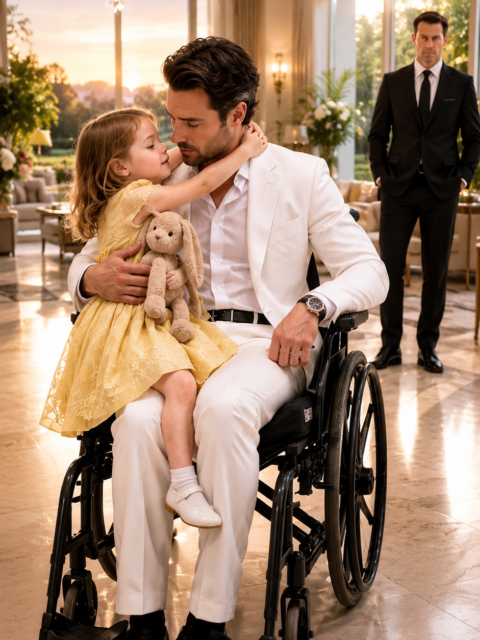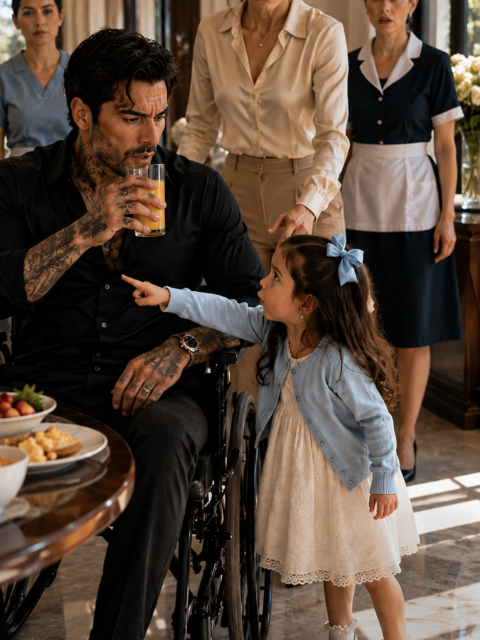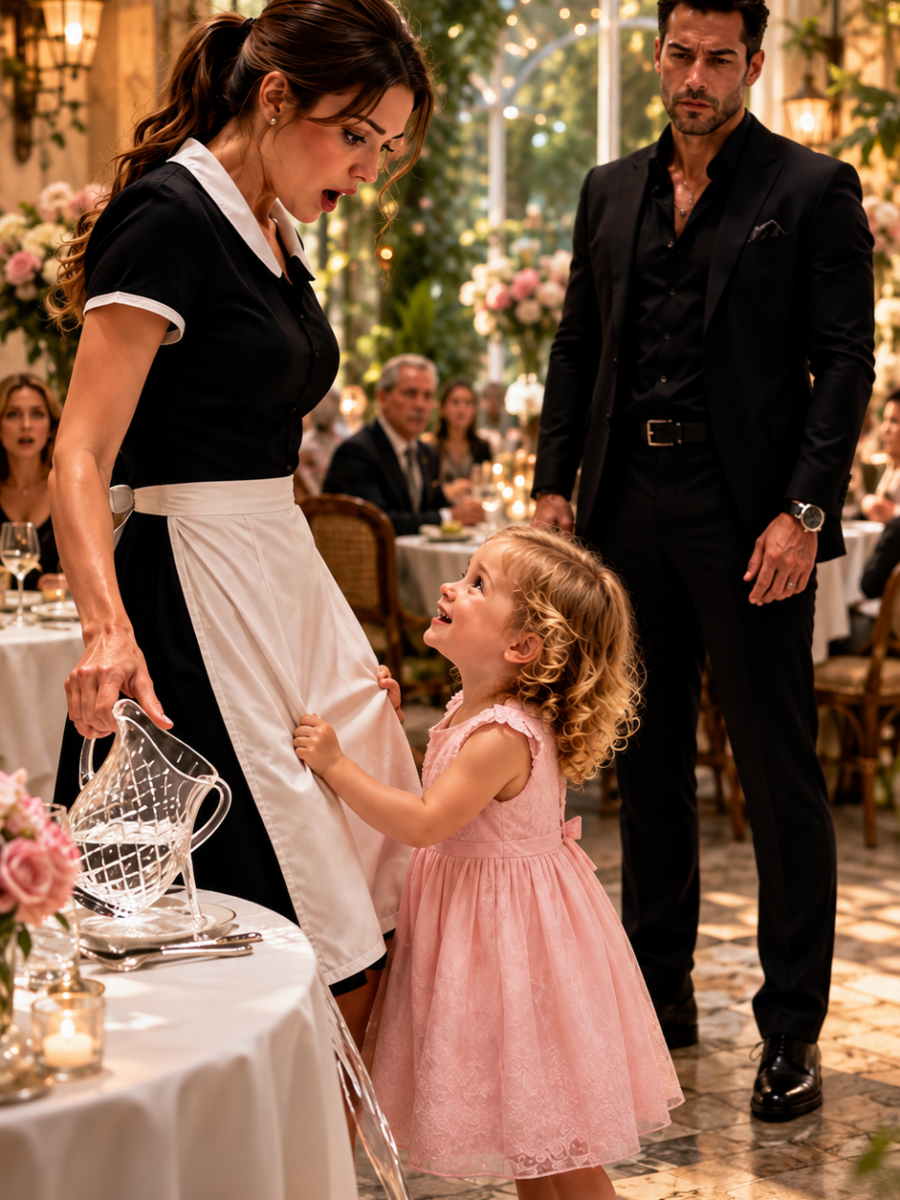
Champagne glasses clinked just yards away when Nora heard a faint cry behind the ballroom wall. She pulled aside an oversized painting and pressed her ear to the vent, and tiny fingers appeared behind the grille. “Please… help me.” She dropped her serving tray, grabbed a fire poker, and forced open a hidden latch nobody was ever supposed to find — and behind the false wall was a tiny, windowless chamber where nine-year-old Ethan Sterling lay curled beneath a thin blanket, clutching an empty water bottle. “She said Dad would never find me,” he whispered. Then Isabella appeared, a brass key clenched in her hand, and told Nora coldly to put him back. William Sterling arrived seconds later, stared at the open wall, at his wife, at the son he’d been told was nowhere in the house, and went pale. “Isabella… why was my son sealed behind that wall?” Before she could answer, Ethan grabbed Nora’s sleeve, terrified, and whispered the sentence that changed who everyone in that ballroom was about to blame: “She wasn’t the one who locked me in.” This is a story about a hidden room built into a family’s own mansion, a wife caught holding the key to a crime she didn’t actually commit, and a nine-year-old boy brave enough to tell the truth even when it meant defending the one adult everyone else was already certain had betrayed him. Read all fifteen chapters to find out who actually locked Ethan behind that wall, why Isabella was found holding the key, and what it took to finally bring him home safely.
Chapter One
The Cry Behind the Wall
Champagne glasses clinked just yards away when I heard a faint cry behind the ballroom wall.
I pulled aside an oversized painting and pressed my ear to the vent. Tiny fingers appeared behind the grille. “Please… help me.”
“Ethan, keep talking. I’m getting you out.”
I dropped the champagne tray, grabbed a fire poker, and forced open the hidden latch. Behind the false wall was a tiny, windowless chamber. Nine-year-old Ethan Sterling lay curled beneath a thin blanket, clutching an empty water bottle.
I pulled him into my arms. “She said Dad would never find me,” he whispered.
Then Isabella appeared. A brass key was clenched in her hand. “Put him back,” she said coldly, “and I may let you keep your job.”
I stepped between her and Ethan.
Seconds later, William appeared. He stared at the open wall. Then at his wife. Then at the boy he’d been told was nowhere in the house. His face turned pale. “Isabella…”
She said nothing. William noticed the key in her hand. His voice dropped to a whisper. “Why was my son sealed behind that wall?”
Isabella’s expression changed. And Ethan suddenly grabbed my sleeve.
“Don’t let her tell Dad…” He looked terrified. “She’ll say I’m lying.”
Then he whispered the words that made William freeze: “Because she wasn’t the one who locked me in” — and I felt the entire ballroom’s worth of assumptions I’d built in the span of about ninety seconds come apart completely, understanding, with a fresh and considerably more urgent alarm, that whoever had actually sealed this child behind a hidden wall was very likely still somewhere in that same crowded room.
Chapter Two
Put Him Back
William knelt immediately beside his son, gathering him gently from my arms, his hands visibly shaking as he checked Ethan over for injuries. “Who locked you in there,” he asked, his voice raw. “If it wasn’t Isabella, who did this to you?”
Ethan buried his face against his father’s shoulder, still trembling too badly to answer immediately, and Isabella, still holding the brass key, finally spoke, her earlier coldness replaced by something considerably more frightened.
“I found him,” she said quietly. “Ten minutes ago. I was looking for a spare tablecloth in the storage closet near the east wing when I heard him crying too, the same way she did.” She nodded toward me. “I found the latch. I found the key already sitting in it, like whoever locked it had left in a hurry.”
“Then why did you tell her to put him back,” William demanded, his fury barely controlled. “Why threaten her job instead of immediately calling for help?”
Isabella’s composure cracked, tears finally spilling down her face. “Because I recognized the key,” she said. “William, I need you to let me explain everything, but not here, not with this many guests still in the building. Please. I promise you I would never, ever hurt Ethan. I need you to believe that while I explain why I panicked.”
William looked between his terrified son, his sobbing wife, and the small brass key still clutched in her trembling hand, and made a decision that cost him visibly, given how badly he clearly wanted answers immediately: “Nora,” he said to me, his voice carrying a controlled urgency I could hear him fighting to maintain, “get Ethan somewhere safe and warm, away from all these guests. I’ll deal with my wife privately. But Isabella — you have exactly as long as it takes to get my son settled to start explaining exactly what that key actually means.”
Chapter Three
She Wasn’t the One
Icarried Ethan to a small sitting room off the main hallway, wrapping him in a heavier blanket from a nearby linen closet, and sat with him quietly while the ballroom’s muffled party continued obliviously on the other side of several closed doors.
“You did really good telling your dad the truth,” I said gently, once his shaking had settled slightly. “About Isabella not being the one who locked you in. That took a lot of courage, especially when everyone was already looking at her like she’d done it.”
“She’s nice to me,” Ethan said quietly. “Not like Mom always said she’d be. Mom said Isabella would never really love me because I’m not her real kid. But Isabella reads to me sometimes, when Dad’s busy with work stuff. She wasn’t ever mean to me before today.”
“Can you tell me who actually locked you in there,” I asked carefully, unsure how much a traumatized nine-year-old could reliably process and explain, but needing to understand as much as I could before William and Isabella returned.
Ethan’s small face crumpled. “Uncle Victor,” he said. “Isabella’s brother. He came to get me from school yesterday, said Dad asked him to pick me up because Dad was busy with the party stuff. I didn’t think anything was wrong until he brought me here instead of home, and then he put me in that room and told me to stay quiet, that it was a game, and that Dad would find me eventually if I was patient.”
“Did he say why,” I asked, my own alarm building steadily as the shape of whatever had actually happened here began to take clearer form. “Why he wanted you hidden, even temporarily?”
Chapter Four
Isabella’s Key
“He said I’d understand when I was older,” Ethan said. “He kept checking his phone a lot. He said something about Dad needing to ‘appreciate what he had’ before he ever really understood, but I didn’t understand what that meant either.”
I held him a little tighter, filing away every detail he was giving me with the same careful attention I’d once given, briefly, to an EMT training course before deciding restaurant work paid the bills more reliably — cataloging facts now, understanding that whatever came next would very likely require exactly this kind of clear, complete account.
William found us roughly twenty minutes later, his own composure looking considerably more fragile than it had in the ballroom, Isabella following a few steps behind him, her eyes red and swollen from crying.
“Tell them what you told me,” William said gently to Ethan, kneeling down to his son’s level. “About Uncle Victor. I need you to tell Isabella too, so she understands exactly what her brother did.”
Ethan repeated the account, considerably steadier this time with his father’s reassuring presence beside him, and I watched Isabella’s face go through a devastating series of emotions — shock, then horror, then something that looked, unmistakably, like genuine grief for a brother she was only now understanding she barely knew at all.
“The key,” William said, once Ethan finished, turning to his wife with a controlled, exhausted patience that told me exactly how much effort it was costing him not to simply demand immediate answers. “You said you recognized it. I need you to explain that now, Isabella, completely, because my son just told an entire family gathering that your own brother is responsible for locking him behind a wall in our own home.”
Chapter Five
Isabella’s Confession
“The key,” Isabella said, her voice shaking, “belongs to a lockbox my brother keeps at his own apartment. I’ve seen it a hundred times, visiting him over the years. I recognized it instantly, the second I found it sitting in that hidden latch, and I understood immediately that Victor had to be involved somehow.”
“Why did you tell Nora to put Ethan back,” William pressed, his voice tight. “If you already suspected your brother, why would your first instinct be to conceal what you’d found rather than immediately calling me, or the police?”
Isabella’s tears fell harder. “Because I panicked, William. I’ve spent the past six months worried about Victor — about decisions he’s been making, financial pressure I knew he was under, a bitterness about our own family’s situation that I never took seriously enough. When I saw that key, my first thought wasn’t protecting a secret. It was pure terror, trying to buy myself thirty seconds to figure out how to handle this without either destroying my brother’s life or somehow making Ethan’s situation more dangerous by acting too quickly, in front of a room full of party guests, before I understood the full situation myself.”
“That’s not a good enough explanation,” William said, though his voice had softened slightly, the raw fury of moments earlier giving way to something more exhausted.
“I know it isn’t,” Isabella said. “I made a terrible, split-second decision, and I understand if you can’t easily forgive it. But William, I need you to understand something else, right now, before we do anything further — Victor has been under financial pressure I never took seriously enough, related directly to money he’s owed you, and I don’t believe what happened today was a random, senseless act. I think my brother had a specific, deliberate reason for wanting your attention, and your fear, focused entirely on Ethan today.”
Chapter Six
Victor
William called the police immediately once Isabella finished her account, formally reporting the incident despite her own visible fear about what that would mean for her brother, a decision Isabella herself, to her credit, didn’t attempt to argue against.
“I need you to understand,” she told the responding detective, once officers arrived to formally document the scene and take everyone’s statements, “that I’m not trying to protect my brother from consequences. I only hesitated initially because I was afraid, and because I didn’t yet understand the full situation. I want him found, and I want Ethan safe, more than I want to protect anyone from what they’ve actually done.”
The detective, a careful, methodical woman named Sergeant Patricia Diallo, took detailed statements from William, Isabella, myself, and, with a child advocate present to ensure the process remained gentle, from Ethan himself.
“Your son’s account is remarkably clear and consistent for a child his age under this kind of stress,” Sergeant Diallo told William, once the initial statements were complete. “That’s going to be enormously helpful for both locating your brother-in-law and building whatever case follows. Do either of you have any information about where Victor might currently be?”
“He has an apartment downtown,” Isabella said, “though I doubt he’s still there if he anticipated any of this being discovered so quickly. William—” she turned to her husband directly, her voice carrying a fresh, urgent fear, “I need to tell you something else, something I should have mentioned to you months ago instead of dismissing it as simply Victor venting frustration. He’s said things, recently, about feeling entitled to a portion of your company’s success, given how much unpaid consulting work he’s done for you over the years. I never took it seriously as an actual threat. I understand now that I probably should have.”
Chapter Seven
The Scheme
Sergeant Diallo’s investigation, moving with considerable urgency given a missing suspect and a documented child endangerment case, quickly uncovered the fuller shape of exactly what Victor had apparently been planning.
“We’ve reviewed your company’s financial records with your permission,” the detective told William, two days into the investigation. “Victor did provide consulting services to your company several years ago, informally, without a documented contract or compensation agreement — work he apparently believed entitled him to considerably more financial recognition than you ever formally provided.”
“I offered him a formal position multiple times,” William said, visibly frustrated. “He always declined, said he preferred the flexibility of informal arrangements. I had no idea he’d developed this kind of resentment over something I genuinely believed we’d both agreed to years ago.”
“Our working theory,” Sergeant Diallo continued, “based on witness statements from people who know Victor socially, and some concerning messages we’ve recovered from his own devices, is that he intended to hide Ethan briefly — frightening, certainly, but apparently not intended as a long-term abduction — specifically to position himself as the one who ‘discovers’ and returns your son, creating exactly the kind of dramatic gratitude and indebtedness he believed might finally secure him the formal partnership and compensation he felt he’d always deserved.”
“He wanted to be the hero,” William said slowly, the full, twisted shape of his brother-in-law’s plan finally settling into place. “He hid my son specifically so he could ‘find’ him later and demand a reward disguised as gratitude — which means, if Nora hadn’t heard Ethan crying when she did, my son might have remained in that hidden room for however long it took Victor to stage his own dramatic rescue.”
Chapter Eight
William’s Fury
William’s fury, once the full scope of Victor’s plan became clear, settled into something considerably colder and more determined than the raw panic he’d shown in the ballroom that first devastating evening.
“I want him found,” he told Sergeant Diallo, his voice controlled but carrying an unmistakable, steely resolve. “Whatever resources you need from me — private investigators, expanded search efforts, anything at all — I want my brother-in-law located and held fully accountable for what he did to my son, regardless of whatever twisted justification he’s built for himself about deserved compensation.”
Isabella, sitting nearby throughout this exchange, remained largely quiet, her own guilt and grief visible in every careful, restrained gesture. “William,” she finally said, once Sergeant Diallo stepped out to coordinate the expanding search, “I need you to know that I will support whatever consequences Victor faces completely. I won’t ask you to go easier on him because he’s my brother. What he did to Ethan is unforgivable, regardless of our relationship.”
William looked at her for a long moment, his expression carrying a complicated mixture of continued hurt and a grudging, growing recognition of her genuine sincerity. “I believe you,” he said finally. “I still need time to fully process my own anger about how you initially reacted, finding that key. But I believe you didn’t know what Victor was planning, and I believe you want Ethan’s safety more than you want to protect your brother from what he’s done.”
“Thank you,” Isabella said quietly, though her relief was tempered by an obvious, continued anguish, “though I don’t think I’ll fully forgive myself for those first thirty seconds of panic for a very long time, regardless of how completely you eventually do.”
Chapter Nine
Building the Case
Sergeant Diallo’s team located Victor within four days, tracked through a combination of financial records and a tip from a former colleague who recognized his description from local news coverage of the case, staying at a budget motel roughly ninety minutes outside the city.
“He hasn’t fled the state, hasn’t tried particularly hard to disappear completely,” Sergeant Diallo told William and Isabella, once the arrest was confirmed. “Which is somewhat consistent with a plan that was never actually intended as a permanent abduction — someone genuinely planning to disappear with a child typically takes considerably more sophisticated precautions than a nearby budget motel under his own name.”
Victor’s own statement, once formally interviewed with his attorney present, largely confirmed the theory Sergeant Diallo’s investigation had already assembled — a plan born from genuine financial desperation and years of accumulated resentment, intended, in Victor’s own apparently sincere but deeply misguided reasoning, as a way to finally secure the recognition and compensation he believed his years of informal consulting work had earned him.
“I never intended to actually hurt him,” Victor reportedly told investigators, according to the formal statement Sergeant Diallo shared with the family once legal proceedings allowed. “I checked on him regularly. I brought food and water. I genuinely believed I was going to ‘discover’ him within a day or two, present myself as the hero who found him, and finally get William to take my contributions seriously” — an explanation that did nothing to soften William’s fury, but that Isabella, hearing her brother’s own words, found herself absorbing with a complicated grief for a sibling whose desperation had apparently curdled into something this genuinely dangerous.
Chapter Ten
Confronting Victor
Isabella requested, and was eventually granted, a single supervised visit with her brother before his formal trial began, a conversation she later described to me, once she’d returned to check on Ethan and, by then, on me as well, given how deeply the entire ordeal had connected the three of us.
“I asked him how he could possibly justify what he did,” she told me. “Locking a nine-year-old child, someone he’d known his entire life, in a windowless room, purely to manufacture his own moment of heroism. He told me he never really thought about Ethan’s own fear during the planning. He was so consumed by his own resentment toward William, so certain his plan would work out cleanly, that he genuinely hadn’t considered how terrifying the actual experience would be for a real child, rather than simply a piece in his own scheme.”
“How did that make you feel,” I asked gently, having grown considerably closer to Isabella over the preceding weeks, an unlikely friendship built from the shared trauma of that devastating evening.
“Furious,” she said honestly. “And devastated. I keep thinking about all the years I spent making excuses for Victor’s bitterness, telling myself it was simply frustration rather than something that could ever curdle into genuinely endangering a child. I don’t know how to reconcile the brother I thought I knew with the man capable of what he actually did.”
“I don’t think you have to fully reconcile those two versions,” I told her. “I think sometimes people are both — genuinely capable of real love, and also genuinely capable of terrible decisions when desperation and resentment build up long enough without anyone, including the person themselves, taking it seriously enough to intervene before it became something this dangerous.”
Chapter Eleven
The Arrest
Victor’s trial, held nearly eight months after that devastating anniversary party, concluded with a conviction on child endangerment and false imprisonment charges, resulting in a sentence that included several years of incarceration alongside mandatory psychological evaluation and treatment.
Ethan testified via a carefully arranged video statement rather than in-person courtroom testimony, a decision the prosecuting attorney and the family’s own child psychologist both agreed would minimize additional trauma while still providing the court with his own direct, credible account of what he’d experienced.
William attended every day of the trial, his fury toward Victor never fully softening throughout the entire process, though he found himself, by the trial’s conclusion, focused considerably more on Ethan’s ongoing recovery than on the specific length of his former brother-in-law’s eventual sentence.
“I don’t think any sentence would have felt like enough,” William told me, once the verdict was finally read, sitting together in the same sitting room where I’d first comforted Ethan eight months earlier. “I’m grateful he’s being held accountable. But honestly, Nora, the thing I actually care about now is making sure my son never has to carry this experience as the defining moment of his own childhood — and I don’t think a courtroom, however important, is where that healing is actually going to happen.”
Chapter Twelve
Why Isabella Stayed Silent
Isabella and William worked through their own difficult reconciliation over those same eight months, supported by couples counseling William initially resisted but eventually found genuinely valuable, given how completely that first devastating evening’s misunderstanding had threatened to permanently damage their marriage before either of them fully understood what had actually happened.
“I keep coming back to those thirty seconds,” Isabella told their counselor, during one of the sessions William later described to me in general terms, careful to respect the privacy of the details themselves. “I understand now why my instinct wasn’t good enough, even though I understand where it came from. I think, more than anything, I need to forgive myself for that reflexive fear, rather than simply waiting for William to eventually forgive me for it.”
William, for his own part, worked through a complicated grief about a marriage that had, in one devastating moment, revealed a fault line he hadn’t previously understood existed — Isabella’s own deep-seated instinct to protect her family of origin, even at the expense of immediate transparency, even in a moment of genuine crisis involving his own son.
“I don’t think I fully understood, before that night, how much unprocessed loyalty Isabella still carried toward her brother,” William told me, during one of our own occasional conversations over those months, our shared experience of that terrifying evening having built an unusual, genuine friendship between us despite our very different positions in the household. “I think we’re both learning, together, exactly what it actually means to build a family where everyone’s first instinct, in a crisis, is complete honesty rather than any instinct toward protecting or managing information — even information about the people we love most.”
Chapter Thirteen
Ethan’s Recovery
Ethan’s own recovery unfolded gradually over those same months, supported by a child trauma specialist William found through careful research, someone experienced specifically in helping young children process exactly this kind of frightening, disorienting experience.
“He’s remarkably resilient,” the specialist told William and Isabella, during one of their regular check-in sessions roughly six months into treatment. “Children often are, particularly when they have consistent, reassuring support from the adults around them during the recovery process. I want you both to understand that his progress reflects considerably more than simple resilience alone — it reflects the stable, loving environment you’ve both worked hard to maintain for him throughout this entire difficult year.”
Ethan had, over those months, developed a particular fondness for spending time with me whenever I was scheduled to work events at the Sterling estate, a friendship William and Isabella both actively encouraged, understanding, I think, exactly how significant my role in that first devastating night had become in Ethan’s own sense of safety and trust.
“He asked me last week whether you’d come to his birthday party,” Isabella told me, during one of our now-regular coffee meetings, our friendship having grown into something considerably more genuine than the circumstances that first connected us. “I told him I’d ask you directly, but Nora, I think it would mean an enormous amount to him — and honestly, to William and me as well, given everything you did for our family that night.”
Chapter Fourteen
Trust Rebuilt
Iattended Ethan’s tenth birthday party the following spring, nearly a full year after that devastating anniversary celebration, watching him laugh and run through the same estate grounds with a lightness that felt, to everyone who had witnessed his fear that first terrible night, like genuine, hard-won progress.
William offered me a permanent position within his household staff shortly afterward, a formal role considerably more stable than the event catering work that had originally brought me to that anniversary party in the first place — an offer I accepted gratefully, understanding that whatever unusual, difficult circumstances had first connected our lives, I’d genuinely grown to care about this family’s continued wellbeing.
Isabella and Victor maintained no ongoing contact throughout his incarceration, a boundary Isabella had decided, with her therapist’s support, was necessary for her own healing regardless of whatever complicated grief she still carried about the brother she’d once believed she understood completely.
“I used to think family loyalty meant protecting people no matter what they’d done,” Isabella told me, watching Ethan blow out his birthday candles with William’s arm wrapped protectively around his shoulders. “I understand now that real loyalty sometimes means choosing honesty and accountability instead, even when it’s the hardest possible choice — especially when a child’s safety is what’s actually at stake.”
Chapter Fifteen
Home, Safe
Two years after that devastating anniversary party, I stood in the same ballroom where I’d first heard Ethan’s faint cry behind a hidden wall — the space fully renovated since then, the false panel and windowless chamber removed entirely during a comprehensive estate renovation William had commissioned specifically to eliminate every trace of that terrifying night.
Ethan, eleven now and considerably more confident than the terrified boy I’d first pulled from behind that wall, found me near the refreshment table during another family celebration, this one considerably happier — his own school graduation party, marking the end of elementary school with the same enthusiastic energy he brought to nearly everything these days.
“Nora! Did you see my science project? I got first place.”
“I heard,” I told him, genuinely delighted by his obvious pride. “Your dad showed me pictures. That volcano was seriously impressive.”
He beamed, then, in the easy, unguarded way children sometimes offer profound observations without fully understanding their own weight, added: “I’m glad you heard me that night. Behind the wall. I was really scared, but I knew someone would come eventually.”
I knelt down slightly to meet his eyes properly. “I’m glad I heard you too,” I said. “And Ethan — I’m proud of you, for telling everyone the truth that night, even when it would have been easier to just stay quiet and let people believe whatever they already assumed.”
He smiled, then ran off toward his father and Isabella, both of them watching him with the particular, hard-won contentment of a family that had survived something genuinely terrifying and had, slowly and carefully, rebuilt something considerably stronger in its aftermath.