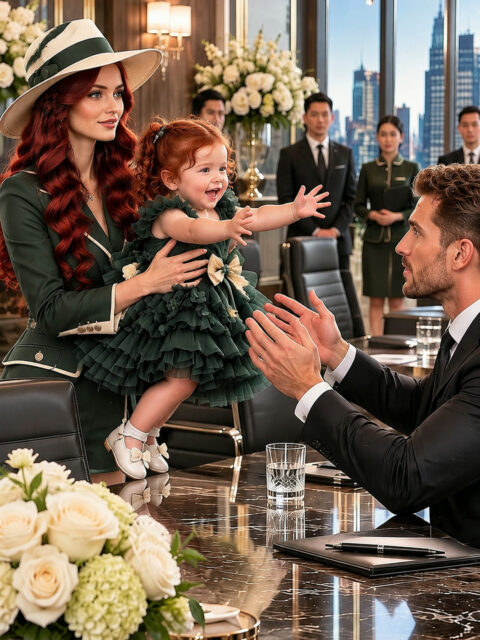
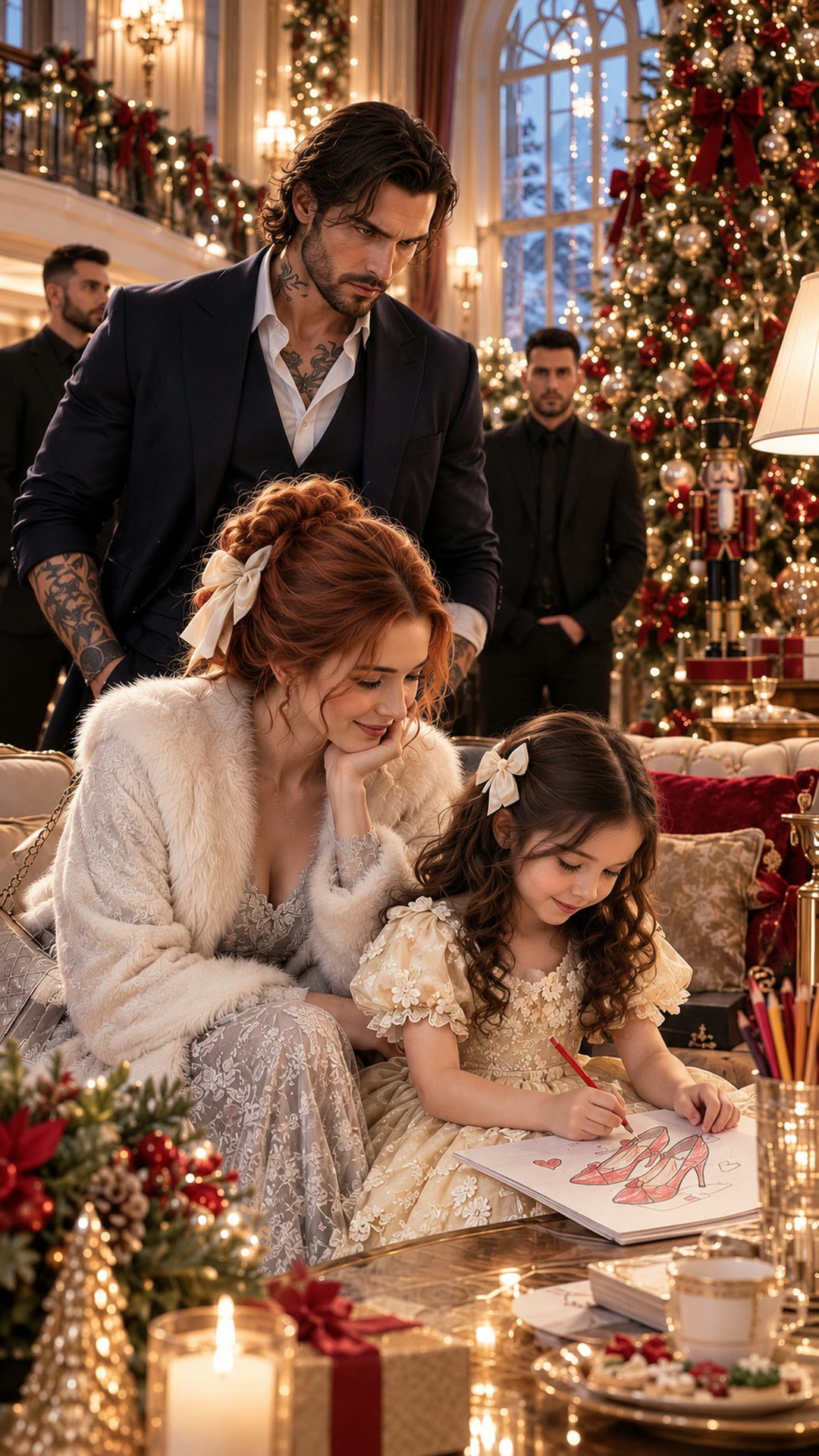
She Couldn’t Afford the $38 Christmas Shoes Her Daughter Dreamed Of — But New York’s Most Feared Mafia Boss Heard What the Little Girl Said Next
Chapter 1: The Bus Ticket and the Red Velvet Shoes
“Mommy, could I wear those for Christmas?”
I stopped three feet behind them in the bustling fourth-floor shoe parlor of Bergman’s department store on Fifth Avenue. Around us, high-society women in mink stoles selected imported Italian leather boots. But pressing her small, chapped fingers against the lower glass display was a six-year-old girl in a faded gray wool coat that was two sizes too short at the wrists.
She was staring at a pair of ruby-red velvet holiday shoes with delicate satin buckles, displayed beside a card that read: Holiday Special — $38.00.
Beside her knelt a young woman whose knuckles were red and calloused from manual labor. She wore a thin canvas jacket, an old woolen scarf wrapped twice around her neck, and shoes worn down to the rubber tread. She looked at the price tag, then closed her eyes for a single, agonizing second. I recognized that look; it was the suffocating arithmetic of poverty, where thirty-eight dollars meant choosing between a child’s smile and three days of heating oil in an uninsulated tenement.
“Not today, sweetheart,” the mother whispered, forcing a gentle smile that trembled at the corners. “Maybe someday soon.”
The child didn’t throw a tantrum. She didn’t beg, whine, or pull on her mother’s sleeve. Instead, she reached into her coat pocket, pulled out a three-inch stub of a graphite pencil, flipped over a crumpled blue MTA bus ticket from her mitten, and smoothed it flat against her knee. Her small hand began sketching the red shoes with painstaking, quiet devotion.
“That’s okay, Mommy,” Rosie whispered softly, blowing a speck of eraser dust from the paper. “I can draw them instead.”
The mother turned her head away, her shoulders hitching as she fought back tears.
A cold shockwave tore through my chest, ripping open a memory I had buried for thirty years. In 1994, in a freezing cellar on Orchard Street, my little sister Angela had sat on an apple crate, drawing a pair of red boots on the back of an electric bill because my father didn’t have twelve dollars. Angela died of double pneumonia that February, never having owned a pair of new shoes in her short life.
“Boss, the Maybach is idling in the rear bay,” my capo, Marco, murmured at my shoulder. “The zoning commissioner is waiting at the athletic club.”
“Cancel my meetings,” I said, my voice dead and absolute.
Marco blinked, stunned. “Every meeting, sir? Even with Senator Vance?”
I turned my head, my slate-gray eyes locking onto him with the quiet lethality that had brought five New York families to their knees. “Did I ask for your opinion, Marco?”
“No, sir.”
“Find out who she is,” I commanded, gesturing toward the mother. “And find out why that child believes she doesn’t deserve a pair of Christmas shoes.”
Marco stepped forward with two guards; but when the mother turned and caught sight of my face, she pulled Rosie behind her back, her hazel eyes widening in sheer terror as she whispered: “Dominic Moretti… are you here to take what’s left of Liam?”
↑ Back to Top
Chapter 2: The Ghost of Terminal 12
The name hit me like a blow to the ribs.
“Liam?” I repeated, signaling my guards to step back. The shoe salon had fallen into an uneasy hush, patrons glancing at the armed men flanking me before hastily retreating toward the elevators. I crouched on one knee so my eyes were level with the trembling woman. “You’re Liam Hastings’s widow.”
“Please,” Nora Hastings breathed, clutching her daughter against her knees. Her body was shaking so violently her teeth clicked. “We have nothing. Liam left no money. We live on Avenue B in a fourth-floor walkup. I earn a hundred and forty-eight dollars a week baking bread at Novak’s. If Liam owed you something before he drowned… take it from my wages, but don’t touch Rosie.”
“Liam Hastings never owed me a dime,” I said, keeping my voice low and firm. “Liam was the only honest maritime safety inspector on the Brooklyn piers. Two years ago, when his car went off the pier at Terminal 12, the police ruled it accidental intoxication.”
“It was murder!” Nora choked out, tears finally breaking past her lashes. “Liam didn’t drink! He found out that someone was using Terminal 12 to smuggle military-grade firearms and industrial narcotics into the city. He refused to sign the safety clearance. Three nights later, they ran his sedan into forty feet of freezing water, stole his survey logbook, and branded him a drunk. The state revoked his pension. The insurance company denied our policy. They left us with eighteen dollars and a funeral bill.”
A suffocating rage rose inside my throat. Terminal 12 was officially under the jurisdiction of my syndicate, but two years ago, my treacherous underboss, Carmine Russo, had sworn to me that Liam Hastings had died in an unfortunate personal accident.
Russo hadn’t just murdered an honest public servant in my territory; he had framed a dead man, stolen his widow’s survival, and operated an unauthorized cartel shipping line under my crest.
“Marco,” I commanded, rising to my full height. “Take the girl and Nora into the executive suite upstairs. Order hot chocolate, roast chicken, and fresh pastries.”
Before Nora could protest, Marco’s encrypted phone buzzed with an urgent vibration. He glanced at the screen, and his jaw hardened into stone. “Boss. Carmine Russo’s collection crew just kicked in the glass front of Novak’s Bakery on Avenue B. They’re tearing the shop apart looking for Nora.”
Marco held up the live surveillance screenshot from our street cameras: “Russo’s enforcers are holding the seventy-year-old baker over the commercial ovens, demanding Nora’s home address.”
↑ Back to Top
Chapter 3: The Broken Glass on Avenue B
“Get them into my armored Maybach,” I ordered Marco, my cashmere overcoat sweeping behind me as we took the private service elevator to the basement.
Nora clutched Rosie tight against her chest, her knuckles bone-white. Little Rosie held her drawn bus ticket in her mitten, looking at me with wide, innocent brown eyes. “Mister… is Mr. Novak hurt? He gives me the cinnamon ends on Tuesdays.”
“No one will hurt Mr. Novak, Rosie,” I promised, resting a large, leather-gloved hand gently over her woolen cap. “I give you my word.”
The Maybach tore through the Manhattan slush, red and blue strobe lights hidden behind the front grille clearing traffic along Houston Street. Two black SUVs followed in tight tactical formation. Within eight minutes, we screeched to a halt in front of Novak’s Bakery on Avenue B.
The front plate-glass window was completely shattered, shards of glass glistening like ice across the snowy sidewalk. Inside, trays of holiday gingerbread and sourdough loaves were stomped into the flour-covered floorboards. Old man Novak, seventy-two and bleeding from a split eyebrow, was pinned against the commercial kneading table by a two-hundred-and-fifty-pound enforcer in a greasy leather bomber.
“Where does the girl live, old man?!” the thug roared, raising an iron pipe. “Russo wants the Hastings ledger before midnight!”
I pushed the broken wooden door open with one boot.
The bell above the shattered frame gave a single, hollow chime. The three men in the bakery spun around with sneers that died the exact second their eyes met mine. The air in the bakery froze instantly.
“M-Moretti?” the man holding the iron pipe stammered, the metal weapon slipping two inches down his sweat-slicked fingers.
“Drop the pipe,” I said, my voice barely above a whisper, carrying the chilling weight of a cemetery vault.
The pipe clattered against the ceramic tile. The three thugs backed against the flour sacks, their hands flying into the air, trembling so hard the dust fell from their sleeves. “Boss! We… we didn’t know you had business down here! Carmine Russo told us this was an independent collection!”
I stepped over the broken gingerbread, grabbed the lead thug by the throat, and slammed his skull against the brick wall: “Who gave you permission to smash bread in my city?”
↑ Back to Top
Chapter 4: The Eviction in the Snow
“R-Russo!” the thug gagged, his boots dangling three inches off the floor. “He’s demolishing the entire block on Fourth Street! He bought the mortgage notes through an offshore shell! He sent four men to throw the widow’s furniture into the street so the city can condemn the building tonight!”
I dropped him into the flour like a sack of garbage. He curled into a ball, gasping for air.
“Marco,” I commanded, turning toward the door. “Have our medical team tend to Mr. Novak. Leave five guards on this shop. If Carmine Russo or any of his dogs takes another breath near Avenue B, put them in the harbor.”
We drove three blocks north to Fourth Street. The winter storm had intensified, heavy wet snow blanketing the Lower East Side tenements. But out on the curb in front of building 214, cruelty was on full display.
Three private bailiffs and two of Russo’s hired muscle were hauling battered furniture out into the blizzard. A worn drop-leaf kitchen table, a box of children’s picture books, and Rosie’s small wooden writing desk had already been dumped into the frozen slush. In the second-floor window, the corrupt superintendent was nailing plywood across the doorway.
Nora let out a strangled cry from the backseat, burying her face in her hands. “Everything… all Liam’s memories. They’re destroying everything.”
I stepped out of the Maybach into the falling snow. Six armed operators from my personal detail fanned out across the sidewalk, their assault rifles raised at low-ready. The bailiffs froze, their clipboards dropping into the snow as they took in my tailored charcoal overcoat and the cold, unyielding fury in my face.
“Step away from the furniture,” Marco announced, stepping forward with his badge and legal injunction. “This property has just been acquired by Moretti Holdings. You have thirty seconds to leave this borough before you are processed for criminal trespass.”
The bailiffs fled like rats into the blizzard, leaving their truck behind.
I walked to the curb, knelt in the slush, and picked up Rosie’s wooden desk, wiping the snow from its battered pine surface. Rosie rolled down the Maybach window, clutching her pencil and the bus ticket. Big, silent tears rolled down her cheeks as she looked at her displaced belongings.
“Mister Dominic,” she whimpered softly. “Will Santa still know where to find my drawing if we don’t have a door?”
I lifted the child out of the car, wrapping her small shivering body completely inside the warmth of my heavy cashmere overcoat: “You don’t need Santa tonight, Rosie. You have Dominic Moretti.”
↑ Back to Top
Chapter 5: The Penthouse Above Central Park
By 8:00 PM, the storm raged outside, but inside my Fifth Avenue triplex penthouse, it was a different world.
Birch logs crackled in the cavernous limestone fireplace, casting a golden glow over the Persian rugs and high coffered ceilings. In the center of the grand salon stood a eighteen-foot Norwegian spruce Christmas tree, illuminated by thousands of warm fairy lights and antique hand-blown glass ornaments. A table was laid out with honey-baked ham, roasted potatoes, hot buttered rolls, and an array of desserts prepared by my personal chef.
Rosie was sitting on a plush velvet ottoman in a pair of warm flannel pajamas my staff had rushed from Bergdorf’s, happily drinking hot cocoa with whipped cream. Her cheeks were rosy, her laughter filling rooms that had known only cold, calculated silence for a decade.
Nora stood by the floor-to-ceiling glass wall, looking out over the snow-covered expanse of Central Park. She held a porcelain teacup in her hands, but her eyes were filled with an overwhelming, disorienting disbelief.
“Why are you doing this, Dominic?” she whispered as I walked over with two glasses of vintage port. “You are the most feared man in New York. People whisper that you have ice in your veins. Why tear down an entire city block to save a baker’s assistant and a child with a pencil?”
I didn’t answer immediately. I walked to the mahogany credenza beside the fire, unlocked a concealed steel safe, and retrieved a small, aged silver frame. Inside rested a faded, yellowed 1994 MTA bus ticket, with a child’s crude pencil sketch of red boots.
“Thirty years ago, on Orchard Street, my seven-year-old sister Angela drew this,” I said, my voice rough with the raw truth I had never spoken aloud to anyone. “Our radiator had cracked. We had four dollars between us. She told my mother she didn’t need real boots, that her drawing would keep her feet warm. Two weeks later, she was buried in a potter’s field. I spent the next twenty years accumulating money, businesses, and power so that no one could ever make me feel powerless again.”
I looked at Rosie, who was currently pinning her drawing of the red shoes to the lowest bough of the Christmas tree. “When I saw your daughter draw those shoes on Fifth Avenue today, I realized that all my billions meant nothing if an innocent child in my city still had to freeze with a pencil in her hand.”
Before Nora could speak, the library double doors clicked open; Marco walked in holding a decrypted red folder: “Boss, the Syndicate Council has convened at the Metropolitan Club. Carmine Russo is there right now, claiming you’ve abandoned your post for a street girl.”
↑ Back to Top
Chapter 6: The Council on Christmas Eve
At 11:30 PM, the ballroom of the Metropolitan Club was thick with Havana cigar smoke and false camaraderie.
Forty capos, four family dons, and two corrupted state supreme court justices sat around a forty-foot mahogany table. At the center of the table sat Carmine Russo, fifty-five, draped in a custom pinstripe suit, his fingers adorned with heavy sapphire rings. He was sipping twenty-year-old bourbon, basking in the belief that my sudden absence from Fifth Avenue signaled weakness.
“Brothers,” Carmine announced, gesturing with his cigar. “Moretti has lost his appetite for business. While our ports face federal audits, he is spending his afternoon running errands for bakery maids in the East Village. A Don who trades shipping corridors for sentimental charity is a danger to the entire alliance.”
A calculated murmur of assent rippled through the older dons.
“I move that Terminal 12 and the East River container docks be reassigned immediately to the Russo family,” Carmine declared, sliding the resolution toward Don Falcone.
The heavy mahogany double doors blew inward with a deafening hydraulic blast that splintered the brass latch into fragments.
The room went so silent you could hear the ashes drop from Carmine’s cigar.
Through the swirling winter mist walked me. I wore my dark tailored suit unbuttoned, carrying no visible weapon. Flanking me were thirty operators from the Moretti inner guard, their weapons held at high-ready, locking red laser sights onto the chests of every guard in the hall.
“You were speaking about Terminal 12, Carmine?” my voice echoed through the high-ceilinged room like thunder over an iron bridge.
Carmine leaped to his feet, knocking his crystal glass onto the floor. “Dominic! This is a closed family tribunal! You can’t just storm in here with assault rifles!”
I walked up to the mahogany table, tossed Liam Hastings’s original maritime survey logbook onto the wood, and plugged a flash drive into the podium monitor. High-definition scans of Carmine’s offshore banking receipts, video surveillance of his hitmen running Liam’s car off the pier, and intercepted wiretaps of his plot to murder Nora and Rosie flashed across the screens.
“Liam Hastings was an honest man murdered under my watch,” I said coldly. “You stole his life, you stole his pension, and you tried to freeze his six-year-old child in the snow on Christmas Eve.”
Carmine sneered, reaching for a snub-nosed revolver concealed in his waistband. “She’s a nobody! Her husband was a pest! You’re tearing down the syndicate for a six-year-old girl?!”
Before his hand could clear his holster, my left hand closed around his throat like a hydraulic vice, lifting him off his feet and slamming him face-first onto the mahogany table until the wood cracked beneath his skull.
↑ Back to Top
Chapter 7: The Box Under the Fir Tree
Carmine Russo’s screams of agony filled the vaulted chamber.
His four personal bodyguards reached for their waistbands, but Salvatore and Marco stepped forward, their assault rifles racking in perfect unison. The guards immediately raised their hands in surrender, stepping away from their fallen boss as if he were carrying a contagious plague.
At that exact moment, the perimeter doors were breached by Federal Marshals and the New York State Attorney General’s Anti-Corruption Task Force, led by Special Agent Marcus Vance. For eighteen months, Vance had been investigating the port smuggling ring using evidence my legal team had quietly provided.
“Carmine Russo, you are under arrest for first-degree murder, federal racketeering, and interstate extortion,” Vance announced, clamping heavy steel handcuffs onto Russo’s bleeding wrists.
I looked at the assembled syndicate elders, who were now standing with their heads bowed in profound terror and respect. Don Falcone stepped forward, bowing his head. “The Russo faction is dissolved. The Moretti word is law across New York.”
I turned my back on the room without speaking another word. Power, fear, and territories meant nothing compared to the promise I had made to a child on Fifth Avenue.
By 6:00 AM on Christmas morning, the snow had stopped falling over Manhattan. A brilliant winter sun broke across the horizon, painting the snowdrifts of Central Park in shimmering shades of gold and pink.
In the penthouse living room, Nora was sitting on the sofa in a warm cashmere sweater, sipping coffee as she looked at an official legal document stamped by the Governor’s office. Liam Hastings’s name had been completely cleared of all false charges, his full civil service pension had been restored with two years of back pay, and a multi-million-dollar wrongful death settlement had been placed into an irrevocable trust for Rosie.
Furthermore, Novak’s Bakery and the entire Avenue B building had been purchased and deeded in full to Nora and Mr. Novak.
Suddenly, the sound of small, frantic footsteps echoed down the grand spiral staircase. Rosie came running into the salon in her red flannel pajamas, her eyes wide as saucers as she saw the mountain of wrapped gifts under the Christmas tree.
Sitting directly in the center, beneath the drawing she had pinned to the lowest bough, was a large, gold-foil box tied with an elaborate red velvet bow.
Rosie untied the ribbon with trembling fingers, pulled off the golden lid, and let out a breathless, joyful shriek that echoed to the ceiling: resting inside on a bed of white silk was the exact pair of ruby-red velvet shoes from Bergman’s.
↑ Back to Top
Chapter 8: Red Shoes in the Morning Snow
Rosie immediately slipped off her woolen socks and slid her feet into the red velvet shoes.
They fit like a glove. She fastened the delicate satin buckles with intense concentration, then stood up on the polished parquet floor. She took two tentative steps, paused, looked down at her feet, and then began spinning in circles, her pajama legs fluttering as she danced across the sunlit room with pure, unadulterated joy.
“Mommy! Look! They’re real! They aren’t on a bus ticket anymore!” she squealed, leaping into Nora’s arms.
Nora caught her daughter, burying her face in Rosie’s neck, weeping tears of profound, overwhelming joy. For two years, she had carried the crushing burden of survival on her thin shoulders; this morning, that burden was gone forever.
I stood by the tall glass terrace doors, watching them with a warm, quiet peace that had eluded me for thirty-seven years. I reached into my pocket and touched the small silver frame containing Angela’s 1994 drawing. For the first time in my life, the memory of my sister didn’t bring a sharp pang of helpless grief; it brought light.
Nora walked over, holding Rosie’s hand. Her hazel eyes looked directly into mine, shining with an emotion that transcended simple gratitude. “You gave us our lives back, Dominic. How could we ever repay you?”
“You don’t owe me anything, Nora,” I replied softly, taking her warm hand in mine. “You and Rosie gave this house something that fifty billion dollars couldn’t buy.”
“What’s that?”
“A reason to open the doors.”
Rosie came running over in her sparkling red shoes, throwing her small arms around my knees and squeezing with all the strength in her six-year-old body. “Thank you, Mister Dominic! You’re better than Santa Claus!”
I laughed—a deep, genuine sound that made Marco and Salvatore smile from the doorway—and scooped the little girl high into my arms, stepping out onto the sunlit terrace overlooking Central Park.
For thirty-seven years, I thought a king’s strength was measured in the fear he commanded in the dark; but holding Rosie in her red Christmas shoes beneath the winter sun, I finally knew that true strength is having the power to turn a child’s paper dream into reality.
↑ Back to Top