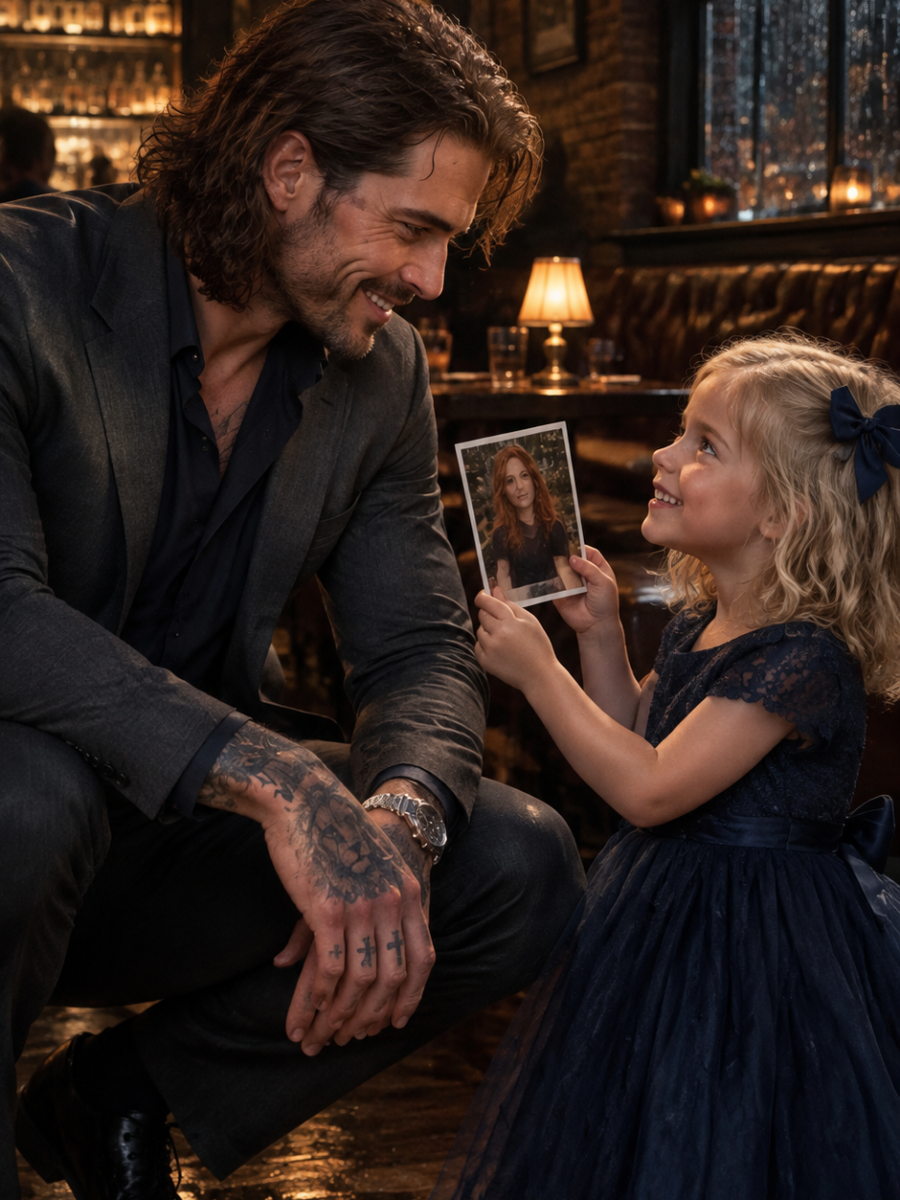
Seven years after burying his wife in an icy grave, architect Adrian Vale was stopped on a cobblestone street by a six-year-old girl holding his wife’s photograph. What began as a bewildering encounter led him to an ivy-covered cottage, a secret silver key, and a miraculous truth that defied death itself.
Table of Contents
- Chapter 1: The Photograph on the Cobblestones
- Chapter 2: The Blue Cottage on the Bluff
- Chapter 3: A Ghost on the Staircase
- Chapter 4: The Fire at the Lighthouse
- Chapter 5: Two Silver Keys
- Chapter 6: The Resurrection of Claire Vale
- Chapter 7: The Castle by the Sea
- Chapter 8: The Promise Under the Stars
- Chapter 9: Love Stronger Than the Grave
Chapter 1: The Photograph on the Cobblestones
At forty-two years of age, I had become an architect of silence.
My name is Adrian Vale. For seven years, my life had been reduced to a monochrome ritual: wake at five in the morning, stare at the empty linen pillow beside me, drink black coffee while looking out over the misty harbor of Bellhaven, Maine, and spend twelve hours running Vale Marine Architecture.
Seven years ago, on an icy November morning that smelled of salt spray and freezing rain, I had stood beside an open grave in Oakridge Cemetery. I had watched a mahogany casket bearing my wife’s name—Claire Sterling Vale—descend into the damp earth. The county coroner had told me the fire at the coastal lighthouse had been so intense that dental records and a scorched platinum wedding band were the only means of identification. I had accepted the coroner’s report because the alternative—believing Claire was still suffering somewhere out in the dark—was more than my sanity could bear.
On a mild Tuesday afternoon in late spring, I was walking along the cobblestone waterfront of Bellhaven, carrying a leather portfolio of yacht hull schematics.
As I reached into the breast pocket of my charcoal wool coat to retrieve my reading glasses, my worn leather wallet slipped from my fingers, striking the wet granite cobbles. Several business cards and a weathered photograph spilled across the stones.
I knelt down to gather the papers.
Before my hand could touch the photograph, a tiny, sun-browned hand with dimpled knuckles darted out and picked it up.
“Why do you have a picture of my mommy?”
The high, clear voice cut through the cry of the harbor gulls like a silver bell.
I froze on my knees, my breath catching in my throat.
I looked up.
Standing before me on the cobblestones was a little girl of perhaps six years old. She wore a simple, pleated sapphire-blue cotton dress, white canvas sneakers scuffed at the rubber toes, and an untamed mane of thick chestnut curls that tumbled past her shoulders.
In her small hands, she held the photograph.
It was an informal snapshot taken eight years ago beneath a blooming magnolia tree on our first anniversary in Savannah. Claire stood smiling at the camera, her head tilted slightly to the right, her hazel eyes dancing with secret mirth, one thumb tucked into the pocket of her cardigan.
My heart slammed against my ribs with a violent, agonizing tremor.
“Sweetheart,” I said, my voice hoarse and trembling as I reached out gently. “That woman… that woman was my wife.”
The little girl blinked her hazel eyes—hazel eyes with tiny flecks of pure gold around the iris, identical to the eyes that had looked up at me as we exchanged wedding vows.
She shook her head with stubborn, unshakeable certainty.
“No,” the child stated firmly. “She’s my mommy.”
“Little one,” I whispered, the old, familiar grief searing my throat like raw lye. “She passed away seven years ago. She was buried in Oakridge.”
“She didn’t die,” the girl replied instantly, her small brow furrowing into a fierce, stubborn little frown—a frown so impossibly, achingly identical to Claire’s whenever I teased her about burning toast that my hands began to shake violently. “Mommy is at home. She’s making blackberry jam right now.”
I stood up slowly, towering over the child, my knees trembling so hard I had to steady myself against a stone bollard.
“Where is your house?” I asked, my voice barely audible over the roaring pulse in my ears.
The little girl narrowed her eyes with sudden, precocious caution. “Mommy says I’m not allowed to talk to strange men with grumpy faces.”
A strange, broken laugh escaped my throat—half a sob, half a gasp. “I promise I’m not grumpy, sweetheart. I will walk three steps behind you. Just… show me where your mother lives.”
She studied my face for four long seconds. Then she reached out, grabbed my index finger in her warm, sticky grip, and tugged firmly.
“Come on, Grumpy,” she chirped. “Don’t step on the sea moss.”
Chapter 2: The Blue Cottage on the Bluff
We walked through the winding, narrow alleys of Old Bellhaven, climbing away from the commercial fishing docks toward the quiet residential bluffs overlooking the ocean.
Every step was an exercise in surreal torment.
The child—who informed me her name was Emma—walked with a light, skipping bounce. She chattered about her calico cat named Barnaby, the stray seagull she fed crusts of sourdough, and how her mommy could play five different songs on the acoustic guitar without looking at the strings.
Claire had owned a 1968 Martin acoustic guitar. She had played those exact five songs on the back deck of our beach house in the evenings.
Three streets above the harbor, Emma turned into a secluded lane framed by towering red cedar trees.
She stopped in front of a weathered wrought-iron gate.
My breath vanished entirely from my lungs.
Behind the gate sat a two-story, cedar-shingled cottage draped in wild honeysuckle and ivy, featuring distinctive royal-blue painted shutters and a wraparound screened porch.
Seven years ago, on our honeymoon drive up the New England coast, Claire had pulled our convertible to the shoulder of this exact lane. She had pointed through the trees at this exact cottage and smiled with misty eyes: *”That was my grandmother Evelyn’s summer house, Adrian. I spent every July here climbing the apple trees. When Grandmother passed, the estate sold it to an anonymous trust… I always dreamed of buying it back.”*
My hands gripped the cold iron pickets of the gate until my knuckles went white.
Emma unlatched the garden gate with practiced ease and skipped up the brick walkway lined with blooming purple hydrangeas.
“Mommy! I found a grumpy man who dropped your picture!” Emma called out, pushing open the heavy oak front door.
I followed her across the threshold, my boots treading softly upon worn pine floorboards that smelled of beeswax, dried lavender, and simmering blackberries.
In the hallway, Emma suddenly stopped before a closed door beneath the stairwell.
“Don’t open that one,” Emma whispered, pointing a finger at the brass knob.
“Why not?” I asked, my voice tight and strained.
“Because that’s where Mommy keeps the things from before,” Emma explained in a hushed, conspiratorial tone.
“Before what, Emma?”
“Before me,” the child answered simply. “She goes in there when she cries on rainy days.”
Emma reached into the front pocket of her sapphire-blue dress.
“I took this from her vanity drawer this morning to play pirate treasure,” Emma whispered, opening her small palm.
Resting in the center of her hand was a heavy, ornate silver key with an intricately engraved handle shaped like an anchor wrapped in ivy.
A cold jolt of electricity surged through my spine.
I knew every scratch, every notch, every microscopic imperfection on that piece of silver.
Eight years ago, on the night of our wedding in Charleston, I had placed that exact key in Claire’s hand. It was the master key to our private coastal family safe, forged by my great-grandfather. On the stem of the key, microscopic script read: *Semper Fidelis, A & C.*
My hands trembled so violently that when I reached down and picked up the key, the metal clicked against my signet ring like teeth chattering in the cold.
I turned toward the locked door beneath the stairs.
Then, above our heads, the floorboards of the second story creaked.
A soft, feminine voice drifted down the stairwell, singing a light, distracted melody before calling out:
“Emma? Sweetheart, did you wash your hands? The jam is ready.”
The world stopped spinning.
Seven years of darkness, grief, and funeral flowers dissolved into absolute, shattering dust.
I knew that voice.
I had heard it in the deepest chambers of my dreams. I had heard it echoing in the empty rooms of my house. I had heard it every night when I closed my eyes and prayed for death to take me to her.
Emma looked up at my frozen, chalk-white face, smiled with radiant innocence, and whispered:
“See? That’s Mommy.”
Chapter 3: A Ghost on the Staircase
Footsteps descended the wooden stairs.
First came a pair of worn canvas espadrilles. Then the hem of a dark green linen apron tied over an ivory sundress.
And then, she stepped onto the landing.
Her chestnut hair was pulled back in a loose, messy clip, with stray wisps framing high cheekbones and soft, flushed cheeks. Her hands were dusted with flour, and a tiny streak of blackberry syrup marked the corner of her chin.
Claire.
Not a ghost. Not an illusion of my broken mind.
Living, breathing, thirty-seven years old, with the same delicate throat, the same graceful posture, and the same golden-flecked hazel eyes that had held my soul since the day we met.
Claire was looking down at Emma, wiping her hands on her apron. “Emma, I told you that you cannot leave the garden without telling—”
She stopped.
Her gaze lifted from the child and landed squarely upon me.
The color did not drain from Claire’s face; it seemed to vanish entirely, as though her blood had turned to water. Her hazel eyes dilated until the black pupils swallowed the gold flecks. The linen apron slipped from her limp fingers, fluttering down to the pine floor like a white surrender flag.
“Adrian,” she whispered.
It was not a scream. It was a breathless, fragile exhalation—the sound of a soul realizing the grave had finally been opened.
“Claire,” I choked out.
My knees finally gave way. I dropped to one knee at the base of the stairs, my forehead resting against the carved newel post, my chest heaving with dry, racking sobs that tore through seven years of frozen scar tissue.
Emma looked between us, her little face suddenly solemn and confused. She walked over to me, rested her tiny hand on my shaking shoulder, and looked up at her mother.
“Mommy? Why is Grumpy crying?”
Claire stepped down the remaining four stairs. She didn’t hesitate. She didn’t run.
She sank to the floorboards beside me, her arms wrapping around my neck, burying her face into the collar of my wool coat. Her tears soaked into the fabric, hot, real, and trembling.
“You’re here,” Claire wept, her voice breaking into ragged, helpless pieces. “God in heaven… Adrian… you’re really here.”
I brought my arms around her waist, pulling her against my chest with a desperate, crushing intensity, needing to feel the solid reality of her ribs, the warmth of her skin, and the wild, racing beat of her heart beneath my palms.
“You’re alive,” I whispered over and over, pressing my lips against her hair, her forehead, her wet cheeks. “You’re alive… Claire, you’re alive.”
For ten minutes, neither of us could speak another word. There were only tears, trembling hands relearning the contours of faces thought lost forever, and the soft, bewildered breathing of the six-year-old child watching from the parlor door.
Chapter 4: The Fire at the Lighthouse
We sat at the rustic pine table in the sunlit kitchen, while Emma sat on the floor nearby, happily eating a warm buttermilk biscuit covered in fresh blackberry jam, flanked by her calico cat Barnaby.
Between Claire and me rested the silver anchor key and the photograph from Savannah.
Claire’s hands were shaking as she held a mug of chamomile tea. She wore no makeup, no jewelry, save for a thin gold chain around her neck from which hung my grandmother’s wedding ring—the true ring, not the replica that had been placed in the scorched coffin.
“Who was in that grave, Claire?” I asked, my voice steady, though my heart was bleeding. “Whom did I bury in Oakridge seven years ago?”
Claire closed her eyes, a shudder of ancient terror passing through her slender frame.
“A homeless woman named Sarah,” Claire whispered, tears welling in her eyes. “She was an addict who slept in the abandoned keeper’s cottage near the lighthouse. The night the lighthouse exploded… she was trapped on the third floor when the propane tanks ignited.”
“And you?”
“I was running for my life, Adrian,” Claire said, looking up into my eyes with raw, desperate sincerity. “From your brother.”
A cold, sickening dread clamped onto my stomach.
“Julian?”
“Julian,” Claire confirmed, her jaw tightening. “Three weeks before the fire, I discovered that Julian was using Vale Marine Architecture’s offshore freight contracts to smuggle illegal weapons and laundering cartel funds through your naval defense subsidiaries. When I confronted him in his office with the audit records, he laughed at me. He said that if I went to federal authorities, he would ensure you were indicted as the primary conspirator and spent the rest of your life in Leavenworth.”
Claire reached across the table, taking my callused hand into both of hers.
“I didn’t care about the money, Adrian. But two days before the explosion, I took a home pregnancy test.”
Her gaze drifted toward Emma.
“I was four weeks pregnant with your child,” Claire wept softly. “That night, Julian called me. He told me that accidents happen to curious wives. He said: ‘If you ever tell Adrian, I’ll make sure neither of you survives the winter.’ When the propane tanks exploded at the lighthouse, I knew it wasn’t an accident. Julian had set the timer.”
I stared at her, the blood in my veins turning into white-hot rage.
“You thought he would kill me if you stayed,” I whispered.
“I knew he would,” Claire answered. “If I vanished, if he believed I died in the fire, his criminal empire was safe. He had no reason to destroy you. So I let the coroner make the mistake. My grandmother’s trust owned this cottage under an unlisted corporate name. I took five thousand dollars from my personal savings, walked thirty miles through the woods, and disappeared into Bellhaven.”
She looked at Emma, who was licking jam from her fingers.
“I gave birth to your daughter in the local clinic six months later. I named her Emma Claire Vale. Every day for seven years, I looked at her face and saw you. And every day, I wanted to pick up the telephone and scream your name… but I was terrified that if Julian ever saw her, he would finish what he started.”
Chapter 5: Two Silver Keys
The silence that followed was suffocating.
I looked at Emma.
The girl who had tugged my sleeve on the cobblestones was not just a sweet stranger; she was my blood, my flesh, the living embodiment of the love Claire and I had shared before the world caught fire.
“Emma,” I called softly.
The little girl looked up from her biscuit, wiping her mouth with the back of her wrist. She walked over to the table and leaned against Claire’s knee.
“Emma,” Claire whispered, her voice choking with tears as she stroked the child’s chestnut curls. “Do you remember the stories I told you about your daddy? The brave builder who designs ships that sail across oceans?”
Emma nodded, her hazel eyes wide and serious. “The one who lives in the castle by the sea?”
Claire gently took Emma’s hand and placed it into mine.
“He’s not a stranger, sweetheart,” Claire sobbed softly. “And he’s not grumpy. This is your daddy. He found us.”
Emma stared at my hand, then looked up into my face.
She studied my jaw, the gray hairs at my temples, and the tears that I could no longer hold back.
Slowly, carefully, she reached up with her other hand and touched the silver anchor key resting on the table.
“You have the other key?” she asked in a tiny, timid whisper.
I reached beneath my shirt, unhooked the silver chain I had worn against my chest for seven years, and pulled out the identical silver key—the master anchor key.
Emma’s eyes went wide as saucers.
She took my key, held it beside her mother’s, and watched the two silver anchors fit together into a perfect circle.
“It is you,” Emma gasped.
She didn’t hesitate. She threw her small arms around my neck, burying her face into my collar, holding onto me with the fierce, unyielding grip of a child who had waited an eternity for her father to come home.
I lifted her into my lap, pressing my face into her soft curls, weeping with a depth of joy that obliterated every shadow of the past.
“I’m here, Emma,” I wept, kissing her forehead. “Your daddy is right here. And I will never let you go.”
Chapter 6: The Resurrection of Claire Vale
While Emma napped on the parlor sofa beneath a patchwork quilt, Claire and I sat on the sunlit screened porch, planning our next move.
“Julian died six months ago, Claire,” I told her quietly.
Claire’s breath hitched in her throat. “What?”
“A high-speed boating collision off Nantucket,” I explained, holding her hand tightly. “He was intoxicated, running from the Coast Guard during a routine inspection. The federal investigation concluded three months ago. The smuggling ring was dismantled, his offshore accounts were seized, and Vale Marine Architecture was fully audited and cleared of any wrongdoing.”
Claire stared at me, the staggering revelation washing over her features.
“He’s gone?” she whispered, trembling. “The threat… it’s really gone?”
“It’s gone, my love,” I said, leaning in and cupping her cheek with my palm. “You have been hiding from a ghost for six months. There is no one left to hurt you. There is no one left to keep us apart.”
Fresh tears spilled over Claire’s lashes—tears of unburdened liberation, washing away seven years of exile, fear, and secrecy.
“I want to go home, Adrian,” she wept softly, resting her forehead against my chest. “I want our daughter to see the ocean from our terrace. I want to wake up beside you.”
“We are going home tomorrow,” I promised her.
At five o’clock that evening, I placed a call from the local harbor office to my private attorney, William Vance, and the Chief Medical Examiner for the State of Maine.
Within twelve hours, an emergency administrative hearing was convened in the chambers of Superior Court Judge Morrison in Portland.
When Claire and I walked into the judge’s private chambers, holding six-year-old Emma between us, the venerable jurist dropped his reading glasses onto his mahogany desk in sheer, disbelieving awe.
“Claire Sterling Vale,” Judge Morrison whispered, rising from his leather high-back chair. “In forty years on the bench, I have never seen a legal resurrection.”
With sworn affidavits, DNA samples confirming Emma’s paternity and Claire’s identity, and the formal expungement of the 2019 death certificate, the legal fiction was erased from the annals of the state.
The woman who had been buried in Oakridge was formally exhumed for identification and reinterred with dignity under her true name, Sarah Jenkins, with a memorial fund established in her honor.
And Claire Sterling Vale was declared fully, legally, and eternally alive.
Chapter 7: The Castle by the Sea
Three days later, our black town car crossed the coastal causeway leading to the Vale Estate on the rocky bluffs of Cape Elizabeth.
The ocean breeze was fresh and salted, whipping through the open windows as the car climbed the long gravel driveway lined with blossoming lilacs.
In the back seat, Emma was practically glued to the glass, gasping in wonder at the soaring lighthouse in the distance, the manicured lawns, and the grand stone terrace overlooking the Atlantic.
“Look, Mommy! It really is a castle!” Emma squealed, clapping her hands.
Claire looked out at the estate where she had spent the happiest year of her life. Her eyes were bright with unspeakable emotion as she turned to look at me, her hand laced tightly through mine.
When the car stopped in front of the grand entrance, our head housekeeper, Mrs. Gable, and seven estate staff members were standing on the stone steps.
Mrs. Gable took one look at Claire stepping out of the vehicle, let out a piercing shriek of joyous shock, and threw her apron over her face, weeping uncontrollably.
“Mrs. Vale! Sweet Lord above! It’s a miracle!”
Claire hugged the old housekeeper, laughing and crying all at once, before turning to introduce the little girl holding her hand.
“Mrs. Gable,” Claire smiled through her tears. “This is Emma. She’s home.”
That afternoon was a whirlwind of laughter, unpacking, and the joyous return of light to a house that had been cold and empty for seven long years.
Emma ran through the vast rooms, exploring the grand library, discovering the secret window seats, and marveling at the grand piano where her mother had once played.
By twilight, the house was filled with the smell of roasting chicken, garlic, and fresh bread.
We sat together at the long mahogany dining table—no longer an empty expanse of polished wood, but a hearth alive with laughter, chatter, and the sweet clatter of a child’s fork against porcelain.
Chapter 8: The Promise Under the Stars
That evening, after Emma had been tucked into the grand four-poster bed in the second-floor nursery—fast asleep with her calico cat curled at her feet—Claire and I walked out onto the stone terrace overlooking the dark, murmuring ocean.
The night sky was a canopy of brilliant silver stars, their light dancing across the rolling Atlantic waves.
Claire was wrapped in my heavy cashmere sweater, leaning back against my chest, her arms resting over mine as I held her from behind.
“Do you know what kept me alive those first few months in Bellhaven?” Claire asked softly, looking out at the glittering water.
“Tell me,” I whispered, kissing the curve of her neck.
“Every night, before I went to sleep, I would take out that silver anchor key,” she said. “I would hold it against my chest and remember the promise you made on our wedding night: that no ocean was too wide, and no storm too dark, to break what God had joined together.”
She turned in my arms, looking up into my eyes with an intensity of love that stripped away every remaining ache of the past.
“You found me, Adrian. Even when I was a ghost, your love pulled us back together.”
“Emma found me,” I smiled, reaching into my pocket and pulling out the two silver anchor keys, now joined by a polished silver ring. “Our daughter looked at a photograph on a cobblestone street and refused to let her father walk away.”
Claire laughed—that sweet, melodic laugh that had haunted my dreams—and reached up to cup my face in her hands.
“She has your stubbornness, Adrian Vale.”
“And your heart, Claire,” I whispered, bringing my lips down to hers.
The kiss was deep, slow, and reverent—a sacred seal upon seven years of waiting, washing away every tear, every grief, and every shadow in the warm, eternal embrace of a love that could never die.
Chapter 9: Love Stronger Than the Grave
One month later, the stone chapel on the bluffs of Cape Elizabeth was bathed in golden afternoon light.
We did not hold a somber legal ceremony. We held a celebration of life, attended by two hundred friends, colleagues, shipbuilders, and the entire harbor community of Bellhaven.
Claire walked down the center aisle in an elegant gown of ivory silk and French lace, her chestnut curls adorned with white sea-lilies.
Beside her, holding her hand, was our daughter Emma, dressed in her favorite sapphire-blue dress, beaming with proud, radiant joy as she scattered rose petals across the stone floor.
I stood at the altar beside the minister, my heart so full of gratitude I could barely breathe.
When Claire reached the altar, she looked into my eyes, her hazel gaze steady, serene, and shining with eternal devotion.
The minister smiled warmly. “Adrian and Claire, seven years ago, tragedy tore your lives asunder. But today, standing before God and those who love you, you declare that love is stronger than the grave, deeper than the sea, and everlasting.”
When we exchanged the silver anchor keys, placing them inside a carved cedar box alongside Emma’s drawing of a blue cottage, the applause from the congregation echoed off the high rafters like rolling thunder.
After the ceremony, as the sun began to sink into the ocean in a blaze of amber, violet, and gold, our family walked down to the private sandy cove below the bluffs.
Emma ran ahead, chasing the incoming tide with her bare feet, her joyful laughter ringing out across the salt water.
Claire and I stood hand-in-hand at the water’s edge, our boots sinking into the wet sand.
Claire leaned her head against my shoulder, watching our daughter run along the shore.
“We have a lifetime ahead of us, Adrian,” Claire murmured softly.
“We have forever, my love,” I replied, wrapping my arm securely around her waist, pulling her close against my side.
As the tide rolled in, sweeping away our old footprints and leaving only smooth, sparkling sand beneath the rising stars, we stood together—a husband, a wife, and the daughter who had brought them home.