When a corrupt frontier banker ordered the indentured auction of a destitute widow’s seven children to settle her dead husband’s debt, Josephine Dalton stood ready to die protecting her babies—until a towering, reclusive mountain man slammed three hundred dollars in raw gold dust onto the block, claimed all eight of them, and defied the town to take them back.
Table of Contents
- Chapter 1: The Auction of Seven Souls
- Chapter 2: The Mother’s Last Stand
- Chapter 3: The Shadow of Buchanan Ridge
- Chapter 4: The Long Climb to the High Timber
- Chapter 5: A Home Built for Nine
- Chapter 6: The Transformation of the Ridge
- Chapter 7: The Shadows in the Timber
- Chapter 8: The Price of Treachery
- Chapter 9: The Father of the Seven
Chapter 1: The Auction of Seven Souls
The wooden gavel slammed down onto the cedar table outside the Oak Haven assayer’s office, echoing through the dusty streets like a rifle shot.
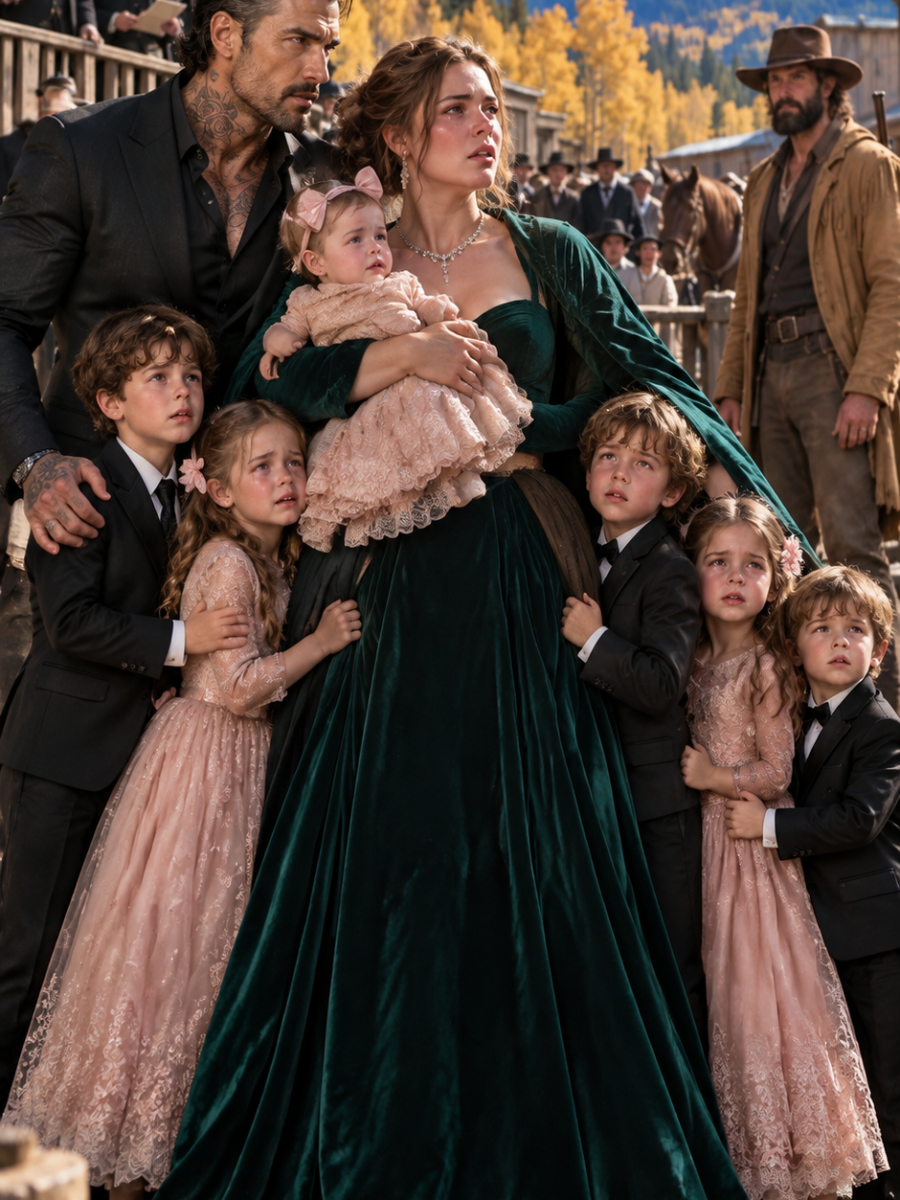
Seven terrified children clung to their mother’s faded gingham skirts like ducklings caught in a mountain hail.
The Colorado Territory in the autumn of 1878 was a country devoid of mercy for the weak. Biting frost howled down from the jagged granite peaks of the Sangre de Cristo range, stripping the gold from the aspen trees and freezing the mud in the wagon ruts. And on this particular Tuesday morning, the town of Oak Haven had gathered to rid itself of what its civic leaders considered an intolerable financial burden.
That burden was Josephine Dalton.
Josie stood in the center of the square, her boots worn through to the wool of her stockings, her stout legs trembling under her own considerable weight and the crushing horror of her situation. In a frontier where harsh labor starved most women down to raw sinew and sharp collarbones, Josie was undeniably, unapologetically large. She had a wide, heavy frame, thick arms that had scrubbed thousands of floorboards, and a round, soft face currently flushed crimson with sheer panic.
Her husband, Arthur Dalton, had been dead for three weeks. He had been crushed beneath a collapsing timber set in the Deep Vein silver mine, leaving Josie with a ruined shack on rocky bottomland, eight dollars in unpaid store credit, and a manufactured three-hundred-dollar gambling debt held by the Oak Haven Bank.
Around her skirts huddled the seven treasures of her life: Wyatt, fourteen, his young jaw clenched as he tried to stand like an adult; twins Levi and Clara, twelve; ten-year-old Amos; eight-year-old Ruth; six-year-old Seth; and clinging to her ample bosom, two-year-old baby Pearl, weeping into the collar of her mother’s dress.
“Order! I will have order in this square!” bellowed Mayor Josiah Higgins, waving his ledger.
Beside Higgins stood Clement Reed, the president of the bank. Reed wore a tailored black broadcloth suit, a silver pocket watch chain looped across his vest, and a face as devoid of human warmth as a minted nickel.
“Mrs. Dalton,” Reed announced, his voice dripping with condescending pity that fooled no one, “the court has established your total insolvency. You cannot feed yourself, let alone seven growing children. The town cannot allow seven vagrants to starve on public land.”
“I can work, Mr. Reed!” Josie shouted, her voice breaking with desperate fury as she tightened her grip on baby Pearl. “I can take in laundry for the miners! I can bake sixty loaves a day! I’ll scrub every saloon on Front Street from midnight till dawn! Just give me sixty days!”
A cruel, nasal scoff erupted from the boardwalk. It came from Mrs. Harriet Montgomery, the merchant’s wife, who fanned herself with a lace handkerchief.
“Heavens, Josephine,” Mrs. Montgomery sneered loud enough for the crowd to hear. “It takes you ten minutes just to haul your bulk up the church steps. Who on earth would hire a woman who eats more than two farmhands just to stay upright? The bank is performing an act of Christian charity by taking those poor children off your hands.”
Cruel laughter rippled through the onlookers.
Josie felt the heat of humiliation sear her cheeks, but she refused to bow her head. She was heavy—childbirth and relentless toil had widened her frame—but every ounce of that flesh was filled with the fierce, protective rage of a mother whose young were about to be slaughtered.
“They are my babies!” Josie roared, taking a thunderous step toward the boardwalk. “You will not tear them apart like cattle!”
“The debt is three hundred dollars, Mrs. Dalton,” Reed replied coldly, tapping the ledger. “Unless that sum is produced in gold coin within sixty seconds, the children are declared wards of the territory. We will now accept bids for their indentured service.”
Chapter 2: The Mother’s Last Stand
A sickening murmur of commercial greed stirred through the crowd.
In frontier Colorado, cheap labor was scarce. A fourteen-year-old boy was worth a grown man’s wages in the timber camps; a twelve-year-old girl could cook and tend children for five years without a dime of pay.
“We begin with the eldest,” Clement Reed announced, pointing his gold pen at Wyatt. “Wyatt Dalton. Fourteen years of age, sound of limb, capable of handling a plow team. Who will assume his indenture for the sum of fifty dollars against the bank’s debt?”
“I’ll take the boy for forty!” yelled an old swine farmer named Gidley from the back of his manure cart.
“No!” Josie screamed.
With the fury of a cornered grizzly bear, Josie lunged forward. She grabbed Wyatt by his collar and hauled him behind her broad back, spreading her heavy arms to shield all seven children behind her massive frame.
“I swear by the living God Almighty, the first man who lays a finger on my boy will leave this square with his throat torn out!” she shrieked, her hazel eyes blazing with lethal madness.
Gidley shrank back into his cart. The crowd took two hurried steps backward. When a two-hundred-pound mother was prepared to kill for her young, even hardened miners hesitated.
Clement Reed’s thin lips tightened into a sneer of disgust.
“Sheriff, restrain this creature,” Reed ordered. “She is obstructing a legal proceeding.”
Sheriff Tucker and two burly deputies stepped down into the mud, unholstering their heavy leather saps. They did not look eager—Josie’s wild, desperate gaze promised broken bones—but they had iron weapons and numbers on their side.
Wyatt stepped out from behind his mother, picking up a heavy oak stave from the dirt. “Don’t you touch my ma!”
A deputy raised his club to strike the boy.
Josie threw herself forward to take the blow with her own shoulder. She squeezed her eyes shut, bracing for the agony, preparing to die in the freezing red mud of Oak Haven rather than watch her family dismantled for thirty pieces of silver.
Then the wind suddenly died.
The horses hitched along the mercantile rail threw their heads, snorting in sudden, trembling panic. A chill swept through the square that had nothing to do with the mountain frost.
A shadow—vast, towering, and wider than the assayer’s doorway—fell across the boardwalk, blotting out the morning sun.
Chapter 3: The Shadow of Buchanan Ridge
Every breath in the square hitched in unison.
The deputy’s leather sap hovered frozen in mid-air. Sheriff Tucker blanched, his hand dropping from his holster as if the leather had turned white-hot.
Standing at the edge of the boardwalk was Luke Buchanan.
In the southern Rockies, mothers frightened unruly boys with the name of Luke Buchanan. He was thirty-six years old, stood six feet six inches in his hand-sewn elk-hide moccasins, with shoulders like the crossbeam of a timber trestle and a beard as black and dense as pine bark. He lived forty miles above the town on Buchanan Ridge, where the timber gave way to sheer granite spires and timber wolves.
Ten years earlier, claim-jumpers had murdered his younger brother at a placer dig. Luke had hunted all four men through two feet of winter snow, bringing their bodies down to the sheriff’s office draped across their own pack mules without uttering a single word of explanation.
Since that day, Luke Buchanan had never traded in Oak Haven. He dealt only with the mountain Utes, lived in impenetrable solitude, and carried an ancient fifty-caliber Sharps buffalo rifle that could take a bull elk down at half a mile.
He walked into the center of the square, his heavy tread making the frozen mud crunch with rhythmic doom.
He stopped three feet from where Josie knelt in the dirt, her arms wrapped around Wyatt and baby Pearl.
Luke didn’t look at the crowd. He looked down at Josie.
His dark eyes, deep beneath thick, scarred brows, took in the ripped hem of her dress, the dirt smeared across her swollen cheeks, and the absolute, unyielding defiance in her tear-stained eyes. He saw the way her body was positioned—not cowering, but arched like an iron shield over seven terrified children.
Luke shifted his gaze to Clement Reed.
“Put the gavel down, Reed,” Luke said.
His voice was not loud, but it possessed a terrifying, subterranean resonance that rattled the windowpanes of the assayer’s office.
Reed swallowed hard, tugging at his stiff white collar. “Now see here, Buchanan… this is a lawful territorial proceeding. The Dalton estate owes three hundred dollars gold to the Oak Haven Bank. The law requires—”
Luke reached inside his massive wolf-skin coat.
He withdrew a heavy, grease-darkened buckskin bag the size of a six-pound sack of flour. With one contemptuous flick of his wrist, he slammed the bag onto the center of the assayer’s table.
The leather ruptured slightly at the seam. Coarse, raw river gold—placer nuggets the size of walnuts, washed from the high secret creeks of the Sangre de Cristos—spilled across Reed’s pristine white ledger.
“There is four hundred dollars in dust,” Luke said, his voice flat as a gravestone. “Three hundred for Arthur Dalton’s debt. One hundred for the deed to their bottomland shack.”
The square fell so silent that the rattle of aspen leaves sounded like rain.
Clement Reed stared at the glittering fortune on his desk, his eyes bulging with naked avarice.
“Three… three hundred,” Reed stuttered, his manicured hands hovering over the gold.
Luke leaned forward over the table, his face inches from the banker’s.
“Write the release, Reed,” Luke whispered. “Write that the debt is canceled in full, that the children are free, and that the Dalton family owes nothing to any man living in this valley.”
Reed didn’t hesitate. With shaking fingers, he dipped his iron nib into the inkwell, scribbled the release across the ledger page, signed it with a trembling flourish, and stamped it with the county seal.
Luke picked up the signed parchment, folded it carefully, and walked back over to Josie.
He knelt in the freezing mud before her, his massive frame dwarfing her, yet his hands were astonishingly gentle as he offered her the paper.
“Get your children, Mrs. Dalton,” Luke said quietly. “You’re coming with me.”
Chapter 4: The Long Climb to the High Timber
Josie stared at the parchment in her hand, then looked up into the rugged, scarred face of the mountain giant.
“Why?” she whispered, her voice cracking. “Why would you spend four hundred dollars on strangers?”
Luke looked at her, his expression unreadable as the granite cliffs above them.
“Because I hate wolves, Mrs. Dalton,” Luke replied simply. “Especially wolves who wear broadcloth suits and rob widows.”
He rose to his full, towering height, turned toward the livery hitching rail, and whistled once—a sharp, piercing note that echoed off the canyon walls.
From the stable alley trotted two immense draft mules hitched to a heavy freight wagon with high cedar sideboard rails, loaded with sacks of winter grain, barrels of salt pork, and bundles of woolen trade blankets.
Luke walked to the wagon, lowered the tailboard, and turned back to the Dalton family.
“Wyatt, help your brothers into the wagon box,” Luke instructed, his tone calm and practical. “Levi, Clara, get beneath those buffalo robes. It will be dark before we clear the lower gorge.”
The children hesitated, looking up at their mother with wide, uncertain eyes.
Josie stood up, brushing the frozen dirt from her skirts. She had heard the rumors about Buchanan Ridge. People said Luke Buchanan was half-savage, that he skinned men alive and ate raw meat. But as she looked at his eyes—clear, sorrowful, and totally devoid of the leering mockery she had endured for years—she knew in her soul that her babies were safer with this solitary mountain giant than in any parlor in Oak Haven.
“Get in the wagon, children,” Josie said, her voice firm.
She carried baby Pearl to the tailboard. Before she could attempt the painful climb, Luke’s large hands were beneath her elbows. With an effortless lift that ignored her two hundred pounds completely, he set her securely onto the spring seat, wrapping a heavy wolf-skin robe around her lap and shoulders.
“Rest, Mrs. Dalton,” Luke said, swinging into the driver’s seat beside her. “You’ve carried enough today.”
He clicked his tongue, the two draft mules leaned into their iron collars, and the heavy wagon rolled out of Oak Haven.
Behind them on the boardwalk, Clement Reed and the townsfolk watched in stunned, bitter silence as the woman they had sought to destroy rode out of their reach, guarded by the most lethal rifle in the Colorado Territory.
Chapter 5: A Home Built for Nine
The climb to Buchanan Ridge took five punishing hours through stands of yellow lodgepole pine and roaring mountain torrents.
As dusk settled, painting the western snow peaks in bruised shades of violet and crimson, the wagon rolled over the crest of a high mountain saddle into a hidden, sheltered bowl.
Josie gasped at the sight before her.
This was no rough hunter’s dugout.
Nestled beneath a soaring granite amphitheater stood a magnificent two-story homestead constructed of massive spruce logs, peeled and sealed with amber resin. Three stone chimneys rose from the shake roof, pouring aromatic pine smoke into the crisp air. Attached to the house was a large timber barn, a blacksmith forge, a root cellar dug deep into the rock, and a clear mountain stream that cascaded through an iron flume directly into a covered wash house.
“It’s… it’s enormous,” Josie whispered, clutching baby Pearl.
“Built it with my brother before he was killed,” Luke said, his voice flat with ancient grief. “We planned to bring our sisters out from Ohio. They took the cholera in St. Louis before they ever saw the mountains. The house has sat empty of children for nine years.”
He set the handbrake and stepped down.
“Inside, all of you,” Luke called out, his deep voice carrying over the rushing creek. “The fire is laid in the hearth.”
The children poured out of the wagon, their terror completely forgotten as they beheld the wonders of the mountain homestead.
Inside, the great room was a sanctuary of warmth and rustic comfort. A massive stone fireplace occupied the north wall, its hearth large enough for six-foot logs. Long trestle tables carved from solid ponderosa pine stood flanked by sturdy benches. Overhead, an open timber balcony led to five separate bedrooms.
Josie stood in the center of the room, looking at the gleaming copper pots, the stacks of cured hams hanging from the rafters, and the barrels of white flour and sugar lined up against the pantry wall.
Tears, hot and blinding, welled in her eyes. For three weeks, she had measured every spoonful of cornmeal, dreading the morning when there would be nothing left to give her weeping children.
Luke walked in, carrying three heavy armloads of dry split cedar, dumping them into the hearth woodbox.
“The east rooms upstairs are for the boys,” Luke said, wiping his brow with his sleeve. “The west rooms are for the girls. The master bedroom on the ground floor is yours, Mrs. Dalton.”
Josie turned to him, her throat tight with emotion.
“Mr. Buchanan… Luke,” she began, her chin trembling. “What do you expect from me? I have no money to pay you back for the gold. I’m a heavy, clumsy widow with seven hungry mouths. I can’t be your—”
Luke stopped, turning to face her. In the warm golden firelight, his dark eyes held a gentleness that shattered her defenses.
“Mrs. Dalton,” Luke said softly, “the only thing I expect under this roof is that you heal. You feed your young ones. You teach them to be honest, and you never look over your shoulder in fear again. This valley has more meat and timber than ten families could use. You owe me nothing.”
Chapter 6: The Transformation of the Ridge
Over the next two months, life on Buchanan Ridge flourished like a mountain meadow in spring.
Josie was not a woman who could sit in idle luxury. Her gratitude was a roaring engine that transformed the lonely homestead.
She took over the great hearth, baking six loaves of golden sourdough bread every morning, simmering vast iron kettles of venison stew seasoned with wild sage and mountain onions, and rendering sweet bear tallow into bars of fragrant pine soap. The smell of cold grease and bachelor solitude vanished from the house, replaced by the irresistible aromas of cinnamon, baking yeast, and clean laundry dried in the mountain wind.
The children, once pale and hollow-eyed from fear, grew round, rosy-cheeked, and strong.
Wyatt worked beside Luke in the forge and timber lot, learning how to shoe draft mules, sharpen two-man saws, and fell eight-foot spruce trees with surgical precision. Levi and Amos tended the sheep and hauled kindling, while Clara and Ruth helped their mother with the sewing and cooking.
And little baby Pearl became Luke Buchanan’s constant shadow.
The fearsome mountain man, whose name made county marshals tremble, would sit by the hearth in the evening with the tiny two-year-old perched upon his massive knee, carving miniature wooden deer and foxes for her with his skinning knife while she giggled and pulled on his dark beard.
Josie would watch them from the kitchen table, her heart aching with a sweetness that terrified her.
She had spent her life believing that her large body made her unlovable—a beast of burden useful only for heavy chores. But Luke Buchanan looked at her differently.
When she hauled heavy water buckets from the flume, he would gently take them from her hands, his fingers lingering on hers. When she sat by the fire mending woolen socks, he would sit opposite her, his dark eyes watching the play of firelight across her soft, rounded cheeks with an intense, quiet reverence that made her breath catch in her throat.
“You look tired tonight, Josie,” Luke said one evening, setting down his whetstone.
“Seven children will do that to a woman, Luke,” she laughed softly, smoothing her apron.
Luke stood up, walked around the table, and rested his large, warm hands on her shoulders. His thumbs gently massaged the tight knots along her neck.
Josie stiffened in surprise, then let out a long, ragged sigh of pure relief, leaning back against his touch.
“You’ve carried seven children on your shoulders for fourteen years, Josie,” Luke murmured, his voice husky and close to her ear. “It’s time someone helped you carry them.”
Chapter 7: The Shadows in the Timber
Trouble arrived in late November with the first heavy snows.
Clement Reed was not a man who accepted defeat. The four hundred dollars in raw river gold Luke had thrown onto his desk had bought the debt, but it had also ignited a fever of insatiable greed in the banker’s black heart.
Reed knew that Buchanan Ridge held the richest untapped silver and gold veins in the territory. For ten years, Luke Buchanan had barred every prospector from the canyon at the point of a buffalo rifle. But Reed believed he had found a legal loophole.
On a freezing Thursday morning, Wyatt rushed into the cabin from the lower corral, breathless and pale.
“Ma! Luke! Riders coming up the switchback! Four men with badges!”
Luke rose from the breakfast table without a word. He walked to the gun rack, took down his heavy Sharps .50-caliber rifle, checked the brass breechblock, and slid a leather cartridge belt over his shoulder.
“Take the children upstairs, Josie,” Luke said calmly.
“No,” Josie said, rising to her feet, her jaw set like granite. She reached behind the door, picked up Arthur’s old twelve-gauge double-barreled shotgun, and snapped both hammers back with an audible clack. “I ran once in Oak Haven because I had no one to stand with me. I don’t run from my own porch.”
Luke looked at her—at her wide, solid stance, the lethal determination in her eyes, and the fearless courage that radiated from her soul. A slow, proud smile touched his lips beneath his dark beard.
“Stand by the door jamb, then,” Luke said. “And don’t shoot until I tell you.”
They stepped out onto the wide spruce porch together.
Four riders halted their horses thirty yards from the steps, their mounts blowing steam into the sub-zero air.
At the head of the group rode Clement Reed, flanked by Sheriff Tucker and two notorious hired gunmen from the Leadville mines—men known for burning homestead cabins and shooting sheep.
Reed pulled a rolled parchment from his leather saddlebag, holding it high.
“Luke Buchanan!” Reed called out, his voice sharp with manufactured authority. “By order of the Territorial District Court in Denver, the guardianship of the Dalton minors has been revoked! The court has appointed me legal custodian of the estate, with writ of entry to survey the mineral resources of this canyon!”
Sheriff Tucker shifted uncomfortably in his saddle, his eyes darting toward the massive muzzle of Luke’s buffalo rifle.
“Step aside, Buchanan,” Tucker said nervously. “We’re just here to take the children into protective custody.”
Chapter 8: The Price of Treachery
Luke Buchanan took one slow step down from the porch.
The five-foot barrel of his Sharps rested easily across his left forearm, pointed directly at Clement Reed’s chest.
“Reed,” Luke said, his voice softer than the falling snowflakes, yet carried with terrifying weight. “You have sixty seconds to turn those horses around before I put a half-pound of lead through your breast pocket.”
One of the Leadville hired guns sneered, his hand dropping toward his pearl-handled revolver.
“He’s one man with a single-shot rifle, Mr. Reed,” the gunman hissed. “Take him down!”
The gunman drew his weapon.
Before the hammer could clear leather, Luke’s Sharps roared like a cannon.
The fifty-caliber slug tore through the gunman’s right shoulder, lifting him clean out of his saddle and throwing him six feet backward into a deep snowdrift with a shriek of agony.
The horses panicked, rearing and plunging in the snow.
The second hired gunman swung his Winchester toward Luke—and from the porch, Josie pulled both triggers of the twelve-gauge shotgun.
The double blast of heavy buckshot shredded the second gunman’s horse’s saddle horn, severed his reins, and peppered his wool coat with lead pellets, sending him tumbling headfirst into the freezing slush.
Sheriff Tucker immediately threw his hands high in the air, his face as pale as curdled milk.
“I’m out! Don’t shoot, Luke! For God’s sake, don’t shoot!” Tucker screamed, kicking his stirrups free.
Clement Reed was left trembling on his dancing stallion, staring down the smoking barrels of both weapons. His arrogant composure had completely disintegrated into whimpering terror.
Luke walked through the snow, unhurried, relentless as an avalanche. He reached up, seized Reed by the collar of his broadcloth coat, and yanked him from the saddle like a bag of dirty laundry, slamming him flat on his back in the freezing mud.
Luke planted his heavy boot directly onto Reed’s chest, leaning his weight down until the banker gasped for air.
“You listen to me, you miserable little thief,” Luke growled, pressing the hot iron muzzle of the Sharps between Reed’s eyes. “Two weeks ago, the circuit judge in Pueblo ratified my legal marriage to Josephine Dalton. She is Mrs. Luke Buchanan. These seven children are legally adopted into my name. Any man who steps onto this ridge to touch my family is an outlaw trespasser, and I have the legal right to bury him where he falls.”
Reed’s eyes rolled back in sheer horror. “Married… you married her?”
“I married the finest woman God ever put breath into,” Luke whispered.
He pulled the forged court writ from Reed’s pocket, crumpled it into a ball, and shoved it into the banker’s mouth.
“Now take your two bleeding dogs and get off my mountain,” Luke said. “If I ever see your face north of Clearwater Gorge again, I won’t use lead. I’ll feed you to the wolves.”
Chapter 9: The Father of the Seven
By late afternoon, the silence of Buchanan Ridge had returned.
Sheriff Tucker had dragged the two wounded hired hands onto their horses and fled down the pass, while Clement Reed had stumbled behind them on foot, disgraced, terrified, and broken.
Inside the great cabin, the stone fireplace roared with cheerful, crackling cedar flames.
The seven children were gathered around the long table, laughing and devouring bowls of hot peach cobbler Josie had baked to celebrate their victory. Wyatt was showing Amos how to clean an iron stirrup, while Levi and Clara were teaching Seth how to carve whistles from willow branches.
On the front porch, the purple shadows of evening stretched across the snow-covered valley.
Josie stood by the timber rail, looking out at the endless mountain peaks glowing gold in the dying sunlight.
Luke walked out, closing the heavy door behind him. He stepped beside her, resting his forearms against the rail, looking out over the land that was now safe forever.
Josie turned to him, her eyes shining with unshed tears.
“You told Reed we were married,” she whispered softly.
Luke didn’t look away. He turned his broad frame toward her, his dark eyes vulnerable and fierce with love.
He reached into his vest pocket and drew out a simple, beautifully carved gold ring—forged from the very river dust he had washed from the high timber streams.
“I told him what I’ve wanted to tell the whole world since the second I saw you standing in that square, Josie,” Luke said, his voice trembling slightly. “A man spends his whole life looking for something worth dying for. But from the moment you stood between those deputies and your babies, I knew I had found the only woman I ever wanted to live for.”
He took her large, warm hand, his rough fingers slipping the gold ring onto her finger.
“If you’ll have a scarred old mountain man, Josie,” Luke whispered. “I want to be their father. And I want to be your husband, for every day God gives us.”
Tears of pure, overwhelming joy spilled down Josie’s cheeks. She didn’t feel heavy. She didn’t feel ugly. She felt cherished, beautiful, and revered beyond measure.
She threw her arms around Luke’s neck, pressing her full, warm frame against his iron chest.
“Yes, Luke,” she sobbed with a laugh of pure happiness. “A thousand times, yes.”
Luke lifted her off her feet, swinging her around in the crisp mountain air as her laughter echoed off the granite cliffs of Buchanan Ridge.
From the cabin doorway, seven children stepped onto the porch, cheering and clapping their hands in the golden dusk.
And beneath the vast Colorado sky, where a town had once tried to auction seven innocent souls, a family stood united—unbroken, unconquerable, and forever home.