My Wealthy Neighbor’s Black-Belt Son Slammed $10,000 onto a Table and Challenged Me to Fight Him — Then I Removed My Jacket and an Old Veteran Saw the Ranger Scroll on My Shoulder
When twenty-seven-year-old Ethan Caldwell slammed a thick envelope containing ten thousand dollars onto the silent-auction table at the Larksburg Court charity gala, he thought he was about to humiliate his quiet neighbor Victoria in front of the entire neighborhood. A flashy Brazilian jiu-jitsu black belt, Ethan had spent weeks mocking Victoria’s quiet demeanor and her military past. But Victoria refused his money, asked for one simple rule, and unzipped her outer jacket—revealing the legendary 75th Ranger Regiment scroll on her shoulder and sending shockwaves through the veterans in the crowd.
Table of Contents
- Chapter 1: The Ten-Thousand-Dollar Envelope
- Chapter 2: The House on Larksburg Court
- Chapter 3: Noise versus Control
- Chapter 4: One Rule on the Blue Mat
- Chapter 5: The Jacket and the Scroll
- Chapter 6: An Old Ranger Steps Forward
- Chapter 7: The Grapple on the Blue Mat
- Chapter 8: The Sound of the Tap
- Chapter 9: The Veterans Fund and True Honor
Chapter 1: The Ten-Thousand-Dollar Envelope
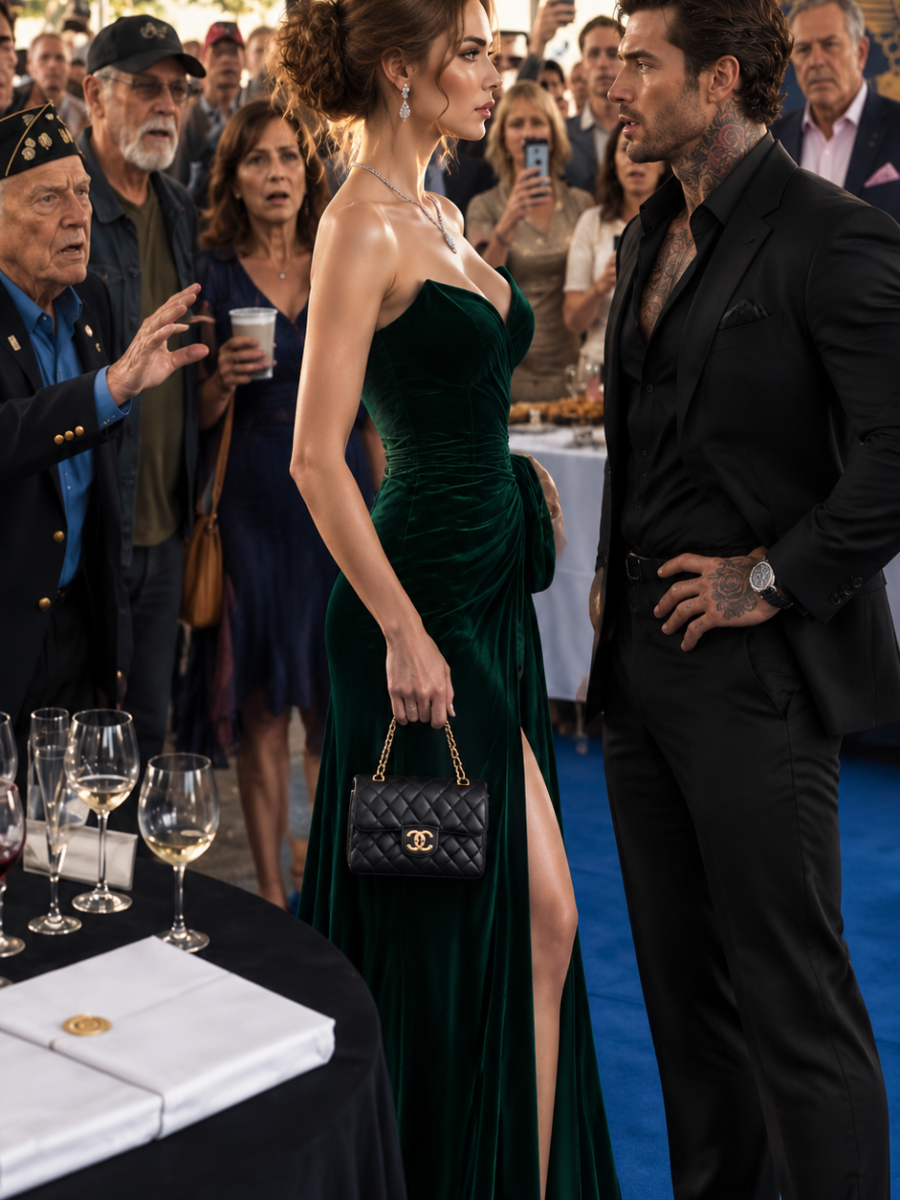
The heavy white linen envelope hit the mahogany silent-auction table with a sharp, concussive slap that caused two crystal wineglasses to rattle and a flower centerpiece to shudder. The sound cracked through the festive hum of the charity tent pitched across the sprawling lawn of the Caldwell estate, slicing cleanly through the gentle chamber music and the clinking of champagne flutes.
“Ten thousand dollars in cash,” Ethan Caldwell announced, his voice projecting across the crowd with theatrical bravado. He planted both palms flat on the auction table, leaning his athletic frame forward while half a dozen of his gym buddies began grinning and reaching into their pockets for their smartphones. “Ten grand says you can’t take me down or hold me for more than thirty seconds. What’s the matter, neighbor? Don’t they teach real fighting in the Army anymore, or do you only know how to salute behind a desk?”
A nervous, uncomfortable silence settled over the seventy-odd residents of Larksburg Court who had gathered under the white marquee for the annual neighborhood charity fundraiser. Beside me, my sixty-two-year-old neighbor Denise Parker reached out, her fingers digging anxiously into my wrist.
“Victoria, don’t pay any attention to him,” Denise whispered hurriedly under her breath, her eyes darting nervously toward Ethan’s father, Richard Caldwell, who stood twenty feet away near the wine bar, swirling a tumbler of twenty-year-old scotch with an amused, complacent smirk. “He’s had four glasses of whiskey and he’s been showing off all afternoon. Just let him look foolish on his own.”
I didn’t answer right away. I stood in the third row of white folding chairs, holding a small paper plate with a half-eaten smoked salmon canapé, my posture relaxed, breathing steady and deep. I had arrived at the fundraiser thirty minutes earlier directly from an afternoon veterans’ memorial service at Fort Meade, wearing my crisp service dress uniform underneath a lightweight black windbreaker jacket that I hadn’t yet taken off.
Ethan was twenty-seven, built like a collegiate decathlete, with square shoulders, a thick neck, and a mop of tousled blond hair that looked perpetually styled for a luxury fitness magazine. He had spent the last eight years training at one of the most prestigious Brazilian jiu-jitsu academies in the region, earning his black belt six months ago—an achievement celebrated in the local society gazette with a two-page spread funded by his father’s real estate firm. Just fifteen minutes earlier, Ethan had performed an elaborate, acrobatic grappling demonstration on the blue vinyl mats set up at the center of the lawn, flipping his training partners with rehearsed flair while the neighborhood moms applauded politely.
Now, his pale blue eyes were locked directly onto me, brimming with the petty, toxic irritation that had been festering for three solid weeks.
Chapter 2: The House on Larksburg Court
I had moved into the modest three-bedroom brick colonial at the end of the cul-de-sac forty-five days ago, seeking quiet and space after eleven years of active military service and multiple deployments to volatile theaters across the globe. I wanted a garden, a porch where I could drink black coffee in the morning without hearing the drone of turboprop engines or the crackle of tactical radios, and neighbors who went to bed by nine o’clock.
Ethan Caldwell had made that quiet impossible from day one.
It started on my second Saturday on the street. I had opened my garage door to find Ethan’s black custom-lifted Ford Raptor parked diagonally across the mouth of my driveway, blocking my small sedan entirely. When I walked across the manicured lawn to where he was polishing his jet ski in his driveway and politely asked him to move his vehicle so I could get to the grocery store, he looked up, noticed the olive-drab PT shirt I was wearing, and smirked.
“Relax, GI Jane,” he had drawled, casually twirling his microfiber towel. “Nobody’s launching a mortar strike on the cul-de-sac. It’s a Saturday morning in an upscale zip code. Learn to unwind.”
I didn’t argue. I didn’t raise my voice. I simply said, “Please move the truck.”
My lack of agitation seemed to offend him far more than an outburst would have. Men like Ethan, raised in insulation where every tantrum was rewarded with an allowance increase and every confrontation was solved by their father’s checkbook, thrive on emotional friction. They want you to scream so they can label you unreasonable; they want you to cower so they can feel sovereign. When you offer them nothing but flat, immovable composure, their internal foundation begins to crack.
Over the next three weeks, the provocations escalated. He would blast bass-heavy trap music from his outdoor speakers until midnight on weekdays. When I ran my morning four miles through the neighborhood at five-thirty, he would rev his Raptor’s exhaust as he passed me on the boulevard. At the community mailbox, he would make loud, sarcastic remarks to his friends about “the deadly Army librarian next door” and ask whether I had ever held a weapon that didn’t shoot blanks.
I never responded. Not once. In the infantry, you learn early on that noise is the natural currency of the insecure. True authority doesn’t shout, doesn’t posture, and never expends ammunition on phantom targets.
Chapter 3: Noise versus Control
Ethan tapped the thick white envelope with his knuckles again. “Ten thousand dollars, Victoria. That’s more than you make in three months of government service. All you have to do is step onto the mat and show everyone here what they taught you in basic training.”
Behind him, Carlos Mendes, the head instructor and owner of the Mendes BJJ Academy where Ethan trained, stood near the edge of the blue mat in a clean white gi. Unlike Ethan, Carlos was a veteran practitioner who had competed in the ADCC and fought in no-holds-barred matches in Rio during the late nineties. Carlos wasn’t smiling. He was watching me with narrow, discerning eyes, taking in the way I balanced my weight evenly over my arches and the stillness in my shoulders.
Ethan turned toward the crowd, throwing his arms out wide like a Roman gladiator demanding adulation. “Come on! Look at her! She struts around this neighborhood in her combat boots acting like she’s untouchable, but when it’s time to back it up on the mat, she freezes!”
A few of his intoxicated friends chuckled and whistled, holding up their phones to record. Richard Caldwell chuckled into his scotch, shaking his head with fond indulgence at his son’s antics.
I placed my paper plate on an empty cocktail table, wiped my hands with a linen napkin, and took two measured steps forward.
The lawn fell instantly quiet. The breeze whispered through the tall oak trees bordering the property, carrying the sweet scent of freshly cut clover.
“Keep your money, Ethan,” I said. My voice was calm, pitched at conversational volume, but it carried effortlessly across the lawn. “I don’t need your father’s cash.”
Ethan’s face tightened into a sneer. “Scared of getting embarrassed in front of the neighbors? It’s okay. Just say you’re outmatched and we’ll forget the whole thing.”
“I’m not scared,” I replied evenly. “I’m simply not interested in turning martial discipline into an ego circus for your social media followers.”
“Then walk away!” Ethan shouted, pointing toward the gate. “Walk away, go back to your little house, and stop walking around this neighborhood acting like you’re better than everyone else!”
That was the pivot point. In any engagement—tactical, corporate, or personal—there is a distinct line between de-escalation and capitulation. Walking away from a belligerent child is wisdom; being driven from a community gathering by an entitled bully who threatens to poison your daily peace is unacceptable.
Chapter 4: One Rule on the Blue Mat
“Fine,” I said.
Denise gasped, her hand flying to her mouth. “Victoria, no! He’s seventy pounds heavier than you, and he trains every single day!”
Across the lawn, Carlos Mendes stepped forward off the mat, raising a hand. “Wait. Ethan, this is a charity event for children’s hospital care. We do not do impromptu grudge matches with untrained guests.”
“She said yes, Carlos!” Ethan protested, stepping closer to his coach. “She’s in the military! She claimed she knows combatives! Let her prove it!”
I looked at Carlos Mendes. “I have one condition.”
Ethan rolled his eyes. “Here come the excuses.”
“One condition,” I repeated, looking directly into Carlos’s dark, experienced eyes. “Carlos’s rules. Controlled submission grappling only. No strikes, no slamming, no heel hooks. Carlos stands on the mat as sole referee. The instant anyone taps, utters a verbal stop, or Carlos determines the match is finished, it ends immediately. No exceptions.”
Carlos studied me closely for five seconds, noting the calm clarity in my pupils and the total absence of adrenaline tremors in my fingers. “Agreed. And the ten thousand?”
“If Ethan loses,” I said, turning my gaze onto Ethan’s grinning face, “that envelope goes directly into the wounded veterans housing fund sponsored by this fundraiser tonight. In cash. On the table before anyone leaves.”
Ethan laughed out loud. “Deal! And when you tap out, all you have to do is apologize to me and my father for being a nuisance on this street.”
“Deal,” I replied.
Carlos stepped into the center of the mat, his face dead serious. He pointed a thick, calloused finger at Ethan’s chest. “Ethan. Listen to me very carefully. You stay technical. You do not muscle. The moment I call break, you let go. If you crank a submission after a tap, you are stripped of your belt and expelled from my academy forever. Do you understand?”
Ethan’s smirk wavered for a split second under the severity of his coach’s tone, but his arrogance quickly regained control. “Yeah, yeah. Relax, Carlos. I’ll make it gentle for the lady.”
Chapter 5: The Jacket and the Scroll
I walked over to the edge of the mat and kicked off my flat dress shoes, placing them neatly side by side on the grass.
Denise stood beside me, clutching her sweater around her shoulders, her eyes wide with dread. “Victoria, honey, please. You don’t have to prove anything to these people. We know who the Caldwells are.”
“I’m not proving anything to them, Denise,” I murmured, reaching for the zipper of my black windbreaker. “I’m establishing boundaries.”
I pulled the zipper down and shrugged the lightweight jacket off my shoulders. Beneath it, I was wearing my Army service dress uniform shirt—crisp, tailored khaki with sharp military creases down the front, gold epaulet buttons, and rows of ribbon bars pinned with absolute precision above my left breast pocket: the Bronze Star with Valor device, the Meritorious Service Medal, the Afghanistan Campaign Medal with three campaign stars, and the Combat Infantryman Badge gleaming in dull silver and blue enamel.
Across the lawn, Richard Caldwell stopped laughing. His glass paused halfway to his lips, his eyes squinting through his designer frames.
In the front row of folding chairs, seventy-eight-year-old Walt Griffin—who lived two doors down from me, a quiet man who had lost his left leg below the knee during the Tet Offensive in nineteen sixty-eight—suddenly straightened his back as if an electric current had surged through his spine. Walt gripped his wooden cane with white knuckles, his mouth dropping open.
Beside Walt sat an elderly gentleman with stark white hair, wearing a navy blazer with gold brass buttons. He was General Marcus Albright, retired four-star commander of United States Special Operations Command and a legend within the airborne infantry community, who was attending the fundraiser as a guest of the hospital board.
General Albright froze. He set his cup of coffee on the table so fast that liquid splashed over the rim.
Neither man was looking at Ethan Caldwell anymore. They weren’t looking at the blue mats.
They were staring at my left shoulder.
Sewn into the upper sleeve of my uniform shirt was the distinctive arched black-and-gold cloth scroll that only a select brotherhood of soldiers in the history of the United States Armed Forces are permitted to wear:
75th RANGER REGT
Chapter 6: An Old Ranger Steps Forward
The lawn became so quiet that the fluttering of the tent canvas in the evening breeze sounded like rolling thunder.
“Hold on,” a rough, weathered voice cut through the stillness.
Walt Griffin rose to his feet, leaning heavily on his wooden cane, but his chin was held higher than anyone on Larksburg Court had ever seen it. He took three unsteady steps toward the mat, his eyes glistening with unshed tears. He stared at the Ranger scroll, then at the Combat Infantryman Badge, then at my face.
“Ranger Captain Victoria Miller,” Walt breathed, his voice trembling with a mixture of awe and fierce, defensive fury. He turned around, facing the crowd, facing Richard Caldwell, facing Ethan’s snickering friends whose phone cameras were still held aloft. “Do you people have any idea who is standing in front of you?”
Ethan frowned, visibly annoyed by the interruption. “Walt, sit down. It’s just an Army jacket.”
“Just an Army jacket?” General Marcus Albright’s voice rang out with the terrifying, gravelly resonance of a man who had commanded fifty thousand troops in combat. The retired four-star general stood up, his gaze fixing on Ethan Caldwell with the intensity of an incoming artillery shell. “Young man, shut your mouth before you disgrace your father’s name beyond repair.”
Richard Caldwell rushed forward, his face pale, waving his hands frantically. “General Albright! Please, this is just a friendly sporting demonstration between neighbors—Ethan didn’t mean any disrespect—”
“Your son put ten thousand dollars on a table to bully an active combat commander who led forty-two direct-action strike missions in Helmand Province,” General Albright barked, stepping to the edge of the mat and coming to a crisp position of attention. He raised his right hand to his temple and rendered a slow, immaculate hand salute directly to me.
“Captain Miller,” General Albright said with profound respect. “It is an honor to stand in your presence. I read the citation for your team’s actions at Sangin Valley. You are the first female infantry company commander in the history of the 75th Ranger Regiment.”
A collective gasp swept through the tent. Denise Parker pressed both hands over her mouth, tears springing to her eyes. Ethan’s gym buddies slowly lowered their smartphones, their faces draining of all color.
Carlos Mendes closed his eyes for a second, let out a long, shuddering breath, and turned to Ethan. “Ethan. Step off the mat right now. Give the envelope to the veterans fund and apologize.”
Chapter 7: The Grapple on the Blue Mat
Ethan stood in the center of the mat, his chest heaving, trapped between his monumental vanity and the sudden, crushing weight of reality. To back down now, in front of seventy neighbors, his friends, his father, and a retired four-star general, was an admission of cowardly insignificance that his pampered ego could not endure.
“No,” Ethan whispered, his voice cracking with humiliated rage. He dropped into a deep grappling stance, raising his hands in a guard. “No! She agreed to the rules! Carlos’s rules! Let’s see what Ranger training is worth against a real black belt!”
I stepped onto the blue vinyl mat, barefoot, my khaki uniform pants allowing full mobility, my posture upright, my hands resting lightly in front of my rib cage. I didn’t drop into a dramatic crouch. I didn’t bounce on my toes. I stood like an ancient cedar tree rooted into bedrock.
Carlos looked between us, shook his head with grim resignation, and brought his hand down. “Combate!”
Ethan exploded forward like a launched missile. He lunged for a double-leg takedown, attempting to use his seventy-pound weight advantage to blast me through the vinyl surface and pin me under his heavy torso.
In military close-quarters combat, speed without observation is suicide.
I didn’t meet his charge head-on. As he closed the distance, I stepped my right foot back at a forty-five-degree angle, redirecting his momentum with a firm, two-handed collar-and-tricep frame. Ethan’s explosive drive missed empty air; his shoulder brushed harmlessly past my hip as I pivoted smoothly, using his own forward velocity to guide him straight past me onto the mat.
The crowd gasped. Ethan stumbled, his knees skidding across the vinyl before he scrambled back to his feet, his face crimson with embarrassment.
“Stay technical!” Carlos shouted from the boundary. “Ethan, watch your base!”
Ethan didn’t listen. Embarrassment had destroyed the last remnants of his training. He lunged again, this time reaching for a head-and-arm tie-up, his fingers clawing frantically at my uniform lapels. He swung his hips, trying to execute an aggressive hip-toss sacrifice throw.
I dropped my center of gravity beneath his hips with the fluid precision of a hydraulic press. My left forearm slipped cleanly under his chin, anchoring against his collarbone, while my right hand clamped behind his tricep. Before he could complete the rotation, I executed an inside foot-sweep, cutting his supporting leg out from under him.
Ethan’s body left the mat entirely and slammed onto the blue vinyl with an audible *oomph* that knocked the breath clean out of his lungs.
Chapter 8: The Sound of the Tap
Before Ethan could register that his back was on the floor, I transitioned with textbook military combatives efficiency. I didn’t allow him space to recover guard or scramble for half-guard. I slid smoothly into knee-on-belly, placing controlled, immovable pressure across his diaphragm while pinning his left wrist flat to the mat with a two-on-one kimura grip.
Ethan bucked violently, grunting and thrashing like a landed marlin, his face contorting into an ugly mask of panic. He threw his free right arm over my shoulder, trying to gouge or twist away, but my hips were an anvil. Every time he pushed, he exhausted his own oxygen.
I stepped my left leg over his head with surgical smoothness, locking his right shoulder into a tight, inescapable figure-four Americana armlock. I didn’t wrench the joint. I didn’t apply brutal, tearing force that would shred his ligaments. I simply isolated the humerus, took out the slack in the tendon, and applied five percent pressure.
The joint locked solid. Ethan could not move his arm a quarter of an inch. His eyes widened in sheer, unadulterated terror as he realized that with one sharp twist of my hips, his rotator cuff would be obliterated.
“Tap, Ethan,” Carlos commanded, his voice sharp as a gunshot. “Tap now!”
Ethan’s hand flailed against the vinyl.
*Slap-slap-slap!*
“Tap! Verbal stop!” Ethan gasped, his voice cracking into a high-pitched whimper. “Stop! I tap! I tap!”
“Parou!” Carlos shouted, throwing his arms between us. “Break! Match over!”
I released the lock instantly, rose to my feet in a single fluid motion, stepped back three paces, and stood at ease, my breathing completely normal, my heart rate barely elevated. The entire engagement had lasted forty-one seconds.
Ethan lay on his back on the blue vinyl, clutching his shoulder and panting as if he had just run a marathon through quicksand. His golden hair was plastered to his forehead, tears of shock and humiliation streaming down his cheeks into the corner of his mouth.
The seventy residents of Larksburg Court stood in stunned, breathless silence. Then, seventy-eight-year-old Walt Griffin brought his hands together, clapping with thunderous, rhythmic ferocity.
Within seconds, the entire tent erupted. Neighbors were cheering, whistling, and applauding. Denise Parker was crying and clapping so hard her palms were bright red. Even Carlos Mendes smiled, bowing respectfully toward me as he stepped off the mat.
Chapter 9: The Veterans Fund and True Honor
Richard Caldwell stumbled forward onto the mat, his face pale and haggard, hastily helping his sobbing son to his feet. Ethan wouldn’t look at anyone. He stared at his bare feet, pulling his jacket around himself as if he could hide inside the fabric.
I walked across the lawn to the silent-auction table where the thick white envelope still lay. I picked it up, turned around, and walked toward Walt Griffin and General Albright.
I handed the envelope directly to Walt.
“For the wounded veterans housing fund, Mr. Griffin,” I said quietly. “Ten thousand dollars, as pledged.”
Walt took the envelope with shaking hands, his eyes overflowing with tears. “Captain… in all my fifty years since coming home from Vietnam, I have never seen a prouder moment on American soil. Thank you.”
General Albright placed a warm, firm hand on my shoulder. “Outstanding composure, Captain Miller. You represented the regiment with absolute distinction today.”
Richard Caldwell approached, his shoulders hunched, looking like an old man whose empire had crumbled in an afternoon. “Captain Miller… Victoria… I don’t know what to say. My son’s behavior was inexcusable. I will match that ten thousand dollars with a fifty-thousand-dollar personal donation to the veterans fund tomorrow morning.”
I looked at Richard, then at Ethan, who stood trembling behind him.
“Mr. Caldwell,” I said calmly, “money cannot purchase character, and confidence is not something you buy in an envelope. Teach your son that respect is earned through humility, service, and restraint. If he ever blocks my driveway again, or disrespects another resident on this street, we won’t settle it on a vinyl mat with Carlos Mendes refereeing.”
Ethan flinched, nodding frantically without daring to raise his eyes.
The next morning, as the sun rose over Larksburg Court, I sat on my front porch with a steaming mug of black coffee, watching the golden light filter through the autumn leaves. The street was peaceful, quiet, and still.
At seven o’clock, a brand-new wooden American flag planter box appeared at the end of my walkway, filled with fresh red geraniums and a handwritten card signed by thirty neighbors, welcoming Captain Victoria Miller to the neighborhood.
True strength does not need an audience, and true honor never needs to raise its voice. Sometimes, all it takes is forty-one seconds on a blue mat to remind the world that those who speak the quietest are often the ones who stand the tallest.