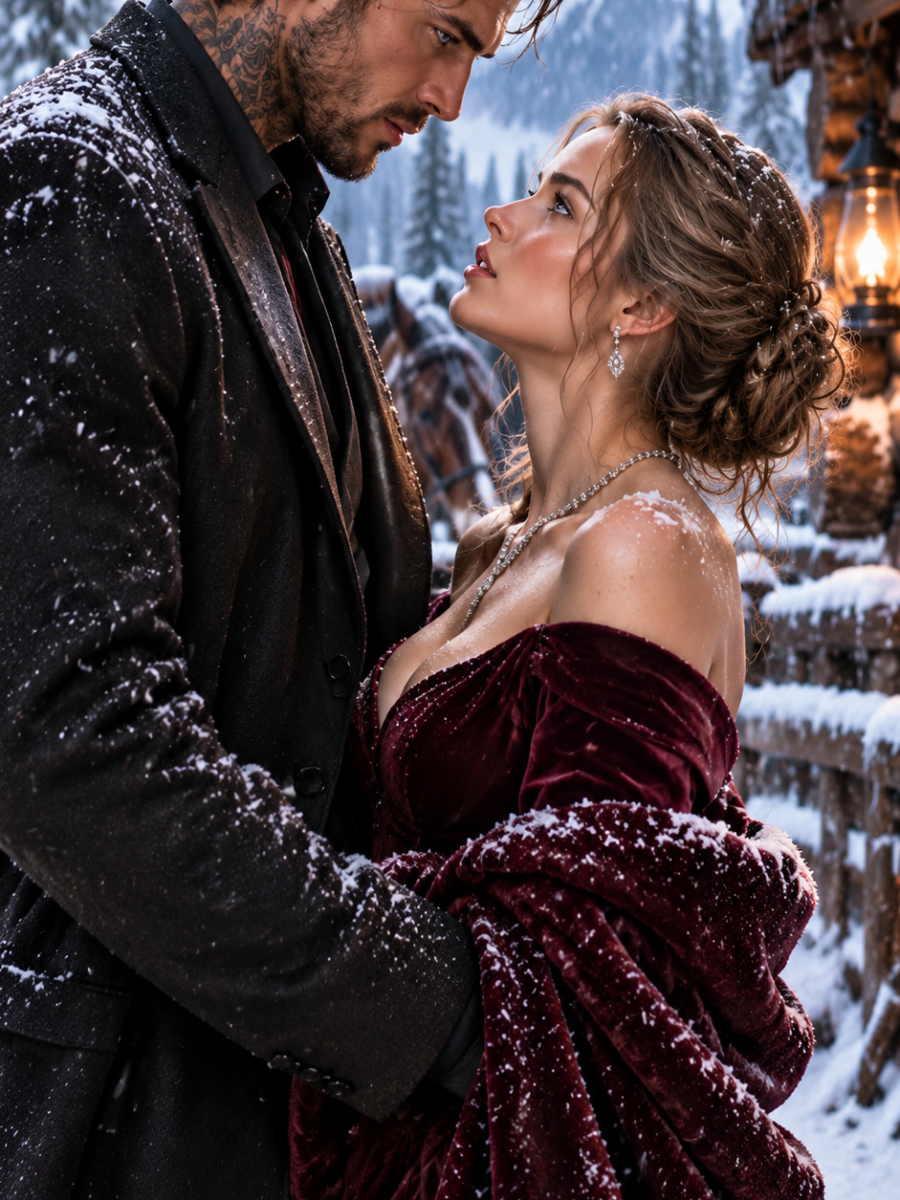
Snow lashed the frosted depot windows in Silver Plume as thirty-five-year-old mountain man Jonas Hargrave waited for a wife he didn’t want. Needing a sturdy housekeeper to survive the brutal Colorado winters at nine thousand feet, Jonas wrote to a St. Louis agency demanding a practical frontier woman. Instead, off the locomotive stepped Rebecca Hale—pale, slender, shivering in a frayed blue velvet traveling suit. Jonas threatened to put her on the next train east, but Rebecca looked into his scarred gray eyes and swore she had survived worse than cold.
Table of Contents
- Chapter 1: The Silver Plume Depot in the Blizzard
- Chapter 2: The Velvet Traveling Suit
- Chapter 3: An Agreement in the Timber Chapel
- Chapter 4: Nine Thousand Feet Above the World
- Chapter 5: Fire in the Cold Iron Stove
- Chapter 6: The Avalanche on Argentine Pass
- Chapter 7: Velvet Hands in the Freezing Snow
- Chapter 8: The Shadow from St. Louis
- Chapter 9: A Hearth That Never Goes Cold
Chapter 1: The Silver Plume Depot in the Blizzard
The steam locomotive groaned to a shuddering halt along the narrow-gauge wooden platform of the Silver Plume depot, venting great plumes of white steam that hissed into the howling mountain blizzard. It was November in the high Rockies of Colorado, where the air was thin enough to make a flatlander’s chest burn and the frost formed jagged ferns across every pane of glass. Outside, the sub-zero wind whipped off Argentine Pass, screaming through the spruce canyons and burying the silver-mining camp under three feet of powder.
Jonas Hargrave stood with his heavy boots planted wide apart on the snow-crusted boardwalk, his canvas duster buttoned to his jaw over a thick shearling vest. At thirty-five, Jonas looked like a man the territory had tried to crush and failed. His broad shoulders carried the lean, corded muscle of fifteen years chopping lodgepole timber, hauling ore carts, and running seventy miles of trap lines across the Continental Divide. A jagged pale scar cut across his left jawline—the permanent mark of an enraged grizzly sow he had killed with an iron hunting knife three winters earlier.
He lived alone at nine thousand feet in an isolated timber cabin perched on the rocky spine of Mount McClellan. Up there, winter lasted seven months, loneliness could rot a man’s mind, and one slip of an axe or a sudden snowslide could turn an ordinary morning into a frozen death sentence.
Romance had nothing to do with his decision to marry. He needed help. The previous winter, a bout of lung fever had kept him delirious on his bunk for a week; he had survived only by chewing dried venison and melting snow in a tin cup beside his bed. He had written to a matrimonial bureau in St. Louis with terms as plain as language could make them: *A practical, strong woman willing to maintain a high-altitude homestead. In exchange: shelter, food, and iron protection. No promises of affection. No pretty lies.*
The letters signed by Rebecca Hale had suited him. Her handwriting was neat, her replies brief and unsentimental. She claimed she was a widow accustomed to manual labor who needed a clean start in the West. Jonas had wired sixty dollars for her railway fare.
Now, as prospectors in mackinaws and teamsters in beaver caps pushed past him through the drifting snow, Jonas watched the coach doors swing open.
Chapter 2: The Velvet Traveling Suit
And then, gathering her skirts with trembling fingers, stepped Rebecca Hale.
Judson—no, Jonas—froze. His jaw clamped tight, his gray eyes narrowing in thunderous disbelief.
She was twenty-four years old, slender and delicate, with skin the color of fresh cream, wide sapphire-blue eyes, and dark raven hair pinned beneath a bonnet that had seen better days. But it was her attire that made Jonas’s blood simmer with immediate frustration.
She wore a dark blue velvet traveling suit. The fabric was undeniably luxurious, but the hem was crusted with three days of train soot and frozen mud. The velvet cuffs were frayed, the seams strained across her shoulders, and from her gloved hand hung a single battered leather case that looked as though it could barely hold two spare dresses.
She was trembling so violently from the bitter cold that Jonas could hear the faint chattering of her teeth from ten feet away. She stepped down onto the wooden platform, swayed slightly as the altitude hit her lungs, and caught the railing with white knuckles.
Jonas strode across the platform, towering over her like a thunderhead. His shadow fell across her shivering form.
“You,” Jonas growled, his voice rough as granite scraping against iron. “Rebecca Hale?”
She startled, looking up into his scarred face. Her breath caught, but her blue eyes did not flinch. “I am. You must be Mr. Hargrave.”
“You lied in your letters,” Jonas said without preamble. “You aren’t any sturdy frontier widow. You look like you’ve never split a cedar log, gutted a trout, or hauled a water bucket in your entire life. You look like you belong in a St. Louis drawing room sipping tea from porcelain cups.”
He reached into his coat, pulling out two twenty-dollar gold coins and shoving them toward her frozen fingers. “The return train east leaves at dawn. I’ll pay for your room at the miner’s boarding house across the street. You’re getting on that train.”
For one remarkable heartbeat, Rebecca stopped shivering. Her slender spine went rigid as a steel rod. Her chin rose, her sapphire eyes blazing with sudden, fierce defiance. She let the gold coins fall from his outstretched hand, tumbling into the snow between their boots.
“I am not getting on that train, Mr. Hargrave,” Rebecca said, her voice small but ringing with unshakable authority. “We have an agreement. Reverend Josiah Abbott is waiting at the parish church right now to solemnize this union. Unless the word of a Colorado mountain man is as worthless as the snow on his boots.”
Chapter 3: An Agreement in the Timber Chapel
Jonas stared at her in stunned silence. He had expected tears. He had expected embarrassment, apologies, or frantic pleading from a city woman stranded in a rough mining camp. He had not expected a half-frozen girl in a frayed velvet dress to challenge his personal honor before she had even left the train depot.
“You’ll die up on that mountain, city girl,” Jonas warned her, stepping closer so his breath plumed in the frost. “The Rockies don’t care about stubbornness. When the temperature drops to forty below zero and the drifts bury the windows to the roofline, pride won’t keep your blood moving.”
Rebecca held his gaze without blinking. Her fingers tightened around the handle of her battered leather case.
“I have survived colder things than winter, Jonas Hargrave,” she whispered, her voice laced with an old, jagged pain that struck him harder than an insult. “Take me to your mountain. I will chop your wood, I will scrub your floor, and I will cook your meals. I will not be a burden to you. I swear it on my mother’s memory.”
Jonas clenched his teeth, feeling the hard knot of reluctant respect lodge in his chest. A man who breaks his word is no man at all in the high country.
“Pick up your case,” he muttered, turning on his heel.
They walked through the blinding snow to the small log chapel at the edge of Silver Plume. Inside, the pine pews were empty, smelling of damp cedar and tallow candles. Reverend Josiah Abbott—a frail old man with spectacles perched on his nose—conducted the service with hurried frontier efficiency.
There were no rings. There were no flowers. There was no kiss.
Jonas took the steel pen, scrawled his name in heavy, jagged strokes across the territory marriage register, and handed the pen to Rebecca. She signed with an elegant, flowing script that looked like art beside his crude signature.
“Husband and wife,” Reverend Abbott declared, stamping the paper. “May the Lord have mercy on both your souls in these mountains.”
Jonas pulled his collar up. “Let’s go. We have four hours of climbing before the pass closes.”
Chapter 4: Nine Thousand Feet Above the World
The ascent to Mount McClellan was a test of raw endurance that had broken seasoned men.
Jonas rode his heavy buckskin gelding and led a pack mule loaded with sacks of winter grain, flour, and salt. Rebecca followed behind on a gentle, sure-footed mountain mare named Bess.
The logging trail was narrow, winding along dizzying ledges where a single misstep meant a thousand-foot tumble into the frozen gorge of Clear Creek. The wind shrieked through the spruce branches, throwing ice pellets like buckshot into their faces. By the time they reached seven thousand feet, the altitude hit Rebecca like an iron fist. Her face drained of all color, her breath came in rapid, shallow gasps, and her fingers grew so numb she could barely maintain her grip on the saddle horn.
Twice Jonas looked back over his shoulder, expecting her to cry out, to halt the horse, or to collapse into the snow.
She never said a word.
Whenever Bess stumbled on the icy shale, Rebecca leaned forward, whispering encouragement to the mare, steadying herself, and pressing onward. Her blue velvet coat was soaked through with melting ice, turning dark and heavy, but her jaw remained clamped shut in absolute, unyielding determination.
At dusk, as the last gray light bled from the sky, they crested a rocky timbered saddle and reached the cabin.
It was built from thick, round spruce logs with deep overhanging eaves to shed heavy snowdrifts. A low stone chimney rose from the western wall. Fifty yards away stood a rough pole barn and a split-rail corral. Around the homestead stood ancient, towering pines, their dark boughs groaning beneath the weight of the blizzard.
Jonas dismounted, caught Rebecca as she slid stiffly from the saddle, and set her on her boots. Her knees immediately buckled from sheer exhaustion, but she caught the wooden porch rail, refusing to fall.
Jonas pushed open the heavy oak door. The interior was pitch-black and freezing, smelling of cold woodash, cured pelts, and dry pine needles.
“This is it,” Jonas said bluntly, striking a sulfur match and lighting a tin lantern on the rough-hewn table. “I sleep on the floor by the hearth on wolf pelts. The bed in the corner is yours. Dry venison and flour are in the pantry. I’m going to the barn to rub down the stock. Try to get warm.”
Chapter 5: Fire in the Cold Iron Stove
He expected to return from the barn to find her weeping on the bunk, paralyzed by the grim reality of a mountain homestead.
Instead, when Jonas pushed open the cabin door thirty minutes later, the sight made him stop dead in his tracks.
The heavy cast-iron stove was roaring, its iron belly glowing cherry-red, sending waves of fragrant, crackling warmth through the cabin. A mountain of kindling that Jonas had stacked near the wall had been neatly organized into three graduated piles. The rough timber table had been wiped clean, and a cast-iron pot sat on the front burner, bubbling with a fragrant stew made from salt pork, dried onions, and hominy corn.
Rebecca stood beside the stove. She had taken off her soaked velvet traveling jacket, hanging it near the flue to dry. She wore a simple white linen chemise and a dark wool skirt, her dark hair pinned up with wooden twigs she had whittled with a pocketknife from her case. Her cheeks were flushed pink from the heat, her sleeves rolled up over forearms that bore the faint, red marks of stove burns.
“Supper will be ready in ten minutes, Jonas,” she said quietly, without looking up as she stirred the pot with an iron spoon. “I found the well bucket by the door. The water was frozen over, but I broke the crust with the fire poker.”
Jonas stood in the doorway, snow melting off his beard, staring at the woman who was supposedly too soft for his world.
He didn’t speak. He took off his duster, washed his hands in a tin basin of warm water she had set out for him, and sat down at the table.
When she placed a steaming bowl of stew and a thick, golden slice of pan-baked cornbread in front of him, Jonas took a bite. The flavor was rich, seasoned with wild sage and pepper—better than anything he had eaten in ten years of frontier isolation.
He ate in silence. Rebecca sat across from him, eating a small portion with slow, polite grace.
“Who were you running from in St. Louis, Rebecca?” Jonas asked suddenly, his gray eyes locking onto hers through the rising steam.
Rebecca’s spoon paused in mid-air. A faint tremor ran through her fingers before she lowered it to her bowl.
“My father owned a commercial flour mill on the Mississippi,” she said softly, her voice barely carrying over the crackle of the fire. “A wealthy magistrate named Thomas Vance wanted the waterfront property. When my father refused to sell, the mill burned down in the middle of the night. My father died trying to save the books. Vance bought up our outstanding bank notes, forged a debt contract, and gave me a choice: marry him as his third wife, or go to the state workhouse.”
She looked up, her sapphire eyes burning with raw, unbroken defiance. “I took the train west the next morning. I will die on this mountain before I let a corrupt tyrant own my soul, Jonas Hargrave.”
Jonas looked at her for a long, quiet moment. He reached across the table, his rough, scarred thumb briefly brushing against the back of her small hand.
“Nobody takes anything from this mountain, Rebecca,” he said quietly. “Eat your cornbread.”
Chapter 6: The Avalanche on Argentine Pass
For the next four weeks, as December deepened and the mountain temperature plummeted to thirty degrees below zero, Rebecca proved that her courage was made of tempered steel.
She learned to use the two-man crosscut saw, pulling with steady, rhythmic cadence while Jonas guided the blade through spruce trunks. She learned how to salt and smoke venison, how to caulk the cabin walls against the creeping drafts, and how to bake sourdough bread that rose like golden pillows in the iron oven. And every night, when Jonas lay on his buffalo robes by the fire and Rebecca slept in the bunk, a quiet, unspoken warmth grew between them—a bridge built of mutual respect and shared survival.
Then, on Christmas Eve, disaster struck.
A sudden warm chinook wind followed by a flash freeze destabilized the deep snowpack along the north face of Argentine Pass. Jonas had gone up to the high ridge at dawn to check his heavy beaver traps before a major blizzard moved in.
At two in the afternoon, a deep, concussive rumble shook the cabin floorboards like an earthquake.
Rebecca ran to the porch, shielding her eyes against the gale. High up the mountain, a colossal white cloud of pulverized snow was billowing into the sky—a Class Four avalanche had sheared off the upper cliffs of McClellan and roared down the ravine.
Right where Jonas’s trap line ran.
Two hours passed. The sun disappeared, and the temperature dropped like a stone to forty below. Jonas did not return.
Rebecca didn’t hesitate. She didn’t wait for morning. In the Rockies, a man trapped in an avalanche freezes to death in three hours.
She pulled on Jonas’s spare wool trousers, two layers of flannel, and her heavy shearling coat. She strapped his wooden snowshoes onto her boots, loaded a canvas pack with whiskey, bandages, clean wool blankets, and an iron trenching shovel, picked up a burning pine-pitch lantern, and marched out into the freezing blackness toward the high pass.
Chapter 7: Velvet Hands in the Freezing Snow
The climb through four feet of powder in the middle of a sub-zero blizzard was agony. The wind tore at her breath, ice formed on her eyelashes, and twice she tumbled into deep drifts, clawing her way out with raw, bleeding fingers.
*“Jonas!”* she screamed into the gale, her voice whipped away by the howling storm. *“Jonas!”*
At nine thousand four hundred feet, where the avalanche path had sheared fifty acres of ancient spruce trees down to splintered stumps, she saw something dark breaking through the white crust.
It was the tail of Jonas’s buckskin gelding. The horse had been pinned against a granite boulder, shivering but alive.
Thirty yards away, beneath a mound of packed snow and fallen pine boughs, Rebecca saw a gloved hand protruding from the drift.
“Jonas!” she sobbed, throwing herself onto her knees in the snow.
She dug with the shovel until her shoulders burned, then threw the tool aside and clawed through the icy crust with her bare hands. Within ten minutes, she had cleared the snow from his torso.
Jonas was unconscious, his skin the color of blue ice, his pulse faint and thready. A falling timber had crushed his left leg, pinning him beneath a spruce log.
Using an iron crowbar from her pack as a lever, Rebecca planted her boots against the boulder, throwing all hundred and twenty pounds of her body against the steel. The log shifted two inches. She wedged a rock underneath, pulled with all her remaining strength, and dragged Jonas’s six-foot-two frame out from under the death trap.
She poured whiskey between his blue lips. She wrapped him in the heavy wool blankets, lashed him securely to the horse’s pack saddle, and led the shivering gelding down the pitch-black mountain trail on foot, step by agonizing step, guided only by the distant yellow glow of the cabin chimney.
Chapter 8: The Shadow from St. Louis
For three days and three nights, Jonas burned with a terrifying, delirious fever in the cabin bed, his crushed leg wrapped in splints and hot pine poultices.
Rebecca never slept. She melted snow, bathed his burning forehead with cold cloths, spooned hot broth into his mouth, and held his calloused hand whenever the delirium made him thrash against the sheets. When he finally opened his eyes on the fourth morning, his fever broken, the first thing he saw was Rebecca sitting on the floor beside his mattress, her head resting against his hip, fast asleep from pure exhaustion.
Jonas reached out with a trembling hand, gently smoothing the dark hair from her pale, hollow cheek. In that quiet dawn, with the woodstove crackling and the mountain wind singing outside, the solitary, cold trapper realized that this woman was not just his wife—she was his salvation.
Two weeks later, as Jonas was hobbling on a wooden crutch he had carved, the peace of McIntyre Ridge was shattered.
A loud pounding rattled the heavy oak door.
Jonas grabbed his loaded Winchester lever-action rifle, limping to the window. Outside in the snow stood three men on horseback: two heavily armed frontier bounty hunters wearing low-slung revolvers, and a man in a plush fur coat and beaver hat.
Thomas Vance. The corrupt magistrate from St. Louis.
“Rebecca Hale!” Vance’s oily, arrogant voice boomed through the log walls. “I hold a legal writ from the Missouri Supreme Court for your return! You owe forty thousand dollars, girl! Come out peacefully, or these gentlemen will drag your husband out into the snow and hang him from his own roof beam!”
Rebecca stepped into the room, her face pale, holding Jonas’s double-barrel ten-gauge shotgun across her chest. Her hands were rock-steady.
“Jonas, don’t,” she whispered. “Your leg is still broken. I won’t let them kill you for my past.”
Jonas looked at her, his scarred face breaking into a grim, wolfish smile.
“Rebecca,” he murmured, cocking his Winchester with an iron click that resonated through the room. “I told you once: nobody takes anything from this mountain. Especially not my wife.”
Chapter 9: A Hearth That Never Goes Cold
Jonas kicked open the door, stepping out onto the porch with his Winchester leveled straight at Thomas Vance’s chest. Beside him stood Rebecca, the twin barrels of the ten-gauge shotgun trained squarely on the two bounty hunters.
Vance sneered, waving a crumpled parchment. “You’re harboring a fugitive, trapper. I have legal title to her person until her family’s debt is discharged.”
“This is Colorado Territory, Vance,” Jonas replied, his voice dead, flat, and colder than the ice on the peaks. “Missouri papers are toilet paper in these mountains. And this woman isn’t Rebecca Hale. Her name is Rebecca Hargrave. She’s my lawful wedded wife under the laws of the United States.”
One of the bounty hunters shifted his hand toward his revolver grip.
*CRACK!*
Jonas fired a single round from his Winchester, the lead bullet tearing through the bounty hunter’s stirrup leather, blowing his boot out of the iron and embedding into the pine post beside him.
The horse reared in panic, tossing the gunman into a four-foot snowdrift.
“The next bullet takes your skull, Vance,” Jonas said, levering another round into the chamber with blinding speed. “Turn your horses around, ride down this canyon, and if I ever see your face in this territory again, I’ll feed your carcass to the wolverines.”
Vance took one look at Jonas’s cold gray eyes, then at Rebecca holding the ten-gauge without a single tremor in her fingers, and realized that out here beyond the law, his wealth and forged papers were completely worthless.
“You’ll rot up here!” Vance screamed, wrenching his horse around in panic. “Both of you!”
The three men galloped away down the snowy canyon, fleeing as if the mountain itself were hunting them.
When the sound of hoofbeats faded into the pines, Jonas lowered his rifle. He turned toward Rebecca.
She stood on the porch in her woolen skirt, snow dusting her dark hair, tears of relief shimmering in her blue eyes.
Jonas tossed his crutch aside, stepped forward on his healing leg, and pulled her tightly against his chest. His arms wrapped around her slender frame, holding her with a fierce, protective tenderness he had never known in his thirty-five years of solitary existence.
“I came to Silver Plume looking for a cold housekeeper,” Jonas whispered against her hair, his deep voice thick with emotion. “And God sent me an angel who set my frozen heart on fire.”
Rebecca wrapped her arms around his neck, burying her face into his shearling collar, laughing through her tears. “I told you, Jonas. I am not a burden. I am your home.”
High on Mount McClellan, the winter winds blew across the granite peaks, but inside the timber cabin, the hearth burned bright, warm, and everlasting—a beacon of courage, love, and unbreakable devotion that no cold on earth could ever extinguish.