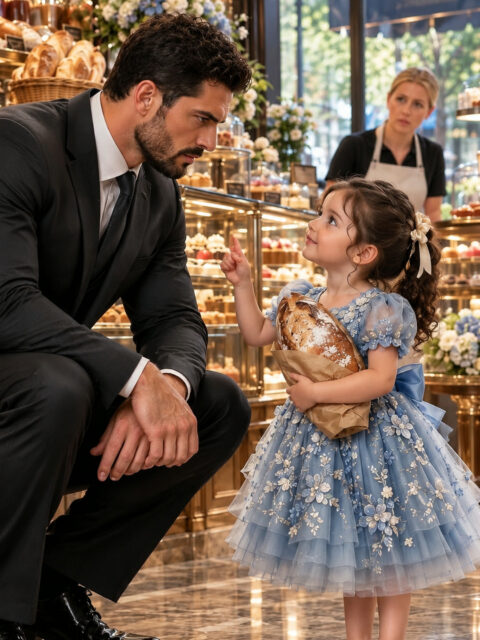
Chapter 1: The Child in the Freezing Rain
The bitter November sleet swept mercilessly across Michigan Avenue, transforming the towering skyscrapers of downtown Chicago into monolithic silhouettes of frosted glass, grey steel, and swirling mist. Sebastian Ross, chief executive officer of Ross Global Holdings and a man whose single signature could shift international financial markets, stood completely motionless on the icy curb outside his global corporate headquarters. His tailor-made cashmere overcoat, worth thousands of dollars, was already soaked through, yet he felt neither the biting gale nor the deep, numbing chill creeping into his bones.
In his trembling gloved fingers, shielded beneath the wool lapel of his jacket, he gripped a confidential medical dossier that had been hand-delivered by his personal physician barely sixty minutes earlier. The diagnosis was as brutal as it was irreversible: terminal stage-four cardiovascular degradation. The world’s preeminent cardiologists had conferred in Switzerland and Boston, and their unanimous verdict offered no compromise—six months of functional vitality, perhaps nine if he subjected himself to experimental therapies. For over thirty years, Sebastian had waged relentless economic warfare, sacrificing every possibility of marriage, fatherhood, and domestic warmth to erect an unassailable financial empire. Now, facing the inevitable closing of the ledger, he discovered the bitterest truth of modern ambition: in a world where he possessed the power to purchase islands, he was walking toward the grave in total, unmitigated isolation.
The sound that pulled him from the abyss of his despair was not the blare of a taxi horn or the rush of evening commuters hurrying toward the subway stations. It was a faint, choked sob—delicate, stifled, and shivering with an unbearable fatigue. Sebastian turned his head slowly, his grey eyes, usually calculating and merciless, clouded with exhaustion.
Sheltered beneath the brutalist granite portico of the federal depository building across the cobblestone alleyway sat a tiny, huddled figure. It was a little girl. She could not have been more than seven years of age. Her oversized winter coat, faded from its original pink to a dismal brownish grey, was frayed and shredded at the cuffs. Patches of mud clung to the hem of her worn denim dungarees, and her worn snow boots were split open at the seams, leaving her sodden socks exposed to the slush collecting on the pavement. Yet despite her ragged attire and the dirt smudging her pale cheeks, what arrested the breath in Sebastian’s chest were her eyes. They were wide, strikingly dark, and framed by thick, wet lashes that held back an ocean of silent terror. In her small, trembling hands, her knuckles raw and purple from the sub-zero wind, she cradled a half-eaten dry biscuit, wrapped carefully inside a torn greaseproof napkin as if guarding the last ration of food on earth.
“Mister… are you crying because you’re hungry too?”
The question emerged like a fragile whisper carried on the winter squall. It was clean, completely devoid of deception or theatricality, carrying the pure, heartbreaking innocence of an abandoned child.
Sebastian froze on the sidewalk, his body locking as if struck by lightning. In the glass-and-steel boardroom sixty stories above them, high-powered executives, federal regulators, and international bankers routinely broke into cold sweats under his scrutinizing stare. Men feared his voice; competitors anticipated his wrath. Not a single living soul in thirty years had ever dared approach him to inquire about his emotional pain. The agonizing reality was that Sebastian had forgotten what tears felt like—he had not wept when his father cast him out into the snow at eighteen, nor when his former business partners attempted to bankrupt him. Yet now, touching his freezing face, he realized that tears had indeed traced lines down his weathered cheeks.
Slowly, deliberately, Sebastian stepped off the curb and walked into the alley. Ignoring the icy puddles that ruined his bespoke Italian leather shoes, he sank down onto his knees directly in front of the shivering child, bringing his tall, imposing frame down to her eye level.
“I’m not hungry, little one,” Sebastian said, his deep baritone wavering with an unfamiliar tremor. “Why are you sitting alone out here in the middle of a storm? Where are your parents? Where is your mother?”
The child drew her thin knees up against her chest, carefully sliding the piece of dry biscuit into her coat pocket like a squirrel hiding an acorn against the frost. “Mommy told me to wait right here on the big steps,” she whispered, her teeth clattering so violently that she had to pause between syllables. “She told me that angels always watch over good little girls who say their prayers, and that someone would come to help if I didn’t wander off. But Mommy went to sleep in the big white hospital room three days ago, and the tall lady in the green coat told me Mommy flew up to the stars and wouldn’t be waking up again. The landlord changed the padlock on our apartment door yesterday morning. I… I didn’t know where else to go.”
Chapter 2: The Silver Locket and the Ghost of the Past
Sebastian felt a constriction in his throat so sudden and tight that he struggled for oxygen. The freezing wind howling between the brick buildings seemed to mute, replaced by the deafening cadence of his own surging pulse. “What is your name, sweetheart?”
The little girl sniffled, wiping her wet nose with the ragged cuff of her sleeve. “Clara,” she answered softly. “Clara Vance.”
The surname struck Sebastian Ross with the force of a physical blow. The world ceased to exist. Twenty-five years dissolved into nothingness. Boston, Massachusetts, 1999. In the years before his heart hardened into corporate granite, there had been one woman who had known him before his millions—Eleanor Vance. She was an idealistic, brilliant literature student whose laughter could dispel the darkest clouds of his ambition. They had loved each other with a fierce, reckless devotion, until his ravenous hunger for wealth and power drove a wedge between them. When Sebastian signed his first predatory corporate merger, Eleanor had looked at him with profound sorrow, packed a single leather valise, and walked out of his brownstone apartment forever, rejecting every trust fund, every bank draft, and every settlement he desperately dispatched across the continent. For seven agonizing years, private detectives traced her across Ohio, Wisconsin, and finally Illinois, reporting only that she had chosen a quiet, humble existence teaching underprivileged children in community centers, refusing to ever speak his name.
“Clara…” Sebastian whispered, his voice cracking entirely. His trembling hands reached into his coat and unwound a heavy, woven Scottish wool scarf, draping it gently around the shivering child’s neck and shoulders until she was completely swaddled in warmth. “Look at me, Clara. Did your mother give you anything? Did she leave anything in your care before she went to the hospital?”
The little girl stared into his eyes, sensing that beneath this strange, powerful man’s severe exterior lay a bottomless well of tenderness. Slowly, her small fingers slipped inside the unzipped collar of her frayed sweater. With agonizing care, she drew forth a slender silver chain that rested against her hollow collarbone.
Dangling from the tarnished links was a heavy, oval silver locket. It was scuffed and scratched from years of handling, its edges worn smooth by the frantic caresses of a mother who had clearly clutched it during long, desperate nights. But on the polished face of the locket was engraved an unmistakable insignia: two intertwined laurel branches encircling an eagle with spread wings, flanked by the Latin motto *Semper Fidelis*.
It was the ancestral seal of the Ross family. It was the private heirloom that Sebastian’s grandmother had bestowed upon him, and the very token he had pressed into Eleanor Vance’s palm the night he proposed to her beside the freezing waters of the Charles River.
A strangled sound tore from Sebastian’s chest. Hot tears spilled freely down his face, scalding against the arctic wind. All his billions, all his private fleets of aircraft and luxury towers, felt completely meaningless compared to the revelation unfolding before him on the dirty pavement of a Chicago back alley.
“David!” Sebastian bellowed, his voice echoing off the brick walls like a clap of thunder.
His head of executive security, David Miller, sprinted down the alley carrying a wide umbrella, two armed tactical guards following immediately behind him. Miller looked at the legendary corporate titan kneeling in the muddy slush, holding a destitute street orphan, and for the first time in fifteen years of service, the former military officer was rendered speechless.
“Mr. Ross… the board of directors has been convened on the top floor for twenty minutes,” Miller stammered, holding the umbrella over them to deflect the freezing sleet. “The final authorization for the multi-billion-dollar acquisition of Henderson Enterprises requires your personal physical presence. If you do not sign before the market closes—”
“Cancel the acquisition,” Sebastian interrupted, his voice dropping into a register of icy, absolute authority that made Miller’s spine straighten. “Cancel the board meeting. Issue a press release stating I have been called away on an emergency executive matter.”
With infinite gentleness, Sebastian slid his arms beneath Clara’s small frame and lifted her up against his chest. She was terrifyingly light, like a sparrow with broken wings, her ribs pressing against his wool coat. She instinctively tucked her cold face into the crook of his neck, seeking shelter from the bitter wind.
“Open the car, David,” Sebastian commanded, striding toward the armored Maybach purring at the corner. “Contact Dr. Harrison at the Medical Pavilion immediately. Tell him to dispatch his top forensic pathology team, full pediatric emergency staff, and mobile genetic sequencing equipment to my penthouse within the hour. We are conducting an expedited, rush-priority DNA paternity test, and if anyone in the organization breathes a syllable of this to my brother Julian, I will dismantle their careers permanently.”
Chapter 3: The Boardroom Conspiracy and the DNA Truth
Midnight blanketed the skyline of Chicago in thick, suffocating darkness, broken only by the shimmering amber lights of traffic crawling along Lake Shore Drive. Within the soaring penthouse atop the Ross Global Tower, the atmosphere was thick with tension. In the far guest wing, after being examined by three pediatric physicians, given warm nourishment, and dressed in soft cashmere pajamas, seven-year-old Clara had finally surrendered to exhaustion, sleeping soundly in a plush bed while clutching an antique velvet teddy bear.
In the cavernous, mahogany-walled library, Sebastian Ross sat behind his massive ebony desk, his gaze fixed on a sealed manila envelope bearing the insignia of the Illinois State Forensic Genetic Laboratory. Standing on the Persian rug across the desk was Dr. Robert Harrison, the chief of diagnostic medicine who had served the Ross family for three decades. And lounging in an adjacent leather wingback chair, nursing a tumbler of aged bourbon with an air of theatrical nonchalance, was Julian Ross, Sebastian’s younger half-brother and vice-chairman of the corporation.
Julian had arrived unannounced at ten o’clock, claiming he had come to review the sudden cancellation of the Henderson merger. But the nervous twitch in his eyelid and the constant, covert checks of his gold watch betrayed an acute, desperate anxiety.
“Is the sequencing certified, Dr. Harrison?” Sebastian asked, his voice steady, devoid of any discernible emotion.
“It is fully certified by two independent laboratory directors, Mr. Ross,” Dr. Harrison replied solemnly, stepping forward to slice open the envelope. He extracted a three-page analytical report covered in genetic charts and numerical probabilities. “We extracted the buccal epithelial cells from the child and cross-referenced them with your venous blood profile. Across all twenty-four standard short-tandem repeat loci, the match is undeniable. The probability of paternity exceeds 99.9999 percent. Clara Vance is, beyond all legal and biological question, your biological daughter.”
Julian’s glass slammed onto the marble side table with such violence that bourbon splashed across the polished stone. He surged out of his chair, his handsome face twisting into a mask of venomous fury.
“This is an unmitigated farce!” Julian shouted, pacing across the library while gesturing aggressively toward the ceiling. “You’ve completely lost your mind, Sebastian! You pick up some filthy, parasitic street beggar off the pavement in the middle of a rainstorm, and within six hours you’re fabricating medical records to claim she’s your long-lost heir? This is an extortion scheme! Some coordinated ring of con artists got their hands on an old family trinket, trained this brat to recite a sob story, and targeted you because they know you’re vulnerable! The executive board will never allow an illegitimate gutter child to take control of a forty-billion-dollar international conglomerate!”
Sebastian didn’t move a single muscle. He watched his brother rant, his cold grey eyes absorbing every gesture of panic like an apex predator observing a cornered jackal.
“How do you know I am vulnerable, Julian?” Sebastian asked softly. The question was quiet, yet it carried the chilling resonance of a steel blade being drawn from a scabbard.
Julian stopped dead in his tracks, his foot frozen mid-stride. A bead of cold sweat broke out across his temple, gleaming under the recessed spotlights. “What… what are you talking about? Anyone can see you’re under stress with the merger—”
“My terminal cardiovascular degradation was diagnosed at precisely three-fifteen this afternoon,” Sebastian said, his voice flat and deadly. “The medical file was encrypted on a private military-grade server. The only individuals possessing the clearance codes were Dr. Harrison and the individual designated as my temporary corporate power of attorney—a position you have occupied for exactly fourteen days. Furthermore, my cyber-security division detected a series of covert wire transfers initiated from your personal investment vehicle at five o’clock, attempting to leverage my impending demise to orchestrate a hostile buyout of my controlling shares.”
Julian backed away from the desk, his chest heaving, his fingers knotting into tight, white-knuckled fists.
“Eleanor Vance passed away three days ago in the charity ward of Cook County General Hospital,” Sebastian continued, standing up slowly from his chair and towering over his younger brother. “The very same charity ward that saw its private benefactor grant mysteriously cancelled last month—a grant overseen by your philanthropic sub-committee. You engineered her destitution, Julian. You monitored her struggle, waited for her to die in poverty, and intended to let my daughter perish on the freezing streets of this city so that not a single trace of my bloodline could challenge your inheritance.”
Sebastian took the forensic report, held it inches from Julian’s pale face, and whispered: “The DNA paternity test has established the truth for all eternity. Your reign as the heir to Ross Global Holdings ended the second Clara asked me if I was hungry.”
Chapter 4: The Legal Fortress and the Living Trust
By eight o’clock the following morning, the library had been transformed into an executive war room. Sunlight poured through the panoramic glass windows, casting long golden rectangles across stacks of legal briefs, court petitions, and corporate asset ledgers.
Curled up in a plush leather armchair by the roaring marble fireplace was Clara. Freshly dressed in a soft navy wool sweater, a pleated tartan skirt, and polished black leather shoes purchased that morning by Sebastian’s personal shopper, she sat happily sipping hot cocoa with miniature marshmallows. Her face was clean, her hair neatly brushed and tied with a blue velvet ribbon, and for the first time in her young life, her dark eyes radiated a sense of absolute, unquestioned safety. Beside her, David Miller stood like a sentinel, quietly cutting fresh strawberries into small porcelain dishes for her.
Seated around the central conference table were two of the most fearsome legal practitioners in the United States: Jonathan Vance, a legendary family law litigator and veteran custody attorney who had dismantled the country’s wealthiest dynasties, and Victoria Sterling, the premier estate architect on Wall Street.
“Let us be exceptionally clear about what we are confronting,” Sebastian instructed, leaning over the table with his hands planted firmly on the mahogany. “Julian and his cabal of hedge-fund vultures will file every injunction in the legal dictionary. They will attempt to claim that Clara is an imposter, that I am suffering from cognitive decline, or that her custody should be remanded to state protective services while decades of litigation drain the estate. I want an unbreachable legal fortress constructed around my daughter before the New York Stock Exchange opens tomorrow morning.”
Jonathan Vance opened a heavy leather binder, adjusting his wire-rimmed glasses with cold professional efficiency. “Under the Illinois Uniform Parentage Act, Mr. Ross, we hold an insurmountable tactical advantage. Because Eleanor Vance died intestate and no legal father was registered on Clara’s original birth certificate, we are submitting an Emergency Ex-Parte Petition for Declaration of Paternity directly to Chief Judge Callahan of the Family Division. Attached to this petition is the certified twenty-four-marker forensic report from the state laboratory. As your custody attorney, I have drafted an immediate Emergency Order of Sole Legal and Physical Custody. Judge Callahan knows Julian’s litigators well; he will sign this decree before the courthouse bells chime noon, completely extinguishing any jurisdiction the Department of Child and Family Services might claim and cutting off any third-party petitions from secondary relatives.”
Sebastian nodded firmly, then turned to Victoria Sterling. “And the corporate structure? If Julian forces probate upon my passing, the board could attempt a forced receivership.”
Victoria smiled thinly, unfurling a thick, embossed document bound in crimson silk. “Probate is a battlefield for the unprepared, Mr. Ross. We are bypassing it entirely. We have created the Clara Vance Ross Irrevocable Living Trust. Within the next two hours, every single share of your seventy-two percent voting stock in Ross Global Holdings, your offshore holding companies, your intellectual property portfolios, and all thirty-four residential and commercial properties will be deeded and transferred into this living trust.”
“Explain the governance mechanism,” Sebastian demanded.
“Under the explicit stipulations of this living trust,” Victoria explained, pointing to the designated clauses, “Clara is named the sole, primary, and irrevocable beneficiary. Until she attains the age of twenty-five, the operational control of the assets is held by an independent board of fiduciaries comprised of Jonathan Vance, David Miller, and the Chief Justice of the State Appellate Court. Not a single voting share can be sold, pledged, or diluted. Furthermore, we have integrated a strict ‘no-contest’ in terrorem provision: if any individual—including Julian Ross—files a challenge against the living trust or Clara’s legitimacy, their remaining executive pensions, options, and severance packages are instantaneously forfeited and redistributed to Eleanor Vance’s memorial charity foundation.”
Sebastian signed his name with a heavy gold fountain pen on each of the thirty-four execution pages. “Establish a liquid reserve of one hundred million dollars within the trust immediately. Ensure every outstanding mortgage on Eleanor’s former schoolhouse is paid, fund full scholarships for every child in her district, and assign round-the-clock executive protection to Clara. Julian believed he could leave my child to freeze. By nightfall, he will realize he no longer owns the floor beneath his feet.”
Chapter 5: The Confrontation at Ross Tower
The afternoon financial markets were thrown into absolute pandemonium when the ticker tape announced an unscheduled, mandatory extraordinary meeting of the board of directors of Ross Global Holdings. By one-thirty, satellite broadcast vans from CNBC, Bloomberg, and Fox Business lined the perimeter of Ross Plaza on Michigan Avenue. Rumors of executive infighting, corporate takeovers, and impending litigation had driven trading volumes to historic highs.
On the sixty-fourth floor of Ross Tower, the executive boardroom was an arena of suffocating tension. The twenty-two voting directors sat in heavy leather armchairs around the forty-foot Brazilian rosewood conference table. At the far end of the room stood Julian Ross, impeccably tailored in a double-breasted grey suit, flanked by five senior corporate litigators from Chicago’s most expensive defense firm.
“Gentlemen, members of the board,” Julian announced, resting his palms on the table with an air of calculated triumph. “You have all read the alarming press leaks regarding my brother’s sudden health crisis and his erratic behavior over the past forty-eight hours. Sponsoring unknown street orphans, cancelling multi-billion-dollar acquisitions, and attempting to divert company assets without committee authorization are clear markers of diminished capacity. I am moving for an emergency resolution under Bylaw Fourteen to suspend Sebastian Ross from his position as chief executive officer and transfer executive operational control to me.”
Before any director could second the motion, the heavy double oak doors of the boardroom were thrown open.
A dead, absolute silence fell over the room.
Walking through the threshold was Sebastian Ross. He wore a bespoke charcoal wool suit, perfectly tailored, his head held high and his stride possessing the terrifying, predatory grace that had built the conglomerate from dust. But what caused several directors to drop their pens onto the table was what accompanied him.
Holding Sebastian’s right hand was seven-year-old Clara. She wore a tailored navy blue cashmere coat, neat white knee-high socks, and gleaming leather shoes. In her small hands, she held the silver family locket, her dark eyes looking calmly across the room full of terrified billionaires. Behind them walked Jonathan Vance, Victoria Sterling, and four armed executive protection officers.
“Sit down, Julian,” Sebastian said. His voice was not loud, but it possessed a terrifying gravity that caused two directors near the door to involuntarily push back their chairs.
Sebastian walked to the head of the table, lifted Clara gently into the massive, high-backed leather executive chair, and stood tall beside her, his hand resting with steady reassurance upon her shoulder.
“Twenty years ago,” Sebastian began, his voice echoing off the acoustic ceiling panels, “this very board voted to strip Eleanor Vance of her minority shares because she refused to allow your chemical division to build an incinerator next to an urban elementary school. You told yourselves that when she walked away with nothing, her voice had been permanently silenced. You assumed that money could erase blood, and that power could bury the truth.”
Jonathan Vance stepped forward, unzipping his leather briefcase and distributing thick, blue-backed legal binders in front of each board member with deliberate, rhythmic slaps against the wood.
“As the court-appointed custody attorney representing Clara Vance Ross,” Jonathan stated with cold precision, “I am serving this board of directors with the certified decree of parentage issued two hours ago by Chief Judge Callahan. Simultaneously, under the recorded registration of the Clara Vance Ross Irrevocable Living Trust, all seventy-two percent of the Class-A voting shares of Ross Global Holdings have been permanently vested in this living trust. Clara Ross is the majority owner of this corporation. By legal proxy and paternal guardianship, Sebastian Ross commands her voting authority with absolute veto power. Every corporate resolution proposed by Julian Ross is rendered null, void, and legally non-existent.”
Julian’s face flushed a deep, violent crimson. He slammed his papers onto the table, his litigators whispering frantically in his ear as they realized the trap had snapped shut. “You think a piece of paper makes you invincible, Sebastian? This isn’t over! I built half these divisions! You can’t expel me from my own family’s company!”
“You didn’t build anything, Julian,” Sebastian replied, his gaze chilling the entire room. “You merely fed off the scraps of what I created. And as of this moment, your security clearance is terminated, your stock options are frozen pending federal audit, and you have exactly twenty minutes to clear your personal belongings from this building before security escorts you into the street.”
Chapter 6: Julian’s Desperate Gambit
Exiled from the boardroom and stripped of his corporate credentials, Julian Ross paced the floor of his private penthouse apartment in the Gold Coast district like a caged, rabid wolf. The evening television broadcasts running on the wall monitors were an unbearable humiliation: financial commentators were dissecting his removal, displaying graphics of the newly ratified living trust and praising Sebastian Ross’s dramatic unveiling of his long-lost daughter.
Julian threw a crystal tumbler against the wall, sending amber whiskey and shattered glass showering over the imported hardwood floor. His phone had been ringing incessantly for four hours—banks calling in personal credit lines, offshore brokers demanding margin calls, and his high-society associates suddenly pretending they had never known his name. If the forensic accountants completed their audit of the charitable foundation and his private equity accounts by Friday, federal indictments for embezzlement and wire fraud were an absolute mathematical certainty.
There was only one way to survive. If Clara Vance did not exist, the living trust would fall into jurisdictional chaos, and as the closest adult relative, he could force a state probate battle that would keep him out of prison for a decade.
Julian reached into his desk drawer, pulled out an encrypted satellite burner telephone, and dialed an unlisted number in Miami.
“The final statutory transfer of the real estate and voting proxies requires the physical filing of the living trust deeds at the Cook County Recorder of Deeds tomorrow morning at eight sharp,” Julian hissed into the receiver, his voice ragged with desperation. “Sebastian’s security detail will transport the child in an armored convoy along Lake Shore Drive around seven-thirty. I don’t care what it takes. Stage an accident. A multi-vehicle pileup. Use a flatbed truck to sever the convoy, breach the rear passenger compartment, and extract the child. If the extraction becomes compromised… ensure that she does not arrive at the courthouse alive.”
Julian hung up, tossing the satellite phone onto the leather blotter. He slumped into his chair, believing that with a single catastrophic strike, he could reverse his fortune and reclaim the empire.
He was entirely unaware that the high-end digital telephone relay servicing his residential tower had been replaced forty-eight hours earlier.
In the sub-basement security nexus of Ross Tower, four federal wiretap technicians from the Department of Justice sat alongside David Miller, listening to the crystal-clear playback of Julian’s satellite transmission. The audio was being synchronized in real time with GPS telemetry tracking the two hitmen dispatched from Miami, who had landed on a private airstrip in Gary, Indiana, barely forty minutes earlier.
Fifteen minutes later, the reinforced mahogany doors of Julian’s penthouse were blown inward with a deafening crack. Tactical assault teams from the Federal Bureau of Investigation, supported by Chicago Police Department SWAT officers in full tactical gear, flooded into the room, their laser sights painting bright red dots across Julian’s chest.
“Julian Ross!” the tactical commander shouted, kicking the coffee table aside and pinning Julian violently against the hardwood floor. “Federal Bureau of Investigation! Do not move! You are under arrest for conspiracy to commit kidnapping, attempted murder of a minor, and federal wire fraud!”
Julian sputtered, his cheek pressed into the spilled whiskey and broken glass. “This is an outrage! You don’t have authorization! My lawyers will have your badges!”
David Miller walked into the apartment, followed by Jonathan Vance, the custody attorney. Miller held up a digital tablet displaying the recorded audio waveform and the signed federal arrest warrant.
“The federal judge signed the Title III surveillance warrant at four o’clock, Julian,” Miller said calmly. “Your contact in Gary was taken into custody before his vehicle even cleared the runway gates. Sebastian knew your greed would drive you to this. He knows you are incapable of walking away from what isn’t yours.”
Chapter 7: A New Dawn on Lake Michigan
Spring arrived in Chicago with an exquisite, gentle warmth that banished the cruel winter ice from the sprawling blue expanse of Lake Michigan. On the sweeping stone terrace of the historic Ross estate in Lake Forest, vibrant beds of golden daffodils, deep purple hyacinths, and velvet white tulips swayed peacefully in the mild lake breeze.
Sebastian Ross sat in a comfortable teak armchair overlooking the manicured lawns. To any corporate associate who had known him six months earlier, his physical transformation was nothing short of miraculous. The pioneering cardiovascular therapies developed by top European specialists had stabilized his arterial condition, but the doctors readily admitted that modern medicine had played a secondary role. The true catalyst for his healing had been the profound, restorative joy of becoming a devoted father. His eyes, once hardened by decades of predatory commerce, were bright, warm, and alive with purpose.
Across the sun-drenched grass, eight-year-old Clara was running with infectious laughter, playing fetch with a boisterous golden retriever puppy. Her cheeks were rosy with health, her dark hair gleamed in the sunlight, and she wore a cheerful sunflower sundress and white canvas sneakers. Her grades at the private academy were exemplary, her musical talents were flourishing, and her laughter filled every corridor of the estate that had once stood as a cold, silent mausoleum to corporate greed.
Jonathan Vance walked out onto the stone terrace, holding a leather folio and wearing an uncharacteristically relaxed smile.
“It is officially finished, Sebastian,” Jonathan said, pulling up an adjacent chair and setting down the legal certification. “Julian entered a formal guilty plea before the federal magistrate this morning. In exchange for avoiding a life sentence on the conspiracy charges, he accepted a mandatory fifteen-year sentence at the federal penitentiary in Marion, with zero eligibility for early release or sentence reduction. His civil challenges have all been dismissed with prejudice, and the supreme court has finalized the registration of the Clara Vance Ross Living Trust. Her position as your sole, unquestioned heir is now an eternal legal reality.”
Sebastian gazed out over the water, where sailboats cut white wakes across the deep blue horizon. He reached into his linen vest and gently touched the silver locket resting against his chest, polished until it shone like a mirror.
“You know, Jonathan,” Sebastian murmured, his voice rich with quiet emotion, “for thirty years I believed that a man’s value was measured in balance sheets, hostile takeovers, and corporate dominance. I was willing to sacrifice Eleanor, sacrifice my health, and spend my final days counting numbers on a screen. But on that freezing night on Michigan Avenue, when that tiny girl offered me her last piece of dry bread and asked if I was hungry, she gave me back my soul. She saved my life long before I ever had the chance to save hers.”
Clara’s joyful shout broke the afternoon quiet. “Daddy! Look! Barnaby learned how to bring the ball back!”
The little girl came sprinting up the stone terrace steps, her puppy bounding at her heels. She leaped into Sebastian’s outstretched arms, wrapping her small arms tightly around his neck and planting a sweet, sticky kiss on his cheek.
Sebastian held his daughter close against his heart, breathing in the scent of fresh rain and blooming flowers, knowing with absolute, unshakeable certainty that no matter what storms might gather in the world outside, his little girl would never have to sit out in the cold again.