Table of Contents
- Chapter 1: The Stew on the Blue Plate
- Chapter 2: The Whispers in the Den
- Chapter 3: The Cold Bag of Peas
- Chapter 4: The Lifeline Behind the Pantry
- Chapter 5: The Red Canister in the Dark
- Chapter 6: The Blue Flashing Lights
- Chapter 7: A Morning of Clean Air
“Betrayal rarely arrives carrying a banner or a weapon; it comes home in the evening smiling, stirs a pot on the stove, and asks how your day was. But maternal instinct is not blinded by deceit—it watches in silence, breathes in the shadows, and fights with everything it has to keep a child alive.”
Chapter 1: The Stew on the Blue Plate
The autumn rain drummed a steady, hypnotic rhythm against the double-paned bay windows of our suburban home in Oakridge, Illinois. It was supposed to be a celebratory evening. Daniel had returned home from his commercial brokerage firm an hour earlier than usual, carrying fresh sourdough bread from the artisanal bakery downtown and humming a soft tune. For months, our marriage had felt strained under the weight of his frequent business trips to Miami and long evenings at the office, but tonight, Daniel had insisted on cooking dinner himself.
“Sit down, Evelyn,” he had said warmly, planting a tender kiss on my temple as I reached for my apron. “You’ve been working seventy-hour weeks doing audits for the state hospital system. Tonight, you and Noah relax. I made your favorite: slow-braised beef burgundy with pearl onions and baby carrots.”
My eight-year-old son, Noah, had cheered from the kitchen island, his freckled face lighting up as Daniel dished out three generous bowls onto our ceramic blue dinner plates. Noah was a bright, remarkably observant boy who loved robotics and spent his weekends building intricate Lego circuits. He climbed into his chair, swinging his sneakers, while Daniel poured two glasses of cabernet sauvignon and a tall glass of whole milk for Noah.
“To fresh starts,” Daniel had toasted, clinking his wine glass against mine. He took a long sip, but I noticed he merely pushed his beef around his plate with a fork, claiming he had eaten a late corporate lunch.
I took three bites of the rich, savory stew. It tasted delicious—earthy, wine-infused, with just a hint of bitter rosemary. Noah ate half of his bowl, chattering excitedly about a science competition scheduled for Friday. But within ten minutes, an unnatural heaviness invaded my limbs. The ambient kitchen lights seemed to smear across my vision in blinding halos of gold and white. A terrifying, cold numbness rushed from my stomach into my chest, constricting my lungs like an iron band.
Across the table, Noah’s fork clattered onto his plate. His eyelids fluttered erratically.
“Mommy?” Noah whispered, his small voice slurred and distant. “My legs feel like heavy rocks… I’m so sleepy…”
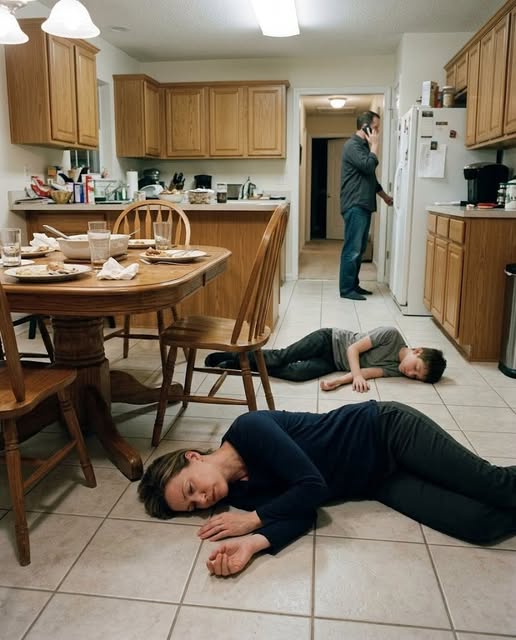
“Noah…” I gasped, trying desperately to rise from my chair. But the neural signals refused to obey my brain. My knees buckled beneath me, and I pitched forward off the wooden dining chair, crashing heavily onto the cold porcelain kitchen tile. A foot away, Noah slipped sideways off his seat, his small arm twisting awkwardly beneath his torso as his head struck the floor with a hollow, sickening thud.
Through the haze of paralyzing dizziness, I saw Daniel stand up from the table. He did not rush to catch his son. He did not cry out in panic or dial emergency services. He stood calmly, wiping his mouth with a linen napkin, looking down at his collapsing wife and child with cold, detached indifference.
Chapter 2: The Whispers in the Den
Panic—pure, primal maternal terror—screamed inside my skull. Every instinct screamed at me to jump up, grab Noah in my arms, and run out into the pouring rain. But my body was trapped in a chemically induced prison. The neurotoxin, whatever it was, was attacking my central motor functions, making even drawing a full breath an agonizing ordeal.
I realized in that terrifying instant that if Daniel saw me conscious, he would finish the job immediately. I forced my breathing into a shallow, imperceptible rhythm. I allowed my cheek to rest completely flat against the freezing tile, letting my jaw sag and my eyelids flutter closed, leaving only the thinnest sliver of vision through my eyelashes.
Daniel’s polished leather dress shoes walked past my head. He strode into the adjoining den, picking up his personal mobile phone from the credenza. I heard the keypad chime as he dialed a number. The line connected after two rings.
“It’s done,” Daniel’s voice drifted down the hallway. It was smooth, devoid of remorse, carrying the conversational tone of a businessman confirming a routine wire transfer. “They ate it. Both of them are down on the kitchen floor… Yes, the paralytic worked in under fifteen minutes, just like the chemist promised. They won’t be a problem after tonight.”
A woman’s voice crackled softly on the speakerphone, too faint for me to decipher the words, but high-pitched and expectant. Daniel chuckled softly—a sound that sent ice water cascading through my veins.
“The gas leak scenario is foolproof, Victoria,” Daniel continued. “I have two fifty-gallon propane tanks in the utility shed behind the garage. I’ll open the furnace valves and rig the water heater pilot light to spark when the basement fills. By midnight, the entire wing will be leveled. The coroner will write it off as an accidental asphyxiation followed by a blast. The insurance trust is filed in Delaware. Ten million dollars tax-free. Meet me at the private airstrip in Gary at three in the morning.”
The call disconnected. Footsteps echoed back toward the kitchen.
I clamped my teeth together beneath relaxed lips, forcing every muscle in my face to stay completely slack. Daniel stopped right beside my head. He crouched down. His large hand closed around my right wrist, pressing his thumb against my radial artery to verify my heart rate. I slowed my pulse through sheer willpower, imagining a frozen winter lake. Satisfied with the faint, sluggish throb, Daniel lowered my limp arm gently back onto the linoleum.
He crossed to Noah. I heard the soft rustle of cotton as Daniel touched our son’s shoulder, turning the little boy slightly onto his side.
“This will be easier for everybody, buddy,” Daniel whispered softly. “No custody fights. No lawyers picking over my commissions.”
Those words—spoken over his own flesh and blood—shattered every remaining trace of fear in my heart. The panic evaporated, replaced by an incandescent, lethal resolve. A mother fighting for her cub does not feel pain. She only calculates survival.
Daniel stood, walked to the dining table, and picked up our two smartphones, slipping them into his overcoat pocket. He opened the heavy door leading into the attached garage, stepped through, and let the heavy deadbolt click shut behind him.
Chapter 3: The Cold Bag of Peas
The instant the garage door latch clicked, I opened my eyes.
Across the cold floor, three feet away, Noah was already staring at me. His hazel eyes were wide with terror, but his jaw was clenched. Despite the heavy numbness dragging down his small limbs, my eight-year-old boy had stayed completely motionless, listening to every horrifying word his father had spoken.
“Mommy,” Noah whispered, his voice trembling so violently his teeth clicked. “Daddy… Daddy wants to kill us.”
“Shh,” I breathed, pressing a trembling finger to my lips. “Listen to me, Noah. We are going to survive this. Do you hear me? We are going to walk out of this house alive.”
The numbness was receding slightly, burning as feeling crawled back into my extremities. I dragged myself onto my elbows, my knuckles scraping against the tile. My forensic accounting training kicked in with ruthless clarity: if Daniel blew up the house or claimed food poisoning, the police would need irrefutable chemical evidence of intentional poisoning. Without physical evidence, it would be his word against ashes.
My eyes locked onto the table.
My ceramic blue dinner plate still sat there, three-quarters of the beef stew and gravy untouched. Noah’s bowl had several chunks of beef and carrots resting in dark sauce. But Daniel had not touched his plate at all; his was pristine.
“Phones,” Noah whispered, pointing to the empty credenza where our devices usually charged. “He took them.”
“I know, baby. Stay right there. Don’t stand up yet,” I commanded quietly.
I crawled across the floor on my belly, pulling myself up using the lower kitchen cabinets. My knees shook violently, but the surge of adrenaline overpowered the neurotoxin. I yanked open the lower drawer beneath the center island, grabbed a heavy-duty quart-sized Ziploc freezer bag, and snatched a silver serving spoon from the drying rack.
With shaking hands, I scraped four large spoonfuls of the poisoned stew, potatoes, and thick sauce from my blue plate into the plastic bag. I added a spoonful of the diced carrots from Noah’s bowl. Then, I zipped the seal tight, pressing out the air.
“Hold the drawer, Noah,” I whispered.
Noah dragged himself across the tile, using his small hands to brace the bottom pull-out freezer compartment of the French-door refrigerator. I opened the top freezer drawer, slid the sealed bag of poisoned food beneath a frozen roast, and shoved it deep behind a half-empty bag of frozen green peas. If Daniel glanced into the kitchen before setting his trap, the evidence would remain safely frozen and concealed.
I returned the serving spoon to the sink and slid my blue plate back onto the wooden table. My hands shook so badly that the ceramic plate clinked against the wood, landing roughly an inch from its original position. I stared at it, praying Daniel wouldn’t notice the microscopic displacement.
Chapter 4: The Lifeline Behind the Pantry
“Mommy, the phone,” Noah whispered, his eyes darting toward the garage door. “How do we call the police?”
In our modern smart home, everything was wireless. Our tablets were docked in the master bedroom upstairs, and Daniel had taken our cellular phones. But five years ago, when we remodeled the kitchen, I had insisted on keeping one relic of the past: an old copper-wire corded rotary landline phone, installed inside the narrow broom cabinet beside the walk-in pantry in case of power outages during Midwest blizzards. Daniel had mocked me for years, calling it an unsightly waste of wall space, and had buried it behind a thick stack of laminated pizza menus and coupon books.
I scrambled across the floor, opened the cabinet door with agonizing slowness to prevent the hinges from creaking, and shoved aside the menus.
There it was. An ivory Western Electric push-button phone, its curly beige cord coated in dust.
I lifted the plastic receiver to my ear.
A crisp, steady dial tone hummed in my ear. The sweetest sound I had ever heard in my life.
With trembling fingers, I punched 9-1-1. The line clicked twice, and a calm, professional female voice responded: “Cook County 911, what is the location of your emergency?”
“1428 Elmwood Drive, Oakridge,” I whispered rapidly, keeping my voice barely above a breath. “Listen to me carefully. My husband, Daniel Vance, just poisoned my eight-year-old son and me with a paralytic neurotoxin in our dinner. He thinks we are unconscious. He has disabled our mobile phones and is currently in the garage preparing to stage an explosion using propane tanks. We are trapped inside. Send armed units and ambulances immediately.”
The dispatcher’s tone shifted instantly to urgent command. “Ma’am, I have your address locked. Units are rolling code three with sirens off right now. ETA is four minutes. Is your husband armed?”
“He owns a nine-millimeter Glock kept in his glovebox,” I replied, my eyes locked on the garage door. “I don’t know if it’s on him.”
“Can you safely evacuate through the back patio?”
“I’m going to try,” I said. “Hurry.”
I hung up the phone and pushed the cabinet shut. Noah crawled toward the kitchen sliding glass door that led out to the covered back deck. He reached up and lifted the corner of the faux-wood blind, peering into the rain-slicked driveway.
He turned back to me, his small face pale, shaking his head. “The driveway is empty, Mommy. His car is parked inside the garage. He hasn’t left.”
I hurried back to the freezer, yanked open the drawer, and pulled out the sealed bag of stew from behind the frozen peas. I shoved the cold, heavy plastic pouch directly into the waistband of my sweatpants, pulling my thick woolen sweater down over it to conceal the bulge.
I grabbed Noah’s hand, pulling him to his feet. His knees wobbled, but he gritted his teeth, leaning his weight against my hip. Together, we took two agonizing steps toward the patio door.
Suddenly, the high-pitched hum of an engine cut through the rain outside. Twin beams of halogen headlights swept through the blinds, casting long, moving shadows across the kitchen ceiling.
A car had just pulled into our driveway.
Chapter 5: The Red Canister in the Dark
“Floor!” I hissed.
There was no time to reach the patio door. The lock on the garage entry clicked. In a fraction of a second, Noah dropped beside his overturned chair, throwing his arm beneath him in the exact posture Daniel had arranged minutes earlier. I lowered myself onto the cold porcelain tile, turning my cheek flat against the floor, allowing my arms to splay limply beside my hips.
I flattened my palms and closed my eyes, letting my mouth fall open.
The garage door swung wide.
Heavy footsteps entered the kitchen, accompanied by the strong, noxious chemical stench of high-octane gasoline. Daniel was breathing heavily, his boots dragging slightly as he carried two heavy red five-gallon plastic fuel canisters across the kitchen threshold. He set them down on the linoleum with a heavy, hollow thud.
Through my barely cracked eyelashes, I watched him. Daniel was wearing heavy leather work gloves. He stood over me for three agonizing seconds, his gaze sweeping over my limp body. Then, he looked up at the dining table.
His eyes narrowed.
He noticed the blue plate. It sat an inch closer to the edge than he had left it. A flicker of suspicion crossed his features. He took two steps toward the table, bending down to examine the ceramic rim.
My heart stopped. The frozen bag of peas in my waistband felt like an anvil pressing against my abdomen. I prepared to kick his kneecap with all my strength if he reached for the food.
Suddenly, a loud electronic chime sounded from his jacket pocket. Daniel pulled out his phone, clicking the screen. It was a text message.
“Hurry up,” Daniel muttered to himself, reading the screen. “The charter pilot wants wheels up by three.”
He abandoned the plate. Daniel walked to the basement door beside the refrigerator, twisted the brass knob, and descended the wooden stairs into the darkness below. Seconds later, the terrifying, metallic hiss of escaping natural gas drifted up through the floorboards. He was unscrewing the primary intake manifold from our heating furnace.
He was going to blow the entire foundation into the sky.
Noah looked at me from the floor, tears of sheer panic welling in his eyes. I shook my head minutely, mouthing two silent words: Not yet.
Daniel climbed back up the basement stairs, carrying a road flare and an electric soldering iron. He began dousing the kitchen curtains and wooden cabinetry with gasoline from the red canisters, splashing fuel across the floor just inches from where Noah lay.
He looked at his watch, pulled the flare from his belt, and raised his lighter.
Chapter 6: The Blue Flashing Lights
CRASH!
The front picture window detonated into a thousand glittering shards of tempered glass. A thunderous roar of tactical orders shook the house.
“POLICE! DROP THE LIGHTER! ON THE GROUND! DOWN ON THE GROUND NOW!”
Six Oakridge SWAT officers in tactical armor poured through the shattered front entryway, their assault rifles raised, tactical weapon lights illuminating the smoke and fumes in blinding white beams. A laser sight locked onto Daniel’s chest.
Daniel screamed in sheer, uncomprehending shock. He dropped the lighter onto the unsoaked portion of the rug, raising his trembling hands into the air, backing toward the refrigerator. “Don’t shoot! Don’t shoot! My house… my house has a gas leak! My wife and son are unconscious!”
“ON YOUR FACE! HANDS BEHIND YOUR HEAD!” the lead sergeant barked, lunging forward with a ballistic shield.
Two officers tackled Daniel to the tile, slamming him down beside the red gasoline canisters, forcing his arms behind his back and clicking heavy steel handcuffs onto his wrists. Daniel struggled violently, shouting incoherently about accidents and poison.
I pushed myself up from the floor, coughing from the gasoline fumes, and threw my arms around Noah, pulling him tight against my chest. “Noah! Baby, look at me! We’re safe! It’s over!”
Noah buried his face in my neck, sobbing with shuddering, disbelieving relief. “Mommy… the police came… they really came!”
Paramedics rushed through the doorway with oxygen masks and medical stretchers. A female paramedic knelt beside us, checking Noah’s pupils and wrapping a thermal blanket around his shivering shoulders. “Ma’am, we need to get you both outside right now. The gas concentration in this house is critical.”
“Wait,” I said, my voice steady, sharp, and commanding.
I reached under my woolen sweater and pulled the thick Ziploc bag of stew from my waistband. The plastic was frosted, the food safely chilled, the dark gravy preserving the deadly chemical compound within. I handed it directly to the lead police investigator standing beside the SWAT team.
“This is the beef stew my husband cooked,” I stated clearly, loud enough for Daniel to hear from the floor where he was pinned. “He poisoned it with a paralytic neurotoxin. He took our phones, called his mistress Victoria, confessed to the poisoning, and went downstairs to open the furnace gas lines. There are two five-gallon gas cans behind him, and the hidden corded phone in that pantry cabinet contains the recording of my 911 dispatch call.”
Daniel’s head snapped toward me from the floor. His eyes bulged in horrified, disbelieving comprehension. His mouth opened, but no sound came out. The woman he believed was helpless, paralyzed, and condemned to burn had outmaneuvered him at every single turn.
The investigator sealed the bag in an evidence container. “Get this monster into the cruiser,” he ordered his officers. “And alert the state toxicologist. We’ve got him on premeditated double attempted murder.”
Daniel was dragged out into the pouring rain in handcuffs, his screams of denial swallowed by the storm.
Chapter 7: A Morning of Clean Air
Six months later, the morning air over Oakridge was crisp, clean, and filled with the scent of blooming apple blossoms. The house on Elmwood Drive had been sold, its painful memories left far behind. In its place was a sun-drenched four-bedroom colonial home in Lake Forest, situated on a quiet cul-de-sac backing into a protected forest preserve.
The forensic toxicology report had revealed that Daniel had laced the stew with suxamethonium chloride, an offshore surgical paralytic, obtained through his mistress Victoria Vance, who had been arrested boarding her private charter flight in Indiana. Daniel had pleaded guilty to two counts of attempted first-degree murder and insurance fraud, receiving a sentence of forty-five years without the possibility of parole.
In our new kitchen, golden sunlight streamed across white quartz countertops and warm oak hardwood floors. Standing at the stove, humming cheerfully as she flipped buttermilk pancakes, was Evelyn. On the counter sat a brand-new set of cheerful yellow ceramic dinner plates—the old blue set having been discarded forever.
Sitting at the island counter, wearing a navy school uniform and a medal around his neck, was Noah. Beside his plate sat a first-place trophy from the State Robotics Championship: an automated Lego rover capable of navigating obstacles using sensory light monitors.
“Pancakes are ready, champ,” I smiled, placing two golden stacks drizzled with pure maple syrup and fresh blueberries in front of him.
Noah looked up, his hazel eyes bright, fearless, and brimming with unshadowed joy. He reached across the counter, placing his small hand over mine, giving my fingers a tight, knowing squeeze.
“Mommy?” he asked softly.
“Yes, baby?”
Noah pointed with his fork toward the freezer door, where a little magnetic clip held an unopened package of frozen green peas, kept as our private family talisman of survival.
“Do you think we should plant an apple tree in the backyard today?” Noah asked, his grin wide and mischievous.
I laughed—a sound of pure, unblemished liberation that echoed through the sunlit home. I leaned down and kissed the top of his head, feeling the warmth of his skin and the strong, steady beat of his heart.
“We’ll plant two trees, Noah,” I whispered softly. “One for courage, and one for life.”
Outside, the morning sun rose high above the green canopy of the trees, banishing every shadow of the past, illuminating a future that was bright, beautiful, and entirely ours.