A hungry little girl counted pennies at a Manhattan bakery counter while a black sedan full of silent men watched her from across the street.
I’m Dante Ruggiero. Most of New York knows my name from restaurant signs and shipping contracts, and the rest of New York knows it for reasons nobody writes down. I have heard grown men beg. I have watched liars smile at me across a table. But nothing ever stopped me the way three whispered words from a six-year-old did on a snowy November afternoon. She had a handful of coins, a coat two sizes too small, and a secret her mother had sewn into the lining of her blue knit hat. Read every chapter to learn who was sitting in that black car, why her mother chose my bakery out of every door on the block, and which man at my own table had sold us both.
“They still have my mommy.”
Chapter 1: The Handful of Coins
The little girl had a handful of coins, an empty stomach, and a black sedan watching her from across the street.
All I heard was her tiny voice breaking under the noise of the bakery.
“I’m so hungry.”
She couldn’t have been older than six, in a gray coat too short in the sleeves and a faded blue knit hat pulled low over her eyes.
I had noticed her the second the bell clattered above the door, because twenty years of learning which rooms are safe teaches you to notice everything.
And I noticed that no adult followed her inside.
I was at my corner table with shipping manifests. Sal Benedetto, my driver, leaned on the back wall. Tommy Russo sat two tables away.
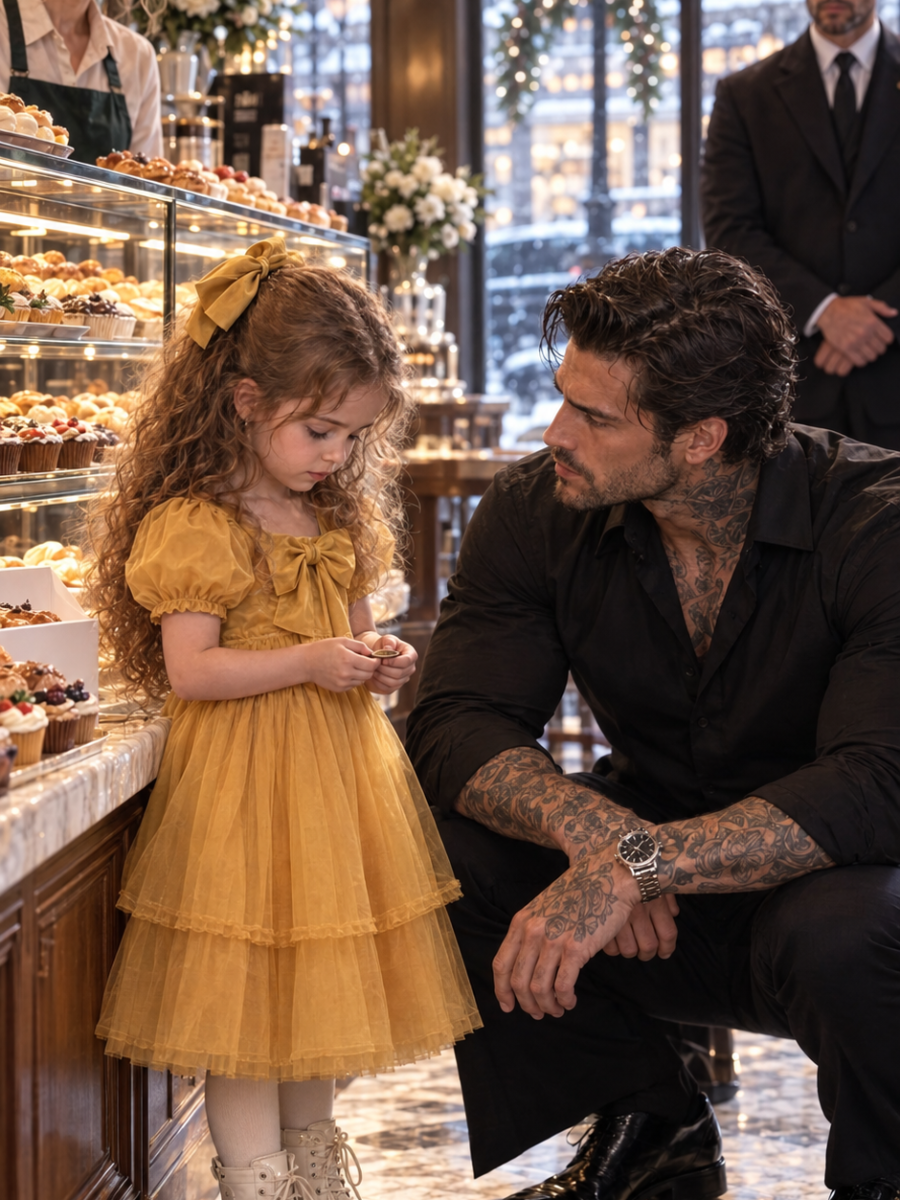
She pushed one hand into her pocket and placed every coin carefully on the counter. Pennies. Nickels. Two dimes. One quarter.
“How much is that one?” she asked, pointing.
“Six-fifty, sweetheart,” said Rosa, the woman who had run that counter for thirty years.
The girl counted her coins.
Then she counted them again.
Her shoulders dropped, a movement so small most people would have missed it.
“I’m so hungry,” she whispered again, gathering the money back up so the coins wouldn’t clink.
I closed the folder.
Sal looked up at once. “Boss?”
I raised one hand. Stay.
When I walked toward her, the girl finally saw me and stepped backward so fast her boot squeaked on the wet tile.
This one looked at me the way a child should never have to look at any stranger.
I stopped several feet away and crouched until I wasn’t towering over her.
“What’s your name?”
“Ivy,” she said, very quietly.
“Ivy, are you here alone?”
Her eyes went to the door, not to a parent. Then to the window. Only then back to me.
“Where’s your mother, Ivy?”
Her lips pressed together, and her fingers dug into her pocket.
“She told me to wait somewhere with people.”
Chapter 2: The Black Sedan
Not Mommy is shopping.
Not She’ll be right back.
She told me to wait somewhere with people.
I glanced at Sal. His phone was already back in his pocket.
“Why did she tell you that?” I asked.
“Because the men were following us,” she whispered.
Every instinct I owned came awake at once, and I kept perfectly still.
“What men, Ivy?”
She lifted one small hand, two coins still pinched between her fingers, and pointed at the window.
“The ones in the black car.”
I turned slowly.
Across the street, a black sedan idled at the curb, snow on its roof but none on the warm hood.
The moment I looked straight at them, both men turned their heads away from the bakery at the same time.
“That’s not a coincidence,” Sal murmured at my shoulder.
“No,” I said. “Innocent people stare back. Guilty people pretend they never noticed.”
“What do you want?”
“Get Ivy something to eat,” I said. “And don’t let anyone near her.”
The sedan’s brake lights flashed red. For one second it stayed still. Then it eased into traffic, not fast, just ordinary.
“They’re pros,” Sal said. “Panicked men floor it.”
Rosa was already wrapping the turkey sandwich and a cup of cocoa. She had watched me grow up on this block, and she had seen hungry children before. Years ago I had read about a little girl who begged for just one bowl of soup with a handful of coins, and I remembered thinking no child in my neighborhood would ever have to count pennies like that.
I was wrong.
“Put it on my tab, Rosa.”
“You don’t have a tab, Dante.”
“Then start one.”
When I turned back, Ivy had moved closer. Her fingers caught the hem of my coat and held on, as if letting go would be worse than anything I might be.
“Please,” she breathed.
Tears filled her eyes. I had thought the hunger was the problem, then the car. The look on her face told me I had been wrong both times.
“What is it, Ivy?”
She looked at the empty curb where the sedan had been, then back up at me.
“They still have my mommy.”
Chapter 3: The Turkey Sandwich
Her mother hadn’t abandoned her. She had been followed, and she had gotten her daughter into the most crowded room on the block.
“Sal,” I said quietly. “Back booth.”
We sat Ivy in the booth behind the counter where nobody on the street could see her through the glass. Rosa set the sandwich in front of her, cut into four triangles the way you cut them for a child.
Ivy looked at it and didn’t touch it.
“It’s yours,” I told her. “Nobody’s taking it back.”
“Mommy says don’t take food from strangers.”
“Your mommy is smart,” I said. “Rosa isn’t a stranger. She’s been feeding this street since before I was your age.”
Rosa nodded. “Eat, baby.”
Ivy picked up one triangle with both hands and ate it so fast she started hiccuping. Rosa pushed the cocoa toward her. Sal looked out the window with his jaw tight.
I waited until she reached for the second piece.
“Ivy, what’s your mommy’s name?”
“Hannah,” she said with her mouth full. “Hannah Pryce.”
“Where were you two going today?”
“To the bus. Mommy said we were going to Aunt Jo’s in Philadelphia. She packed my bunny in her big bag.”
“Did she say why?”
Ivy shook her head. “She was crying in the bathroom last night. She thought I was asleep.” She took a sip of cocoa. “She cries quiet. Like me.”
“When did you see the black car?” I asked.
“Lots of days,” Ivy said. “It sits by our building. Mommy closes the curtains when it comes.”
“And today?”
“Today the men got out.” She set the sandwich down. “Mommy squeezed my hand three times. That’s our secret squeeze. It means do what I say and don’t ask questions.”
“What did she say?”
“She said, ‘Go into the bakery with the green awning and wait somewhere with people. Don’t come out for anybody but me.’” Ivy’s voice cracked. “Then the man with the gray scarf took her arm, and she didn’t scream. She smiled at him. Why did she smile?”
“So you wouldn’t be scared,” I said. “And so he wouldn’t look at you.”
Ivy wiped her nose on her sleeve. Then she reached into her coat and pulled out something folded small and tight.
“Mommy put this in my pocket with the money,” she said. “She said give it to the man at the corner table.”
I went cold.
I was the only man who ever sat at the corner table.
Chapter 4: The Folded Receipt
It was a crumpled drugstore receipt, folded eight times.
On the back, in blue ink that had smeared where Ivy’s warm hand had held it, someone had written in quick, slanted letters.
Mr. Ruggiero, I am so sorry. I had nowhere else to go. They work for someone close to you. Ivy has what they want. Please keep her safe and don’t trust the people at your own table. —H.P.
I read it twice.
“What does it say?” Sal asked.
“It says she knew exactly whose bakery this was.”
“Boss, how does some lady with a kid know where you sit every Tuesday at three?”
“That’s the question,” I said. “Ivy, did your mommy ever talk about me?”
Ivy thought hard, swinging her boots under the table. “She said there was a man who sits by the window in the bakery and everybody is a little scared of him, but he gave Grandpa’s funeral flowers when nobody else came.”
I sat back.
Six years earlier, an old longshoreman named Walter Pryce had died on Pier 12 after a crane cable snapped. The company had tried to call it his fault. I had paid for his funeral and made sure the company paid his widow. I had never met his daughter.
“Walter Pryce,” Sal said softly. “The crane accident.”
“His granddaughter is sitting in front of us.”
Ivy looked between us. “Do you know my grandpa?”
“I knew him,” I said. “He was a good man who worked very hard.”
“He made pancakes shaped like boats.”
“I bet he did.”
I turned to Sal and lowered my voice. “She wrote that the men work for someone close to me.”
“Could be a setup,” Sal said. “Somebody wants you walking into something.”
“A mother doesn’t hand her child to a setup.”
Tommy came back in from the street, stamping snow off his shoes. “Car’s gone, Boss. Headed toward the bridge.”
“Did you get the plate?”
He held up his phone with a small grin. “Course I did.”
I looked at the screen. New York plates, a black Lincoln.
“Run it,” I said. “Quietly. Nobody else hears about this.”
Tommy nodded and stepped toward the door to make a call.
Ivy tugged my sleeve.
“Mister Dante?”
“Yes, sweetheart?”
She leaned close and whispered so softly I almost missed it.
“The man with the gray scarf was at Grandpa’s funeral too. He gave Mommy a hug.”
Chapter 5: The License Plate
Tommy came back twenty minutes later and didn’t sit down.
That was how I knew it was bad.
“The Lincoln’s registered to Greco Linen Supply,” he said. “Red Hook.”
Sal swore under his breath.
Paulie Greco had been my father’s captain before he was mine. He ran the linen company that cleaned tablecloths for my restaurants, and he sat at my right hand every Sunday.
And every Sunday, he passed me the bread.
“Maybe somebody stole the car,” Tommy offered.
“Nobody steals a car and then parks it outside my bakery for an hour,” I said.
I looked at Ivy, who was coloring on a napkin with a pen Rosa had given her. She had drawn a boat with pancakes on it.
“Ivy, did your mommy have a job?”
“She does numbers,” Ivy said without looking up. “At the laundry place with the big trucks. She brings home papers.”
Sal closed his eyes.
I once heard about four terrified sisters hiding under a café table from an extortionist who were saved because a stranger chose to pretend he was their father. That afternoon I understood the man who did it. Some moments ask you who you are, and you only get to answer once.
“What do you want to do?” Sal asked.
“Nothing yet,” I said. “If Paulie has Hannah, he wants something she took. If he thinks we know, she stops being useful to him.”
“And then she stops breathing,” Tommy said.
“Tommy.”
“Sorry, Boss.” He glanced at Ivy. She hadn’t heard. She was adding a sun to her drawing.
“Where would he take her?” I asked.
“The linen warehouse has a basement,” Sal said. “Old boiler room. Paulie used to keep his card games down there.”
“Then we find out without walking in blind.”
My phone buzzed against the table.
The screen read Paulie G.
I let it ring twice, then answered with the warm voice I had always used for him.
“Paulie. You never call on a Tuesday.”
“Dante, kid.” His laugh was easy and familiar, the laugh of a man who had known me forty years. “I heard you had a little trouble at Rosa’s place this afternoon. Some stray kid. You okay?”
I looked across the table at Ivy.
Nobody had told him about any kid.
Chapter 6: The Blue Knit Hat
“Just a hungry little girl,” I said lightly. “Rosa fed her. Her aunt picked her up.”
“That’s good. That’s good.” A pause, a fraction too long. “You know how it is, kid. People talk. I worry about you.”
“You always did, Paulie.”
“Sunday dinner still on?”
“Wouldn’t miss it.”
“He’s fishing,” Sal said. “He doesn’t know how much the kid told you.”
“Then the kid is the only reason Hannah’s still alive,” I said. “Whatever she took, he hasn’t found it.”
I turned to Ivy. She had finished the sandwich and was licking sugar off one of Rosa’s pastries.
“Ivy, your note says you have something the bad men want. Did your mommy give you anything else today?”
“Just the money and the paper.”
“Anything in your bag? In your boots?”
She shook her head, then frowned and reached up to touch her hat.
“Mommy fixed my hat last night,” she said. “She said it had a hole. But it didn’t have a hole.”
I held out my hand. “May I see it?”
She hesitated, then pulled the faded blue knit hat off. The hat was heavier than wool should be.
Along the inside brim, someone had stitched a fresh seam with gray thread, the stitches tiny and careful, the work of a frightened woman sewing at midnight.
“Rosa, scissors,” I said.
I snipped three stitches. A flash drive slid into my palm, no bigger than my thumb, wrapped in a strip of plastic bag to keep it dry.
The drive held two folders. One was labeled GRECO REAL. The other was labeled RUGGIERO.
Inside the first were three years of ledgers: linen trucks that never carried linen, and containers listed under my name arriving at Pier 12 with cargo that had nothing to do with tablecloths.
“He’s been moving product through our containers,” Sal said. “Under your name.”
“For three years,” I said.
Then I opened the second folder.
It held a typed statement, a list of dates, and copies of my signature. Every page was ready to be handed to federal agents, and every page said Dante Ruggiero had run the whole thing.
Paulie wasn’t just stealing from me.
He was going to bury me with it.
Chapter 7: The Burner Phone
Hannah had found both folders. She couldn’t trust the police or my table, so she hid the proof in her daughter’s hat and sent her to the one man Paulie couldn’t walk past.
“She bet her life on you,” Sal said quietly.
“Then I don’t intend to lose her bet.”
I took a cheap phone from Tommy’s glovebox, one with no history, and called the only person I trusted outside my own family. Assistant U.S. Attorney Miriam Vasquez had spent five years trying to put me in prison and had never once lied to me.
“Ruggiero,” she said flatly. “This had better be a confession.”
“It’s a gift,” I said. “Three years of ledgers on a man who’s been moving fentanyl through Pier 12 under my name. And a woman being held in Red Hook because she found them.”
Silence.
“Why would you hand me one of your own?”
“He stopped being one of mine the day he put a little girl on the street with a handful of coins.”
“Send me something I can verify.”
I sent her three pages. Four minutes later she called back.
“These container numbers match an open case,” she said. “If this is real, I can have a warrant team in Red Hook in ninety minutes.”
“She may not have ninety minutes.”
“Don’t do anything stupid, Ruggiero.”
“I never do anything stupid,” I said. “I do things carefully.”
I hung up. Sal was watching me.
“You’re going in.”
“I’m going to Sunday dinner early,” I said. “Paulie wants the drive. I’m going to bring him one.”
Tommy copied the folders and loaded a blank drive with nothing but old restaurant menus. Rosa took Ivy upstairs to her apartment with a blanket and a cartoon on the television.
Before I left, Ivy ran back down the stairs in her socks.
“Mister Dante, are you going to get Mommy?”
I knelt in front of her. “I’m going to try very hard.”
“Squeeze three times,” she said, holding out her hand. “Then you have to do what I say.”
I squeezed three times.
“Bring her back,” Ivy ordered.
Then my burner phone buzzed with a text from an unknown number.
Bring the hat. Come alone. Warehouse. 7 p.m. Or the bookkeeper takes a swim.
Chapter 8: The Linen Warehouse
I walked into Greco Linen Supply alone at exactly seven, carrying a blue knit hat Rosa had bought on Canal Street.
Paulie was waiting between racks of folded tablecloths, wearing a gray scarf.
Two men stood behind him. Hannah Pryce sat on a folding chair by the boiler room door, hands taped, chin up.
She looked at me with something between terror and relief.
“Dante,” Paulie said warmly, spreading his arms. “Kid. You shouldn’t be mixed up in this.”
“You put me in it, Paulie. Three years ago.”
His smile thinned. “You found it.”
“A six-year-old found it. She carried it past your car with a handful of coins in her pocket.”
I tossed him the hat. He tore at the seam, found the drive, and handed it to the man with the bruise, who plugged it into a laptop on a pallet.
“You know what I never understood about you?” Paulie said while they waited. “Your father would have buried that girl’s mother and the girl beside her. You pay for funerals. You feed strays. You made us soft, Dante. Somebody had to keep the family fed.”
“By feeding the family to the feds under my name?”
“Business,” he said with a shrug.
The man at the laptop looked up. “Paulie. It’s menus. Restaurant menus.”
Paulie’s face changed.
“Where is it?”
“With somebody who doesn’t pass me bread on Sundays,” I said.
His men reached into their coats.
Then the loading door behind me rolled up with a roar, and the warehouse filled with headlights and voices shouting “Federal agents!” Sal stepped in beside the first agent, and Miriam Vasquez walked in behind them with a warrant in her hand.
Paulie’s men dropped to their knees.
Sal cut the tape from Hannah’s wrists. She stumbled toward me, shaking.
“Ivy?” she whispered.
“Upstairs at Rosa’s, eating pastries and watching cartoons. She’s safe.”
Hannah folded over and sobbed into her hands.
I once read about a five-year-old who whispered she was hungry over the phone to a feared syndicate boss and the father who raced across a city to reach her. I understood him that night more than I wanted to.
As the agents led Paulie past, he twisted toward Hannah.
“You think he’s any better than me?”
Hannah lifted her chin.
“He paid for my father’s funeral when you told the crane company my dad was drunk,” she said. “I knew it was you. I found the letter in your files.”
Chapter 9: The Corner Table
Paulie Greco went quiet for the first time in forty years.
Miriam Vasquez stopped beside me, tucking the copied ledger into her coat.
“This doesn’t make us friends, Ruggiero.”
“I wouldn’t want it to,” I said. “You’d get bored.”
She almost smiled. “The containers under your name will be cleared once these ledgers check out. The other folder, the forged one, goes into evidence against him.”
“And Hannah?”
“Cooperating witness. Full protection.” She looked at Hannah, who was wrapped in Sal’s coat. “She’s the bravest bookkeeper I’ve ever met.”
We drove back to Mulberry Street just after nine. Rosa had kept the bakery lights on.
Ivy was asleep on the upstairs couch with Rosa’s cat on her feet and the blanket pulled up to her chin. Hannah dropped to her knees beside her and pressed her face into the child’s curls.
Ivy opened one eye.
“Mommy?”
“I’m here, baby.”
“Did Mister Dante squeeze three times?”
Hannah looked at me over her daughter’s head with tears running down her face.
“He did exactly what you said,” she whispered.
Downstairs, Rosa poured coffee. Hannah sat across from me at the corner table, both hands around the mug.
“I’m sorry I dragged you into this,” she said. “I didn’t know where else to send her.”
“You sent her to the right table,” I said. “Why mine?”
“Because the night my father died, you were the only one who called him a good man,” she said. “Everybody else called him a drunk. I figured a man who would say that about a stranger would never walk past a hungry child.”
“The linen company is gone,” I said finally. “My restaurants need a new bookkeeper. Someone honest enough to catch a thief, and stubborn enough to sew evidence into a hat.”
Hannah laughed through her tears. “Is that a job offer?”
“Full salary. Health insurance. And Ivy never counts pennies at a counter again.”
She looked at me for a long moment, then nodded.
Three months later, Paulie Greco pleaded guilty to every charge on that ledger.
And every Tuesday at three, a little girl in a new red coat walks through the bakery door, climbs into the booth across from me, and drops one shiny quarter on the corner table.
“For the sandwich,” Ivy says seriously.
“That’s not enough,” I tell her every week.
“I know,” she says, grinning. “Put it on your tab.”
Rosa has never once charged her.