In February of 1878, winter did not merely descend upon the Colorado high country; it laid siege to it. High in the jagged shadow of the Sangre de Cristo Mountains, six miles beyond the rough frontier outpost of Bitter Creek, our pine-log homestead stood alone against the elements. The wind roared down the timbered gulches with the screech of an iron locomotive, driving dry, granular snow through every chink in the mortar. Inside the cabin, the temperature hovered just above freezing three feet from the stone hearth, where the final oak log had collapsed into a bed of grey, lifeless ash.
My name is Marian Voss. At twenty-seven years old, I was nearly eight months pregnant, shivering beneath a thin wool shawl, and utterly abandoned. Nine days earlier, when the first dark clouds gathered over the mountain crests, my husband Edwin had vanished before the morning light broke. There had been no embrace, no farewell, and no warning. Only a scrap of butcher paper weighted down by the tin coffee cup on the pine table:
Marian — I cannot stay. There is another woman in Denver. You will find money beneath the flour sack. Forgive me.
When my trembling fingers had overturned the stoneware flour sack in the pantry, there had been no currency. Only stale cornmeal, dry hulls, and cold mountain dust. Edwin had taken our roan mare, our two heaviest feather quilts, forty-six dollars in gold coin—everything we owned—leaving me to face the bitterest winter in Colorado history with a child kicking fiercely inside my womb.
Table of Contents
- Chapter 1: The Cold Cabin at Bitter Creek
- Chapter 2: The Rider in the Blizzard
- Chapter 3: The Birth by the Hearth
- Chapter 4: The Truth Behind Edwin’s Flight
- Chapter 5: The Stolen Survey of Black Rock Canyon
- Chapter 6: The Ambush at Bitter Creek Cabin
- Chapter 7: The Dawn Over the Colorado Ridge
“Cowards wrap their betrayals in convenient lies to soothe their guilt. But when the winter tempests strip away the falsehoods, the truth stands unyielding as mountain granite.”
Chapter 1: The Cold Cabin at Bitter Creek
The first sharp contraction struck my lower back at four in the afternoon, like the sudden blow of an iron maul. I cried out, dropping to my knees against the braided rag rug, both hands clutching my swollen stomach. The pain tightened across my abdomen until my vision blurred into streaks of grey. “Not yet,” I gasped, biting my dry lower lip until the metallic taste of blood touched my tongue. “Please, little one. Just wait until the storm passes. Wait until morning.”
The child answered with another violent wave of pressure. In the corner of the room, only three split logs remained in the woodbox. There were twenty cords of seasoned pine stacked beneath the cedar lean-to twenty yards outside, but the wind was howling at fifty miles an hour, and four-foot drifts had already sealed the base of the cabin door. To venture outside in labor meant freezing to death within five minutes.
I dragged myself toward the hearth, my fingernails scraping against the rough pine floorboards. My water broke with a warm rush that chilled almost instantly against the icy draft creeping under the sill. Trembling violently from shock and fever, I managed to reach the iron poker, attempting to rake together the three tiny glowing embers slumbering beneath the soot.
Then, above the shriek of the gale, I heard a sound that turned my blood colder than the mountain ice.
Crunch. Silence. Crunch.
Footsteps. Heavy boots breaking through the frozen crust of snow right outside the timbered porch wall.
Every terrifying tale whispered across the saloons of Bitter Creek flooded into my mind—renegade outlaws, starving drifters, and ruthless men who preyed on isolated frontier women without consequence. I grasped the heavy iron fire poker with both hands, my breath hitching as the iron latch of the door began to rattle.
Chapter 2: The Rider in the Blizzard
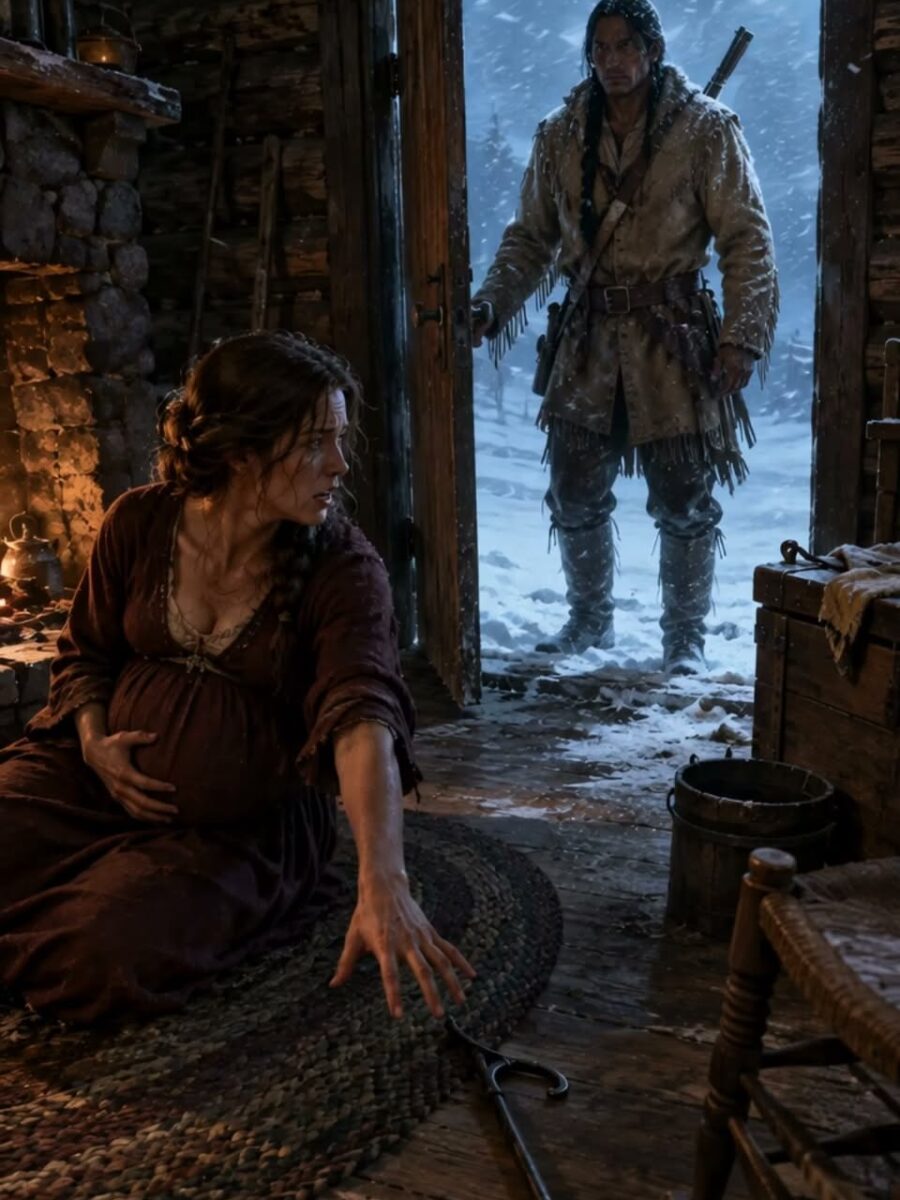
The wooden door was shoved violently inward against the weight of the snowdrift. A swirl of blinding white powder exploded into the room, extinguishing our single tallow candle.
Framed against the white vortex was a towering figure. He stood over six feet tall, broad-shouldered, draped in a heavy buffalo-hide coat caked in ice. Across his back was strapped a Winchester Model 1873 carbine, and a long raven braid fell over his right shoulder. A pale white scar traced the line of his bronze jawline, his dark obsidian eyes sweeping across the dim room with feline alertness.
A Ute man.
In Bitter Creek, the settlers spoke that word only with fear or prejudice, blaming the local native bands whenever cattle went missing or mining wagons broke an axle. I raised the iron poker, my hands shaking so violently the tip rattled against the stones.
“Stay back,” I whispered, my voice failing me. “I have nothing left to steal.”
The stranger did not draw a weapon. He took one step inside, turned around, and leaned his full weight against the heavy timber door, throwing the iron crossbar into place to seal out the freezing gale. He stood in the gloom, letting the snow melt from his eyelashes.
His dark eyes took in the scene with swift, clinical accuracy: the bloodstains on the braided rug, my swollen belly, the empty water pail, the cold hearth, and the absence of any man’s coat on the wall pegs.
“You are in labor,” he said. His voice was deep, measured, and spoken in quiet, fluent English.
“The fire,” I sobbed, the poker slipping from my numb fingers and clattering to the floor. “The baby will freeze… please.”
Without a word of hesitation, the man unslung his rifle, leaned it against the dry timber wall, and knelt before the cold fireplace. From his coat he produced dry birch bark shavings and a small tin of pitch. Using his heavy hunting knife, he split one of the remaining pine logs into pencil-thin kindling with three deft strokes. He gathered the tiny dying ember, placed the shavings above it, and blew gently with steady, patient breath.
Within thirty seconds, a bright yellow flame licked the birch bark. Within two minutes, dry pine roared into life, casting glorious, radiant heat across my shivering limbs.
Chapter 3: The Birth by the Hearth
The stranger filled the iron kettle from the snow bucket and hung it over the flames. He stripped off his frozen gloves and washed his weathered hands in hot water before turning to me.
“My name is Kohana,” he said quietly, crouching beside me. Up close, I saw the deep sorrow and steady strength in his eyes. There was no malice in his presence—only the quiet resolve of a man who understood the fragile boundary between life and death in these mountains.
“Tell me what you need,” he said.
A contraction seized my body with such ferocious intensity that my back arched off the floor. Without thinking, my hand shot out and clamped onto Kohana’s thick buckskin forearm with bruising force. He didn’t pull away. He braced his shoulder against mine, absorbing my weight, murmuring calm, rhythmic words in his native tongue until the wave subsided.
“The cedar chest,” I gasped, sweat mixing with the tears on my cheeks. “Clean linen sheets… tear them into strips. Twine is in the lard tin above the stove. If I pass out, wake me. And if I say I cannot bear it… do not believe me.”
Kohana nodded with solemn understanding. For three hours, as the blizzard rattled the cedar shingles above our heads, that mountain scout served as my physician, my anchor, and my protector. He tended the fire, bathed my burning brow with cool cloth, and guided my breathing through each agonizing contraction.
At eight in the evening, with one final, tearing push, our daughter entered the world. Her sharp, healthy wail cut through the roar of the mountain wind like a silver bell. Kohana severed the cord with his sterilized blade, tied it with clean linen twine, and gently wrapped the squirming infant in a soft flannel blanket warmed by the fire.
He placed the baby onto my bare chest. She had a mop of dark chestnut hair, perfect rosebud lips, and tiny fingers that curled instantly around my thumb.
“A daughter,” Kohana whispered, a rare, radiant smile breaking across his scarred face. “Strong as the mountain pine.”
“Clara,” I breathed, pressing my lips to her warm forehead, weeping tears of pure relief. “Her name is Clara.”
Chapter 4: The Truth Behind Edwin’s Flight
Kohana added two more logs to the roaring hearth, then knelt down to wipe the blood from the braided rug. As he picked up the damp cloths, he looked up at me with quiet curiosity.
“What is your family name, mother of Clara?”
“Marian Voss,” I replied, cradling Clara against my breast.
The cloth slipped from Kohana’s fingers. His entire body locked into absolute stillness. Slowly, his dark eyes rose to meet mine. The warmth in his expression vanished, replaced by an intensity so sharp it made my heart hammer with dread.
“Voss?” he repeated, his voice low as rumbling earth. “Edwin Voss is your husband?”
“Yes,” I whispered, feeling the cold air return to my throat. “Nine days ago, he left me. He wrote a note claiming another woman in Denver… he took all our money from beneath the flour sack and fled.”
Kohana stood up slowly, looking toward the dark window where the blizzard raged. He shook his head, a bitter, sorrowful scoff escaping his lips.
“Edwin Voss never went to Denver, Marian. And there is no other woman.”
I stared at him, stunned. “What are you saying? I found the note with my own eyes!”
“The note was written under the gun of Sheriff Silas Thorne,” Kohana said, turning to face me. “Two weeks ago, your husband was caught in the high pass by Thorne’s deputies. Edwin had been hired by the Black Rock Mining Syndicate to survey the water rights of Bitter Creek Valley. But when Edwin realized what they intended to do, he tried to run.”
“What did they intend to do?”
“To dynamite the limestone shelf above the sacred mountain spring,” Kohana answered grimly. “The spring feeds every homesteader’s well in this valley and provides water to our reservation downriver. Thorne and Black Rock wanted to divert the river entirely into their hydraulic gold sluices. It would have turned this entire valley into a poison-soaked desert, forcing every homesteader to sell their land for pennies on the dollar.”
Chapter 5: The Stolen Survey of Black Rock Canyon
The pieces of a horrific puzzle began falling into place. I remembered Edwin’s sleepless nights, the way he jumped whenever a horse galloped past our fence, the rolled parchment maps he had hidden beneath our floorboards, and the intense arguments he had held with Silas Thorne at the town livery.
“Edwin was a surveyor, not a killer,” I murmured, my voice shaking. “He couldn’t do it.”
“He couldn’t,” Kohana confirmed. “He told Thorne he would testify before the Territorial Land Commission in Denver. So Thorne gave him a choice: sign a false confession that he had stolen the syndicate’s funds, write a note abandoning his wife so no one would come searching for him, or be lynched from the cottonwood tree behind the livery. Edwin broke under the pressure. He signed the forged papers, took his horse, and fled south toward the New Mexico border.”
“And the money?” I asked, tears stinging my eyes. “The forty-six dollars from the flour sack?”
“Thorne’s deputies took it from his saddlebags when they ran him out of town,” Kohana said coldly. “And they took the duplicate surveyor maps. But they did not find the original field notes.”
Kohana pointed toward the stone hearth. “Before Edwin fled, he met my brother in the timber. He told my brother that the original survey ledger—the one bearing the certified government stamps and Thorne’s handwritten bribery demands—was hidden inside this cabin. Beneath the third hearthstone from the left.”
I looked at the stone hearth where the fire danced. Reaching down beside my mattress, I pointed toward the hearthstone. “The loose mortar… Edwin repaired it with fresh lime three weeks ago.”
Kohana knelt before the hearth, pried the flat granite stone with his knife, and lifted it free. Nestled in the dry sand beneath was a heavy, oilskin-wrapped leather ledger. When he unrolled it, pages of detailed surveyor notes, chemical water assays, and three signed promissory notes bearing Sheriff Silas Thorne’s official seal gleamed in the firelight.
“This ledger is Silas Thorne’s death warrant,” Kohana said, his eyes burning with grim determination. “And Thorne knows it. When the storm clears at dawn, Thorne and his deputies will ride to this cabin. Not to look for Edwin. To burn this homestead to the ground and bury every trace of evidence in the ashes.”
Chapter 6: The Ambush at Bitter Creek Cabin
By sunrise, the blizzard had broken. The high mountain sky cleared into brilliant, crystalline turquoise, the pristine snowdrifts sparkling like crushed diamonds under the morning sun. Inside the cabin, baby Clara slept peacefully against my chest, full of warm milk, wrapped in clean flannel.
Kohana stood by the window, his Winchester carbine loaded, his hunting knife sheathed at his hip. Through the frosted pane, the sound of horse hooves crunching through fresh snow broke the stillness of the valley.
Four riders approached along the ridge. At the front was Sheriff Silas Thorne, a burly, silver-haired man in a beaver-skin coat, accompanied by three heavily armed deputies carrying kerosene tins and carbines.
“Stay down beside the hearth, Marian,” Kohana commanded softly. “Hold the child.”
Thorne halted his horse twenty paces from the porch. “Marian Voss!” the Sheriff’s booming voice echoed across the snow. “We know your coward husband skipped out on you! By order of the county court, this property is being foreclosed for delinquent mining debts! Come out with your hands up, or we’ll burn the timber down around your ears!”
The cabin door swung open.
Silas Thorne’s horse reared in surprise as Kohana stepped out onto the porch, holding the Winchester at his hip, the oilskin ledger tucked securely beneath his arm.
“You have no jurisdiction here, Thorne,” Kohana called out, his voice ringing across the white expanse. “This homestead belongs to Marian Voss and her daughter. And the ledger you are looking for is already in federal custody.”
Thorne’s face darkened with savage fury. “A renegade scout! Shoot the redskin down! Burn them all!”
Before Thorne’s men could raise their carbines, the sharp crack of rifle fire echoed from the pine ridges behind them. Three bullets struck the snow at the deputies’ feet, kicking up icy geysers.
Emerging from the timberline on horseback were eight riders led by United States Deputy Marshal Jackson Cole, accompanied by six armed homesteaders from the valley. Jackson held his badge high, his Colt revolver cocked.
“Drop your weapons, Thorne!” Marshal Cole roared. “We’ve been tracking your mining fraud since Denver! Kohana sent word to the territorial garrison two days before the storm!”
Thorne reached for his sidearm in desperate panic, but Kohana fired a single, blistering round that shattered the revolver clean from the Sheriff’s hand. The three deputies threw their rifles into the snow, raising their hands in terrified surrender.
Chapter 7: The Dawn Over the Colorado Ridge
Within an hour, Silas Thorne and his corrupt deputies were bound in irons, their horses tied behind the Marshal’s wagon. Marshal Cole inspected the oilskin ledger on the cabin table, shaking his head in disgust at the depth of the mining syndicate’s treachery.
“Mrs. Voss,” Marshal Cole said, removing his Stetson with deep respect. “Your husband was a coward for abandoning you, but his survey notes have saved this entire valley. The Black Rock syndicate’s charter has been revoked by federal court. The mountain spring is declared protected public land forever.”
“And the homestead?” I asked, holding Clara tightly.
“The territorial government has issued a clear patent deed in your name, Marian,” the Marshal smiled. “No one can ever take this land from you or your daughter. And we found your husband’s stolen horse and forty-six dollars in Thorne’s saddlebags. It is yours.”
By late afternoon, after the marshals departed for Denver with their prisoners, the cabin was warm, safe, and filled with the scent of pine smoke and brewing chicory coffee. Kohana stacked thirty cords of split dry wood beneath the porch overhang, filled every water bucket from the clean spring, and repaired the broken door latch with fresh iron bolts.
As the winter sun began to sink behind the jagged peaks, painting the snowfields in breathtaking hues of gold, rose, and violet, Kohana saddled his horse at the fence line.
I walked onto the porch, bundled in a warm wool coat, holding little Clara in my arms. “Kohana,” I called out, my voice thick with emotion. “How can I ever repay the man who saved my child and my home?”
The mountain scout paused, his hand resting on his horse’s reins. He looked back at me, his dark eyes carrying the tranquil peace of the Colorado wilderness.
“Raise her strong, Marian,” Kohana said softly. “Teach her that the land gives life to those who protect it. And whenever the winter blizzard blows down from the Sangre de Cristo crests, know that my people will always watch over the cabin at Bitter Creek.”
He swung into the saddle, raised his hand in farewell, and rode peacefully toward the sunlit ridges, leaving behind a homestead that had survived the storm—and a mother who would never be afraid again.