Table of Contents
- Chapter 1: The Parlor on the Prairie
- Chapter 2: The Six Words of Dawson Reed
- Chapter 3: The Daughter in the Kitchen Doorway
- Chapter 4: The Silver Thimble from the Blizzard
- Chapter 5: The Cabin on Willow Creek
- Chapter 6: The Reckoning of Harold Hail
- Chapter 7: The Sovereign Queen of Reed Valley
“The world is easily seduced by ribbons, powder, and delicate poses, mistaking vanity for worth. But a true man of honor looks beyond the surface, recognizing the rare, unshakeable beauty of a woman whose hands know the grit of honest labor and whose heart knows how to save a life.”
Chapter 1: The Parlor on the Prairie
The vast, sweeping golden plains of the Wyoming Territory stretched toward the jagged, snow-capped peaks of the Wind River Range in the late autumn of 1888. The prairie wind whistled softly through the dry sagebrush and cedar fence lines of the Hail homestead. Inside the modest two-story log-and-frame ranch house, the aroma of burning pine, sweet molasses tea, and lavender sachet filled the front parlor, where the Hail family had gathered in anxious, breathless expectation.
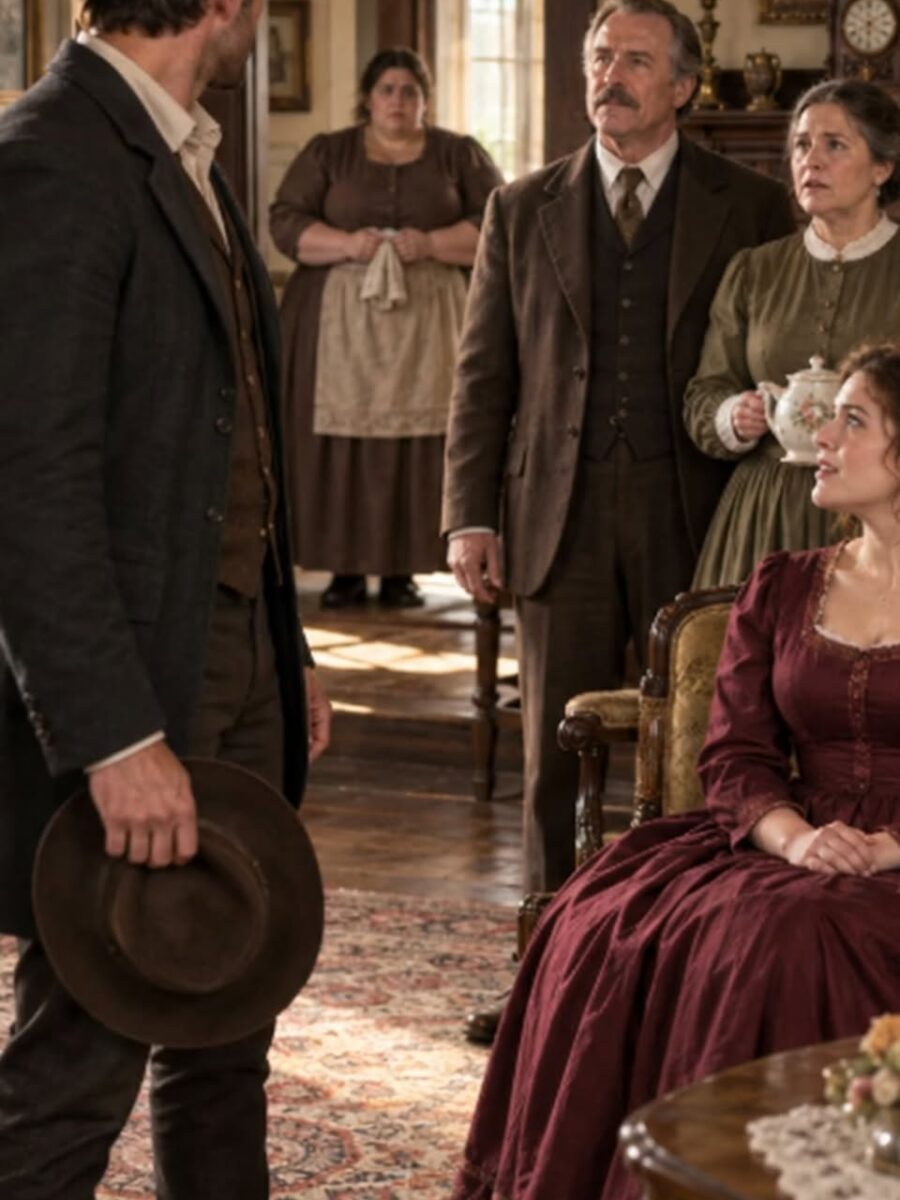
Seated upon the horsehair parlor settee was twenty-two-year-old Eliza Hail. Eliza was considered by the local settlement to be the jewel of the territory—petite, delicate, with smooth caramel skin, carefully curled ringlets pinned with pink silk ribbons, and wearing an imported rose-colored taffeta gown that had cost two months of the ranch’s cattle sales. Her father, fifty-four-year-old Harold Hail, stood proudly by the stone fireplace in a freshly pressed wool suit, smoking a pipe, while his wife Beatrice fidgeted with a silver tea service, checking the polished porcelain cups every thirty seconds.
They were waiting for thirty-two-year-old Dawson Reed. Dawson was the most eligible, powerful, and respected African American cattle sovereign in the Northwest—a self-made empire builder whose 10,000-acre ranch in Reed Valley commanded water rights, three rail spurs, and thousands of prime Hereford cattle. Tall, six feet two inches of solid frontier muscle, with warm chocolate skin, sharp jawline, and piercing, intelligent dark eyes, Dawson was a man who answered to no one. For weeks, rumors had circulated through the settlement that Dawson had finally decided to take a wife to share his sprawling timber-and-stone estate.
And Harold Hail had spent every waking hour convinced that Dawson had chosen his pampered, beautiful Eliza.
Meanwhile, twenty feet away, separated by a thin pine swinging door in the hot, smoke-filled kitchen, stood twenty-six-year-old Lena Hail. Lena was Harold’s eldest daughter—and the family’s invisible workhorse. She was a full-figured, tall woman, carrying nearly three hundred pounds with the broad-shouldered, athletic grace born of twelve years of relentless ranch labor. While Eliza slept late and practiced piano, Lena was up at four in the morning chopping firewood, hauling twenty-gallon water buckets from the well, repairing split-rail fences, doctoring calves with pneumonia, and cooking three meals a day for six hungry ranch hands.
Lena wore a faded, patched brown calico dress, a coarse canvas apron stained with flour and grease, and her dark, natural curls were tucked tightly into a plain bandana. In her rough, calloused hands, she held a damp flour-sack dish towel, scrubbing the cast-iron skillets in the iron sink. For twenty-six years, Lena had endured the cruel whispers of the town: “Too big,” “Poor Harold, one beauty and one burden,” “No man will ever marry Lena.”
Lena had learned to bury her heartache in silence, making herself invisible, asking for nothing, believing love was a miracle reserved for women like Eliza.
Chapter 2: The Six Words of Dawson Reed
The rhythmic, echoing thunder of heavy horse hooves and the rumble of carriage wheels sounded in the front drive. Outside, Dawson Reed pulled his magnificent team of black Morgan horses to a halt beside the hitching post. He stepped down into the dust, wearing a tailored charcoal wool duster coat over a crisp white linen shirt, a dark vest, and polished leather boots. Beneath his wide-brimmed Stetson hat, his dark eyes scanned the ranch yard with sharp, discerning intelligence.
Harold Hail practically sprinted to the front door, throwing it open wide with an exaggerated, obsequious bow. “Dawson! Welcome, my good friend! Welcome to our humble home! Please, come inside by the fire!”
Dawson removed his Stetson, his deep, resonant voice courteous yet measured. “Good afternoon, Harold. Mrs. Hail.”
Eliza straightened her spine, batting her eyelashes, smoothing her rose taffeta skirt, and offering Dawson a rehearsed, blushing smile. “Mr. Reed. We are so honored by your visit. Would you care for some tea?”
Dawson stepped into the parlor. But he did not sit in the armchair beside Eliza. He did not accept the porcelain cup. In fact, his dark eyes barely grazed Eliza’s ribbons for more than a second. His gaze swept around the room, past the lace curtains, past the fireplace, and came to an immediate, laser-focused halt on the swinging pine door of the kitchen.
Harold chuckled, rubbing his hands together. “Well, Dawson, we know you are a busy man of few words. We know why you’ve honored us today. Eliza has been speaking of nothing but your visit for a fortnight. She would make an exquisite mistress for Reed Valley.”
Dawson looked Harold dead in the eyes. His face was granite, unsmiling, and completely absolute.
When Dawson spoke, his baritone echoed off the timber rafters with concussive, life-altering force:
“I don’t want Eliza. I want Lena.”
Chapter 3: The Daughter in the Kitchen Doorway
Absolute, paralyzed silence crashed over the parlor.
Harold Hail’s mouth fell open, his pipe slipping from his fingers and clattering onto the brick hearth, spilling gray ash across the rug. Beatrice gasped, her hands shaking so violently that hot tea sloshed over the rim of the silver pot, scalding her fingers. Eliza’s radiant smile turned into a grotesque mask of disbelieving horror, her cheeks draining of every ounce of color.
“Dawson…” Harold gave a strained, nervous bark of laughter, waving his hand as if brushing away a fly. “You… you must be joking. You mean Lena? The older one?”
“I know exactly who she is, Harold,” Dawson replied, his voice level and steady as a surveyor’s plumb line.
“B-but surely,” Harold stammered, his eyes darting frantically toward Eliza, “Eliza is the more… suitable choice! Look at her! She is cultured! She plays the pianoforte! Lena is… well, Lena is a farmhand! She’s nearly three hundred pounds, Dawson! She’s not built for high society!”
Dawson’s jaw hardened, his eyes narrowing into slits of pure, arctic contempt. “Suitable for what, Harold? To sit on a velvet couch while other people bleed for her bread?”
In the kitchen doorway, the swinging door creaked open.
Lena stood there, holding her greasy dish towel against her apron. Her heart was slamming against her ribs so violently she could hear the blood roaring in her ears. Her hands were shaking. She looked at Dawson Reed—the wealthiest, most powerful cattle titan in the territory—standing in her family’s parlor, looking directly at her as though the rest of the room were empty air.
“What… what did you say, Mr. Reed?” Lena whispered, her voice trembling with the fragile, terrifying hope of a woman who had known only rejection.
Dawson turned his entire body toward her. He did not look at her patched apron. He did not look at her flour-dusted hands with disgust. He looked at her strong, honest face, her warm brown eyes, and the deep, resilient spirit that shone through her gaze.
“I came here to ask whether you would do me the profound honor of becoming my wife, Lena,” Dawson said, every word clear, deliberate, and ringing with absolute certainty.
Chapter 4: The Silver Thimble from the Blizzard
Eliza jumped up from the settee, shrieking with hysterical indignation. “This is an outrage! She’s a servant in this house! Why would you choose her over me?”
Dawson did not even turn to look at Eliza. He took three long, purposeful strides across the parlor rug, stopping exactly two feet in front of Lena. He towered over her, his presence a fortress of quiet, unyielding devotion.
“Why me, Mr. Reed?” Lena asked, tears finally spilling over her dark eyelashes. “You could have any woman in the territory. Why would you want an overlooked, heavy woman who has nothing?”
“Because you have everything that matters, Lena,” Dawson answered softly, his voice softening into an intimacy that made the parlor disappear.
Dawson reached into the pocket of his tailored vest. He pulled out a small, gleaming object and held it out on his open palm.
Resting in the center of Dawson’s calloused hand was an antique sterling silver sewing thimble, engraved around the rim with a delicate pattern of wild prairie roses and two faint initials: L. H.
Lena gasped, her hand flying to her mouth. Her knees nearly buckled. “My thimble… I lost that two years ago in the Great Blizzard of ’86!”
“You didn’t lose it, Lena,” Dawson whispered, his eyes shining with profound, unpayable gratitude. “You left it on the timber table of the trapper’s cabin on Willow Creek after you saved my life.”
Harold Hail’s eyes widened in shock. “Willow Creek? What is he talking about, Lena?”
Chapter 5: The Cabin on Willow Creek
Dawson slowly turned his head toward Harold Hail, his gaze cutting through the older man like an iron blade.
“Two years ago, in January of 1886,” Dawson stated in a ringing voice that filled the entire house, “an unseasonal blizzard struck the pass with sixty-mile-an-hour winds and thirty-below-zero temperatures. My horse broke its leg in a ravine, and I was thrown against the rocks, suffering three cracked ribs and hypothermia. I managed to drag myself into an abandoned line cabin, but my hands were frozen stiff. I had no matches. No firewood. I lay on the dirt floor, waiting to freeze to death.”
Beatrice covered her mouth, staring in disbelief.
“Then the cabin door burst open,” Dawson continued, his eyes returning to Lena. “A woman rode out into that murderous gale alone on a giant draft horse. She kicked through the snowdrifts, broke dead pine branches with her bare hands, built a roaring fire in the hearth, and dragged my two-hundred-pound body onto a mattress of dry cedar boughs.”
Tears poured down Lena’s cheeks as the memories of that terrifying night returned.
“For three days and three nights, while the blizzard screamed outside, that woman stayed by my side,” Dawson said, his voice thick with raw emotion. “She boiled snow for water, melted dried beef into hot broth, and fed me with a wooden spoon. When my body shook with violent fever chills, she lay beside me beneath her heavy wool blanket, using her own warmth to keep my heart beating. She dressed my wounds, mended my torn coat with that silver thimble, and on the fourth morning, when the storm cleared, she slipped away before I could even open my swollen eyes to see her face.”
Dawson took Lena’s rough, calloused hands into his own, lifting them to his lips, kissing her knuckles with the deepest reverence.
“I spent two years searching every settlement from Cheyenne to Laramie for the woman who owned that silver thimble,” Dawson said softly. “And three months ago, when I visited this ranch to inspect Harold’s cattle, I saw you standing by the barn, mending a leather harness with that exact same hand-stitch. I saw the wild rose pattern in your scrap basket. I saw the quiet angel who saved my life.”
Chapter 6: The Reckoning of Harold Hail
Harold Hail’s face turned from pale to an ugly, mottled crimson. “Lena! You went out into the blizzard of ’86? You risked my draft horse for a stranger?”
“She risked her life to save a dying man, Harold!” Dawson roared, stepping between Lena and her father, his presence a towering mountain of protective fury. “While you sat by this fire drinking whiskey, your daughter was braving thirty-below winds! And for twenty-six years, you have treated her like cattle!”
Dawson pulled a heavy leather ledger from inside his duster coat, tossing it onto the parlor table with a thud.
“I’ve had my auditors look into this ranch, Harold,” Dawson continued ruthlessly. “Every single pound of beef you sold this year was weighed and branded by Lena. The accounts were balanced in Lena’s handwriting. The fences were repaired with Lena’s sweat. You took her labor, you took her dignity, and you spent her hard-earned money buying imported silk gowns for Eliza while Lena walked through the snow in patched rags!”
Eliza burst into bitter, defeated tears, sinking onto the settee, covering her face in complete humiliation. Beatrice dropped into a chair, weeping into her apron.
“Without Lena,” Dawson said, his voice cold and final, “this ranch will collapse in three months. And when it does, Harold, do not come knocking at my gates. You had a diamond in your house, and you treated it like dirt.”
Dawson turned back to Lena. His iron expression melted into boundless, tender love. He reached out with both hands, gently untying the faded bandana from her head, letting her thick, beautiful dark curls tumble freely around her shoulders.
“Pack your personal things, Lena,” Dawson whispered gently. “Only what you hold dear. You are leaving this kitchen forever.”
Lena looked at her father, whose head was bowed in bitter, irreversible disgrace. She looked at Eliza, stripped of all her vanity. For the first time in twenty-six years, Lena felt no fear, no shame, and no need to apologize for taking up space in this world.
“I don’t need to pack anything, Dawson,” Lena said, her voice clear, steady, and radiant with freedom. “Everything I care about is standing right in front of me.”
Chapter 7: The Sovereign Queen of Reed Valley
Dawson smiled, a dazzling, joyous smile that lit up the entire room. He took Lena’s hand, placed her arm securely within his own, and led her out the front door into the bright Wyoming sunshine.
He helped Lena into the plush, cushioned leather seat of his private carriage, wrapping a thick buffalo robe around her shoulders to keep out the prairie breeze. He climbed up beside her, took the reins, and with a whistle, the black Morgan horses leaped into a confident gallop, carrying them away from the Hail homestead forever.
Two weeks later, the grand timber-and-stone manor of Reed Valley was ablaze with thousands of glowing lantern lights. African American ranchers, territorial officials, and neighboring families traveled from fifty miles around to celebrate the wedding of Dawson Reed and Lena Hail.
Lena stood in the soaring great hall beneath chandeliers fashioned from elk antlers and wrought iron. She wore an exquisite, custom-made gown of midnight blue silk and cream lace that hugged her full curves with regal, breathtaking majesty. Around her neck hung a pendant of polished Wyoming jade, while on her left hand gleamed a thick band of solid gold set with three diamonds.
Dawson stood beside her, dressed in a bespoke black tuxedo, unable to take his eyes off his radiant bride. When the minister pronounced them husband and wife, Dawson pulled Lena into his arms, kissing her with a fierce, passionate devotion that drew thunderous cheers and applause from two hundred guests.
During the wedding feast, Dawson stood before his cattlemen and neighbors, lifting his glass to his wife.
“To the true sovereign of Reed Valley,” Dawson announced, his voice rich with boundless pride. “A woman whose courage conquered the blizzard, whose hands built our empire, and whose love has made me the richest man under God’s sky.”
Lena smiled through tears of pure, unblemished happiness, clasping Dawson’s strong hand. In her pocket, safely tucked beside her heart, rested the silver thimble—a quiet reminder that the hands that once scrubbed kitchen floors now held the reins of an empire.
Outside, the stars shone bright and eternal over the snow-capped Wind River Range, but inside the kingdom of Dawson and Lena Reed, the fire burned warm, powerful, and forever bright.


