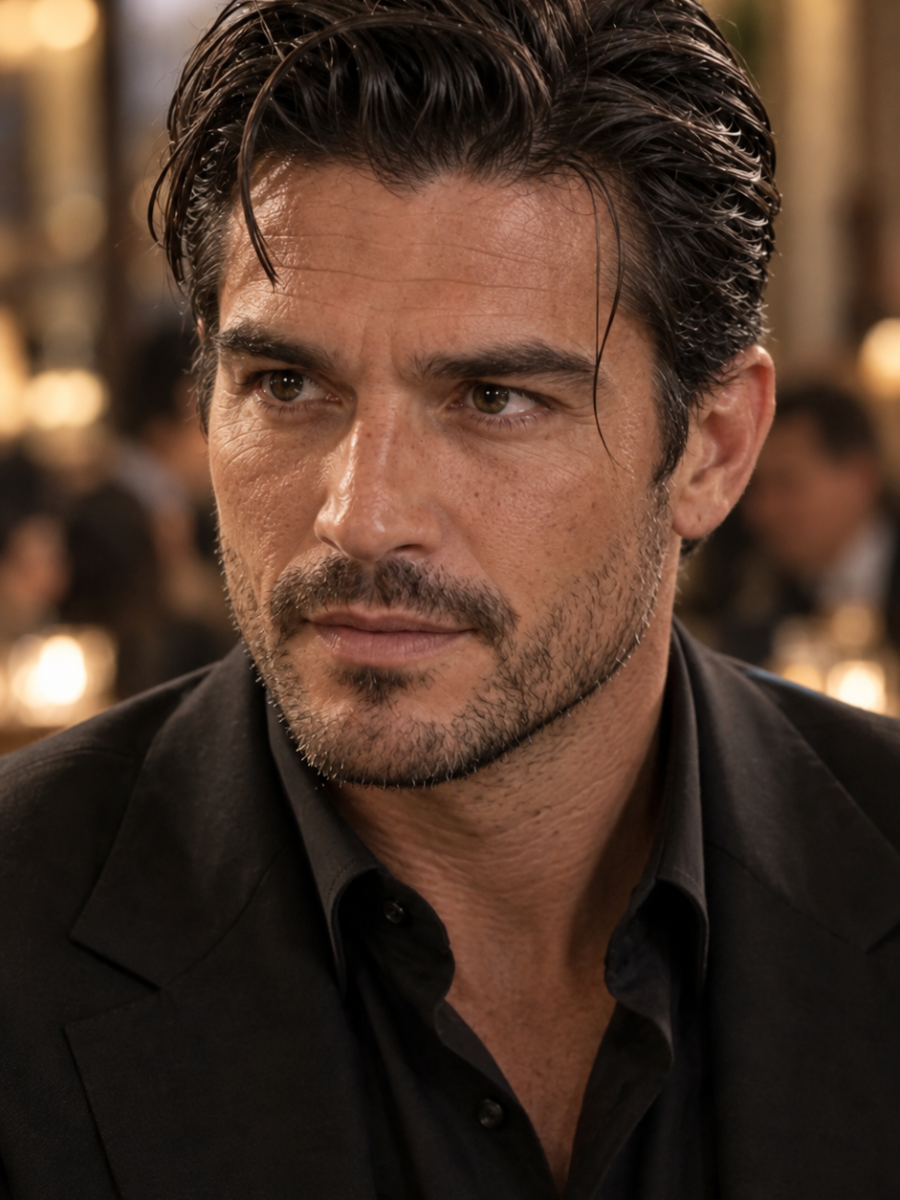
Everyone in New York’s most expensive dining room stepped backward when Ricardo Moretti rose from his chair, but when his three-year-old son started screaming, I saw what none of the bodyguards noticed.
I’m Clara Martinez. For three years I survived on night shifts, cash tips, and looking at the floor whenever men with heavy coats walked through the revolving doors. I had a reason to hide. But when a frightened little boy choked on his own tears while six servers froze in panic, I broke every rule of survival. Read every chapter to uncover what Ricardo offered me in the rainy alley, why a billionaire mafia don needed a fake fiancée to save his child, and how a venomous tattoo in a crowded ballroom dragged my buried past back into the light.
“A frightened child does not need a discipline lesson. He needs a sanctuary.”
Chapter 1: Table Twelve
Table Twelve was the only booth at Le Petit Miroir that had a direct sightline to both the front brass doors and the service exit behind the kitchen.
The reservation had come in without a name, only a black titanium card on file and an instruction that emptied three neighboring tables before seven in the evening.
When Ricardo Moretti walked in, the restaurant fell so silent you could hear the silver butter knives scraping porcelain across the dining room.
He was thirty-four years old, wearing a charcoal wool coat tailored so cleanly it looked forged rather than stitched, with black hair cut short against his temples and dark eyes that measured the exits before he even pulled out a chair.
Beside him walked a boy no older than three, dressed in a miniature stiff navy blazer that looked like a tiny prison uniform.
The boy’s name was Leo.
Within ten minutes, the wine glasses at Table Twelve began to vibrate.
Leo didn’t merely cry; he shrieked with a breathless, jagged terror that made the maitre d’ drop a leather-bound wine menu onto a runner of Persian carpet.
“He is out of order, sir,” the head waiter whispered frantically from behind the service screen. “Shall I call a car?”
Ricardo didn’t shout. His voice was dangerously low, vibrating through the mahogany paneling like low thunder before a gale.
“Leo,” he commanded, his large hand resting heavily on the table. “Sit up straight. You represent the Moretti name.”
The boy curled into a fetal ball on the leather cushions, his knuckles white around the hem of his blazer, choking on air until his lips turned faint violet.
Nobody moved. Four armed men in dark suits stood against the mirrored pillars, their hands hovering near their left lapels, looking terrified of their own employer.
I wasn’t supposed to be serving Table Twelve. I was the back-station runner who polished water goblets and carried trays of bread.
Yet I had seen that exact shade of blue in a child’s lips once before, back in Chicago, during the cold winter when my own world caught fire.
Without asking the floor manager, I stepped into the service pantry, poured half a cup of whole milk into a small pitcher, warmed it over the espresso steam wand for seven seconds, and dropped in a small spoonful of wild honey.
“Martinez!” Monsieur Laurent hissed, grabbing my apron string. “Do not approach that table. That man owns half the docks in Brooklyn.”
“The boy is going into respiratory shock,” I said quietly, pulling my apron free. “If he vomits while hyperventilating, you won’t have to worry about a tip. You will have an ambulance blocking your valet.”
I walked steadily toward Table Twelve, keeping my chin low and my shoulders relaxed so as not to trigger the four men standing sentinel.
Ricardo Moretti’s eyes locked onto me the instant my canvas shoes crossed the marble threshold.
They were cold, amber-flecked, and completely stripped of mercy.
“Did I request service?” he asked, the words clipping the air like scissors.
“No, sir,” I said, sinking onto both knees right onto the cold marble beside the booth.
I didn’t look at Ricardo. I leveled my gaze strictly with the trembling little boy.
“Hey,” I murmured softly, letting my breath drop into a gentle rhythm. “The jacket feels like bricks, doesn’t it, little man?”
Leo’s shuddering chest hitched. His tear-streaked face peered out from between his elbows.
“Let’s take the bricks off,” I whispered, unfastening the two stiff buttons of his blazer without waiting for permission.
Behind me, I heard the sharp rustle of an unbuttoning holster. Ricardo held up one finger, and the sound ceased instantly.
I slid the heavy navy coat off Leo’s small shoulders, folded it into a soft cushion behind his head, and held out the warm porcelain mug.
“Honey milk,” I said. “Smells like warm toast. Blow on it three times before you take a sip, or the magic escapes.”
The boy’s chest rose and fell in ragged hitches, but he leaned forward, blew twice with trembling lips, and took a small gulp.
Within two minutes, the gasping slowed. His tiny hand reached out and gripped the cuff of my black server shirt.
I smoothed back his damp dark curls with my thumb, feeling the rapid flutter of his pulse calming against my skin.
Then, without thinking, the words slipped out of my mouth before my survival instincts could muzzle them.
“He doesn’t need punishment, Mr. Moretti,” I said, still looking at the child. “He is terrified. He needs a mother, not a commanding officer.”
The silence that settled over Table Twelve was suffocating.
I stood up slowly, smoothed my apron, and backed away toward the pantry without another word.
Twenty minutes later, Monsieur Laurent handed me an envelope containing three hundred-dollar bills and told me my locker had already been emptied into a cardboard box in the alley.
Chapter 2: The Alley in the Rain
The rain over Manhattan was not a gentle mist; it fell in thick, freezing needles that soaked through my canvas sneakers before I reached the mouth of the alleyway.
I stood beneath the rusted fire escape holding my cardboard box, shielding my small stack of paperwork under my coat.
Inside that box were my birth certificate, two nursing school textbooks from before my life ended in Chicago, and twenty-eight dollars in cash tips.
A black Maybach pulled up to the curb, its tires hissing against the slick asphalt.
The rear passenger door opened automatically, and a broad-shouldered man in a charcoal overcoat stepped out into the downpour holding a black umbrella.
He didn’t hurry. He walked toward me as if the rain had received orders not to touch his collar.
“Clara Martinez,” Ricardo Moretti said, his deep voice slicing through the drumming storm. “Born Clara Vance. Chicago, Illinois. Former pediatric triage nurse at Cook County Memorial until November fourteenth, three years ago.”
A cold dread far sharper than the winter rain seized my throat.
My fingers clenched against the cardboard box until the wet cardboard tore beneath my nails.
“Who are you?” I managed to whisper, my heart battering against my ribs.
“You know who I am,” he said calmly, stopping three feet in front of me and tilting the umbrella so that it covered my head, shutting out the storm. “And you know that the man who had your apartment firebombed in Chicago is currently sitting in the federal courthouse here in New York, negotiating his expansion into Queens.”
“I don’t know anything about that,” I lied, my voice shaking uncontrollably. “I’m a server. I don’t follow the news.”
“You are a witness,” Ricardo said bluntly. “The only living witness to the execution of ADA Thomas Miller behind the Fulton Market meat plant.”
The breath left my lungs in a cold white plume.
For three years, I had jumped at every siren, changed apartments six times, and used dead people’s surnames just to buy groceries.
“Are you going to kill me?” I asked, looking directly into his unblinking amber eyes.
“If I wanted you dead, Miss Vance, you would have choked on carbon monoxide in your basement apartment two days after you arrived in Brooklyn,” he replied evenly. “I don’t kill women who save my son from drowning in his own lungs.”
He reached into his breast pocket and produced a sleek black leather folder, extending it toward me.
“What is this?”
“A job offer,” he said. “Better paid than clearing dessert plates for Monsieur Laurent.”
“I don’t work for the mob.”
Ricardo let out a low, humorless chuckle that sounded like stones grinding in a riverbed.
“I don’t need a waitress, Clara. I don’t even need an employee. I need a fiancée.”
I stared at him through the pouring dark, wondering if hypothermia was finally causing me to hallucinate.
“You’re insane,” I said.
“My late wife’s family, the Castiglione syndicate, has petitioned the family court for full custody of Leo,” he explained, his tone tightening with an edge of lethal steel. “Their argument is that a single man engaged in high-risk private enterprise cannot provide a stable domestic environment for an heir. The court evaluator arrives in twelve days.”
He stepped closer, towering over me, his presence an absolute wall of power and gravity.
“If I marry a respected woman—a former nurse, a woman who calms my son when six trained specialists fail—the judge will dismiss their petition within ten minutes.”
“And what do I get?” I asked bitterly. “A target painted on my back?”
“You get my name,” Ricardo said softly, leaning down so his words struck me like a vow. “In this city, nobody touches a Moretti. Not the police, not the federal marshals, and certainly not the Chicago butchers who made you run into the dark.”
He held open the Maybach’s passenger door.
“Six months,” he added. “A penthouse on Fifth Avenue. Full legal protection. And when the custody ruling is permanent, five million dollars in an offshore trust to start whatever life you want anywhere on earth.”
I looked down at my soaked canvas shoes, then back into the rain-swept alley where my cardboard box was already disintegrating in the mud.
“What are the rules?” I asked.
Ricardo’s eyes gleamed with a dark, satisfied flame.
“Rule one: Leo comes first. Rule two: you never lie to me. Rule three: when the cameras flash, you look at me as if I am the only man in this world you trust.”
I stepped out from beneath the dripping awning and into his car.
Chapter 3: The Fifth Avenue Fortress
The penthouse took up the top two floors of a pre-war limestone building overlooking Central Park, but it felt less like a home and more like an armored bunker wrapped in Italian marble.
There were biometric scanners beside the private elevator and armed guards posted at the landing who greeted Ricardo with lowered heads and unblinking deference.
When the doors opened into the foyer, a small figure came barreling down the polished oak hallway, tiny socks skidding on the parquet floor.
“Clara!”
Leo didn’t hesitate. He wrapped both arms around my knees, burying his face into my wool slacks.
My heart did something painful and warm inside my chest.
I knelt down immediately, ignoring the wet dampness of my clothes, and pulled the boy into an embrace.
“Did you keep the magic inside?” I asked, tapping his nose gently.
Leo nodded vigorously, holding up a small plastic dinosaur with a chewed tail. “T-Rex had milk too. No loud noises.”
Standing behind us, Ricardo watched the exchange without speaking. The severe line of his jaw seemed to soften by a fraction of an inch, though his posture remained as rigid as iron.
“Maria,” Ricardo called softly.
An older woman with silver hair pulled into a neat bun appeared from the dining room, wiping her hands on an embroidered linen apron.
“Take Leo to his room and read him the book about the harbor boats,” Ricardo instructed. “Miss Vance and I have paperwork to review.”
Once the hallway was quiet, Ricardo led me into an expansive mahogany-paneled library that smelled of old leather, pipe tobacco, and beeswax.
On the heavy desk sat three thick stacks of documents, a gold fountain pen, and a velvet jeweler’s box.
He flipped open the box.
A four-carat emerald-cut diamond caught the library lamps, throwing pale blue and white prisms across the dark wood.
“Your left ring finger,” he said.
I held out my hand. My fingers were cold, and when he took them in his large, calloused grip, a sharp jolt traveled straight up my forearm.
He slid the ring into place. It was a flawless fit.
“From this moment,” Ricardo said, his voice dropping into that dark, hypnotic register, “you are my fiancée. My family will question you. The press will dig into your school records. My enemies will watch the way you breathe when I walk into a room.”
“I survived twenty-two months running from contract killers, Mr. Moretti,” I said, meeting his gaze steadily. “I know how to act.”
“Good,” he said, opening the first folder. “Because tomorrow morning, the social evaluator arrives. Her name is Evelyn Cross. She has revoked parental rights for three state senators and two federal judges. She cannot be bought, she cannot be intimidated, and she has a particular hatred for men who carry handguns under their dinner jackets.”
I looked at the notes spread across the blotter. “Then we don’t try to buy her. We give her the one thing she never expects to find in a mafia household.”
Ricardo arched an eyebrow. “Which is?”
“The truth about a little boy who misses having someone tuck him into bed.”
Chapter 4: The Custody Audit
Evelyn Cross arrived at precisely nine o’clock in the morning, carrying a worn leather briefcase and wearing a charcoal wool suit that looked as unyielding as sheet metal.
She refused coffee. She refused water. She sat on the velvet sofa in the morning room and laid out a digital voice recorder between two porcelain saucers.
“Mr. Moretti,” she began without preamble, her spectacles resting low on her sharp nose. “Your file contains seven police incident reports in four years, two grand jury subpoenas that resulted in dismissed indictments, and an affidavit from your late wife’s brother claiming that your home is essentially an armed camp.”
Ricardo sat across from her, his arms resting casually on the chair arms, looking completely unbothered.
“My late wife’s brother would like control of the Moretti shipping trusts,” Ricardo replied calmly. “His affidavit is as reliable as a counterfeit banknote.”
“And yet,” Miss Cross continued, turning her sharp gray eyes toward me, “two weeks ago, Mr. Moretti was unmarried. Today I am presented with Miss Clara Vance, a former nurse who apparently reconnected with him after an intimate courtship that left zero digital footprint.”
The trap was laid neatly on the Persian rug.
I didn’t glance at Ricardo. I leaned forward, resting my elbows on my knees, matching her gaze with calm, direct sincerity.
“Miss Cross,” I said softly, “when my parents died in a car wreck during my senior year at Northwestern, I learned very quickly that grief doesn’t post updates on Instagram.”
She paused, her pen hovering over her legal pad.
“Ricardo and I didn’t broadcast our relationship because neither of us is interested in an audience,” I said. “He lost his wife. Leo lost his mother. When Ricardo and I met, we didn’t discuss trust funds or family syndicates. We talked about how Leo wakes up at three in the morning checking if the hall lamp is still burning.”
Just then, the double doors of the morning room pushed open with a soft squeak.
Leo peeked in, clutching his worn stuffed rabbit by one ear.
He didn’t look at the stern woman with the legal pad. He looked straight at me, his face lighting up with unfeigned joy.
“Clara! Look! The blue truck has wheels!”
I smiled, opening my arms. Leo ran across the room and clambered up into my lap, burying his nose in the crook of my neck without an ounce of hesitation.
I wrapped my arms around him, resting my chin against his soft curls, breathing in the scent of baby powder and fresh oatmeal.
Miss Cross looked at the child. Then she looked at the way Leo’s small hand rested trustingly against my collarbone.
She slowly clicked the off button on her recorder.
“Children do not fake attachment, Miss Vance,” she said, her voice dropping its combative edge. “A three-year-old child cannot be rehearsed by a legal team.”
She stood up, packed her recorder into her briefcase, and extended a gloved hand toward Ricardo.
“My preliminary report will recommend that Leo remain in your custody, Mr. Moretti. However,” she added, turning back toward me with a piercing glance, “I will be attending the annual Saint Jude Children’s Hospital Gala on Saturday evening. I expect to see you both there. The social committee will be watching whether this union is genuine or decorative.”
“We will be delighted to host you at our table, Miss Cross,” Ricardo said smoothly, standing to escort her to the foyer.
When the front doors clicked shut, Ricardo turned to me. His eyes were dark, glowing with something intense and unreadable.
“That was extraordinary,” he said quietly.
“It wasn’t an act,” I said, kissing Leo’s forehead. “Your son deserves to be loved, Ricardo. Not just protected.”
He stood motionless for three seconds, looking at us as if seeing his own living room for the first time in his life.
Chapter 5: The Velvet Dress
On Thursday afternoon, three wardrobe fitters from a private salon on Madison Avenue arrived accompanied by two armed couriers carrying velvet garment bags.
They dressed me in an emerald green silk velvet gown that fell in a sculptured column to the floor, cut with an elegant boatneck that flattered my collarbones and long sleeves that tapered down to delicate covered silk buttons at my wrists.
“Mr. Moretti requested emerald,” the lead stylist remarked, pinning a microscopic tuck into the waistline. “He said black makes you look like you’re attending a funeral, and you are going to the Plaza to celebrate an empire.”
When I looked in the three-way mirror, I barely recognized the woman staring back.
The exhausted, haunted waitress in the grease-spotted apron was gone.
In her place stood someone regal, composed, and undeniably dangerous.
Ricardo stepped into the salon doorway, dressed in a custom midnight-navy tuxedo with satin peak lapels. His white dress shirt was crisp against his tanned throat, and a single black onyx button gleamed at his cuffs.
He stopped dead in his tracks.
For five long seconds, the most feared man in the five boroughs said nothing at all.
“Does it meet your specifications?” I asked, arching an eyebrow to mask the nervous flutter in my throat.
“You look breathtaking, Clara,” he said, his voice dropping into a husky timbre that made the stylist’s assistant blush.
He dismissed the stylists with a quick nod and stepped closer, pulling a long velvet box from behind his back.
Inside lay a vintage Cartier necklace of diamonds and deep green Colombian emeralds, linked by delicate platinum filigree.
“My grandmother’s,” he said, lifting the heavy jewels. “Turn around.”
I turned. His fingers brushed the nape of my neck as he fastened the clasp, his touch warm and surprisingly tender against my bare skin.
“Tonight will not be easy,” he warned, speaking close to my ear. “The five families will be present. Don Salvatore Marcone from Chicago has arrived in New York as a guest of the Castiglione family.”
The name Marcone struck my chest like an iron bar.
I spun around, my face draining of every drop of color. “Marcone is here? In New York?”
Ricardo frowned, his sharp gaze searching my panicked eyes. “You know him?”
I swallowed hard, forcing my lungs to draw air, remembering the rules of my survival.
“His name was in the Chicago newspapers every week,” I managed to say, smoothing down the emerald velvet of my skirt. “Everyone in Illinois knows who controls the docks.”
Ricardo studied me for another agonizing heartbeat, his instincts clearly signaling that I had left something unsaid.
“You have nothing to fear from Marcone,” he said firmly, taking my hand and pressing it to the inside of his arm. “Tonight you are under my roof, under my name, and under my gun.”
Chapter 6: The Plaza Ballroom
The Grand Ballroom of the Plaza Hotel was a sea of crystal chandeliers, white calla lilies, and champagne flutes that reflected the flashbulbs of fifty society photographers.
The moment Ricardo stepped through the gilded archway with my hand resting on his arm, the murmur of two hundred conversations stuttered into silence.
He didn’t smile. He walked with the heavy, unhurried grace of an apex predator walking through a herd of prize cattle.
“Keep your chin up, Miss Vance,” he murmured without moving his lips. “They are looking for cracks in the armor. Give them only steel.”
Men in three-thousand-dollar tuxedos stepped aside, murmuring greetings with tight smiles, while women draped in chinchilla stoles whispered behind their champagne glasses.
“Ricardo,” a smooth voice called from the center of the terrace rotunda.
A tall man with silver hair and an impeccably tailored pinstripe tuxedo turned toward us, flanked by two younger men whose coats bulged faintly beneath their left armpits.
It was Dominic Castiglione, the brother of Ricardo’s late wife.
“Dominic,” Ricardo greeted him coolly, not extending a hand. “I trust the flight from Palermo was uneventful.”
“Pleasant enough,” Dominic purred, his serpent-like gaze drifting over me with predatory assessment. “Though I hear rumors that you have taken sudden domestic vows. Is this the young lady who has captured the heart of our fierce Don Moretti?”
“This is Clara,” Ricardo said, his arm tightening possessively around my waist. “My fiancée. And very soon, the mother of my son.”
Dominic smiled, but his eyes were like chips of dirty ice.
“A former hospital worker, I understand. How remarkably grounding for a man of your volatile temperament.”
“A woman of honor and courage,” Ricardo countered, his voice carrying clearly to the surrounding circle of listeners. “Two virtues that have become exceptionally rare in your family, Dominic.”
Dominic’s jaw clenched, his smile vanishing into a venomous sneer. “We shall see what the family court magistrate thinks of your sudden romance, brother-in-law.”
He turned on his heel and disappeared into the crowd.
I let out a breath I hadn’t realized I was holding. “Is everyone in your social circle this charming?”
Ricardo looked down at me, a rare, genuine smile tugging at the corner of his lips. “Only the ones who know they are losing.”
Chapter 7: The Viper on the Wrist
At nine-thirty, the orchestra transitioned into a slow waltz, and Ricardo led me onto the polished parquet floor.
He moved with surprising rhythm and effortless command, his hand broad and steady against the small of my back, guiding me through the swirling couples as if we had danced together for a decade.
“You’re thinking too much,” he said softly, spinning me beneath the glow of the center chandelier.
“I’m watching the room,” I whispered. “That’s what nurses do. We triage.”
“Tonight, let me do the triaging,” he said, drawing me an inch closer until the heat of his chest pressed through the emerald velvet of my bodice.
For a brief, terrifying second, I forgot the contract. I forgot the five million dollars. I forgot the shadow of Chicago.
Then my eyes drifted over his shoulder toward the raised VIP balcony near the private bar.
A man was leaning against the brass railing, swirling amber whiskey in a lowball glass.
He was in his late forties, with a scarred eyebrow and a thick neck. As he lifted the glass to his lips, his white French cuff rode back two inches above his wrist.
There, inked into the dark skin between his tendon and his palm, was a coiled black viper wrapping its fangs around a blood-dripping dagger.
My feet stopped moving.
The entire ballroom seemed to lose its gravity, tilting violently sideways.
That tattoo.
Three years ago, on a rainy Tuesday behind the meatpacking docks in Chicago, I had hidden behind an industrial trash dumpster with my mouth clamped shut with my own hands.
I had watched that exact coiled viper press a suppressed nine-millimeter pistol against ADA Miller’s temple.
I had seen the muzzle flash. I had watched the killer wipe his shoe on the wet gravel.
And then, before he ran, he had looked straight into the gap beneath the dumpster and made eye contact with me.
His name was Victor Vance—no relation to my forged alias, but the top lieutenant of Don Salvatore Marcone.
“Clara?” Ricardo’s voice broke through the buzzing in my ears. “What is it?”
Up on the balcony, Victor Vance set down his whiskey glass.
His eyes scanned the dance floor, lazily at first, then locked onto the woman in the emerald green gown.
His head tilted slightly. His eyes narrowed in recognition.
He recognized me.
The blood froze in my veins as I watched his right hand slide slowly, deliberately, into the inner pocket of his tailored jacket.
Chapter 8: The Shadow in the Library
“Ricardo,” I whispered, my voice trembling so hard the words barely made sound. “Ten o’clock. Balcony. The man in the gray vest.”
Ricardo didn’t turn his head abruptly. His eyes flicked upward with cool, predatory precision.
He saw the hand inside the jacket.
Without raising his voice, without alerting the socialites dancing three feet away, Ricardo leaned down and kissed me firmly on the forehead.
“Walk toward the east hallway,” he instructed, his tone calm as glacier ice. “Do not run. Do not look back. Gianni and Marco are outside the library doors. Step inside and lock it.”
“Ricardo, he has a gun—”
“So do I, sweetheart,” he replied softly. “And this is my city.”
I did as I was told. I turned and walked gracefully across the ballroom floor, smiling at an elderly dowager as I passed, every nerve in my spine screaming that a bullet was about to tear through my shoulder blades.
I slipped through the mahogany double doors into the quiet carpeted gallery, where two of Ricardo’s security men immediately stepped into formation behind me.
They ushered me into the hotel’s private oak library and bolted the heavy brass latch from the inside.
Ten minutes passed. The muffled music from the ballroom seemed to fade into a hollow echo.
Then came the sound of muffled scuffling in the corridor, the heavy thud of a body slamming against paneling, and the sharp metallic click of a deadbolt sliding back.
The library door swung open.
Ricardo walked in, dusting off the cuffs of his navy tuxedo. Behind him, two guards dragged a bleeding, battered Victor Vance by his collar, tossing him onto the oriental rug like a sack of damp laundry.
“Victor Vance,” Ricardo said, pulling a leather chair around and sitting down, resting his elbows on his knees. “Chief enforcer for Don Marcone. Caught attempting to draw a suppressed ceramic weapon in the east corridor.”
Victor spat blood onto the rug, glaring up with furious, terrified eyes. “You’re making a mistake, Moretti! Marcone is allied with the Castiglione family! If you touch me—”
“Shut up,” Ricardo said mildly.
He looked over at me, standing trembling by the dark window.
“Now, Miss Vance,” Ricardo said softly, “suppose you tell me why Marcone’s top assassin looked at my fiancée as if he had just seen a ghost rising from Lake Michigan.”
I stepped away from the window, looking down at the bruised face of the monster who had haunted my nightmares for three years.
“Because three years ago, I didn’t just witness him kill ADA Miller,” I said, my voice gathering strength with every syllable. “I was the triage nurse who checked Miller’s body into the morgue. And before Miller died in my ambulance, he handed me a digital flash drive hidden inside his shoe.”
Victor’s face drained of every speck of color. Even through the blood, his skin turned the color of ash.
“The ledger,” Victor rasped, his voice cracking. “You had the offshore accounts.”
“I had every bribe, every wire transfer, and every corrupt judge paid by the Marcone syndicate for fifteen years,” I told Ricardo. “I hid the drive inside a safety deposit box in Dayton, Ohio. That’s why Marcone had my apartment bombed. That’s why Victor hunted me across three states.”
Ricardo looked from Victor to me, a slow, terrifying smile spreading across his handsome face.
“Dominic Castiglione thought he could use Marcone to strip me of my son,” Ricardo mused, his amber eyes blazing with lethal triumph. “And all this time, the woman sleeping in my guest room holds the execution order for their entire syndicate.”
Chapter 9: The Broken Contract
By sunrise on Monday morning, the federal courthouse in Brooklyn looked like a garrison under siege.
Six FBI sedans and four state trooper cruisers flanked the steps as Victor Vance, handcuffed and wearing an orange prison jumpsuit, was escorted inside under federal witness protection.
The flash drive from the Dayton safety deposit box had been delivered directly to the United States Attorney’s office at midnight.
By dawn, warrants had been executed across Chicago and New York. Don Salvatore Marcone was arrested at a private hangar at Teterboro Airport, and Dominic Castiglione was taken into custody in his suite at the Carlyle.
The custody petition against Ricardo wasn’t merely dismissed; the judge issued a permanent protection order barring the Castiglione family from coming within five hundred yards of Leo for the remainder of his life.
At three in the afternoon, I stood in the library of the Fifth Avenue penthouse, packing my small canvas duffel bag.
My old clothes were folded neatly at the bottom. On top lay the emerald green velvet dress, cleaned and wrapped in tissue.
Beside it, on the desk, sat the Cartier diamond necklace and the five-million-dollar cashier’s check Ricardo’s attorney had delivered an hour earlier.
The heavy oak door opened softly.
Ricardo stood on the threshold, wearing a crisp white dress shirt with the top two buttons unfastened and dark trousers.
He looked at the packed duffel bag, then at the jewelry box on the desk.
“The car is downstairs,” he said quietly. “Flight to Denver leaves at six.”
“Thank you, Ricardo,” I said, offering a small, grateful smile. “For protecting me. For keeping your word.”
“You gave me back my son,” he said, stepping into the room. “A cashier’s check hardly balances the ledger.”
“It balances my life,” I said softly. “I can buy a house. I can work in a clinic again without looking over my shoulder.”
I reached down to pick up my bag, but Ricardo’s hand closed gently over mine, stopping me.
He didn’t take his eyes off my face.
With his other hand, he reached into his pocket, pulled out the six-month engagement contract we had signed in the rain, and tore it in half.
Then he tore it in quarters and dropped the pieces onto the mahogany desk.
“What are you doing?” I whispered.
“I don’t want an employee, Clara,” he said, stepping closer until I could feel the steady warmth of his heartbeat. “And I don’t want a business contract.”
He picked up the four-carat emerald-cut diamond ring from the velvet box and held it between his fingers.
“Leo has spent the entire morning asking why his mother is packing a suitcase,” Ricardo murmured, his voice thick with raw emotion he had never shown to another living soul. “And for the first time in my life, I don’t have a tactical answer.”
He took my left hand, his fingers warm and steady.
“Stay,” he said. “Not because you need a protector. Marcone is finished, and nobody will ever hunt you again. Stay because this house isn’t a fortress anymore when you’re in it. Stay because I don’t want a fake fiancée.”
He paused, his amber eyes burning with fierce, unshakable devotion.
“Be my wife, Clara. For real.”
I looked at the torn pieces of paper on the desk, then out the window at the morning sunlight dancing across the green canopies of Central Park.
Then I heard small footsteps pattering down the hall, followed by a giggle and the squeak of miniature sneakers on the parquet floor.
“Clara! Look! The helicopter has a siren!”
I looked back at the man who had torn down an empire to keep me safe.
I slid my hand into his, letting the diamond settle back into its rightful place on my finger.
“Only if we throw out the rule about never making loud noises,” I whispered.
Ricardo laughed—a rich, booming sound that echoed through the fortress like spring sunlight—and pulled me into his arms as our little boy came running through the door.