When Judson McIntyre took one look at his mail-order bride stepping off the Silverthorne stagecoach in a strained green wool dress, the hardened Rocky Mountain trapper turned on the matrimonial broker and spat, “She’ll eat through my winter stores before Christmas.” Having buried his former life in the Colorado snow, Judson expected a burly woman who could chop ice and skin elk. But Boston baker Winifred Hayes had survived far worse than cold. And when a notorious claim-jumper kicked open her cabin door with a loaded Colt while Judson was away checking traps, Winifred showed the entire territory what a woman with a hot cast-iron skillet could do.
Table of Contents
- Chapter 1: The Stagecoach in Silverthorne
- Chapter 2: “She’ll Eat Through My Winter Stores”
- Chapter 3: The Ascent to McIntyre Ridge
- Chapter 4: Eleven Years of Grease and Silence
- Chapter 5: Hot Biscuits and Fresh Curtains
- Chapter 6: The Outlaw with the Drawn Colt
- Chapter 7: Cast Iron and Sizzling Bacon Grease
- Chapter 8: The Outlaw Hog-Tied by the Hearth
- Chapter 9: The Heart of the Rocky Mountains
Chapter 1: The Stagecoach in Silverthorne
The stagecoach from Denver rattled into the mud-slicked mining depot of Silverthorne, Colorado, with a violent screech of wooden brake shoes against iron rims, spraying half-frozen slush across a waiting crowd of prospectors, trappers, and timber cutters. High above the valley, the jagged granite peaks of the Tenmile Range were already shrouded in heavy November storm clouds, promising sub-zero temperatures before sundown.
Judson McIntyre stood on the wooden boardwalk with his heavy hands thrust deep into the pockets of his fleece-lined buffalo hide coat. At thirty-six years old, Judson looked as if the Rockies had carved him directly out of weathered granite and lodgepole pine. His face was framed by an untamed dark beard streaked with early silver, his gray eyes narrowed against the biting mountain wind, and a jagged pale scar traced along his cheekbone where a wounded timber wolf had snapped at him three winters earlier.
He lived alone at eight thousand feet on McIntyre Ridge, five miles beyond the nearest mining claim, cutting spruce timber, panning cold mountain creeks, and tending seventy miles of high-altitude trap lines. Romance had played zero part in his decision to contact the Matrimonial Union Bureau in St. Louis. He needed a partner. A sturdy, thick-boned frontier woman capable of hauling fifty-pound sacks of flour, butchering an elk quarter before the meat soured, chopping firewood in four-foot drifts, and keeping the cabin fire burning while he spent four days snowbound on the high passes.
In return, he promised an honest roof, dry firewood, wild game in the smokehouse, and the iron protection of a man who never missed with a Winchester rifle. No promises of affection. No flowery poetry. No parlor lies.
Then the coach door swung open, and the passengers began disembarking.
Two grizzled prospectors with pickaxes clambered down first, followed by a traveling saddle merchant.
And then, gathering her skirts with hesitant, trembling fingers, stepped Winifred Hayes.
Judson’s jaw tightened so hard his back teeth ached.
She was twenty-eight years old, with soft, creamy skin that had clearly never seen a high-altitude sun, wide hazel eyes framed by dark lashes, and warm auburn hair escaping in soft curls from beneath a bonnet trimmed with velvet ribbon. She wore a tailored olive-green wool traveling dress that was noticeably tight across her full bust and round hips—a dress meant for a Sunday church social in Massachusetts, not a muddy mining depot in the Colorado high country. She carried a single wicker trunk wrapped with a frayed leather strap, her soft hands lacking the leathered calluses of a frontier woman.
Beside her on the platform, Horace Finch, the greasy-suited regional matrimonial agent who had pocketed Judson’s fifty-dollar gold eagle fee, hurried over with an oily, nervous grin. “Mr. McIntyre! Here she is! Miss Winifred Hayes of Boston! A woman of impeccable moral character, just as agreed!”
Chapter 2: “She’ll Eat Through My Winter Stores”
Judson didn’t step forward. He didn’t offer a hand to help her navigate the slippery boardwalk. He towered over the matrimonial broker like an impending landslide, his gaze raking over Winifred’s rounded figure with unmasked disgust.
“I asked for a wife, Finch,” Judson growled, his voice rumbling like grinding stones. “Not a pastry cook.”
Horace Finch nervously adjusted his bowler hat, casting anxious glances at the crowd of miners who were already gathering near the depot rail to watch the spectacle. “Now, Judson, be reasonable! Miss Hayes was the head baker at her family’s renowned Boston confectionery! Her letters said she was seeking a fresh start out west after her aunt passed—”
“She’s soft,” Judson cut him off, speaking loud enough for every prospector on the platform to hear every syllable. “Her hands look like they’ve never touched anything heavier than a rolling pin. Look at her, Finch. She’ll eat through my winter stores before Christmas and freeze into an icicle the first time the temperature drops to thirty below zero. Take her back to Denver on the return coach.”
A few rough miners laughed into their beards. Horace Finch stammered, holding his hands up defensively.
Winifred Hayes stood on the wet wooden boards. The cold mountain wind whipped her olive skirt against her shins, biting through the thin fabric, but she did not cry. Her hazel eyes did not waver. The faint blush that had colored her cheeks when she first saw Judson faded into stark, motionless resolve. She pulled her wicker trunk an inch closer to her boots and looked directly into the scarred, angry face of the mountain man.
“I heard every word you said, Mr. McIntyre,” Winifred said, her Bostonian accent crisp, steady, and remarkably clear in the thin air. “And you are quite mistaken. I have worked fourteen hours a day beside brick baking ovens since I was twelve years old. I have carried hundred-pound sacks of grain on my shoulders through four flights of tenement stairs. Softness is a condition of the spirit, sir, not the shape of a woman’s waistline.”
Judson blinked, momentarily caught off guard by the absence of tears. Most women broke down in hysterics when confronted with frontier brutality.
“The agency agreement was signed and notarized, Mr. McIntyre,” Winifred continued, stepping forward until she stood less than three feet from his broad chest. “You paid for my passage. Reverend Miller at the community chapel has our marriage license ready. Unless your word as a mountain man is as cheap as the mud on your boots, you will honor your contract.”
Judson stared at her for ten long seconds. The silence between them was heavier than the gray clouds rolling off Mount Royal.
“You want to freeze on my ridge, city woman?” Judson hissed, snatching her wicker trunk with one massive hand and tossing it effortlessly into the bed of his freight wagon. “Climb up. But don’t expect me to hold your hand when the winter wolves start howling at the door.”
Chapter 3: The Ascent to McIntyre Ridge
The wedding ceremony at the Silverthorne Methodist chapel took less than seven minutes. Reverend Miller spoke the vows in a hollow, echoing wooden sanctuary, smelling of damp cedar and melted tallow candles. Judson produced an unadorned brass band from his waistcoat pocket, slid it onto Winifred’s ring finger without looking into her eyes, signed his name with a heavy scratching of the steel nib, and walked out the door without waiting for her.
By two in the afternoon, the wagon was climbing the steep, switchbacked logging trail leading up to McIntyre Ridge.
The air grew thinner, colder, and sharper with every mile. The yellow aspens of the valley floor gave way to dense stands of blue spruce and towering lodgepole pines, their dark branches heavy with early crusts of snow. The trail curled along sheer drop-offs where the valley floor lay hundreds of feet below in dizzying gray depths.
Winifred sat on the rough wooden wagon bench beside Judson, holding onto the iron grab-rail with white knuckles. She had wrapped herself in her traveling wool cloak, but the wind pierced straight through the seams, numbing her fingers and turning her lips a faint, delicate blue. Twice the wagon hit deep granite ruts, tossing her violently against the wooden rail, but not a single whimper escaped her lips.
Judson kept his eyes locked on the team of heavy draft horses, his face an impenetrable mask. He expected her to beg him to turn back. He expected her to plead for a blanket or complain about the altitude sickness that usually struck easterners like a sledgehammer at nine thousand feet.
When she remained silent for two solid hours, he finally glanced sidelong at her. Her jaw was clamped tight, her breath coming in shallow, frosty clouds, but her eyes were fixed straight ahead on the rising summit.
“You can still go back tomorrow morning,” Judson said roughly, the words whipped away by the wind. “The stage leaves Silverthorne at dawn. I’ll give you twenty dollars for the return train to Boston.”
Winifred turned her head slowly, looking at him through the wind-blown strands of her auburn hair.
“There is no Boston to return to, Judson,” she replied quietly. Her voice carried the deep, unvarnished weight of real grief. “My aunt took ill with consumption last spring. The apothecary bills, the doctor fees, and the landlord took every cent of our bakery’s savings. When she died, the bank foreclosed on the ovens. My entire family is buried in the Dorchester churchyard. You think you’re the only person on this mountain who knows what it feels like to lose everything?”
Judson’s hands tightened on the leather reins. He didn’t answer. He snapped the reins over the horses’ backs, urging the team onward into the gathering dusk.
Chapter 4: Eleven Years of Grease and Silence
They arrived at McIntyre Ridge just as the last amber glow of daylight vanished behind the Continental Divide.
The cabin stood on a high, granite promontory surrounded by ancient, towering pines. It was solidly built of heavy, hand-hewn spruce logs with an overhanging roof to shed snow, a massive stone chimney built from river boulders, and a low barn and woodshed fifty yards to the east. But inside, it was a dark, suffocating bachelor’s den that had not seen a woman’s touch in eleven years.
When Judson kicked open the heavy oak door and struck a match against the stone hearth to light the tallow lamp, the scene inside made Winifred stop on the threshold.
The massive rough-cut pine table was black with decades of rancid bacon grease and spilled lamp oil. Half-skinned beaver pelts hung from the ceiling rafters, their pungent musk mingling with the sour stench of stale woodsmoke, unwashed wool blankets, and dried venison. The single iron cast-iron stove was encrusted with charred ash, dirty tin plates were stacked in an unwashed wooden wash basin, and the draft through the uncaulked corner logs whistled like a phantom pipe.
Judson dumped her wicker trunk near the stone hearth with a heavy thud.
“You sleep in the bed,” he announced abruptly, pointing a thick thumb toward the single wooden bunk built against the far wall, piled high with gray wool blankets and matted wolf pelts. “I sleep on the buffalo rug by the stove. Flour, salt pork, and dried corn are in the root cellar under the floorboards. Water bucket is by the door. The spring is two hundred yards down the ravine—you break the ice with an axe if it freezes over. Try not to burn the place down.”
He pulled on his heavy leather mittens, picked up his lantern, and walked out the door toward the barn without another word, intending to feed and bed down his draft horses.
Winifred stood alone in the freezing, shadowy room. Her breath plumed in the cold air. For sixty seconds, she stared at the greasy table, the blackened stove, and the matted pelts on the bunk. A thousand miles from the cobblestone streets of Boston, married to a mountain man who treated her like an unwanted pack mule, she had every reason in the world to sink onto her wicker trunk and weep until her chest broke.
Instead, Winifred took off her velvet bonnet, unpinned her damp wool cloak, and hung them neatly on a wooden peg behind the door.
She rolled up the sleeves of her olive wool dress past her elbows, tied a clean white cotton baker’s apron tightly around her waist, picked up the iron water bucket and the short kindling axe, and walked out into the freezing night toward the spring.
Chapter 5: Hot Biscuits and Fresh Curtains
When Judson returned from the barn forty-five minutes later, smelling of horse sweat and cold straw, he halted on the threshold as if he had walked into another man’s cabin.
The iron stove was glowing cherry-red, radiating bone-deep, fragrant warmth that had banished the chill from every corner of the room. The pungent stench of rancid pelts had been completely overwhelmed by an aroma so heavenly that Judson’s stomach let out a violent, involuntary growl: sourdough biscuits baking in the oven, dried apples stewing with a pinch of cinnamon, and salt pork frying crisp in an iron skillet.
The wooden floor had been swept clean of pine needles and dried mud. The heavy pine table had been scrubbed with boiling lye water and coarse river sand until the pale, golden grain of the virgin pine emerged from beneath eleven years of grease. Two clean tin plates sat side by side on linen napkins cut from Winifred’s spare petticoat.
Winifred stood by the stove, holding an iron ladle, her cheeks flushed rosy pink from the oven heat, wisps of auburn hair framing her forehead.
“Supper will be on the table in three minutes, Judson,” she said calmly, without looking up from her skillet. “There is warm water and lavender lye soap in the basin behind the door if you wish to wash your hands.”
Judson stood motionless for ten seconds, his wet hat in his hand. He looked at the scrubbed table. He looked at the clean tin plates. He looked at the woman moving with effortless domestic authority around his hearth.
He didn’t say thank you. Mountain pride was an iron trap. But he walked to the wash basin, scrubbed his weathered hands until the dirt came away, sat down at the table, and ate four steaming, golden-brown biscuits dripping with apple syrup and crispy pork without uttering a single complaint.
Over the next two weeks, a quiet revolution took place on McIntyre Ridge.
While Judson worked twelve-hour shifts checking his seventy-mile trap line across the high ridges, Winifred transformed the cabin into a home. She ripped down the rancid ceiling pelts, scraped the soot from the flue, caulked the drafty logs with moss and clay mortar, washed eleven years of grime from the wool blankets in boiling creek water, and sewed gingham curtains from fabric in her trunk to hang across the frost-crusted windowpanes.
Every evening when Judson trudged up the ravine in the dark, frozen to the bone, he would see the warm yellow light of the cabin windows shining like a beacon through the snowy pines. And the moment he pushed open the door, the cabin welcomed him with boiling beef stew, fresh crusty bread, and dry woolen socks warming on the stove rack.
Judson noticed everything. He noticed that she never complained when her hands blistered from the axe handle. He noticed that she hummed quiet hymns while stirring the kettle. He noticed how her hazel eyes softened whenever he entered the room.
He wanted to speak. He wanted to tell her that she was more of a wife than he had ever dreamed of having. But the stubborn silence of a solitary life held his tongue captive.
Chapter 6: The Outlaw with the Drawn Colt
On the first Tuesday of December, winter finally descended upon the Rockies with full, merciless fury.
Judson had left at first light to retrieve forty beaver pelts from a high-altitude cache on Red Peak before an approaching blizzard blocked the ravine. He had warned Winifred to keep the stove banked, to keep the heavy bar across the oak door, and promised he would return before dusk.
By three in the afternoon, the sky had turned the color of bruised slate, and heavy snow began falling in thick, silent curtains.
Inside the warm cabin, Winifred was finishing a batch of honey-glazed lard biscuits. A large, twelve-inch cast-iron skillet sat on the front stove eye, filled with an inch of boiling, sizzling bacon grease that she was rendering for winter suet candles. The cabin smelled rich, savory, and comforting.
Suddenly, without warning or knocking, the heavy oak latch of the cabin door rattled.
Winifred looked up, wiping her hands on her apron. “Judson? You’re early—”
*BANG!*
The door was kicked open with concussive violence, the wooden bar snapping in two as the door rebounded against the log wall with a splintering crash that blew snow and icy wind across the scrubbed floorboards.
Framed in the doorway stood a tall, broad-shouldered man in a torn buffalo coat, tracking bloody snow and filth across Winifred’s clean floor. He wore a low-slung gun belt, and in his right hand rested a heavy, blued Colt Army .44 revolver, cocked and leveled straight at her chest.
It was Gar Dempsey.
Dempsey was a notorious outlaw and ruthless claim-jumper wanted across three territories for stage robbery, claim murder, and horse theft. Two winters earlier, Judson McIntyre had caught Dempsey stealing pelts from his cache, shot Dempsey through the left shoulder, and run him off the ridge with a warning that the next bullet would find his skull.
Now, Dempsey stood in Judson’s cabin, his yellow teeth bared in an ugly, nicotine-stained sneer, smelling of rotgut whiskey, wet horse hide, and murder.
“Well, well,” Dempsey rasped, his cold, bloodshot eyes raking over Winifred’s figure in her baker’s apron. “I come up here to put a lead ball through McIntyre’s head while he slept, and look what the mountain gave me instead. I didn’t know Judson ordered his women by the pound from St. Louis.”
Chapter 7: Cast Iron and Sizzling Bacon Grease
Winifred’s heart leaped into her throat like a trapped sparrow, beating against her ribs with terrifying speed. Her breath caught, cold fear freezing her blood.
She looked toward the corner beside the fireplace. Judson’s double-barreled ten-gauge shotgun rested in the wooden gun rack—twenty feet away, completely out of reach.
Dempsey took two heavy steps into the room, kicking the broken oak bar aside, his Colt revolver steady in his grip. “Where is he, girl? Where’s McIntyre hiding?”
Winifred stood beside the stove, her fingers trembling behind her apron. But as her eyes fell upon the muddy footprints staining the pale pine floorboards she had spent two weeks scrubbing on her knees, the blind terror inside her dissolved. It was replaced by a cold, white-hot fury that had survived tenement fires, starvation, and the cruel judgment of men who measured souls by appearance.
“My husband is not here,” Winifred said, her voice dropping into an icy, steady register that caused Dempsey’s grin to falter for a split second.
“I figured,” Dempsey chuckled, taking another step forward and raising the revolver barrel toward her chin. “Which means you and me have plenty of time to get acquainted before I clean out his cache and burn this shack to the ground. Get away from that stove, fatty.”
“Leave this house,” Winifred said.
Dempsey laughed—a harsh, mocking sound. “Or what, sweetheart? You gonna bake me a pie?”
He stepped within arm’s reach, his free left hand reaching out to grab the collar of her dress.
That was his fatal mistake.
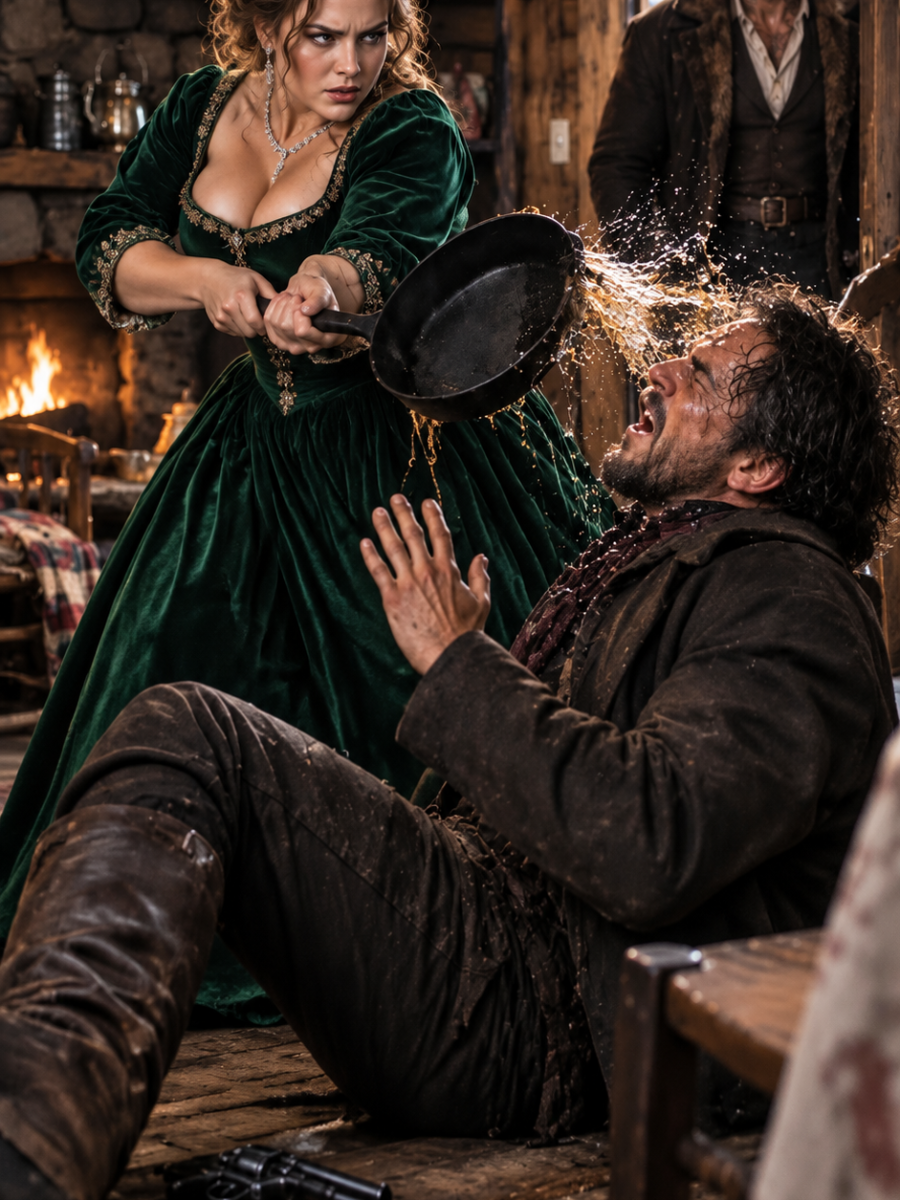
Winifred didn’t scream. She didn’t flinch. With the muscle memory of a woman who had lifted fifty-pound iron dough trays over roaring coal furnaces for sixteen years, her right hand seized the long handle of the twelve-inch cast-iron skillet sitting on the front burner.
She hauled the skillet off the flame and swung it with all the rotational momentum of her entire body.
An entire inch of boiling, sizzling, two-hundred-degree bacon grease splashed directly across Dempsey’s face and eyes.
A fraction of a second later, fifteen pounds of solid, scalding cast iron struck Dempsey squarely across the bridge of his nose and cheekbone with a sickening, metallic *CRACK!*
Dempsey unleashed a blood-curdling shriek of agony that shook the cabin rafters. The searing hot grease scorched his skin on contact; the iron impact shattered his nasal bone and fractured his eye socket. The Colt revolver flew from his numb fingers, clattering across the floorboards toward the woodpile.
Dempsey fell to his knees, clutching his blistered, bleeding face, thrashing on the floor in blind, screeching torment. “My eyes! God Almighty, my eyes!”
Chapter 8: The Outlaw Hog-Tied by the Hearth
Winifred did not hesitate. Frontier survival did not permit second chances.
She dropped the smoking skillet onto the hearth, seized the heavy iron fire poker from beside the fireplace, and delivered a devastating, two-handed downward strike across Dempsey’s right shin, cracking the bone and taking what little fight remained in his legs completely out of him.
The six-foot-two outlaw collapsed flat onto his stomach, groaning in the pool of grease and blood.
Winifred dropped her full, solid hundred-and-seventy-pound weight directly onto the outlaw’s shoulder blades, driving her knee into the small of his back and knocking the remaining wind out of his lungs. Reaching into the basket of tanned rawhide deer rope Judson used for lacing snowshoes, she looped the thick, wet leather around Dempsey’s wrists, wrenching his arms behind his back until his shoulders popped.
She tied his wrists with an iron baker’s hitch that only tightened when pulled. She yanked his ankles upward, binding his boots to his wrists in a brutal, inescapable frontier hog-tie.
When she was finished, Gar Dempsey—wanted for three murders across two territories—lay face down on the pine floor, trussed like a prize hog, weeping and whimpering through a face covered in flour, grease, and blood, unable to move a single joint.
Winifred stood up. Her apron was splattered with hot grease, her auburn hair had fallen completely loose around her shoulders, and her hands were steady as granite.
She walked over to the woodpile, picked up the loaded Colt revolver, checked the cylinder, and placed it on the dining table. Then she fetched a fresh bucket of cold water, washed her hands with lavender lye soap, swept the broken kindling into the hearth, pulled a fresh batch of hot biscuits from the oven, and sat down in the wooden rocking chair by the fire with her knitting needles.
Chapter 9: The Heart of the Rocky Mountains
At five-thirty in the evening, as the blizzard howled through the pines, Judson McIntyre kicked his snowshoes off on the porch and hit the cabin door with his shoulder, his Winchester rifle cocked and ready, expecting the worst when he saw the broken bar from outside.
He burst through the doorway, his eyes wild with adrenaline, shouting her name: *“Winifred!”*
The scene that greeted him stopped the mountain man dead in his tracks.
The cabin was warm and bathed in golden lantern light. The air smelled of woodsmoke, cinnamon, and fresh, flaky biscuits cooling on a clean linen towel on the table.
In the rocking chair beside the hearth sat his wife, Winifred, calmly clicking her wooden knitting needles, working on a pair of thick wool mittens.
And lying on the floor beside the woodbox, hog-tied so tightly his boots touched his ears, was Gar Dempsey—the most terrifying killer in the county—sobbing like a whipped dog through a mask of blistered skin, dried blood, and bacon grease.
Winifred looked up from her knitting, offering a polite, composed smile.
“Good evening, Judson,” she said smoothly. “You have a guest. He was rather loud, so I had to use the breakfast skillet. Supper is in the oven whenever you’re ready to wash up.”
Judson lowered his Winchester. He looked at Gar Dempsey. He looked at the dented cast-iron skillet on the hearth. He looked at the Colt revolver resting on the table. And finally, he looked at his wife.
A wave of shame so hot and crushing washed over him that his knees almost buckled on the floorboards. The woman he had called soft. The woman he had sneered would eat his winter stores and freeze before Christmas. This woman had faced an armed outlaw alone with a pan of bacon grease and conquered a killer without firing a single shot.
Judson walked across the room. He didn’t touch Dempsey. He walked straight to Winifred’s rocking chair, dropped down onto both knees on the scrubbed pine floor, and looked up into her hazel eyes with tears burning in his weathered gray gaze.
“Winifred,” Judson whispered, his deep voice trembling like a child’s. “I am a fool. A blind, miserable, undeserving fool. I asked for a beast of burden because I thought my heart was dead. God sent me an angel with iron in her blood.”
He reached out, taking her soft, capable hands between his rough, scarred palms, kissing her knuckles with reverent tenderness.
“I don’t care about the winter stores, Winifred,” he said, his voice thick with emotion. “I don’t care about anything on this mountain except you. If you’ll have me… truly have me… this cabin, this mountain, and every breath in my chest belongs to you forever.”
Winifred smiled—a warm, radiant smile that banished every winter chill from McIntyre Ridge. She reached out with one gentle hand, caressing his scarred cheek.
“I have had you since the depot, Judson,” she whispered softly. “Now get up off the floor and help me tie this outlaw onto the mule so we can collect the five-hundred-dollar bounty in town tomorrow. We need to buy a bigger stove for our children.”
The next morning, under clear mountain skies, Judson marched into the sheriff’s office in Silverthorne leading a mule carrying a trussed, humiliated Gar Dempsey, while Winifred rode beside him on Bess, her chin held high and proud.
The townsfolk stared in awe. And Judson McIntyre, who had lived eleven years in cold silence, spent the rest of his days holding his wife’s hand, telling everyone who would listen that the softest woman from Boston had become the strongest, warmest heart in the entire Rocky Mountains.