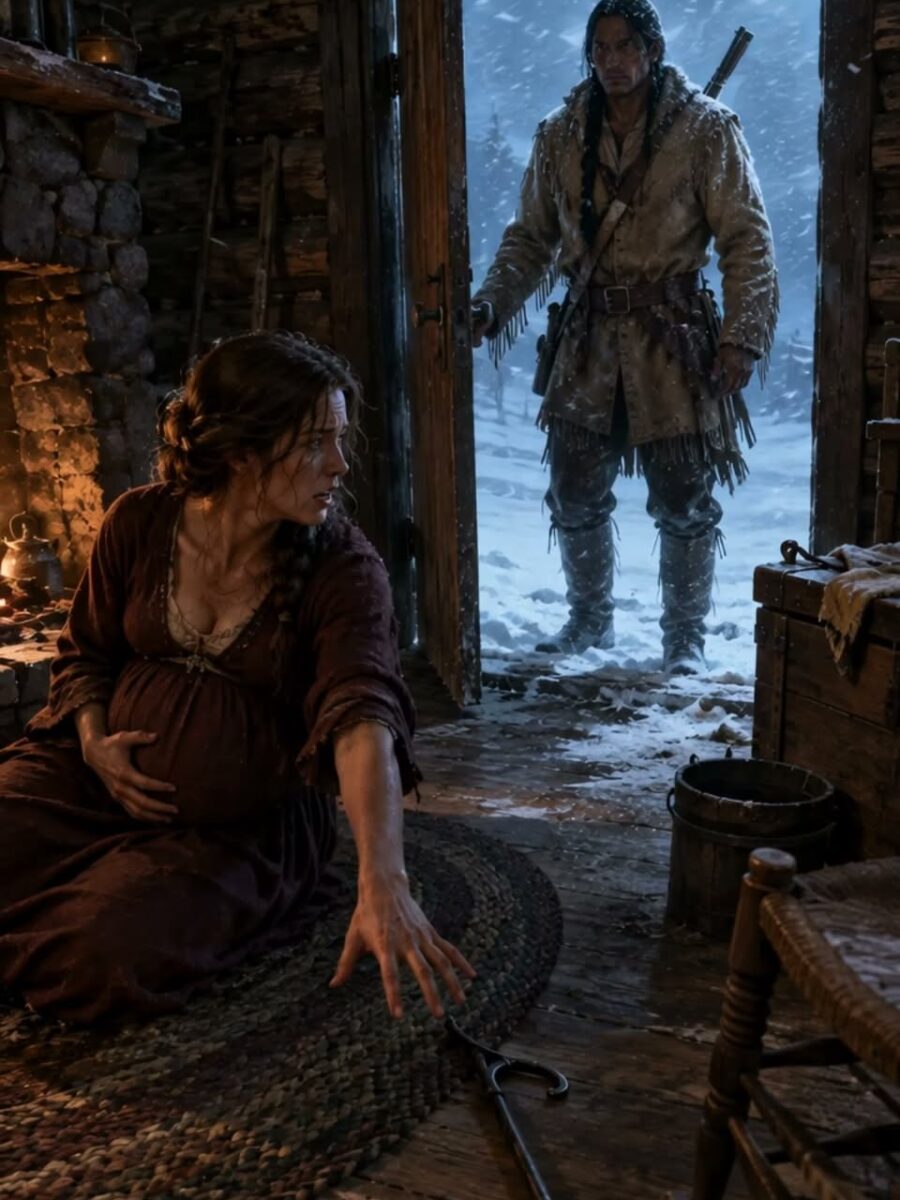
Marian Voss had spent five winters in the high country of Colorado, but she had never heard the wind scream with such feral hatred. The gale roared down from the razor-sharp crags of the Sangre de Cristo Range, driving frozen needles of snow through every warped seam between the hand-hewn cedar logs of her isolated cabin. Outside, the world was a howling cataract of white, erasing the mountain trail, the horse corral, and the towering spruce trees until heaven and earth merged into one suffocating shroud of ice.
Inside, the cabin was dying. On the wide fieldstone hearth, the last pine knot had collapsed into a single grey cinder, pulsating with a faint, mocking ember that offered no warmth against the creeping frost. Marian knelt beside the braided rag rug, both of her hands pressed white-knuckled against the rounded swell of her eight-month pregnancy. Her skin, the rich warm tone of roasted pecans, was slick with cold sweat. Every breath felt like inhaling broken glass.
Table of Contents
- Chapter 1: The Cold Hearth and the Coward’s Note
- Chapter 2: The Crunch of Boots in the Tempest
- Chapter 3: The Stranger with Gentle Hands
- Chapter 4: The Shock of a Spoken Name
- Chapter 5: The Deceit Beneath Bitter Creek
- Chapter 6: Shadows on the Ridge
- Chapter 7: Dawn Over the Free Valley
“A man who flees his responsibilities leaves behind more than empty chairs and cold hearths; he leaves a monument to his own smallness. But when honor arrives unbidden through the blinding storm, it proves that dignity does not depend on blood or paper deeds, but on the courage to protect the innocent when all hope seems lost.”
Chapter 1: The Cold Hearth and the Coward’s Note
The contraction seized her lower spine like an iron vice, bowing her backward until her teeth bit into her bottom lip, drawing copper-tasting blood. She gasped, fighting the instinct to scream, knowing that sound alone in the vast emptiness would only sap the pitiful remnants of her strength. Her baby was coming four weeks early. The sheer terror of abandonment, the days of freezing bread crusts, and the unrelenting dread of winter had triggered what nature had intended for mild March.
Nine days had passed since Edwin had slipped away like an ungrateful shadow. She remembered that morning with excruciating clarity: waking up to an unnatural, cavernous silence in their two-room homestead. The woodstove had been cold. The kettle had not been filled from the well. She had called out his name into the dim light, thinking he was tending the mare in the lean-to stable, but only the creak of mountain timber had answered.
On the rough pine table beside the tin of chicory coffee, held down by a smooth river stone, she had found the scrap of butcher paper. Edwin’s hurried, spidery scrawl was burned permanently into her memory: “Marian, I cannot stay. There is another woman in Denver. A life here was a mistake I should have never dragged you into. You will find forty dollars beneath the flour sack in the pantry. Forgive me, but do not look for me.”
Weeping in disbelief, she had rushed to the pantry shelf. She had tipped over the heavy canvas sack, spilling white flour across the split-log planks. There had been no forty dollars. There had not even been forty cents. Nothing lay buried beneath the coarse weave except stale cornmeal, rodent droppings, and dry grey dirt. Edwin had taken their sturdy sorrel mare, the spring wagon, both heavy buffalo wool blankets, the double-barreled shotgun, and every silver dollar they had saved from two seasons of timber cutting.
He had left her alone on a high-altitude ridge, six miles from the nearest neighbor in the rough mining hamlet of Bitter Creek, with five sticks of wet pine, three handfuls of dried beans, and a child about to enter the world. For nine days, she had rationed the kindling, boiling melted snow and praying the weather would hold until she could walk the mountain pass. Instead, the skies had darkened to slate grey, the barometer had plummeted, and the greatest blizzard since 1860 had swallowed the valley whole.
Chapter 2: The Crunch of Boots in the Tempest
Another spasm ripped through her abdomen, fiercer than the last. Marian slumped forward onto her forearms, her forehead resting against the icy wood of the floor. “Please, little one,” she choked out through chattering teeth. “Hold on. Just wait until daylight. Don’t leave me alone in the dark.” The child answered with a violent flutter against her ribs, as if demanding its right to breathe despite the freezing grave their cabin had become.
Only four pieces of pine remained near the hearth, all soaked with roof seep. She needed dry kindling from the woodshed behind the kitchen wall. Gritting her teeth, Marian grabbed the rough rung of a ladder-back chair and hauled herself upward. Her vision darkened with spots of grey and purple; the room tilted sickeningly. The moment she took a half-step toward the door, another contraction buckled her knees, dropping her back onto the braided rug with a thud that drove the breath from her lungs.
She lay there, shivering uncontrollably as the cold from the cellar floor seeped through her woolen skirt and flannel petticoat. The wind outside rose to a deafening shriek, rattling the heavy wooden storm shutters like eager fists wanting to tear the cabin apart. And then, through the rhythmic roaring of the gale, her ears caught a distinct, rhythmic sound.
Crunch. Crunch. Crunch.
Marian stopped breathing. Her chest froze mid-inhale. She pressed her cheek harder against the pine planks, listening with every nerve ending in her body. It was not the heavy creak of a pine bough snapping under snow. It was not the erratic scratching of a starved coyote. It was the deliberate, measured cadence of heavy winter moccasins packing fresh snow outside her porch.
In Bitter Creek, solitary homesteaders lived by the gospel of the gun. The mining camps attracted the dregs of the continent: deserters from the territorial forts, claim jumpers with blood under their fingernails, and brutal vagabonds who knew that sheriff’s deputies rarely rode beyond the timberline in winter. If a desperate outlaw discovered a pregnant, helpless woman in an unbolted cabin, mercy would be the last thing he offered.
Her fingers clawed along the rough stonework of the hearth, reaching for the heavy cast-iron poker. It was two feet away, just out of arm’s reach. Before her fingertips could graze the iron, the iron latch rattled violently. A thick thump shook the doorframe. The heavy bar had not been dropped. With a groaning screech of frozen hinges, the cabin door was shoved violently inward against a wall of white powder.
Chapter 3: The Stranger with Gentle Hands
A swirling vortex of snow and sub-zero air rushed into the room, instantly extinguishing the faint red glow on the hearth. Framed against the white chaos stood a figure of monumental presence. He was well over six feet tall, broad across the shoulders as a draft horse, draped in a heavy elk-hide coat crusted with thick rime and frost. Across his back hung a canvas-wrapped Winchester carbine. From beneath a fur-lined hood, a long, gleaming black braid fell across his left chest, and a pale scar ran in an unbroken line from the corner of his cheekbone down to the edge of his jaw.
A Ute warrior. In the saloons and mercantile stores of Bitter Creek, the settlers spoke of the Utes with low, superstitious venom, blaming them for every lost heifer, every dry well, and every misstep of drunken miners. Marian’s heart hammered against her ribs like a trapped bird. Her hand touched the cold poker, her fingers curling around the iron handle with the desperate courage of a mother defending her unborn.
The stranger did not raise a weapon. His dark, penetrating eyes swept across the room in a single, surgical sweep. He saw the cold ashes in the hearth. He saw the empty water pail beside the door. He saw the bloodstains where Marian had bitten her lip, the sweat sheen on her brow, and the unmistakable silhouette of a woman in the throes of full labor. Without a single word, he reached back, dragged the heavy door shut against the blizzard, and dropped the stout oak bar across the brackets.
“You are giving birth,” he said. His voice was surprisingly deep, steady as ancient granite, and his English was impeccably clear, devoid of the hesitation she expected.
Marian gripped the poker tighter, though her arm trembled violently. “I have nothing… nothing here for you to steal,” she gasped, her voice thinning to a thread. “Please… just leave me to die.”
“I did not come to steal,” the man replied evenly. He knelt beside the hearth, unbuckling his heavy rawhide mittens and tossing them onto the hearthstone. He pulled a heavy forged knife from a beaded sheath at his waist. With blinding efficiency, he took one of Marian’s wet pine logs, shaved away the damp outer bark with swift strokes of the blade, and split the dry resinous heartwood into fine, feather-edged slivers. From an inner pocket of his wool shirt, he withdrew a small tin of dry cedar bark and flint.
Within thirty seconds, sparks bit into the cedar fluff. A thin spiral of fragrant smoke rose toward the chimney flue. He blew upon it with steady, patient breath, cupping the spark until a vibrant orange flame leaped onto the pine shavings. Warmth—real, life-saving warmth—bloomed into the icy room. Marian’s fingers loosened from the iron poker. It clattered softly to the floor.
Chapter 4: The Shock of a Spoken Name
The stranger rose and stepped outside the rear door, returning moments later with an armful of split dry tamarack logs he had harvested from the woodshed. He built the fire into a crackling roar, then melted snow in the heavy black kettle until steam curled into the rafters. When he turned back to Marian, his expression was solemn, stripped of all menace.
“I am Kai,” he said, kneeling beside her on the rug and placing a clean, steaming rag against her burning forehead. “My mother was a midwife among the White River bands. You cannot stay on this floor. Can you reach the bed?”
“I can try,” she breathed, the warmth from the hearth thawing the bitter frost from her limbs. With his immense strength supporting her waist, he lifted her as gently as though she were made of delicate porcelain, carrying her into the adjoining alcove and laying her onto the mattress. He had already gathered clean linen sheets from the cedar chest, tearing them into precise strips with his knife, and placed scissors and boiled hemp twine on the stool beside the bed.
For the next three hours, time ceased to exist in the cabin. The blizzard shrieked outside like a choir of banshees, but inside, Kai was an anchor of calm precision. When the crowning contractions tore through Marian’s body, bringing her to the brink of delirium, he held her wrists with unshakable firmness, never flinching, never looking away, guiding her breath with rhythmic commands in low, soothing tones.
At two in the morning, a sharp, indignant wail shattered the mountain quiet. A baby boy, healthy, robust, with dark curls and lustrous brown skin, cried out against the mountain cold. Kai wiped the child clean with warmed flannel, tied and cut the cord with practiced reverence, and laid the infant against Marian’s bare chest. Tears of sheer exhaustion and overwhelming love spilled freely down her cheeks, soaking the rough fabric of the pillow.
Kai stood by the hearth, scrubbing his hands with boiled water and lye soap before checking the kettle. The firelight flickered across his bronze face, illuminating the harsh scar along his jaw. He looked back at her, his posture relaxing for the first time since he had breached the door. “He has the lungs of an eagle,” Kai said quietly. “He will survive this winter. What is your name, woman of the ridge?”
“Marian,” she whispered, her fingers stroking the baby’s velvet cheek. “Marian Voss.”
Kai froze. The tin cup in his hands paused an inch above the wooden bucket. The easy gentleness in his eyes vanished, replaced by an expression so sharp, so completely rigid with shock, that Marian felt a chill run down her spine that had nothing to do with the freezing draft. He set the cup down with deliberate slowness. His gaze traveled toward the small writing desk in the corner, where the empty coffee tin and Edwin’s note still sat.
“Voss?” Kai repeated, his voice dropping into a lower, darker register. “Edwin Voss?”
“Yes,” Marian said, her heart leaping into her throat. “He… he was my husband. He ran away nine days ago. He left with a woman to Denver.”
Kai stepped closer to the foot of the bed, his dark eyes burning with grim certainty. “Your husband did not go to Denver with a woman, Marian. And he did not abandon you because of love. He fled because the blood on his hands could no longer be washed away.”
Chapter 5: The Deceit Beneath Bitter Creek
Marian stared at the tall hunter, her mind reeling in the firelit haze of postpartum exhaustion. “What are you talking about? Edwin was a surveyor. He cleared timber for the railroad.”
“Edwin was a forger,” Kai said coldly, though his voice remained carefully modulated so as not to startle the sleeping infant. “Three months ago, the territorial land office in Denver issued blanket land scrip for the foothill parcels south of the valley. Those lands belonged to two groups: my people, under the Treaty of 1868, and thirty families of freedmen who migrated from Tennessee after the war to homestead the high meadows. We held the sovereign filings. We had the registered seals.”
Kai took a seat on the wooden chest, his gaze fixed on the dancing flames. “Silas Thorne, the banker who owns the Bitter Creek Mercantile and the assay office, wanted those timber and coal veins for the Denver & Rio Grande syndicate. But the law required original signatures to relinquish the homesteads. Thorne hired Edwin because Edwin had worked in the land recorder’s office in St. Louis. For two months, while you thought your husband was marking timber lines in the snow, he was sitting in the backroom of Thorne’s bank, forging the marks and signatures of thirty Black farmers and five Ute band leaders.”
Marian felt the room spin. Her stomach churned with nausea. She remembered Edwin coming home late at night, smelling of cheap whiskey and cigar smoke, his cuffs stained with black India ink, muttering feverishly about how they would soon be rich enough to leave the mountains forever. Whenever she had asked about the ink, he had snapped at her, accusing her of prying into affairs she had no business knowing.
“Edwin forged deeds worth sixty thousand dollars in timber and coal rights,” Kai continued, his tone heavy with bitter truth. “Thorne promised him a third of the profit. But Edwin was greedy, and Thorne was merciless. When the forged scrips were completed, Edwin realized Thorne had no intention of paying him thirty pieces of silver. Thorne had already sent two riders to Denver to file the papers—and hired two killers from the Red Mountain gang to ensure the surveyor who drew the fraudulent maps never testified before a federal judge.”
Marian pressed her hand against her mouth, tears of horror blinding her. “The note… the other woman… the flour sack…”
“A decoy,” Kai said. “He stole every dollar you had to buy fresh mounts and provisions. He wrote that lie so you would not immediately run to the sheriff in Bitter Creek, giving him time to reach the southern border into New Mexico territory before Thorne’s gunmen caught his scent. He left you here, pregnant and starving, knowing Thorne’s men would search this cabin first. You were his human shield, Marian. If the killers came, they would interrogate you, waste precious days searching your floorboards, while he slipped through Raton Pass with forty thousand dollars in stolen cashier’s checks.”
Chapter 6: Shadows on the Ridge
The horrifying truth settled over the warm room like a suffocating shroud. The man she had loved, the man who had promised to build a free sanctuary for their family in the high Rockies, was not merely a coward—he was a monster who had willingly condemned his pregnant wife and unborn child to slaughter or starvation to save his own miserable skin.
“How do you know this, Kai?” Marian asked, her voice trembling. “Why were you riding past my door in a blizzard that would freeze an elk in its tracks?”
Kai looked directly into her eyes. “Because Edwin did not make it to New Mexico. Two days ago, before the storm fully broke, my scouts found a sorrel mare frozen in a ravine three miles up Dead Man’s Gulch. Edwin tried to cross the high ridge in the night to avoid Thorne’s patrols. His horse lost footing on the black ice. The beast broke its forelegs, and Edwin tumbled two hundred feet into the boulder field. He died with his boots on, his neck broken, his saddlebags stuffed with Thorne’s stolen bank drafts and the duplicate carbon copies of every forged deed.”
Kai pulled a thick leather packet bound in oiled pigskin from inside his coat and laid it gently on the small table. “I took the papers. I was riding toward the telegraph office in Trinidad to alert the federal marshals when the blizzard caught me on the upper plateau. I saw the faint smoke from your chimney. I came because no soul should freeze alone. I did not know the woman dying inside was the wife he betrayed.”
Before Marian could speak, the wind outside momentarily ceased, leaving a hollow, echoing lull in the storm. And in that stillness, from the southern tree line beyond the cabin porch, came the unmistakable, sharp whinny of a blowing horse, followed by the clinking of saddle irons.
Kai’s head snapped toward the barred front door. In an instant, the gentle healer was gone, replaced by a deadly warrior whose instincts were honed by twenty years of survival. He blew out the oil lantern on the table with one puff, plunging the cabin into the deep, dancing shadows of the dying fire. He lifted his Winchester, checking the brass receiver with silent, fluid grace.
“Thorne’s riders,” Kai whispered, his voice barely audible above the hiss of the hearth. “They have followed the mare’s trail from Bitter Creek. They believe Edwin crawled back to his own hearth.”
“Kai,” Marian whispered, fear clutching her throat as she clutched her baby against her heart. “What do we do?”
“Lie flat, Marian,” he commanded softly, stepping beside the heavy oak door and raising the barrel of the carbine. “They did not come to talk. But they do not know who holds the threshold tonight.”
Chapter 7: Dawn Over the Free Valley
Heavy footsteps trudged up the wooden steps of the porch. A rough, whiskey-soaked voice shouted through the timber: “Voss! We know you’re in there, you lying bastard! Thorne wants his packet, and he wants your hide! Kick open the door or we burn the timber down around your head!”
Kai did not hesitate. Knowing that fire in a wooden cabin was certain death for the mother and child, he threw the bar, kicked the door wide into the face of the nearest gunman, and fired. The roar of the Winchester inside the small cabin was deafening. The lead outlaw, knocked backward into the snowbank by the swinging oak plank, discharged his Colt revolver harmlessly into the rafters before Kai’s second shot disabled his shoulder, disarming him instantly.
The second gunman, blinded by the sudden muzzle flash and the roaring wind, raised a double-barreled shotgun. But before his finger could squeeze the rear trigger, Marian—summoning every remaining ounce of maternal fury—heaved the heavy cast-iron kettle of boiling water through the open doorway, dousing the gunman’s hands and chest. The outlaw shrieked in agony, dropping the shotgun into the snow as Kai leveled the Winchester against the bridge of his nose.
“Drop your gun belts,” Kai said, his voice colder than the Colorado ice. “Or your blood joins Edwin’s at the bottom of the gulch.”
Within minutes, both shivering, disarmed thugs were bound tight with hemp cord inside the woodshed. When dawn finally broke over the Sangre de Cristo Range, the storm had spent its fury. The sky cleared to a brilliant, crystalline turquoise, the morning sun turning four feet of fresh snow into a blinding expanse of diamond dust.
Two days later, federal marshals arrived from Trinidad, summoned by Ute runners Kai had dispatched once the pass cleared. Silas Thorne was arrested inside his Bitter Creek bank before he could board the noon stagecoach. The forged deeds and stolen cashier’s checks were handed directly to the territorial circuit judge, invalidating Thorne’s fraudulent land grabs and securing the permanent legal patents for both the Ute reservation and the thirty Black homestead families who had carved their dreams into the mountain soil.
Marian stayed in the high valley. With the help of the neighboring Black homesteaders and Kai’s people, she rebuilt her homestead into the Sangre de Cristo Cooperative Ranch—a flourishing cattle and timber spread where honesty, hard work, and mutual protection took the place of Edwin’s cowardice. She named her son David Tahvo Voss. And whenever visitors asked about the tall carved cedar post standing proudly at the entrance to her valley, Marian would smile, looking out across the sparkling snowfields.
“That marks the day a coward tried to bury us in the dark,” she would say, holding her son close, “and an honorable stranger taught us that true family is forged not by blood or empty promises, but by the light we bring to each other through the storm.”