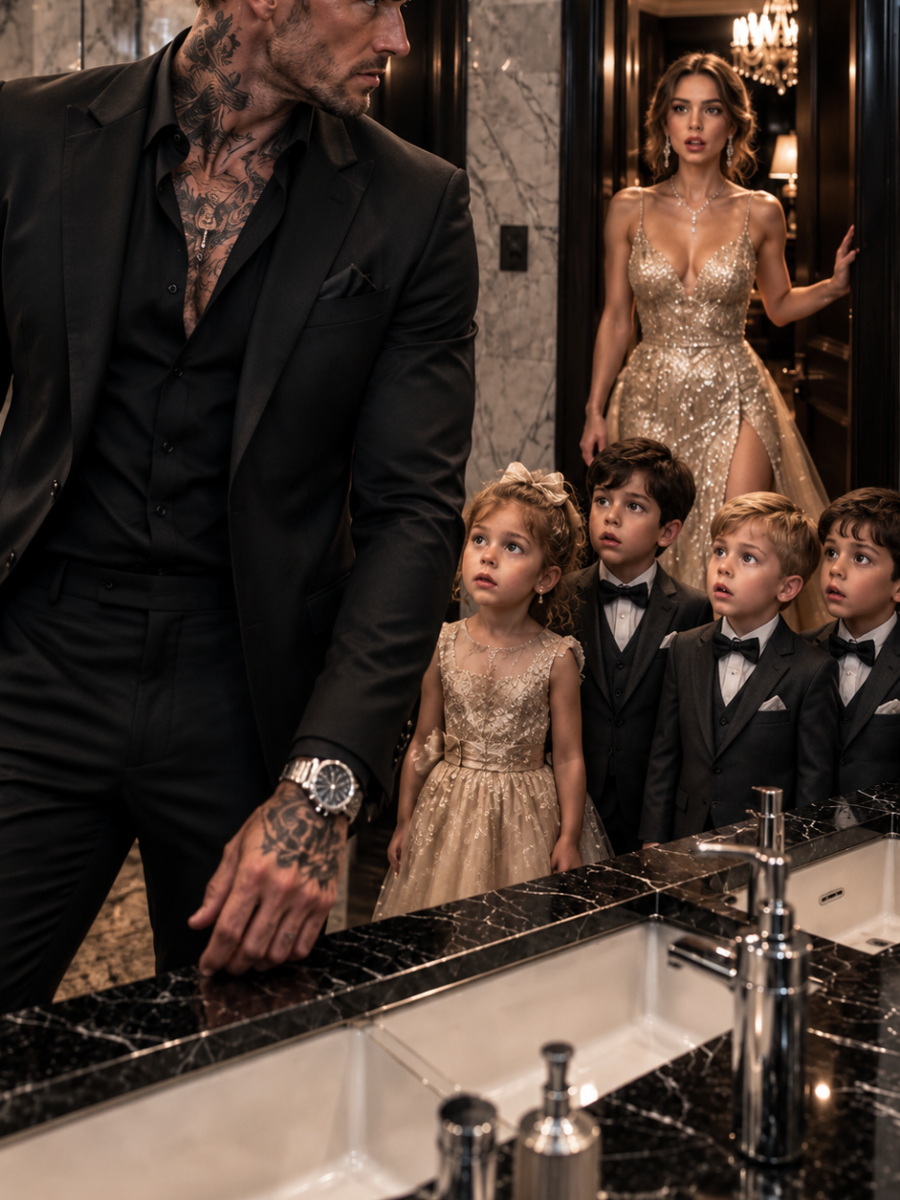
Chapter 1: The Mirror in the Restaurant Bathroom
Four little boys walked into a luxury restaurant bathroom only hours before I was scheduled to announce my high-society engagement, and five minutes later, my entire world had shattered into a thousand jagged pieces.
That afternoon, every detail of my future had been calculated with ruthless precision. My charcoal three-piece suit was hand-tailored on Savile Row, my grandfather’s antique platinum cufflinks gleamed against starched French cuffs, and resting in the breast pocket of my coat was a seven-carat flawless emerald-cut diamond ring. The ring had been selected by my imperious mother, Eleanor Whitaker, vetted by our family’s corporate trust attorneys, and celebrated by Manhattan society columnists. The only person whose opinion had never been solicited was mine.
By seven o’clock this evening, I was expected to stand before two hundred elite guests at my family’s private conservatory overlooking Central Park and formally propose to Brielle Cartwright—the daughter of a banking dynasty whose merger with Whitaker Enterprises would forge a three-billion-dollar commercial empire.
It was not love. It was a merger dressed in white silk and diamonds.
Needing a moment to escape the suffocating weight of my obligations, I ducked into the restroom of the Midtown steakhouse where I had been dining with corporate counsel. The marble room was deserted, save for four small boys standing on their tiptoes at the porcelain sinks, washing their hands. They could not have been older than six years old, dressed in matching navy knit sweaters with elbow patches that had seen better days.
At first, I barely glanced in their direction, occupied with checking my watch. But as I approached the adjacent mirror, the boy on the far left did something that made every muscle in my body lock completely rigid.
With an unconscious, familiar flick of his wrist, he swept his wet brown bangs straight back from his forehead to his crown. He gave his head a tiny, brisk shake, and then brought his left hand up to lightly touch the nape of his neck, his fingers curling against his collar.
A second later, as if orchestrated by instinct, the other three boys repeated the exact same sequence in unison: sweep, shake, touch.
My breath stopped dead in my lungs. My chest thudded with the force of a sledgehammer.
That was my gesture. I had done that exact sequence every single day of my life whenever I was anxious, overwhelmed, or deep in thought. My late father used to laugh at boardroom dinners, nudging my shoulder and whispering, *“That’s how you spot a Whitaker man under pressure. It’s written in our marrow.”*
The boy closest to me caught my reflection in the mirror. He turned his head, his wide eyes blinking up at me with innocent curiosity. “Mister, why are you copying us?”
“I’m not,” I whispered, my voice sounding distant and hollow in the cavernous room.
All five of us stood shoulder to shoulder facing the expanse of silvered glass. The sight was impossible, dizzying, terrifying: the exact same sharp jawline, the same striking gray-blue eyes framed by thick dark lashes, the same messy wave of chestnut hair, and the identical, prominent dimple indented deeply into the left cheek.
It was like staring into four miniature mirrors reflecting my own six-year-old self.
“I’ve always done that,” I choked out, my fingers trembling as I reached down toward my collar.
The four boys grinned at the same time, four identical dimples flashing in the fluorescent light. “So have we!”
The boldest boy stepped forward, wiping his damp hands on his jeans, offering a small, honest hand. “I’m Milo. That’s Mason, that’s Max, and that’s Micah. We’re quadruplets!”
My mouth felt as though it had been packed with dry sand. “Where… where is your mother, Milo?”
“She works out front,” Milo answered cheerfully. “She’s arguing with the big manager man right now because we don’t have anywhere warm to sleep tonight.”
Chapter 2: The Dimple and the February Wind
I followed the four little boys out of the restroom into the service corridor behind the restaurant’s kitchen, my heart pounding so loudly that it drowned out the clatter of silverware and sizzling pans.
Near the rear delivery exit, standing beside the industrial stainless steel prep tables, a young woman was standing with her head bowed. She wore a stained black server’s apron over a faded white button-down shirt. Her slender shoulders were trembling with cold and exhaustion, her dark chestnut hair pulled back in a hasty clip.
In front of her stood the floor manager, a corpulent man with an unbuttoned vest, shaking his head with callous, bureaucratic impatience. “I’ve told you three times, Mara. Restaurant policy strictly prohibits employees from stashing children in the dry-storage room during winter shifts. It’s an insurance liability.”
“Mr. Henderson, please,” the woman begged, her voice cracking with unspeakable desperation. “The shelter on Thirty-Fourth Street was full at four o’clock. The temperature is dropping below twenty degrees tonight. My boys will sit quietly in the back corner on my coat. They won’t make a sound, I swear to God! Just let them stay until my shift ends at midnight!”
“Not my problem,” the manager sneered, turning on his heel. “Clock out by seven and take them elsewhere. Or I’ll call building security to escort you off the premises.”
Hearing the scuffle of the boys’ sneakers, the woman turned around quickly. “Boys, did you wash your—?”
Then her eyes rose past their small heads, and time seemed to stop completely.
The delicate scar above her left eyebrow. The luminous emerald-green eyes that held the depth of the sea. The soft curve of her lips that I had kissed under rainy awnings across New York City six years ago.
Mara.
The woman I had loved with every fiber of my being. The woman my mother had sworn took a two-million-dollar buyout check while I lay in a hospital coma after a skiing accident, abandoning me without leaving a single letter behind.
“Mara…?” The name escaped my throat like a broken prayer.
Mara’s face drained of every ounce of color. Her emerald eyes widened with sheer, unadulterated panic. She took two frantic steps forward, scooping little Micah into her arms while grabbing Milo’s and Mason’s wrists. “Boys, coats on. Right now. We’re leaving.”
“Mara, wait!” I shouted, lunging forward, catching the strap of her canvas tote bag. “Look at me! Please, just look at me!”
She pulled away violently, pushing through the heavy rear exit door out onto the frigid concrete alleyway. Outside, a brutal February wind was whipping down the canyon of Manhattan skyscrapers, carrying flurries of icy sleet. Sitting beside the metal dumpster were two battered nylon duffel bags containing everything they owned in the world.
The four boys shivered, pulling their thin sweaters tight around their ribs, huddling close to their mother’s knees.
I reached into my overcoat and pulled out the electronic smart-key card to my private Tribeca penthouse. I knelt down in the icy wind, holding it out toward her trembling fingers. “Mara, listen to me. I don’t know what happened six years ago. I don’t understand any of this. But it is seventeen degrees outside. Take my car. Take this key. My penthouse in Tribeca is empty, warm, and fully stocked. Go there. Put the boys in a warm bed. We don’t have to speak a single word until morning, but please… don’t let them freeze.”
Mara stared at the golden crest on the keycard, her jaw tightening with bitter pride. “We don’t need your charity, Julian Whitaker. We’ve survived six years without you, and we will survive tonight.”
Then, six-year-old Milo tugged softly at the hem of her apron. “Mommy… my toes hurt from the ice. I’m so tired.”
That small, whimpering whisper broke the iron wall of her resistance. Mara’s eyes brimmed with hot, bitter tears. With shaking fingers, she snatched the keycard from my hand.
My driver pulled my black Cadillac Escalade to the curb, helping the four shivering boys into the heated leather seats. Before stepping inside, Mara turned to me, her green eyes blazing through her tears with a fury that cut deeper than any blade.
“You don’t get to disappear from our lives for six years, Julian,” she hissed, her voice trembling with raw grief. “And you sure as hell don’t get to show up out of nowhere and decide you’re their father.”
I looked at the four little boys peering through the tinted glass, all four of them pressing their identical noses against the window, watching me with wide, searching eyes.
“I’m not deciding anything, Mara,” I said quietly, the freezing wind stinging my face. “I’m just trying to understand why they have my face.”
The SUV door clicked shut, and the vehicle pulled into the Manhattan traffic. At exactly 4:18 PM, standing in the freezing sleet on Forty-Second Street, I pulled my phone from my pocket and dialed my executive assistant, Marcus.
“Marcus. Cancel tonight.”
There was a long, stunned silence on the other end. “Mr. Whitaker…? Cancel the Cartwright engagement gala? Your mother is already at the conservatory welcoming the first fifty ambassadors and executives!”
“I don’t give a damn who is at the conservatory,” I commanded, my baritone hard as diamond. “Call the caterers. Call the press. Tell them the event is terminated. And get Leo Thorne on a secure line within five minutes.”
Chapter 3: The Cold Conservatory and the Canceled Ring
By 5:30 PM, the grand glass conservatory overlooking Central Park had been transformed into an opulent battleground of aristocratic fury.
I pushed through the towering bronze doors, shaking the freezing sleet from my cashmere trench coat. The conservatory was breathtaking in its extravagance: thousands of imported white Ecuadorian orchids cascaded from the vaulted iron arches, crystal chandeliers bathed the marble floors in golden brilliance, and a twenty-piece string quartet was playing Mozart in the gallery.
Standing near the champagne tower, surrounded by socialites and hedge-fund titans, was my mother, Eleanor Whitaker. She was draped in an emerald silk couture gown, wearing a ten-strand pearl necklace, holding court like a reigning monarch. Beside her stood Brielle Cartwright, looking radiant and smug in an ivory column dress, already holding her left hand out for guests to admire where the diamond ring was supposed to rest.
When Eleanor spotted me entering the hall alone, unsmiling and without my formal tuxedo jacket, her smile vanished behind a mask of icy irritation. She excused herself from the British consul general and marched across the marble floor, her heels clicking sharply.
“Julian!” Eleanor hissed, grabbing my elbow with claws of steel, dragging me into the shadow of a towering palm tree. “Where have you been?! Your assistant had the audacity to call my office claiming you demanded this evening be canceled! Do you have any idea how much capital is riding on the Cartwright alliance?! Arthur Cartwright is signing the maritime syndicate merger tomorrow morning!”
“Where was Mara six years ago, Mother?” I asked, my voice low, flat, and lethal.
Eleanor froze. The manicured hand on my arm loosened slightly, and for a fraction of a second, a flicker of raw panic crossed her aristocratic eyes before being swiftly buried beneath a haughty sneer. “What on earth are you babbling about? That little gold-digging waitress from Brooklyn? I told you six years ago, Julian. The moment your ski helicopter crashed in Aspen and you fell into that coma, she marched into my office, demanded two million dollars in bearer bonds, and boarded a flight to Europe. She never loved you.”
I looked at the woman who had given me birth, feeling a sickening chasm open in my chest. “She didn’t board a flight to Europe, Mother. She was washing dishes in a midtown steakhouse two hours ago. And she has four six-year-old sons with my eyes, my jaw, and my blood.”
Eleanor gasped—a sharp, strangled sound. Her complexion turned the sickly gray of wet ash. “That’s… that’s impossible! She wouldn’t dare—!”
She caught herself, biting her lip, but the slip of the tongue was fatal.
“*She wouldn’t dare?*” I echoed, stepping closer, towering over her with righteous wrath. “You knew, didn’t you? You knew she was pregnant when you threw her out!”
Brielle Cartwright glided over, her champagne flute trembling in her manicured hand, her smile brittle. “Julian, darling? Is everything alright? The photographer is waiting for us by the fountain.”
I reached into my pocket, pulled out the velvet box containing the seven-carat emerald-cut diamond ring, and tossed it carelessly into the crystal champagne bowl on the cocktail table. The velvet sank beneath the bubbling wine with a soft splash.
“The wedding is off, Brielle,” I said clearly, loud enough for thirty nearby guests and the lead society columnist from the Times to hear. “And if you or my mother take one step near my family, I will burn both of your dynasties to the ground.”
I turned on my heel and walked out into the freezing night, leaving the conservatory in dead, stunned silence.
Chapter 4: The Tribeca Penthouse and the Midnight Truth
By nine o’clock that evening, the snow was falling heavily over the cobblestone streets of Tribeca, blanketing the city in a tranquil, muffled white hush.
I let myself into my private penthouse on Franklin Street using my backup biometric scan. The sprawling loft was warm and silent, the floor-to-ceiling glass windows framing the glittering panorama of the Hudson River. In the guest bedroom, beneath two heavy goose-down comforters, all four boys were sound asleep. They had eaten hot soup and grilled cheese sandwiches delivered by my staff, their damp clothes washed and neatly folded on the dresser.
Milo and Mason were sleeping head-to-head, while Max had his arm thrown over little Micah’s chest, protecting his brother even in sleep. Beside their pillows sat four small glass cups of water, exactly as their mother had taught them.
I stood in the doorway for ten breathless minutes, watching their tiny chests rise and fall, a lump of unbearable sorrow choking my throat. Six years. Seventy-two months of their first words, their first steps, their first scrapes, and their bedtime prayers had been stolen from me by lies.
I turned quietly and walked back into the living room. Mara was sitting on the edge of the large leather sofa, wrapped in a plush cashmere throw, holding a steaming mug of peppermint tea. She had washed her hair, her face bare and luminous in the soft glow of the fireplace.
I sat in the armchair across from her, leaning forward with my forearms on my knees. “Tell me everything, Mara. Please. Start from the day of the crash.”
Mara looked into the crackling fire, a single tear escaping her eyelashes and tracing a slow path down her cheek. “You were in Aspen. The helicopter went down in a whiteout blizzard. The news reported you were brain-dead at Presbyterian Hospital, on life support.”
She swallowed hard, her voice trembling with the weight of remembered agony. “I was twenty-two, Julian. I had just found out that morning that I was carrying your children. The doctor told me it was quadruplets, a one-in-a-million miracle. I was terrified, but so desperately happy. I took a cab straight to the hospital to be at your bedside.”
“What happened at the hospital?” I whispered.
“I never made it past the executive lobby,” Mara wept softly. “Your mother had hired eight private armed security contractors. They cornered me in a private consultation suite. Eleanor threw an envelope of cash at my feet, called me a filthy opportunist trying to trap her comatose heir with bastard children, and had two corrupt lawyers present me with a forged restraining order.”
Mara pulled back her sleeve, showing me an old, faint silver scar on her wrist. “They told me that if I ever tried to contact you, if I ever spoke your name to the press, or if I ever showed my face in Manhattan again, they would have my younger brother’s medical trust revoked and ensure my mother’s nursing home evicted her into the street. Eleanor whispered in my ear: *‘A Whitaker does not breed with the gutter. If you have those brats, you will raise them in the dark.’*”
A terrifying, suffocating fury tore through my soul like volcanic magma. My mother had not merely lied; she had terrorized the woman I loved and cast my unborn flesh and blood into starvation.
“I never took that money, Julian,” Mara said, looking directly into my eyes with proud, broken dignity. “I walked out of that hospital with forty dollars in my purse. I worked three jobs. I scrubbed floors until my knees bled. But I gave my boys everything I had. They know honor. They know love. And I never let Eleanor Whitaker touch their souls.”
Chapter 5: The Forensic Audit of a Two-Million-Dollar Lie
At 1:30 AM, while Mara slept in the master suite and the boys dreamed peacefully, my private investigator, Leo Thorne, arrived at the penthouse carrying two encrypted laptops and a sealed leather briefcase.
Leo was a former federal forensic auditor who had served as my corporate fixer for seven years. He spread dozens of certified bank transaction sheets across my kitchen island, his expression dark and triumphant.
“Julian, you need to see this,” Leo said, turning the primary screen toward me. “We subpoenaed the cold-storage financial records of the Whitaker Family Foundation from six years ago. The two-million-dollar cashier’s check that Eleanor claimed Mara Bennett cashed? It never went to Mara.”
I leaned over the counter, my eyes scanning the high-resolution scan of the original bank draft. “Where did it go?”
“The check was made out to ‘M. Bennett’,” Leo explained, tapping the endorsement line. “The signature on the back was an amateur forgery. Three days after your helicopter accident, the funds were cleared through an offshore private bank in Bermuda and deposited directly into an account owned by Cartwright Global Equities—specifically controlled by Brielle Cartwright’s elder brother, Thomas Cartwright.”
I stared at the screen in utter, blinding disbelief. “The Cartwrights were in on it from day one?”
“It was an orchestrated corporate coup,” Leo confirmed, opening the second binder. “Six years ago, Cartwright Equities was facing a ninety-million-dollar liquidity crisis. Brielle and Eleanor had planned the arranged marriage to merge your capital with theirs. When Eleanor discovered Mara was pregnant with your legitimate heirs, they knew that under your grandfather’s irrevocable trust, seventy percent of the Whitaker fortune would bypass Eleanor and vest directly into your biological children upon their birth.”
The puzzle pieces fell into place with sickening clarity. If Mara had given birth while I was awake, the entire Whitaker estate would have been legally locked away for my children. Eleanor would have lost her multi-million-dollar discretionary spending, and Brielle Cartwright would have been left with nothing but an empty banking firm.
“So they paid off the hospital security, fabricated a restraining order, and stole the two million dollars to cover their own tracks,” I said, my voice dropping to an icy whisper that sent shivers through the kitchen.
“And there’s more,” Leo added, sliding a certified lab courier envelope onto the marble. “Dr. Charles Vance from Manhattan Genetics just arrived. We have the rapid buccal swab kits for you and the boys. We can have full twenty-four-marker DNA profiling before the stock market opens at 9:00 AM.”
I took the sterile swabs in my hand, walking quietly into the boys’ room. With gentle, reverent touches, I swabbed the inner cheeks of Milo, Mason, Max, and Micah as they slept, followed by my own. When I handed the samples back to the genetic courier, I knew that the execution of House Cartwright was officially underway.
Chapter 6: The Paternity Certificate at Dawn
At exactly 7:15 AM, the pale golden winter sunrise broke through the mist over the Manhattan skyline, illuminating the living room of my Tribeca loft.
A gentle chime sounded on my private encrypted tablet. A five-page certified document bearing the embossed gold seal of the American Association of Blood Banks appeared on the screen, signed by Chief Forensic Pathologist Dr. Charles Vance.
I scrolled directly to the bottom of the final page, where the probability calculations were printed in bold black ink:
PROBABILITY OF PATERNITY FOR MINOR CHILDREN: MILO WHITAKER, MASON WHITAKER, MAX WHITAKER, MICAH WHITAKER.
COMBINED PATERNITY INDEX: 99.999998%. BIOLOGICAL RELATIONSHIP: CONFIRMED ABSOLUTE.
Tears that had been buried beneath six years of corporate numbness broke free, spilling down my cheeks as I stared at the names. My sons. My four brave, beautiful, unbreakable sons.
A soft footstep sounded behind me. Mara was standing in the doorway, dressed in a warm ivory cashmere sweater I had ordered for her that morning. She looked at the tears on my face, her breath catching in her throat. “Julian…?”
I turned to her, holding up the certificate. “They are mine, Mara. On paper, before God, and before the law. No one can ever dispute it. No court can ever question it.”
Mara covered her face with both hands, dropping to her knees on the Persian rug as six years of terror, poverty, and isolation dissolved into wracking, healing sobs. I crossed the room in two strides, dropping to my knees beside her, gathering her into my arms, holding her so tightly that her trembling heartbeat resonated through my chest.
“I’m sorry, Mara,” I wept into her soft hair. “I’m so sorry for every cold night, every empty cupboard, every cruel word she spoke to you. I will spend every second of the rest of my life making this right.”
She buried her face in my shoulder, her fingers gripping my shirt, nodding through her tears.
Suddenly, the bedroom door squeaked open. Four little boys padded out onto the hardwood floor in their oversized socks, rubbing their eyes, blinking in the morning sunlight. When they saw us on the floor, little Milo tilted his head, his dimple appearing.
“Mommy? Are you crying because we have to leave?”
I slowly stood up, taking Mara’s hand and helping her to her feet. I looked at the four little boys who held my face, my eyes, and my soul.
“No, Milo,” I smiled, my voice thick with boundless love. “You are never leaving. You are home.”
Chapter 7: The Gala of Truth at the Plaza
At eleven o’clock that morning, the Grand Ballroom of the Plaza Hotel was packed to capacity with three hundred titans of global finance, diplomatic dignitaries, and international media reporters.
Having failed to announce the engagement the previous evening at the conservatory, Eleanor Whitaker and Arthur Cartwright had convened an emergency emergency press symposium, ostensibly to announce the three-billion-dollar merger between Whitaker Enterprises and Cartwright Global Banking.
Eleanor stood at the mahogany podium beneath the towering crystal chandeliers, attempting to project an image of supreme, unshakeable confidence, though her manicured hands were visibly shaking against her notes. “Ladies and gentlemen of the financial press,” Eleanor announced into the battery of microphones. “Despite minor scheduling misunderstandings yesterday, the alliance between House Whitaker and House Cartwright represents the pinnacle of American enterprise—”
The heavy gilded double doors at the rear of the ballroom slammed open with the force of an explosion.
Every camera in the auditorium spun around. Three hundred heads turned in stunned unison.
Walking down the center aisle, flanked by eight tactical security officers in dark suits and four senior federal prosecutors from the Southern District of New York, was Julian Whitaker. Dressed in an immaculate navy bespoke three-piece suit, I radiated an aura of lethal, terrifying authority.
Walking beside me was Mara, looking breathtakingly regal in a tailored midnight-blue velvet gown, her head held high with the radiant dignity of an empress. And holding our hands were Milo, Mason, Max, and Micah—all four dressed in sharp, miniature navy blazers and silk ties, walking with proud, synchronized steps.
The ballroom erupted into sheer, unadulterated pandemonium. Flashbulbs blinded the room like lightning. Reporters leaped to their feet, shouting questions, while high-society dowagers gasped and pointed in absolute shock at the four identical boys who looked exactly like the corporate titan leading them.
Eleanor’s face turned from pale to the color of wet chalk. Her reading glasses slipped from her fingers, clattering onto the stage floor. Beside her, Brielle Cartwright shrank backward behind her father, clutching her throat.
I marched straight up onto the executive stage, taking the podium microphone with cold, measured authority. My deep baritone boomed across the auditorium, silencing the shouting press in a single breath:
“Good morning, members of the press. Allow me to introduce the true, rightful heirs of the Whitaker dynasty: my six-year-old quadruplet sons—Milo, Mason, Max, and Micah Whitaker. And their mother, the only woman I will ever love, Mara Bennett.”
Chapter 8: The Ruin of the Cartwright Alliance
Before Eleanor Whitaker or Arthur Cartwright could utter a single word of protest, Leo Thorne connected his forensic tablet directly into the ballroom’s high-definition projection screens.
The massive forty-foot digital displays flanking the stage flickered to life. Instantly displayed for three hundred journalists and dozens of live television broadcasts were the certified bank wire authorizations, the forensic handwriting analysis proving the forged two-million-dollar endorsement, and the Bermuda shell account registered directly to Thomas Cartwright.
“For six years,” I declared into the microphone, my voice ringing with righteous vengeance, “my mother and the Cartwright family conspired to commit federal wire fraud, grand larceny, and corporate extortion. They falsified legal documents to exile my pregnant partner, stole millions from our family foundation to bail out Cartwright Equities, and attempted to force an illegal merger based on deceit.”
Arthur Cartwright lunged toward the podium, his face purple with rage. “This is slander! This is an unverified attack on my family’s reputation!”
Lead Federal Prosecutor Marcus Vance stepped up onto the stage, producing a folder of sealed federal indictments. “Arthur Cartwright and Thomas Cartwright, pursuant to true bills returned one hour ago by the Federal Grand Jury, you are under arrest for Conspiracy to Commit Wire Fraud, Extortion, and Bank Larceny.”
Four federal marshals marched onto the stage. Steel handcuffs clicked shut around Arthur Cartwright’s wrists, while Brielle burst into hysterical shrieks, covering her face as photojournalists captured every second of her family’s utter public humiliation.
I stepped over to Eleanor, who was clutching the edge of the stage curtain, trembling in complete, shattered disgrace.
“Under Section 12 of my grandfather’s testamentary trust,” I informed her in a quiet, chilling tone, “your fiduciary voting privileges on the board of Whitaker Enterprises are revoked effective immediately. Your credit lines are terminated, and your penthouse lease on Fifth Avenue has been reassigned to the Whitaker Children’s Education Trust. You wanted Mara to raise my sons in the dark. Now you will learn what it feels like to live in the cold.”
Eleanor collapsed into a nearby chair, burying her face in her hands as federal marshals cleared the stage. As the media swarmed the front of the auditorium, I turned my back on the wreckage of the past, scooping up Milo and Micah in my arms while Mason and Max held Mara’s hands, leading my family out into the brilliant, clean light of day.
Chapter 9: The Four Little Knights at the Altar
One year after the truth shattered the Grand Ballroom of the Plaza, the bright, golden summer sun washed over the restored glass conservatory overlooking Central Park.
The room was no longer filled with cold business contracts or arrogant societal posturing. It had been transformed into a paradise of blooming peach roses, fragrant white jasmine, and soft, joyful laughter. A hundred close friends, loyal family members, and true allies sat in the white garden chairs, smiling as the string quartet played an acoustic arrangement of *Canon in D*.
Standing at the altar in an immaculate black tuxedo was Julian Whitaker, his eyes fixed on the rear double doors. Walking down the flower-strewn aisle was Mara, looking more radiant than any queen in history in a classic silk organza gown, a veil of delicate French lace framing her emerald eyes and happy, tear-streaked smile.
Walking proudly ahead of her, serving as our four ring-bearers and protectors, were seven-year-old Milo, Mason, Max, and Micah.
Dressed in bespoke miniature tuxedos with tiny black bow ties, each boy carried a polished silver box containing a part of the wedding vows. They walked with solemn, military dignity for ten paces, before Milo caught my eye, flashed his trademark left dimple, and gave our secret nervous gesture: sweep, shake, touch.
A ripple of affectionate laughter swept through the conservatory, and my heart overflowed with a joy so vast that tears pricked behind my eyes.
When Mara reached the altar, I took both of her warm hands in mine, looking into the eyes that had held onto hope through six years of darkness.
“Six years ago, I thought I had lost everything,” I whispered as I slipped a platinum band encircled with four emeralds onto her finger. “Today, you gave me the world. You gave me our boys, you gave me your heart, and you gave our family a soul.”
“You brought us home, Julian,” Mara answered softly, kissing my cheek as the minister declared us husband and wife.
The conservatory erupted into cheering and applause. All four boys ran forward, wrapping their little arms around our legs, laughing and shouting, “We’re a real team now! We’re Whitaker brothers!”
I bent down, gathering all four boys and my wife into one massive, unbreakable embrace beneath the golden Manhattan sun. The cold, lonely years of the past had vanished like mist. We had fought through the storm, conquered the lies, and forged a tomorrow that belonged forever to love.