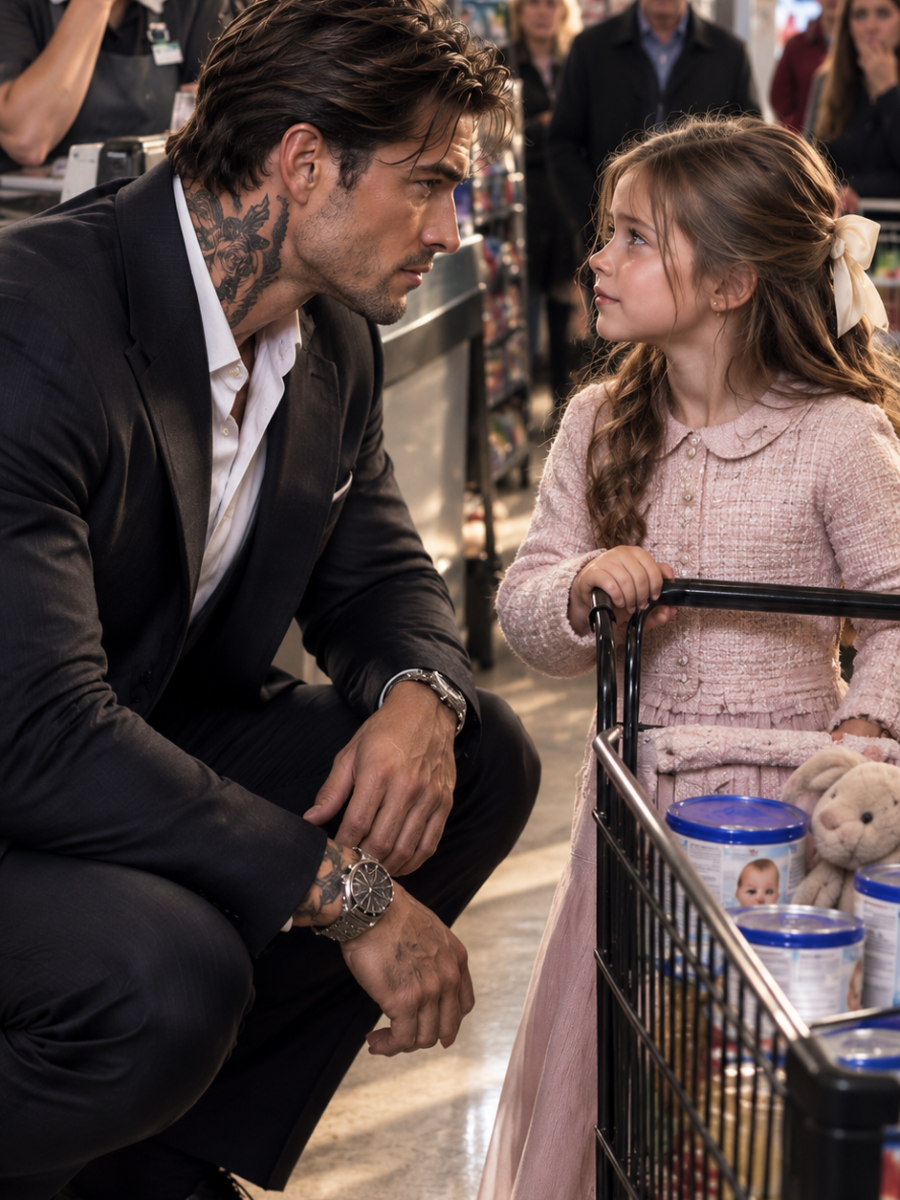
When ten-year-old Lily Carter was seven dollars short for baby formula to feed her starving twin brothers, Pittsburgh’s most feared billionaire Daniel Mercer paid for everything and handed her his business card—never imagining that nineteen years later, he would be on his knees with a dying grandchild, and she would be the only surgeon on earth who could save them.
Table of Contents
- Chapter 1: The Shortfall at Mercer Market
- Chapter 2: The Black Card and the Stubborn Girl
- Chapter 3: The Promise on the Card
- Chapter 4: The Nineteen Years
- Chapter 5: The Glass Tower on Grandview
- Chapter 6: The Steel and the Thread
- Chapter 7: The Debt on the Table
- Chapter 8: A Promise Kept
- Chapter 9: The Harbor on Grandview
Chapter 1: The Shortfall at Mercer Market
Eleven dollars and forty cents was every single penny I possessed in the world.
The metal can of infant formula resting on the black conveyor belt of Mercer Market cost nineteen dollars and twenty-six cents.
It was a freezing, slush-choked December evening in the Hill District of Pittsburgh. Outside, the steel mills across the Monongahela River breathed columns of red smoke into a sky as black as coal ash. Inside the supermarket, bright fluorescent tubes buzzed overhead, reflecting off the clean linoleum aisles where holiday shoppers pushed carts loaded with standing rib roasts, sparkling cider, and boxes of chocolates.
I was ten years old. Strapped securely against my small, trembling chest in an old canvas double sling were my five-month-old twin baby brothers, Owen and Noah.
Noah was sucking frantically on his tiny fist, whimpering softly in rhythm with the dull ache in his stomach. Owen had already started to scream—a hoarse, ragged wail that drew irritated glances from the shoppers in line behind me.
I pushed my crumpled pile of dollar bills, nickels, and two flattened silver quarters across the rubber belt.
“You’re seven dollars and eighty-six cents short, sweetheart,” the cashier said gently. She was an older woman with tired eyes and a name tag that read *Evelyn*.
“I know, ma’am,” I whispered, my face burning with a shame that made my throat feel as though I had swallowed crushed glass. “My aunt gets her laundry paycheck on Friday afternoon. I promise on my mother’s grave that I’ll bring you the seven dollars before five o’clock. Can I please just take this one can today?”
Owen screamed louder, his little forehead turning mottled red against my coat collar.
“I’ve been watering down their bottles since yesterday,” I pleaded, fighting back the hot tears stinging my eyes. “The can is completely empty. If I don’t feed them tonight, they’re going to get sick.”
Behind me, a sharp, impatient voice cut through the air.
“Excuse me, cashier! Some of us have dinner reservations! If the kid doesn’t have the money, call the manager and clear the register!”
I turned around. A woman in a dark mink coat with diamond studs in her ears glared down at me, checking her gold wristwatch with undisguised contempt. Beside her, a man in a cashmere overcoat shook his head, muttering, “Where are the parents? Letting children beg in supermarkets.”
I bit my lower lip until I tasted copper. My mother had died of pneumonia when the twins were six weeks old. My father had disappeared on a freight train to Ohio three years before that. My aunt worked fourteen hours a day pressing shirts at a commercial dry cleaner, her hands blistered with steam burns, barely earning enough to pay the rent on our third-floor walk-up.
Evelyn, the cashier, looked toward the raised customer service booth, then sighed with genuine, helpless sorrow.
“Store policy, honey,” Evelyn murmured. “The scanners count the inventory automatically. If the drawer is short, it comes out of my paycheck.”
“I understand,” I said softly, my voice trembling. “I shouldn’t have asked.”
I reached out with trembling hands, pushed the can of formula back toward the cashier, and turned to walk out into the blizzard.
Chapter 2: The Black Card and the Stubborn Girl
I took three steps toward the automatic sliding glass doors before a tall, towering figure stepped directly into my path.
I flinched, my arms flying up to shield Owen and Noah in their harness, bracing myself for a security guard or an angry manager.
“I’m leaving, mister,” I blurted out, my voice cracking. “I didn’t steal anything.”
“I know you didn’t,” a deep, quiet voice replied.
The man was in his early forties, standing six feet two inches tall, dressed in an immaculate charcoal-gray wool coat with a black silk scarf tucked neatly at his throat. His hair was dark, trimmed sharp around the temples, and his eyes were the color of cold river slate. He didn’t have the hurried, frantic energy of the other shoppers; he stood with an absolute, immovable stillness that made the busy store around him feel entirely irrelevant.
He looked down at the screaming infants strapped to my chest, then looked at the red-eyed little girl who refused to lower her gaze.
“Do your brothers need that formula?” he asked.
“Yes, sir,” I said, holding my chin high despite the tears drying on my cheeks.
“Then take it.”
My cheeks burned hotter. “I don’t have enough money. I’m seven dollars short.”
“I heard.”
The man turned toward the register. Evelyn the cashier froze, her jaw dropping open, the color draining from her cheeks until she looked like she might faint onto the scanner belt.
“M-Mr. Mercer!” Evelyn gasped, stammering so hard her voice shook. “I… I was just following company policy—”
“I am aware of company policy, Evelyn,” the man said smoothly.
His name was Daniel Mercer.
I was ten years old. I didn’t know that Daniel Mercer was the sole owner of Mercer Food Enterprises, twenty-four commercial shipping lines, and four hundred real estate properties across the Midwest. I didn’t know that judges, police chiefs, and state senators lowered their voices when his name was spoken in private clubs.
To me, he was simply a stranger in an expensive coat.
Daniel reached into his breast pocket and drew out a matte-black American Express Centurion card. He laid it flat on the register counter.
“Ring up the formula,” Daniel said.
“No,” I said.
The word cut through the lane like a gunshot.
Evelyn gasped. The woman in the mink coat blinked in disbelief.
Daniel Mercer stopped. He turned slowly, looking down at me with an arched dark brow.
“No?” he repeated, a faint flicker of amusement touching his eyes.
“I can’t take it for free,” I said, my voice ringing clear across the aisle.
I held out my fist, opening my fingers to reveal the eleven dollars and forty cents in wrinkled bills and coins.
“Take this now,” I insisted, pushing the money toward him. “It’s eleven dollars and forty cents. You pay the rest. And when I grow up, I will find you, and I will repay you every single cent plus interest.”
Chapter 3: The Promise on the Card
Daniel Mercer stared at the crumpled paper money in my small palm.
For five unbroken seconds, the billionaire who had negotiated corporate takeovers worth hundreds of millions of dollars looked completely at a loss for words.
“How will you find me?” Daniel asked quietly.
“I’ll remember your face,” I replied without a moment’s hesitation. “My mother told me that a debt forgotten is a soul corrupted. I don’t forget debts, Mr. Mercer. And I don’t take charity.”
A slow, profound change moved across Daniel Mercer’s chiseled features. The cold, impenetrable armor that surrounded him seemed to fracture, revealing a deep, reverent respect.
He reached down, but he did not take my eleven dollars. He closed my fingers back over the crumpled bills, wrapping his large, warm hand around my small fist.
“Keep your money, Lily,” he said, reading my name from the plastic emergency tag my aunt had pinned to my coat. “You’ll need it for the bus.”
He turned to Evelyn.
“Ring up the formula,” Daniel commanded. “And send a floor manager to aisles four, seven, and twelve. I want two cases of that exact formula, three boxes of diapers, pediatric electrolyte fluid, thermal baby blankets, and four bags of fresh groceries brought to the front curb immediately.”
“Wait!” I cried out, panic rising in my throat. “I said one can! I can’t pay for two cases!”
“You aren’t paying for it,” Daniel said calmly, taking his black card back from the trembling cashier. “I am investing in a future creditor.”
He escorted me through the glass doors out into the snowy night. A sleek black town car was idling by the curb, its exhaust curling into the freezing air. His driver, a broad-shouldered man in a chauffeur’s cap, loaded the two cases of formula and grocery boxes into the rear seat.
Daniel pulled a heavy, linen-cardstock business card from his gold-plated case. Using a silver fountain pen, he wrote a single line across the back in sharp, elegant cursive, then pressed it into my hand.
*Daniel Mercer — Private Office — 400 Grandview Avenue, Pittsburgh.*
And on the back, in ink that was still wet:
*A promise between equals. Repay when you are ready. — D.M.*
“Keep this in your Bible, Lily,” Daniel said, his gray eyes holding mine with an intensity that rooted itself into my soul. “When you are grown, if you still feel you owe me a debt, come to this address. I will be waiting.”
He closed the car door, and his driver took us home to the Hill District.
That night, my brothers drank their warm milk until their bellies were round, drifting into peaceful sleep in a warm room filled with food.
And I placed Daniel Mercer’s card between the pages of my mother’s Bible, swearing an oath before Almighty God that I would never stop until I became someone worthy of that promise.
Chapter 4: The Nineteen Years
Nineteen years will either break a person down to dust or temper them into steel.
For me, it became a furnace of relentless purpose.
While other girls played in schoolyards, I worked. I took odd jobs after class—sweeping hair in barber shops, cataloging books in public libraries, tutoring younger students for twenty-five cents an hour. In the evenings, while Owen and Noah slept in our cramped apartment, I studied by the glow of a single brass desk lamp, devouring textbooks on biology, chemistry, and human physiology.
My aunt passed away when I was sixteen, leaving me as the sole legal guardian of my two brothers.
I did not let the state take them. I worked double shifts at a diner on Carson Street, maintained a perfect four-point-zero grade average, and earned a full academic scholarship to the University of Pittsburgh’s School of Medicine.
Owen and Noah grew into strapping, honorable young men. Owen joined the Pittsburgh Fire Department, becoming a decorated rescue captain; Noah earned his degree in civil engineering, building bridges across the Allegheny. They were healthy, strong, and alive because one man had bought them milk on a snowy December night.
And I became a surgeon.
Not an ordinary surgeon.
By the age of twenty-nine, I was the Chief Fellow of Pediatric Cardiothoracic Surgery at Children’s Hospital of Philadelphia. By thirty-two, medical journals around the world were publishing the *Carter Protocol*—a revolutionary surgical technique utilizing micro-vascular bypass to repair congenital hypoplastic left heart syndrome in neonates, a condition previously considered an absolute death sentence.
I traveled to Tokyo, London, and Zurich, operating on the most complex pediatric heart defects known to modern medicine. I earned millions in consulting fees and surgical patents.
Yet in the drawer of my surgical scrub locker, inside a clear plastic protective sleeve, sat a yellowed, water-stained business card.
*A promise between equals. Repay when you are ready. — D.M.*
Every time I scrubbed my hands before cracking an infant’s sternum, I looked at that card.
I had never forgotten the face.
I had never forgotten the debt.
And in the spring of my thirty-second year, my private satellite telephone rang in the middle of a symposium in Geneva.
The call was from the Chief of Surgery at Pittsburgh Presbyterian Hospital.
“Dr. Carter,” the voice said, thick with panic. “We have a catastrophic pediatric emergency. An acute aortic arch rupture in an eight-month-old infant. The patient is the sole great-granddaughter and heiress of Daniel Mercer. None of our staff surgeons can touch it without killing her on the table. You are the only person on earth who has completed this repair.”
My heart stopped.
“Prep the operating theater,” I said, grabbing my surgical bag. “I’m wheels up in twenty minutes.”
Chapter 5: The Glass Tower on Grandview
A private Gulfstream jet chartered by Mercer Holdings touched down at Pittsburgh International Airport four hours later.
A police motorcycle escort screamed through the Fort Pitt Tunnel, clearing traffic across the bridge, delivering me directly to the trauma pavilion of Pittsburgh Presbyterian Hospital.
I stepped through the emergency double doors in my dark traveling coat, carrying my personal set of titanium micro-vascular surgical instruments.
The hospital’s VIP waiting lounge on the seventh floor was surrounded by twenty armed private security guards.
Sitting in a high-backed leather chair at the far end of the room was a solitary figure.
He was seventy-one years old now. His thick hair was silver as polished pewter, his shoulders slightly rounded by age, his face lined with the deep grooves of heavy burdens. He was dressed in a dark wool suit, his hands clasped between his knees, staring down at the polished terrazzo floor with a look of utter, hollow devastation.
Beside him sat his granddaughter, weeping softly into a linen handkerchief.
The billionaire whose name commanded obedience from governors looked smaller than I had ever remembered him. He looked like an old man whose entire world was balancing on the edge of a razor.
The hospital’s Chief of Surgery hurried toward me, wiping nervous sweat from his brow.
“Dr. Carter, thank God you’re here,” the chief whispered. “The infant is little Maya Mercer. Eight months old. Congenital coarctation of the aorta that catastrophically dissected an hour ago. She’s on temporary extracorporeal bypass, but her pressure is plummeting. She has less than forty minutes before cerebral hypoxia is irreversible.”
I did not answer the chief.
My boots clicked softly on the floor as I walked across the lounge, stopping directly in front of the chair where the old man sat.
Daniel Mercer looked up slowly.
His slate-gray eyes were clouded with grief and exhaustion. He saw a tall, commanding woman in her early thirties, dressed in an elegant black suit, with sharp, intelligent hazel eyes and surgical authority radiating from every line of her posture.
“Dr. Carter?” Daniel murmured, his voice trembling with an old man’s desperate prayer. “The doctors say… they say you are the only one.”
I looked down at the man who had bought my brothers’ lives with a black card nineteen years ago.
“I am the only one, Mr. Mercer,” I said softly.
Chapter 6: The Steel and the Thread
The pediatric operating theater was a cathedral of sterile tension.
The overhead surgical lamps beat down upon the tiny, draped form of eight-month-old Maya Mercer. The rhythmic, urgent beep of the heart-lung bypass machine filled the quiet room, keeping time against the encroaching shadow of death.
“She’s in ventricular fibrillation, Dr. Carter,” the anesthesiologist announced, his voice tight. “Perfusion pressure is dropping below twenty. We have twenty-two minutes before we lose neurological viability.”
I stepped up to the table, my sterile gloves snapping into place.
“Turn down the ambient room temperature to sixty-two degrees,” I ordered, my voice cutting through the sterile room with icy, absolute precision. “Deep hypothermic circulatory arrest on my mark. Give me the pediatric titanium micro-clamps and two-point-five millimeter Gore-Tex graft.”
The room moved in absolute sync with my commands.
When I opened the pericardium, the damage was catastrophic. The infant’s ascending aorta had split like wet paper along the curvature of the transverse arch, blood pooling into the thoracic cavity faster than the suction cannula could clear it.
A millimeter to the left, and the carotid arteries would thrombose; a millimeter to the right, and the aortic valve would shear.
Every resident and attending surgeon in the observation gallery held their breath behind the glass.
For two hours, I did not blink.
My hands—hands that had once carried battered cans of formula through the snow—moved with microscopic, sub-millimeter perfection. With needle drivers thinner than sewing pins, I placed forty-eight microscopic sutures into tissue as delicate as wet tissue paper, reconstructing the infant’s aorta from synthetic graft material, bridging the torn artery with millimeter-precise anastomosis.
“Release the proximal clamp,” I commanded.
The perfusionist turned the brass valve.
Blood surged through the reconstructed arch. The graft swelled, firm, pink, and completely watertight. Not a single drop leaked through the suture line.
“Defibrillate at five joules,” I said.
The tiny internal paddles touched the infant’s heart.
A sharp jolt.
*Beep… Beep… Beep…*
A steady, rhythmic, normal sinus rhythm of one hundred and twenty beats per minute appeared on the cardiac monitor.
“We have spontaneous pulse, Dr. Carter,” the anesthesiologist whispered, let out a ragged breath of awe. “Pressure is ninety over sixty. Perfusion is one hundred percent.”
I set my needle driver down on the stainless-steel tray.
“Close the chest, Dr. Rossi,” I said quietly, stepping back from the table. “She’s going to live.”
Chapter 7: The Debt on the Table
At five o’clock that morning, the heavy wooden doors of the VIP surgical lounge opened.
Daniel Mercer rose from his chair with agonizing slowness, his knuckles white against his silver-headed cane, his granddaughter clutching his arm in terrified suspense.
I walked into the room, still wearing my surgical scrubs, my mask hanging loose around my neck.
“Dr. Carter?” Daniel whispered, his breath catching in his throat.
I smiled—a warm, radiant smile that swept away the nineteen hours of exhaustion in my limbs.
“Maya came through the repair flawlessly, Mr. Mercer,” I said gently. “The aortic reconstruction is fully intact. She is breathing on her own, her neurological reflexes are sharp, and she will be out of pediatric intensive care before the weekend.”
A ragged, choking sob broke from Daniel Mercer’s chest.
The seventy-one-year-old titan of industry sank onto his knees on the hospital floor, burying his face in his trembling hands, weeping tears of pure, overwhelming gratitude as his granddaughter fell into his arms.
“Thank God…” Daniel wept. “Thank God Almighty…”
His security chief and personal attorney stepped forward with a leather portfolio, wiping their own eyes. The attorney cleared his throat, pulling out a certified bank draft.
“Dr. Carter,” the attorney said, his voice trembling with emotion. “Mr. Mercer authorized an unrestricted surgical honorarium of five million dollars, payable to your foundation or private account, for saving the heir of Mercer Enterprises.”
I looked at the check. Five million dollars.
I walked past the attorney, stepping directly before the chair where Daniel Mercer had slowly sat back down.
I reached into the pocket of my white lab coat.
I drew out a crisp, fresh twenty-dollar bill.
Beside it, I placed an ancient, yellowed, water-stained business card from nineteen years ago, setting both items gently onto the small mahogany coffee table between us.
Daniel Mercer’s eyes dropped to the table.
He stared at the faded cursive on the back of the card:
*A promise between equals. Repay when you are ready. — D.M.*
The old man froze.
His head snapped up. His slate-gray eyes, wide with sudden, staggering recognition, searched my face—the curve of my cheekbones, the steady hazel eyes, the unyielding tilt of my chin.
“Lily…” Daniel choked out, his voice cracking into a ragged whisper. “Lily Carter.”
Chapter 8: A Promise Kept
The room fell into an echoing, sacred silence.
The hospital chief, the attorney, and the security guards looked between the old billionaire and the world-renowned surgeon, completely baffled by what was happening.
Daniel Mercer’s hands shook as he picked up the yellowed card. His thumb traced the ink he had written nineteen years ago in the snowy parking lot on the Hill District.
“You were ten years old,” Daniel whispered, tears streaming down his weathered cheeks. “You were carrying two babies in a canvas sling, and you refused to let me pay for seven dollars worth of milk.”
“Seven dollars and eighty-six cents, Mr. Mercer,” I smiled, the tears finally brimming in my own eyes.
I tapped the twenty-dollar bill on the table.
“The formula was nineteen dollars and twenty-six cents. I had eleven forty. I owed you seven dollars and eighty-six cents. With nineteen years of compound interest at five percent, the total balance comes out to exactly nineteen dollars and forty-two cents.”
I pushed the twenty-dollar bill closer to his cane.
“You can keep the fifty-eight cents change.”
Daniel Mercer let out a laugh—a broken, joyful, weeping sound that tore through the sterile hospital lounge. He rose from his chair, ignoring his cane, and pulled me into his arms.
He held me with the fierce, protective warmth of a father, his tears soaking the shoulder of my scrubs, while my own tears fell freely against his collar.
“I waited for you, Lily,” Daniel sobbed against my hair. “Every December, I looked at that door. I wondered if the little girl with the fire in her eyes had survived this city.”
“I survived, Mr. Mercer,” I whispered. “And so did Owen and Noah. Owen is a fire captain on the North Side. Noah builds bridges across the river. We survived because you didn’t look away when everyone else was laughing.”
Daniel pulled back, his hands framing my face, looking at me with a reverence that surpassed all the wealth and power of his empire.
“You don’t owe me a debt, Dr. Carter,” Daniel said, his voice ringing with absolute certainty. “You gave me the greatest gift a man can ever receive: the breath of my grandchild.”
He picked up the twenty-dollar bill, folded it carefully, and slipped it into his breast pocket directly over his heart.
“This is the most valuable payment I have ever received in my life,” he whispered.
Chapter 9: The Harbor on Grandview
Six months later, summer arrived in full splendor across the hills of Pittsburgh.
On the high bluffs of Grandview Avenue, overlooking the glittering convergence of the three rivers, the gardens of Mercer Manor were filled with music, laughter, and sunlight.
On the wide stone terrace, little Maya Mercer—now fourteen months old, chubby, radiant, and laughing with pure joy—waddled across the manicured lawn chasing a yellow butterfly, her heart beating strong and true beneath her pink sundress.
At the garden table sat my brothers, Owen and Noah, wearing sharp suits, laughing with Daniel Mercer as they talked about the restoration of the historic Smithfield Street Bridge.
Daniel looked ten years younger, his gray eyes sparkling with vitality, his hand resting affectionately on Owen’s shoulder.
I stood by the terrace balustrade, holding a glass of iced tea, looking out over the city that had once tried to starve us.
Daniel walked up beside me, resting his hands on the carved stone rail.
“The board approved the transfer this morning, Lily,” Daniel said quietly.
“What transfer?” I asked, turning to him.
Daniel handed me a leather-bound document stamped with the seal of the Commonwealth of Pennsylvania.
“The Mercer Pediatric Medical Foundation is officially endowed with one hundred and fifty million dollars,” Daniel said, a soft, proud smile touching his lips. “And by unanimous vote of the board of trustees, Dr. Lily Carter is appointed permanent Chief Executive Officer and Medical Director.”
I looked down at the document, my breath catching in my throat.
“Daniel… this is too much.”
Daniel Mercer looked out over the three rivers, his arm wrapping around my shoulders in a warm, fatherly embrace.
“It’s not enough, Lily,” Daniel whispered. “Nineteen years ago, I gave a little girl seven dollars and eighty-six cents for baby milk. Today, that little girl gave life back to my family and hope back to this entire city.”
He looked at me with eyes full of tears and pride.
“A promise between equals, Dr. Carter. Now let’s go save some more children.”
I smiled, resting my head against his shoulder as my brothers’ laughter echoed across the summer gardens.
The cold December night was gone forever.
And beneath the warm Pittsburgh sky, a debt born in poverty had blossomed into an empire of healing, honor, and love.