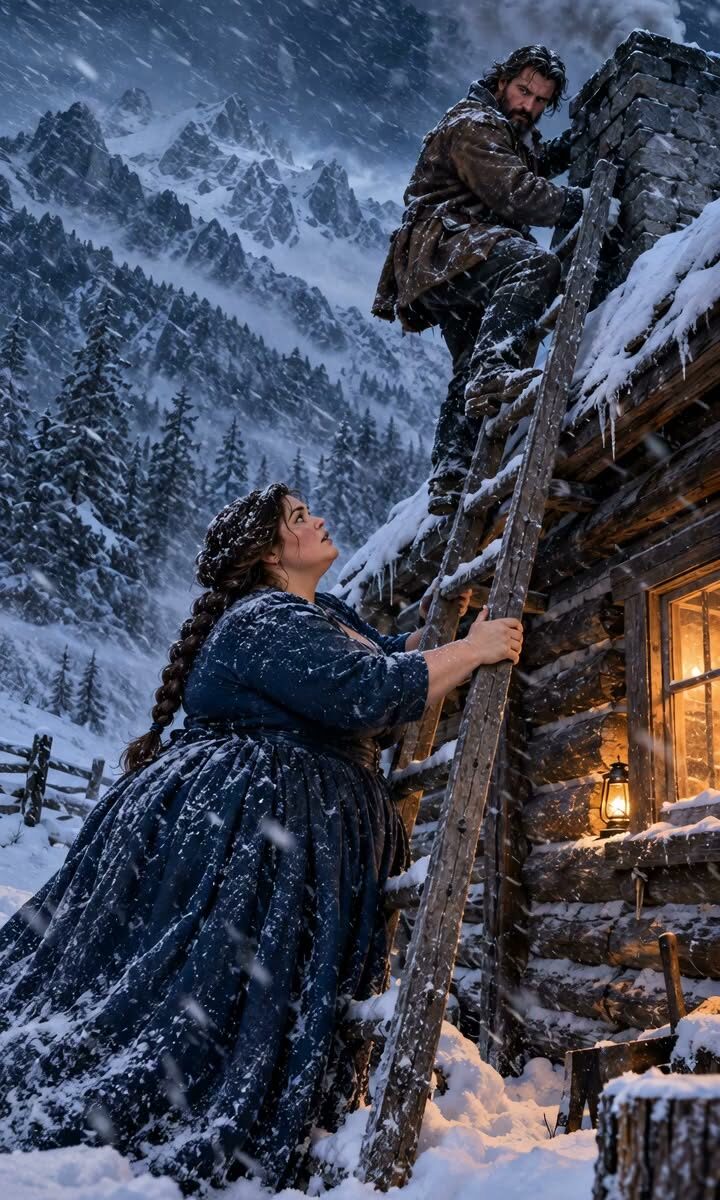
The timber ridges above the Blackfoot River in western Montana did not suffer weak souls or sentimental illusions. At four thousand feet above sea level, when the autumn tamaracks dropped their golden needles and the grizzly bears retreated to their high dens, the mountain wilderness prepared for five months of arctic isolation. Temperatures routinely plunged to thirty-five degrees below zero, blizzards tore roofs from log outbuildings, and snowdrifts buried cabin doors up to the lintels. A man living alone on a mountain homestead needed wood, meat, salt, and endurance; anything else—poetry, fine clothes, or romantic fantasies—was simply fuel waiting to be burned.
My name is Henry Mercer. At thirty-four years old, I had spent seven years proving up a hundred and sixty acres of virgin timber on Wolf Creek Ridge. I was broad-shouldered, scarred from a decade of wrestling two-man crosscut saws, with a thick beard touched by trail frost and a quiet disposition that most men in town mistook for hostility. I didn’t hate people; I simply understood that the wilderness made promises it never broke, while human words were often as brittle as dry pine kindling. But after three winters of waking up to ice in my washbasin and cooking tasteless salted pork in complete silence, I acknowledged a hard frontier truth: a homestead with only one pair of hands is a race against injury and time.
Table of Contents
- Chapter 1: The Carpetbag with No Weight
- Chapter 2: The Canvas Divider Between Strangers
- Chapter 3: Bear Grease and Burned Stew
- Chapter 4: When the Black Sky Swallowed the Ridge
- Chapter 5: The Woman Who Held the Ladder
- Chapter 6: Soot, Laughter, and the Shivering Bed
- Chapter 7: The Canvas That Never Went Back Up
“A man can believe he needs only cold logic and iron muscle to endure the winter, building thick walls to keep out vulnerability. But when the arctic gales howl and the chimney chokes on ice, it is not solitary pride that saves a home; it is the fierce, stubborn loyalty of someone willing to stand in the storm beside you.”
Chapter 1: The Carpetbag with No Weight
I didn’t seek love. Love was for wealthy shopkeepers in Helena or Philadelphia bankers who could afford parlor sofas and piano sheet music. I sought a partner—a sensible, sturdy woman who understood that life on a mountain ridge required hard work, early mornings, and shared grit. I placed an advertisement with the Western Matrimonial and Emigration Society in Chicago: “Homesteader, 34, owns 160 acres timber and water, seeks healthy, capable woman of good character for marriage and mutual labor. Remote location, harsh winters. Practical arrangement.”
Three months later, on a raw October morning, Clara Hayes stepped down from the wooden passenger coach at the Helena staging depot. She was twenty-six years old, tall and slender, with rich chestnut hair braided tightly beneath a plain wool bonnet and hazel eyes that held the guarded, watchful exhaustion of someone who had survived too many broken promises in the city. Her woolen traveling coat was threadbare, patched at the cuffs, and utterly inadequate for the mountain territory.
She held a single battered tapestry carpetbag in her gloved hand. When I reached down to take it from her, the bag was so light it felt practically empty.
“This is everything?” I asked, looking from the bag to her pale face.
“Everything I own in this world,” Clara replied, her chin lifting slightly with quiet, defensive pride. “If you were hoping for a dowry of silver spoons or feather mattresses, Mr. Mercer, you have wasted your agency fee.”
On the eighteen-mile wagon ride up the rocky switchbacks toward Wolf Creek Ridge, the autumn wind whipped down from the snowcaps. Clara sat on the wooden bench beside me, shivering so hard her teeth clicked, but she refused to complain. I reached behind the seat, grabbed my heavy buffalo-hide driving coat, and tossed it across her lap.
“If you freeze to death before we reach the cabin, I don’t get my twenty-dollar agency deposit back,” I grunted, keeping my eyes on the mules.
Clara pulled the thick fur up to her nose, peering out at me with a spark of dry humor in her hazel eyes. “Your overwhelming romantic tenderness leaves me breathless, Mr. Mercer.”
A smile nearly broke through my beard. That unsettled me more than the cold.
Chapter 2: The Canvas Divider Between Strangers
My cabin was a single twenty-by-twenty-four-foot room constructed of peeled lodgepole pine logs, chinked with moss and lime mortar. It contained a massive hand-built fieldstone fireplace, a cast-iron cookstove, a sturdy oak table with two benches, and a wide cedar rope bed in the far corner.
Before leaving for town, I had stretched a heavy hemp clothesline across the center of the cabin, suspended from the rafters. Over it hung a thick, waterproof wagon canvas that divided the room into two equal halves, completely screening the bed from the stove and table. Against the near wall sat a narrow pine cot covered with a wool blanket.
Clara stood on the threshold, her carpetbag in hand, taking in the canvas divider with cautious surprise.
“You take the bed behind the canvas,” I said, setting her bag on the floor. “The door has an inside latch. I’ll sleep on the cot by the cookstove. This arrangement remains business until both of us decide otherwise. You have your privacy, Mrs. Mercer.”
Clara looked at the heavy canvas tarp, then looked at me. The defensive tension in her posture softened by a fraction. “You don’t have to sleep on a cot in your own house, Henry.”
“I know I don’t,” I said. “Which is why I chose to.”
For the first two weeks, we lived like polite strangers sharing a logging camp. I rose at 4:30 a.m. while the cabin was pitch black, stoked the stove, hauled three buckets of water from the creek, and headed into the timber stands with my axe and team of draft horses. Clara took over the domestic duties with fierce, stubborn determination. But city life in Chicago had not prepared her for a high-altitude frontier homestead.
She struggled with the damper on the iron cookstove; her first loaf of sourdough was as dense as river gravel; she scorched a pot of navy beans until the cabin smelled like charcoal; and she repeatedly jammed the pump handle.
Chapter 3: Bear Grease and Burned Stew
Yet what struck me most was her refusal to surrender. Every evening when I returned from the timber stand, covered in sawdust and snow, Clara had supper waiting. If the stew was burned on the bottom, she ate it without a word, staring down at her plate. I ate it too, cleaning my bowl, never uttering a syllable of criticism.
One evening, as she handed me a tin mug of coffee, I noticed her hands. Both of her palms were split with deep, red cracks from hauling freezing well water and swinging the kindling hatchet. Raw blisters had broken along her fingers.
The next morning before leaving for the woods, I left a small ceramic jar on the kitchen table beside her plate. It contained rendering bear grease mixed with pine pitch and crushed wintergreen—the mountain salve trappers used for frostbite and split skin.
When I returned at dusk, the jar was still sitting in the center of the table. Clara was standing by the stove stirring a pot of venison soup.
“I don’t need your charity, Henry,” she said quietly, her back turned to me.
I took off my heavy leather gloves and set my boots by the hearth. “Your hands are tools, Clara. If you let them get infected and crippled, you can’t haul water or milk the cow, and I’ll have to do twice the work when I come in from the woods. It isn’t charity. It’s maintenance.”
Clara turned around, a wry, exasperated smile touching her lips. “That may very well be the least romantic sentence a man has ever spoken to his lawful wife.”
“I never claimed to be a poet,” I said.
She used the salve anyway. Within three days, her palms began to heal, the pain receded, and a quiet, unspoken rhythm took root in our home. I filled the wood box to overflowing every morning before dawn; she stopped pretending my boiled chicory coffee was drinkable; and together, we stacked eight cords of split tamarack against the west wall of the cabin. It was not passion, and it was certainly not romance. It was something far sturdier: mutual respect forged in shared labor.
Chapter 4: When the Black Sky Swallowed the Ridge
On the fourth Thursday of November, the barometer nailed beside the cabin door dropped off the scale. By noon, the sky above the Blackfoot Range had turned the color of bruised slate. The wind died completely—a dead, suffocating mountain stillness that signaled a monster blizzard crossing over the Canadian border.
“We have four hours before the ridge closes,” I told Clara, bringing the team into the barn and securing the heavy bar across the double doors. “Once this hits, nobody moves off this mountain for three days.”
Clara had already filled every crock and kettle with water, covered the windows with heavy woolen quilts to block drafts, and stacked sixty logs beside the stone fireplace. “I’m ready, Henry.”
At 3:00 p.m., the storm struck. The wind hit the cabin with the force of an avalanche, screaming through the eaves, rattling the hand-hewn rafters, and driving blinding sheets of freezing sleet against the logs. By eight o’clock, the outside thermometer read twenty-eight below zero.
Suddenly, the cast-iron cookstove emitted a violent, coughing wheeze. A dense, billowing cloud of acrid black soot and suffocating pine smoke blasted backward through the firebox door into the room.
Clara dropped to her knees on the floorboards, coughing violently, her eyes streaming with tears. “Henry! What is it?”
I grabbed a wet rag and tied it over my nose. The stone chimney on the roof had choked. Heavy, wet snow mixed with freezing rain had frozen over the chimney cap, forming an impenetrable dome of solid ice. Without draft, the smoke was trapped. In less than twenty minutes, carbon monoxide and smoke would fill the sealed cabin, forcing us out into twenty-eight-below weather or suffocating us in our sleep.
“The chimney is frozen shut!” I shouted over the howling gale. “I have to clear the cap from the roof!”
Chapter 5: The Woman Who Held the Ladder
I grabbed a heavy iron fire poker, pulled on my sheepskin coat and mittens, and dragged our sixteen-foot wooden rungs ladder out the kitchen door into the howling whiteout. The wind hit me like a solid wall of ice, tearing the breath from my lungs. Drifts were already waist-deep against the cabin wall.
I heaved the ladder upright against the exterior stone chimney. But the wind was howling at sixty miles an hour down off the ridge; the ladder shivered violently, the wooden base sliding on the slick ice, threatening to kick out into the drifts the instant I put weight on the rungs.
I turned to adjust the base—and my heart stopped.
Clara was standing behind me in the waist-deep snow. She had come out without her buffalo coat—wearing only her thick woolen work dress and an apron, her hair whipping loose in the screaming gale, her cheeks already turning the waxy white of severe frostbite.
“Get back inside!” I roared, coughing against the smoke leaking from the open door. “You’ll freeze to death in three minutes!”
Clara didn’t argue. She waded through the drift, threw both of her arms around the lower uprights of the ladder, and braced her entire four-hundred-pound frame against the wood, planting her heavy boots into the frozen earth. She looked up through the stinging sleet, her hazel eyes blazing with ferocious, unbreakable defiance.
“Climb the damn ladder, Mercer!” she screamed into the teeth of the storm. “Climb before this house burns down!”
I looked at the woman who had arrived with an empty carpetbag three weeks ago. Her bare hands were clamped around the rough pine uprights like iron vises, anchoring my life against the mountain wind.
I didn’t waste another second. I slammed my boots onto the rungs, scrambling upward through the freezing sleet. The wind hammered the ladder, but Clara never budged. Her body was an anchor in the storm.
I hauled myself onto the steep, icy cedar shingles, crawling on my belly toward the chimney. With my iron poker, I struck the thick ice dome capping the stone flue.
CRACK. CRACK. CRACK.
A huge slab of ice shattered into the snow. The trapped draft caught instantly. A roaring plume of black smoke and flying orange sparks shot twenty feet into the blizzard sky, clearing the flue with a deep, echoing roar.
Chapter 6: Soot, Laughter, and the Shivering Bed
I slid backward down the icy shingles, caught the top of the ladder with my arm, and scrambled down the rungs into the snowdrift. The instant my boots hit the ground and I pulled Clara away from the ladder, her knees gave out completely.
She collapsed into the snow, her body shaking with violent, uncontrollable tremors, her fingers frozen into stiff claws around the wooden rungs. I scooped her up into my arms, kicked the cabin door shut behind us, and threw the heavy oak bar into the brackets.
The cabin was warm once more. The draft in the chimney was roaring cleanly, pulling the remaining haze up through the stone flue. But the scene on the floor was pure chaos.
We collapsed together onto the braided rug before the hearth, gasping for air. Ice was crusted two inches thick in my beard and eyebrows. Soot and black ash streaked Clara’s forehead, nose, and cheeks. She looked like an apparition who had crawled out of a coal furnace.
I sat up, breathing heavily, looking at her blackened face and wild, tangled hair. “You could have died out there, Clara. You were out in twenty-eight below without a coat.”
Clara looked at my icy beard, then down at her own blackened hands. Her chest heaved. “The great Henry Mercer… master of the Blackfoot timber… nearly defeated by five pounds of chimney ice.”
For two seconds, we stared at each other in the firelight.
Then, from deep in my chest, a laugh broke out—a loud, booming, helpless laugh that rattled the copper kettles on the wall. Clara looked startled, then her lips curved, and she began laughing too—a bright, rich, beautiful sound that echoed through the logs, washing away seven years of solitary silence.
Suddenly, Clara’s laughter broke into a sharp, painful gasp. Her teeth began chattering so violently her whole body vibrated. Hypothermia was setting into her core. When she tried to push herself up, her legs folded beneath her like wet paper.
“Can you stand?” I asked, kneeling beside her.
“No,” she whispered, her lips pale blue, tears of cold squeezing from her eyes.
I slipped my arms beneath her shoulders and knees, lifting her with gentle, effortless strength. I carried her across the room toward the cedar rope bed. I laid her down, pulled off her wet boots and soaked stockings, and piled three heavy wool blankets and my buffalo-hide driving coat over her shivering frame.
I turned toward the hemp clothesline, reached up to slide the heavy canvas divider closed to give her privacy to warm herself.
Then, a cold, trembling hand reached out from beneath the buffalo fur.
Clara’s fingers caught the sleeve of my flannel shirt, holding on with surprising strength. Her hazel eyes looked up into mine through the amber firelight.
“Henry,” she whispered through her chattering teeth.
“Yes, Clara?”
“Don’t put the canvas back up.”
Chapter 7: The Canvas That Never Went Back Up
I froze. The heavy canvas was resting in my left hand.
For twenty-one days, that canvas had been a boundary—a declaration that our lives were an economic transaction, a practical contract devoid of heart. But as I looked at the woman who had stood in waist-deep drifts, risking her life to hold a ladder so I wouldn’t fall, I realized that she was no longer talking about the tarp.
She was talking about the wall between our souls.
I slowly unhooked the canvas from the hemp rope. I folded the heavy waterproof fabric into a neat square, set it on the floor in the corner, and untied the clothesline from the rafters, coiling the hemp rope and placing it inside the tool chest forever.
I walked to the hearth, brought back a steaming mug of black tea sweetened with mountain honey, and sat on the edge of the mattress. I held the warm tin to Clara’s lips while she drank in small, grateful sips. As the warmth returned to her skin, the blue faded from her lips, replaced by a radiant, flushed rose.
“Your hands are warm, Henry,” she murmured, her eyelids drooping with exhaustion.
“They’re big enough to keep the cold out,” I said softly.
Clara smiled—a genuine, unburdened smile that made the modest log cabin feel brighter than any gilded mansion in Chicago. She reached out and rested her hand over mine, her fingers sliding naturally between my calloused knuckles. She did not pull away, and neither did I.
Outside on Wolf Creek Ridge, the blizzard raged for two more days, burying the high passes under six feet of snow and howling like a pack of wolves through the timber stands. But inside the four walls of our home, the cold had already lost its power. For on that frozen night in western Montana, the ice had broken—not only in the stone chimney, but in the heart of a mountain man who had finally discovered that the greatest fortress on earth is the warmth of two souls facing the storm together.