A Gripping American Pioneer Romance of Cruel Mockery, an Unlikely Frontier Marriage, and the Raw Strength That Conquered the High Country
Chapter 1: The Laughter at Bitter Creek
The miners laughed when Amos married Bessie. They laughed until their ribs ached and their whiskey sloshed over their grease-stained tin mugs.
Bessie stood beside the half-drunk circuit magistrate on the dirt floor of the Bitter Creek saloon in a flour-stained calico dress. She was twenty-eight years old, stood five feet nine inches tall, and carried nearly two hundred and ninety pounds on her broad, powerful frame. Behind her, sixty gold miners shouted crude jokes about whether the pack mule would collapse before they reached the timberline.
“Careful on the climb, Amos!”
“If she rolls over in your cot, we’ll have to scrape you off the floorboards with a trowel!”
More drunken guffaws shook the timber walls of the saloon. Bessie kept her hazel eyes fixed straight ahead, gazing at the rough pine knots of the wall behind the magistrate. She didn’t flinch. She didn’t blink. She had heard variations of those exact same jokes since she was nine years old in an orphan asylum outside St. Louis.
For three brutal years, Bessie had been the sole cook at the Bitter Creek gold camp high in the Montana Territory. She fed sixty foul-mouthed men seven days a week: baking forty loaves of sourdough bread every morning, butchering whole hogs before dawn, hauling fifty-pound iron kettles of boiling beans across open fire pits, and chopping cords of green fir when the camp boys were too hungover to swing an axe. They insulted her weight to her face, yet they fought like starved wolves for third helpings of her beef stew.
To the miners, she was an object of ridicule—too big, too heavy, too loud, too much woman for any sensible man.
Until Amos walked down from the high peaks.
Amos was thirty-six, a solitary trapper and woodsman who descended to the mining settlement only twice a year to trade prime beaver and marten pelts for salt, tobacco, and rifle lead. He was six feet two, lean and corded with whipcord muscle, with a thick dark beard streaked with gray, weathered crow’s feet around pale storm-gray eyes, and a jagged scar trailing from his cheekbone down into his buckskin collar—the souvenir of a grizzly sow he had fought with an iron skinning knife four winters back.
Two days before the wedding, Amos had sat at the edge of the cook tent, quietly drinking black chicory coffee while sixty men bellowed and banged their tin plates.
He didn’t stare at the miners. He watched Bessie.
He watched her lift a fifty-pound sack of whole wheat flour from the wagon bed with one arm as easily as if it were a bag of feathers. He watched her split frozen larch logs with clean, single strokes of a five-pound splitting maul. He watched the dignity in her posture when a drunken teamster made a vulgar remark about her hips, and how she merely served him his plate in silence, her pride completely unbroken by their cruelty.
When the last miner staggered out toward the claims, Amos had remained on the wooden bench, his gray eyes steady as flint.
Chapter 2: The Nuggets on the Cook Tent Table
“They talk to you like a dog,” Amos said. His voice was low, gravelly, and carried the heavy weight of long mountain silences.
Bessie continued scrubbing the heavy grease from the cast-iron griddle with a pumice stone. “They pay for their grub. The talk comes free with the territory.”
Amos stood up, walking slowly across the sawdust floor until he stopped three feet from her. He studied her face—not with the leering mockery of the miners, nor with the patronizing pity she despised even more. He looked at her the way an experienced shipbuilder examines the keel of an icebreaker: assessing balance, density, and unyielding structural strength.
“Winter’s coming early,” Amos said. “The geese flew south two weeks ahead of season. The velvet on the elk horns is already scrubbed clean.”
Bessie shrugged her broad shoulders beneath her flour-sack apron. “Winter always comes.”
“I have a cabin three hard days up through Dead Man’s Pass,” Amos continued evenly. “Two rooms of hand-hewn spruce logs. A stone fireplace with a five-foot hearth. A cellar full of smoked venison, salted trout, and dried squash. Four cords of split birch under dry eaves. But I have no partner.”
Bessie stopped scrubbing. She turned her head, her jaw tightening. “If this is a joke cooked up by the boys at the saloon to see if you can get the fat cook to blush, you can take your coffee and walk out right now.”
“I don’t joke,” Amos replied. He reached into his leather pouch, pulled out four heavy, rough-cast gold nuggets the size of walnuts, and set them down on the greasy pine table with dull, metallic thuds. “That’s three hundred dollars in raw placer gold. More than enough to buy out the remainder of your cook tent contract from the mining syndicate and leave you with forty dollars in your pocket.”
Bessie stared at the gold. Then she looked Amos directly in the eye, her voice sharp with twenty-eight years of defensive bitterness.
“I am not a small woman, Amos. I weigh more than you do. I take up space on a bench. I eat three bowls of oats in the morning. When I walk, the floorboards complain.”
Amos didn’t flinch. A faint, almost imperceptible softening touched the edges of his weathered gray eyes.
“You’re strong,” Amos said, his voice quiet and absolute. “You can haul water through four feet of snow without spilling a drop. You can swing an axe without weeping. You’ve got enough meat on your bones to survive a lean month if the drifts block the door. I don’t need a fragile parlor doll who faints at the smell of deer blood. I need a woman built for the mountains. Will you marry me, Bessie?”
Bessie looked at his scarred face, at the honest, unblinking respect in his pale eyes. For the first time in her life, a man looked at her and saw an equal.
“I’ll pack my trunk,” she said.
Chapter 3: Three Days Up the Pass
The morning after the magistrate sealed their union, the Bitter Creek saloon emptied onto the muddy street to watch them depart. The miners whistled and hooted as Bessie swung her leg over the broad back of a draft mule named Goliath. The heavy work animal snorted, settled its hooves into the gravel, and didn’t sway an inch under her weight.
Amos mounted his buckskin mare, grabbed the pack mule’s lead rope, and without looking back at the jeering crowd, led them into the dark, towering lodgepole pines.
For three days, they climbed into the clouds. The muddy wagon ruts gave way to narrow deer trails flanked by granite scree and roaring glacial streams. The air grew thinner, crisper, scented with crushed pine needles and the sharp, clean bite of incoming snow. Whenever Goliath paused on a steep grade, Amos waited patiently, never urging haste, always ensuring Bessie had a tin of fresh mountain water from his canteen.
On the evening of the third day, they crossed the crest of Dead Man’s Pass. Nestled in a protected subalpine meadow surrounded by towering granite crags stood Amos’s homestead.
It was not a hovel. The cabin was built of thick, hand-notched spruce logs with chinking of lime and moss. A sturdy stone chimney rose from the roof, and smoke curled lazily into the twilight sky. Beside the main house stood a massive wood shed, a sturdy log barn, and a fenced root cellar dug deep into the hillside.
“It’s home,” Amos said simply, dismounting and offering his broad, calloused hand to help her down.
For the first month, their marriage was a quiet, practical partnership. Bessie took command of the cabin with the ferocious efficiency of a professional cook. She organized the larder, made sourdough starters that rose high in the stone hearth, cured venison sausages with juniper berries, and stuffed the mattress tick with fresh, fragrant sweetgrass. Amos trapped, set snares, split timber, and checked the high ridges.
At night, they shared the wide pine bed. The mountain cold was brutal—frost crept up the interior windowpanes by nine o’clock—and sharing warmth was a matter of survival. Amos was a gentleman. He never made crude demands, never treated her with disrespect. Yet when his arm draped around her waist in the dark, pulling her warm, abundant body against his back, Bessie felt a deep, unfamiliar peace settle over her heart.
For the first time in twenty-eight years, she was not an outcast. She was cherished.
Chapter 4: The Black November Sky
On the second Tuesday of November, the Montana wilderness turned feral.
At dawn, the sky was an unnatural shade of bruised slate-purple. The wind didn’t howl; it moaned through the high spruce boughs with a low, vibrating hum that made the horses stomp anxiously in the log barn. Amos stood on the porch in his heavy sheepskin coat, sniffing the biting air.
“A blizzard is coming off the Canadian peaks,” Amos said, strapping on his snowshoes and slinging his Winchester rifle over his shoulder. “I have six beaver traps set along the upper gorge above the waterfall. If the water freezes solid tonight, the ice will crush the chains and drown fifty dollars worth of pelts. I’ll run the line and be back before three.”
Bessie stepped to the doorway, handing him a tin flask of hot spiced tea and a packet of smoked venison jerky wrapped in wax paper. She looked at the darkening northern horizon, an uneasy tightness coiling in her gut.
“Don’t push your luck with the weather, Amos,” she warned softly. “Pelts can be trapped next season. A man only freezes once.”
Amos reached out, his gloved fingers lightly brushing the curve of her cheek. “I’ll be back before the snow sticks, Bessie. Keep the hearth hot.”
By one o’clock, the purple clouds dropped like an iron curtain. The temperature plummeted twenty degrees in thirty minutes. By two o’clock, the wind struck the cabin with the concussive force of an avalanche. Snow did not fall; it blew horizontally in thick, blinding sheets of white needles that erased the log barn thirty yards away.
Three o’clock came. The grandfather clock on the mantle ticked in the howling gloom. Amos did not return.
Four o’clock. Five o’clock. By six o’clock, night fell—an impenetrable, screaming blackness where the wind roared at sixty miles an hour, shaking the solid spruce rafters of the cabin.
Bessie stood by the frost-covered window, her hands gripping the sill until her knuckles turned white. A lesser woman would have huddled by the fire, weeping in despair, praying for a miracle while waiting for dawn. But Bessie had spent her life bearing weight that broke other people.
“He’s down,” she whispered into the dark room. “He’s down, and he can’t walk.”
She turned from the window. Her movements were calm, deliberate, and terrifyingly purposeful.
Chapter 5: The Clink of Iron in the Blizzard
Bessie did not hesitate. She pulled on two pairs of thick woolen stockings, her heavy leather boots, and strapped on a pair of wide bear-paw snowshoes. She wore three wool skirts, Amos’s spare wool mackinaw coat over her sweater, a sheepskin cap pulled low over her ears, and wrapped a thick wool scarf three times around her face, leaving only a narrow slit for her eyes.
Into a heavy canvas rucksack, she packed a bottle of whiskey, a roll of linen bandages, two splinting boards from the kindling box, a coil of stout manila rope, an axe, and two iron lanterns fueled with kerosene.
She lit the first lantern, grabbed an iron crowbar for a walking staff, pushed open the heavy cabin door against the screaming wind, and stepped into the blizzard.
The cold hit her like a physical blow. The wind slammed into her chest, threatening to topple her backward. But Bessie lowered her center of gravity, planting her heavy, powerful boots deep into the three-foot drifts. She weighed nearly three hundred pounds; while a lighter person would have been blown across the clearing like a dry leaf, Bessie’s immense mass became her armor. She walked like a living mountain into the teeth of the gale.
She followed the creek bed by the sound of the churning water beneath the ice. Step by agonizing step. Her breath froze into icicles against her wool scarf. Her eyelashes crusted with frost. The lantern threw a pitiful circle of yellow light barely four feet in front of her, reflecting off swirling walls of white.
For nearly an hour, she fought her way up the boulder-strewn canyon toward the upper gorge. Her thighs burned like molten lead, but she did not stop. She paused every fifty yards, raising her voice in a powerful, booming shout that cut through the roar of the gale:
“AMOS! AMOS!”
Nothing answered save the howling spruce trees.
Then, during a momentary lull in the wind, a faint metallic sound drifted from a ravine fifty yards to her left.
CLINK.
A second later, another weak strike: CLINK.
It was the sound of metal striking iron. The sound of a skinning knife tapping against the steel barrel of a rifle.
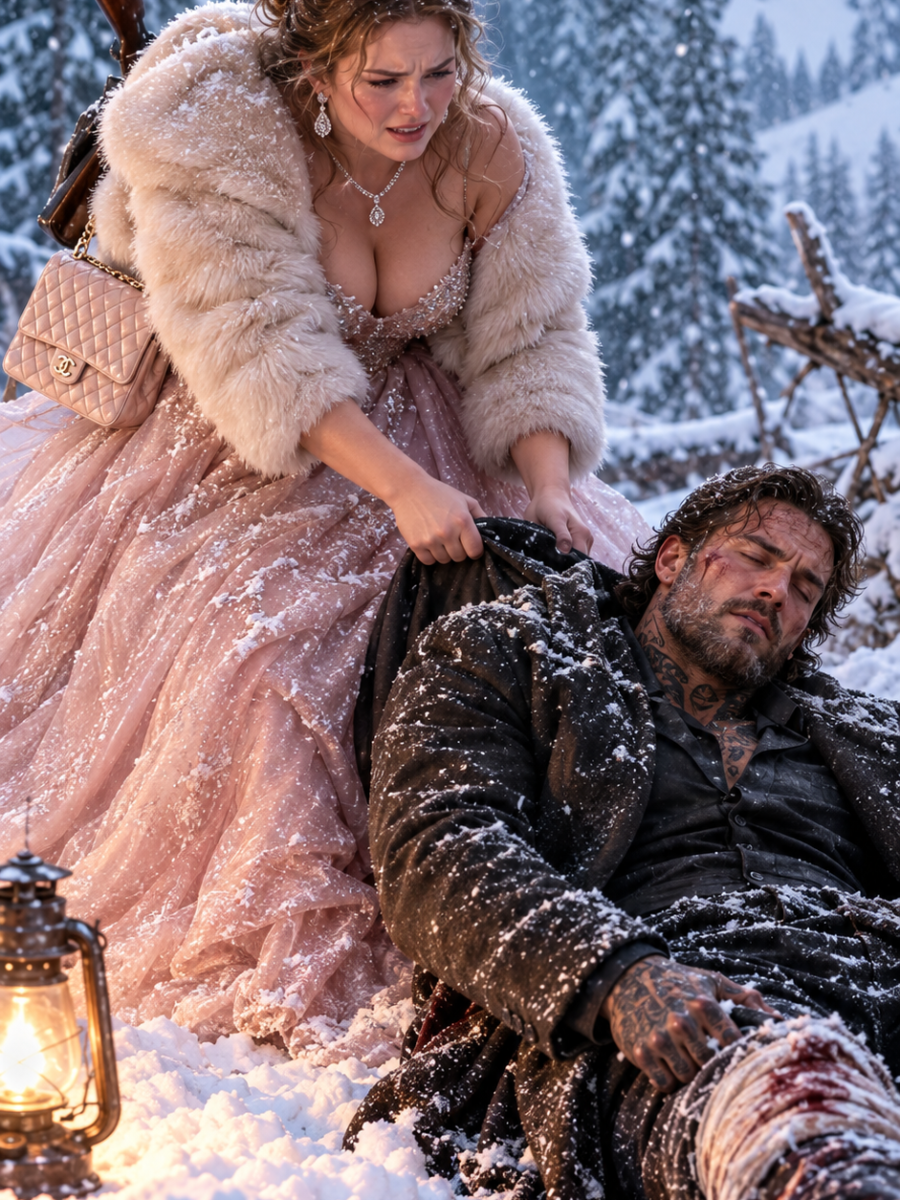
Bessie turned off the trail, plunging through waist-deep powder into the ravine. Ten yards down, pinned beneath the massive trunk of a fallen, lightning-shattered lodgepole pine, lay Amos.
Chapter 6: The Long Drag Through the Drift
Amos was nearly buried. Snow had drifted over his legs and chest. His face was gray-white, his dark beard frozen into a solid block of ice. His right leg was trapped under the three-hundred-pound pine trunk, twisted at an unnatural, sickening ninety-degree angle. Splintered white bone protruded through his torn wool trousers into the frozen red slush.
In his numb right hand, he clutched his hunting knife, tapping weakly against the receiver of his rifle. His storm-gray eyes were half-glazed with hypothermia.
When the lantern light spilled across his face, Amos blinked, his cracked lips parting in a delirious, disbelieving whisper: “Bessie…? No… you fool… you’ll freeze…”
“Shut your mouth, Amos,” Bessie commanded, her voice fierce and steady above the roar of the storm.
She unslung her pack, uncorked the whiskey bottle, and forced two burning swallows down his throat. The alcohol made him cough, a spark of color returning to his cheeks. Bessie didn’t waste a second. She grabbed the iron crowbar, jammed it beneath the fallen pine trunk, planted her heavy boots into the frozen earth, and leaned her entire body weight backward into the lever.
Her muscles groaned; the pine trunk shifted two inches. With a final, ferocious heave that tore the seams of her wool coat, she hoisted the log upward, kicking Amos’s shattered leg free with her boot.
Amos groaned, losing consciousness from the agony. He weighed two hundred pounds of dead weight, soaked with freezing slush. The cabin was nearly a mile away, down through deep drifts and wind-swept ridges.
“Leave me,” Amos rasped weakly, his head lolling against her knee. “No woman can carry a grown man through this drift. Save yourself.”
Bessie looked down at the man who had given her four gold nuggets and treated her like a queen while a whole town laughed.
“I told you in the cook tent,” Bessie said, her voice shaking with fierce devotion. “I’m built for the mountains.”
She strapped his shattered leg tightly against his wooden rifle stock using her wool scarf and linen bandages to immobilize the bone. Then, she uncoiled the stout manila rope, looping it securely beneath his armpits and across her own broad chest. She locked her heavy gloved hands into the rope, leaned her three-hundred-pound frame forward at a forty-five-degree angle, and began to pull.
It was a journey forged in agony and iron will. For every ten yards, her lungs burned like fire, her heart hammered against her ribs, and the blizzard beat against her face. Whenever her boots slipped on hidden river stones, she dug her knees into the snow and pulled forward with raw hip and leg drive. Behind her, Amos slid over the packed powder like a heavy log.
She did not stop. She did not rest. She dragged her husband across the canyon, through the frozen meadow, and up to the wooden porch of the cabin just as the clock struck midnight.
Chapter 7: The Spring Melt and the Unshakable Crown
Inside the warm cabin, Bessie’s true trial began. She hauled Amos onto the sturdy pine table. Working by lantern light while the blizzard shook the roof, she cleansed the wound with boiling water and whiskey, pulled the compound fracture back into alignment with a sickening pop, bound the splints with boiled rawhide, and cauterized the bleeding tissue with heated spruce pitch to prevent gangrene.
For three weeks, Amos burned with delirious fever. Bessie never left his side for more than an hour. She bathed his brow with snow water, fed him warm venison broth spoonful by spoonful, and held his trembling hands through the night sweats. Her own hands blistered from chopping wood to keep the stone hearth roaring twenty-four hours a day.
By December, the fever broke. When Amos opened his clear gray eyes and saw Bessie sitting beside his bed, sewing a wool quilt by the firelight, tears rolled silently into his dark beard. He reached out and wrapped his calloused hand around hers, kissing her scarred, hardworking knuckles with infinite reverence.
“You carried me out of the grave, wife,” Amos whispered, his voice thick with unshakeable love.
“I didn’t carry you,” Bessie smiled softly, leaning over to kiss his forehead. “I dragged you. And you’re staying put.”
Five months later, in late May, the mountain snow melted from Dead Man’s Pass. A party of four miners from Bitter Creek rode up the trail leading pack horses, carrying shovels and pickaxes. They expected to find two frozen corpses inside the isolated cabin, eager to reclaim Amos’s placer gold.
Instead, as their horses broke through the timber into the sunlit meadow, the miners stopped dead in their tracks.
The cabin was surrounded by a lush green garden of sprouting potatoes, cabbage, and wild berries. Forty cords of split timber were stacked like palace walls under the eaves. Fat venison sausages and smoked hams hung in the open curing shed.
Standing on the porch, leaning comfortably on a hand-carved cedar walking staff, was Amos. His leg was healed, strong, and straight. Beside him, dressed in an emerald calico dress with white lace trim, stood Bessie, her cheeks flushed with radiant health, her dark hair shining under the spring sun.
Amos wrapped his arm around Bessie’s waist, pulling her against his side, looking down at the four gaping miners with the cold amusement of a sovereign king.
“Looking for someone, boys?” Amos called out across the meadow, his deep voice ringing off the granite peaks.
The miners looked at the fat cook they had mocked in the saloon. They looked at the thriving homestead. They looked at the pure, unbreakable devotion shining in Amos’s eyes. Not a single man could utter a word. One by one, the miners slowly tipped their hats in silent, humiliated respect, turning their horses around and riding back down the mountain.
Amos turned to his wife, smiling down into her hazel eyes.
“You’re the greatest treasure in Montana, Bessie,” he murmured, kissing her lips under the open western sky.
Bessie laughed—a rich, joyous sound that echoed across the high timber—holding her husband close as the warm spring sun crowned their mountain home in golden light.